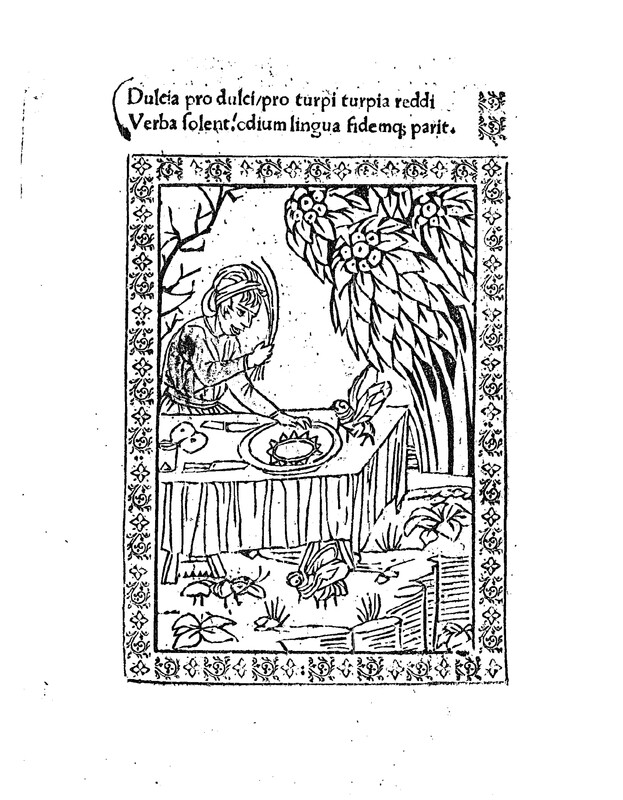
A man in a hat it setting up a dinner table, there is a large fly on the table, another large fly on the ground just below the table, as well as a large Ant. A dead tree is in the back left, and a forest of live trees to the right. The image is bordered by a vine design
A group of Tupinambá people tend to a large pot on a fire in which they cook a human body. Two people lift a human skull out of the pot. Two children sit on the ground near the fire, and a bearded man observes the pot. Another man carries extra logs to the fire. In the background two people sit and share a cannibalistic meal – a skull sits on the ground between them.
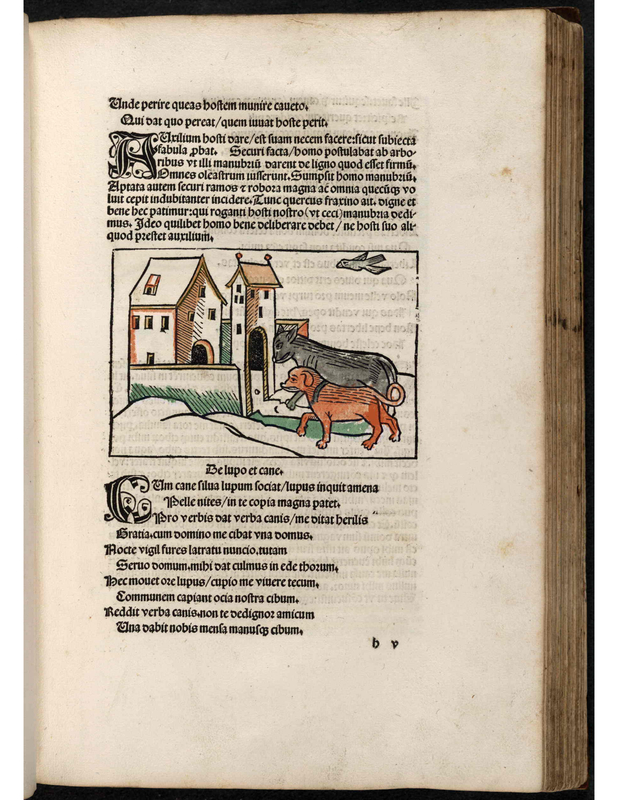
A wolf and a dog approach the entrance gates to a small village or town which is enclosed by a wall. A bird flies overhead directly above the dog and the wolf.
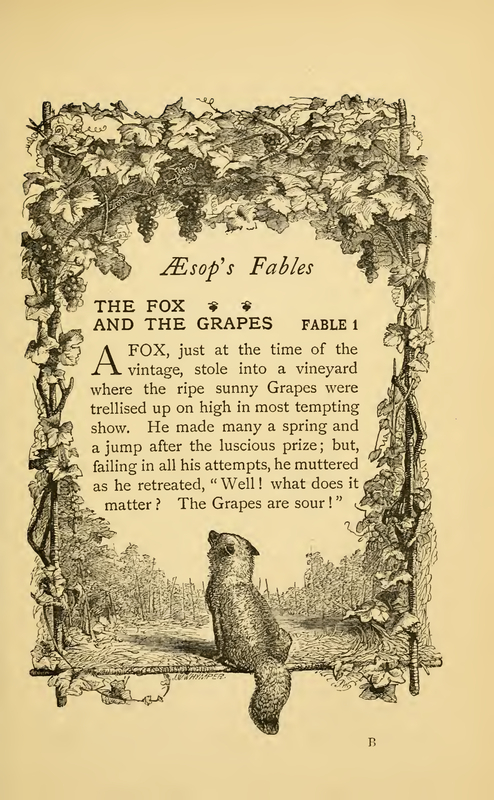
There is a fox sitting in a vineyard. He is surrounded by an entry that is covered in vines. Grapes are growing from the vines that are above him, he observes them particularly whiel there are many other vines growing far into the horizon.
This chapter is dedicated to discussing the sorcerers of the Inca Empire and their practices. This illustration depicts three different types of practicing sorcerers. There is a sorcerer depicted at the top of the image sleeping. The author explains that this type of sorcerer can communicate with demons during their sleep while they dream. There is a demon figure illustrated leaning over the sleeping sorcerer. There is a caption to the left of the demon which reads hichezero de sueño [sorcerer of sleep]. The sorcerer in the middle of the image is depicted standing in front of a fire. The author explains that these sorcerers can heat up cauldrons with fire and add items into it to conjure demons, which is why there is a demon depicted in the fire. The caption beside this sorcerer reads hichezero de fuego [sorcerer of fire]. The illustration at the bottom of the image depicts sorcerers who could suck illnesses out of people. The author explains that he believed these sorcerers to be false and illegitimate. The caption at the very bottom of the image reads hicheseros falsos [false sorcerers].
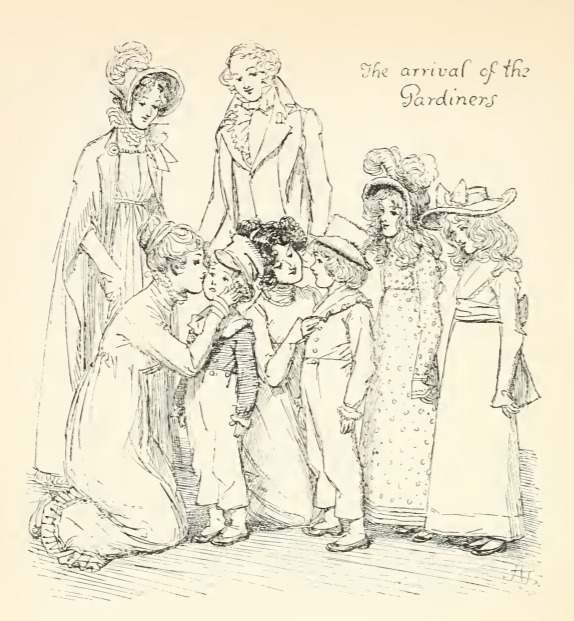
In this image the Gardiner’s arrive at Longbourn. Mr. And Mrs. Gardiner invited Elizabeth to join them on their tour of Derbyshire. In this image, Jane and Elizabeth hug the Gardiner children who were staying at Longbourn while their parents were traveling. This scene occurs in chapter 42. The characters are shown in the traditional regency style. Jane and Elizabeth wear dresses with empire waistlines. Mrs. Gardiner wears a shawl over her dress with a bonnet. Mr. Gardiner wears a waistcoat and tailcoat with a cravat. The Gardiner’s daughters wear regency dresses with bonnets. The Gardiner sons wear breeches and a short coat with top hats. The regency period dated to the early nineteenth century (1811-1820) when George, Prince of Wales, later George IV (r. 1820-1830), reigned as regent for his mentally ill father, King George III (r. 1760-1820). The regency period is associated with the rise of neoclassicism in art and fashion.
There is an illustration at the center of the page; above and below this illustration are bodies of text. In the illustration, four men can be observed. Three men are moving towards the right where the left most man has a broom in his left hand up in the air while putting a palm on the short man in front of him. The short man is shirtless and has his left palm out, and a holy person is conversing to these two men. The fourth man is walking away from these three men while holding a handful of plants. Two birds can be also seen in the background of this picture.
Here we see the Lilliputian Emperor and Finance Minister discussing what to do about Gulliver, as it was very expensive to continue to feed and clothe him due to his size. The two ultimately came up with a plan to charge him with treason among other charges to force him to leave. The same image appears in the 1843 Krabbe edition.
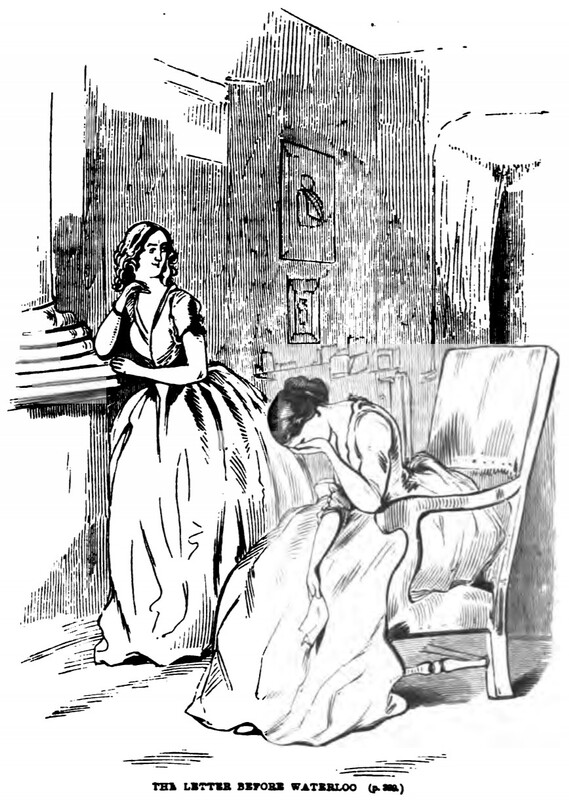
Rebecca Sharp is standing against a column on the left of the image and looking to the right towards Amelia Sedley, who sits crying in a chair with one hand over her face. In her other hand she holds the letter which her husband gave to Becky in Chapter XXIX, asking her to run away with him. Two portraits hang on the wall behind the women. Below the illustration is printed its title and location in the story, THE LETTER BEFORE WATERLOO (p. 329.).
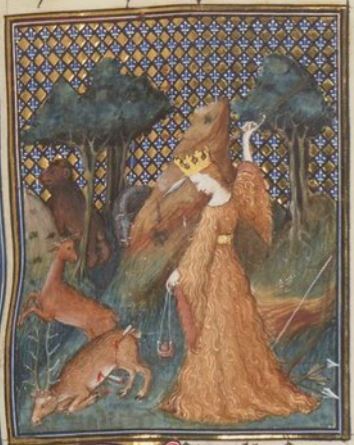
This illumination depicts Camilla, the daughter of King Metabus, hunting animals in the forest in order to make clothing out of their fur and skin. Camilla had been raised in the forest by her father after he was exiled from their kingdom. She set aside common womanly duties and devoted herself to hunting and preserving her chastity. Due to her strength and fearlessness, the Volscian people summoned her back to be their queen.
In this image we see the farmer from Brobdingnag picking up Gulliver and examining him, holding Gulliver between his fingers. This image shows the size difference between Gulliver and the Giants of Brobdingnag. A sheathe with a knife hangs from the giant’s waist. The Giant has long straight hair and wears short pants, a loose shirt and a vest over it. He stands amid the field of wheat where he found Gulliver. The same image appears in the 1843 Krabbe edition.
In this image we see a procession of Diplomats from Blefuscu arriving on Lilliput to make peace. The Emperor of Blefuscu is in the centre of the image riding a white horse and wearing a long cape which is being held up by his attendants. The Blefuscudian Emperor is also wearing a different shaped hat than the others in the party. In the front of the procession is a heralder riding a black horse and announcing their arrival by trumpeting on an instrument. Behind the Emperor is a procession of other diplomats and nobles, one of whom is carrying the banner of Blefuscu. Gulliver is looking on from behind a tower within the walls of Lilliput. The same image appears in both the 1839 and 1843 Krabbe editions.
This illustration depicts the Amazons on the left side, with the Scythians on the right. It can be inferred that the Amazons are on the left as their skin is illustrated as being paler in comparison to those on the right, which is how women in antiquity were often depicted. There is also no facial hair on any of the figures on the left side, which further indicated that these are the Amazon women. Boccaccio explains that after the Scythians killed the Amazons husbands, they went to battle to seek vengeance. The Amazon woman at the front of the group on the left side is presumed to be either Martesia or Lampedo, who were the queens of the Amazons.
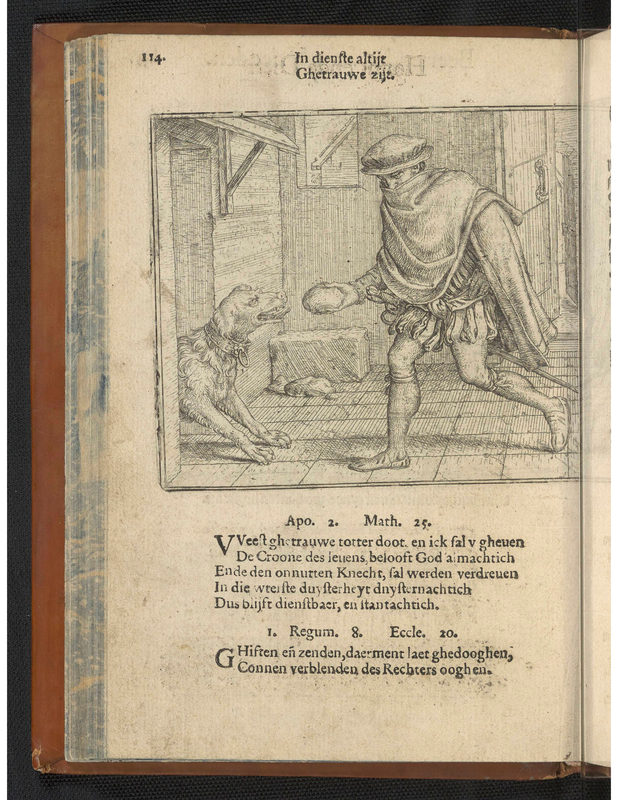
The dog and the thief'; a man hidden under his mantle walks up to a dog at left with a loaf of bread in his hands; Dutch letterpress on verso; illustration to Eduwaert de Dene's edition of Aesop's Fables, De Warachtighe Fabulen der Dieren (Pieter de Clerck, Bruges: 1567). c.1567
A European man stands captive in the entrance of a structure. He is nude, and his legs are bound with rope. Four Indigenous people stand around him and gesture towards him. The outside of the structure is covered in large leaves.
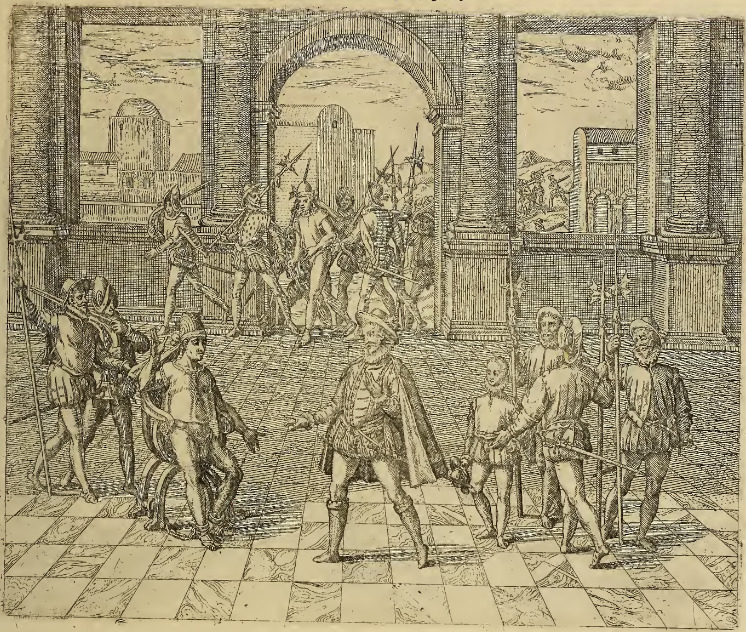
Inca Emperor Atahualpa (Atabalipa) negotiates a ransom amount with Francisco Pizarro, to secure his release from Spanish captivity. Inside a large, open room in the city Cajamarca in Peru, Atahualpa is seated on a chair with his ankles chained to the chair legs. Francisco Pizarro stands in front of him while the two negotiate. Several other Spaniards mill about the room, including a young boy. In the background, an Inca man is escorted into the building by a group of soldiers, led by a chain attached to his ankle. This image is identical to one found on page 9 (127) of Frankfurt, 1596.
This image shows the capture of a European man on the island of S. Maro. First, he is surrounded by the Tupinambá, who aim their bows towards him, in the group towards the far side of the island. Then he is shown having been captured and stripped of his clothes, with the Tupinambá holding him by both arms, in the group on the island nearer to the viewer. The canoes of the Tupinambá have been been pulled up to the shoreline of the island, with several people remaining in the canoes. Many of the Tupinamba wear feathered headdresses and adornments around their waists. Most carry a bow and arrow, although some have a spear or a club instead. There is a triangular fortification on the left side of the island with cannons at each point, and another walled fort with cannons on the mainland labelled ‘Brikioka’.
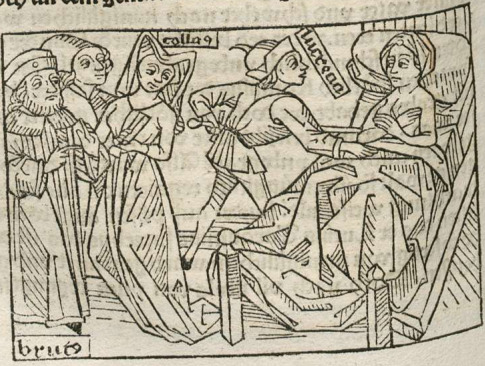
Lucretia is depicted on the right side of the engraving, lying in bed as she is approached by Sextus, her husband’s relative. The creator engraved Lucretia’s name beside the bed to identify her. Lucretia is depicted with her hands crossing her chest as Sextus is forcing himself upon her. He is illustrated with a sword in his hands while he threatens to kill her if she screams for help. The left side of the engraving illustrates Lucretia with her husband, Collantinus, and her husband’s relative, Brutus (Brutus’ name is engraved below his feet). Lucretia told the men what Sextus had done to her in the night, and then plunged a knife into her own chest in shame.
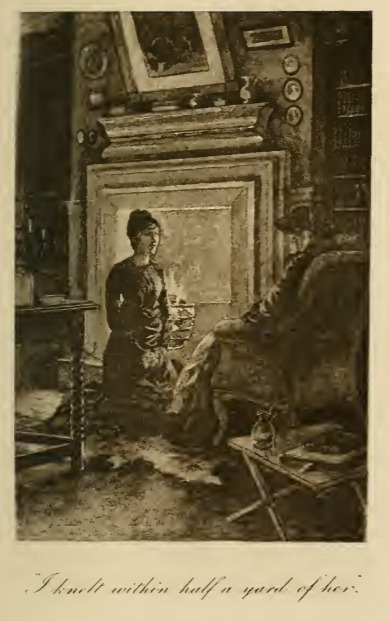
Here Jane kneels in front of the psychic that came to visit Thornfield. The psychic asked to speak to each of the ladies in the party that was visiting Thornfield. It turned out that the psychic was really Mr. Rochester in disguise, as he wanted to gain insight into the minds of both Jane and Miss Ingram without them knowing who they were talking to.
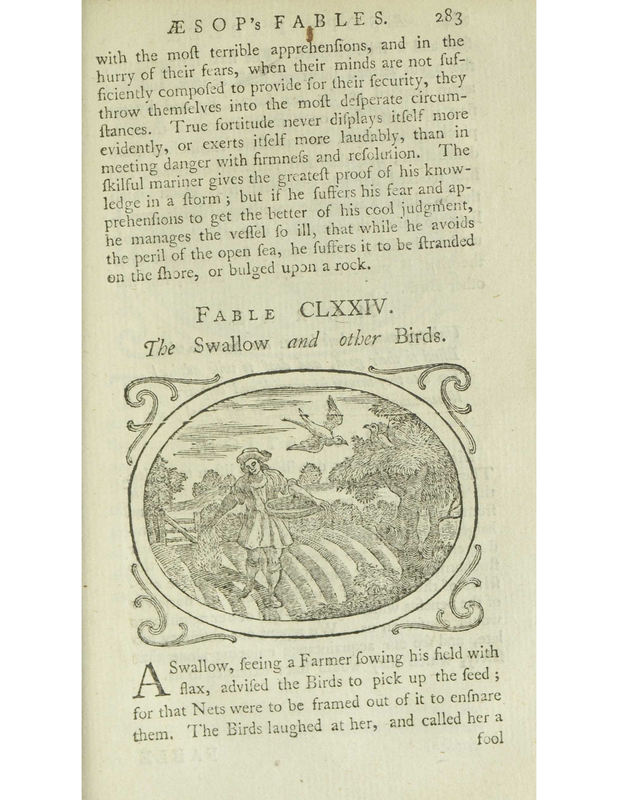
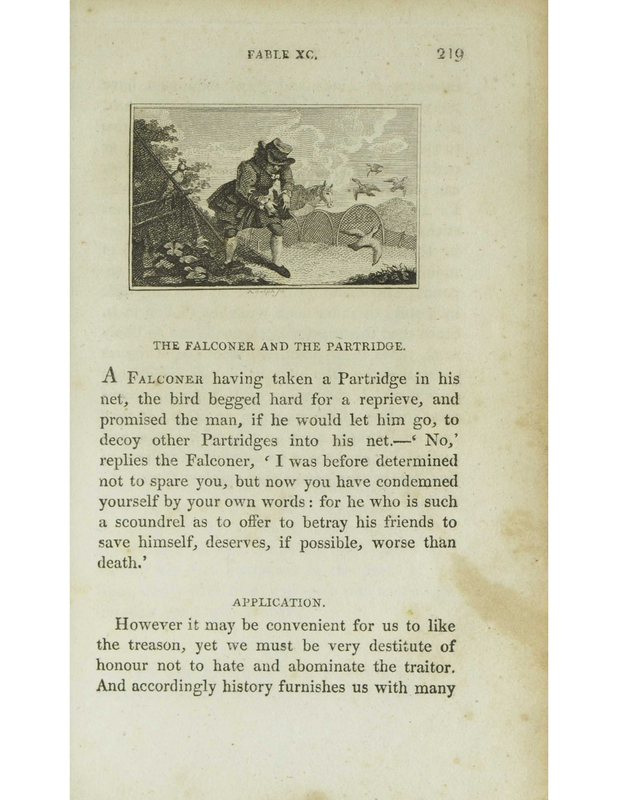
A man spreads seeds across a ploughed field.Above him a large bird swoops over his head. To the right, at the top of the tree sits to smaller birds. The swooping birds appears to be speaking to the birds sitting on the top of the tree.

![[Tupinambá people cook a human body in a large pot]](https://collections.cemvc.ca/files/large/6766102bcac58e242bbff6a54e6c6d2cf35a220c.jpg)

![Vita et Fabulae [Three men including a shirtless man are travelling rightwards, and another person carrying branches is travelling leftwards]](https://collections.cemvc.ca/files/large/c94cf22fd27eee8d05bf9593963941897ed6c248.jpg)
![[The Lilliputian Emperor and Finance Minister discuss Gulliver]](https://collections.cemvc.ca/files/large/18342b0c90763b606d256271489c3037e9507fdf.jpg)
![[the farmer from Brobdingnag picking up Gulliver]](https://collections.cemvc.ca/files/large/b9e19041db0778fc43ee25e1ed4ab598ee0efb83.jpg)
![[Diplomats from Blefuscu arrive on Lilliput]](https://collections.cemvc.ca/files/large/d6e8b42d8d3bd565c8c86447f5acfdee24edd25f.jpg)
![[Amazon Women Fighting Their Enemies in Battle]](https://collections.cemvc.ca/files/large/cbea79c566a6a3ab02ec4b925f821d32bf008276.jpg)
![[A European man stands captive in the entrance of an Indigenous structure]](https://collections.cemvc.ca/files/large/9fdce1d7689ecc55814ce759560e965277ebcd27.jpg)
![[A group of Tupinambá people take a European man captive]](https://collections.cemvc.ca/files/large/86ee87fea0be0f3544626cfcc4e9a0fb2254d975.jpg)