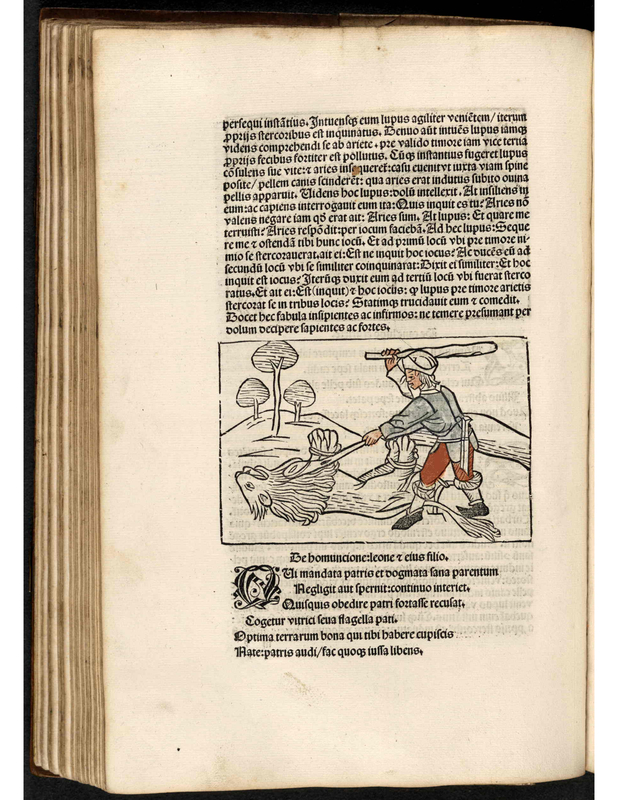
Man in orange/ brown pantaloons has a lion tied with ropes to the ground on its back with the ropes attached to pegs in the ground. The man is using one stick to pin the lion down, while another is raised in a position that suggests he will beat the lion. There are three trees in the background.
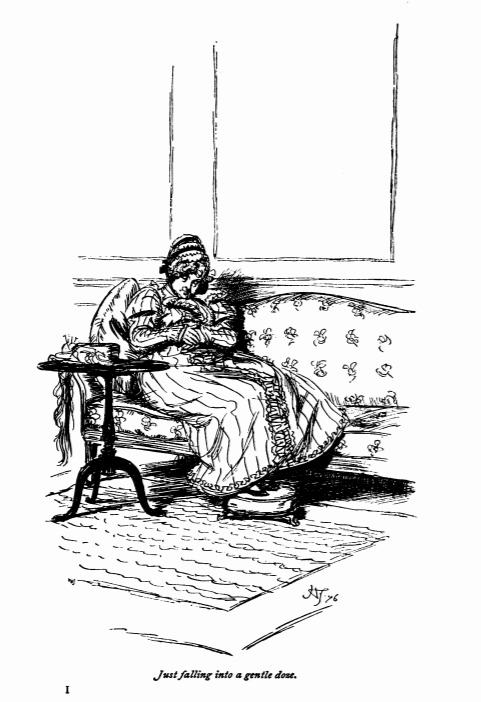
Here we see Lady Bertram dozing on the sofa at Mansfield Park. This scene occurs while Tom and Edmund discussed the propriety of putting on a play. Edmund was convinced that they should not because Sir Thomas would not approve, but Tom said they could continue to work on the play, and they would be able to perform it before he came home, and he would never know. While they had this conversation, Lady Bertram was on the sofa, dozing off. Tom and Edmund both looked to their mother to try and get her support, only to find her asleep. This scene occurs in chapter 13. The characters are shown in the traditional regency style. Lady Bertram is wearing a regency style dress with an empire waist, and a mop cap to cover her hair. The regency period dated to the early nineteenth century (1811-1820) when George, Prince of Wales, later George IV (r. 1820-1830), reigned as regent for his mentally ill father, King George III (r. 1760-1820). The regency period is associated with the rise of neoclassicism in art and fashion.
In this image we see Gulliver whittling a tree that he cut down to use as a mast for his boat. He was given supplies to refurbish the boat that he found so he could return home. Here we see Gulliver holding a tree under his arm, with the leaves and branches still attached at one end. He whittles one end to use in his boat, likely for a mast. He whittles the tree with a small handheld knife. In the bottom right, two more Blefuscudians cut down another tree, and behind Gulliver two more walk carrying a long plank. Gulliver’s hat is on the ground behind him. The same image appears in both the 1839 and 1843 Krabbe editions.
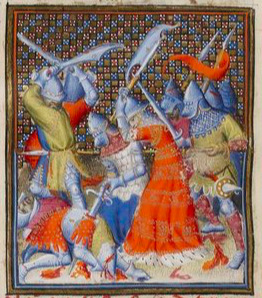
When Lucius Vitellius went to war in a city, his wife, Triaria, followed him. She wanted his victory, and fought with him. Since it was night, the enemy was unprepared and drowsy. Triaria was armed with a sword and fought mercilessly, killing brutally and in great numbers. In the image, she is wearing a red gown and armor. She is holding a sword, about to swing it down onto an enemy. Around her is the rest of her husband’s army. Her victim lies on the ground, already impaled by a sword.
Mrs. Tinker, Sir Pitt Crawley, and Rebecca Sharp stand around a small round table in front of the fireplace in the dining room. Mrs. Tinker has just brought Sir Pitt’s pipe, which she holds, and a paper of tobacco, which is on the table. Sir Pitt has grabbed hold of Miss Sharp’s hand and is leering at her, while she is turned mostly away from the other two and glaring back in their direction.
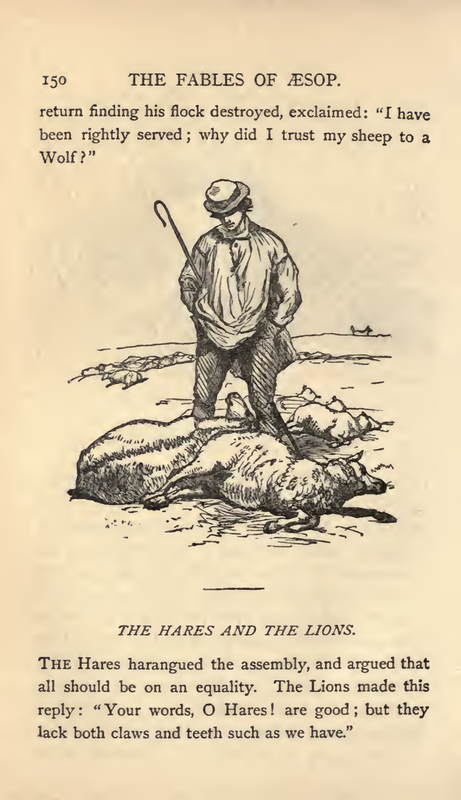
A little boy is hugging a nurse's skirt. A baby is sleeping in a basinet in the middle of the room. The house is a little messy with a broom lying on the ground and a rodent crawling around. A wolf's paws are perched on the windowsill, and it is looking at the people.
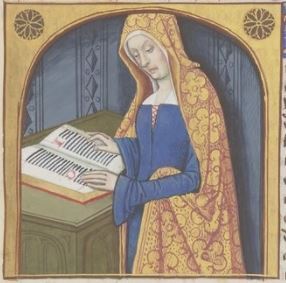
This image depicts a woman named Thisbe standing as she reads a book. Thisbe was a young Babylonian woman who fell in love with a man named Pyramus. Their families would not allow them to be together, which resulted in them devising a plan to run away together. The night they were meant to run away together, Pyramus found a blood-stained cloak that had belonged to Thisbe. He thought she had died, and he killed himself as a result. Thisbe was not dead, and her cloak was only blood-stained because a lioness had picked it up in her mouth which had blood on it. Thisbe found Pyramus dead, and she killed herself as well to be with him.
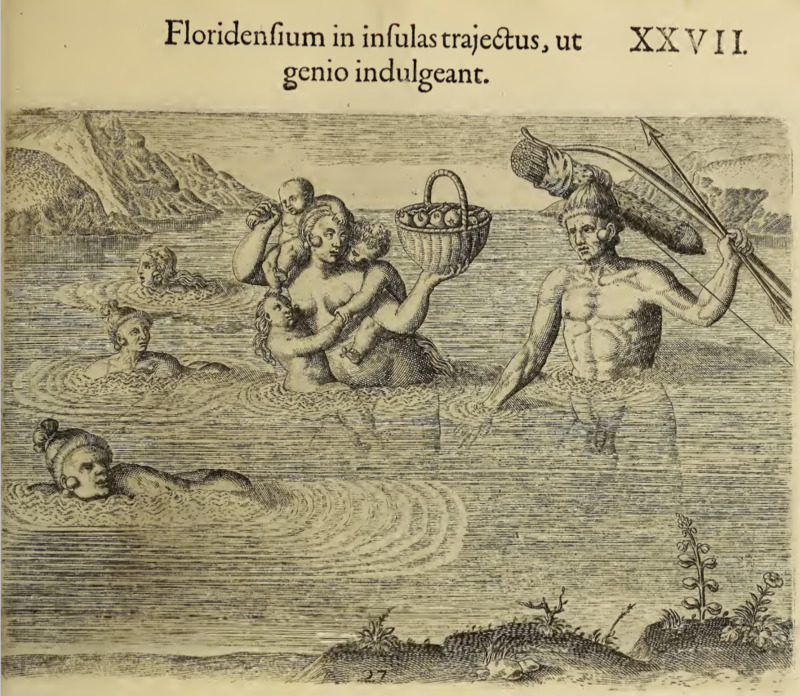
A group of Indigenous women, men, and children crosses a river towards an island. One woman carries a basket of food in one hand raised over her head, and three children cling to her. A man carries a bow and arrow, as well as a quiver of arrows above his head.
A crane has its head inside of a tall glass vase. Inside the vase are small pellets, possibly some kind of food as the crane has grabbed a pellet in its mouth. Next to the vase, there is a foxlike animal, with its tongue sticking out of its mouth. Trees and bushes are in the background.
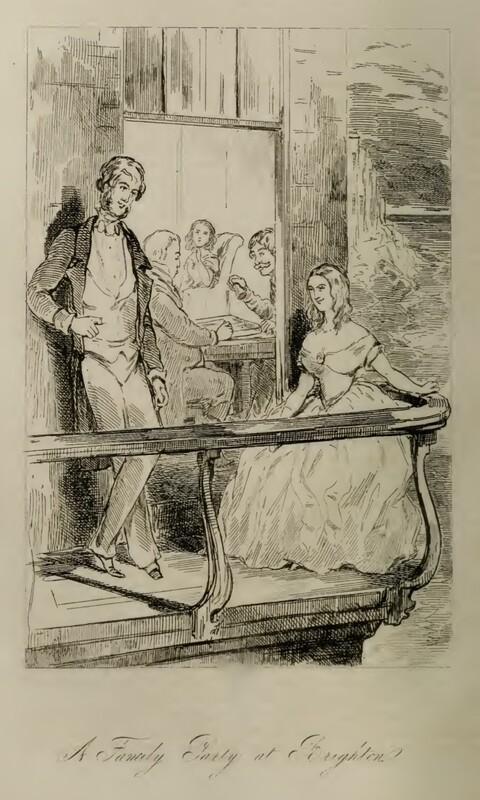
George Osborne and Rebecca Crawley are out on the balcony of the inn at Brighton, looking at the ocean. He is leaning against the house, facing out, while she is seated by the railing, facing him. Through the doorway, Joseph Sedley and Rawdon Crawley can be seen inside at the table, playing backgammon. In the far background, Amelia Osborne is sitting alone in an armchair, looking forlornly at the others. Below the illustration is printed in cursive its title, A Family Party at Brighton.
A European ship – broken in half – sinks near the coast of Brazil. Several men swim towards shore, with many clinging to debris, where several survivors already stand near the water helping others onto land. There are several settlements, both Indigenous and European, near the shipwreck site: on nearby island St. Maro there is a European settlement and a fortification wall, on a second island, St. Vincetii, there are two settlements and several single dwellings. To the left is a Tupinambá village labelled 'Brikioka' and on the right is another called 'Itenge Ehm'. There is an unlabeled village close to where the European men have come ashore.
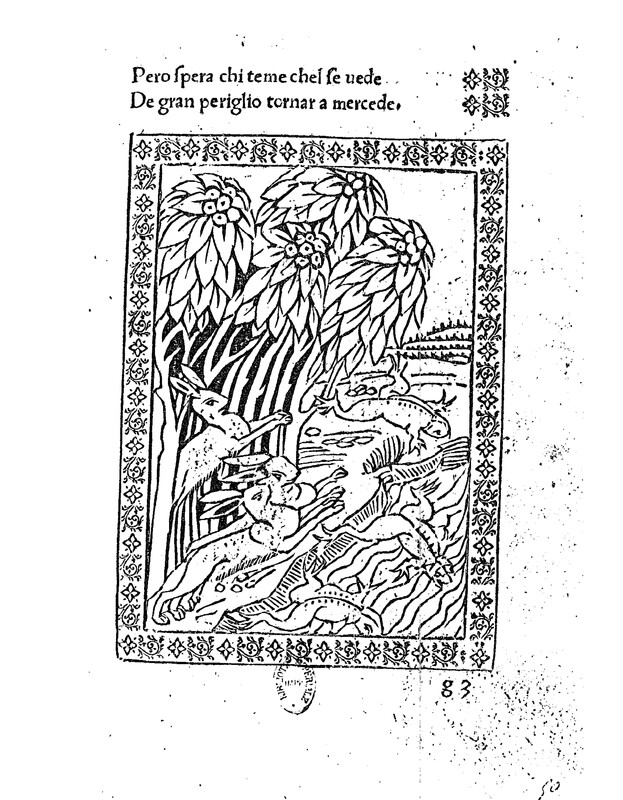
Rabbits and frogs are frantically jumping out of what looks like a dense forest into the open which almost looks like water. The image is bordered by a vine design and the signature of Liberale de Verona is stamped on the bottom, underneath the border.
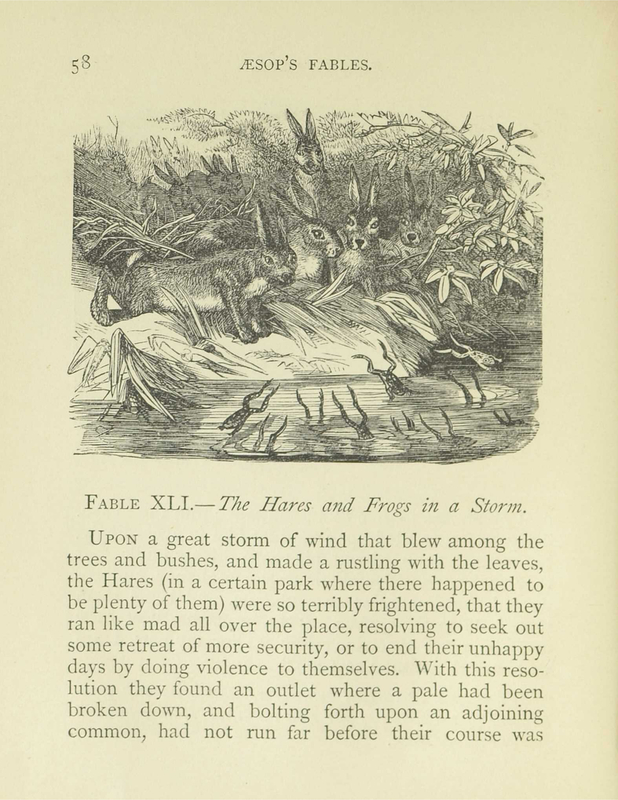
In the foreground of the image around ten frogs jump headfirst into the river off a bank as a storm approaches. The riverbank is lush with foliage and flowers that are blown over presumably by the storm. In the background, several rabbits sit on the bank watching the frogs intently as they dive in the water and huddle together.
In this image the Lilliputian Emperor addresses Gulliver. The Emperor stands on a podium with two attendants. The Emperor holds his arms up during the speech. Gulliver is not in the image. The Emperor wears a form of turban with a large feather and a long cape that one of the attendants holds up. Behind the podium we see a line of Lilliputian militia men holding spears. The same image appears in the 1839 Krabbe edition.
A group of Tupinambá men dance in a circle. They all wear round feathered adornments hanging down their backs and ornaments, possibly noisemaking, around their calves. The group dances around three men at the center of the circle. These men wear feathered headdresses, cloaks, and adornments around their waists. Two of them blow smoke from pipes towards the dancers, and all three hold a rattle or religious object with feathers on it. In the background, three European men stand and watch the ceremony.
Amelia Sedley is seated in a one-armed chair in the corner of a room. The curtains on the window next to her have been drawn back and she is gazing out while thinking about George Osborne.
Melibea’s servant Lucrecia spots Celestina as she approaches the house. Lucrecia opens the door to her and questions the purpose of her visit. Celestina explains that her sole intent is to sell some yarn and pay a visit to Melibea’s mother Alisa, an old acquaintance. Alisa grants her entry under this false pretense. Shortly thereafter, a page/servant arrives with a message on behalf of Alisa’s dying sister, requesting Alisa’s presence. Thus, Celestina is left alone with Melibea (and Lucrecia). Celestina circles around the true purpose of her visit, but when she finally reveals that she is there to cure Calisto’s affliction, Melibea is infuriated. Celestina lies and tells her that the cure only requires her girdle cord and a handwritten charm/spell, and this calms Melibea. She gives Celestina the girdle cord and asks her to return the following day to retrieve the spell.To the left of the image, we see Alisa leaving with her sister’s page/servant. She is shown in a robe and a veil, while he is wearing a hat. The two centre figures represent Melibea and Lucrecia, both of whom are wearing robes and veils. The dress worn by the right central figure appears to be a bit more decorative, and her face seems to express anger, both of which hint at the likelihood that this represents Melibea. The rightmost figure is Celestina, who is shown wearing a robe and a veil.The entire image is nearly identical to those found on pages 130 and 157 of the text. The composition is also wholly distinct from any of the illustrations found in the 1580 Antwerp edition.
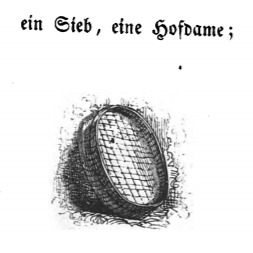
This image shows a sieve, which is the code word for a court lady. This image comes in a description of a conspiracy found by a professor from the Grand Academy on Balnibarbi. This idea is representing code word for terms in the conspiracy that Swift is satirizing. The professor advises that those named in the conspiracy papers be closely monitored at all times, naming specifically while they were using the bathroom, as this is when men were most thoughtful. This conspiracy is thought to be an allusion to the trial of Francis Atterbury, the bishop of Rochester for allegedly plotting with the Jacobites. Atterbury was charged with treason in 1722 and was exiled to France. The same image appears in the 1839 Krabbe edition.
An Indigenous man wearing a feathered headdress and ornament at his back starts a fire by twirling a long stick against a log on the ground. Another man, also wearing a feathered headdress and carrying a bow, watches and smokes a cigar (or similar item). Several women and children are also amongst the group, including a small child carried in a basket on a woman’s back and another child who carries a miniature bow and kneels on the ground to watch the fire starting. This illustration is a simplified and mirrored version of the one found on page 101 of Paris, 1557.

![[Gulliver whittles a tree to use to repair his boat on Blefuscu]](https://collections.cemvc.ca/files/large/2f7f46f4c7801ce8ce0becc1a3b1ba10638bca53.jpg)
![[Sir Pitt’s Poor Behavior]](https://collections.cemvc.ca/files/large/b7006057ef4c4ac3d61bf62c2b0fb30e6306e151.jpg)
![[The Nurse and the Wolf]](https://collections.cemvc.ca/files/large/96efdbc0e84c8e2e9ecf3132c1885ce58fa27e03.jpg)
![[The Crane Stuck in the Vase and the Fox]](https://collections.cemvc.ca/files/large/ed6cc59902e52362d420fdf0e45be97cc35935ce.jpg)
![[Europeans are shipwrecked near the coast of Brazil, close to several European and Tupinambá settlements]](https://collections.cemvc.ca/files/large/7d2f0aef3dba6c4b7dfeabad4ee312eb5433419c.jpg)
![[The Lilliputian Emperor addresses Gulliver]](https://collections.cemvc.ca/files/large/ec2781ba2bb68306e736d5771775a1e17d68d744.jpg)
![[The Tupinambá engage in a religious or ceremonial dance]](https://collections.cemvc.ca/files/large/473402d6f2fd12e22ce77156f6a99085a447969e.jpg)

![[Amelia Sedley]](https://collections.cemvc.ca/files/large/eddbc06ff47554c1cb35893aad9df2a2056921d5.jpg)
![[Act IV] Celestina spreect teghen haer zelven gaende over wech](https://collections.cemvc.ca/files/large/aefa6248476c7feeba8f707e554d6a662d4167ad.jpg)
![[Method of starting a fire of the Indigenous Brazilians]](https://collections.cemvc.ca/files/large/9287ec6425ea2e4714b339d64541614262815063.jpg)