Here we see two Lilliputian tailors taking Gulliver’s measurements for new clothes. Gulliver is kneeling on the ground. One tailor stands on Gulliver’s shoulder and drops the weighted measuring tape down to the ground. A second tailor stands on the ground and records Gulliver’s measurements in a notepad. A tall ladder is leaning against Gulliver’s back. The same image appears in both the 1839 and 1843 Krabbe editions.
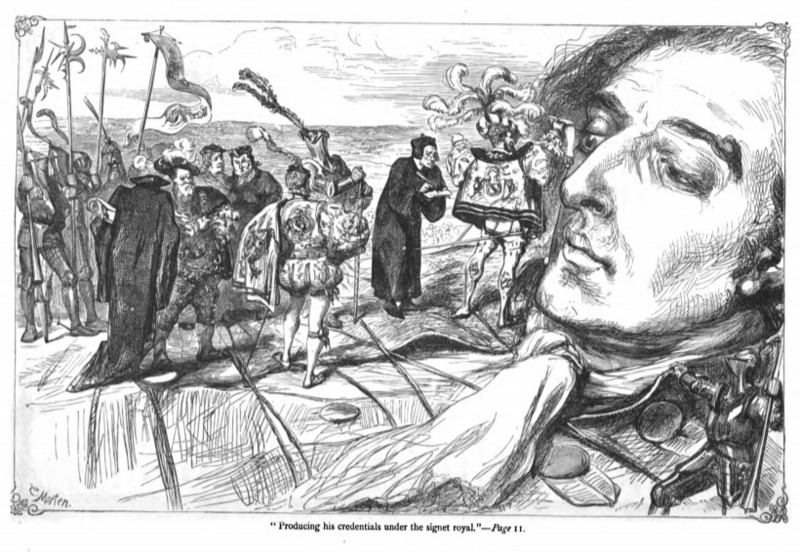
Here the Lilliputian Emperor stands on Gulliver’s chest and holds his credentials, written on a scroll, up to Gulliver’s eye. The emperor is attended by several guards and attendants, standing lower on Gulliver’s chest. Rope is seen across Gulliver’s chest, restraining him.
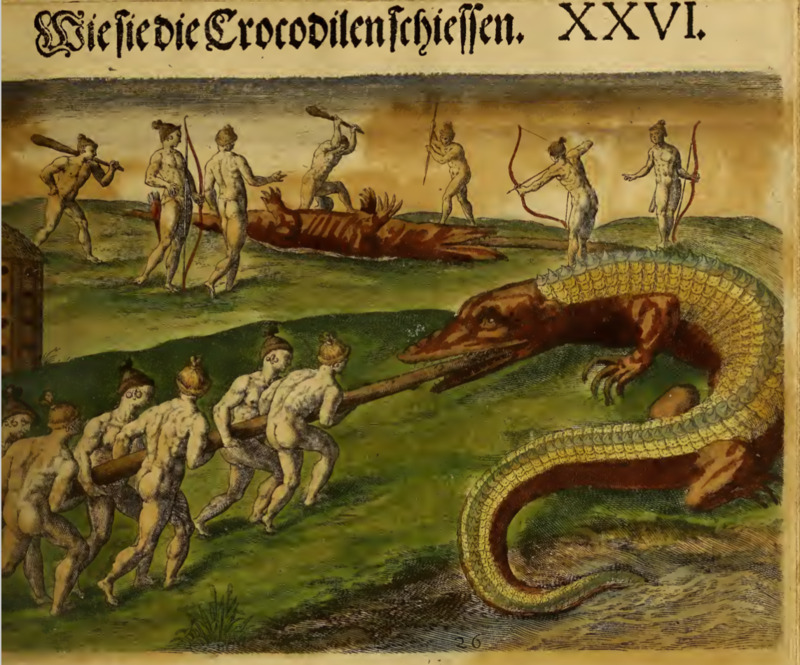
In the foreground, six Indigenous men ram a long log into the mouth of a large crocodile. Behind them, seven individuals surround a second crocodile, attacking it with clubs, spears, and bow and arrows. This illustration is identical to the one found on page 93 of Frankfurt 1591, but colored.
This image depicts a Dominican friar forcing an indigenous woman to weave. The woman is sitting down with her legs straight in front of her as she weaves at her loom which is hanging from a nail. The woman has tears running down her face while her small child is wrapped on her back. The friar is illustrated pointing to the loom as he orders her to work and weave clothing and bedspreads. The author criticizes the Dominican friars for abusing their powers against the indigenous peoples of Peru and for not fearing God and justice.
Here we see a young Lilliputian girl looking into a mirror. The upper-class Lilliputian children are sent to boarding school where they are taught domestic skills. The girl looks into a round mirror sitting on a table with a cloth draped over the back of the mirror and the table. A chair with clothes on it is behind the girl. Her arms are clasped behind her back and she is holding something resembling a handheld mirror. This image comes when Gulliver describes the education system in Lilliput in the sixth chapter in which Gulliver discusses the values and traditions of the Lilliputians. The same image appears in the 1843 Krabbe edition.
This image depicts Cleopatra VII of Egypt standing in a room with her lover Mark Antony. Mark Antony is holding a sword in his right hand as he is about to kill himself to avoid dying at the hands of Emperor Octavian and his forces. Mark Antony kills himself with his sword, and although it is not depicted in the image, it is said that Cleopatra uses venomous snakes to kill herself.
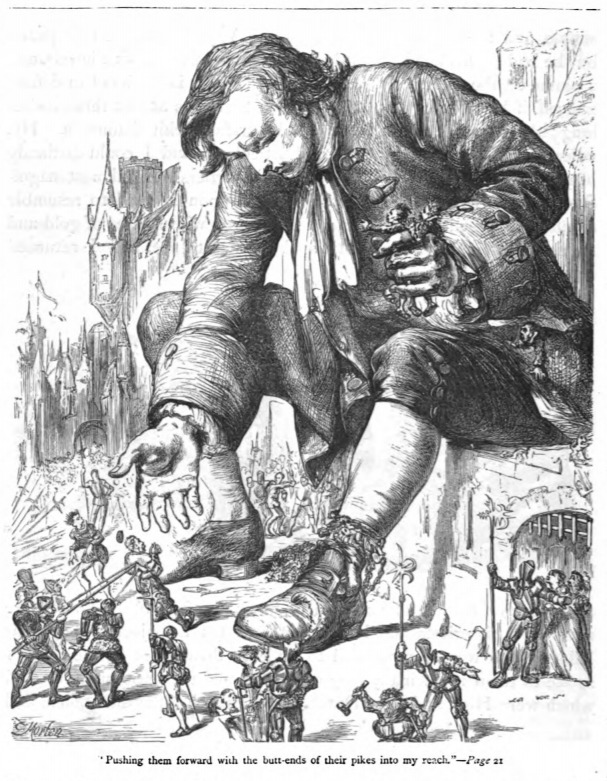
The Lilliputian guards were threatening Gulliver with their spears. Gulliver picks one of them up and acts as though he were going to eat them. He pushed the rest of them away. This was meant to scare the guards and make them leave him alone.
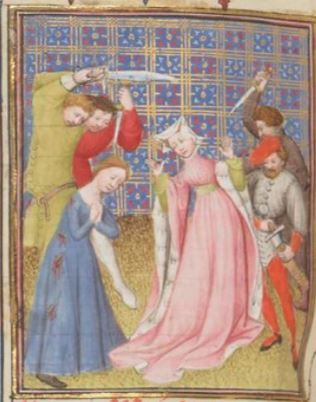
This illumination depicts a young servant girl, disguised as the noble Harmonia, about to get stabbed to death by the men who are surrounding her. Boccaccio explains that there was a rebellion in Syracuse against nobility, and because Harmonia was the niece of the king, she was in danger. Harmonia’s nurse disguised a servant girl to look exactly like Harmonia so that when the rebels came, the real Harmonia would be safe. This illumination depicts the servant girl who died in Harmonia’s place. The nurse is illustrated in the blue shirt on the left side of the image.
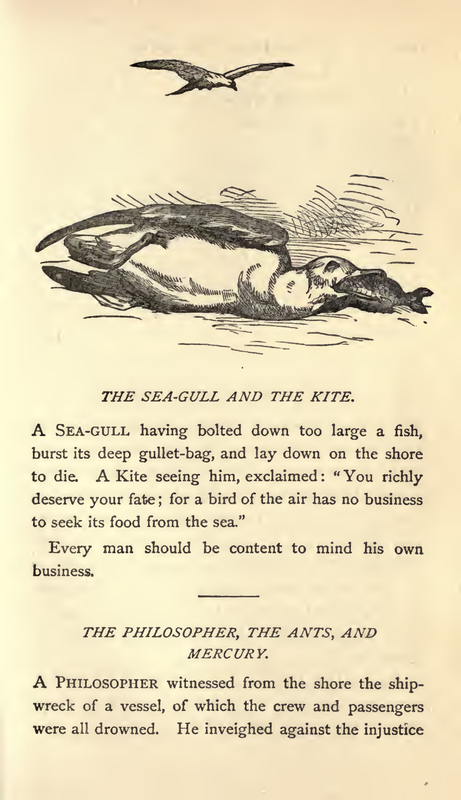
A sea-gull is lying on its side on the shore. Its mouth is wide open and the bottom half of a fish is sticking out from its mouth. The sea-gull's neck looks unnaturaly swollen and its eyes are dropping in a way that conveys that it is hurt. A bird is flying over the sea-gull.
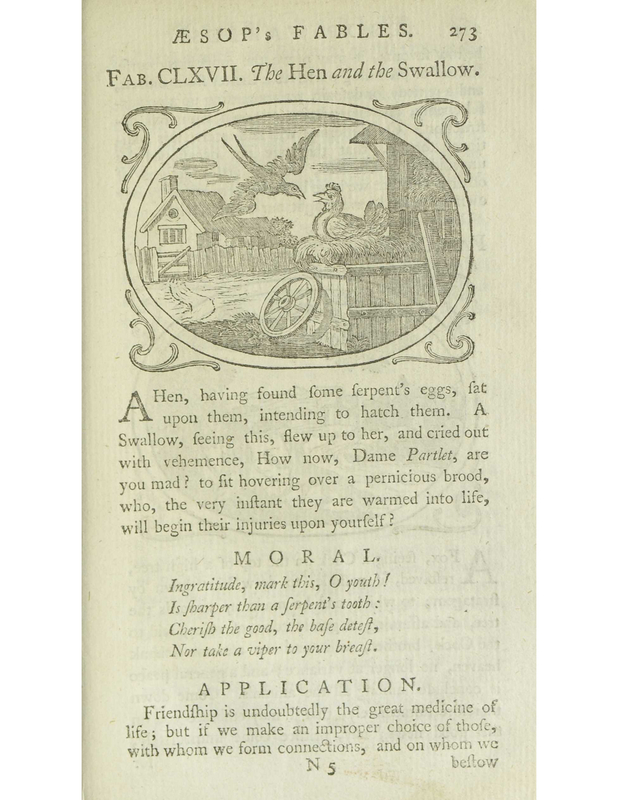
A swallow swoops down from to speak with a hen. The Hen is sitting on a nest on top of the box. The two birds seem to be in disagreement. In the background to the left there is a small house, and in the immediate background to the right there is a barn.
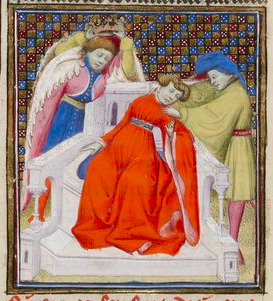
Irene raised her young son after the death of her husband. Despite being his mother, her son disowned her and forbid her from his court for eight years. In the image, Irene is seated in the throne, wearing a red gown. She is being ordered to be removed from the throne by her son, on the left, who is being crowned. To the right is the servant that is removing her.
A group of small birds surround a large bird that is wearing a crown and carrying a sceptre in its talons. The large, crowned bird stands upon the back of a small bird.
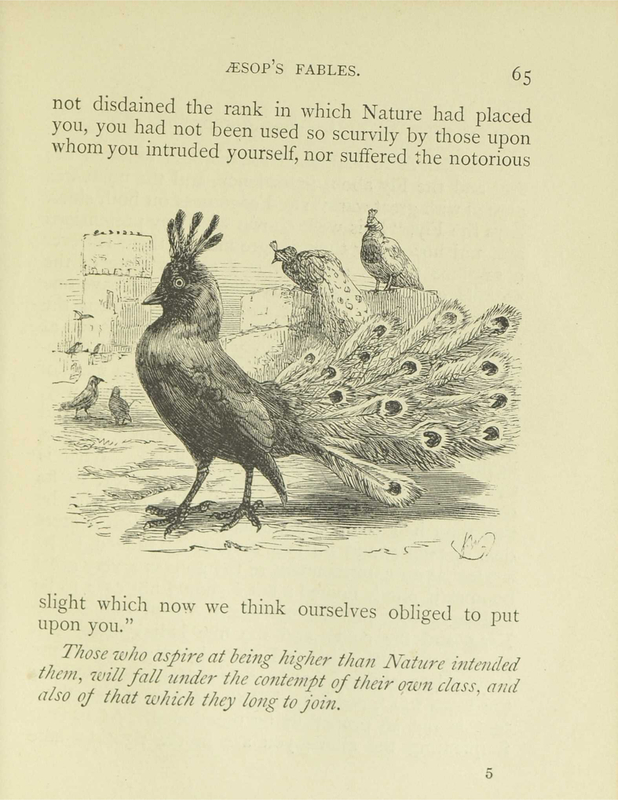
In the foreground we see a jackdaw bird standing proudly with a bunch of peacock feathers tucked in with its own in its tail and on its head. In the background on the left there are few other jackdaws standing around on the ground amongst bales of hay. In the background on the right there are two peacocks perched atop bales of hay lookin down at the other birds.
A group of Indigenous Tupinambá people are gathered to witness the execution of a prisoner from another Indigenous group. The prisoner is a man, he is restrained by a rope tied around his waist with the ends of the rope held on both sides by members of the capturing group. A man on the left holds a club raised over the head of the prisoner, ready to strike. Four women stand beside a fire watching the execution.
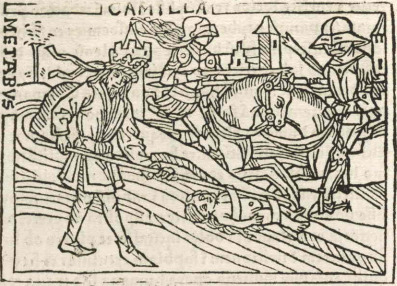
Metabus, king of the Volscians is depicted on the left-hand side of the engraving with a lance in his hands. We know that this is Metabus as his name is engraved horizontally adjacent to his body. Boccaccio explains that after being exiled from his kingdom, he took his only daughter with him. When he came across a river, he tied his daughter Camilla to a lance and hurled is across the river in order to save her. They both survived, and Camilla grew up to be a strong, fierce warrior. Camilla goes to war against the Trojans and ends up getting wounded by a Trojan knight named Arruns. This is depicted in the background of the engraving, as Camilla is seen riding on her horse with a lance under her arm as she charges at the enemy. Her name is engraved above her head to identify her. The enemy’s lance is illustrated piercing the chest of Camilla which ends up killing her.
Two rabbits and a stag are running up a hill. To their left, the lower left corner of the image, a small river flows and three frogs jump around. Next to the running animals are high trees that stretch out into a thick forest.
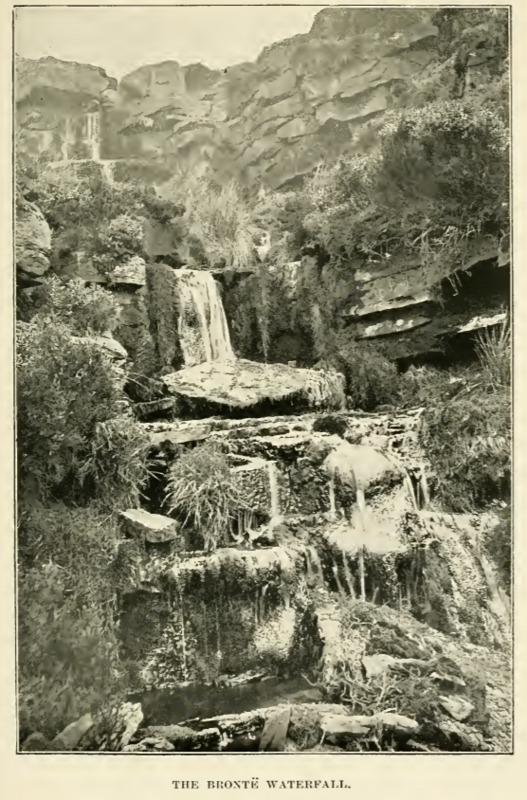
Here we see an image of the ‘Bronte Waterfall’. It is located in West York, near Haworth, England. It is part of the moorland and farmland nicknamed ‘Bronte Country’, a region of West York, south of the Pennine Hills, where the Bronte sisters wrote their most famous works. The image is a reproduction of a photograph using a technique called photogravure, where photographs are taken on plates which could then be etched on to create a plate for use in a printing press.
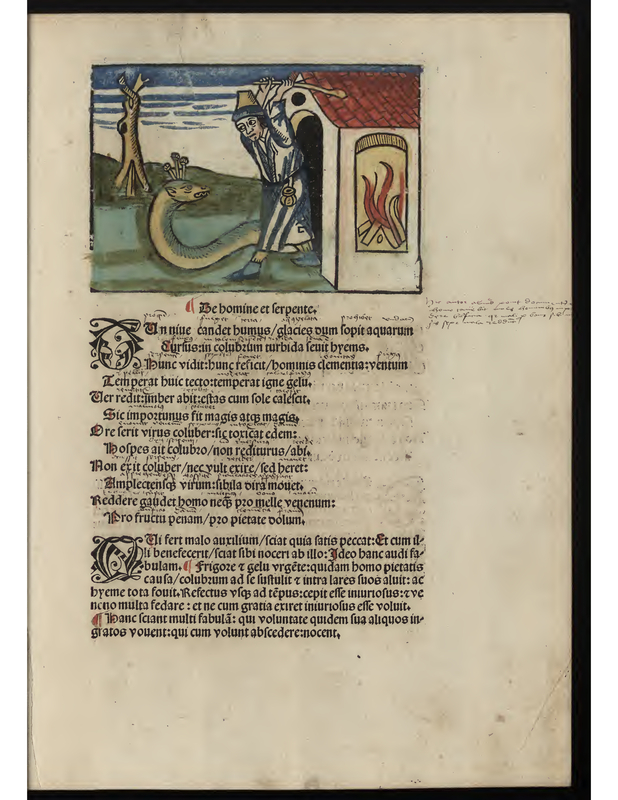
A large snake faces a man. The man stands just outside a doorway with a weapon raised above his head – likely about to strike the serpent. A lit fire can be seen inside the house.
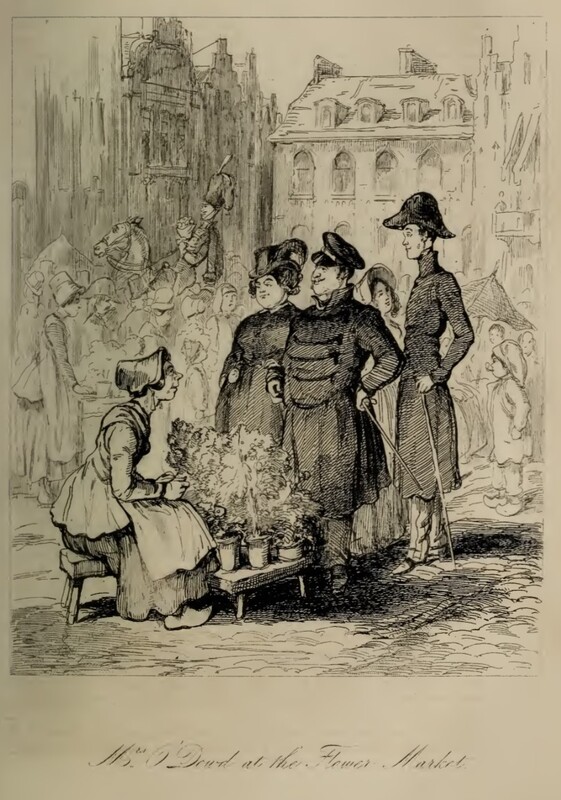
Peggy O’Dowd, in a feathered hat, stands in front of a flower seller at the market in Brussels. She is holding onto the arm of her husband, Major Mick O’Dowd, who has on a cap and is wearing his sword at his hip. Behind the pair are William Dobbin, also with his sword, and Amelia Osborne, who is in a bonnet and looking up at Dobbin. The flower seller is in a bonnet and clogs, seated on a low stool behind the table which holds her rows of potted plants. In the background of the image are the crowds of shoppers, another flower seller standing at her table of plants, a mounted officer holding a bouquet, and the tall, ornate buildings that surround the market square. Below the illustration is printed in cursive its title, Mrs. O’Dowd at the Flower Market.
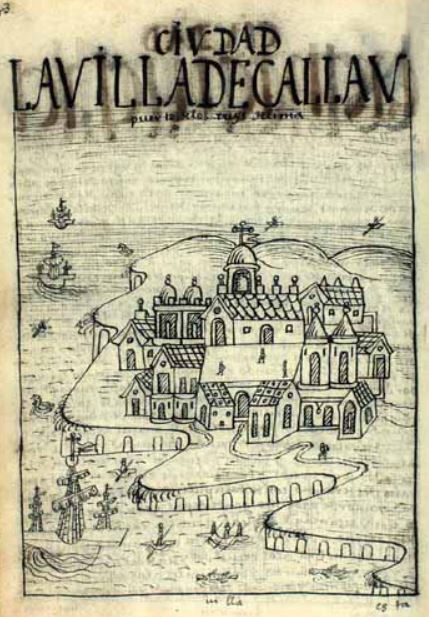
This image is depicted in the author’s chapter where he discusses cities, towns, villages, and provinces in colonial South America. This image depicts the port town of Collao in Peru. The city is located on the edge of the shore where many boats are depicted in the water approaching the shore. The town itself is arranged in a cluster of buildings which forms a square in the centre where people are illustrated walking. There is a winding path that leads in and out of the city. A person is depicted walking along that path towards the town. The author explains that this port was used as the point of entry and exit to and from Castile. He also explains that the people who live in Callao were good, charitable Christians. The caption at the bottom of the image reads uilla [town].

![[Gulliver is measured by tailors for new clothes]](https://collections.cemvc.ca/files/large/69c144fde1fe3dc34a22dd0a56c7e09fc99bb75b.jpg)
![Fraile Dominico Mvi Colerico y Soberbioso que Ajunta Solteras y Biudas, Deziendo que [E]stan Amanzebadas. Ajunta en su Casa y Haze Hilar, Texer Rropa de Cunbe, Auasca, en Todo el Rreyno en las Dotrinas](https://collections.cemvc.ca/files/large/0cffcee40d9b2d7d22ecde5587cb3e743f030ee3.jpg)
![[A young Lilliputian Girl looks into a mirror]](https://collections.cemvc.ca/files/large/bbb8f1364d2a47b1763ec6e470db4ecce361d5aa.jpg)
![[Cleopatra and Mark Antony]](https://collections.cemvc.ca/files/large/51c0cf91b38c06ca0087e1aff04e6475d5b4e83c.jpg)
![[Flock of birds, one bird wears a crown in the center]](https://collections.cemvc.ca/files/large/3b472a0fe0a1de442d11161252bd614ac36b056e.jpg)
![[The execution of a prisoner]](https://collections.cemvc.ca/files/large/dab970bdb1fd1acef18e94fb7d196bc61e1dae5d.jpg)
![[The Rabbits, the Stag, and the Frogs]](https://collections.cemvc.ca/files/large/ed16f6a93f7f79afe44bfce9b288b368a5d9ef5c.jpg)