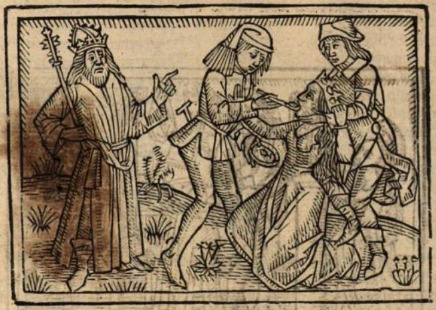
This engraving depicts Agrippina, the wife of Germanicus, being forced to eat food. Agrippina is depicted on the right side of the image on her knees as a man holds her head back while the other man is force feeding her with a spoon. The man on the left side of the image is Tiberius, the one who is ordering her to be fed. Tiberius is Germanicus’ father, and after he killed his own son, he sent his daughter-in-law Agrippina to prison. Agrippina decided to starve herself to death to avoid dying at Tiberius’ hands, however, Tiberius force fed her so that she would not die on her own. There is a visible stain on the left side of the engraving which is partially covering Tiberius.
In this image, the central figures are four Lilliputian cavaliers who are practicing underneath an archway attached to the royal palace. The cavaliers are skirmishing, with some of the horses rearing. The riders are wearing plumed hats. We see Gulliver’s legs in the background. We see another Lilliputian watching from a window in the background. The same image appears in the 1839 Krabbe edition.
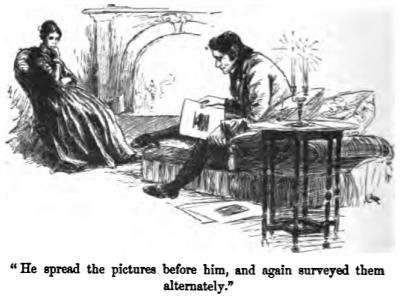
Here Jane shows her drawings to Mr. Rochester. He invited her into the library shortly after his arrival at Thornfield. He quizzed her about her life and talent and asked to see her artwork and she brought out her portfolio. He spent some time looking them over as Jane watched him.
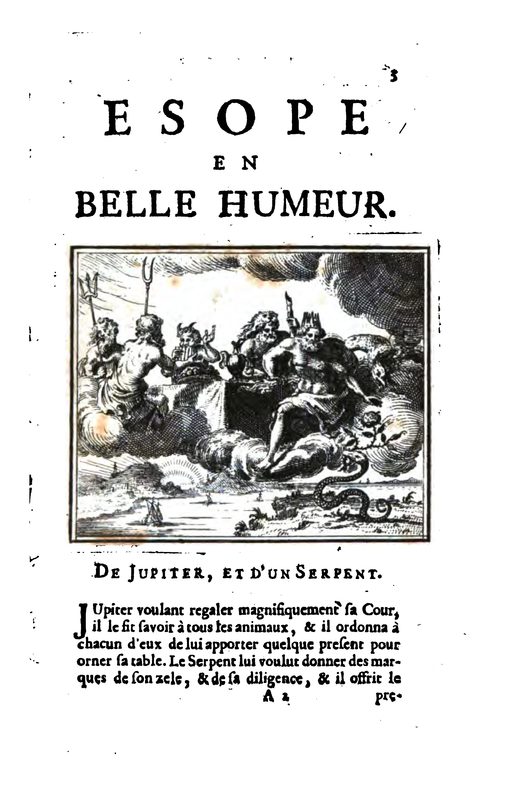
Five men, one appearing to wear a crown, three holding a pitchfork, and one appearing to have horns, are having a feast in the clouds, with a serpent slithering towards them. Below the clouds, there is water and land with a village.
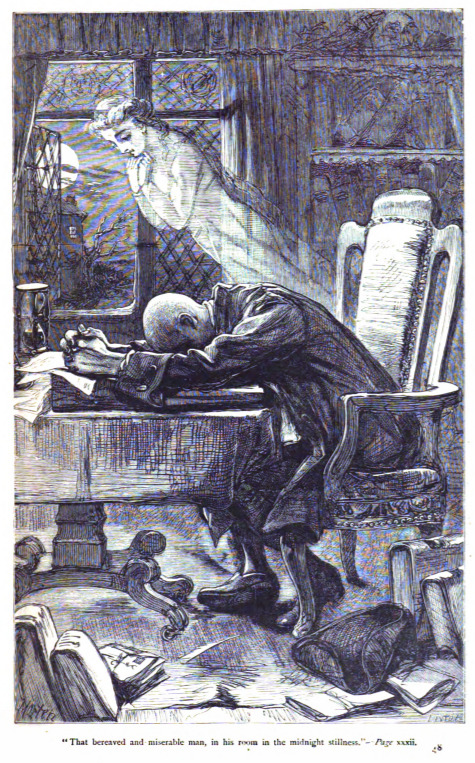
Here we see Swift sitting with his head down on his desk. Here Swift is mourning the loss of Stella Johnson, with her ghost behind him. This image appears as part of the biography of Jonathan Swift.
On the left side of this illustration, we see a male figure and a female figure off by themselves, the latter of which is wearing a robe. To the right, we see a female figure wearing a robe and a veil. She is interacting with a group of four male figures. In Act XI, there are two female characters (Celestina and Elicia) and three male characters (Calisto, Sempronio, and Pármeno). The youthful appearance of the leftmost female figure indicates that it would represent Elicia, but she does not interact with any male characters in this act. The other female figure would represent Celestina, who interacts with the three male characters involved in this act. The presence of a fourth male figure in the group, combined with Elicia’s interaction with a male figure, allows us to say that this scene is unrelated to the events of Act XI.[This illustration is identical to those found in Acts I (folio 9r), VII (folio 52v), IX (folio 67r), XII (folio 83v), XIV (folio 96v), XVI (folio 106v), and XIX (folio 115v).]
A drummer boy glances fearfully around the battlefield as he plays a beat upon his drum. The background is of low hills covered in clouds of smoke, with the letter T from Thus in the top right corner.
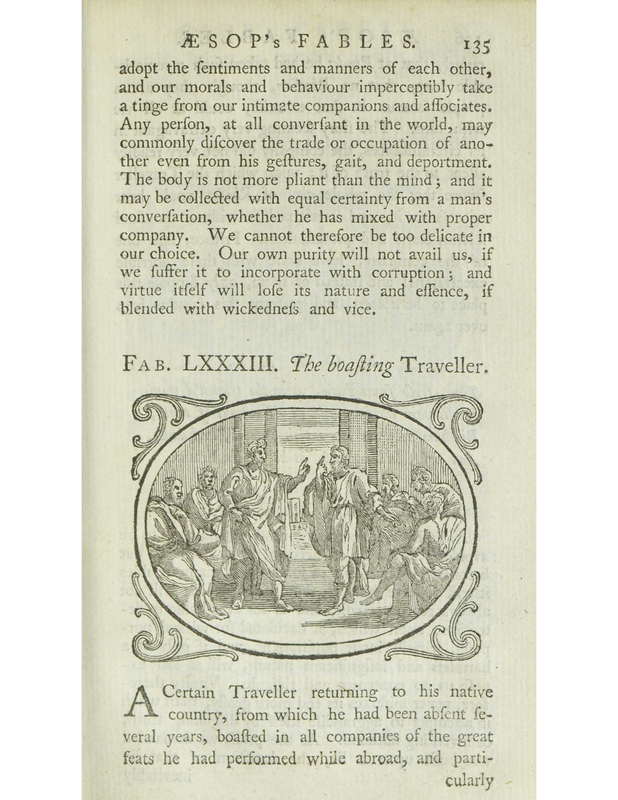
Two men appear to disagree with each other, while five other men watch and listen from the sidelines. They stand in front of a door through which a building can be seen.
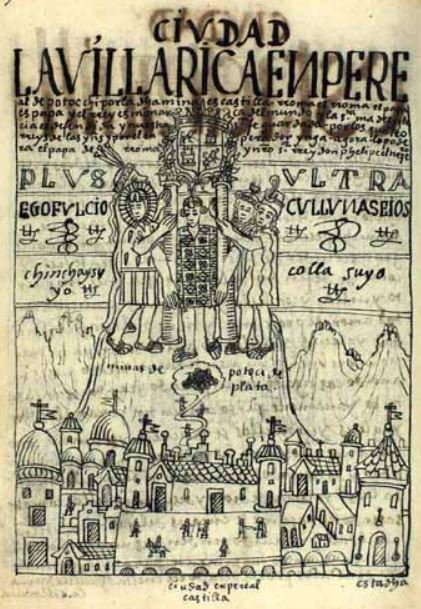
This image depicts the rich, imperial town of Potosí, which is now in modern-day Bolivia. The town is arranged in a large cluster of buildings at the bottom of the image which forms a square in the centre where people can be seen walking or riding on horseback. A mountainous landscape is depicted behind the city to highlight the importance of the silver mines. There is a long pathway leading into a hole in the mountain where it reads minas de potoci de plata [silver mines of Potosí]. The top of the image depicts the Inca ruler in the centre and four of his loyal kings surrounding him. They are holding the symbols of imperial Spain which is their coat of arms and the columns of Hercules. The author incorporated this into the image to show the support that Peru and the Inca’s gave to Spain. The large caption at the top of the image reads, Por la dicha mina es Castilla, Roma es Roma, el Papa es Papa y el rrey es monarca del mundo. Y la Santa Madre Yglecia es defendida y nuestra santa fe guardada por los quatro rreys de las yndias y por el enperador ynga. Agora lo podera el Papa de Roma y nuestro senor rrey don Phelipe el terzero [For the mine is Castile, Rome is Rome, the Pope is the Pope, and the king is the monarch of the world. And the Holy Mother Church is defended, and our holy faith guarded by the four kings of the Indians and by the Inca emperor. Agora will be the power of the Pope and Rome and our Lord King Philip the Third].
This illustration depicts Juno, queen of the heavens and wife of the god Jupiter, sitting on a throne whilst holding a scepter and wearing a crown to signify her importance. She is looking to a woman on her right who is wearing blue. There are two other women on the right-hand side of the illustration. Boccaccio explains that he believed Juno was a mortal woman, which could be the reason as to why Juno looks like a mortal woman in this depiction. This scene could potentially be set in Samos, the city where Juno was sent to be brought up and raised before getting married to her brother, Jupiter.
The picture shows Peggy O’Dowd in a feathered turban, holding a closed fan with both hands, with her elbows on a the edge of an opera box. In the top right of the image is the letter M from Mr.
A large European ship sails near the coast of Brazil. In the distance, an Indigenous settlement can be seen amongst the hills along the coast. Two long structures are visible, and the shadow of an individual can be seen in the hills near the center (top) of the image.
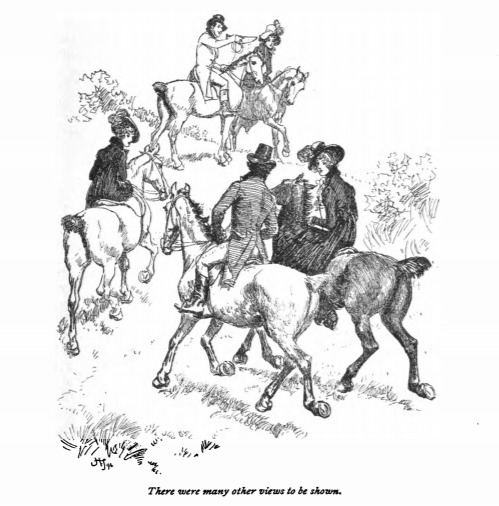
Here we see Edmund, Julia and Maria Bertram, Mr. Crawford, and Miss Crawford riding horses. Miss Crawford had never ridden before, so Edmund offered his spare horse, usually ridden by Fanny, to Miss Crawford to teach her to ride. They rode as a group, and Miss Crawford caught on quickly. Miss Crawford used Edmund's horse every day for a week, meaning that Fanny could not ride, denying Fanny her principal source of exercise. The group rode to show the Crawfords different sites in Mansfield. This scene occurs in chapter 7. The characters are shown in the traditional regency style. The women ride side-saddle, wearing regency style dresses and coats with empire waists. Edmund and Mr. Crawford wear waistcoats and tailcoats, and top hats, with breeches. The regency period dated to the early nineteenth century (1811-1820) when George, Prince of Wales, later George IV (r. 1820-1830), reigned as regent for his mentally ill father, King George III (r. 1760-1820). The regency period is associated with the rise of neoclassicism in art and fashion.
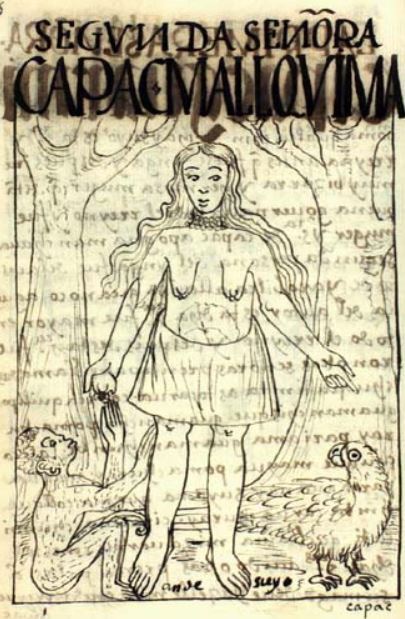
This illustration depicts the second lady of the region Antisuyu in the Inca Empire. Her name was Capac Mallquima. The words ande suyo are written at the bottom of the image to identify Antisuyu as the region the image takes place in. The author explains that Capac Mallquima and her people wore limited clothing which is why she is depicted partially nude. There is a small child depicted in the bottom left-hand corner of the image looking up at Capac Mallquima as she hands him something. There is a large bird depicted in the bottom right-hand corner of the image.
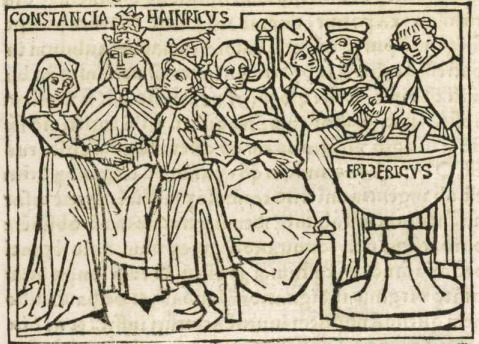
The left side of this engraving depicts Constance, the daughter of king William of Sicily, marrying Henry, the emperor of Rome. Constance is on the far-left with her name engraved above her head, while Henry is depicted holding her hand as the priest marries them. Henry’s name is also engraved above his head to identify him. Constance was forced to be a nun at a young age as a prophecy foretold Constance would somehow cause the destruction of Sicily. Her father, William, put her in a convent to prevent the prophecy from happening. At an older age, Constance was married to emperor Henry and bore a son at the age of 55. Constance is depicted in the centre of the engraving lying in a bed after giving birth to her son, Frederick. Frederick is depicted getting baptized in a large bowl which has his name engraved on the front. The baby grows up to be the one to fulfill the prophecy that King William was fearful of.
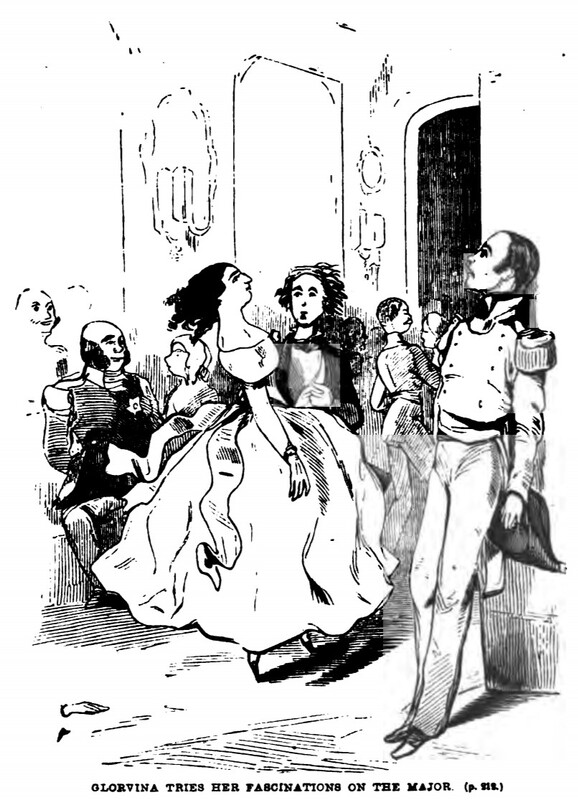
Miss Glorvina O’Dowd dances past Major William Dobbin, trying to get his attention at the King’s Regiment ball. He is leaning against the wall, holding his hat in his hand, and paying no attention. In the background are assorted other officers and their ladies. Below the illustration is printed its title and location in the story, GLORVINA TRIES HER FASCINATIONS ON THE MAJOR. (p. 212.).
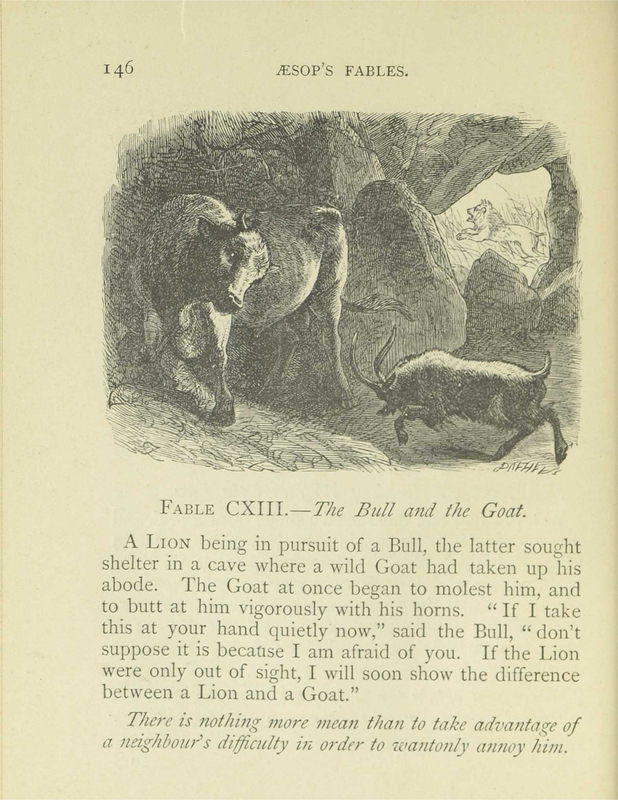
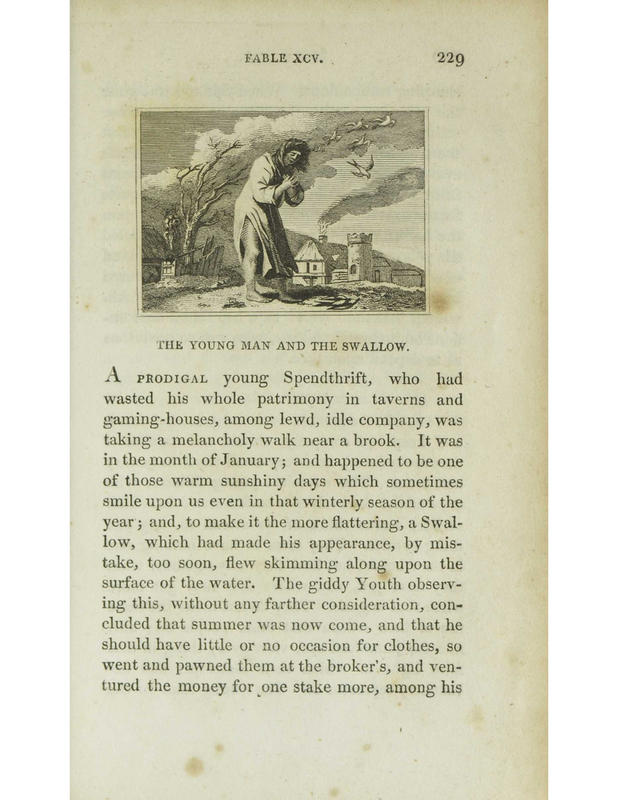
There is an illustration at the center of the page, above and below this illustration are bodies of text. In the illustration, towards the left of the illustration a short man is carrying crops, towards the middle and right of the illustration a holy person is talking to a man.
In this image we see Gulliver sleeping outside the city in Blefuscu. Due to his size, there was nowhere for him to sleep in Blefuscu. Thus, Gulliver was forced to sleep outside, using his overcoat or coverlet as a blanket. In this image we see Gulliver’s size as compared to the buildings surrounding him. Gulliver leans on a large structure with his arms crossed, his head resting in his folded arms. The same image appears in the 1843 Krabbe edition.
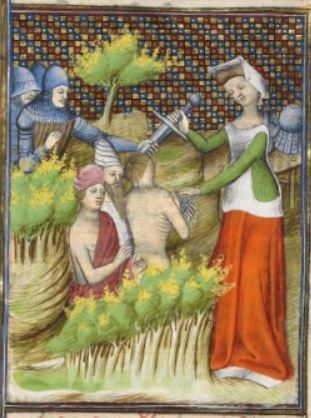
This illumination depicts a woman named Busa on the right side of the image looking at the group of people in front of her. Boccaccio explains that after a city called Cannae was attacked by Hannibal the Carthaginian, the people fled to Canusium. Busa opened her home graciously to the people who fled the danger of war and provided them with hospitality, food, clothing and supplied them with arms as illustrated in the image.
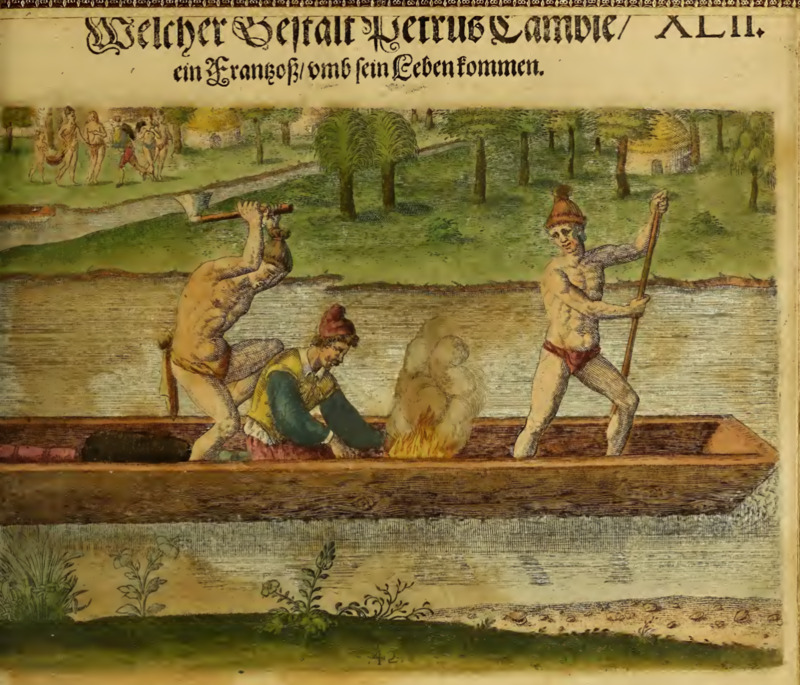
Three men are shown in a dugout canoe. An Indigenous man in the front of the canoe uses a long pole to maneuverer the boat in the river. Another Indigenous man stands in the rear of the canoe, looming over a colonist who kneels in the center of the boat (according to the title, he is a Frenchman named Pierre Gamble). The Indigenous man holds a small axe raised over the colonist’s head. A fire burns in the center of the boat, in front of the colonist. This illustration is identical to the one found on page 133 of Frankfurt 1591, but colored.
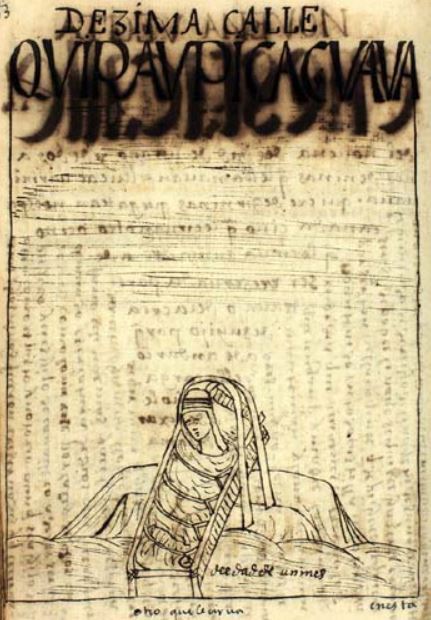
The author explains that there were ten paths for women to follow in the Inca Empire based on age division. This group is called quiraupicac uaua [baby in the cradle] and these were babies were two to five months in age. The author explains that the baby’s mother, relatives and siblings would care for the child as she grows. This image depicts a baby girl sleeping in a wicker cradle. The caption reads de edad de un mes, otro que le cirua, which translates to one month old, others serve her.
In this image we see Gulliver climbing over the walls of the Emperor’s palace, which lies in the centre of Mildendo. The walls were five feet high, so Gulliver built himself two stools out of wood to help him get over the walls – as the gates were too difficult for Gulliver to get through or over. The stools were each three feet tall, and there was one on each side of the wall. Gulliver did this because the Emperor wanted to see the Imperial Palace. The same image appears in both the 1839 and 1843 Krabbe editions.

![[Lilliputian cavaliers]](https://collections.cemvc.ca/files/large/2bd84aa46ecf673032e90a1965bb2320bdfa3d7e.jpg)
![[Act XI]](https://collections.cemvc.ca/files/large/506ee1afde6cbd7f0bdffe036445b0da3ab01a89.jpg)
![[Vanity Fair Chapter XXXI Inhabited Initial]](https://collections.cemvc.ca/files/large/4466c3c4661bee10e5bbf3622f0d5eede18dd2d7.jpg)
![[Juno Sitting on a Throne Holding a Scepter and Wearing a Crown]](https://collections.cemvc.ca/files/large/03cea8552d11d05a3a7e8829c155d4ecc26f2d57.jpg)
![[Vanity Fair Volume I. Chapter XXIX Historiated Initial, M]](https://collections.cemvc.ca/files/large/08562b6ad7e6a485ea843cdf327fb58776f9d696.jpg)
![[A European ship sailing near the coast, with an Indigenous settlement in the distance]](https://collections.cemvc.ca/files/large/f9abd3769b6675bcf2dcdae91e36277f9ba7dfe2.jpg)
![Vita et Fabulae [Two men are talking to each other as the third man carries crops]](https://collections.cemvc.ca/files/large/cc0e23d95dc88ac1ea60ddfc0465a4bf8d2a72dd.jpg)
![[Gulliver sleeps outside covered by his coat in Blefuscu]](https://collections.cemvc.ca/files/large/f6f004a6b747ed5f3b718aa50edc2e1851eb74c7.jpg)
![[Gulliver climbs over the wall of the Imperial palace in Mildendo]](https://collections.cemvc.ca/files/large/16228872679ecc4e7460702aeeb1dd160290c9ee.jpg)