This image is illustrated in a chapter that discusses and criticizes the government and society in Spanish conquered Peru. This image depicts a standing portrait of a Spanish encomendero [trustee]. The author explains that some of these men were good Christians and friends of the poor, while others were enemies of the indigenous peoples of Peru. They were the highest-ranking members of Spanish colonial society in Peru. They were tasked with caring for the spiritual needs of the indigenous peoples, in exchange for tribute (usually in the form of agricultural products or unpaid labour).
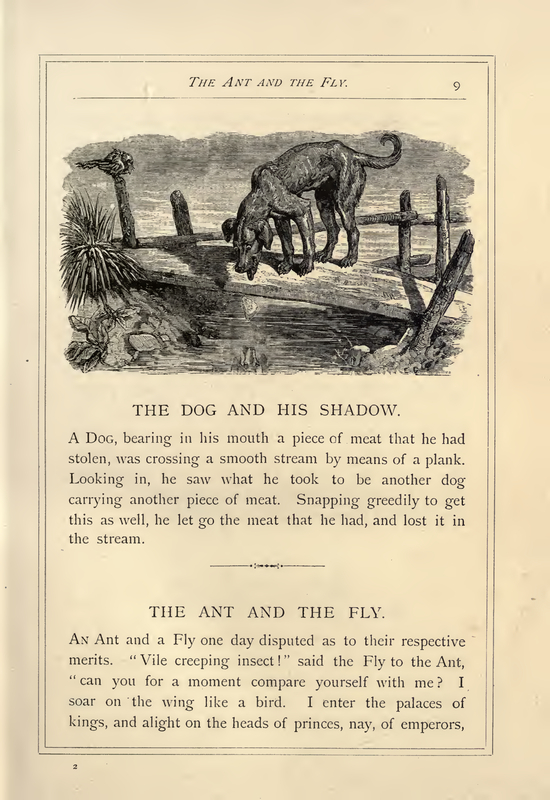
A dog is crossing a water stream on a small wooden plank, looking down in the water. The dog sees its reflection in the water and drops in the piece of meat he had been holding in his mouth.
There is an illustration at the center of the page; above and below this illustration are bodies of text. In the illustration, a man wearing a hat is holding a stick while having 5 dogs like animals beside him and with two dog like animals in front of him. A tree branch can be observed in the background.
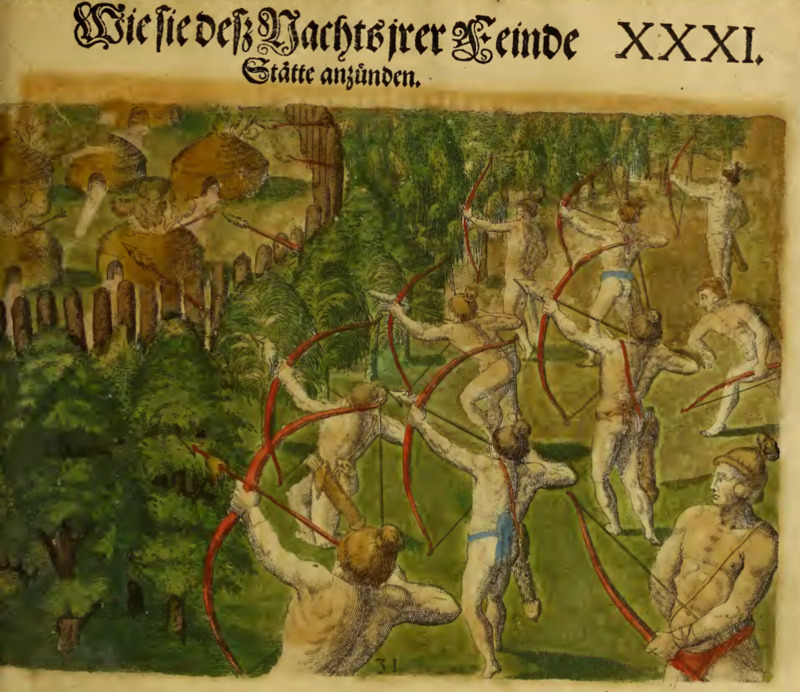
A group of Indigenous men stand outside a town. They are using large bows to fire arrows over the trees and fence surrounding a town. The arrows have been set on fire and they spread flames to the roofs of the houses in the town when they land. This illustration is identical to the one found on page 103 of Frankfurt 1591, but colored.
The European settlement under attack is comprised of several long structures and cannons surrounded by a fence and a group of European men stands at the center aiming guns and firing cannons out towards the Tupinambá. The Tupinambá surround the village and aim bows and arrows over the fence towards the European men. On either side of the European settlement there is a Tupinambá camp, each featuring a large fire with a wooden frame placed over it at the center and several hammocks, all surrounded by thick poles arranged in a circle. Fish and human limbs have been set on the wooden frames over the fires to cook. Two rowboats full of European men are making their way up the channel towards the settlement, with the Tupinambá trying to prevent them from reaching their destination by firing arrows and felling trees to block passage. Several of the Tupinambá wear feathered headdresses and adornments around their waists.
The Reverend Mr. Binny sits on a sofa with Georgy Osborne on his lap. Opposite him sits Amelia Osborne, to whom he has just proposed marriage and been turned down. She is knitting or crocheting, and above the sofa is a framed portrait of the elder George Osborne.
Here we see the shipwreck which resulted in Gulliver’s separation from the rest of the ship, then ending up in Lilliput. The image shows the large wave which overtook the ship, which we see as it tips over into the rough seas. The same image appears in the 1839 Krabbe edition.
After being embarrassed by Mr. Brocklehurst in front of the class, Jane went away into the corner crying. Helen Burns found her first, and comforted her, then the two girls were found by Miss Temple, a teacher at the school. Miss Temple was a kind young woman and brought the girls into her office and gave them tea, reassuring them. She told Jane that she would write to the doctor that recommended Jane go to school and find out the truth and absolve her of the claims made against her by Mr. Brocklehurst.
Here we see the Tower of London from the Thames. There are several boats in the river, and the Tower of London is on top of a hill, with buildings in front of it. When comparing this image to others from the eighteenth century, this view of the Tower is recurring. This image comes at the end of the sixth chapter of Gulliver’s travels in Laputa, when he has decided he wanted to return home to England. The same image appears in the 1839 Krabbe edition.
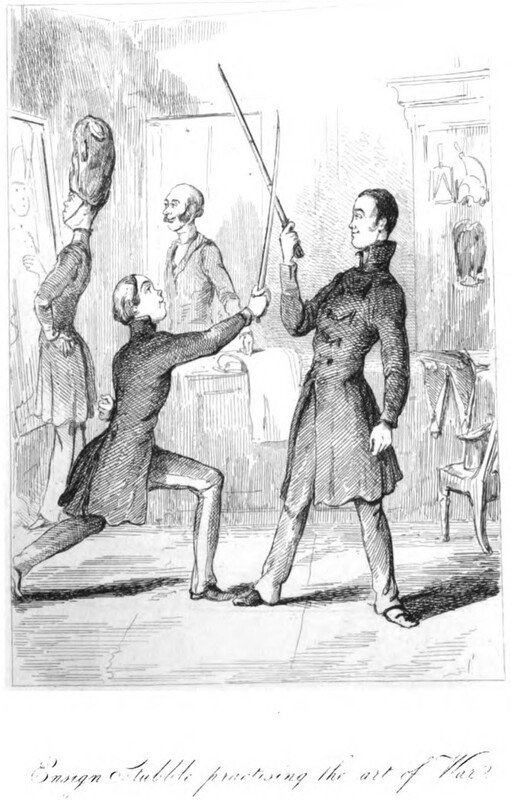
Ensign Tom Stubble holds up a new sword at the accoutrement-maker’s, lunging at the much taller Captain William Dobbin, who parries with his bamboo walking-stick. Both men are smiling. In the background a store employee can be seen, along with a man trying on a tall guard’s hat. Below the illustration is printed in cursive its title, Ensign Stubble practising the art of War.
In the centre of the illustration, we see Celestina wearing a robe and a veil. There are two male figures to the left and one to the right, representing Calisto, Sempronio, and Pármeno. This depicts the scene in which Celestina tells Calisto about her visit with Melibea, after which she presents him with Melibea’s girdle.[This illustration is identical to those found in Acts IV (folio 32r), V (folio 42r), VIII (folio 62r), X (folio 74r), XIII (folio 93v), XV (folio 102r), and XVII (folio 109r).]
Here we see Gulliver speaking to an official from the Lilliputian court. The official sits in a sedan chair, however the chair attendants were dismissed. The official was there to inform Gulliver that he had been charged with treason. Gulliver was charged because he urinated on the Imperial Palace to put out a fire in the Empress’s apartments and for preparing to visit the Emperor of Blefuscu – the enemy of Lilliput. Because of these charges, Gulliver leaves Lilliput and travels to Blefuscu. The same image appears in both the 1839 and 1843 Krabbe editions.
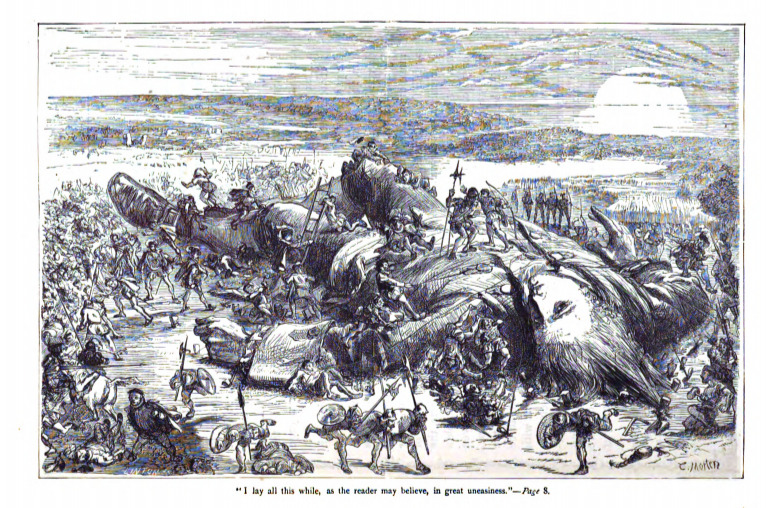
Here we see Gulliver lying on the shore of Lilliput, tied up. Gulliver was restrained at his wrists, ankles, and waist. Lilliputian guards surround him, and several climb on top of Gulliver. We see ladders leaning against Gulliver so Lilliputians could climb on top of him.
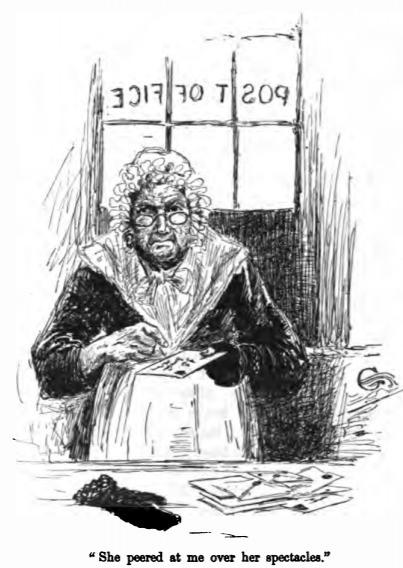
Jane spent eight years at Lowood school, six as a student and two as a teacher. After teaching for two years she began to feel unsatisfied and put an advertisement in the paper stating she wanted to be a governess. Mrs. Fairfax, the housekeeper at Thornfield Hall responded to her advertisement and hired Jane as a governess for Adele. Here the postmistress hands Jane Mrs. Fairfax's letter inviting her to Thornfield.
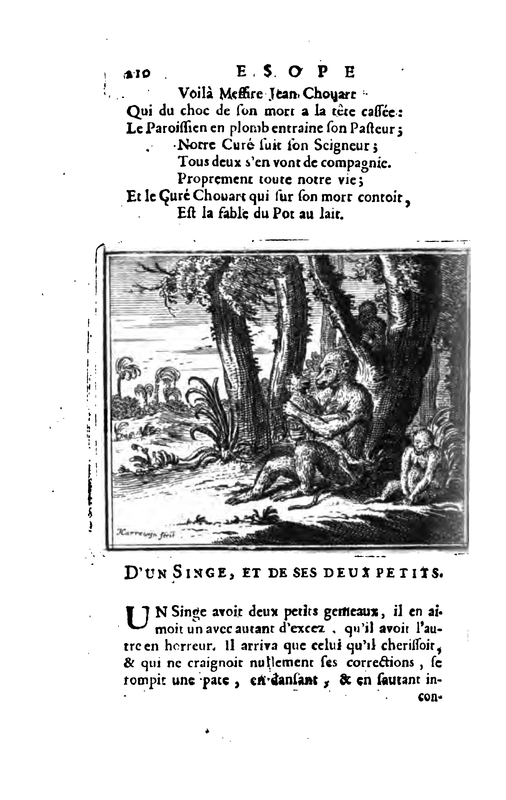
An adult monkey is sitting under a tree with an infant in its arms. There is another infant in the tree and another infant sitting beside the adult below the tree. The infant sitting below the tree is looking down. There are trees and plants in the background. The illustration has the signature of Harrewijn in the bottom left corner.
The European settlement under attack is comprised of several long structures and cannons surrounded by a fence and a group of European men stands at the center aiming guns and firing cannons out towards the Tupinambá. The Tupinambá surround the village and aim bows and arrows over the fence towards the European men. On either side of the European settlement there is a Tupinambá camp, each featuring a large fire with a wooden frame placed over it at the center and several hammocks, all surrounded by thick poles arranged in a circle. Fish and human limbs have been set on the wooden frames over the fires to cook. Two rowboats full of European men are making their way up the channel towards the settlement, with the Tupinambá trying to prevent them from reaching their destination by firing arrows and felling trees to block passage. Several of the Tupinambá wear feathered headdresses and adornments around their waists.
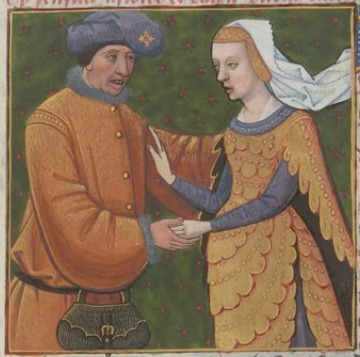
This illumination depicts the vestal virgin, Rhea Ilia (more commonly known as Rhea Silvia), holding hands with a man. As a vestal virgin, Rhea Ilia was forbidden from becoming pregnant or having relationships with men. Despite her vow, Rhea Ilia met a man (as depicted in the image) and ended up having sexual relations with him. She became pregnant and birthed the founders of what would become Rome (Romulus and Remus). Rhea Ilia was buried alive for her crime of breaking her vow of virginity.
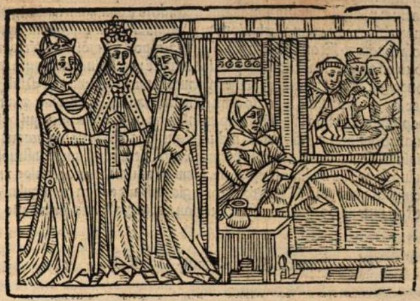
The left side of this engraving depicts Constance, the daughter of King William of Sicily, marrying Henry, the emperor of Rome. Constance was forced to be a nun at a young age due to a prophecy which foretold Constance would somehow cause the destruction of Sicily. Her father, William, put her in a convent to prevent the prophecy from happening. At an older age, Constance was married to Emperor Henry and bore a son at the age of 55. Constance is depicted on the right side of the engraving lying in a bed after giving birth to her son, Frederick. Frederick is depicted getting baptized in the background of the image in a large bowl. The baby grows up to be the one to fulfill the prophecy that King William was fearful of.
This image is depicted in the author’s chapter where he discusses cities, towns, villages, and provinces in colonial South America. The image depicts the desert town of Nazca in Southern Peru. It is arranged in a cluster of buildings which forms a square in the centre where two people are walking, and one person is riding on a horse. The author explains that Nazca is the best wine region in the kingdom. There are grapes on vines on the trees at the foreground of the image to demonstrate the importance of wine. There are three winding pathways that lead into and out of the city from different directions where people can be seen walking or riding along them. The caption at the bottom of the image reads uilla [town].
In a field, a half-animal half-human creature is sitting on a throne. The creature is wearing long robes, and the throne has a small circular roof atop its head. In front of the creature is a deer on the left, and a sheep on the right. The deer and the creature are exchanging looks, while the sheep is looking at the deer. In the upper right corner, a small dragon is seen flying in the sky. Trees and bushes decorate the background.


![Cristiano Comendero de In[di]os Deste R[ei]no](https://collections.cemvc.ca/files/large/a18287319b0ca3c1e5f7e67c7e2df2927112d1bb.jpg)

![Vita et Fabulae [A man with a group of dogs]](https://collections.cemvc.ca/files/large/26c46849da63bf6487e9bcf485ddae53080a0955.jpg)

![[Tupinambá people attack a European settlement and rowboats]](https://collections.cemvc.ca/files/large/e1db41d4ed06563d8b06eb0eb4eea943c91b4a92.jpg)
![[Reverend Mr. Binny]](https://collections.cemvc.ca/files/large/93d1aba04f91f98bedeb5f7a31e6ae7e3c4e8d21.jpg)
![[Gulliver’s ship is shipwrecked]](https://collections.cemvc.ca/files/large/940a70aed6b4c3017c166124193991312e76b1d3.jpg)
![[The Tower of London seen from the Thames]](https://collections.cemvc.ca/files/large/f9d75263a52104cfb815e484e52f4f768c0b8b2b.jpg)

![[Act VI – Celestina, Calisto, Sempronio, and Pármeno]](https://collections.cemvc.ca/files/large/e229b69095c87b2db3d7546c4f55a12960be4e13.jpg)
![[Gulliver speaks with a Lilliputian official]](https://collections.cemvc.ca/files/large/1571b7fbbd7326d3c178a379cbc849e3f6e0dc52.jpg)

![[Tupinambá people attack a European settlement and rowboats]](https://collections.cemvc.ca/files/large/56121777d91c48d3a8c3c7a31219c5780b061587.jpg)
![La Villa de S[an]tiago de la Nasca, Uino de Uayuri](https://collections.cemvc.ca/files/large/8b8dde2ed2eb8612403925a4d762ecf3ad4b6a65.jpg)
![[The Animal Royalty, the Deer and the Sheep]](https://collections.cemvc.ca/files/large/e44fa2a1589e05a1160cc36837dd27db168a24ac.jpg)