Here we see a group of young people harvesting hay. There are piles of hay in the background covered with cloth to keep them pinned down and protected from rain. A young man and young woman carry pitchforks, and three other workers are visible in the background. Thornfield is visible in the distance. This scene occurs when Jane Eyre is returning to Thornfield after visiting her aunt and cousins. The title is not underneath the image itself, but it is listed in the List of Illustrations preceding the text.
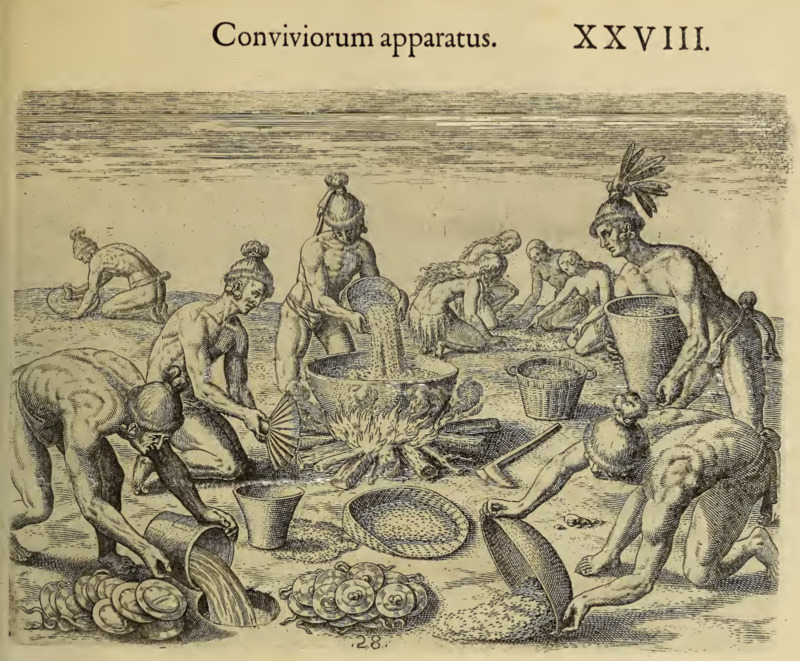
Several Indigenous people are shown preparing food for a feast. A large pot sits on a fire in the middle of the group, one man pours a substance into the pot and another man kneels beside the pot and fans the flames.
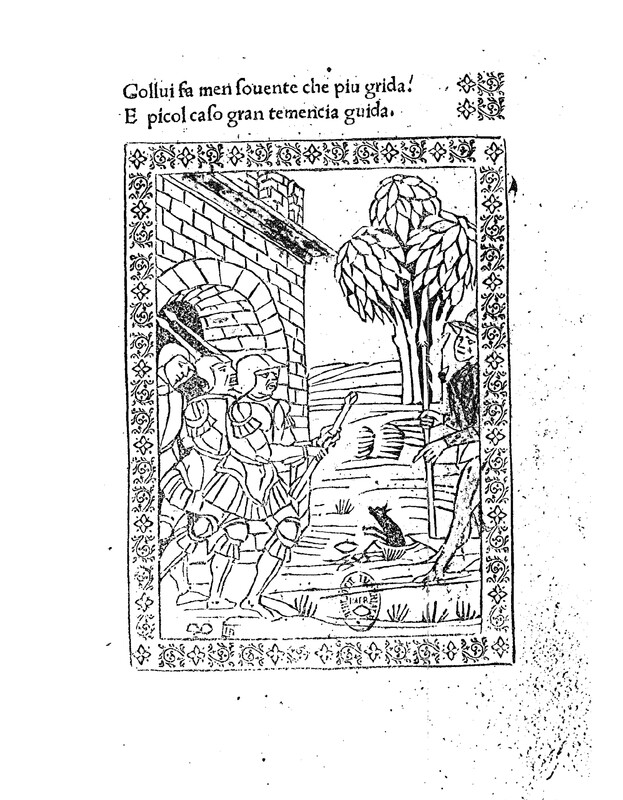
Three men exit a castle directly behind eachother, the first holds a staff and looks stirn, the second looks almost afraid, and the third is looking towards the ground and seems sad. To the right is what looks like a wizard holding a long staff. An indistinguishable anamal looks like it is coming out of the ground infront of the wizard. A large tree is in the background. The image is bordered by a vine design and the signature of Liberale de Verona is stamped on the bottom
A group of Tupinambá people is shown fishing. Two of them use a bow and arrows to shoot the fish in the water while others swim and dive, catching the fish with their hands. One of the individuals with a bow and arrow has several fish attached to a line that he wears tied around his neck and hanging down his back.
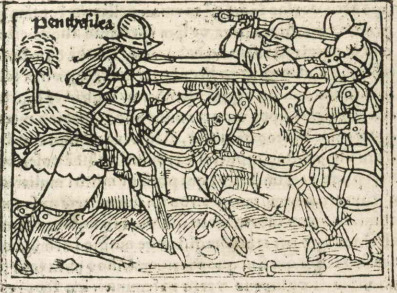
This engraving depicts Penthesilea, the queen of the Amazons, riding a horse into battle with her lance pointed towards her enemies. We know that this figure is indeed Penthesilea as her name is engraved to the left of her head. We also know that this is a woman as her long hair is sticking out from underneath her helmet. Penthesilea, as Boccaccio describes, was a great warrior. She wanted to secure a strong heir for the Amazons, so she sought out Hector of Troy to provide her with an heir. She fought in a battle against the Greeks to prove herself worthy of bearing Hectors child. The enemies she is fighting against in the image are the Greek soldiers in the Trojan War.
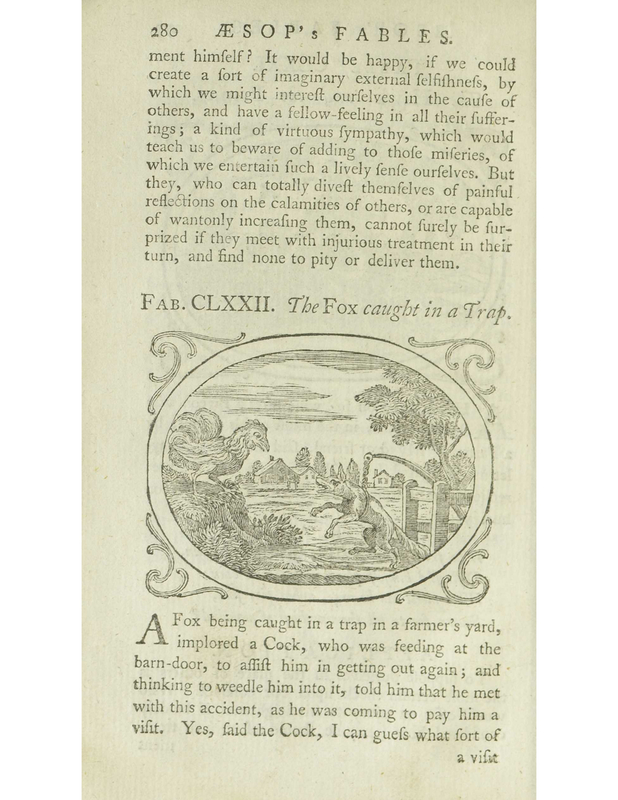
A fox is trying to get out of a trap that is clamped around their waste. To the left a chicken watches on with curiosity. The fox is calling out to the chicken with a look of concern. In the background there is a small house and a barn can be observed, indicating the animals are on a farm
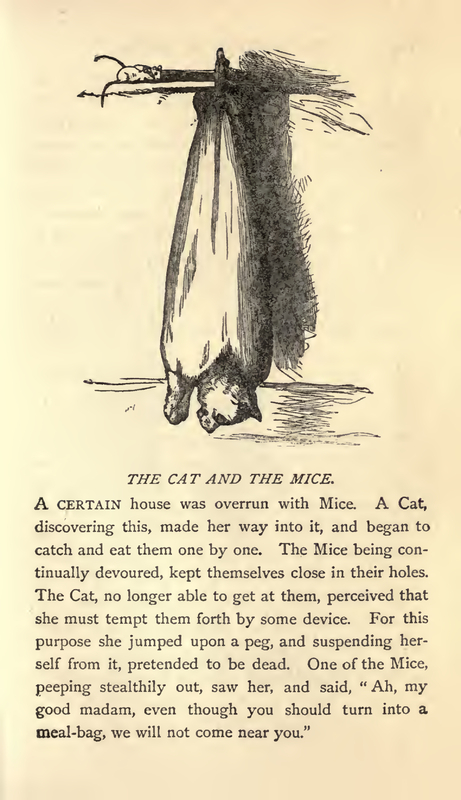
A cat is hanging upside down from a peg. In the distance, there is a mouse looking at the cat. The mouse seems to be wary of the cat while the cat doesn't seem to be paying any attention to the mouse.
In this image we see how the Lilliputians bury their dead. The deceased is buried head down because they believe that the world will eventually turn upside down and the dead will be resurrected, thus when this happens, they will be right side up. The burial is attended by a crowd of mourners. This image appears when Gulliver discusses the various traditions and practices of the Lilliputians. The same image appears in the 1843 Krabbe edition.
Here a Lilliputian orator addresses Gulliver. Gulliver the describes to the reader the Lilliputian language and peoples. He describes the language as a combination of several languages Dutch, Latin, French, Spanish, Italian, and the Lingua Franca. Gulliver tells the reader that he could not understand the Lilliputians, nor could the Lilliputians understand him.
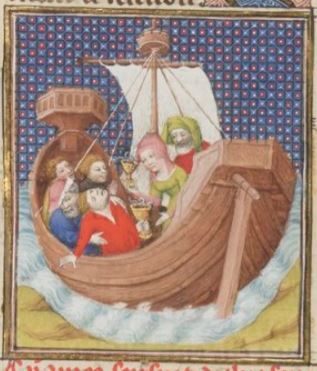
This illumination depicts Theoxena, her husband Poris, and her nephews and child killing themselves. They are illustrated on a ship as they had attempted to escape King Philip of Macedon by sea, however, their ship was being pulled back to shore by the winds. To avoid dying at the hands of King Philip, Theoxena had given them all a choice between stabbing themselves with knives or to drink poison. Theoxena is depicted holding a chalice full of poison while a child in front of her holds one as well. Theoxena and her husband decided to die as a couple and jump off the ship and drown together.
Here we see the letter N with people surrounding it. The letter N using a method of coding developed by scholars at the Grand Academy on Balnibarbi signifies the word plot. This image comes in a description of a conspiracy found by a professor from the Grand Academy on Balnibarbi. This conspiracy is thought to be an allusion to the trial of Francis Atterbury, the bishop of Rochester for allegedly plotting with the Jacobites. Atterbury was charged with treason in 1722 and was exiled to France. The same image appears in the 1839 Krabbe edition.
Rebecca Crawley learns against the back of George Osborne’s chair, flattering him about his appearance and teasing him about his bad habits. He is turned slightly to look at her, while Rawdon Crawley sits opposite him, smoking. The men are each holding two cards in their game of écarté. A portrait with two figures hangs on the wall next to the table.
Calisto goes to visit Melibea as promised, accompanied by Sosia and Tristan instead of Sempronio and Pármeno. He ascends the high wall to Melibea’s garden while Sosia and Tristan stand guard (as seen in this image). Centurio’s men arrive and begin harassing Sosia, but Sosia manages to scare them off. To the left of the image we see Calisto, with a sword mounted on his belt, climbing a ladder to enter Melibea’s garden. Sosia and Tristan stand behind him with swords and shields. To the right we see Melibea and Lucrecia looking out from a window. Each is wearing a robe and a veil. They seem to be making eye contract with Calisto, though perspective makes this impossible. The entire image is identical to the one found on page 209 of the text.
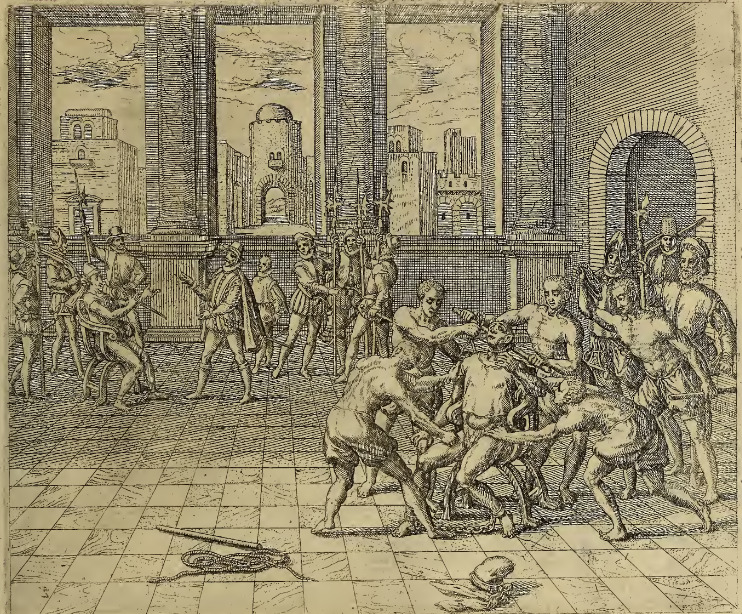
Inca Emperor Atahualpa (Atabalipa) is executed at Cajamarca, despite the ransom of gold and silver having been paid. Atahualpa is seated in a chair with his ankles chained together, inside a large open room. A group of enslaved Black people are forced by the Spanish to carry out his execution. Several men hold down Atahualpa’s limbs while two behind him strangle him to death with a rope tied to a wooden pole. Groups of Spanish soldiers armed with pikes and muskets mill around the room while the execution takes place. This image is identical to one found on page 11 (131) of Frankfurt, 1596.
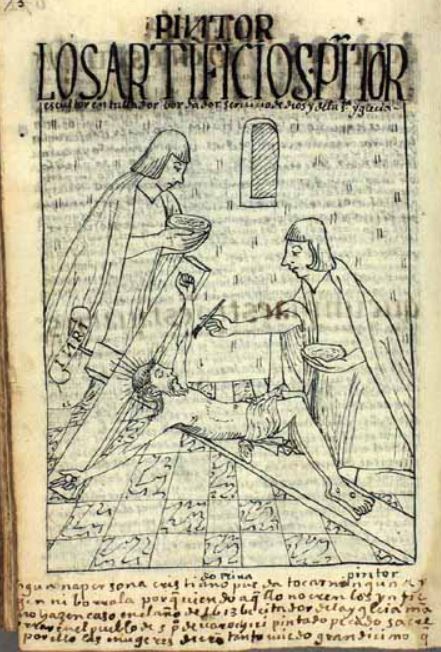
This image depicts two indigenous artisans painting a crucifix inside of a church. One artisan is kneeling as he holds a paint brush in his right hand and a bowl of paint in his left hand. The other artist who is depicted standing is holding a bowl of paint with both hands. The author praises the artisans of colonial Peru who worked in service of the church to create religious images and artisanal creations. The large caption at the bottom of the image reads, [ni]ngunna persona cristiano pueda tocar ninguna y[ma]gen ni borrala porque uiendo aquello no cre[e]n los ynfie[les], no hazen caso. En el ano de 1613 becitador de la ygl[e]cia man[do] [...]rrar en el pueblo se san pedro de uarochiri pintado pecado sacre[mento], por ello las mugeres dieron tanto miedo grandicimo que [...] [No Christian person can touch or erase any image because the non-believers to not believe it. In the year 1613 a resident of the church commanded in the town of San Pedro painted a sin sacrament, which is why the women gave such great fear that …].
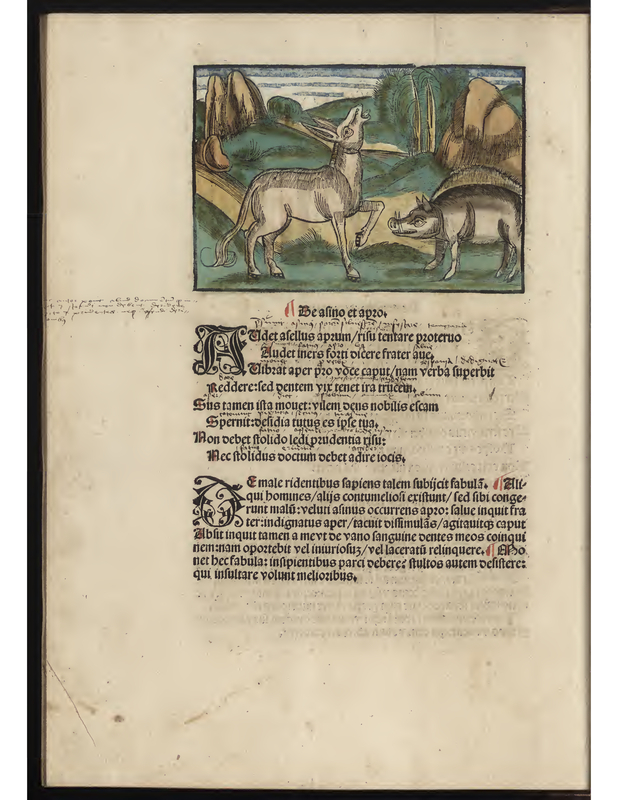
There is an illustration at the top of the page; below this illustration is a body of text. In the illustration, towards the left are a group of people observing with a person dressed in holy attire leading the ritual that is taking place. Towards the right, a comparatively large bird can be observed dropping a ring to a man who is sitting down whilst looking up towards the bird dropping the ring.
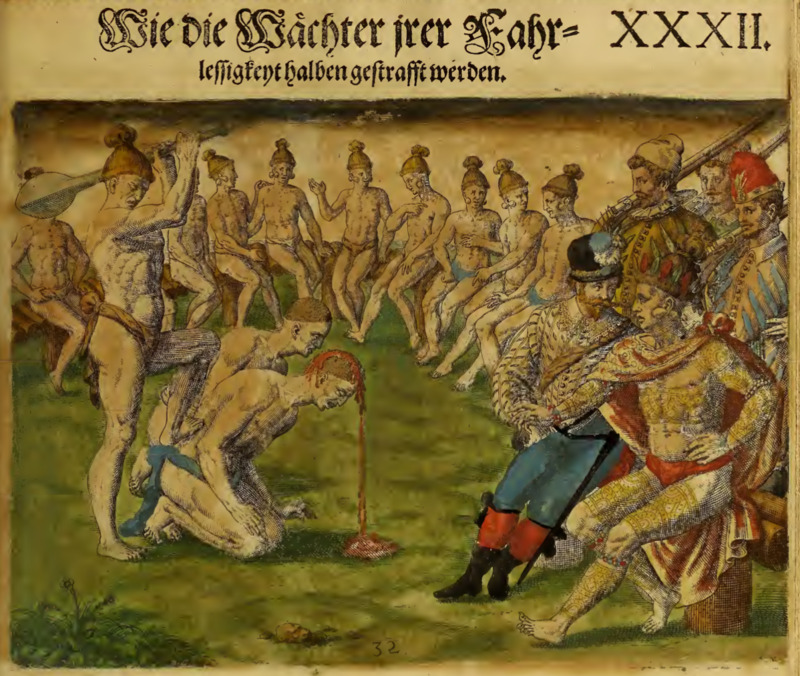
A group of Indigenous and colonist men sit on wooden benches in a semi-circle. In front of the group, two Indigenous men kneel on the ground. Another man stands behind them holding a club in the air above the head of one of the men. The man kneeling is bleeding from the head from a previous blow. This illustration is identical to the one found on page 105 of Frankfurt 1591, but colored.
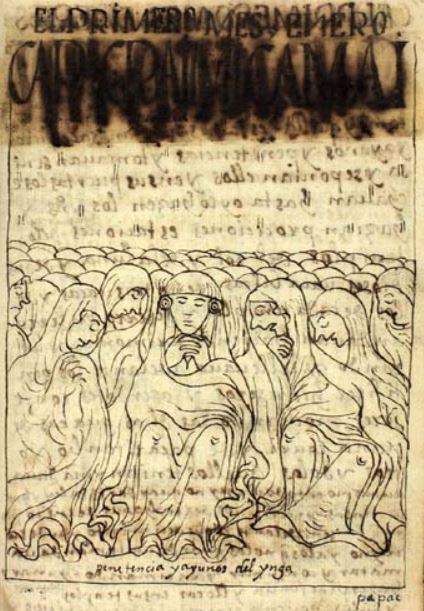
This chapter is dedicated to discussing the traditions and rituals of each month during the Inca Empire. The Incas tracked the months and years through the stars and their months consisted of thirty days. This image depicts the month of January, which was dedicated to sacrifices, seeking penance and fasting. Capac Raymi Camay Quilla translates to Royal Feast, Festival of the Moon. The image depicts a large group of people sitting together in a ceremony and appear to be praying. The caption on the image reads penitencia y ayunos del ynga, which translates to penance and fasting of the Incas.
![[The haymakers were at work all along the road]](https://collections.cemvc.ca/files/large/f6381d2225584db6956ca36030bb7f61fbd7aeec.jpg)
![[Tupinambá people fish with bow and arrow]](https://collections.cemvc.ca/files/large/fe88fce72c4ee5b8b02fc9df570e08536b821fc3.jpg)

![[Depiction of how the Lilliputians bury their dead]](https://collections.cemvc.ca/files/large/ad5ab4b259f7a32c98e2409c3b407848e33b56e3.jpg)
![[A Lilliputian orator addresses Gulliver]](https://collections.cemvc.ca/files/large/f686b09fbd0185704b9be7fbf7a4e556127804dc.jpg)
![[The Young Man and His Cat]](https://collections.cemvc.ca/files/large/4f9f2a7d9e1d53b30384f9f9687c4a18226dfdfc.jpg)
![[A method of coding using acrostics by scholars at the Grand Academy on Balnibarbi]](https://collections.cemvc.ca/files/large/d3ca19833015c0b5bf29f420b26ca158aef6487a.jpg)
![[George Osborne at the Crawley’s]](https://collections.cemvc.ca/files/large/2b5cf2fd2e61254ff92f8ace66f34fd13b3d95f6.jpg)
![[Act XIX – Calisto, Guarded by Sosia and Tristán, Climbs Melibea’s Garden Wall While Melibea and Lucrecia Watch from a Window (Repeated)]](https://collections.cemvc.ca/files/large/77e937142e7c2df0bdce089f586984508ef6e571.jpg)
![Vita et Fabulae [A group of people are observing a bird dropping a ring on top of a man sitting on the floor]](https://collections.cemvc.ca/files/large/53471d387215e1433a65a660aa6fa470e6de0abc.jpg)