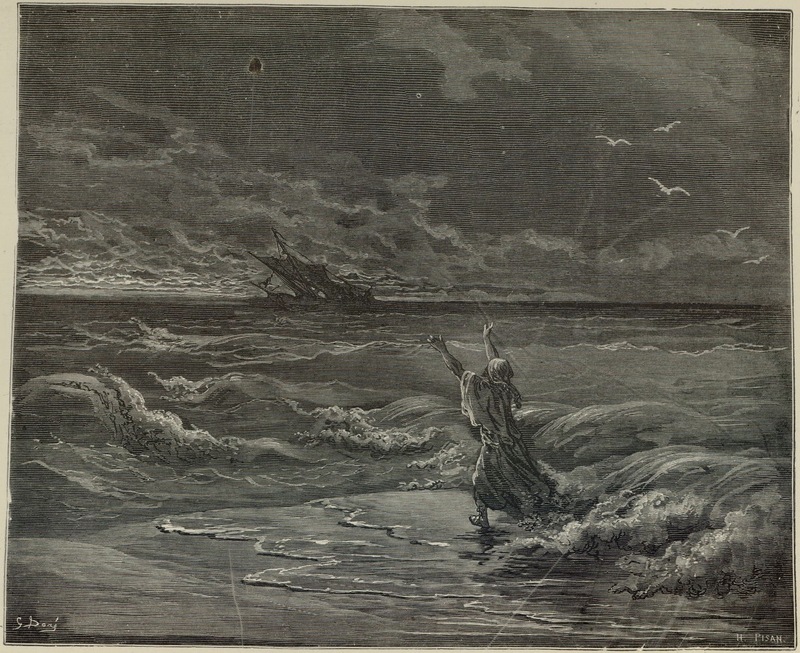
Zoraida’s father, Agi Morato, and the Moor oarsmen are put ashore at Cava Rumía. As the captive and Zoraida leave in the boat, they hear her father cry for his daughter to come back, forgiving her and pleading with her to console her grieving father. Signed by G. Doré (illustrator) and H.-J. Pisan (engraver). Part 1, ch. 41.
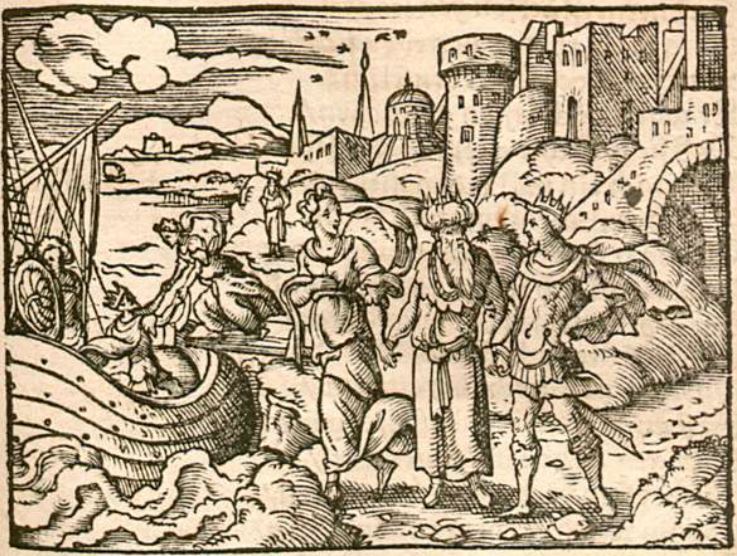
This engraving illustrates King Pandion of Athens with Prince Tereus on his left, and his daughter Philomela to his right. Pandion is wearing a large crown to differentiate himself from the others as king. Tereus was sent to Athens by his wife Procne to fetch her sister, Philomela, in order to reunite with her for a short visit. The ship in the image is to illustrate the method in which Tereus will be escorting Philomela to Thebes. This arrangement, however, ends up being dangerous for Philomela, as Tereus has become irresistibly infatuated with her.
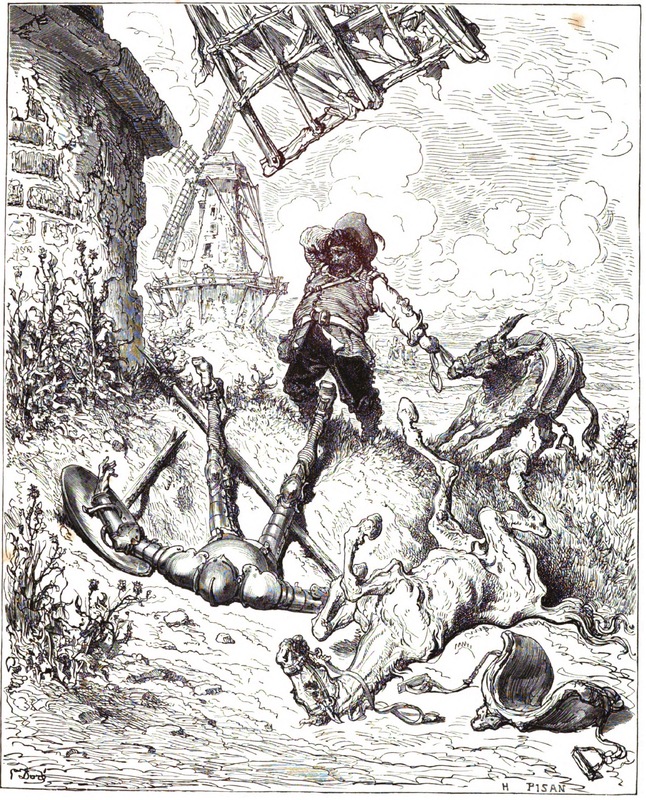
After Don Quixote’s disastrous attack on the windmills he believed were giants, Sancho runs to rescue his master. Don Quixote and Rocinante lie on their backs. Rocinante’s saddle has fallen off and is beside him on the ground. Sancho and his donkey look on in horror. This scene can be found in Part I, Book 1, Chapter 8
In the background, Don Quixote lies dazed on the broken bed after having been beaten by the muleteer. In the foreground, the innkeeper, holding a candle, discovers the fight between Sancho Panza, Maritornes, and the muleteer. Signed by J. Rivelles (illustrator) and T. L. Enguídanos (engraver). Part 1, ch. 16.
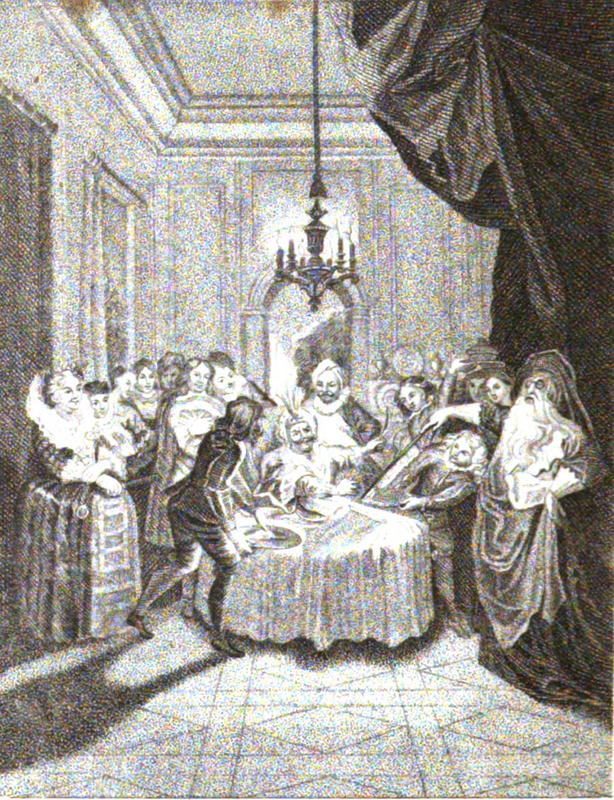
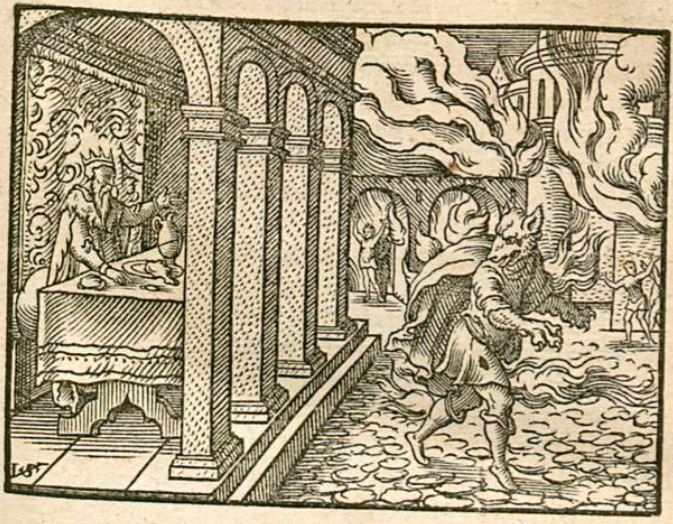
The King of Arcadia, Lycaon, did not believe that Jupiter was a deity. He devised a plan to test Jupiter to see if he was truly immortal. He served Jupiter food that contained human flesh in order to see if Jupiter would know the true contents of the food he was being served. Jupiter is depicted standing behind a table on the left side of the image with his hand pointing towards Lycaon. He is depicted wearing a crown to signify his status as a god. Jupiter knew he was being tricked, and in order to punish the Arcadian king for his disbelief in the god, Jupiter transformed him into a wolf. Lycaon is depicted on the right side of the image with his head transformed into a wolf, with his hands changing into paws. Jupiter also set the buildings ablaze as further punishment for Lycaon’s hubris, which is depicted in the background of the engraving.
In the forests near La Mancha a hermit's house is pictured on a hill in front of a dense grouping of trees, single roomed and small, but well built and maintained, with basic wooden fencing and a beaten path that leads to the doorstep. To the left of the house stands a large wooden cross with a straw humanoid doll crucified on it.
Sancho Panza suggests that Mimicona (Dorotea) is not a genuine princess, provoking Don Quixote. The knight is infuriated and tries to punish him. Dorotea, who understands Don Quixote’s madness, tries to pacify him by claiming that Sancho Panza saw illusions that offended her good name. Signed by D.-N. Chodowiecki (illustrator) and D. Berger (engraver), dated 1779. Plate 6. Part 1, ch. 30.
Master Peter, the puppet master with a patch covering his right eye departs from the inn with walking stick in his right hand. An ape is cradled in his left hand that wears a shirt and grasps tightly to Peter's chest. In the background on the left is a cart that carries fragments of his castelet having been destroyed by Quixote, and taking his ape, master Peter, who is Gines de Pasamonte in disguise, walks in quest of farther adventures.
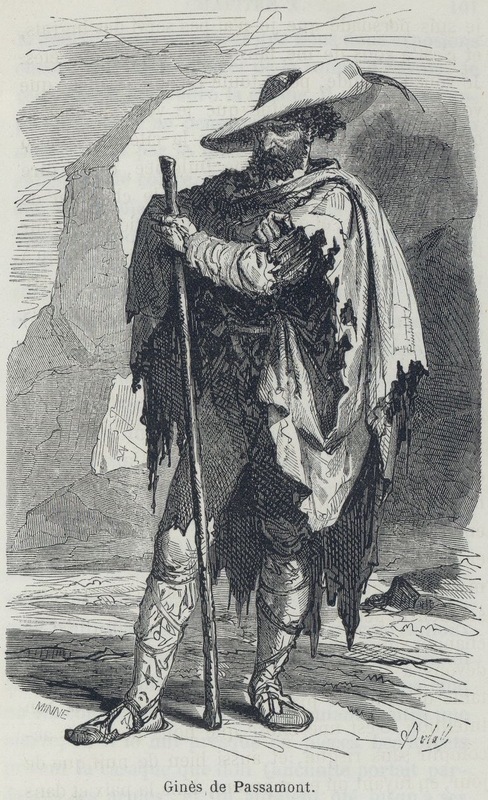
Portrait of Ginés de Pasamonte, an ungrateful galley slave that Don Quixote and Sancho Panza free in ch. 22. Signed by A. ‘Bertall’ d’Arnoux (illustrator) and Minne (engraver). Part 1, ch. 22.
Don Quixote and Sancho Panza encounter a cart carrying the actors of Angulo el Malo’s company for the mystery play ‘The Assembly of Death.’ The latter are dressed as Devil, Cupid, Death, Angel, Emperor, Queen, and Soldier. Rocinante is alarmed by the sound of bells and runs across the field. While Sancho runs to Don Quixote’s assistance, a member of the company makes off with his donkey. Unsigned. Part 2, ch. 11.
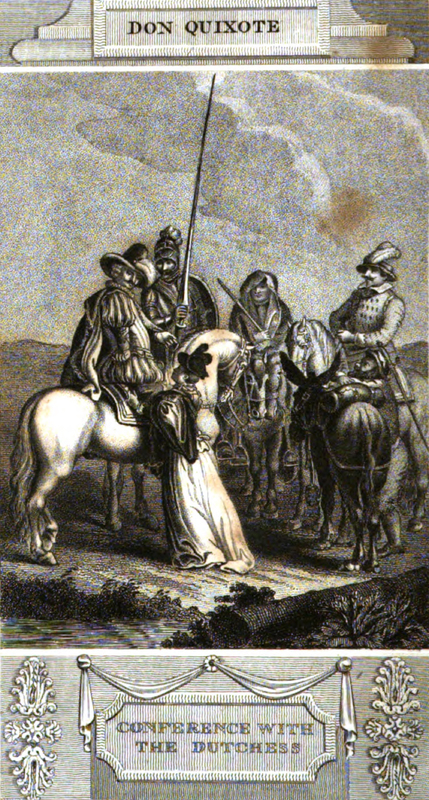
Don Quixote meets the Duke and the Duchess clad in full armor with his beaver up and making a show of displaying his knighthood., Sancho was hastening to hold his stirrup, but in getting off from Dapple, got foot hung in one of the stirrups, in such manner, that it was impossible for him to disentangle himself, so he stood by his donkey facing the duchess. As Quixote approaches, the Duchess explains to her husband, the duke, of the countenance of Don Quixote. The duchess is standing on the ground next to the duke's horse dressed in green fanciful attire. The other two men are the duchess' attendants, aiding her in her hunting. The duke is mounted atop a strong white horse with a feathered cap and rich apparel with a hand on his hip.
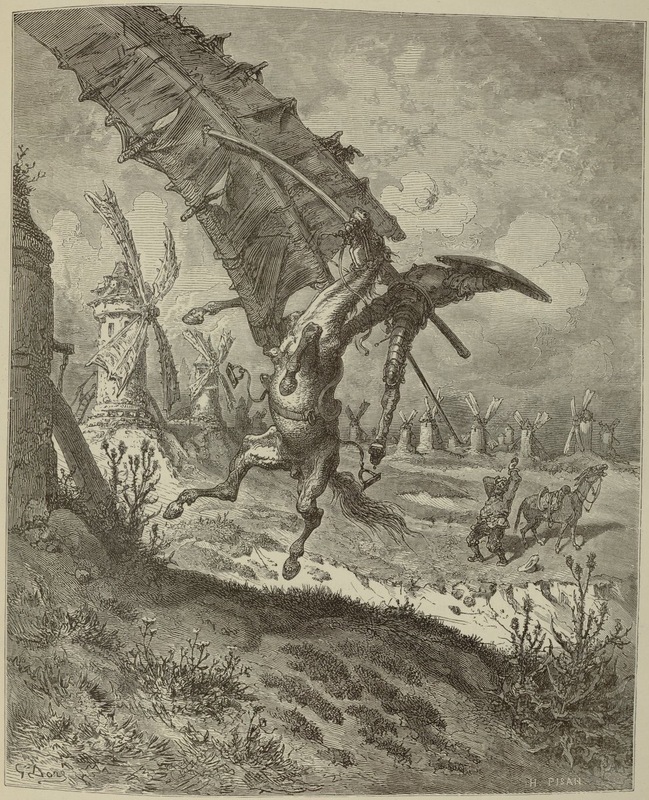
Don Quixote, mounted on Rocinante, charges a windmill that he mistakes for a giant despite Sancho Panza’s warning. The sail catches the wind, moving with so much force that it picks up the horse and the knight. Signed by G. Doré (illustrator) and H.-J. Pisan (engraver). Part 1, ch. 8.
Having jumped from his bed, Sancho Panza, dressed in a loose white shirt and slippers opens his chamber-door. In the bright hall outside, a large group of men hastily rush towards him, their swords drawn with lit torches by their side.
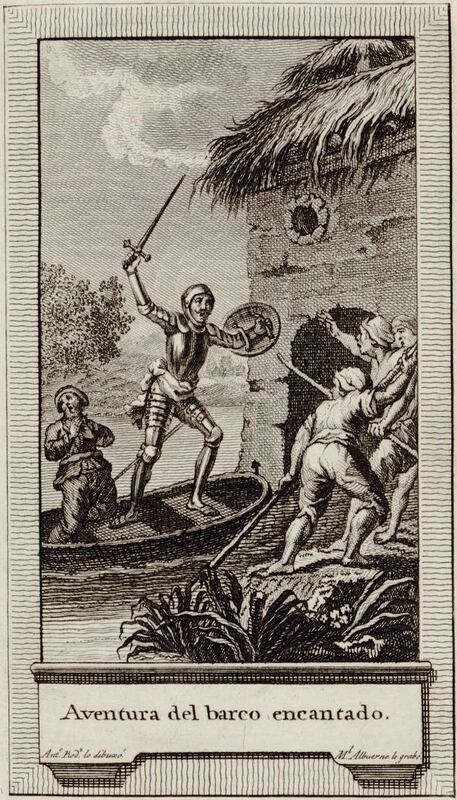
Don Quixote and Sancho Panza make their way down the river Ebro in the enchanted boat, approaching two watermills. The millers hurry out with long poles to prevent Don Quixote and Sancho Panza’s dory from being swallowed up in the torrent of the wheels. They are covered in dust from the flour, such that the errant knight mistakes them for miscreants and scoundrels. He threatens them while Sancho Panza prays. Signed by A. Rodríguez (illustrator) and M. Albuerne (engraver). Part 2, ch. 29.
Sancho Panza sits at the head of a white clothed table. A physician with a long white beard places himself, standing, on the right side of him, with a whalebone rod in his hand. On the table in front of Sancho stand several fruits and a great variety of eatables, with which the table is spread. A page stands to the left of Sancho, with a plate of smoking chicken in his hand. Meanwhile, man with the wand touches the rightmost dish with the tip of his whalebone staff, to which Sancho stares at him in surprise.
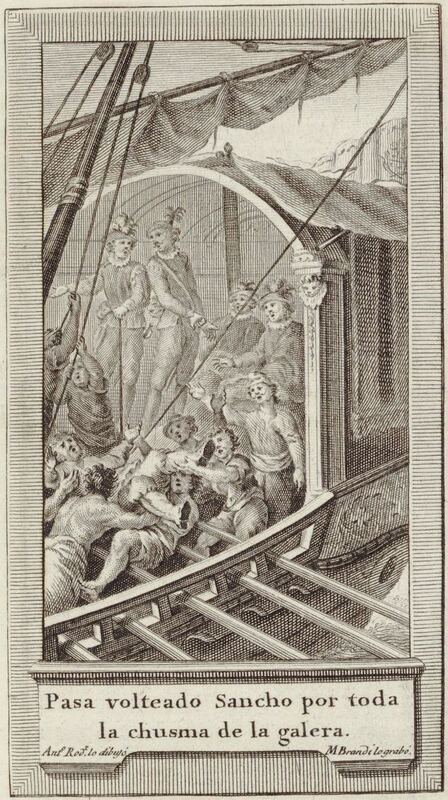
Don Antonio Moreno, Don Quixote, and Sancho Panza visit the galleys at Barcelona’s port. When they reach the harbor, the galleys take down their canopies, flageolets sound, and cannons are fired. The galley slaves hoist Sancho up and toss him from bench to bench, not stopping until they had returned him along the port side back to the stern. Signed by A. Rodríguez (illustrator) and M. Brandi (engraver). Part 2, ch. 63.
Two men embrace each other; Sancho Panza mounted upon his donkey Dapple on the right and Ricote the pilgrim with his pilgrim's staff and garb on the left. Locking their left hands to each other they gaze into the other's eyes before departing.
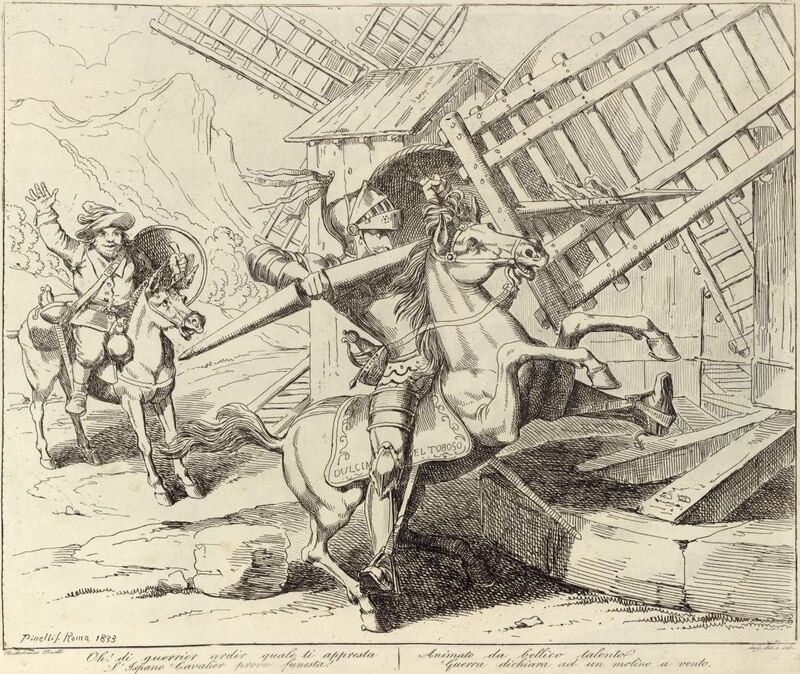
Don Quixote, mounted on Rocinante, charges a windmill that he mistakes for a giant despite Sancho Panza’s warning. The sail catches the wind, moving with so much force that it breaks his lance and picks up the horse and the knight. Signed by Bartolomeo Pinelli (engraver and illustrator) and dated Rome, 1833. Plate 13. Part 1, ch. 8.
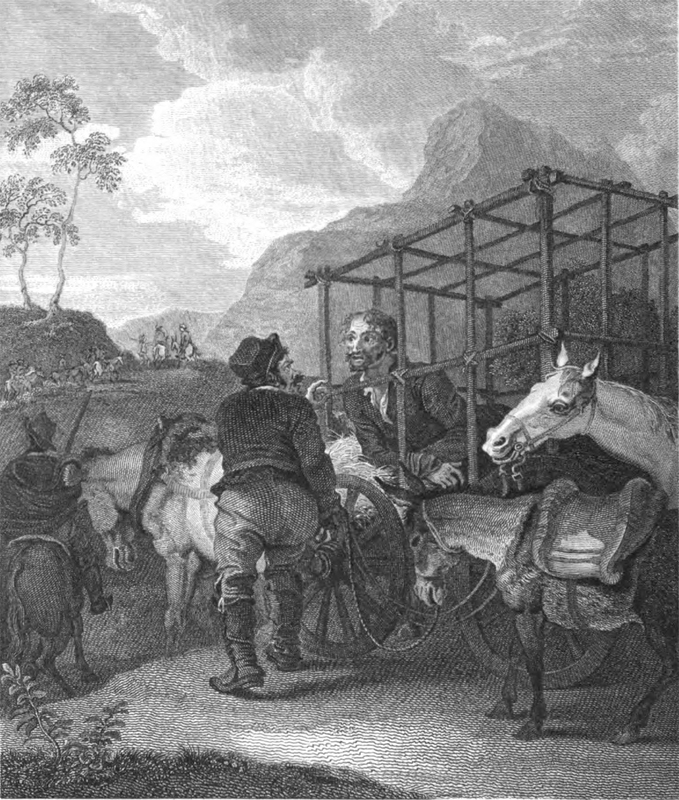
Don Quixote sits in a wooden cage, pulled by two horses, with his hands tied , and his legs stretched out, leaning against the bars, listening to his squire Sancho Panza. The priest, and the barber, and the bachelor have struck up conversation further along the winding path with a canon who was curious as to why Quixote was tied up and imprisoned. Quixote believes he is enchanted and must return to the plains of La Mancha to rid himself of enchantments. During the foregoing conversation between the canon and the Priest, Sancho, perceiving that he might speak to his master without the presence of the priest and the barber, whom he looked upon with suspicion , came upto his master's cage and told him that those who are riding along with them, with their faces covered, are the priest and the barber of their town.
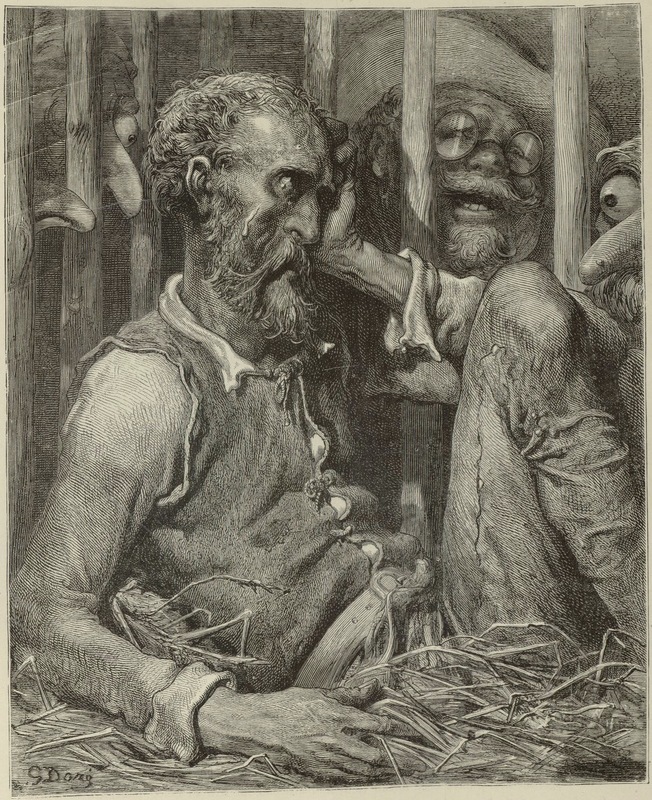
Don Quixote ‘enchanted’ into a cage and surrounded by ‘phantoms,’ in reality Don Fernando, his companions, Don Luis’ servants, the officers of the Brotherhood, the innkeeper, and the priest. He tells Sancho Panza that in all the histories of knights errant he has read, he has never heard of knights being carried on an oxcart. Signed by G. Doré (illustrator) and H.-J. Pisan (engraver). Part 1, ch. 47.
Just after midnight, Don Quixote asks Sancho Panza to lead him to Dulcinea’s palace in El Toboso. They make their way to the church, mistaking its tower for that of a castle. A man (background) with two mules and a plow comes toward them, singing a ballad of Roncesvalles. The illustration is not accurate to Cervantes’ text: the scene is not depicted at night. Signed by J. Rivelles (illustrator) and A. Blanco y Asensio (engraver). Part 2, ch. 9.
Having been rubbed down with ointment and untied of his shields, Sancho Panza sits upon his bed, dressed in an oversized white shirt and slippers. His face is that of fright, surprise, and fatigue as he holds the bed with his hands. On the left, one of the men who tricked him, looks at Sancho with a face of concern, a bottle of wine in his right hand. On the right, another moustached man looks at Sancho with similar concern, a glass of wine in his left hand. Two other men can be seen on the far right similar to the rest.
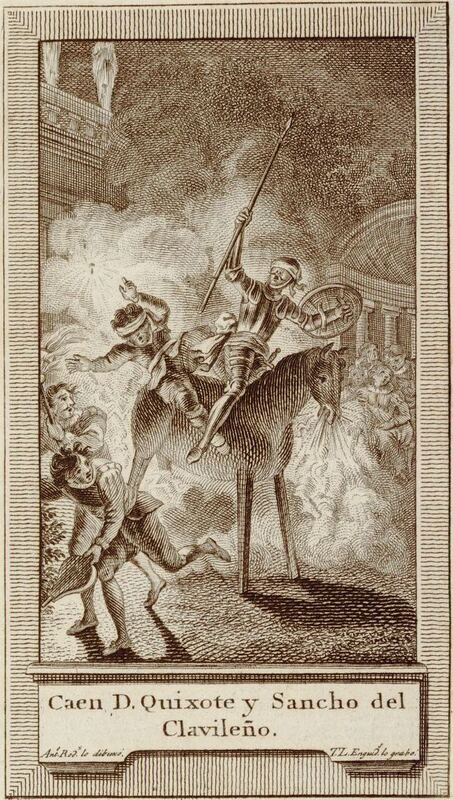
The firecrackers inside Clavileño explode, throwing Don Quixote and Sancho Panza in the air. The duke and the duchess (background) look on. The servants that were simulating Clavileño’s flight using bellows and torches are also pictured (foreground). Signed by A. Rodríguez (illustrator) and T. Enguídanos (engraver). Part 2, ch. 41.
This plate depicts three scenes in ch. 8. In the background, Don Quixote charges the windmills, which he mistakes for giants, while Sancho Panza tries to stop him. In the middle ground, the Benedictine friars’ servants beat Sancho on the road to Puerto Lápice. In the foreground, Don Quixote battles the Basque squire while the lady watches the fierce contest from the safety of her carriage. The illustration is not accurate to Cervantes’ text: the Basque is pictured holding a stool, while Cervantes writes that he defends himself from Don Quixote’s blows with a pillow. Unsigned. Part 1, ch. 8.
After finishing his work in the justice tribunal, Sancho is led to a sumptuous room where was placed an elegant and splendid table. Sancho sat down at the upper end of the table as there was but one chair and no other napkin or plates. On the far right, a physician dressed in black robes with a long white flowing beard and black spectacles, placed himself next to the table with a whalebone rod in his hand. Delicious food was brought forth to the table and a laced bib was placed under Sancho's chin. Sancho had scarcely had a bite of a fruit plate when the physician touched the dish with the wand, and a page took the plate away. Sancho was going to try another plate but before he could reach or taste it, the wand had touched it and another page whipped that away also with as much speed as they had done the fruit.

![[Fight between Don Quixote, Maritornes, and the muleteer]](https://collections.cemvc.ca/files/large/82a204efa5c5c4639c838e29873edd45d71a18d8.jpg)
![[A Hermitage]](https://collections.cemvc.ca/files/large/4fb928559ca73b3f2fee1ec48fc60e6baab8794f.jpg)
![[Don Quixote punishes Sancho Panza]](https://collections.cemvc.ca/files/large/9688d6c9c28f62a2496da371f20ef994dba7653c.jpg)
![[Master Peter Leaves the Inn]](https://collections.cemvc.ca/files/large/5112e936dbc1444fb5f4db9a60da54eadb3a9c8b.jpg)
![[Encounter with the cart of actors]](https://collections.cemvc.ca/files/large/d9a94e075fc10373ea611244a44d3aec97a66023.jpg)
![[Sancho Learns of the Forces Assaulting Barataria]](https://collections.cemvc.ca/files/large/71304f93c6a4efd6bc1d9cc8c185748233c67464.jpg)
![[Sancho Panza Has His Food Whisked Away in Barataria]](https://collections.cemvc.ca/files/large/492f5c342cf99e46a9bc90d3b12f1acb666d384d.jpg)
![[Sancho Departs From Ricote]](https://collections.cemvc.ca/files/large/0bb18af5fd0efed74f3c4858534d23c917fa6c9f.jpg)
![[Don Quixote and Sancho Panza arrive in El Toboso]](https://collections.cemvc.ca/files/large/040cf54c00338570c60822d403fe0f9876b9d88d.jpg)
![[Sancho Sits Upon His Bed Having Won the Battle of Barataria]](https://collections.cemvc.ca/files/large/94bdcc573c55a19a7ddb847febb89e5c4b97cbca.jpg)
![[Don Quixote fights the Basque; the Benedictine friars' servants beat Sancho Panza; Don Quixote charges the windmills]](https://collections.cemvc.ca/files/large/e112e82ee7c87e14f2947200f3bbcb584e19f2ed.jpg)