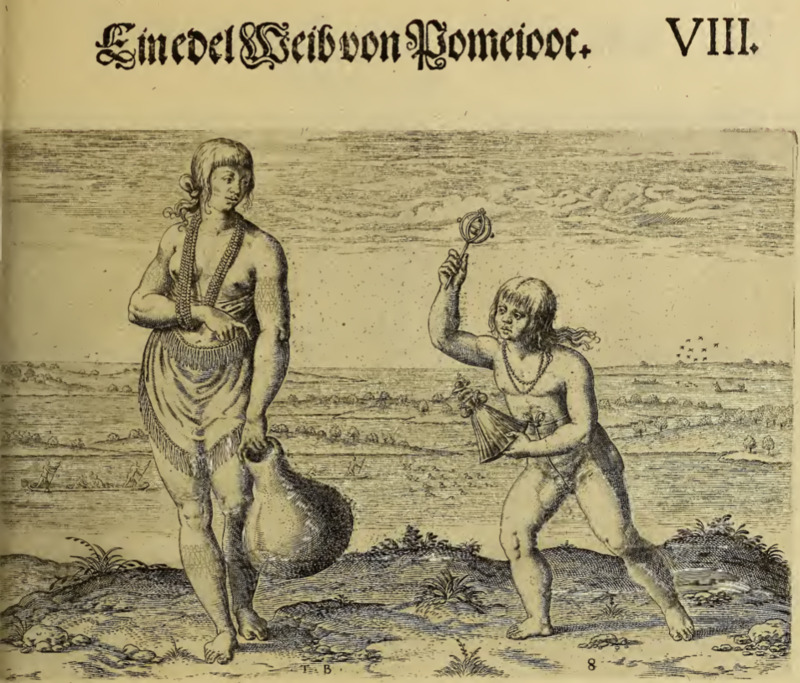
An Indigenous woman, a chief, is pictured standing on the bank of a river. Her hair is knotted at the nape of her neck, she wears several strands of beads around her neck, and her right wrist is cradled in the beads. She wears a fringed skirt around her waist and is topless and shoeless. She holds a large pot/container in her left hand. Beside her is a child, nude except for two strands of beads around their neck. The child holds a doll dressed like an English lady in one hand, and an object similar to a rattle in the other. Behind the pair, other Indigenous people are seen in canoes.
An Indigenous man has been taken captive by another Indigenous group and is about to be executed. He is restrained by a rope tied around his waist, with each end of the rope held taut. The captive wears a feathered headdress and a necklace. Another man stands beside him holding a club raised over his head, poised to swing. There is a body lying on the ground behind the man with the club. Groups of people stand on either side of the captive to watch the execution, most of the men hold bows or clubs and at least one woman has a small child in a sling against her chest. Another woman crouches beside the prisoner with her hands over her face in distress. Several structures are visible in the background. This illustration is a simplified and mirrored version of the one found on page 76 verso of Paris, 1557.
A cat is hanging upside down, holding itself on a peg in the wall with both its back legs. The cat looks to the left where a hanging line of what seems to be garlic hangs on the wall. Above the wall, three mice are looking down at the hanging cat.
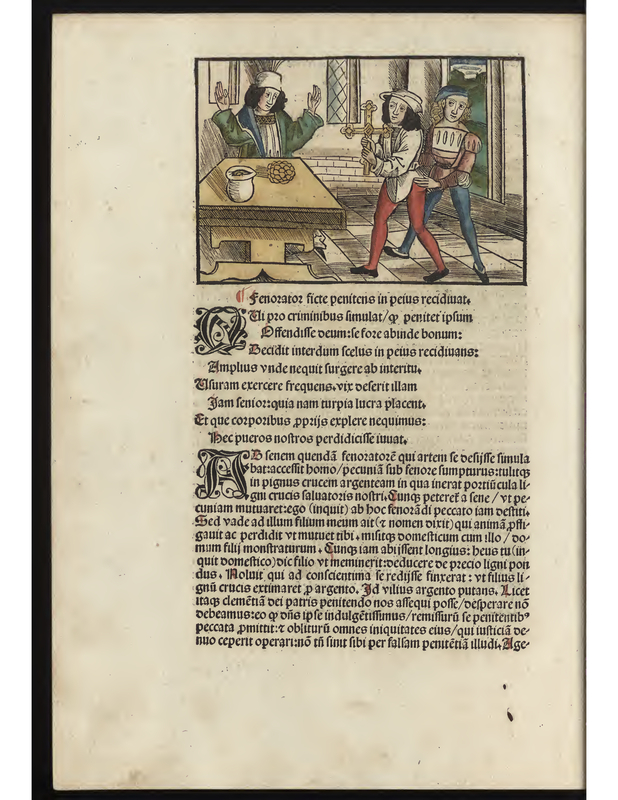
There is an illustration at the top of the page; below this illustration is a body of text. In the illustration, five men are seen at a riverside. These five men are interacting with each other. Towards the left of the illustration the two men are holding a table and conversing. Towards the center of the illustration a man is pointing towards the right and the man in front is kneeling and holding a large lamp like object at the riverside. Towards the right of the illustration a short man is putting his left index finger on his right palm.
This illumination depicts Antonia, the daughter of Mark Antony and Octavia, standing on the right side of the image wearing black as she mourns the death of her husband, Drusus. Drusus had been away on a military expedition when his older brother, Tiberius, poisoned him. Drusus is on the left side of the image dressed in his armour and military gear as he drinks the poison from the goblet in his hand. Boccaccio wrote on Antonia to praise her for her chastity and remaining a widow for her entire life following her husband’s death.
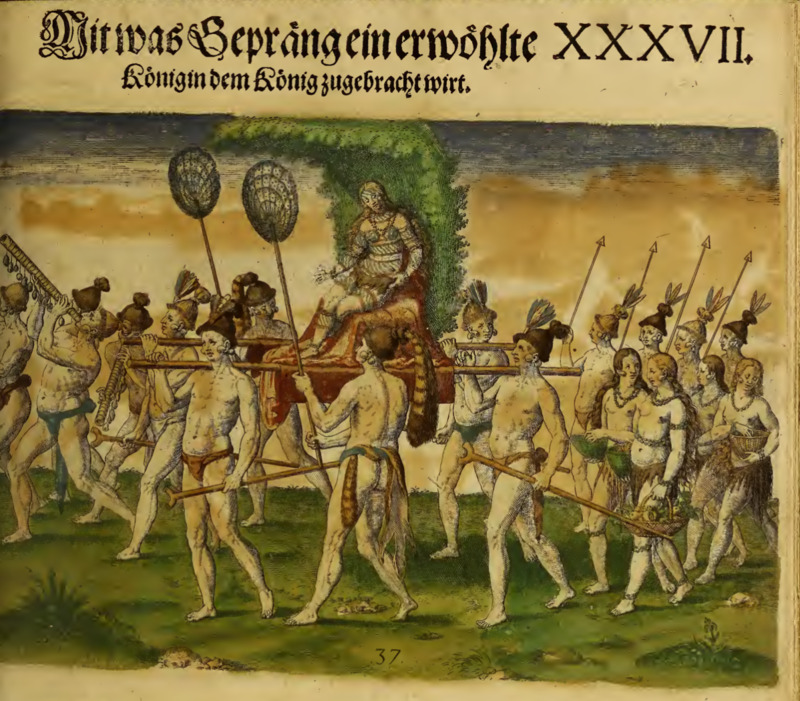
The chosen queen is carried on a litter by four men. Her body is decorated with paint or tattoos, and she wears strands of beads around her neck, arms and legs. Several men in front of the procession play large instruments, and a man walks on either side of the litter each waving a fan beside the queen. Behind the procession several women and men, the women carrying baskets and the men spears. This illustration is identical to the one found on page 117 of Frankfurt 1591, but colored.
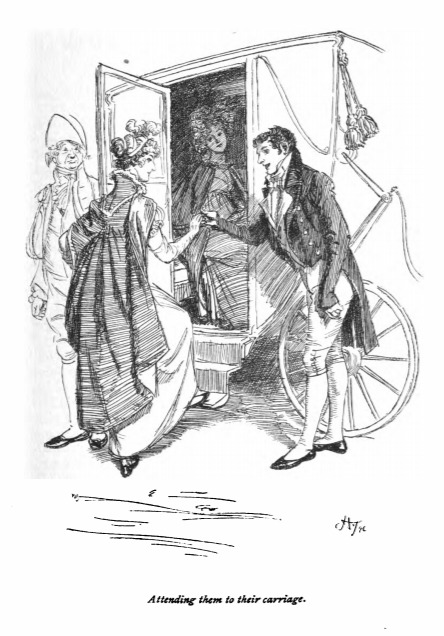
Here we see Mr. Crawford helping Maria Bertram into her carriage. Miss Mary Crawford and her brother, Mr. Henry Crawford, came to Mansfield to visit her sister, Mrs. Grant, after Dr. And Mrs. Grant moved into the Parsonage. The Bertram children, Tom, Edmund, Maria, and Julia, and their cousin, Fanny, went to dinner at the Parsonage shortly after the Crawfords arrived. In this image, Mr. Crawford helped Maria Bertram into the carriage, in which Julia Bertram is already seated. This scene occurs in chapter 5. The characters are shown in the traditional regency style. Maria and Julia wear the regency style dress with an empire waist. Mr. Crawford wears a waistcoat and tailcoat with breeches. The regency period dated to the early nineteenth century (1811-1820) when George, Prince of Wales, later George IV (r. 1820-1830), reigned as regent for his mentally ill father, King George III (r. 1760-1820). The regency period is associated with the rise of neoclassicism in art and fashion.
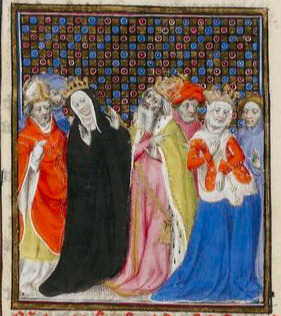
Constance was married late in her life – in her 50’s. Her chastity was broken unwillingly on her wedding night, resulting in a pregnancy. Due to her age, many people did not believe the pregnancy. When she was due to have her baby, her husband invited anyone who wanted to be a witness to come. This is represented in the image with many people standing around Constance, who is represented in a red and blue gown on the right.
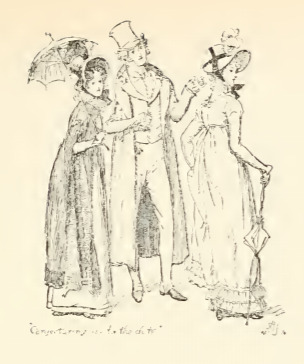
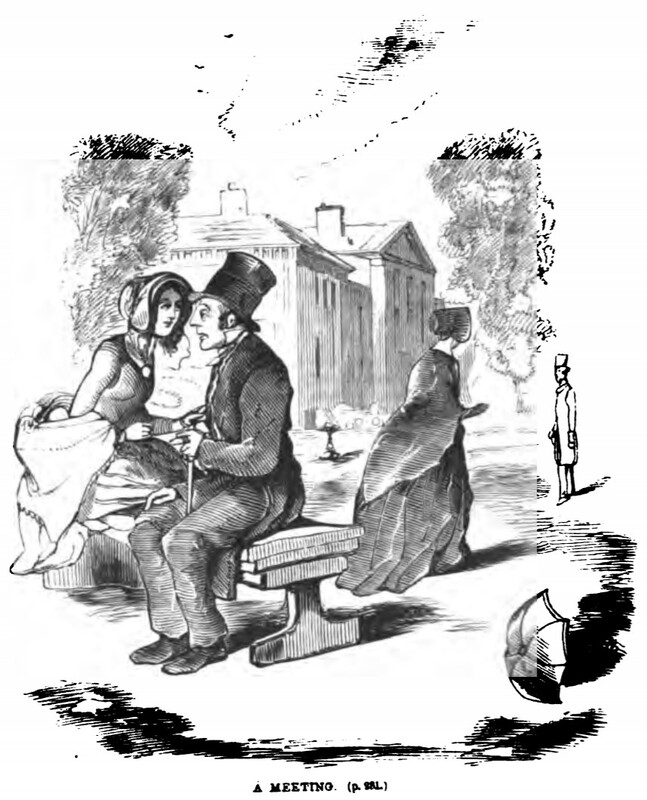
John Sedley sits on a bench in the park, holding onto his cane. Next to him is his daughter, Amelia Osborne, holding onto his arm. Mary Clapp, also in a shawl and bonnet, is standing facing away from them to point at William Dobbin, who she has brought to meet the pair. On the ground near the bench is a small parasol or umbrella. Below the illustration is printed its title and location in the story, A MEETING. (p. 281.).
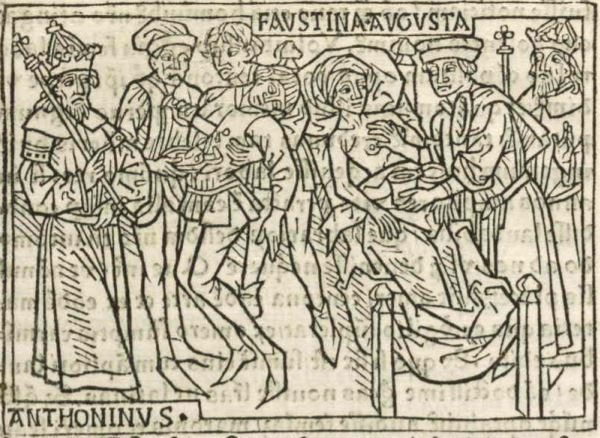
This engraving depicts Faustina Augusta, the wife of emperor Marcus Aurelius Antoninus, on the right side of the engraving lying in a bed. The creator engraved her name above her head to identify her. There is a doctor hovering over her body while rubbing an ointment over her chest to cure her illness. Her husband, Marcus Aurelius is standing behind the doctor. Faustina Augusta had fallen ill due to being passionately in love with a gladiator, and her husband Marcus Aurelius sought the help of a doctor. The doctor suggested killing the gladiator and using his blood to cure her of her sickness and overwhelming lust for him. Marcus Aurelius Antoninus is depicted on the left side of the engraving wearing a crown and holding a scepter as he watches his men kill the gladiator his wife was in love with. One of the men is holding a bowl underneath the gladiators wounds so they can use the blood to treat Faustina Augusta.
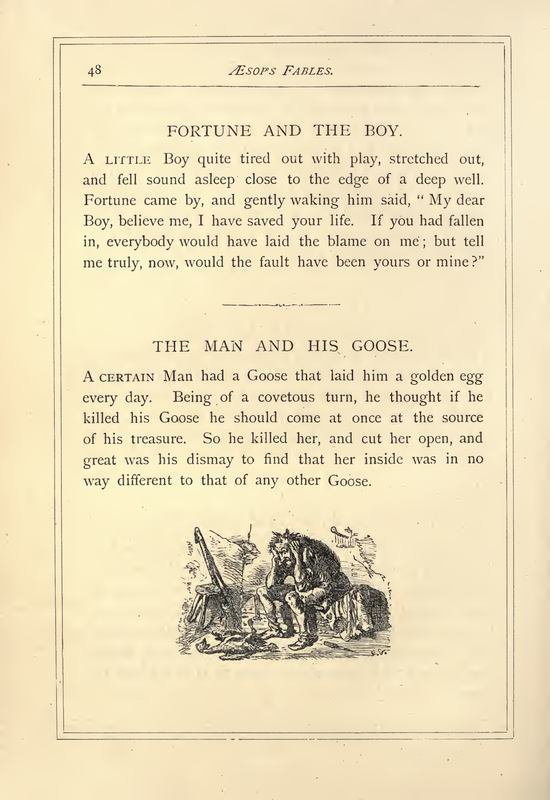
A man is sitting down, his elbows resting on his knees as his hands grip his hair. He is looking down where a goose lies lifeless on the ground on its back.
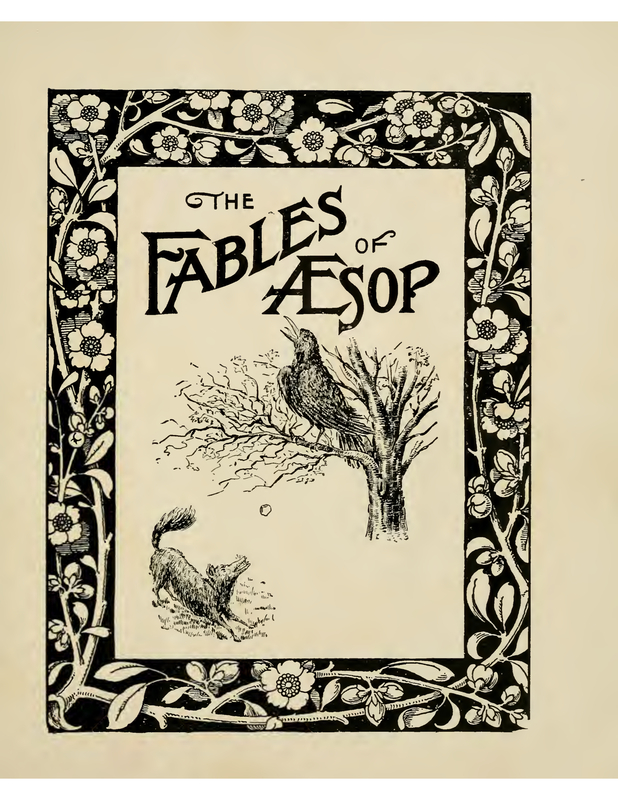
What seems to be a crow, or an eagle, is perched upon a tree. Below it is a fox which seems aggravated towards the crow. This illustration is framed with flower vines.
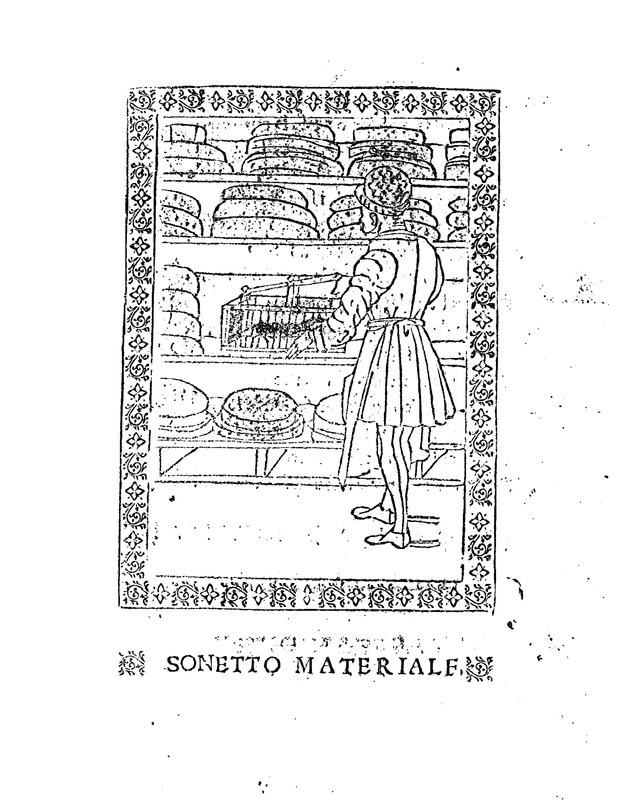
On the right of the image is a man facing backwards. He is reaching into a cage that houses a Weasel. The cage is on the middle shelf of what looks like a pantry. The image is bordered by a vine design
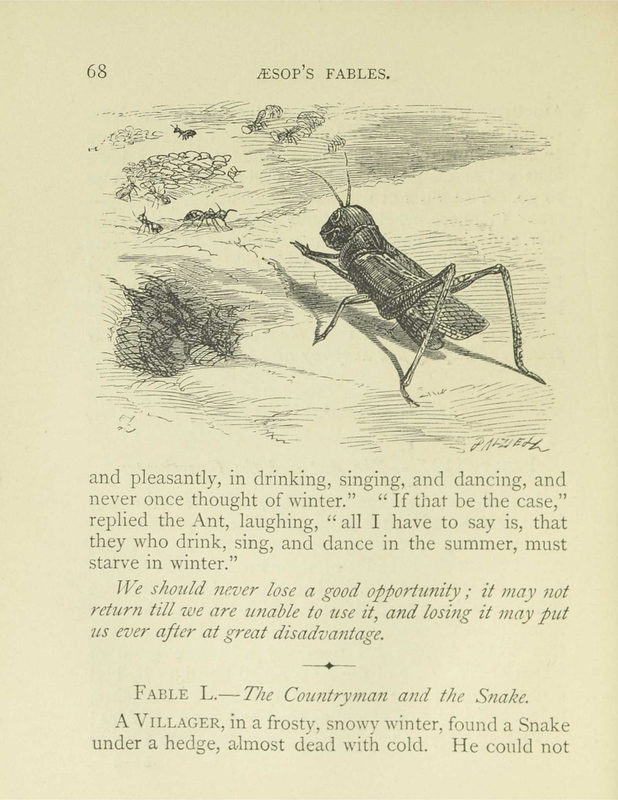
In the foreground we see a large grasshopper facing away looking at a bunch of ants in the background. The land is very empty except for the grasshopper, the ants, corn, and a small piece of foliage in the left front of the image. The ants in the back are seen scurrying and moving a bunch of corn into a large pile in the back left corner of the image.
This illumination depicts Hecuba, the queen of Troy, on the left side of the image watching her husband and children die at the hands of the Greeks. Boccaccio explains that he wrote on Hecuba to highlight her terrible misfortunes. Her husband, King Priam, is illustrated laying on the ground with wounds on his chest. He is depicted wearing a crown to identify him. One of Hecuba’s daughters is depicted sitting beside her brother’s and father’s dead bodies as she looked at the Greek soldiers behind her. Along with watching her loved ones violently die, Hecuba watched her entire city fall to the ground. The city of Troy is depicted in the background on the right side of the image.
Rawdon Crawley stands in an opera box, looking up and to the right through his opera glasses. General Tufto and Rebecca Crawley are seated on either side of him, looking at each other, with a bouquet between them.
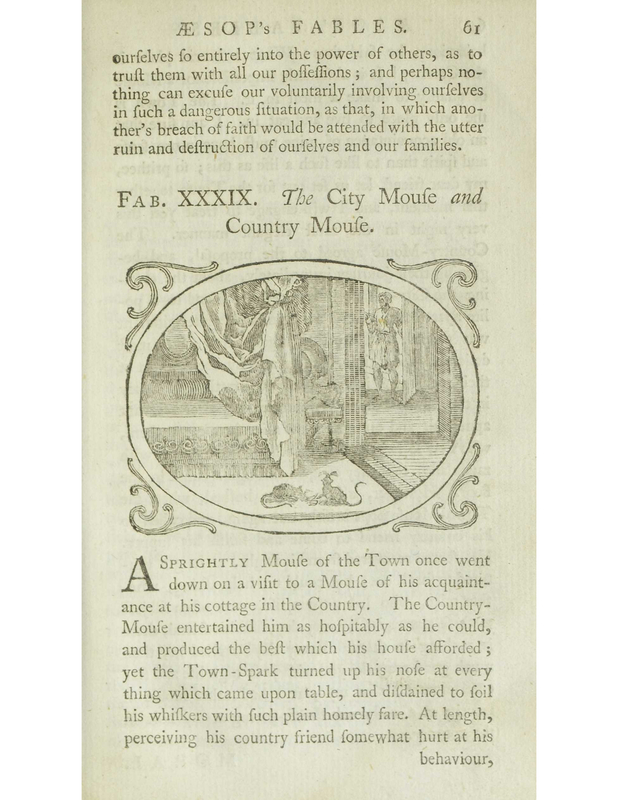
Two mice stand in the middle of the bottom part of the page, one facing down eating and the other's head up in alert. They stand under a sheet hanging from the ceiling above. A man stands in the doorway on the right side of the image.
This image is depicted in the author’s chapter where he discusses cities, towns, villages, and provinces in colonial South America. This image depicts the city of Chuquisaca in modern-day Bolivia. The city is arranged in a cluster of buildings that forms a square in the centre where people are depicted walking and riding horseback. There is a mountainous landscape illustrated in the background. There are four winding paths in front of the city. There are people depicted carrying supplies on their backs as they walk towards the city on the paths. There is also a person riding horseback off the path with a dog walking behind them. The author explains that this city was founded by the Incas but was later conquered by the Spaniards and Francisco Pizarro. The caption at the bottom of the image reads ciudad [city].
In this image Elizabeth and the Gardiners walk together through the grounds of Pemberley. On their trip to Derbyshire the Gardiners wanted to visit Mr. Darcy’s estate of Pemberley. At this time, touring stately homes was a common pastime for the upper classes on vacation. This scene occurs in chapter 43. The characters are shown in the traditional regency style. Mrs. Gardiner and Elizabeth wear dresses with empire waistlines. Mrs. Gardiner wears a shawl over her dress and both wear bonnets and carry parasols. Mr. Gardiner wears a waistcoat and tailcoat with a cravat. The regency period dated to the early nineteenth century (1811-1820) when George, Prince of Wales, later George IV (r. 1820-1830), reigned as regent for his mentally ill father, King George III (r. 1760-1820). The regency period is associated with the rise of neoclassicism in art and fashion.
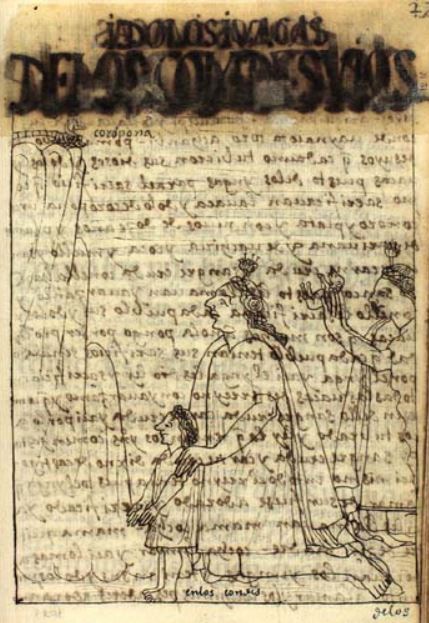
This chapter is dedicated to describing the idols and gods of the Incas. This image depicts the indigenous people of the Condesuyo region in Peru making a sacrifice to their local huaca [deity]. Their deity is depicted on top of the volcano on the left side of the image. The volcano is labeled as coropona [Coropuna]. The people at the base of the volcano are offering their sacrifices to the deity. The kneeling man is offering a twelve-year-old child as his sacrifice, while the person beside him is offering what appears to be a small animal. The caption at the bottom of the image reads en los condes [in Condesuyo].
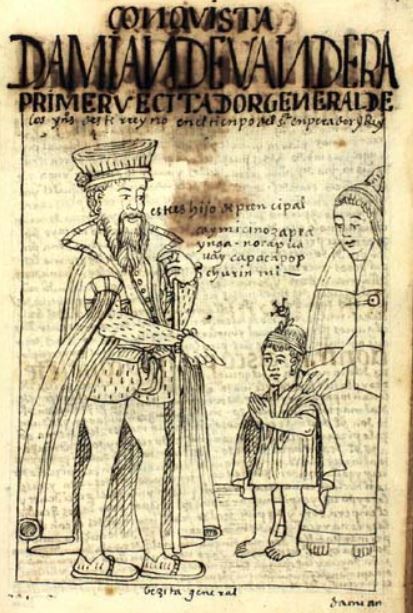
This chapter focuses on discussing the arrival of Spaniards and the Spanish conquest of Peru. This image depicts a Spaniard man wearing traditional European clothing pointing towards an Indigenous woman and her son as he inspects the kingdom. This Spaniard’s name is Damian de la Bandera, and he was the first General Inspector of the kingdom after the Spaniards conquered the Inca Empire. The General Inspector has dialogue written beside him which reads, este es hijo de prencipal [This one is a nobleman’s son]. The mother on the right side of the image replies, caymi cino zapra ynga. Nocap uauay capac apop churinmi [This one señor is the Sapra Inca. He is my own child and the son of a powerful lord]. The caption at the bottom of the image reads, bezita general [General inspection].

![[Execution of a prisoner in an Indigenous Brazilian village]](https://collections.cemvc.ca/files/large/58b3de4f172aa01bd001df1d037b4aef7a04bcf4.jpg)
![[The Cat and the Mice]](https://collections.cemvc.ca/files/large/b5c21e3fe95e76cb261dc32573bb8c6906c5d1bb.jpg)
![Vita et. Fabulae [Five men near a riverside]](https://collections.cemvc.ca/files/large/49a94e76f43bc5a95878c531b87166a39d7d616a.jpg)
![[The Widow Antonia]](https://collections.cemvc.ca/files/large/b1f0547a6c612e10be8a55809f59421739212417.jpg)
![[Vanity Fair Volume I. Chapter XXVII Inhabited Initial, W]](https://collections.cemvc.ca/files/large/99773503bd54c4e09bdbd98c90f27a5f9d2e7a86.jpg)
![[General Tufto and the Crawleys]](https://collections.cemvc.ca/files/large/c3c4ee781971ce02e1dc0bc2a0bf3f72c55a6bc4.jpg)
![La Civdad de Chvqvizaca, Audiencia Rreal y Obispado de su Juridici[o]n](https://collections.cemvc.ca/files/large/a0824c18596e85dd2096087f30edd0da6ad62f08.jpg)