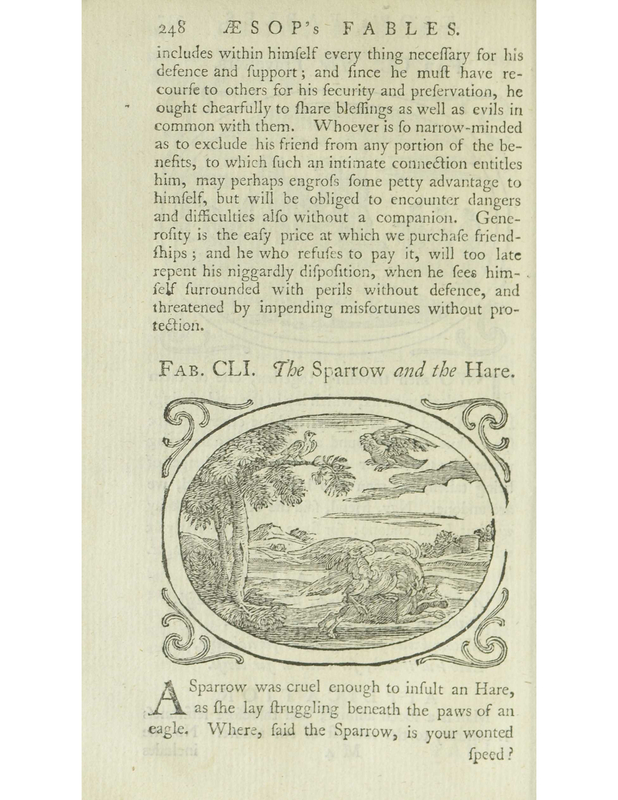
An eagle is on top of a hare, attacking them. In the background to the left, a sparrow sits in a tree, watching as another eagle flies towards them. In the background to the right there is a small farm surrounded by trees. The terrain is full of hills.
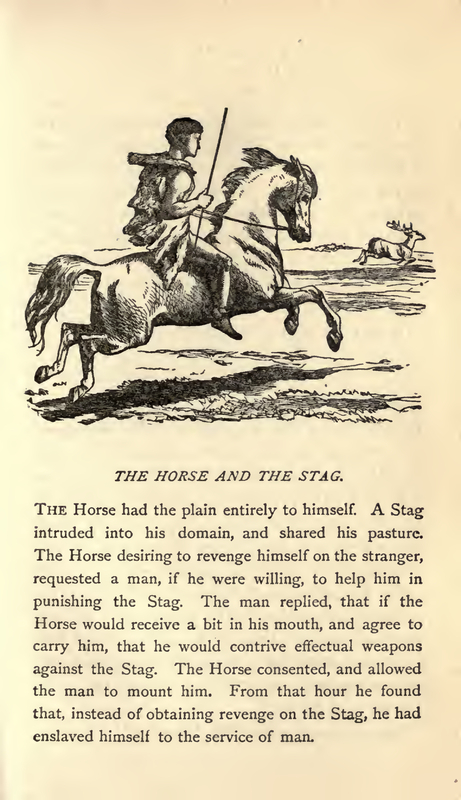
A man, a horse and a stag are on a field. The man is on top of the horse, holding what seems to be a spear in his right hand, and a rein in his left. The horse is galloping towards the stag. The stag is in the distance running away from the horse.
Here we see Gulliver participating in a military procession to boost military morale in preparation for battle with the neighbouring land of Blefuscu. The Emperor asked Gulliver to stand with his legs apart so that the army could walk underneath him, as though he were a triumphal arch, and Gulliver obliged. In the front, we see the military band, complete with drums and horns. Near Gulliver’s right foot, we see three men on horseback. The army is about to pass under Gulliver’s legs, with many men carrying either swords, spears, or bows and arrows. The procession can be seen well into the distance. The royal box with the Emperor and Empress and their page is near Gulliver’s right foot and is decorated with feathers on top of the box. Other spectators watching from stands near Gulliver’s left foot. The image comes at the point when the Lilliputians prepare for war, and Gulliver is asked to join the war effort, which he does, helping the Lilliputians to win the war. The same image appears in the 1843 Krabbe edition.
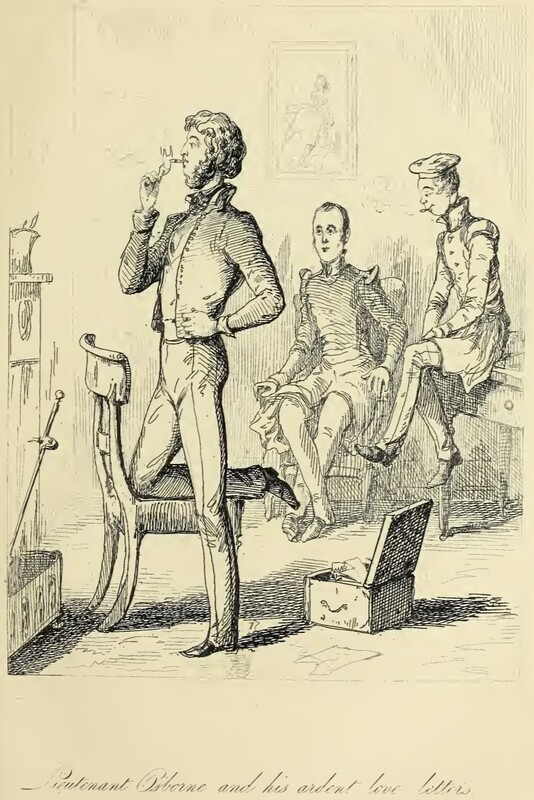
George Osborne stands facing the fireplace with one leg resting on a wooden chair, smoking a cigar which he has lit using a love letter. At the base of the chair is an open chest, filled with letters from Amelia Sedley. Two other officers are seated in the background. One is sitting on the edge of the desk, also smoking. The other is Dobbin, seated in an armchair over which a portrait of a woman hangs, looking appalled. Below the illustration is printed in cursive its title, Lieutenant Osborne and his ardent love-letters.
The right-hand three fourths of the image is inside a home. In the lower right corner is a low table with a small stool. Food lays untouched on the table with a cup and a knife. A man is standing up on the left of the stool and table. He is holding a long stick, possibly a sword or some other weapon. He is facing a dragon like creature. It is standing on its hind legs that resemble the feet of an eagle. It has horns and its wings are open. To the left of the man is a door, and on the other side of the door is a seen a man outside holding a snake-like creature. The man is bare-footed, wearing ripped trousers and a blouse. There is a leafy tree behind him in the field that he stands in.
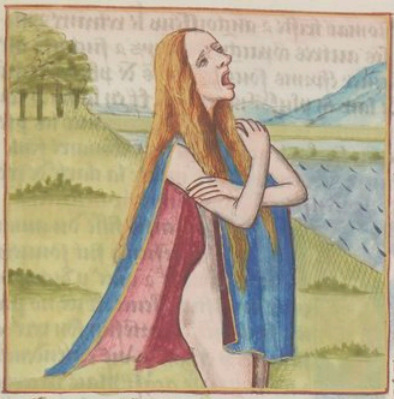
This illumination depicts Turia, a Roman woman and wife of Quintus Lucretius, wrapping her arms around her body as she expresses a look of despair. After her husband had gotten proscribed, Turia kept her husband safe within their house so that he would not have to go to war. She took care of him, and even went so far as to go out in public and pretended to have lost her husband, so that no one would suspect that he was home. This image depicts her pretending to mourn the loss of her husband.
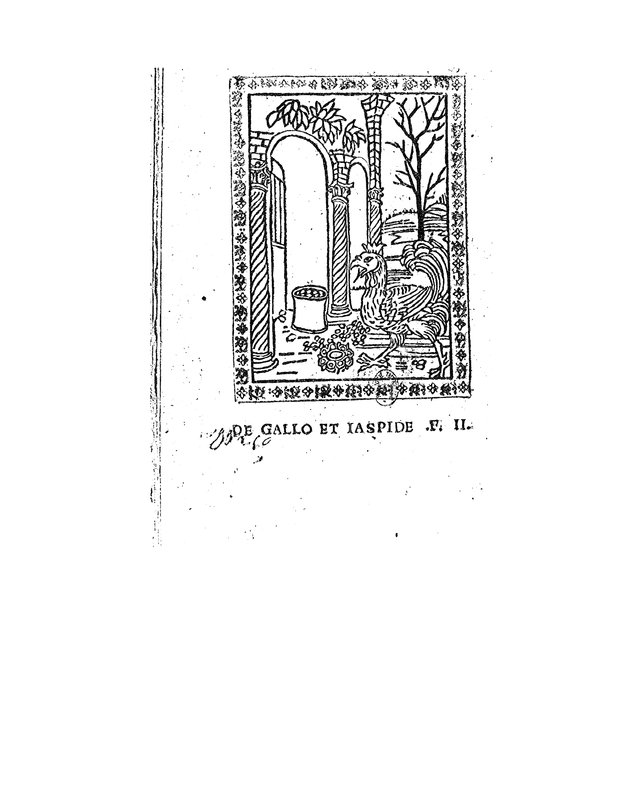
A cock who has stumbled upon a precious stone or jewl after diggin through a bag of grain. The setting seems to be on a path leading under a greek styled archway
A French ship (identifiable by the fleur de lis on the flag) sails near the coast. A European man (likely representing Staden) is in the water near the ship and appears to be pleading with the men on the ship. Along the shore several Indigenous women pick up objects (possibly shells or rocks) from the ground. The village is comprised of three long structures surrounded by a fence. A group of Indigenous people holding bows stands on the right.
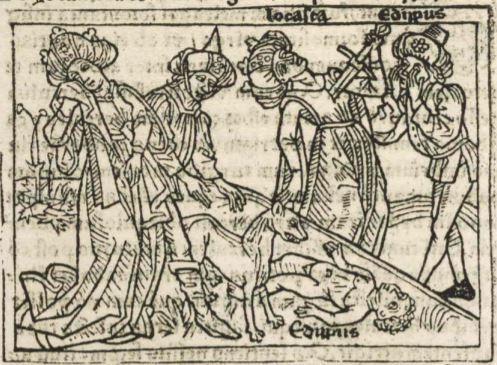
Queen Jocasta of Thebes is depicted on the left-hand side of the engraving rubbing the tears away from her eyes with a shawl. She is crying because her husband exposed their child into the wilderness due to a prophecy which foretold the baby would grow up to kill his father and marry his mother. Her child, Oedipus, is depicted lying on the ground after being exposed. There is a shepherd approaching the baby as he takes him in and raises him as his own. Oedipus’ name is engraved beside his arm. Oedipus ends up killing his father later in life, and marries his mother, Jocasta. When Jocasta and Oedipus find out they are mother and son, Oedipus gouges out his eyes and Jocasta kills herself. This scene is depicted on the right-hand side of the engraving with Jocasta and Oedipus’ names engraved above their heads to identify them.
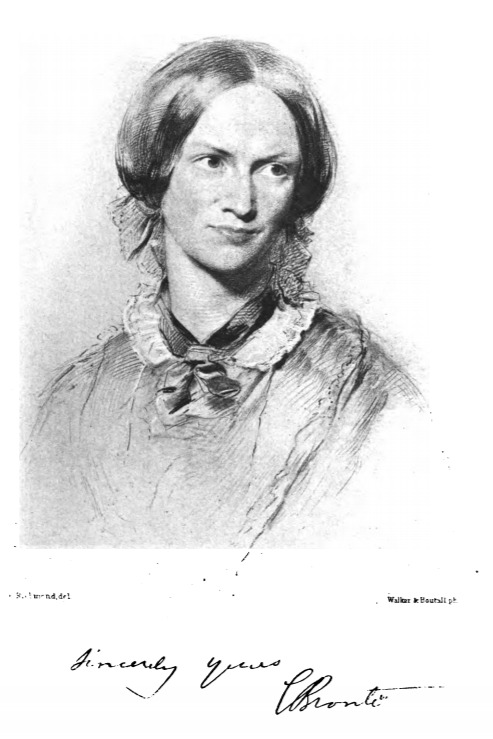
Here we see a portrait of Charlotte Bronte, with her signature underneath. The image is a reproduction of a drawing by G. Richmond. The original is in the possession of the Rev. A. B. Nicholls. The same image appears in the 1899 edition of Jane Eyre published by Harper.
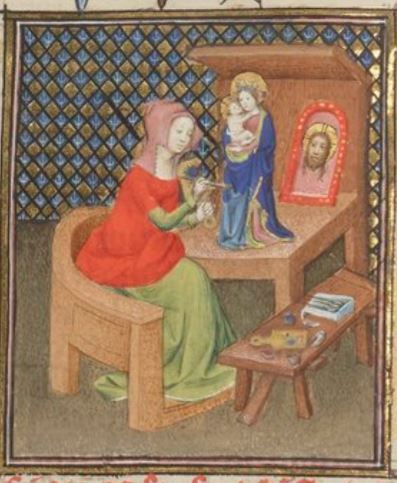
This illumination depicts a woman named Irene painting a sculpture that she created of a woman holding a child. Irene was a renowned, skillful painter during her time which Boccaccio believed to deserve praise as the arts were not a common practice of women. Boccaccio explains that Irene was the daughter of a man named Cratinus, who was also a painter (although much less renown).
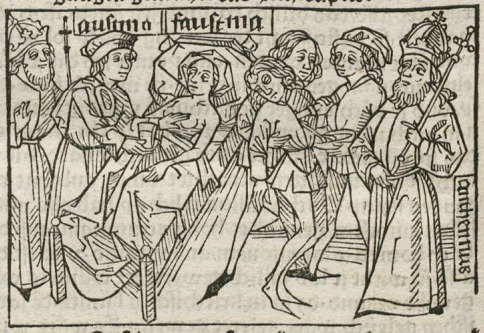
This engraving depicts Faustina Augusta, the wife of emperor Marcus Aurelius Antoninus, on the left side of the engraving lying in a bed. The creator engraved her name above her head to identify her. There is a doctor hovering over her body while rubbing an ointment over her chest to cure her illness. Her husband, Marcus Aurelius is standing behind the doctor. Faustina Augusta had fallen ill due to being passionately in love with a gladiator. The doctor suggested killing the gladiator and using his blood to cure her of her sickness and overwhelming lust for him. Marcus Aurelius Antoninus is depicted on the right side of the engraving wearing a crown and holding a scepter as he watches his men kill the gladiator his wife was in love with. One of the men is holding a bowl underneath the gladiators wounds so they can use the blood to treat Faustina Augusta.
Five figures, four men in tall hats and a woman a dark coat, sit upon a public carriage travelling from London to Queen’s Crawley. At the right of the picture, in the box, are the coachman and Sir Pitt, holding a crop. Behind them are a young man from Cambridge, who has lent one of his coats to Rebecca Sharp, who sits between him and the final man. All four men are wearing tall hats, though Sir Pitt’s is shorter than those of the others. On the left of the picture is the front of the pile of luggage stacked on the carriage roof.
When evening arrives, Celestina, Elicia, and Areusa wait for Pármeno and Sempronio to join them. Along their journey to Celestina’s house they discuss Celestina’s self-serving and deceitful ways. When they arrive, Elicia and Areusa are frustrated by their lateness. To make matters worse, Sempronio praises Melibea’s beauty and virtue, causing his lover Elicia to become jealous and infuriated. Celestina talks her down from her rage, and the four lovers share a meal while Celestina drinks her wine. Lucrecia knocks at the door and tells Celestina that Melibea wants her girdle returned. More importantly, she tells Celestina that Melibea is afflicted by an illness of the heart and has requested her presence. Thus, Lucrecia and Celestina depart for Melibea’s house.The central figure in this illustration, which is likely meant to represent Celestina, is shown wearing a veil (and likely a robe, although the table conceals this). The two figures seated on either side of her are likely meant to represent Elicia and Areusa, whereas the two figures in the foreground are likely meant to be Pármeno and Sempronio. The lack of distinct facial features makes it extremely difficult to determine who is who.The composition of this illustration is entirely distinct from any of the illustrations found in the 1580 Antwerp edition. Additionally, its production is even less careful than the other illustrations in this edition (proportions are off, facial features are indistinct, etc.). This may imply that it was an afterthought or a last-minute addition, but it may also imply that a separate artist, less experienced with engraving, was responsible for rendering this illustration.
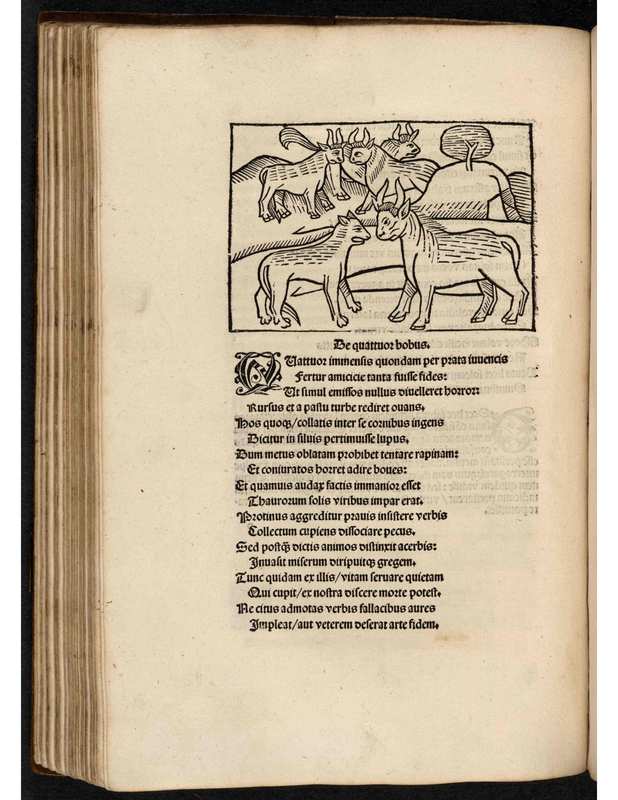
There are four oxen, and a lion in the image. Three of the oxen are on the top of the image, and one of the oxen is on the bottom of the image facing a lion. The lion and the oxen are having a face-off.
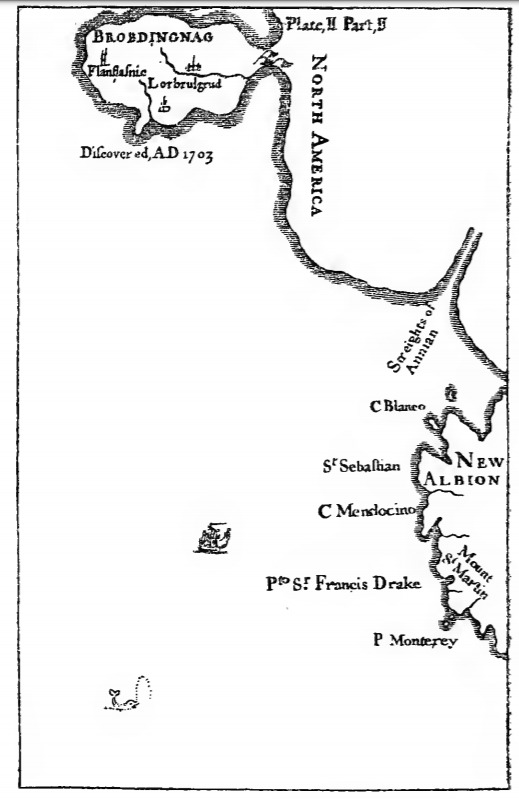
The image depicts the fictional land of Brobdingnag, off of North America. The cities of Flagnlamic and Lorbrulgrud are shown in Brobdingnag. Underneath Brobdingnag reads Discovered AD. 1703. The bottom half of the map includes New Albion. A ‘man-of-war ship is shown off the coast of New Albion, and a dolphin is near the bottom of the image. The same map is featured in several other editions of the text, including those in other languages.
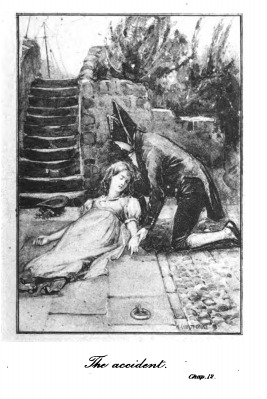
Here we see Louisa lying on the ground after having jumped down some stairs while out for a walk. Captain Wentworth cradles her head. Louisa Musgrove is Charles’ youngest sister and is very headstrong. While jumping down the stairs she hits her head on the wall and goes unconscious. Louisa jumped once and landed safely on her feet, and enjoying the experience, she jumps again, this time hitting her head. Mary and Louisa’s older sister, Henrietta are hysterical, but Anne remains calm, directing Captain Benwick to go for a doctor, and Captain Wentworth to carry her to the Inn. Captain Wentworth feels guilty for Louisa’s fall, because she only wanted to jump after seeing him do so. He confides his feelings of guilt in Anne on their way home to the Musgroves’ estate, asking her opinion on how to break the news of the accident there. He also praised her for her capability in caring for Louisa. Anne is flattered he trusted her to confide in and valued her opinion. This scene occurs in chapter 12 as noted underneath the title of this image. The characters are shown in the traditional regency style, with Captain Wentworth wearing waistcoat, tailcoat, and knickers that stopped at the knee. He also wears the traditional navy bicorn hat. Louisa wears the regency style dress with an empire waist. Her hair is worn tied up, as was tradition for women after their coming out before the queen, signaling her entrance into society. Her bonnet lies on the ground next to her. Women at this time always wore bonnets to protect their faces from the sun while out for a walk. The regency period dated to the early nineteenth century (1811-1820) when George, Prince of Wales, later George IV (r. 1820-1830), reigned as regent for his mentally ill father, King George III (r. 1760-1820). The regency period is associated with the rise of neoclassicism in art and fashion. The same image appears as an insert between pages 104 and 104 for the Dent 1893, 1894, 1895, 1896, and 1897 editions of Persuasion.
This image comes when Gulliver imagines himself as one of the immortals from Luggnag. Gulliver imagines witnessing the changes in the world such as the rise and decline of empires, seeing ancient cities, the first European contact with the other continents, and the development of medicine, among others. In this image we see Gulliver as an old man looking over the ruins of Pompeii while Mount Vesuvius smokes in the background. The tops of Roman buildings are visible sticking out of the ash and stone that covered the city. Gulliver rests his foot on the skull of one of the victims. He stands next to destroyed capitals of pillars and marble carvings. When Swift wrote the first edition of Gulliver’s Travels in 1727, excavations at Pompeii had not yet begun, however by the time of this edition in 1839, the excavations at both Pompeii and Herculaneum were well underway, and there was a growing public fascination with the ancient Roman cities. This contemporary fascination is likely why this site was chosen to illustrate Gulliver’s imaginings of witnessing major historical events, as many of the readers of the novel in the 1830s would be able to identify the site, even though Pompeii was likely not was Swift was imagining when he wrote this passage. The same image appears in the 1843 Krabbe edition.
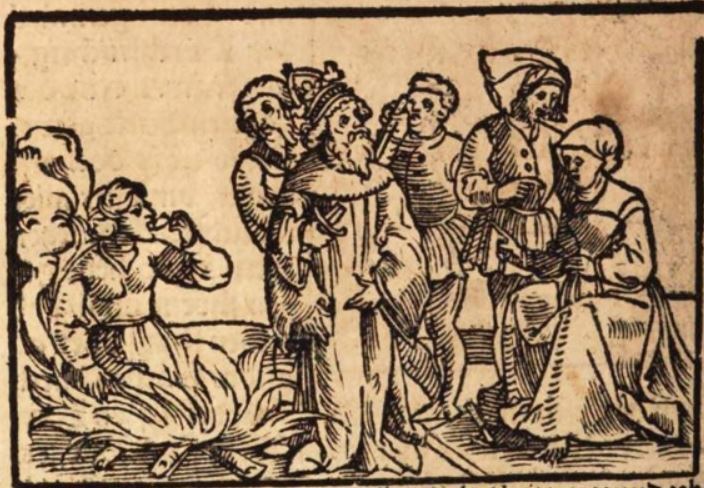
This engraving depicts three separate events. The far right of the engraving depicts a man named Brutus having a discussion with his wife Portia. Brutus is explaining the conspiracy plan to kill Julius Caesar. After hearing the murderous plan, Portia took a barber’s razor and cut herself with it. The engraving depicts the barber’s razor sticking out of her foot. She does this to prepare herself in case she has to kill herself should the conspiracy not work out in Brutus’ favour. The centre of the engraving depicts the assassination of Julius Caesar. Brutus and a man named Cassius are depicted stabbing Caesar in the chest and in the back. Brutus is eventually murdered after the assassination of Caesar, and as planned, Portia kills herself after hearing of her husband’s death. She is depicted eating burning hot coals from the fire on the left side of the image.
A man is holding very tightly onto the trunk of a tree. On top of the tree, between the leaves are a man and a woman. The man and women are kissing and look happy. The man at the bottom of the tree looks as if he is in despair.
Here we see a Lilliputian royal official reading Gulliver’s sentence of blinding via arrows publicly. This was common practice and was meant to show the leniency of the Emperor who spared Gulliver from death when he was faced with charges of treason. This can be read as an allusion to the Parliamentary Proclamation of 1715 praising George I of England’s mercy towards the Jacobites following a revolt; some of the rebels, however, were executed despite this proclamation of mercy. In this image we see an official reading from a scroll with his mouth open. He is accompanied by another official and a woman who hands out copies of the proclamation to the crowd. This proclamation would have outlined the charges against Gulliver as well as his punishment. This scene takes place in the centre of the city and we can see a fountain behind the crowd and several other buildings. The same image appears in the 1839 Krabbe edition.


![[Gulliver stands as a triumphal arch under which the Lilliputian army marches]](https://collections.cemvc.ca/files/large/fc2739906357bc71d59e08b14e21d4ede41dd2d2.jpg)
![[The Man and the Dragon]](https://collections.cemvc.ca/files/large/e20a0ad72157a358ab064c66348269e2586c1586.jpg)
![[A European ship sails along the coast of Brazil near an Indigenous village]](https://collections.cemvc.ca/files/large/81b9cde314181169f5112d5e1c245095847d8813.jpg)
![[Becky Sharp atop the Carriage]](https://collections.cemvc.ca/files/large/b3ea6ab211ffcc4d97df9f242ca4ce964640955c.jpg)
![[Act IX] Sempronio spreect tot synen ghezelle Pármeno.](https://collections.cemvc.ca/files/large/9ef2e666db349f92de30becee95469706b80c515.jpg)

![[Gulliver imagines himself as an immortal seeing the rise and fall of empires]](https://collections.cemvc.ca/files/large/09f4f3ea23fe03c16305279cf167edf47c27b936.jpg)
![[Man holding tree]](https://collections.cemvc.ca/files/large/ff957a86561431a02ab5ea47f0a4584d6124abad.jpg)
![[Gulliver's sentence is read to the public]](https://collections.cemvc.ca/files/large/1aa4afe871ff44bb60aada9510f0147edcf112ee.jpg)