Here we see Homer and Aristotle speaking with Gulliver. When asked who Gulliver wanted to speak with, he chose Homer and Aristotle as he thought these two men epitomized wit and learning. Homer is on the right and Gulliver notes that he stands taller than Aristotle, walks with straight posture, and has piercing eyes. Many think Homer was blind, however, in Swift, as in Lucian’s A True Story, Homer can see. He carries a lyre, as Homer was a poet. Aristotle is on the left and is stooped and relies on a cane. He has thin hair and a weak voice. Aristotle’s voice is weak because his words were continually misrepresented by commentators. This idea is borrowed from Dante’s Virgil in the Commedia. Homer and Aristotle appear at the head of all their commentators throughout history. Gulliver quickly discovered that neither Homer nor Aristotle had ever heard or seen their commentators. Gulliver tried to introduce the men to their commentators, however, neither of the men were interested nor receptive to them. The commentators all kept their distance from both Homer and Aristotle because they felt guilty that they had misrepresented their writings. The same image appears in the 1839 Krabbe edition.
In this image Mr. Frank Churchill looks into the Crown Inn while on a walk with Emma and Mrs. Weston. Frank Churchill was Mr. Weston's from an earlier marriage. He came to Highbury in February after Mr. And Mrs. Weston’s wedding, meeting Mrs. Weston for the first time. Emma became very fond of Frank Churchill believing she was in love with him. This scene occurs in chapter 24. The characters are shown in the traditional regency style. Emma and Mrs. Weston wear regency style dresses with empire waistlines. They wear bonnets to protect their faces from the sun and carry parasols. Mr. Frank Churchill wears a waistcoat and tailcoat with a cravat. He has a top hat and carries a walking stick. The regency period dated to the early nineteenth century (1811-1820) when George, Prince of Wales, later George IV (r. 1820-1830), reigned as regent for his mentally ill father, King George III (r. 1760-1820). The regency period is associated with the rise of neoclassicism in art and fashion.
Here Gulliver smokes a pipe while speaking with a Lilliputian. He holds the pipe in his right hand, and the Lilliputian in his left. Another Lilliputian is in Gulliver’s pocket. Gulliver’s height is shown by comparison with the door and the Lilliputians he holds. The same image appears in both the 1839 and 1843 Krabbe editions.
This image is illustrated in a chapter that discusses the Christian priests in the colonial government in Peru. This image depicts a parish priest standing in the centre of the image while he receives a blessing from the saints Peter and Paul, who are illustrated standing beside him. Saint Paul is depicted holding a sword to represent his martyrdom – he was beheaded. Saint Peter is depicted holding a key to represent his access to the kingdom of heaven and his papal authority. The author criticizes the parish priests of Peru by saying they did not act in a blessed way. Instead, they were focused on money and greed and sins of the flesh.
Celestina (rightmost figure) is pictured with a younger woman, likely Melibea (leftmost figure). The two appear to having a conversation in a bedroom (as indicated by the bed in the background). This could represent the scene in which Celestina persuades Melibea to reveal her love for Calisto, whereupon Celestina proposes that she meet with Calisto at midnight. Both figures are depicted wearing robes, and Celestina is wearing a veil. The text in the image reads Vetula cauda scorpionis in Latin. This transates to old scorpion’s tail, a foreboding allusion to the harm Celestina’s actions will cause. [This illustration is unique in this edition, since the other two illustrations make up the remaining 16 prints (eight instances of each).]
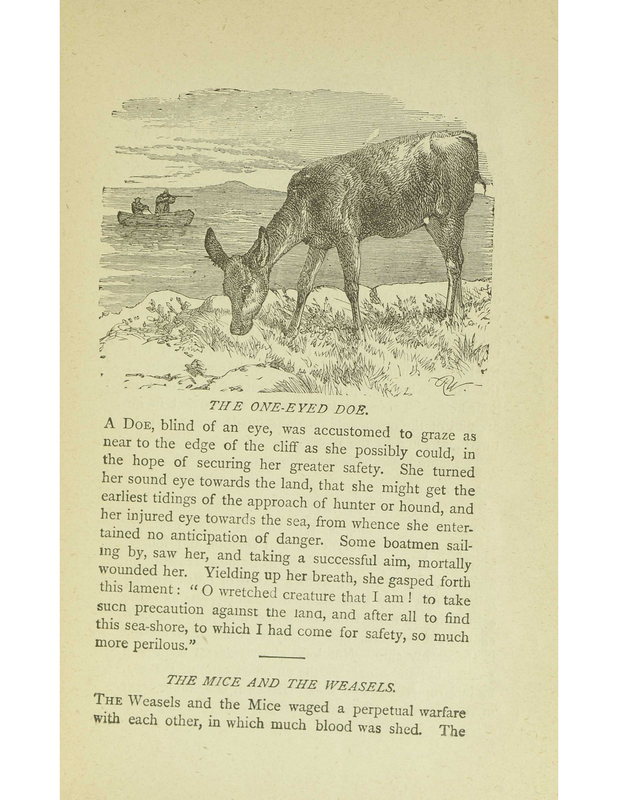
In the foreground, a small doe is eating grass. In the background, in the ocean, two men are in a small boat. The one behind the boat is rowing, while the one upfront is standing and aiming its gun towards the right-hand side of the image.
This image is illustrated in a chapter that discusses the descendants of the Inca and Andean nobles under Spanish colonial rule in Peru and their importance to a revived Andean society. After discussing powerful lords, the author discusses powerful women and wives to those lords. This image depicts a powerful woman standing in the center of the frame dressed in luxurious clothing. She is illustrated standing on a rug with frills along the edges. She has a long cloak wrapped over her shoulders and her dress has embroidery at her waist and by the feet. She is wearing earring and a necklace. She holds a hankerchief in her left hand and a rosary in her right. There is writing beside her head that identifies her as, doña juana curi ocllo, coya [Doña Juana Curi Occlo, Queen]. The caption at the bottom of the image reads, rreyna del pirú de las yndias llamada coya [Queen of Peru of the Indies].
John Sedley, slightly stooped, holds a plate. George Osborne’s valet Trotter, surprised and slightly pleased, has just taken the glass of wine which Mr. Sedley offered him. He has just brought Amelia Osborne to visit her parents.
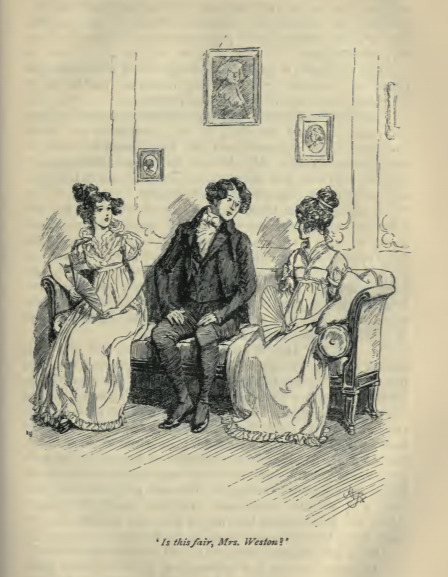
Here we see Mr. Elton sitting between Emma and Mrs. Weston at the Christmas party. Harriet was invited to the party but was ill and could not attend. Emma went to visit her that day, and upon hearing this, Mr. Elton asked Emma not to put herself in danger of getting sick herself by visiting Harriet. He then applied to Mrs. Weston to agree with him, seen here. It was at this party that Mr. Elton proposed to Emma. This scene occurs in chapter 14. The characters are shown in the traditional regency style, with Emma and Mrs. Weston wearing the regency style dress with an empire waist. Their hair is worn up as was the fashion at this time and they carry fans. A fan was often used at evening events by women to communicate with others across the room by moving or holding the fan in a specific manner. Mr. Elton wears a waistcoat and tailcoat with a cravat. The regency period dated to the early nineteenth century (1811-1820) when George, Prince of Wales, later George IV (r. 1820-1830), reigned as regent for his mentally ill father, King George III (r. 1760-1820). The regency period is associated with the rise of neoclassicism in art and fashion.
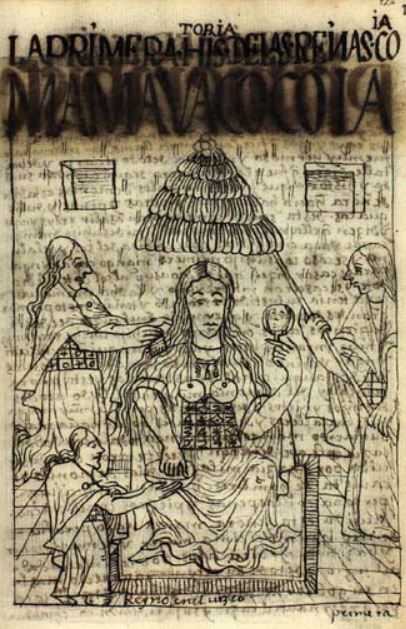
This illustration depicts Mama Waco, the first Coya [Queen] and wife of the Inca kings. She married her son Manco Capac Inca and she was well respected in their kingdom. The author describes her to be incredibly beautiful and a practicing sorceress. She is depicted sitting in the centre of the image holding a mirror in her left hand with servants surrounding her. A servant on the right side of the image is shading Mama Waco, and the servants on the left side of the image are brushing her hair and tending to her nails. The words Reyno en el Cuzco are written at the bottom of the image, which translates to She ruled in Cusco.
Joseph Sedley is asleep at the dinner table, leaning back in his chair. On the table in front of him are the remains of dinner, including his plate and cup and a decanter. He is framed in the letter O from On.
George Osborne stands, looking uncomfortable, with his hand slightly extended in greeting towards Rebecca Sharp. Miss Sharp is seated in a one-armed chair under a portrait. She is looking challengingly up at Mr. Osborne and has a single finger extended in his direction.
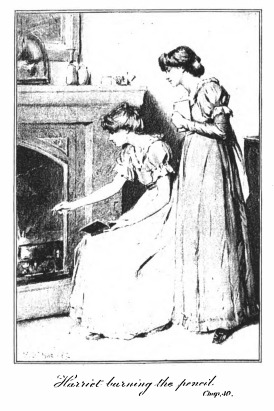
Here we see Harriet burning the nub of a pencil given to her by Mr. Elton as Emma stands behind her. Harriet fell in love with Mr. Elton with Emma’s encouragement, but he loved Emma, not Harriet. Mr. Elton proposed to Emma after a dinner party at the Weston’s house, Randalls, but she refused. Mr. Elton then went away, and married a woman he met in Bath. Harriet then came to visit Emma and brought with her a box of mementos of Mr. Elton. In this box was the nub of a pencil and a piece of unused gauze from a bandage. She then threw them into the fire as a means of catharsis. In this image, Harriet sits in front of the fire, throwing the pencil into the fire as Emma stands behind her looking into the fire. This scene occurs in chapter 40 as noted underneath the title of this image. The characters are shown in the traditional regency style, with Emma and Harriet wearing the regency style dress with an empire waist. Their hair is worn tied up, as was tradition for women after their coming out before the queen, signaling her entrance into society. The regency period dated to the early nineteenth century (1811-1820) when George, Prince of Wales, later George IV (r. 1820-1830), reigned as regent for his mentally ill father, King George III (r. 1760-1820). The Prince of Wales was a fan of Austen’s work, and she dedicates the novel to him. The regency period is associated with the rise of neoclassicism in art and fashion. The same image appears as the frontispiece for the Dent 1893, 1894, 1895, 1896, and 1897 editions of Emma.
This illustration is interesting, since it is not specified in the narrative that Pleberio (leftmost figure) takes Alisa (central figure, leaning over Melibea) outside to see Melibea’s body, although he does tell her to look at it. It is just as likely that he is asking her to look through the window in their bedchamber. The rightmost figure almost certainly represents Lucrecia, who witnessed the preceding series of events.
Rebecca Sharp is seated on the arm of a chair in the great hall, looking at a large painting of a woman. It is hung on the wall between paintings of other Crawley ancestors. To the left a cabinet, and to the right an armless chair.
Two men are on a bridge having a passionate conversation. They are at the end of the bridge next to an opening to a building. Beyond the bridge we can see that they are in very mountainous land.
In this image we see Gulliver whittling a tree that he cut down to use as a mast for his boat. He was given supplies to refurbish the boat that he found so he could return home. Here we see Gulliver holding a tree under his arm, with the leaves and branches still attached at one end. He whittles one end to use in his boat, likely for a mast. He whittles the tree with a small handheld knife. In the bottom right, two more Blefuscudians cut down another tree, and behind Gulliver two more walk carrying a long plank. Gulliver’s hat is on the ground behind him. The same image appears in the 1839 Krabbe edition.
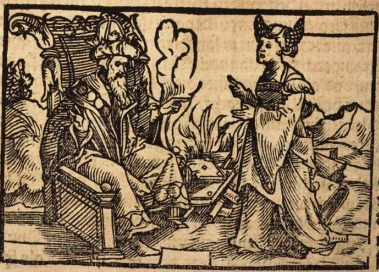
This engraving depicts the sibyl, Amalthea (also known as Deiphobe), burning 3 books in a fire in front of Tarquinius Priscus. Amalthea brought 9 books for King Tarquinius Priscus, and when he failed to pay her the full price for them, she burned 3 books at a time until he paid her in full. These books had the prophecies of Amalthea written in them, which outlined the entire course of the Roman people’s lives and events.
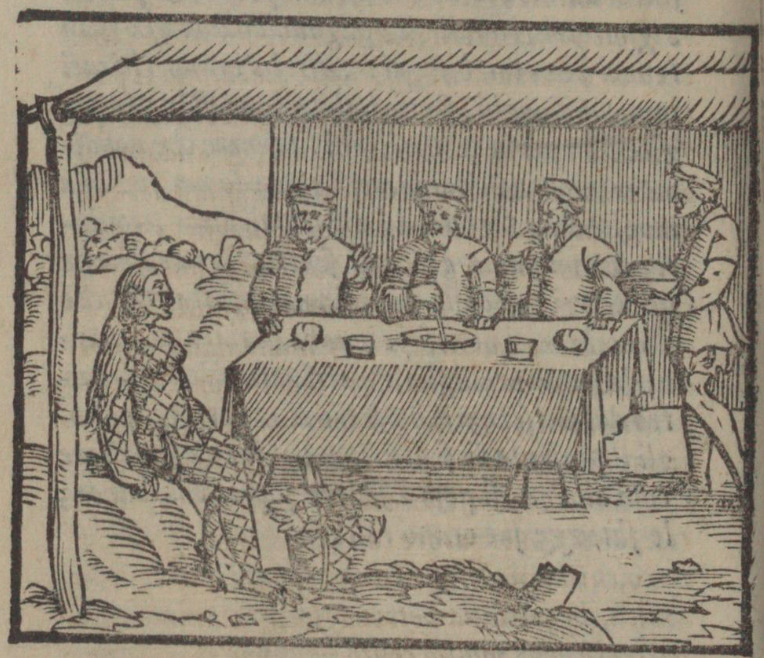
An Indigenous woman with long hair, a ring through her nose and heavy earrings sits on a cluster of rocks under a man-made overhang. At her feet she has a basket of fruit that she has brought for four European men, who sit and stand around a nearby table to eat. The woman’s body is covered in a crosshatch pattern, possibly tattooed or painted on. This image is identical to one found on page 3 verso of Venice, 1565.
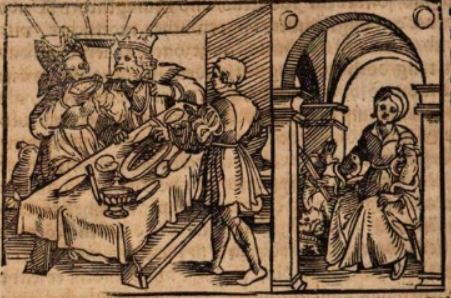
This engraving depicts two separate scenes. The left side of the engraving depicts Queen Cleopatra of Egypt sitting at a dinner table with her husband Antony beside her. Cleopatra had very expensive tastes and demanded a feast which would cost an outrageous amount of money. When Antony did not provide the entire feast Cleopatra demanded, she took out one of her pearl earrings and dissolved it in her drink and drank it to get the luxuriousness she desired. Cleopatra is depicted drinking the pearl in this image. There is a third figure in this scene, which is a man named Lucius Plautus. He was called to be a judge of the feast. The right side of the engraving depicts the suicide of Antony. After realizing the forces of Octavian were on their way to destroy them, Antony plunged his sword into his chest, as depicted in the engraving. Cleopatra is depicted kneeling over his body before she kills herself as well.

![[Gulliver speaks with Homer and Aristotle]](https://collections.cemvc.ca/files/large/19e5171b6df0ef20e2a67aba3be854603012b3be.jpg)
![[Vanity Fair Vol. I. Chapter III Historiated Initial, A]](https://collections.cemvc.ca/files/large/ed45419ca02ef4773ba3ff53f6472df3ba7ecca5.jpg)

![[Gulliver smokes a pipe while speaking with a Lilliputian]](https://collections.cemvc.ca/files/large/b088ac1caa752ca9fd2af31c96568bc488c3c29c.jpg)
![Capitvlo Primero de P[adres], Cristianicimo P[adre]](https://collections.cemvc.ca/files/large/2c9e8cfe7a170aa10c37789089044e2c2d33fbde.jpg)
![[Title Page – Celestina and Melibea]](https://collections.cemvc.ca/files/large/fbdfa3eaa77a49677bac119711ff867fbcbc00dc.jpg)
![S[eno]ras Principalas, Capac Apo Mama Poma Valca, Que Son Muger de Principales y Segundas](https://collections.cemvc.ca/files/large/468a8c647f570fadf4f5947824e2a00a8e8da985.jpg)
![[Mr. Sedley’s Courtesy]](https://collections.cemvc.ca/files/large/7bbd7a53b55ad468f428bf4d13037e27d2974310.jpg)

![[Vanity Fair Vol. II Chapter XXVI Historiated Initial]](https://collections.cemvc.ca/files/large/b670a6deda6a25e08788546996de32a232a40b67.jpg)
![[George and Rebecca]](https://collections.cemvc.ca/files/large/1fc22f0a5e34500809b0b6340b948e993e929a6a.jpg)
![[Act XXI (Second Illustration) – Alisa, Pleberio, and Lucrecia Mourning the Loss of Melibea]](https://collections.cemvc.ca/files/large/a90fa153f754fa3908241a587462ef95ee37f66e.jpg)
![[The Great Hall at Queen’s Crawley]](https://collections.cemvc.ca/files/large/a72565412dc083021b9ad9f4b7d98b8db61172ad.jpg)
![[Men on bridge]](https://collections.cemvc.ca/files/large/614a1803e5275630cab5a46f0868b5bfccb0fd6e.jpg)
![[Gulliver whittles a tree to use in his boat]](https://collections.cemvc.ca/files/large/74be6df1382ff1110348b90d775127011cace73e.jpg)