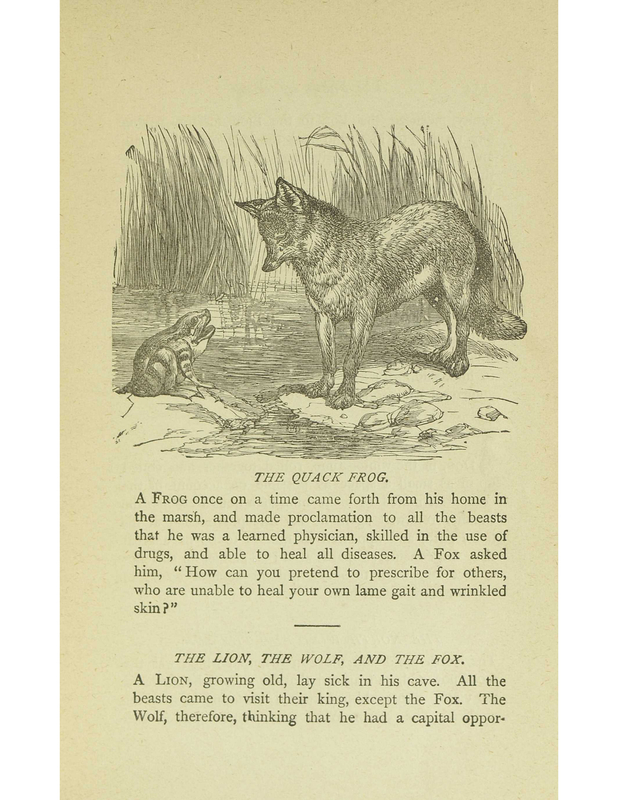
A frog is sitting down on a small patch of land in a small lake. In front of the frog, a fox stands on the other piece of land. The frog and the fox are close but separated by a short trail of water from the lake. The frog is looking up at the fox with its mouth open. The fox looks down at the frog, intrigued. Behind them, tall grass grows in the lake.
This image shows El Cid fighting off an enemy. The enemy is most likely a Muslim soldier. The soldier is wearing a turban over his head and he is carrying a shield and a sword. He is wearing armour and he is pointing his sword at the man on the horse. The man on the horse is El Cid. He is wearing armour and a helmet with plumes on it. HE is carrying a sabre and a shield. On the left side a tree is visible and on the right side the tower of a castle wall is visible. On the wall there is a flag hoisted up.
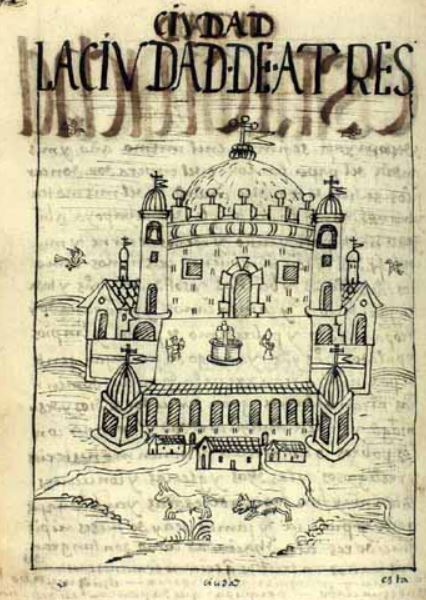
This image is depicted in the author’s chapter where he discusses cities, towns, villages, and provinces in colonial South America. This image depicts the city of Atres. The author describes it to be a city with a good supply of food, wine, and bread. The city, according to the author, was conquered by the Spaniards Captain Aluarado and Sebastián de Balcázar. The image depicts a large fortification of buildings that make up a square that has a fountain in the centre. There are two people depicted approaching the fountain. Outside of the city walls, there are three houses situated at the front. There are birds flying above the city and dogs running in the fields outside of the city walls. The caption at the bottom of the image reads, ciudad [city].
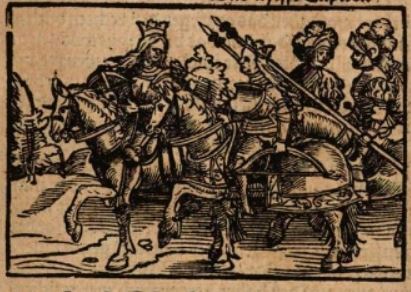
This engraving depicts the queens of the Amazons, Martesia (also called Marpesia) and Lampedo. The Amazons, as described by Boccaccio, were a group of widows who decided to take up arms and fight to avenge their husbands’ deaths. They began dedicating their lives to training in riding horse-back, archery, and other military skills. The Amazons elected Lampedo and Martesia to be their queens. Lampedo and Martesia are depicted on horseback in this engraving, while wearing crowns and holding weapons in their hands as they lead a group of Amazon women behind them. Boccaccio believes them to be praiseworthy as they were wonderful leaders.
Here we see Gulliver’s crew chaining him to his bed after they mutinied. Many of his crew died of fever, and Gulliver recruited more men from Barbados. These men then mutinied and chained Gulliver to his bed. They rushed into his room, threatening to throw him overboard if he did not cooperate. Gulliver swore to submit, then they chained him to his bed, and placed a guard at his door. At the first sight of land, the crew dropped Gulliver on land, and left him. In this image we see a man putting a chain around Gulliver’s ankle, while another looks on. The same image appears in the 1839 Krabbe edition.
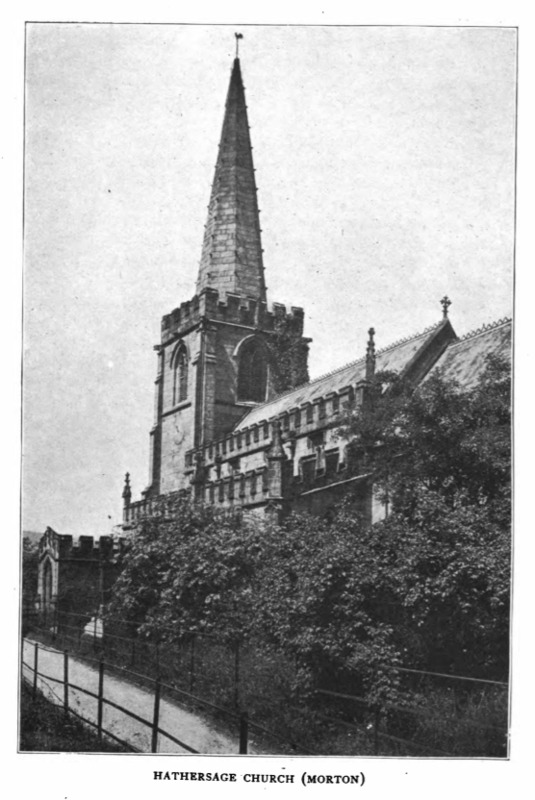
Here we see an image of the church in Hathersage, a village in Derbyshire. This church is supposedly that on which Morton Church – where Jane sought refuge after running away from Thornfield – was based. The same image appears in the 1899 Harper edition of Jane Eyre.
The Roman woman Paulina is depicted on the right side of the engraving as she kneels in prayer. She is looking up at the statue of the Egyptian god Anubis. Paulina’s name is engraved above her head at the top of the image to identify her. The statue of Anubis is sitting on a tall platform, with the name Anubis engraved on the platform. Paulina was an incredibly devout and chaste woman and was completely faithful to her husband. A man named Mundus had fallen in love with Paulina due to her overwhelming beauty, and when she continuously rejected his advances, he devised a plan to have her as his own. Mundus is depicted in the centre of the engraving handing a bag of money to a priest. Mundus bribed the priest of the temple to invite Paulina to sleep at the temple to have an encounter with the god Anubis in her sleep. Paulina stayed at the temple, expecting to have an experience with Anubis, however, Mundus came to Paulina in her sleep and pretended to be the god and convinced her to have intercourse with him. This is depicted on the left side of the engraving. Paulina and Mundus (disguised as Anubis) are illustrated in bed together after having intercourse. Paulina is famous for having been tricked into losing her virtue and chastity. Mundus ended up being exiled, and the priest was tortured for his involvement in the deception.
In this image we see a satire of the English legal system. We see a lawyer holding a sign saying ‘black’ and ‘white’, a representation of how lawyers viewed the law. The lawyer is speaking to sheep, representing the people confused by lawyers.
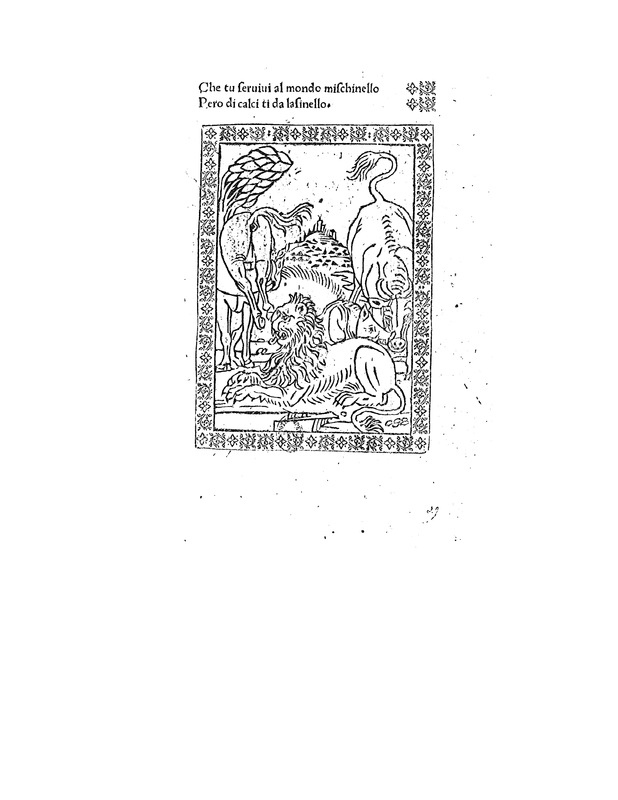
A lion who looks in pain and distressed is lying in the middle. On the left there is a donkey about to kick the lion. On the right there is a bull lowering itself seemingly also getting ready to ram the lion. Just behind the lion a boar can be seen.
A Tupinambá village is shown. Four canoes are anchored along the shore and a group of Indigenous people, some holding bows, moves towards the canoes. One person on the left kneels on the ground to light a fire while another person observes holding a bow. Another group of individuals sits on the ground in a circle near the shore. There are two wooden frames set up over fires, one frame holds roasting fish and the other holds human limbs. There are two individuals lounging in hammocks near the fires and on the left there are three long structures.
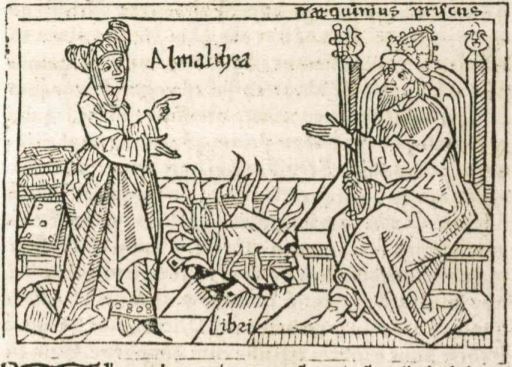
This engraving depicts the sibyl, Amalthea, burning three books in a fire in front of Tarquinius Priscus. We know that these figures are indeed Amalthea and Tarquinius Priscus as their names are engraved beside and above their bodies to identify them. Amalthea, as explained by Boccaccio, brought nine books for Tarquinius Priscus, and when he failed to pay her the full price, she burned three books at a time until he paid her. The word Libri is engraved below the fire, which translates to books in English.
In a field, surrounded by trees, is a wolf and a crane. The wolf is sitting on the left side of the image, and the crane is standing in front of it on the right side of the image. The crane has its beak inside the wolfs mouth. In the background is a castle/town, trees, and birds. On the right-hand side of the image is a rock cliff.
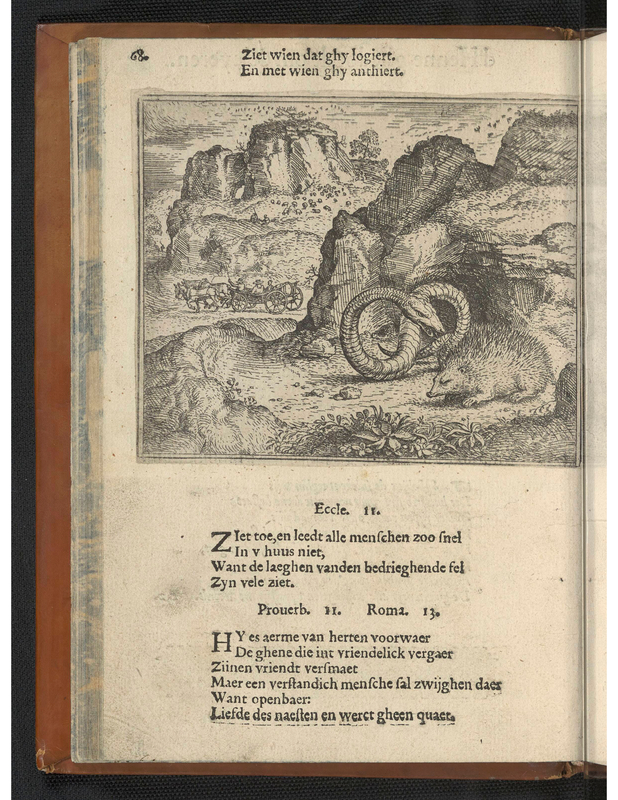
On a rock face, a snake looks at a hedgehog. A road runs between the rock face with the animals and a second in the background. On the road is a wagon drawn by horses.
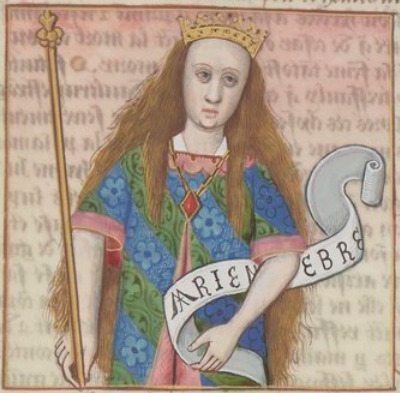
This illumination depicts a portrait of Mariamne, the queen of Judaea. She is illustrated wearing a crown and holding a scepter in her right hand and parchment with her left arm. Mariamne was renowned for her incredible beauty, and for having been the wife of the jealous King Herod. Boccaccio explains that King Herod was so jealous and protective of Mariamne, that he did not want her to outlive him. He devised a plan for someone to murder Mariamne if he were to die before her, so that no one else could have her.
In this image we see Gulliver walking along the main street of Mildendo – the capital city of Lilliput. This image is shown at the beginning of chapter four, in which Gulliver visits the city for the first time. Gulliver’s height is emphasized in this image, however the city itself resembles a European walled city during the eighteenth century. In the foreground we see a guard working at the gate, which also serves as a bridge for carriages. A horse drawn carriage is going across the top of the wall. Flags fly from both turrets of the walls. The street is lined with buildings, likely shops with apartments on the upper floors. Behind Gulliver, we see another arch. Gulliver walks down the middle of the street, with sidewalks on either side of the road. The same image appears in the 1843 Krabbe edition.
Celestina (upper figure) informs Melibea (lower figure) that she can only be cured if she reveals her love for Calisto, which causes Melibea to experience intense emotions and faint. Upon waking, she finally acknowledges her love for Calisto. Celestina tells her that she will be cured if she meets with Calisto at midnight, and Melibea agrees. As Celestina departs for home, she encounters Melibea’s mother Alisa, who asks her the purpose of her visit. Alisa asks Melibea the same question, and when the two answers differ, she warns Melibea to avoid Celestina.
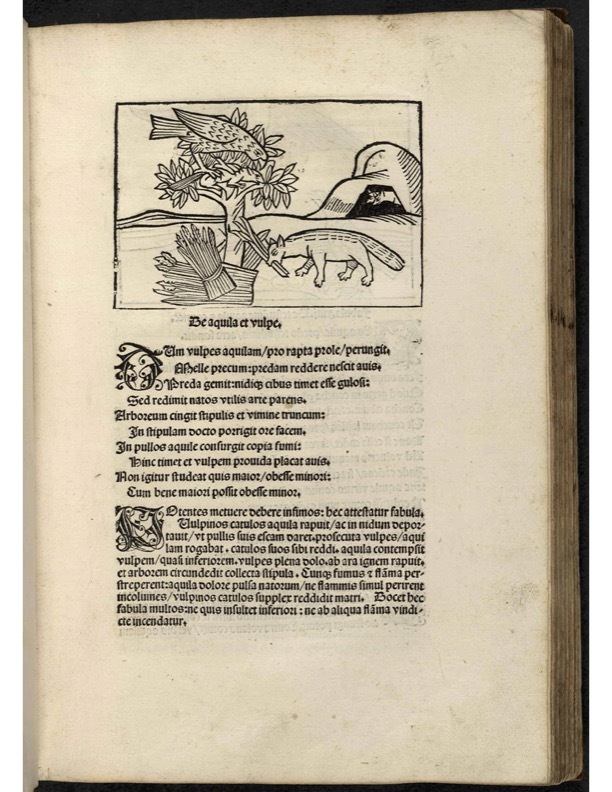
In a tree an eagle holds a fox pup in its talons. At the base of the tree a fox is stacking piles of sticks. in the background we see a fox den with two foxes peeking out.
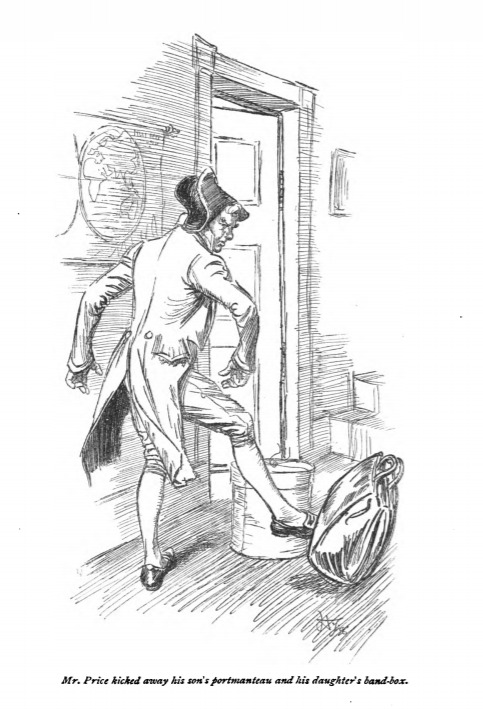
Here we see Mr. Price, Fanny and William’s father, kicking their luggage after their arrival in Portsmouth. Mr. Price was a retired naval officer, who was frequently drunk. Fanny’s first impression of her father after her eight-year absence at Mansfield was his short temper. This scene occurs in chapter 38. The characters are shown in the traditional regency style. Mr. Price wears a tailcoat with breeches and a bicorn hat. The regency period dated to the early nineteenth century (1811-1820) when George, Prince of Wales, later George IV (r. 1820-1830), reigned as regent for his mentally ill father, King George III (r. 1760-1820). The regency period is associated with the rise of neoclassicism in art and fashion.
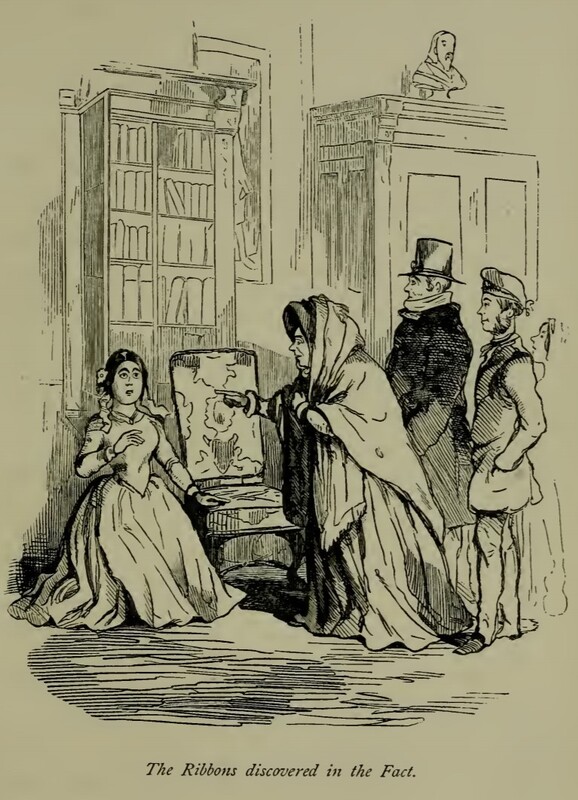
Miss Betsy Horrocks, with large ribbons in her hair, kneels in shock next to a chair in Sir Pitt Crawley’s study. Mrs. Martha Crawley, who has just caught Miss Horrocks trying a stolen set of keys on the locked drawers in the room, points an accusing finger at her. Behind her are Reverend Bute Crawley, her husband, and James Crawley, their son, who have both also witness the robbery. Below the illustration is printed in cursive its title, The Ribbons discovered in the Fact.
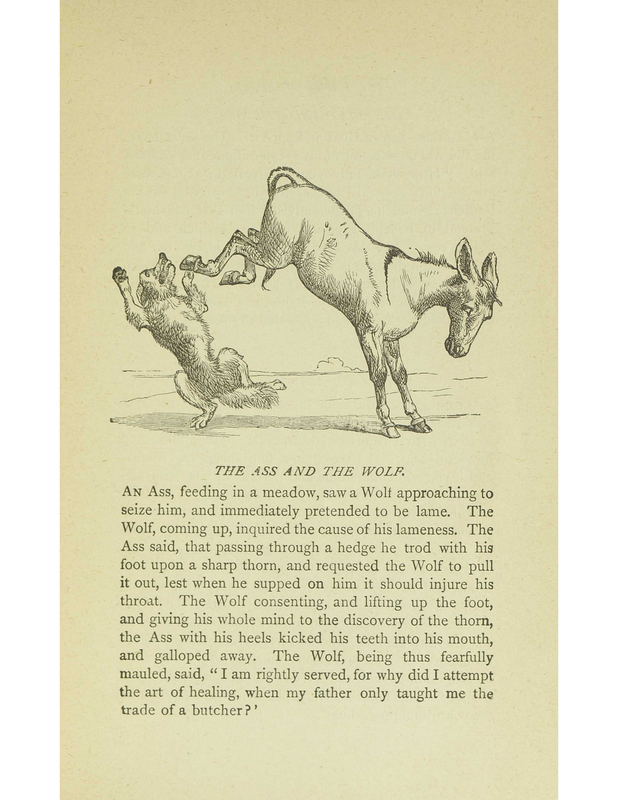
On the right side of the image, an ass is bracing itself on its front legs as it kicks back with its hind ones. Behind the ass is a wolf. With the impact from the ass’s kick, the wolf is thrown back. The wolf stands on one hind leg, and its two front legs are up next to its head as it falls back.
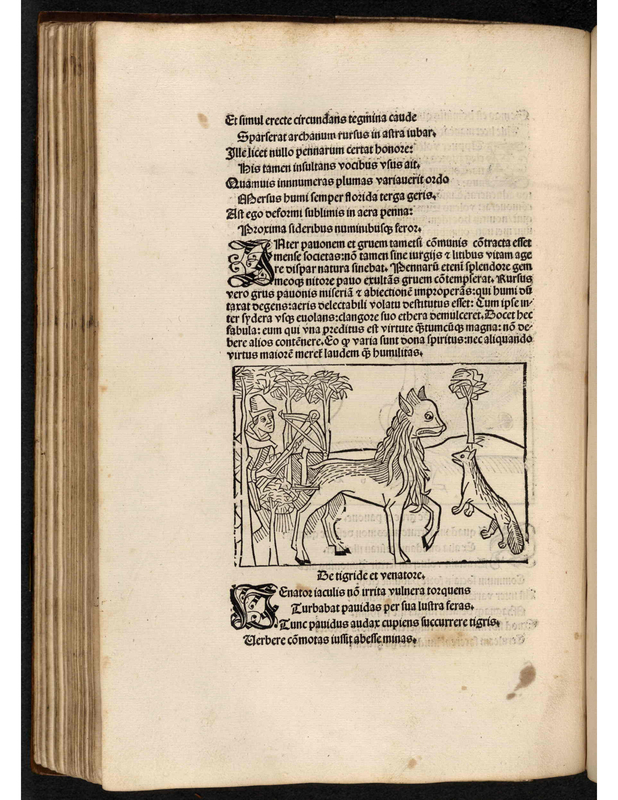
A man on the left side of the image is holding a crossbow in the forest and has shot a tiger in the leg. On the right side of the image, there is a fox facing the tiger.
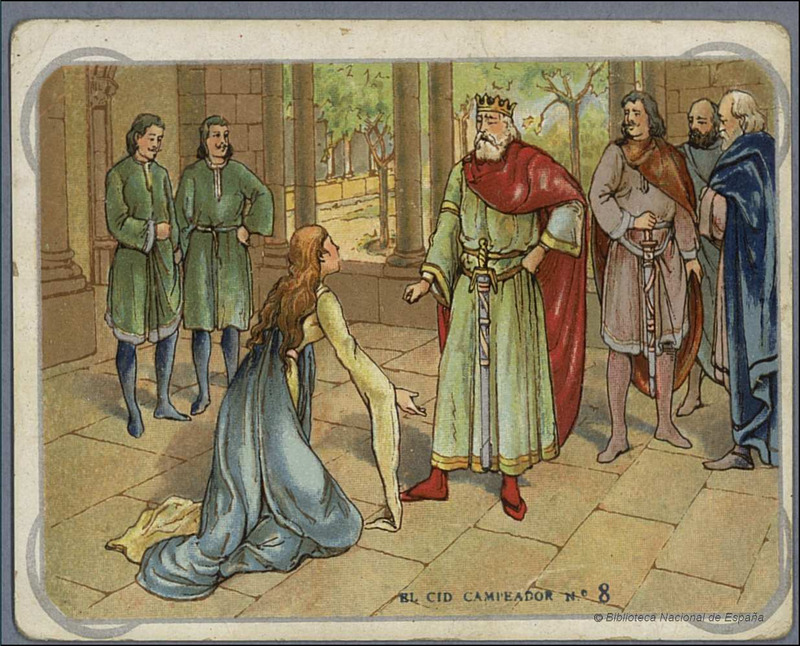
In this image Jimena is kneeling in front of the king. The king is wearing a red cloak with green robes. He has, at his waist, a gold hilted sword sheathed. He has a white beard and is wearing a golden crown. Jimena who is kneeling in front of him is wearing a blue and beige dress with her blond hair flowing on her back. She has a hand out in protestation. To the left of the image there are two men both dressed in green with brown hair and moustaches. On the far right of the image there are three men. The one closest to the king is wearing a mauve tunic with a brown cloak. At his waist there is a sword sheathed. The man with little hair behind the man with the mauve tunic is wearing blue robes. The man with the white hair and beard is wearing a mauve tunic with a blue cloak. They all appear to be in a hallway of a castle as a courtyard is visible through the arched windows. There are trees and shrubbery outside.


![[Vanity Fair Vol. II Chapter XLIII Inhabited Initial]](https://collections.cemvc.ca/files/large/365f7d11637afba35cb53c47759986383cd20c0a.jpg)
![[The Cid fighting an enemy]](https://collections.cemvc.ca/files/large/82743b9eea61744b9f001422db28e4ac80ca8632.jpg)
![[Gulliver’s mutinied crew chains him to his bed]](https://collections.cemvc.ca/files/large/4e3d749f3db672b4c72116e4b17858266ace279a.jpg)

![[A satire on the legal system in England]](https://collections.cemvc.ca/files/large/22ebbc7eecef589d9ef0ebdd65f89b3ad99b5d21.jpg)
![[A bustling Tupinambá village]](https://collections.cemvc.ca/files/large/b7026673db725d1a1eac6475c1a00f0165d7889c.jpg)
![[The Wolf and the Crane]](https://collections.cemvc.ca/files/large/6e734eef2ba0fe0635c73e4af009b5e839e557bc.jpg)
![[Gulliver enters the city of Mildendo]](https://collections.cemvc.ca/files/large/621cfd55a83105351b3d94edcb4360d3caec3d88.jpg)
![[Act X (Second Illustration) – Melibea Collapses After Celestina Pressures Her to Reveal Her Love for Calisto]](https://collections.cemvc.ca/files/large/8848a922876d31b34fad1300b30f11ee54ecf4df.jpg)