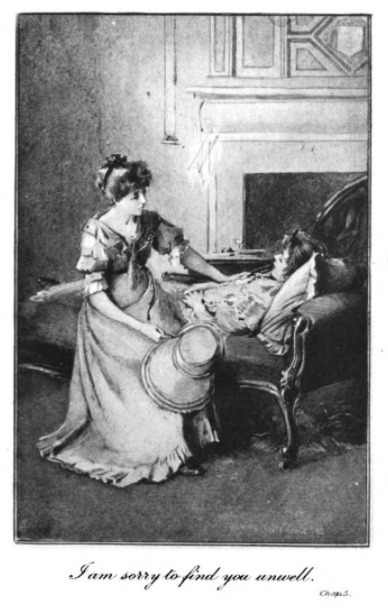
Here we see Anne visiting her younger sister Mary. Mary is married to Charles Musgrove. Mary requested Anne come visit her at her home, Uppercross cottage for a few weeks before going to Bath, as she was unwell. This image depicts Anne’s arrival at Uppercross, where she finds Mary lying on the couch in a bad mood, claiming that she was alone all morning because her husband was out shooting, and her two sons were unmanageable. Austen tells us that Mary was often in a bad mood because she often pitied herself because she was not as beautiful as her sisters. Anne is eventually able to cheer her sister up and they go to visit the Musgroves at the Great House on the estate. This scene occurs in chapter 5 as noted underneath the title of this image. The characters are shown in the traditional regency style, with Anne and Mary wearing the regency style dress with an empire waist. Their hair is worn tied up, as was tradition for women after their coming out before the queen, signaling her entrance into society. Anne holds her bonnet in her hand. The bonnet had a large brim, used to protect a woman’s face from the sun. These bonnets were a popular style in this era as going for walks were common pastimes. The regency period dated to the early nineteenth century (1811-1820) when George, Prince of Wales, later George IV (r. 1820-1830), reigned as regent for his mentally ill father, King George III (r. 1760-1820). The regency period is associated with the rise of neoclassicism in art and fashion. The same image appears as the frontispiece for the Dent 1893, 1894, 1895, 1896, and 1897 editions of Persuasion.
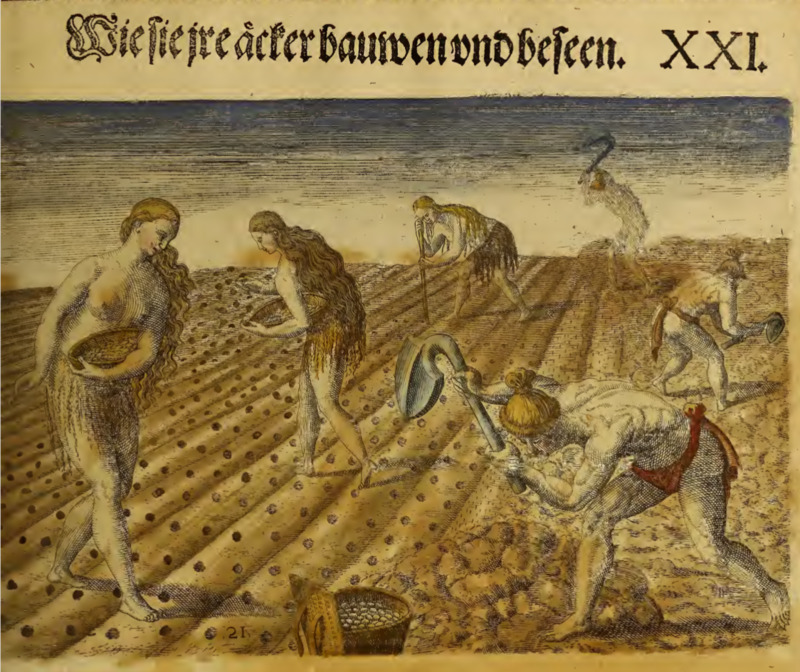
Several Indigenous people work in a large cultivated field. Men plow the ground using handheld, hoe-like implements while women scatter seeds from a basket in the furrows the men have made. This illustration is identical to the one found on page 77 of Frankfurt 1591, but colored.
Two Indigenous people walk beneath tall trees that bear oval-shaped fruit (calabash trees). Both individuals have a large basket strapped to their back to gather and carry the fruit, which they will use to make pots and other vessels.
Here we see battle plans for the war between Lilliput and Blefuscu. A compass is used to calculate the attack routes, with the farthest route being 1874 units. Surrounding the maps we see barrels and bottles representing the ammunition and other provisions which were necessary. In the foreground we see a meal prepared, possibly representing the meals the Emperor would eat while his citizens were away fighting – a commentary on the divisions within society. Gulliver’s hat is seen in the background, representing the Lilliputian’s secret weapon. The image comes at the end of the third chapter. The same image appears in the 1839 Krabbe edition.
The author spends this section of this chapter discussing religious establishment in Peru and the Church’s hierarchy. This image depicts the Inquisitor of the Holy Office which was located in Lima. The caption at the bottom of the image reads, la santa fe en el mundo en Lima [the holy faith in the world in Lima]. The Inquisitor is depicted sitting on a chair on the left side of the image dressed in European clothing. He is holding his right finger up as he points to the man standing in front of him. The man standing in front of him is his assistant who is depicted holding a book and wearing a floor-length robe.
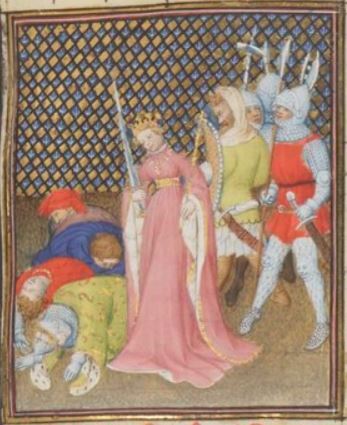
This illumination depicts Artemisia, the queen of Caria, standing in the centre of the image holding a sword as she looks down at dead bodies on the ground. She has soldiers dressed in armor standing behind her. Boccaccio explains that Artemisia was renowned for her military leadership as she had taken up arms against enemies multiple times.
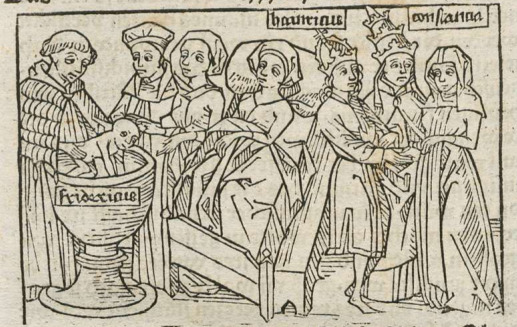
The left side of this engraving depicts Constance, the daughter of king William of Sicily, marrying Henry, the emperor of Rome. Constance is on the far-left with her name engraved above her head, while Henry is depicted holding her hand as the priest marries them. Henry’s name is also engraved above his head to identify him. Constance was forced to be a nun at a young age as a prophecy foretold Constance would somehow cause the destruction of Sicily. Her father, William, put her in a convent to prevent the prophecy from happening. At an older age, Constance was married to emperor Henry and bore a son at the age of 55. Constance is depicted in the centre of the engraving lying in a bed after giving birth to her son, Frederick. Frederick is depicted getting baptized in a large bowl which has his name engraved on the front. The baby grows up to be the one to fulfill the prophecy that King William was fearful of.
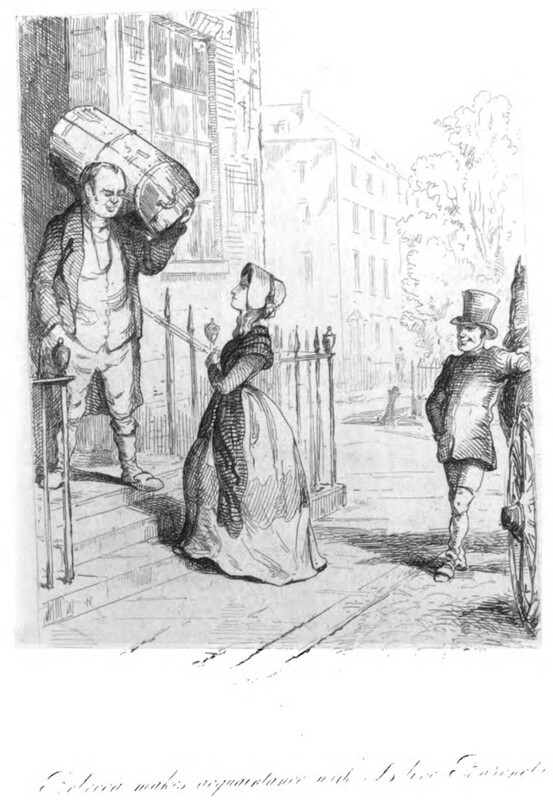
Rebecca Sharp stands in the center of the picture at the base of the staircase to Crawley mansion, scowling up at the man on the stairs. He is holding her trunk on his shoulder with his other hand in his pocket, and, though assumed by the others to be a porter, is Sir Pitt Crawley. To the right of the image, John, the Sedley’s groom, is leaning against his carriage with a smirk on his face. In the background the corner of the Crawley mansion and a neighboring house are lightly sketched. Below the illustration is printed in cursive its title, Rebecca makes acquaintance with A live Baronet.
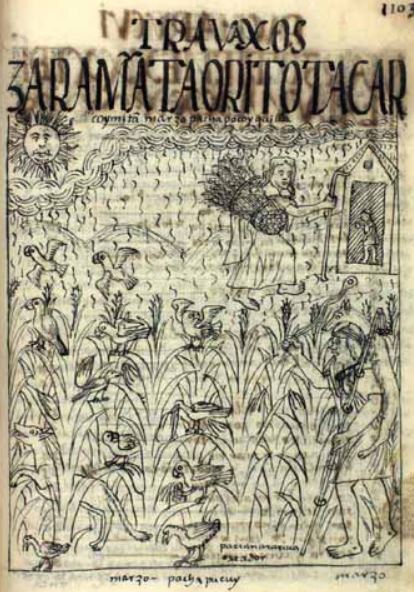
This image is reflected in the final chapter of Ayala’s chronicle where he provides a description of labours and festivals that occur in the rural areas of the Spanish colonial Andes during each month of the Inca calendar year. This image depicts the month of March, which was an important month for the growth of agriculture. There is an indigenous man depicted chasing away the many parrots flying over and sitting in the corn field. There is a dog on the left side of the image in the corn field and a dog on the back of the indigenous man helping their owner chase away the parrots. There is an indigenous woman in the background of the image walking towards her small home with a bundle of her harvest resting on her back. There is a child in the doorway of the house. There are clouds in the sky with rain falling from them to signify the growth of soil and vegetables. The caption written at the bottom of the image reads parian arariua oxeador [scaring away the parrots]. The caption written outside of the image border at the bottom reads marzo, pacha pucuy [march, the fourth month].
After Gulliver spoke about the wonders of immortality, a diplomat from Luggnag corrected him. The diplomat explained that while elsewhere in the world most people did not want to die, saying that even with one foot in the grave they would try and hang onto life. This is the image shown here. A skeleton, representing death, tries to pull a man into his grave, while the man pulls away, holding onto the cliff, representing life. The diplomat from Luggnagg explained that on the island, most people did not have this same resistance to death because they could see people who were immortal. These immortals would not die, but would continue to age, thus their quality of life would continue to deteriorate forever. The same image appears in the 1839 Krabbe edition.
A jester in a checkered suit with a large ruff, holding his hat in his hand, bows deeply to a man in military uniform. A window, through which the heads of two soldiers can be seen, forms the letter O from Our.
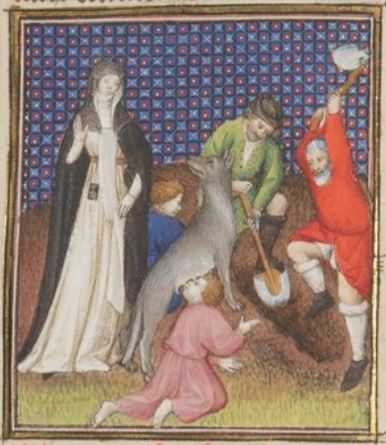
This illumination depicts Rhea Ilia (also known as Rhea Silvia) on the left side of the image dressed in a long black cloak. There are two men on the right side of the illustration digging a grave for Rhea Ilia. As a vestal virgin, Rhea Ilia was forbidden from having relationships with men. She gave birth to twin boys, and as her punishment for having sexual relations with someone, she was buried alive. Therefore, the two men are digging a grave. The twin boys were named Remus and Romulus, and they were the eventual founders of Rome. They were raised by a mother wolf after being exposed in the wilderness. There is a wolf in the centre of the image with one boy drinking her milk.
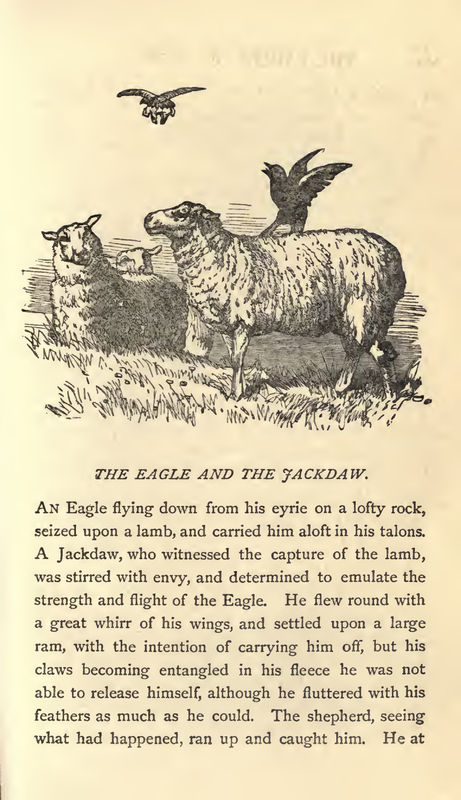
In the meadow, there are three sheep. One of them has the jackdaw on their back and tried to say something. In the sky, there is an eagle which flied far away the meadow
Gulliver lived in a hut on the Houyhnhnm’s property. Here we see the Sorrel Nag – one of the servants of Gulliver’s master – showing Gulliver to his hut, visible in the background.
Here we see Gulliver sitting on a rock with a Houyhnhnm who sits on his haunches. In the background we see the Houyhnhnm’s house. The Houyhnhnm teaches Gulliver their language, which Gulliver learns and is able to converse with the Houyhnhnms. The same image appears in the 1839 Krabbe edition.
Peggy O’Dowd stands in her bedroom, brushing her husband’s cap. His sword lies on the table in front of her, along with a bottle and a large mirror. She has already packed his travelling-valise, which lies open on the ground next to her. Major O’Dowd himself is sleeping in the background, with his boots next to the bed and his coat thrown over a chair. Below the illustration is printed its title, Venus preparing the Armor of Mars.
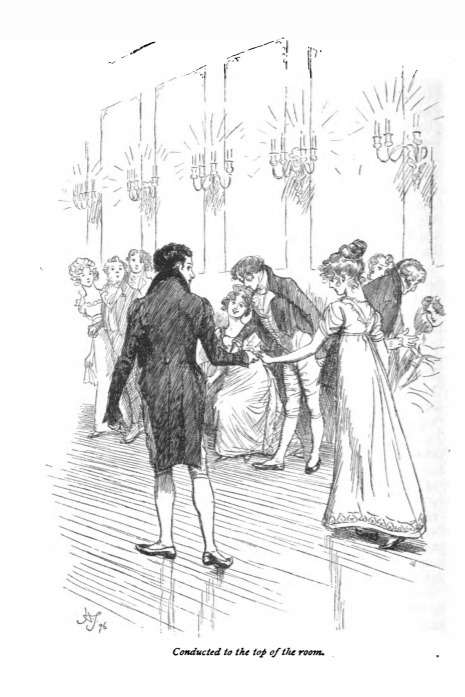
Here we see Mr. Crawford leading Fanny to the dance floor to open the ball. Sir Thomas gave the ball in honour of William’s visit to Mansfield. It was at this time when Mr. Crawford decided he wanted to make Fanny love him. At the ball, Sir Thomas came over to ask if she had a partner for the first dance. She answered that Mr. Crawford had engaged her for the first two dances. Then Sir Thomas told her that she was to open the dancing with Mr. Crawford. She was shocked and tried to convince him that Edmund should open the dancing with Miss Crawford because she was very shy. Sir Thomas insisted, and Fanny relented and began the dancing with Mr. Crawford. This scene occurs in chapter 28. The characters are shown in the traditional regency style. Fanny wears a regency style dress with an empire waist. Mr. Crawford wears a tailcoat and breeches. The regency period dated to the early nineteenth century (1811-1820) when George, Prince of Wales, later George IV (r. 1820-1830), reigned as regent for his mentally ill father, King George III (r. 1760-1820). The regency period is associated with the rise of neoclassicism in art and fashion.
The woman in this picture is Jimena. She is wearing a dress with a headdress that flows along her back. She is sitting on a chair near a window holding a piece of fabric. The window is arched with a vase of flowers on the sill. Plants are also tangling from the top of the window suggesting pots of plants are hanged outside. The wall behind her has designs on it.
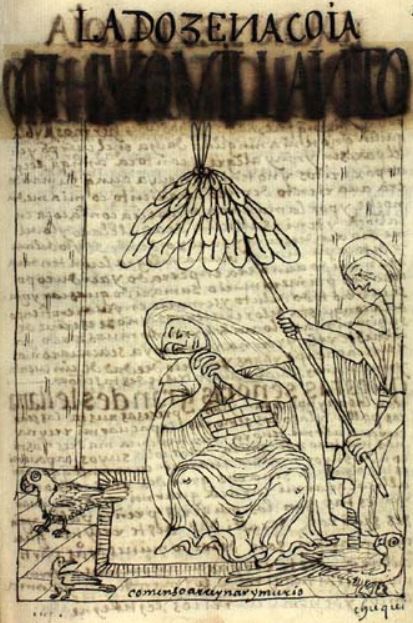
This illustration depicts Chuqui Llanto, the twelfth Coya [Queen] of the Inca Empire. She was married to her brother, Huascar, the twelfth king of the Inca Empire. The author explains that she was known for being a beautiful woman and for raising birds, which is why there is a bird depicted in the image. The queen is illustrated sitting with her hands interlocked as she is being fanned by a servant. The words Comenso a rreynar y murio which translated to She began to rule and she died. The author says that this queen died when she died at the age of fifty-nine.
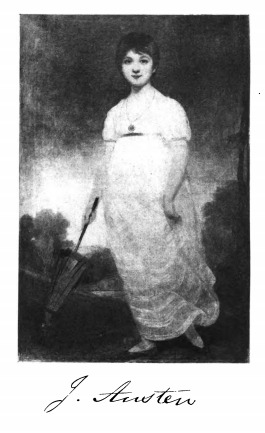
This is a portrait of Jane Austen, said to have been painted when she was fifteen years old in Bath. The painting was done by Johann Zoffany. At the time of printing of this edition, the painting was in the possession of Reverend J. Morland Rice, Rector of Bramber, Sussex, grandson of Jane Austen’s brother, Edward. It was reproduced with permission of Rev. Rice as the frontispiece of this collection of Austen’s novels. According to information in the list of illustrations, the painting belonged to Colonel Austen of Kippington, a descendant of Jane Austen’s great-uncle, Uncle Francis, and was a friend of her father. Colonel Austen then gave it to his friend, Mrs. Hardinge-Newman who greatly admired Austen's novels. Mrs. Hardinge-Newman's stepson, Dr. Hardinge-Newman, left it to Mr. Rice. In this painting, Austen wears a dress in the traditional regency style with an empire waist. Her hair is worn up, and she holds a parasol. The same image appears as the frontispiece for the Dent 1893, 1894, 1895, 1896, and 1897 editions of Sense and Sensibility.




![[Plans for the war between Lilliput and Blefuscu]](https://collections.cemvc.ca/files/large/99e27cfe5a2898e7c8de81358719e7c5c3c2825e.jpg)
![Sv S[enori]a El Inqvicidor y Familiares y Fiscal de la Santa Ynquicicion deste Rreyno](https://collections.cemvc.ca/files/large/7713de9e3233ee2160bfd79f3cf43109e7fadda7.jpg)
![[Depiction of a human resisting death]](https://collections.cemvc.ca/files/large/8b14f5f6cf171211e3a3fba6fae6a5a24c81d0bb.jpg)
![[Vanity Fair Chapter XVIII Inhabited Initial]](https://collections.cemvc.ca/files/large/3cfdbad44ec4224f1b90894e07ad5a0df7411864.jpg)
![[The Sorrel Nag takes Gulliver to his hut]](https://collections.cemvc.ca/files/large/3e7d97323b0a65e6766688b19555cf23dc061347.jpg)
![[Gulliver learns the language of the Houyhnhnms]](https://collections.cemvc.ca/files/large/695e1d7ea3427641d992623ff4a9369914967815.jpg)



![[Jimena sitting by a window]](https://collections.cemvc.ca/files/large/186200e84cda489eaa1d957e2650783702e8602c.jpg)