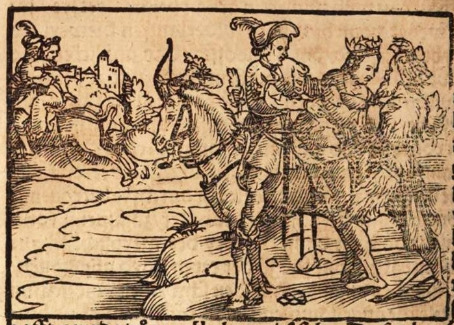
[A male figure is pictured on a horse, while another male figure helps him place his foot in the stirrup. While the figure on the horse looks the same as that used to depict Calisto, we can infer from the narrative that it is likely meant to represent Sempronio. Because the figures for Calisto and Sempronio resemble one another, this is likely a simple oversight in printing/engraving. The second figure is likely another of Calisto’s servants.] Shortly after Celestina leaves Calisto, Calisto grows impatient and sends Sempronio to visit her house and hurry her along in her progress. When Sempronio departs, Pármeno tries to dissuade Calisto from procuring Celestina’s services.
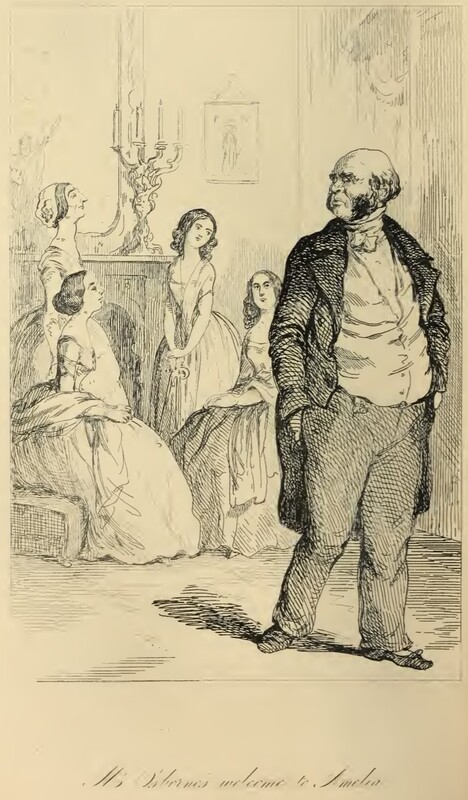
Jane and Maria Osborne are seated on two low chairs in front of the fireplace. Upon it are a very large mirror, a statue of a warrior, and a candelabra; to the side of the mirror hangs a small portrait. Amelia Sedley is standing between the sisters, looking uncomfortable and holding her hands clasped together. Miss Wirt is standing opposite Amelia, looking haughty. In the foreground of the image is Mr. Osborne, mostly turned away from the others as he walks away with a scowl on his face. Below the illustration is printed in cursive its title, Mr. Osborne’s welcome to Amelia.
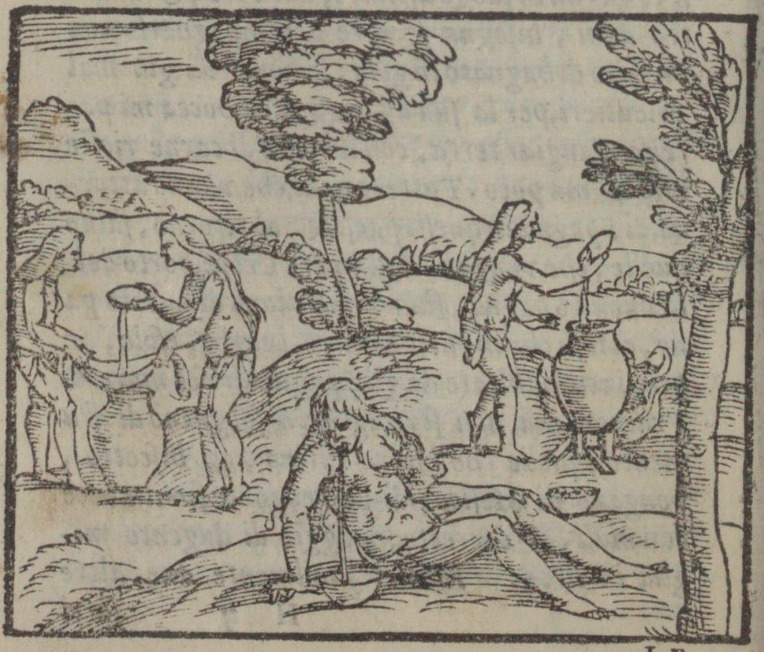
Four Indigenous women prepare an alcoholic beverage. The woman in the middle sits on the ground while she chews on the corn or grain used to make the alcohol and spits it into a bowl beside her. Two women on the left strain the saliva mixture into a large pot using a cloth. On the right, another woman pours the strained liquid into a pot over a fire to boil. This image is identical to one found on page 58 verso of Venice, 1565.
William Dobbin sits slouched against the base of a tree, reading a book. In the far background are the buildings of Dr. Swishtail’s academy. Near the buildings are a few distant figures of boys playing games. Between Dobbin and the buildings, on the right side of the image, Cuff is holding George Osborne by the collar and threatening him.
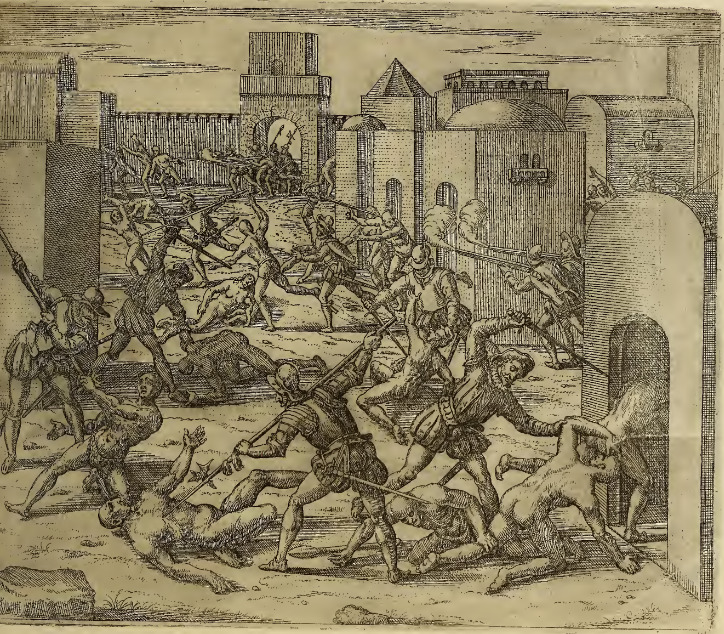
After the execution of the Inca Emperor Atahualpa, the Spaniards embarked on the long voyage to Cuzco in search of the gold Pizarro had been told was kept there. Within the walls of Cuzco, Spanish soldiers kill unarmed Inca men and women with pikes or spear, swords, and muskets. Some of the Inca people flee the Spaniards.
After Sosia informs Tristan that Sempronio and Pármeno are dead, they awaken Calisto and tell him the news. Sosia explains that they were decapitated by the executioner on the orders of the justice (or ‘alguacil’). Calisto is struck with grief and asks Sosia to tell him the reason for their punishment. Sosia explains that they murdered Celestina because she would not share the gold chain that Calisto had given her.In this illustration, we see the alguacil’s men and onlookers standing around the gallows, where a winged Cupid (seen standing at the base of the ladder, blindfolded) is about to be hanged. The rightmost figure, dressed in armour, is holding Cupid’s bow in his left hand, while Cupid’s quiver can be seen resting at his feet. The leftmost figure, riding a horse and holding a stick-like object, is shown wearing a cloak and a hat. In the background we see two more male figures, of whom the one on the right is shown wearing a hat and holding a large axe. The choice to use Cupid instead of Sempronio and Pármeno is quite odd, as is the choice to show a hanging instead of a decapitation. The use of Cupid may be meant to convey the inevitable death of Calisto and Melibea’s love once Sempronio and Pármeno have been killed. However, a more likely explanation for the inclusion of this illustration is that the more relevant 1580 woodblock was misplaced or destroyed in the intervening 36 years.
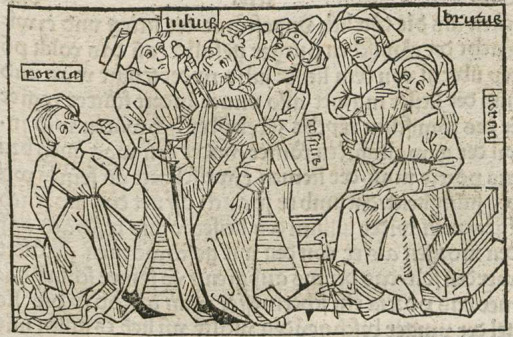
This engraving depicts three separate events. The far right of the engraving depicts a man named Brutus having a discussion with his wife Portia. We know that these figures are Brutus and Portia as Portia’s name is engraved beside her body and Brutus’ name is engraved above his head. Brutus is telling his wife the conspiracy plan to kill Julius Caesar. After hearing the conspiracy plans, Portia took a barber’s razor and cut herself with it. The engraving depicts the barber’s razor sticking out of her foot. She does this to prepare herself in case she has to kill herself should the conspiracy not work out in Brutus’ favour. The centre of the engraving depicts the assassination of Julius Caesar. Brutus is on the left side of Caesar, stabbing him in the chest. A man named Cassius is behind Caesar as he stabs his abdominal area. Their names are engraved above their heads. The far left of the engraving depicts Portia eating burning hot coals from the fire directly beside her after hearing of her husband’s death.
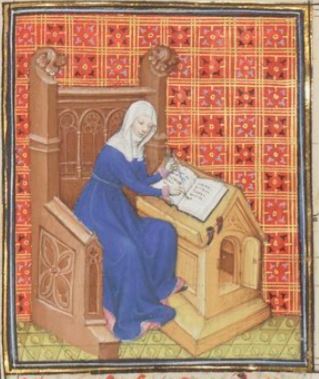
This illuminated image depicts a woman named Erythraea (also known as Eriphila) sitting down while writing a book. Erythraea was a famous sibyl and was known for predicting many major events in history. Boccaccio explains in his story of Erythraea that she predicted the fall of Troy, as well as the life and death of Jesus Christ.
Melibea (presumably the right-central figure, since her robe appears ornate and she is wearing multiple necklaces) overhears Pleberio (left-central figure) and Alisa (leftmost figure), her parents, talking about the prospect of giving her away in marriage. They discuss the mistaken fact that she is still a virgin, and Alisa points out that she has probably never considered having a male companion. Melibea grows frustrated with their presumption that she is ignorant, and she orders Lucrecia (rightmost figure) to interrupt the conversation.
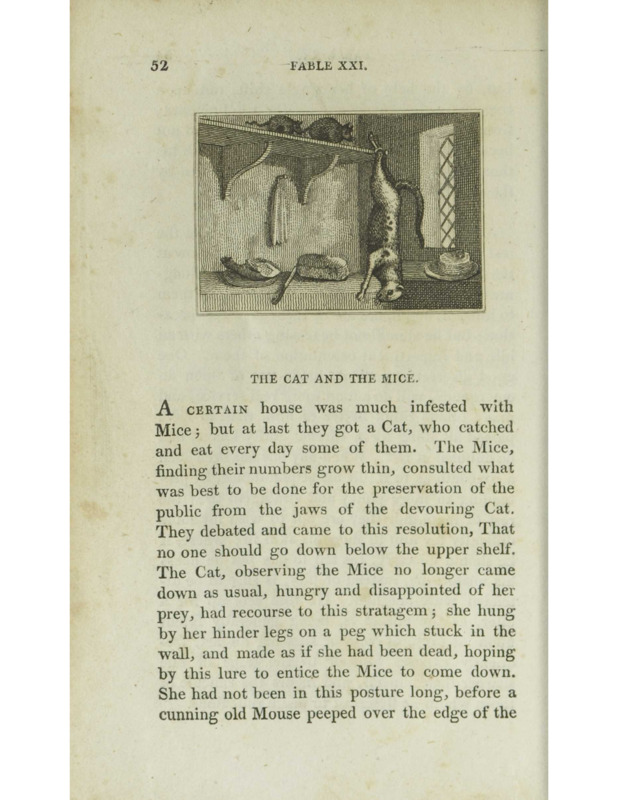
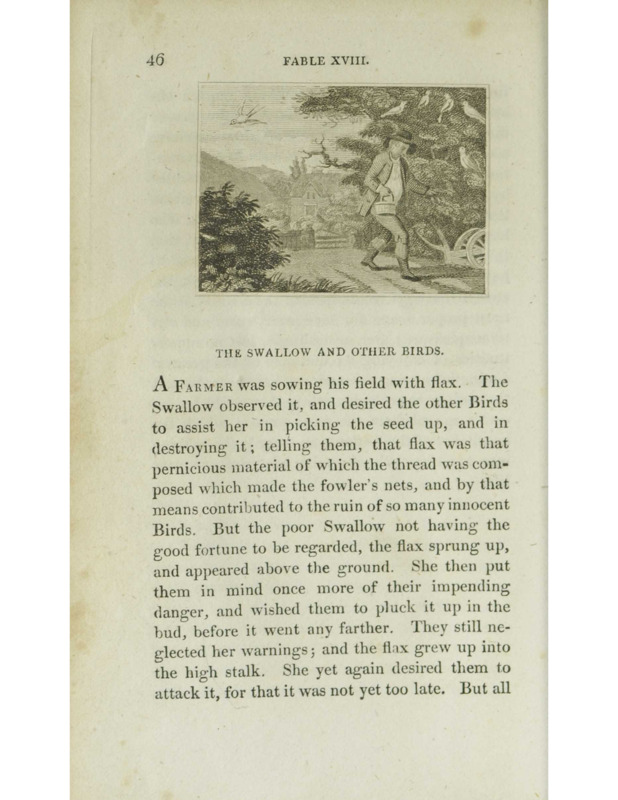
There are four birds. One bird is tied to the ground by its neck. The second bird is tied to the ground by its leg. The third bird is flying away. The fourth bird is being held by a man at its feet. The birds seem to be in distress
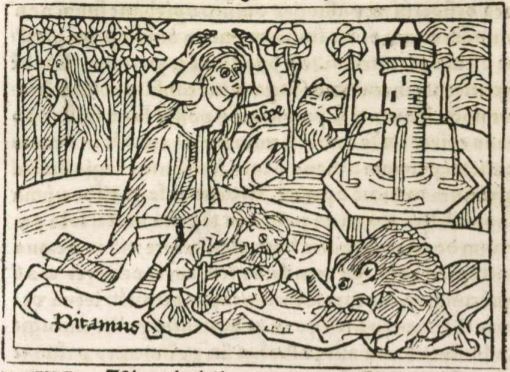
This engraving depicts Thisbe, a young virgin from Babylon killing herself after finding her lover, Pyramus, already dead. Boccaccio explains that the two lovers were forbidden from being together, so they devised a plan to run away. Thisbe waited for Pyramus by the fountain depicted on the right-hand side of the engraving, when a lioness appeared. Thisbe ran into the woods, as seen in the left-hand top corner of the illustration. The lioness, with a bloodied mouth, chewed on the cloak that Thisbe left behind after running. This is illustrated in the foreground of the engraving. Pyramus had then arrived at the meeting point, only to find the bloody cloak of Thisbe. Believing her to be dead, Pyramus killed himself with his sword. Pyramus is depicted in the foreground of the engraving, lying on the ground with his sword impaled into his chest. The creator engraved his name beside his leg to identify him. Thisbe found Pyramus as he was dying and impaled herself with the same sword in order to be with her lover. Her name is engraved just below her left arm.
Hercules is depicted on the right side of the engraving holding his new wife Deianira in his arms as they attempt to cross the Evenus river. Deianira is illustrated wearing a crown. A man named Nessus is depicted beside Deianira, holding his arm out to her as he offers to take her across the river on horseback. Boccaccio explains that Nessus was riding horseback, however, Nessus is known to be a centaur in Greek mythology. Boccaccio explains that Nessus betrayed Hercules’ trust and began to run away with Deianira after crossing the river. Hercules uses a poison infused arrow to shoot Nessus and rescue his wife. This is illustrated in the background on the left side of the engraving. Hercules’ bow is in hand, and his arrow is sticking out of the chest of Nessus.
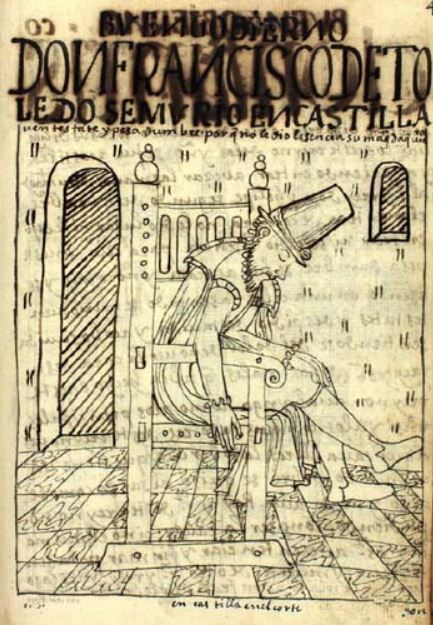
This image depicts the death of the fourth viceroy of Peru, Don Francisco de Toledo. He is illustrated sitting hunched over in an armchair with his eyes closed. After ruling as viceroy in the kingdom of Peru, he returned to Castile to meet with King Philip II. The king, however, did not meet with Toledo, which upset him to the point of starving himself. The caption at the bottom of the image reads en castilla en el corte [in Castile in the court].
In this image Mr. Wickham meets a man in town who then persuaded him to join the militia. After reading Darcy’s letter, Elizabeth reflects on the inconsistencies in his story. This scene occurs in chapter 36. The characters are shown in the traditional regency style. The men wear waistcoats and tailcoats with breeches. They wear top hats and carry walking sticks. He raises his top hat and holds the letter in his hand. The regency period dated to the early nineteenth century (1811-1820) when George, Prince of Wales, later George IV (r. 1820-1830), reigned as regent for his mentally ill father, King George III (r. 1760-1820). The regency period is associated with the rise of neoclassicism in art and fashion.
In this image we see Gulliver in the foreground running away from two giants on Brobdingnag. Gulliver ducks and runs through wheat stalks fleeing the giants. The central figure is the giant famer who eventually takes Gulliver in. He holds a large scythe and wears loose short pants and a shirt sewn together using various pieces of fabric. A second giant is visible in the distance. Only the head and shoulders of the second giant is visible. The second giant wears a large brimmed hat, while the Farmer is bareheaded. The same image appears in the 1839 Krabbe edition.
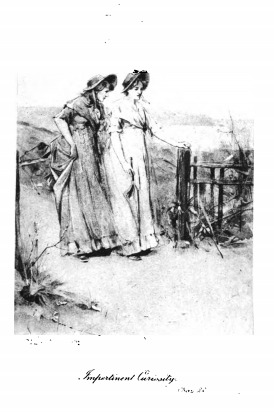
Here we see Elinor walking from Barton Park to her cottage with Lucy Steele. Lucy Steele was a cousin of Mrs. Jennings, Lady Middleton’s mother. Lucy took a liking to Elinor, although Elinor was not very fond of her. On this walk, Lucy confided in Elinor that she was engaged to Mr. Edward Ferrars, and had been for a year. Elinor was taken aback by this news, because she believed that Edward Ferrars, the eldest son of a wealthy family, was going to propose to her. He was the brother of Elinor’s half-brother's wife, and during her time at Norland, he visited her frequently and showed her much attention. He even came to visit the Dashwoods at Barton Park for a week. Lucy told Elinor that he left her home to come visit Elinor. This scene occurs in chapter 22 as noted underneath the title of this image. The characters are shown in the traditional regency style, with Elinor and Lucy wearing the regency style dress with an empire waist. Their hair is worn tied up, as was tradition for women after their coming out before the queen, signaling her entrance into society. They both wear bonnets to protect their faces from the sun. These bonnets were popular during this period because going on walks was a common pastime, and the fashion was for young women to be quite pale, indicating that they did not have to do manual labour outside. The regency period dated to the early nineteenth century (1811-1820) when George, Prince of Wales, later George IV (r. 1820-1830), reigned as regent for his mentally ill father, King George III (r. 1760-1820). The regency period is associated with the rise of neoclassicism in art and fashion. The same image appears as an insert between pages 125 and 126 for the Dent 1893, 1894, 1895, 1896, and 1897 editions of Sense and Sensibility.
Celestina, Elicia, Sempronio, Areusa, and Pármeno (in clockwise order, starting from leftmost figure) are gathered around a table at Celestina’s house for dinner. While the two pairs of lovers dine, Celestina drinks her wine. Sempronio starts praising the beauty and virtue of Melibea, which enrages Elicia and causes her to become jealous. (She is standing with her back hunched over, and Sempronio has his left hand open, both of which signal an argument.) Celestina manages to calm her, and the two lovers reconcile. Lucrecia arrives shortly thereafter, and she tells Celestina that Melibea has asked to have her girdle returned. More importantly, Lucrecia informs Celestina that Melibea has an illness of the heart and has requested her presence.
Two figures, a woman in a bonnet holding a thin walking stick and a man in a curved hat, walk along a path. A sign by the side of the road reads To London. Two sets of forked branches in the background form the letter W from We.
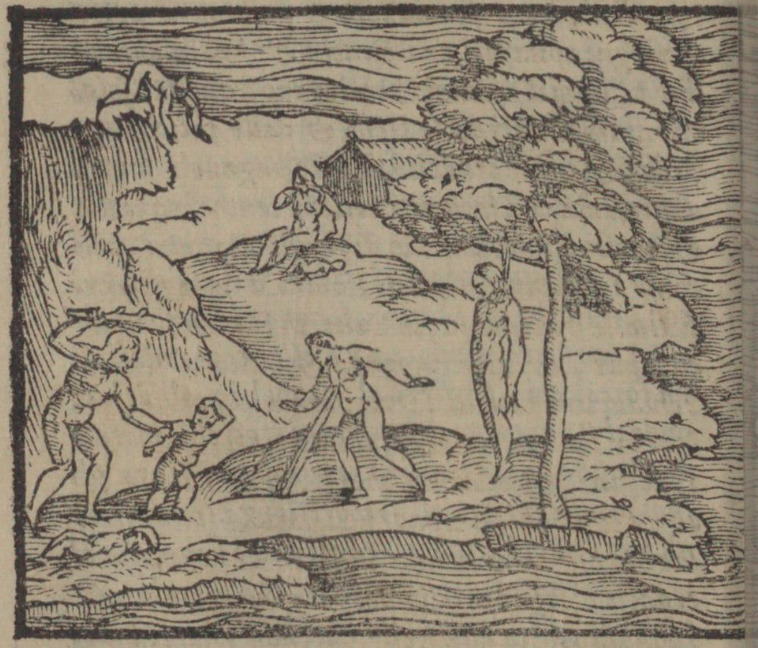
A group of Indigenous people on the island of Hispaniola (today Haiti and the Dominican Republic) commit suicide using various methods, to avoid serving the Christian Spaniards who colonized the island. One individual has hung themself by the neck from a tree; another leans into a spear that has been planted point-up into the ground; a mother uses a club to beat her two children to death; another person jumps from a cliff. There is another mother with her deceased child in the background, and behind them is a single dwelling. This image is identical to one found on page 52 of Venice, 1565.
Rawdon Crawley stands in an opera box, looking up and to the right through his opera glasses. General Tufto and Rebecca Crawley are seated on either side of him, looking at each other, with a bouquet between them.

![[Act II (Second Illustration) – Sempronio (?) Sitting on a Horse as He Prepares to Visit Celestina]](https://collections.cemvc.ca/files/large/d14ddbc760a007730651b50620b1a01cab920a9c.jpg)
![[Dobbin Reading under a Tree]](https://collections.cemvc.ca/files/large/72463792d8d4dbc29a029f6f312fdd80cb61026e.jpg)
![[Act XIII – Cupid Being Hanged by the Alguacil’s Men]](https://collections.cemvc.ca/files/large/abd59708b408be9a0be1fa170ba4edb63ce17c3d.jpg)
![[Act XVI – Melibea and Lucrecia Overhear Pleberio and Alisa Discussing the Possibility of Finding a Husband for Melibea]](https://collections.cemvc.ca/files/large/3556371b6f1153f8f4e33997f3e25912d42e3207.jpg)
![[Rebecca’s Purchase]](https://collections.cemvc.ca/files/large/109c411b65105382bcd515687c2798d82f0d50a8.jpg)
![[Birds Held Captive]](https://collections.cemvc.ca/files/large/f9182ba73e78bcd1244d3c8dfd4788009d86a39f.jpg)

![[Gulliver runs from giants on Brobdingnag]](https://collections.cemvc.ca/files/large/6e0c3b22e62281c752786d472d5aef10cc6d0abb.jpg)
![[Act IX – Celestina, Elicia, Sempronio, Areusa, and Pármeno Share a Meal]](https://collections.cemvc.ca/files/large/c3d72bcca1839259e75e0cb086acdd68df8166cd.jpg)
![[Vanity Fair Vol. I Chapter XII Inhabited Initial]](https://collections.cemvc.ca/files/large/abf2f9a1242feb8b95effb8752c56c03b2830828.jpg)
![[Rebecca, Rawdon, and the General]](https://collections.cemvc.ca/files/large/789b2e36920166f5a45ec25039156261859934e7.jpg)