In this image the two people on the front are the focus of the image because they are El Cid and Jimena at their wedding. Jimena is wearing a white dress and her head is veiled. On her waist there is a belt separating the top part of her dress from the bottom part. The top part of her dress has patterns on it. She is holding a lit candle in her hand. The man next to her is El Cid and he is wearing a dark tunic with a white cape. A sword is visible at his waist. He is also holding a lit candle in his hand. His hand is dark and thick. In front of them on the altar is the bishop with his hand raised. He has a robe on and a hat. Next to the bishop a priest is holding a staff with a symbol of a cross on top of it. Behind the bride and groom there are many people. One distinguishable guest is the one right behind them who is a man wearing a tunic and a cape. He is carrying a sword at his waist. He has a moustache. Next to the man with the moustache the king is standing there with another man. The king is wearing his crown and white robes covered with a black cloak. He has a long white beard and moustache. The other man standing next to the king is wearing white robes and a dark cloak as well. He has a white beard as well. The room they all appear to be in is a church with the rock pillars. Also, it appears to be day because the two lines in the air seem to be sunshine coming in from windows on high in the church.
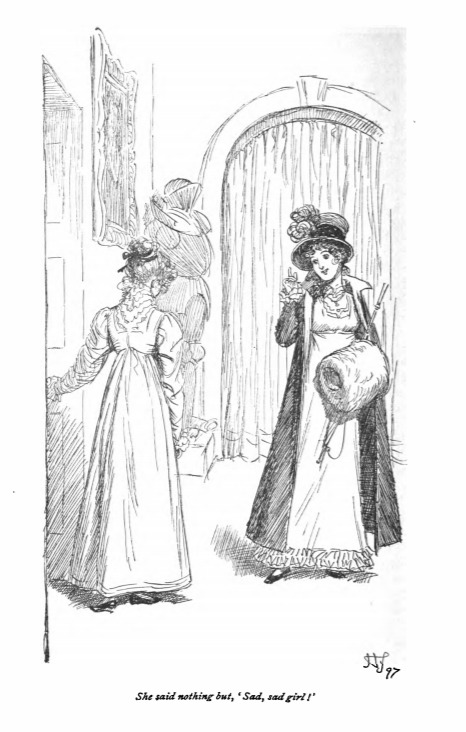
Here we see Miss Crawford entering the hall at Mansfield Park, where Fanny greets her. Miss Crawford greeted Fanny by saying Sad, sad, girl, in reference to Fanny’s refusing Mr. Crawford's proposal. This scene occurs in chapter 36. The characters are shown in the traditional regency style. Miss Crawford and Fanny wear regency style dresses with empire waists. Miss Crawford wears a bonnet and overcoat, and holds a muff, used to keep her hands warm. The regency period dated to the early nineteenth century (1811-1820) when George, Prince of Wales, later George IV (r. 1820-1830), reigned as regent for his mentally ill father, King George III (r. 1760-1820). The regency period is associated with the rise of neoclassicism in art and fashion.
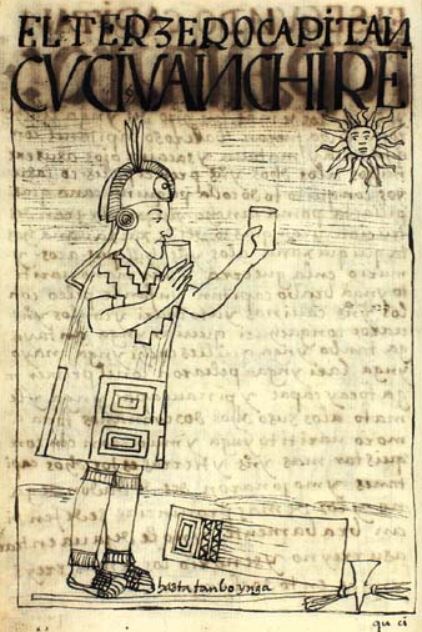
This image depicts the third captain, Cuci Uanan Chire. These captains were a level of Inca authority who helped lead the conquest of the Andes. He was the son of the third Inca king, Lloque Yupanqui Inca. The author explains that this captain had fought and conquered other Inca leaders. The captain is depicted standing on the left side of the image drinking from a cup in his right hand with another cup being held up with his left hand. His shield and axe are laying on the ground in front of him. There is a sun with a face in the top right corner of the image. The words hasta tanbo inca are written at the bottom of the image which translates to to tambo inca. This could be referring to the span of his conquests.
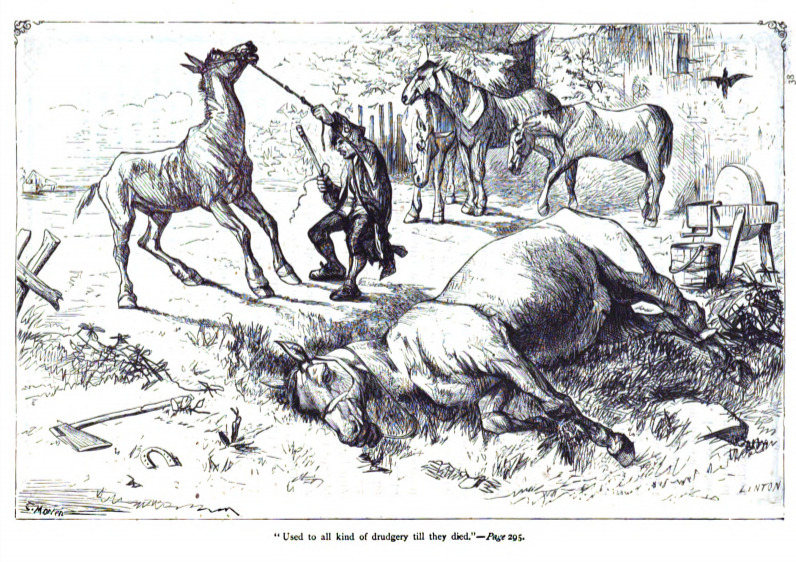
Gulliver explained to the Houyhnhnms how horses were treated in Europe. He explained that they were work animals and worked to death. The Houyhnhnms were shocked to learn about the treatment of horses.
Here Gulliver explains his situation to two Houyhnhnms. He asks them for shelter, and in return he says he will make them a present in return for the favour using his knife. The Houyhnhnms spoke between themselves and agreed to help Gulliver. During their conversation Gulliver heard the two saying the word yahoo, so Gulliver repeated the word back to them. The Houyhnhnms looked surprised, then proceeded to teach Gulliver the correct pronunciation of the word. The Houyhnhnms then took in Gulliver and taught him the language. The same image appears in the 1839 Krabbe edition.
A satisfied looking boy standing on a rectangular box or platform holds in front of him a stick. On it are a turnip disguised as a head and a ragged sheet or coat, forming the semblance of a ghost. A terrified looking man is on his knees with his arms raised in front of the ghost, a shovel dropped beside him. A tall fence in the background forms the letter W from We.
The narrator is depicted as a piper, standing beneath a tree on a hill and playing his pipe for the small dog that sits in front of him, looking up. In the distance are the silhouettes of the buildings of a town. In the top right of the image is the letter I.
Here we see Gulliver after he returned home to his family in England. Gulliver is sitting in the centre, surrounded by his friends and family. This image appears at the end of the third part, when Gulliver returned home after five and a half years following his travels in Laputa, Balnibarbi, Glubbdubdrib, Luggnagg, and Japan. The same image appears in the 1839 Krabbe edition.
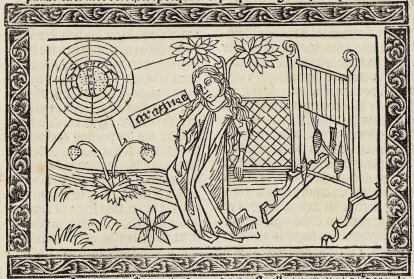
This engraving depicts Arachne killing herself by means of hanging. We know that this is Arachne as her name is engraved beside her body. There is a loom on the right-hand side of the engraving and a net to the left of the loom. Boccaccio explains in his story that Arachne is known by ancient writers as being the one who discovered the uses of woven wool and the first to make nets. Arachne became too confident in her wool work and challenged Minerva to a weaving competition. After the goddess had won, Arachne hung herself, as depicted in the engraving. There is a spider on a spider-web on the left-hand side of the engraving, as Arachne is said to have been transformed into a spider after this event.
In this image we see Gulliver climbing over the walls of the Emperor’s palace, which lies in the centre of Mildendo. The walls were five feet high, so Gulliver built himself two stools out of wood to help him get over the walls – as the gates were too difficult for Gulliver to get through or over. The stools were each three feet tall, and there was one on each side of the wall. Gulliver did this because the Emperor wanted to see the Imperial Palace. The same image appears in the 1839 Krabbe edition.
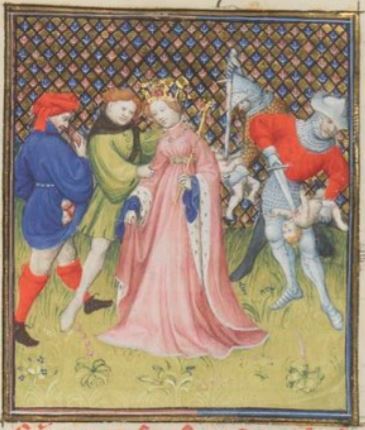
This illumination depicts Queen Athaliah of Jerusalem in the centre of the image wearing a pink dress and a crown to symbolize her royal status. There are two guards on the right side of the illustration holding children as they stab them with knives. In order to gain complete control of her kingdom, Athaliah ordered her guards to kill all the descendants of David so that none could rise and take her throne. Unbeknownst to Athlaliah, a grandchild named Jehoash had escaped her wrath and grew up to overthrow her. There are people depicted grabbing Athaliah’s arm as they take her away and kill her for her crimes.
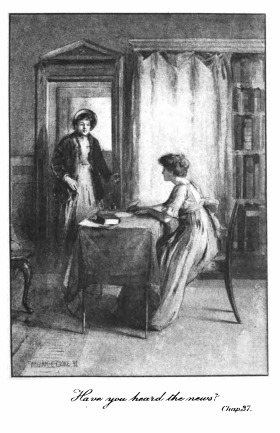
Here we see Elinor sitting at a desk writing a letter when Mrs. Jennings came in to tell her the news that Edward Ferrars’ engagement to Lucy Steele had become public. Elinor and Marianne accompanied Mrs. Jennings to London in the new year and stayed for several months. Elinor’s half-brother and sister-in-law also came to London, and liking Miss Steele, invited Lucy and her sister Anne to come and stay with them for a few weeks. Edward Ferrars is the brother of Fanny Dashwood, Elinor’s sister-in-law. While staying with the Dashwoods, Anne Steele announced that Lucy was engaged to Edward. This caused outrage and Mrs. Ferrars disowned Edward, believing Lucy Steele to be an unsuitable match. Mrs. Jennings loved gossip, and as soon as she heard the news, she wanted to share it with Elinor. This scene occurs in chapter 37 as noted underneath the title of this image. The characters are shown in the traditional regency style. Elinor wears the regency style dress with an empire waist. Her hair is worn tied up, as was tradition for women after their coming out before the queen, signaling her entrance into society. Mrs. Jennings walks in wearing her shawl and a bonnet to protect her face from the sun. The regency period dated to the early nineteenth century (1811-1820) when George, Prince of Wales, later George IV (r. 1820-1830), reigned as regent for his mentally ill father, King George III (r. 1760-1820). The regency period is associated with the rise of neoclassicism in art and fashion. The same image appears as an insert between pages 90 and 91 for the Dent 1893, 1894, 1895, 1896, and 1897 editions of Sense and Sensibility.
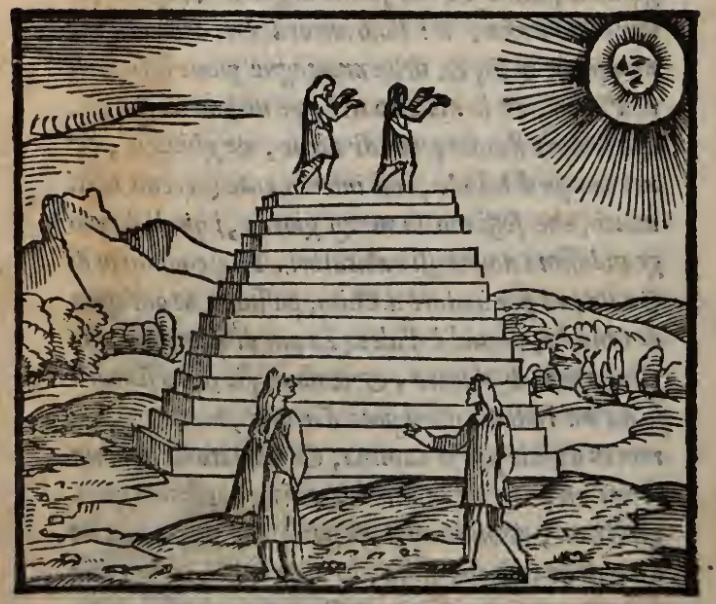
Two Indigenous people in Peru stand atop a step pyramid to worship the sun. They face the sun, with their hands raised towards it. The sun has been designed here with a face that gazes down towards the worshippers. At the base of the pyramid, two other Indigenous people stand in conversation.
Lady Matilda Southdown, in her bed-gown and nightcap, carries a candlestick, a cup of medicine she has devised, and her favorite tracts through the doorway into Rebecca Crawley’s room.
Two Indigenous men and a child stand around a tree. The man on the left crouches as he threads the items harvested from the tree (dried fruit or nuts) onto a string to make a leg rattle, like those worn by the man on the right. The man on the right dances with one hand on his hip, wearing leg rattles and holding a maraca or religious item in the other hand. Both men wear feathered headdresses. This image is identical to one found in Paris, 1557.
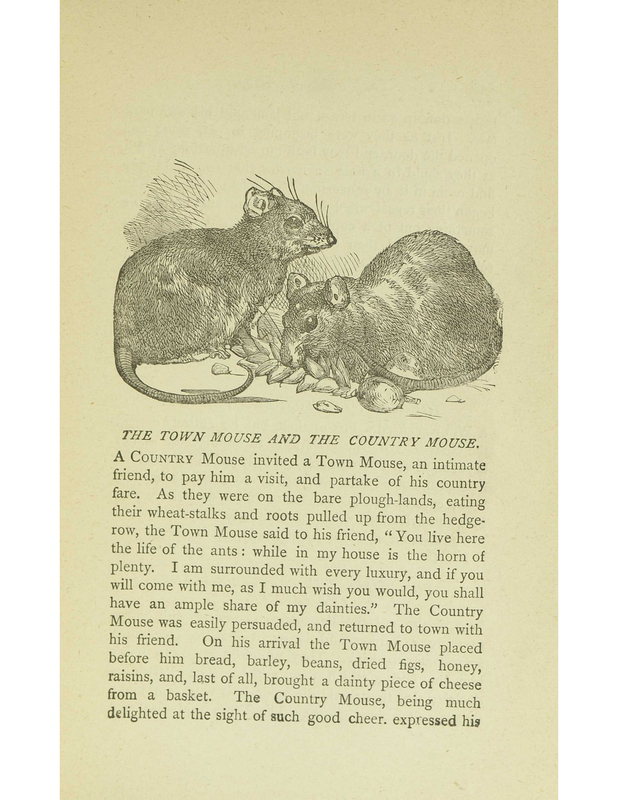
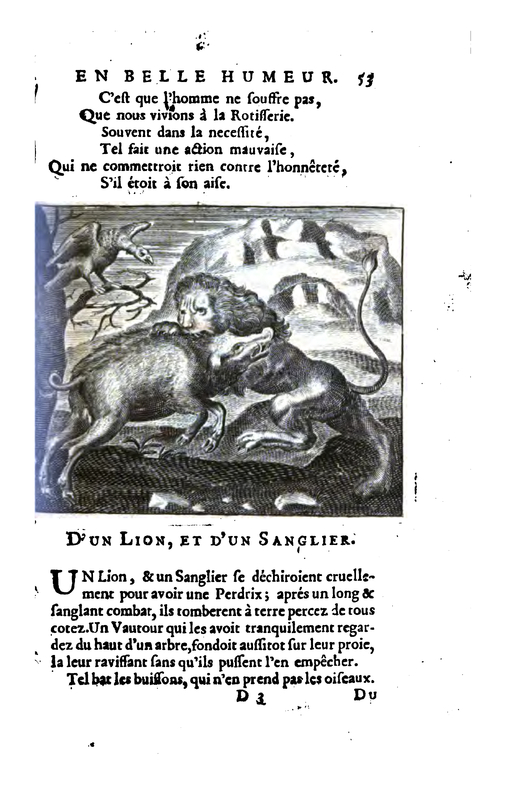
Two mice are in the center of the image. The one to the left is sitting down, its tail coming around at the front of the image. The one to the right is bent to the ground eating grains off a stem on the ground.
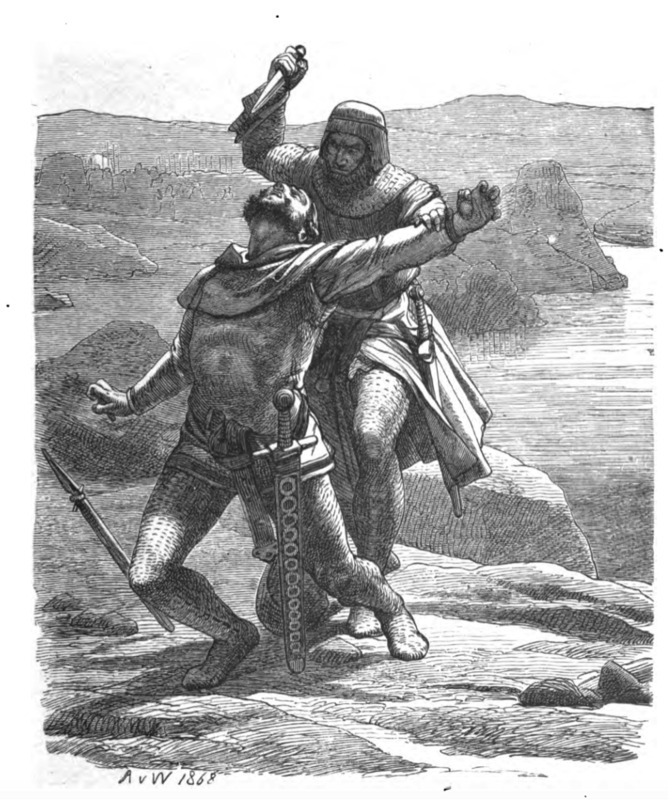
In this image there are two men. The one being assassinated is the King Sancho. His assassin is wearing chainmail and he is carrying a sword at his waist. He is using his right hand to hold down the king and in his left hand he is holding a dagger. The king seems he is falling down, he is wearing an armour plate and he has a sword sheathed at his waist as well. His sheath has ornate decorations on it. He has his head up due to his fall so his face is hidden, but his beard is visible. They seem to be on a little hill overlooking a river. Next to the king’s feet there is a piece of metal that looks like a spear.

![[Jimena and El Cid's wedding]](https://collections.cemvc.ca/files/large/89514b6c618e60709e56b989eafdd356e1b927d6.jpg)
![[Gulliver shows his knife to the Houyhnhnms]](https://collections.cemvc.ca/files/large/f988daf9a95913bd4e353b6a299047664989d08f.jpg)
![[Vanity Fair Chapter XIX Inhabited Initial]](https://collections.cemvc.ca/files/large/8a15be26951ece1f2c082f877da67988665172b7.jpg)
![[Vanity Fair Vol. I. Chapter VI Historiated Initial, I]](https://collections.cemvc.ca/files/large/b9105dc7eac033449ae8258283d455a964c632b1.jpg)
![[Gulliver returns home to his family]](https://collections.cemvc.ca/files/large/8863c24f30607ee40005ef20ffada3f60b6cdbd0.jpg)
![[Gulliver arrives at the Imperial Palace of Mildendo by climbing over the wall]](https://collections.cemvc.ca/files/large/6077f7e59143cdc960209254850dc0bb5d082c1e.jpg)

![[Lady Southdown’s Tracts and Medicine]](https://collections.cemvc.ca/files/large/711b3c3e662374e7b5f9e7df4a58ce318e1bf859.jpg)
![[Indigenous Brazilians harvest fruit or nuts for leg rattles]](https://collections.cemvc.ca/files/large/ce2e5093c7569dbbb767867370989dd04c5cf0d4.jpg)