A man, known to be a king because of his crown, is laying in bed. There is a man next to his bed talking to him. A window next to them lets us see outside. There is a man crossing a river on a boat with sheep. There are also sheep already across the river.
In this image Mr. Darcy confesses his love for Elizabeth. Mr. Collins and Charlotte went to Rosings, but Elizabeth stayed at the Parsonage. She was surprised when Mr. Darcy arrived and professed his love for her and asked her to marry him. In his confession he describes how he overcame her family’s socio-economic inferiority and fell in love with her. This upset her and she refused his proposal. This scene occurs in chapter 34. The characters are shown in the traditional regency style. Elizabeth wears the regency style dress with an empire waistline. Mr. Darcy wears a waistcoat and tailcoat with breeches. The regency period dated to the early nineteenth century (1811-1820) when George, Prince of Wales, later George IV (r. 1820-1830), reigned as regent for his mentally ill father, King George III (r. 1760-1820). The regency period is associated with the rise of neoclassicism in art and fashion.
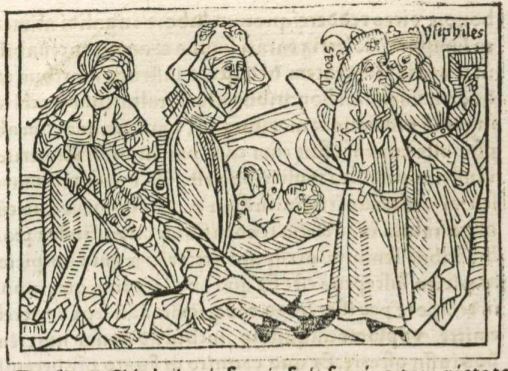
Hypsipyle and her father, King Thaos of Lemnos, are depicted on the right-hand side of the engraving. We know that the figures are Hypsipyle and Thaos as the creator engraved their names beside their bodies. Hypsipyle appears to be in discussion with her father, as she tells him that the women of Lemnos are planning to turn on all the men of the city and kill them. Boccaccio explains that Hypsipyle warns her father of the crime so that she may help him escape. There is a woman on the left-hand side of the engraving with a sword in her right hand and a man’s head in her left as she carries out the plan to kill the men of the city. Later in life, Hypsipyle has a ward named Archemorus. He is depicted in the background of the engraving, lying on the ground with a snake biting into his chest. This kills the child, and Hypsipyle is illustrated with her hands in the air as she grieves for him.
The left panel depicts Calisto’s servant Pármeno, who is wearing a hat and has a sword mounted on his belt. To the right we see Calisto wearing a hat and holding a long item of some sort, perhaps a cane or walking stick. Both figures are placed outside.The left panel is identical to those found on pages 146, 173, and 187, and nearly identical to those found on pages 263 (where it is labeled ‘Sosia’), 299 (labeled ‘Pleberio’), and 326 (labeled ‘Sosia’). The right panel is identical to those found on pages 12, 122, 225, and 235, and nearly identical to the one found on page 317 (where it is labeled ‘Centurio’).
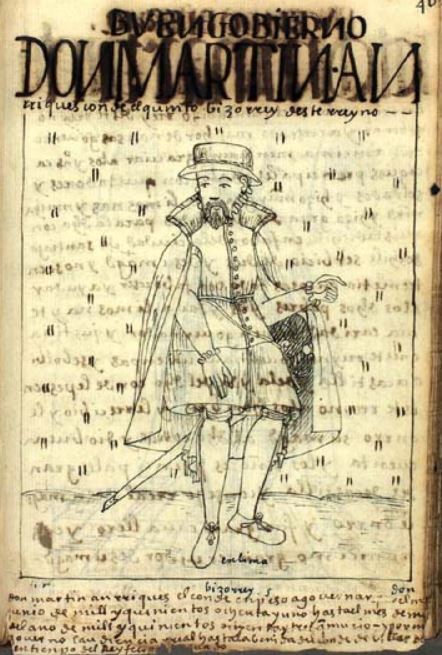
This image depicts a standing portrait of Don Martin Enriquez, the fifth viceroy of Peru under Spanish control. He is illustrated wearing European/Spanish clothing. The caption written by his feet indicate the location as it reads, en lima [in Lima]. The long caption written at the bottom of the image reads don martin anrriques, el conde, enpeso a gouernar el m[es de] junio de mill y quinientos ochenta y uno hasta el mes de m[...] del ano de mill y quinientos ochenta y tres que murio y por m[...] gouerno la [a]udiencia rreal hasta la benida del conde de Uillar de [...] en tienpo del rrey felipo [el] segundo [Don Martin Enriquez, the count, governed from the month of June 1581 until the month of [...] of the year 1583 and he died for [...]. The royal audience was held until the arrival of the Count of Villar from [...] the time of King Philip the Second].
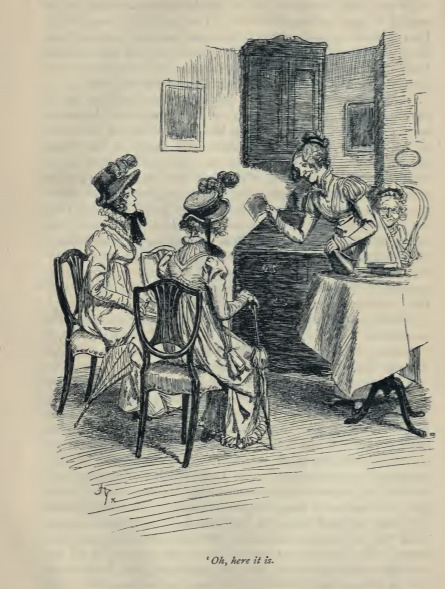
Here we see Harriet and Emma visiting the Bateses. While out on a walk, Emma and Harriet felt obliged to visit them. Miss Bates brought out a letter from her niece Jane Fairfax writing to say that she would be arriving in Highbury the following Tuesday. Emma was not excited to hear this as she found Jane Fairfax irksome. This scene occurs in chapter 19. The characters are shown in the traditional regency style. The women wear regency style dresses with empire waistlines. Emma and Harriet wear bonnets. Bonnets were a popular fashion for women who wanted to protect their faces from the sun while out on walks. The regency period dated to the early nineteenth century (1811-1820) when George, Prince of Wales, later George IV (r. 1820-1830), reigned as regent for his mentally ill father, King George III (r. 1760-1820). The regency period is associated with the rise of neoclassicism in art and fashion.
There are two men talking and pointing at another man who is holding a long stick. There are two sheep in the back right corner who have their backs turned. There is a wolf biting a sheep at its neck. There is a sheep walking away to the right.
This illumination depicts the young woman named Megullia Dotata on the left side of the image as she is being given away for marriage. The two figures standing beside her appear to be her mother and father. Megullia Dotata is known for having a dowry so massive that it was unheard of during her time. Her father is depicted giving the dowry to her new husband who is standing on the right of the image.
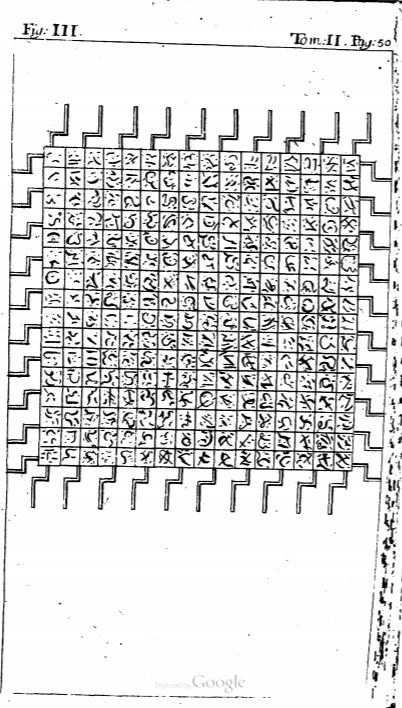
This image depicts an invention created by Laputian Projectors. The invention is to rework the Laputian language. On each of the squares is a symbol representing a word or phrase in the Laputian language. There are handles which would be turned to create different phrases which would then be analyzed. This image is the same as that in the 1727 German von Wiering edition.
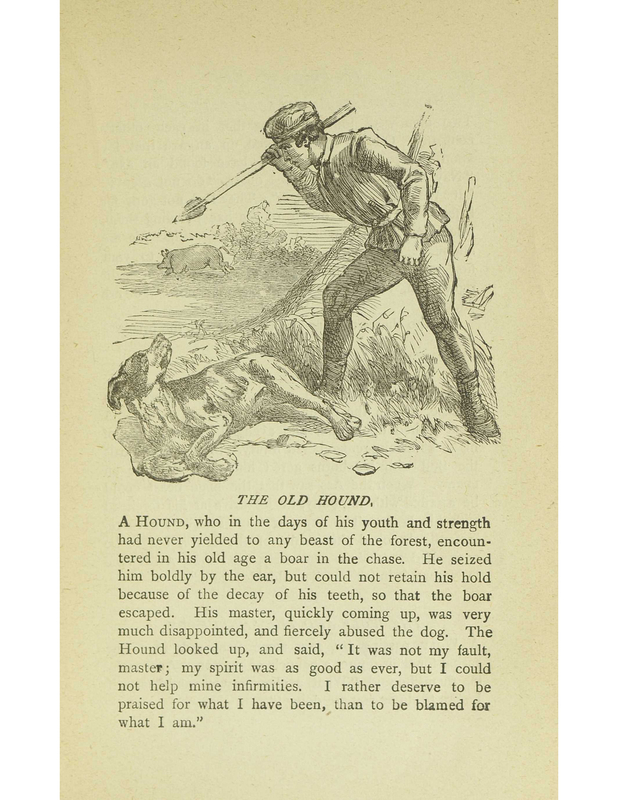
In the foreground, an old hound lies on the ground helpless on the left-hand side of the image. The hound is on its side, looking up at an angry man. The man is bent forward towards the old hound and has a long arrow in his right hand. He is holding the arrow in the direction of the hound, as though he is about the strike him. In the background, a wild boar runs off into the forest.
After the death of Calisto, Melibea is overcome with grief. Lucrecia goes to the bedchamber of Pleberio and informs him that Melibea is ill, and Pleberio rushes to her aid. Melibea explains that she has an illness of the heart, which she claims has no cure. Pleberio suggests they go outside to get some fresh air, and she agrees. Once outside, she asks him to fetch some musical instruments to alleviate her ailment. Pleberio departs, and Melibea asks Lucrecia to climb to the top of the house tower with her. At the top, she tells Lucrecia that the height is making her uneasy. When Lucrecia begins descending, Melibea slams the door and locks herself in. Pleberio rushes to the foot of the tower, and Melibea reveals everything. She then takes her own life by jumping.[In the earlier 1520 Augsburg edition, this illustration is placed in Act XX, before the illustration in which Melibea is lying in the street.]
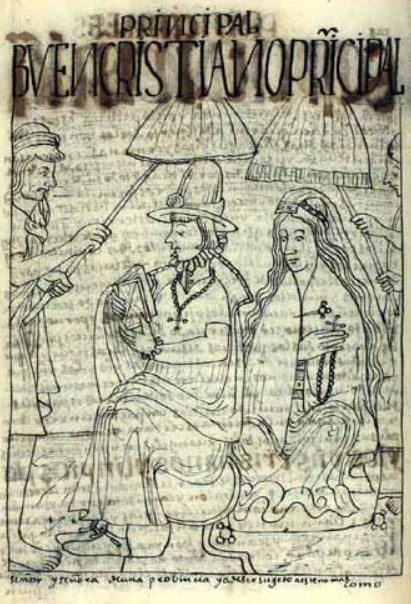
This image is illustrated in a chapter that discusses the descendants of the Inca and Andean nobles under Spanish colonial rule in Peru and their importance to a revived Andean society. This image depicts a local Andean lord sitting on an unsu [Incan ceremonial seat] with his wife. He is illustrated reading from a book. The Andean lord has a rosary around his neck and his wife is holding hers in her right hand. There are two servants depicted on both sides of the image as they hold umbrellas over the lord and his wife to protect them from the sun. The author praises these Andean nobles for being devout Christians. The caption at the bottom of the image reads, señor y señora de una probincia y a de ser sugeto a este no mas [lord and lady of a province and to be submissive to this no more].
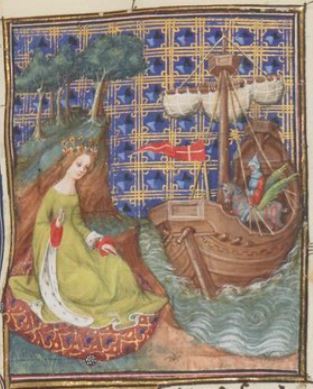
Medusa is illustrated on the left side of the image sitting by the shore as a ship approaches the land. Medusa is depicted in her human form in this image before Minerva transformed her into a monster. Boccaccio explains that Minerva transforms Medusa into a monster because she was angry that she had sexual relations with Neptune inside one of her temples. The hero Perseus is depicted riding his Pegasus on the right side of the illustration in the ship as he is on his way to conquer Medusa’s kingdom.
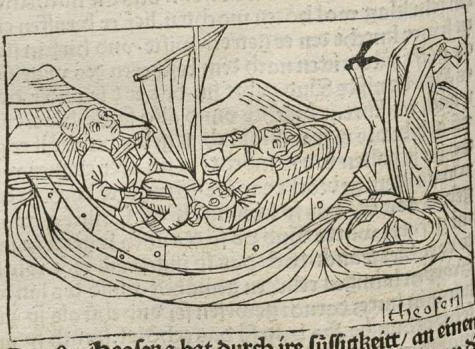
This engraving depicts Theoxena, her husband Poris, and her nephews and child killing themselves. Theoxena and her husband are depicted jumping from the ship head-first into the sea to drown themselves. They are illustrated holding each other as they die as a couple. Theoxena’s name, written as Theosen, is engraved at the bottom right corner of the image to identify her. The figures on the ship are her nephews and her son, who are also killing themselves. Theoxena had given them a choice between stabbing themselves with knives, or to drink poison. There are two boys who had stabbed themselves and one child is depicted drinking the poison from a cup. Boccaccio explains that Theoxena and her family killed themselves to avoid dying at the hands of king Philip of Macedon.
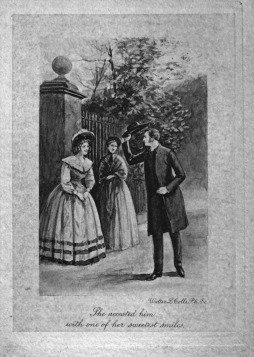
Here we see Rosalie Murray and Agnes Grey outside of their home. Mr. Weston raises his hat, greeting the ladies. Agnes Grey was hired as a governess for the Murray family, where Rosalie was the eldest child. Agnes becomes a confidante for Rosalie. Rosalie liked to flirt with any men whom she saw and became jealous of Agnes because Mr. Weston was flirting with her. Mr. Weston was the village parson who lived near the Murray estate. Agnes believed that Mr. Weston was in love with Rosalie, but he really loved her. Agnes and Mr. Weston eventually fell in love and got married.
After spending several days speaking with different historical figures, Gulliver became disgusted with how history was portrayed, specifically that of the Princes and Kings in history. He found that the writers of history had misled the story leading to corruption and falsehoods. In this image we see some of the corruption of the courts. The King stand in the front of the line with his courtiers behind him. The Queen is next in line holding the hand of the friar behind her, representing the corruption of the church, and the infidelity of women, a theme seen again in this image, as a courtier kiss the hand of a woman who is standing with her husband. The same image appears in the 1839 Krabbe edition.
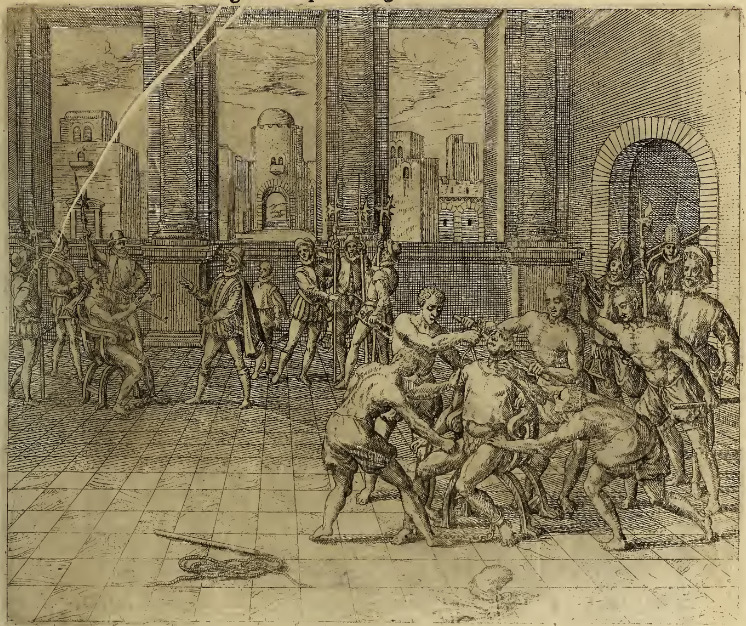
Inca Emperor Atahualpa (Atabalipa) is executed at Cajamarca, despite the ransom of gold and silver having been paid. Atahualpa is seated in a chair with his ankles chained together, inside a large open room. A group of enslaved Black people are forced by the Spanish to carry out his execution. Several men hold down Atahualpa’s limbs while two behind him strangle him to death with a rope tied to a wooden pole. Groups of Spanish soldiers armed with pikes and muskets mill around the room while the execution takes place.
A group of Tupinambá women is shown making a traditional alcoholic beverage using cassava (manioc) root. A group of women in the left corner of the image sit in a circle and chew the roots. Another woman tends a large pot over a fire on the right. In the foreground three women strain liquid into large pots while two other women nearby carry children on their backs.
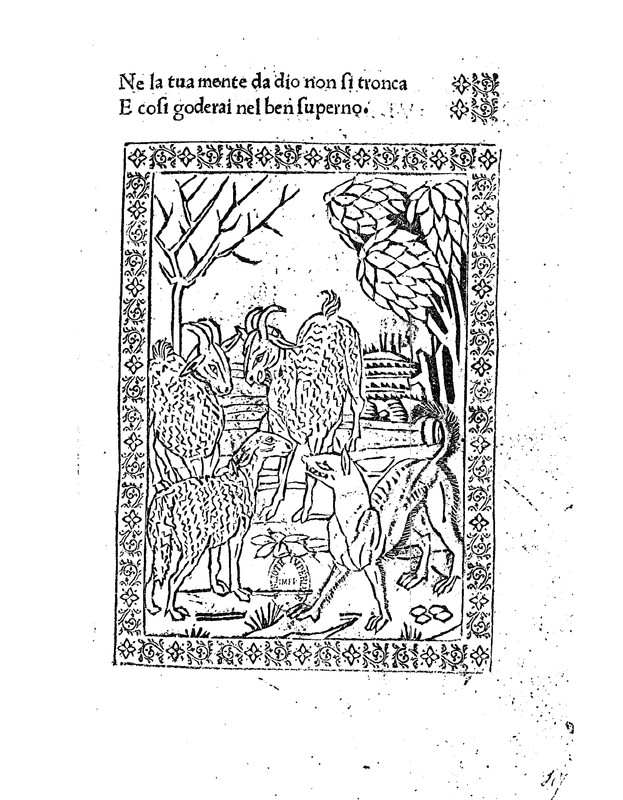
A wolf showing it's teeth is looking at a baby goat that is to the left and two adult goats that stand behind the baby. A dead tree is in the back left of the image, and a tree with leaves is on the right behind the wolf. The image is bordered by a vine design and the signature of Liberale de Verona is stamped on the bottom
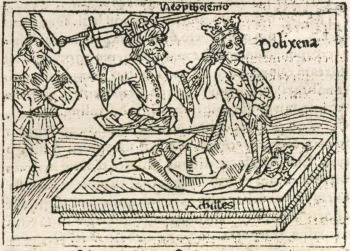
This engraving depicts Polyxena, the daughter of king Priam of Troy, getting executed on top of Achilles’ grave. Polyxena is illustrated kneeling on the grave of Achilles with her hands crossed while looking up to the sky as she accepts her fate. Her name is engraved beside her body to identify her. Achilles’ name is engraved on the side of his tomb. The man about to execute Polyxena is Neoptolemus, the son of Achilles. His name is engraved above his sword. Polyxena had lured Achilles into the temple of Apollo, where Paris shot Achilles with his arrow. Neoptolemus is the one to execute her as she is the one who is partly responsible for killing his father. Boccaccio explains that Polyxena did this through her mother’s instructions. Boccaccio explains that he wrote on Polyxena due to her fearlessness before her execution.
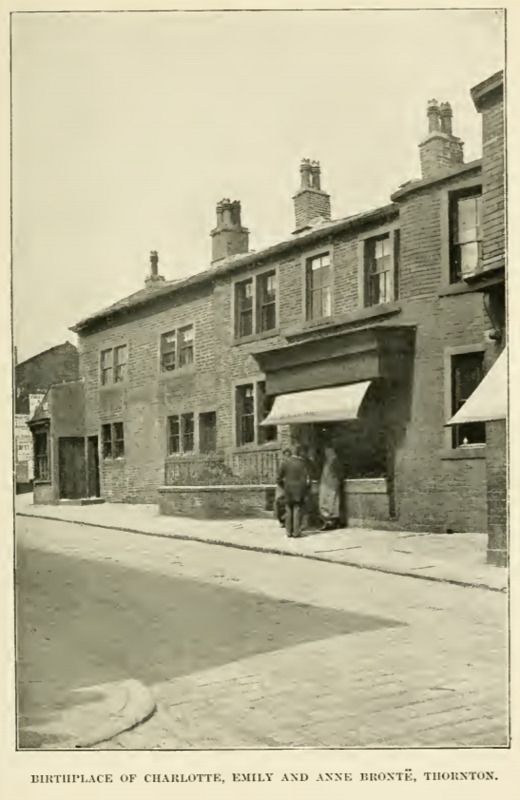
Here we see an image of the ruins of the house where Charlotte, Emily, Anne, and Branwell Bronte were born to Patrick Bronte and Maria Branwell. The house is a small townhouse in the town of Thornton in West Yorkshire. The family lived here until 1820 when they moved to Haworth. The house has been used for several purposes including as a butcher shop and a restaurant. In the 1990s it was converted into a museum that closed in 2007 and it returned to a coffee shop. This image is a reproduction of a photograph using a technique called photogravure, where photographs are taken on plates which could then be etched on to create a plate for use in a printing press.
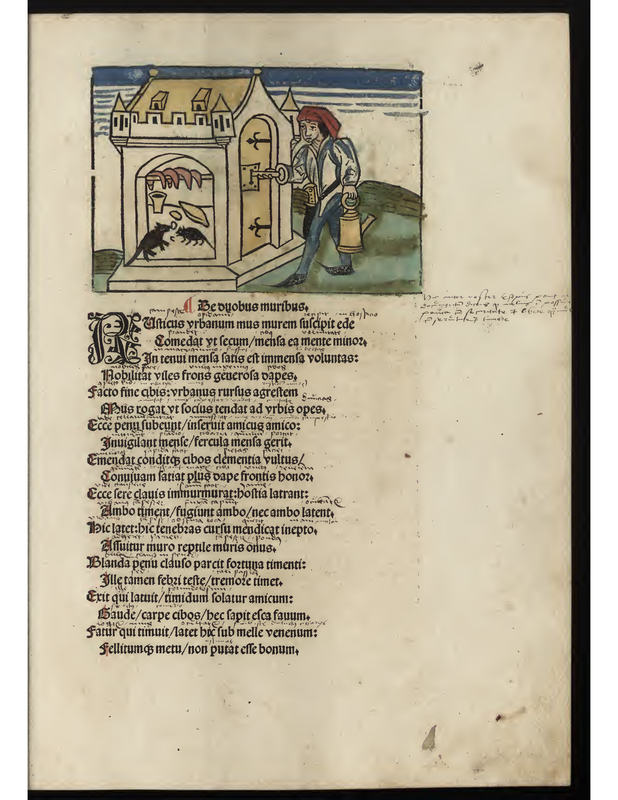
A man holding a lantern is seen unlocking a door to a small building with a key. He carries a knife on his side. Rats are on the left-hand-side of the building.
Here we see Gulliver looking through the window at the seated Empress of Lilliput and her maid. The Empress is seated and has her arms reaching out towards the maid who holds a cat. The same image appears in the 1843 Krabbe edition.
Here Lilliputians are taking an inventory of Gulliver’s personal effects. Two Lilliputians carry Gulliver’s pocket watch, linked through the top loop of the watch. The inventory was taken by the Emperor’s guards, identified by their uniform and large headwear with large feathers.

![[King in bed]](https://collections.cemvc.ca/files/large/bb7e9b32076dd8bdf3b0ac9fb9b37fd56da0c77c.jpg)
![[Mr. Darcy confesses his love for Elizabeth]](https://collections.cemvc.ca/files/large/76ed2fa68207b9e95bebb573d7fb5cc3d4a6419a.jpg)
![[Act II – Pármeno and Calisto]](https://collections.cemvc.ca/files/large/fc8cacb52b9b7a25716b6da38760667ecae72a4f.jpg)
![[Wolf Bites Sheep]](https://collections.cemvc.ca/files/large/b8cf8a24b6a793517e872b21edc44cd891a66359.jpg)


![[Act XXI (First Illustration) – Melibea Falling as Pleberio Watches in Agony]](https://collections.cemvc.ca/files/large/2fe66deea2cee0a0105ae2641a6a93f697ed714b.jpg)
![[The corruption of the courts of Europe]](https://collections.cemvc.ca/files/large/567a982f4f591d6bd8d3a8476917c0c81b2584d2.jpg)
![[Tupinambá women make a traditional alcoholic beverage]](https://collections.cemvc.ca/files/large/3ce0fc382c3faf09c962bb2938083ed0cc788ee5.jpg)
![[Gulliver looks in on the Empress of Lilliput through the window]](https://collections.cemvc.ca/files/large/cd867e94d0697450901c1087e57d71d2e1a8aec3.jpg)
![[Lilliputians take inventory of Gulliver’s personal effects]](https://collections.cemvc.ca/files/large/1f0132af9c070a48ab0ba221708dbf219e2f74e4.jpg)