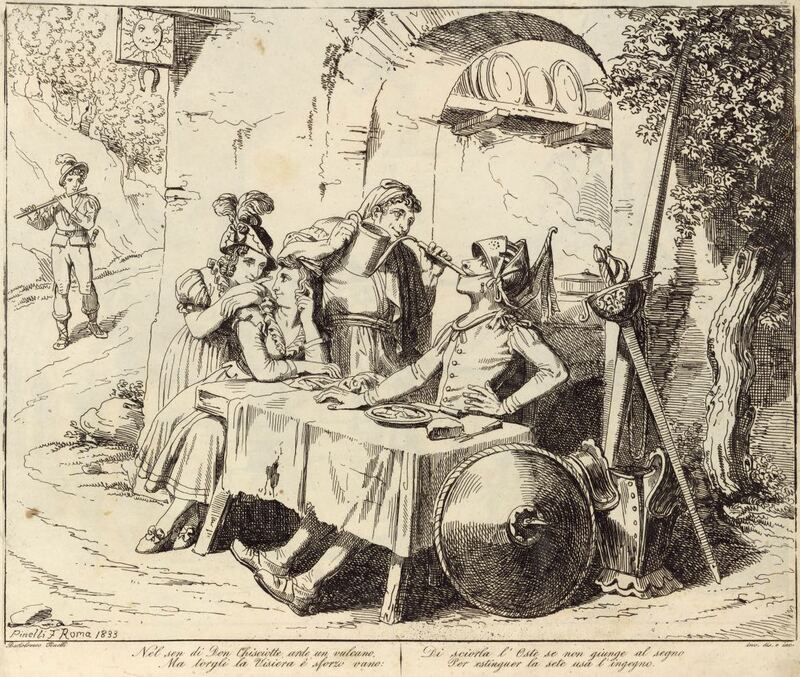
Don Quixote dines at the inn with the innkeeper, Doña Molinera, and Doña Tolosa. They are seated at a table at the door of the inn to take advantage of the cooler air. The innkeeper helps Don Quixote drink wine with a hollow reed through his helmet. In the background, a gelder of hogs arrives at the inn and plays his reed pipe (pictured in the illustration as a flute). Don Quixote mistakes this sound for music played for his entertainment. Signed by Bartolomeo Pinelli (engraver and illustrator) and dated Rome, 1833. Plate 3. Part 1, ch. 2.
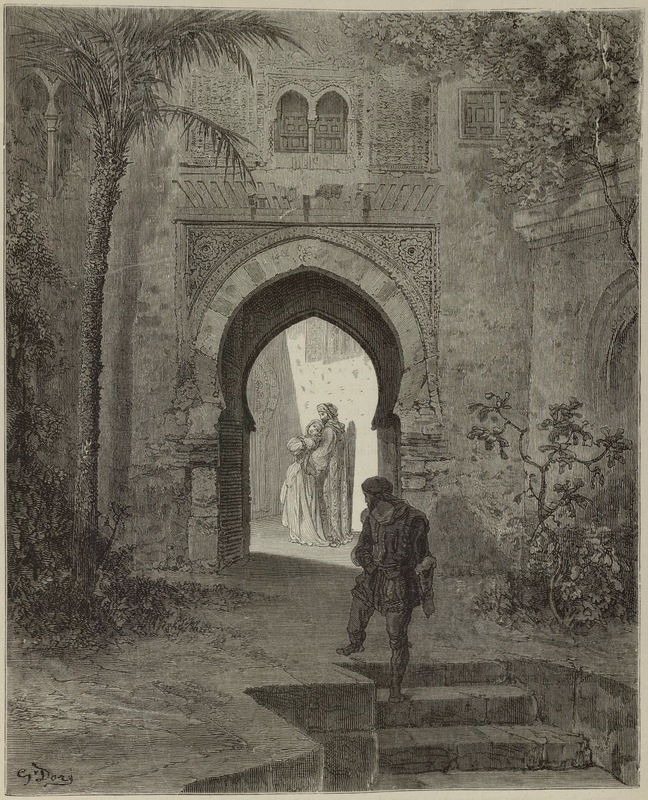
The illustration represents part of the captive’s tale: Zoraida’s father, Agi Morato, holds her in his arms as the captive leaves the estate. Signed by G. Doré (illustrator) and H.-J. Pisan (engraver). Part 1, ch. 41.
Sitting upon a high throne, Sancho Panza crosses his legs and extends his left hand towards a man (right) dressed in the manner of a rich herdsman with his hat sheepishly clutched between his hands. In Sancho Panza's right hand he holds a wand between his fingers. On the right, a woman crosses her arms smugly and a man by Sancho's left stands with a halberd by his side.
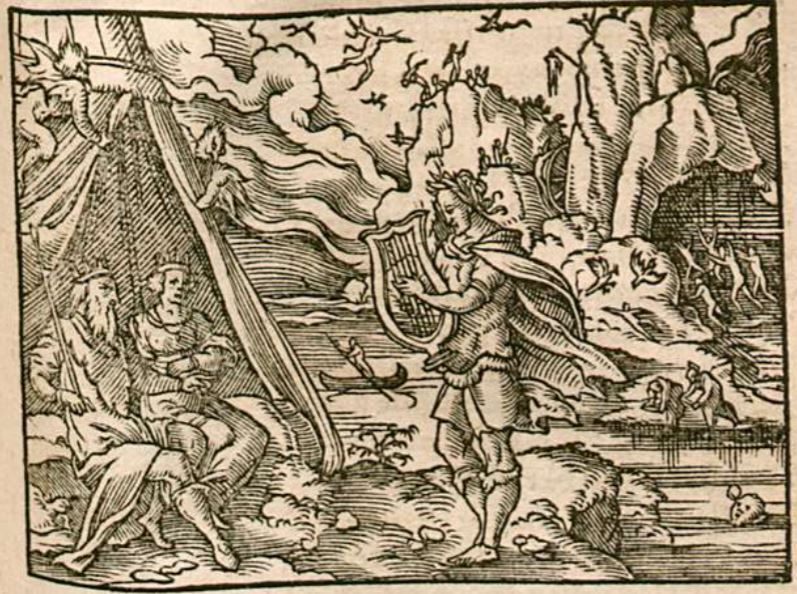
Pained by the death of his new bride, Orpheus was determined to get her back. With his lyre in hand, he travels to the Underworld to convince the lord of the Underworld and his wife, Proserpina, to let Eurydice finish living her life. Orpheus is illustrated in the center of the engraving, singing and playing his lyre to the lord and lady of the Underworld, who are sitting directly in front of him. Charon, the ferryman who carries the dead across the River Styx is illustrated in the background of the engraving in the water. Pluto and his wife were impressed with Orpheus and his lyre playing and singing abilities, and allows him to bring Eurydice back with him, so long as he does not look back to her while they travel out of the Underworld.
Having given up his governorship, Sancho Panza returns to the Duke's castle, but having partaken in a prolonged farewell night falls before he reaches the castle. In seeking a place to camp for the night, Sancho ventures off the path and falls into a very deep and dark pit with his donkey named Dapple. The next morning, Don Quixote chanced upon the hole while riding upon Rocinante and heard a voice from within. Upon hearing Sancho's voice, Don Quixote (pictured on Rocinante observing the rescue of his squire) thinks that his squire has died and become a specter who is doing penance within the chasm. Quixote only believes that it is his live squire within the pit when he hears the braying of Panza's donkey. Quixote returned to the Duke and Duchess for aid, and they sent ropes, pulleys and aides (pictured surrounding the pit). Through a great deal of labor Sancho Panza (pictured emerging from the pit) was drawn out of the dark pit into the light of the sun.
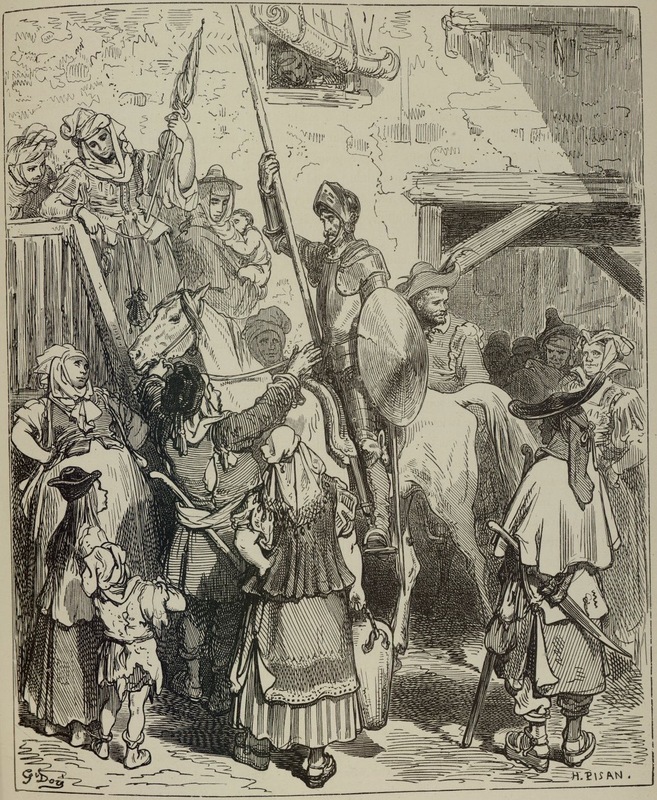
As Don Quixote makes ready to leave the inn, the innkeeper asks him to pay for the night he spent in the inn: straw and feed for Rocinante and Sancho Panza’s donkey, and their supper and beds. Don Quixote refuses, asking the innkeeper to forgive the debt. He cannot contravene the order of knights errant, who he believes never pay for their room and board because whatever welcome they receive is owed to them as their right and privilege in return for the hardships they suffer in the course of their adventures. Signed by G. Doré (illustrator) and H.-J. Pisan (engraver). Part 1, ch. 17.
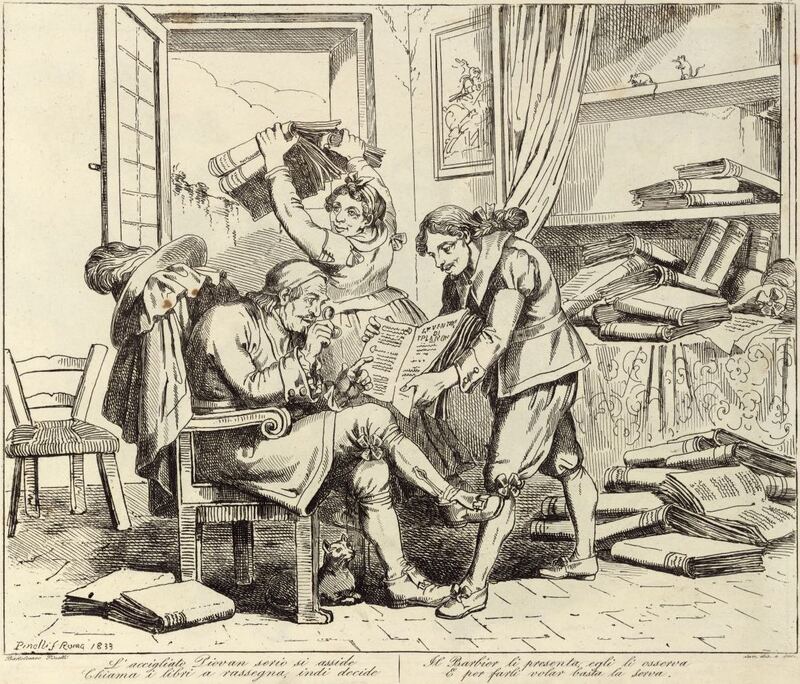
The housekeeper, the priest, and the scrutinise the books in Don Quixote’s library, later deciding to burn them for their responsibility in Don Quixote’s madness. The barber holds a chivalric book open while the priest reads. The housekeeper throws books out the window into the courtyard. Signed by Bartolomeo Pinelli (engraver and illustrator) and dated Rome, 1833. Plate 11. Part 1, ch. 6.
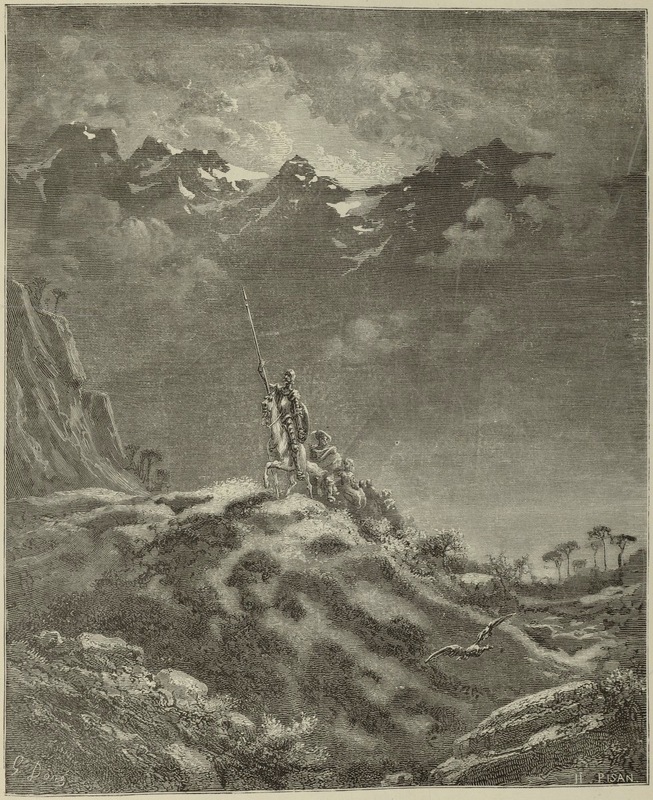
As the party leaves Sierra Morena, the priest suggests that they take the road to Cartagena on their way to the kingdom of Micomicón. Signed by G. Doré (illustrator) and H.-J. Pisan (engraver). Part 1, ch. 29.
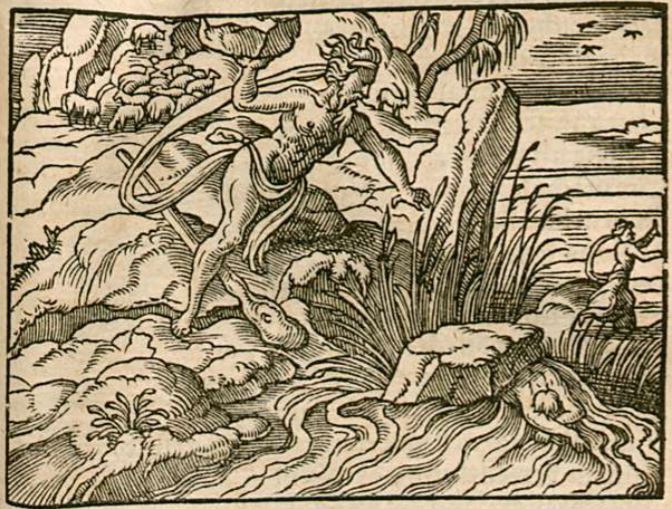
This engraving illustrates Polyphemus, a cyclops, hurling a massive boulder at Acis. Polyphemus was in love with Galatea, a Nereid who did not mutually share this feeling. Galatea was in love with Acis and rejected Polyphemus’ affections. One day, Polyphemus found the two lovers embracing and chased Acis until he threw a massive rock at him. The boulder crushed Acis as illustrated in the engraving. Galatea is depicted in the background of the engraving running away from Polyphemus. Acis' blood transforms into a river.
This plate depicts two scenes in ch. 17. In the background, Don Quixote attacks a flock of sheep. In the foreground, several mischievous guests at the inn wrap Sancho Panza in a blanket and toss him in the air, while Don Quixote watches from behind the inn wall. Unsigned. Part 1, ch. 17.
In an inn, a Moorish captive tells Quixote's company of his long and troubled past. In this image, the captive and his alleys unbound the Moors whose ship they had stolen, and set them free, one by one, on shore, to their great surprise. The order to unbind the prisoners was give at Zoraida's expense who could not bear to see her father and the rest of the moors bound. The ship came to a creek by the side of a small promontory, which the Moors called the cape of Cava Rumia. Zoraida's father (pictured praying to his God) who was then perfectly in his senses, fell to his knee's and prayed to his god to curse the captive and his daughter. So high he once raised his voice that it reached the ship on the horizon upon which the captive and Zoraida had set sail towards Spain.
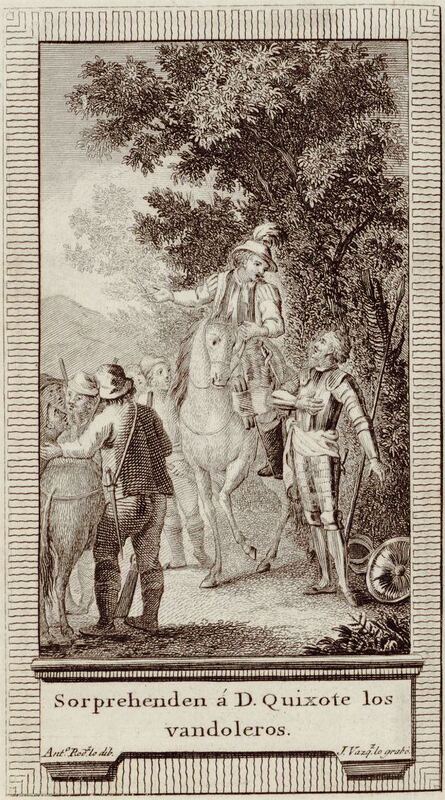
Don Quixote meets Roque Guinart after he and Sancho are surprised by the bandits. He explains that he was captured unarmed and that had found him on his horse, with his lance and his shield, it would not have been easy for them to defeat him. Signed by A. Rodríguez (illustrator) and B. Vázquez (engraver). Part 2, ch. 60.
A procession of pilgrims in rows of two enter beneath a stone archway into a holy place. The pilgrims wear white robes that fall to the ground and wide brimmed white hats with walking sticks that reach the chest. On the left, one of the pilgrims is on his knees praying at the entrance to this holy place. The image is occasioned by Ricote saying "I took a house in a village near Augsburgh, but soon left it and joined company with these pilgrims, who come in great numbers every year into Spain to visit its holy places, which theylook upon as their Indies, and a certain gain and sure profit" (Page 547).
Don Quixote and Sancho Panza get into a boat on the Ebro River, leaving Rocinante and Sancho’s donkey braying on the riverbank. The boat lacks oars. Signed by J. Rivelles (illustrator) and A. Blanco y Asensio (engraver). Part 2, ch. 29.
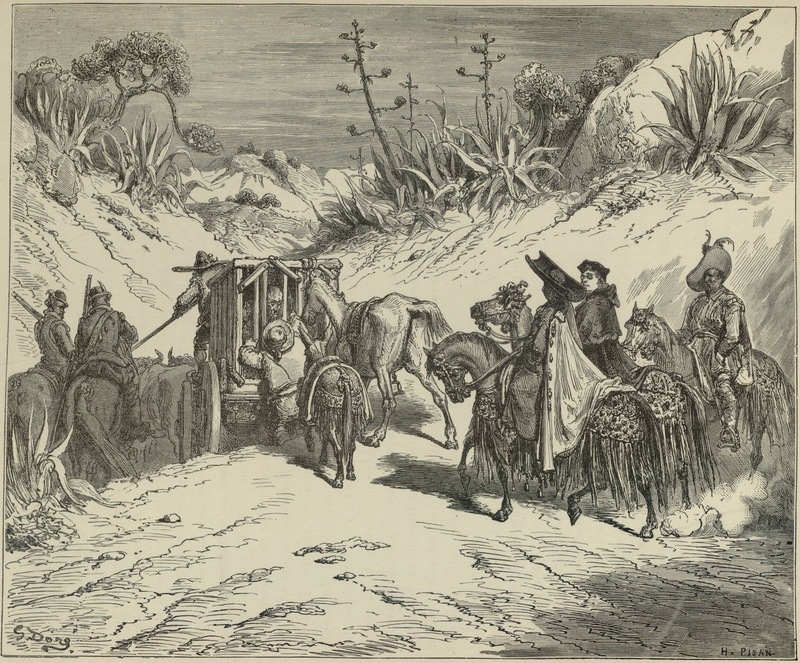
While the priest and the canon of Toledo discuss chivalric novels, Sancho Panza speaks with Don Quixote through the bars of his cage on the oxcart. The officers of the Holy Brotherhood are also depicted (left). Signed by G. Doré (illustrator) and H.-J. Pisan (engraver). Part 1, ch. 48.
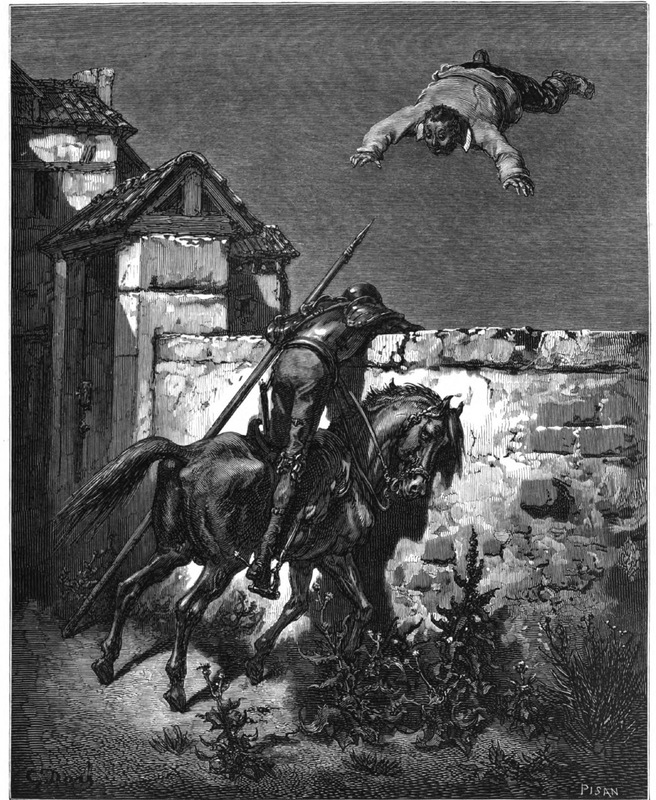
In order to punish Sancho Panza and Don Quixote for refusing to pay for their time at the inn, several of the other guests at the inn begin to blanket Sancho, tossing him into the air with a blanket. Seeing this, Don Quixote yells insults over the wall at them, but to no avail. Don Quixote can be seen attempting unsuccessfully to climb the wall from Rocinante’s back while Sancho Panza flies in the air above the wall. This scene can be found in Part I, Book 3 Chapter 3.
Having fallen down amidst the violence, Sancho lies like a tortoise enclosed and covered by his two shields, like a boat keeled upwards upon the sand, his arms outstretched and a halberd clenched in his right hand, his mouth wide crying out at his assaulters to cease their attack. Above Sancho, a young man equipped with a stick steps onto his back followed by a spearman. On the right, a moustached man with a spear points his weapon towards Sancho's hind shield. In the background a large group of people have become involved in a scrum.
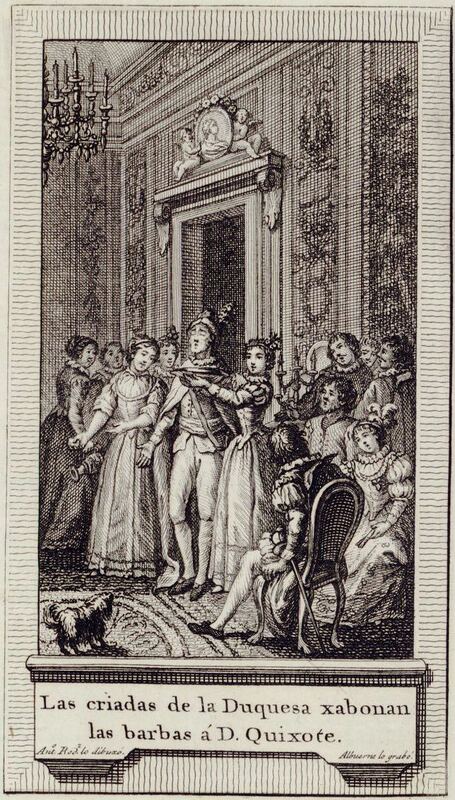
As the table is being cleared after the meal, four of the duchess’ maidens enter the room. The first bears a silver basin, the second a silver pitcher, the third two thick white towels, and the fourth a round cake of Neopolitan soap. They place the basin before Don Quixote, leading him to conclude that it must be the custom in this land to wash one’s beard rather than one’s hands. After the beard-washing maiden has covered his beard with lather, she pretends that there is no water left asks the one with the pitcher to fetch more, leaving Don Quixote waiting. The duke, the duchess, Sancho Panza, and the maidens hide their laughter at the strange and funny sight. Signed by A. Rodríguez (illustrator) and M. Albuerne (engraver). Part 2, ch. 32.
Meeting with Don Quixote to try and persuade him away from knight-errantry, the barber tells a story of what once happened in Seville. In an asylum for the 'insane', a 'madman' (left) sits, his head resting on his hands behind the iron bars of a cell. The licentiate (middle) points towards the madman angrily, having been told that he is not so sane as he says and that he may well not leave at all to save himself the trouble of returning. The chaplain (right) dressed in black robes and a long hat listens to the licentiate rebuke the madman.
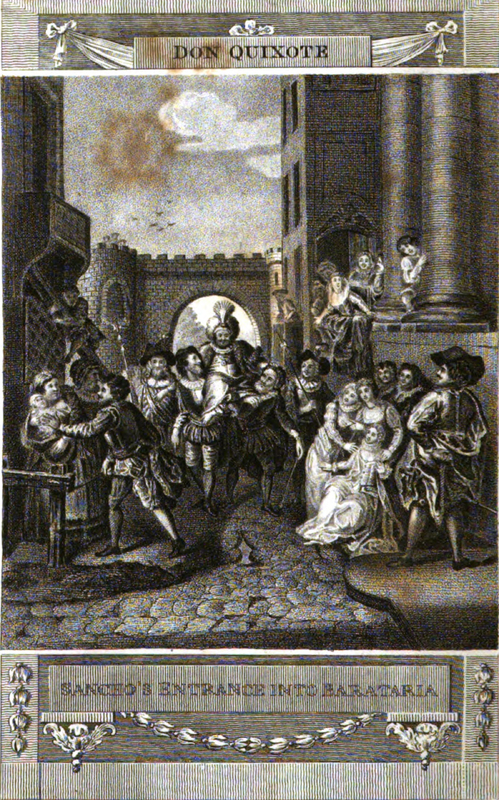
Sancho Panza sets out with a great number of followers towards the Barataria, the island which he is to govern. He is wearing a wide surtout coat and a murrey coloured camlet, with a cap. At his arrival in the walled town,, the magistrates, in their robes of office, came out to receive him and carry him to the church along a cobbled road. As they proceed bells ring, and the thousand inhabitants of the city give their demonstrations of joy at their governor's arrival.
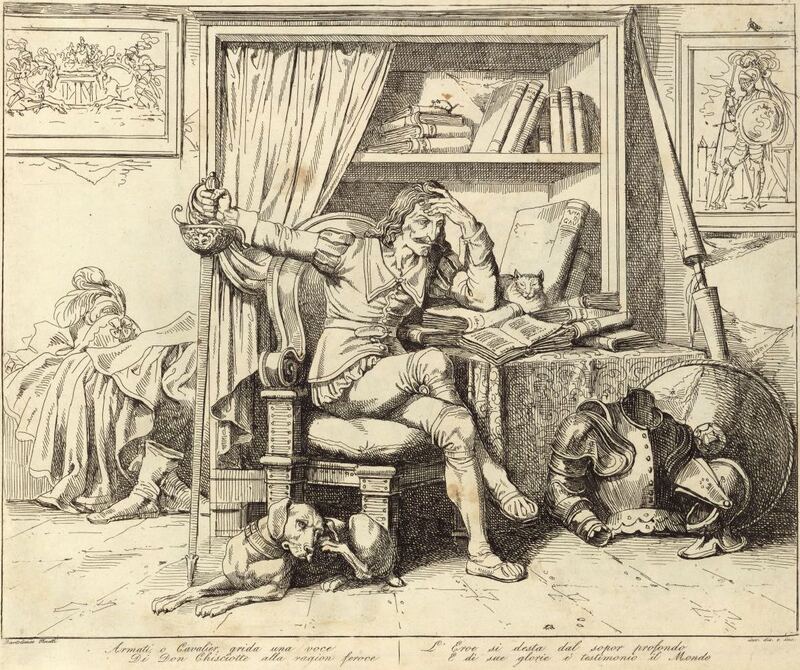
Don Quixote reads chivalric books in his study. He holds a sword and his lance and armour are scattered around him. His bed is pictured in the background. Also depicted are a dog, at Don Quixote’s feet, and a cat, amongst the books on his desk. Signed by Bartolomeo Pinelli (engraver and illustrator) and dated Rome, 1833. Plate 1. Part 1, ch. 1.
A young boy sits against a wall with one shoe on his left foot and eats a pear with his right hand. On the ground by his side lie five more pears. The imae is occasioned by Sancho Panza saying "That is what I renounce, Signor Sampson, my master makes no more of attacking an hundred armed men, than a greedy boy would do half a dozen pears" (Page 48).
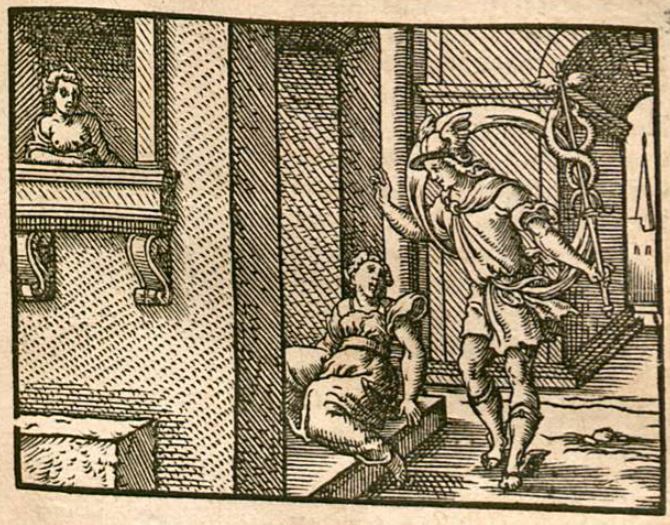
This image illustrates the messenger god Mercury depicted with his winged helmet and ankles and carrying his caduceus. He is standing over the body of Aglauros, one of the three daughters of King Cecrops. Herse is one of Aglauros’ sisters, and she is illustrated on the far right of the engraving looking out the window of her bed chamber. Mercury is trying to get to Herse, but Aglauros is standing in the way by laying on the ground in front of the entrance. Aglauros is jealous of Mercury’s attraction to her sister and she denies Mercury entry to Herse’s room. Mercury gets frustrated with Aglauros’ attempts to deny him access to Herse, so he turns her into stone.
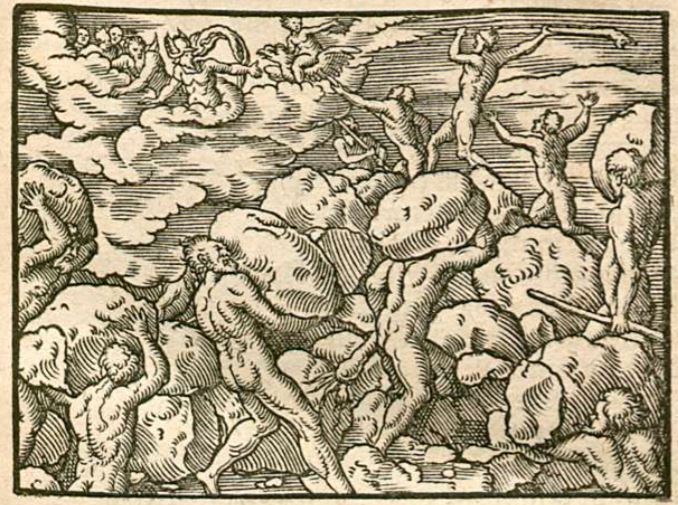
This engraving illustrates giants participating in a war against the god Jupiter, who is depicted in the top left corner of the image surrounded by clouds and other gods on top of Olympus. The giants in the image are carrying rocks and stacking them on top of each other in order to reach Mount Olympus. Mount Olympus proves to be too high to reach, so the giants pile Mount Pelion on top of Mount Ossa in further attempt to reach Jupiter. Before the giants can reach Jupiter, he hurls his thunder bolts on to the mountains that the giants were climbing, eventually knocking them over, which leads to their destruction.
Don Quixote, clad in armor save for his helmet (left) and Sancho Panza (center) lie on the ground having been beaten by the Yanguesians. Quixote's sword and shield lie at his feet and Rocinante lies, also beaten, to the right. In the background Sancho's donkey, Dapple, grazes passively.

![[Sancho Panza Orders the Herdsman to Pay the Woman Twenty Ducats]](https://collections.cemvc.ca/files/large/1ef882b349e7331c2504059c77401be20d90a65c.jpg)
![[Through a Great Deal of Labor, Sancho Panza was Drawn Out of the Dark Pit into the Light of the Sun]](https://collections.cemvc.ca/files/large/b9a1f42a5e4093fa4844018b650d4c166328c24c.jpg)
![[Don Quixote attacks a flock of sheep; Sancho Panza is blanketed]](https://collections.cemvc.ca/files/large/a494ffa4091fdf97b9669dee6302873ac828c8c1.jpg)
![[Zoraida's Father Curses the Captive and his Crew]](https://collections.cemvc.ca/files/large/74a536a615d8b8e5b8140250b63d19400a133a5e.jpg)
![[Ricote Joins Company With Pilgrims]](https://collections.cemvc.ca/files/large/ab9f22733c229d07dd0b9c75f26661c44a682567.jpg)
![[Adventure of the enchanted boat]](https://collections.cemvc.ca/files/large/899f20447f3909505065dfaa9e7150c16ebf997f.jpg)
![[Sancho Panza Lays Like a Tortoise in the Battle of Barataria]](https://collections.cemvc.ca/files/large/c14f0d0aa74fda0f21c1a66a7ecefde1d963cf82.jpg)
![[Of How the Jailed 'Madman' Told the Licentiate to Save Himself the Trouble and Stay in Prison]](https://collections.cemvc.ca/files/large/e8150aa1ace7503e08f2ae2537be9c46498d2ce7.jpg)
![[A Greedy Boy Eats Half a Dozen Pears]](https://collections.cemvc.ca/files/large/457b6a9d094dc15bbd4904d002d504a782ec2f06.jpg)
![[Don Quixote Meets the Yanguesians]](https://collections.cemvc.ca/files/large/15e0b811625a30209bf37be88d40e57190a495ee.jpg)