The picture shows Peggy O’Dowd in a feathered turban, holding a closed fan with both hands, with her elbows on a the edge of an opera box. In the top right of the image is the letter M from Mr.
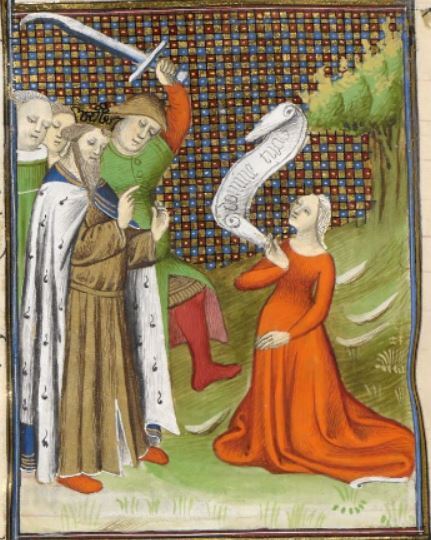
This illumination depicts Cassandra, the daughter of King Priam of Troy, kneeling while holding a scroll of parchment. She is showing this to King Agamemnon, who is standing on the left side of the image. Cassandra had the gift of foresight and predicted the events of the Trojan War and the downfall of her city. She predicted the death of Agamemnon, as well as her own. Cassandra appears to be desperate in this illustration as she tries to tell Agamemnon her predictions, however he does not understand her prophecies (as she is cursed to not have her prophecies believed by anyone). There is a man with a sword beside Agamemnon which foreshadows Cassandra’s death.
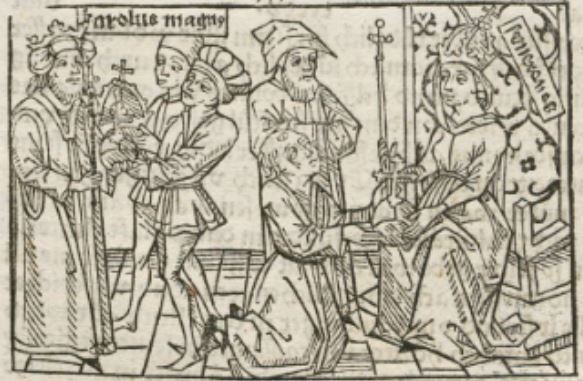
The right side of the engraving depicts Empress Irene of the Eastern Roman Empire sitting on her throne. There is a man kneeling in front of her presenting her with the globus cruciger to demonstrate her authority. The left side of the image depicts the pope crowning Charlemagne as emperor. The pope did not recognize Irene’s rule as she was a woman, which led him to coronate Charlemagne as emperor.
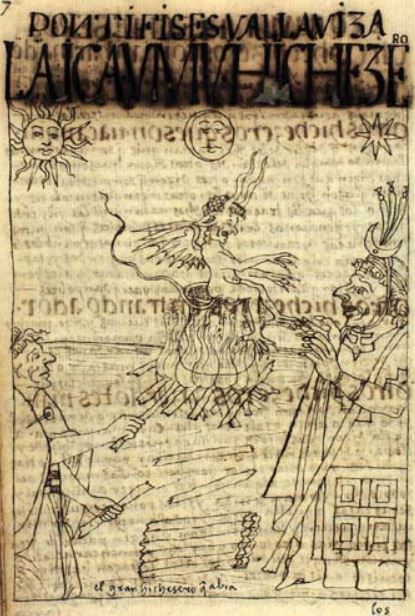
This chapter is dedicated to discussing the sorcerers of the Inca Empire and their practices. This image depicts two sorcerers practicing their craft by lighting a fire under their ari manca [pot]. The sorcerer on the left side of the image is holding firewood in his hands to keep the fire lit, while the sorcerer on the right side is depicted looking at the pot. The author explains that the sorcerers would put items such as coca, silver, gold, and feathers into the pot and burn it in order to speak to the devil. There is a demon figure illustrated sitting on the pot to demonstrate this. There is a sun, moon, and start illustrated at the top of the image. The caption at the bottom of the image reads el gran hichesero que abía [the greatest sorcerer there was].
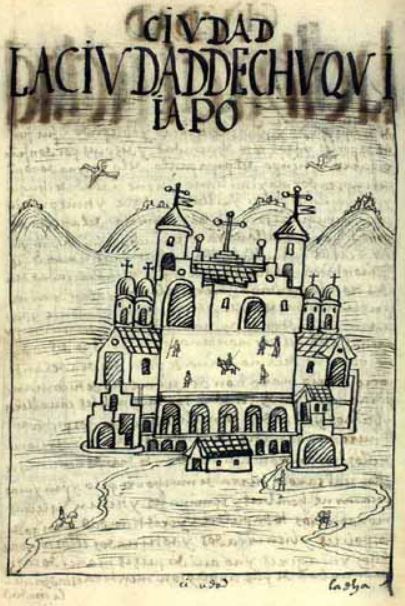
This image is depicted in the author’s chapter where he discusses cities, towns, villages, and provinces in colonial South America. This image depicts the city Chuquiyabo [La Paz] in modern day Bolivia. The city is arranged in a cluster of buildings that forms a centre where people are depicted walking. The mountainous Andean lanscape is illustrated in the background with birds flying in the sky. There are two winding pathways that lead in and out of the city where two people are illustrated walking and one person is riding a horse. The author explains that the city was founded by Spanish conquistadors and was wealthy in food and silver and gold. The caption at the bottom of the image reads ciudad [city].
Amelia Osborne sits in her chair in the bedroom she used before she was married, looking melancholy. Behind her, Miss Flannigan, the maid, is leaning over the chair with one hand on her hip. On a smaller, wooden chair and the floor in front of Amelia there are scattered papers.
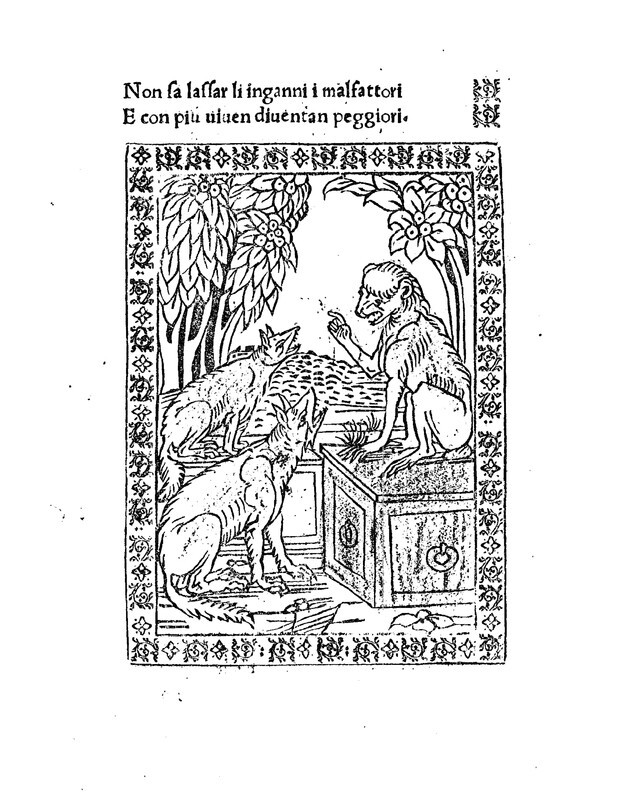
in the forest, Two Wolves are howling at a Fox which is perched ontop of a large box with one arm in the air pointing a finger. The image is bordered by a vine design
Two European ships are anchored near the coast, close to an island labelled ‘S. Catherina Ins.’ Several European men sit around a fire on the island, while others chop down a tree and gather brush. A canoe bearing several Tupinamá men and one European approaches the island from the left and five other canoes come from the right, with the five heading towards a rowboat filled with European men. On land several European men with spears explore an abandoned Tupinambá village near the shore. The frames of several of the structures are exposed and parts of the fence are broken. A large cross with a plaque hanging around it has been erected on the cape near the village and two European men stand beside it.
Miss Betsy Horrocks, with very large ribbons in her hair, sits on a low stool in front of the piano in the Crawley manor’s drawing-room. Beside her stands Miss Hester, the kitchen maid, who is praising her playing.
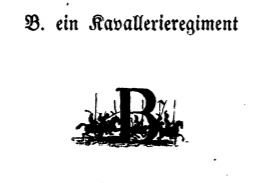
Here we see the letter B with cavalry surrounding it. The letter B using a method of coding developed by scholars at the Grand Academy on Balnibarbi signifies the word cavalry. This image comes in a description of a conspiracy found by a professor from the Grand Academy on Balnibarbi. This conspiracy is thought to be an allusion to the trial of Francis Atterbury, the bishop of Rochester for allegedly plotting with the Jacobites. Atterbury was charged with treason in 1722 and was exiled to France. The same image appears in the 1839 Krabbe edition.
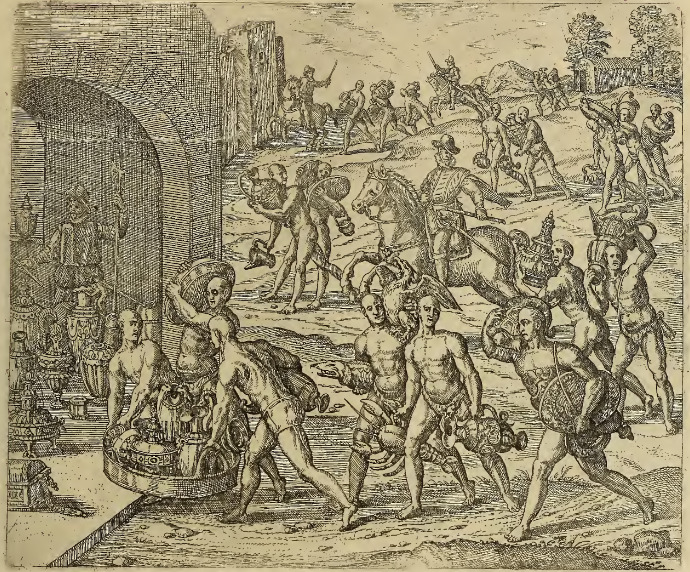
Inca Emperor Atahualpa (Atabalipa) agreed to pay the ransom amount demanded by Francisco Pizarro to secure his freedom. Inca men stream towards the walls of the city Cajamarca bearing gold and silver items, including plates, vases, chests of jewelry, carvings of mythical creatures, and other pieces they have gathered throughout Peru. The Inca people are supervised by several Spaniards on horseback wielding wooden clubs or truncheons. This image is identical to one found on page 10 (129) of Frankfurt, 1596.
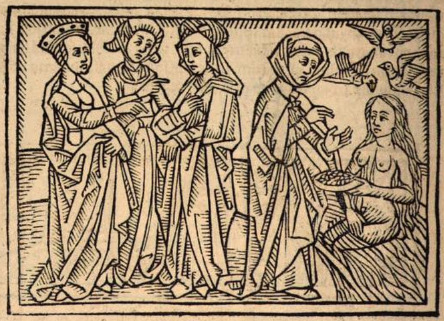
This engraving depicts Sulpicia, a woman renown for her chastity, consecrating a statue of Venus. Sulpicia is depicted on the right side of the engraving with her hands reaching out towards the nude statue of Venus. There are doves flying above the statue of Venus as doves are known to be one of many symbols of the goddess. There is a group of women depicted behind Sulpicia as they were all chosen as some of the most chaste women of their time, and they all voted for Sulpicia to be the one to consecrate the statue.
Amelia Osborne stands with her head tilted slightly to one side, looking up and to the right of the image. She has one hand held to her chest and is holding a closed fan in the other by her side. She is framed in the letter C from Conducted.
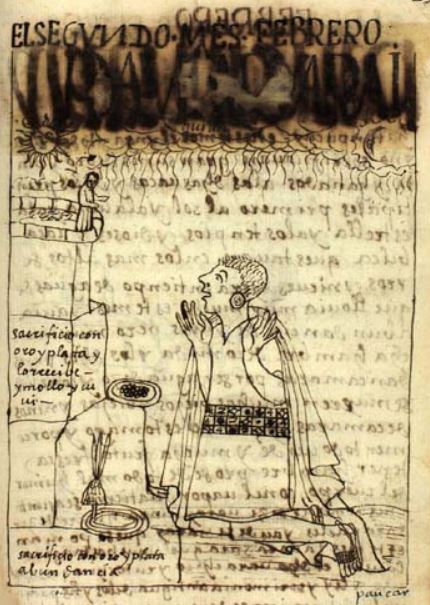
This chapter is dedicated to discussing the traditions and rituals of each month during the Inca Empire. The Incas tracked the months and years through the stars and their months consisted of thirty days. This image depicts the month of February, which was dedicated to wearing loincloths and sacrificing gold, silver, and llamas to their idols and Gods. The author explains that February was also a month of heavy rains, which is why there are clouds and rain drawn at the top of the image. There is a man kneeling in the image as he offers his sacrifice to his idol which is pictured atop a mountain on the left side of the image. The caption that describes the image is written written on the side of the mountain and it reads sacrificio con oro y plata y lo rrecibe y mollo y cuui, which translates to sacrifice of gold and silver, and he receives it, and seashell and guinea pig. The other caption at the bottom of the image reads sacrificio con oro y plata abundancia, which translates to abundance of sacrifice in gold and silver.
In this image we see Gulliver pulling Blefuscudian ships back to the port in Blefuscu. Gulliver threw ropes and hooked the ships. Gulliver then used the ropes to pull the ships back to their home port, resulting in damage to the ships. In the image we see Gulliver stepping out of the water onto land with his left arm stretched above his head. In his right hand he holds fifteen ropes attached to ships – not all of which are visible. On the right hand side several Blefuscudians are visible, looking onto the scene. The same image appears in both the 1839 and 1843 Krabbe editions.
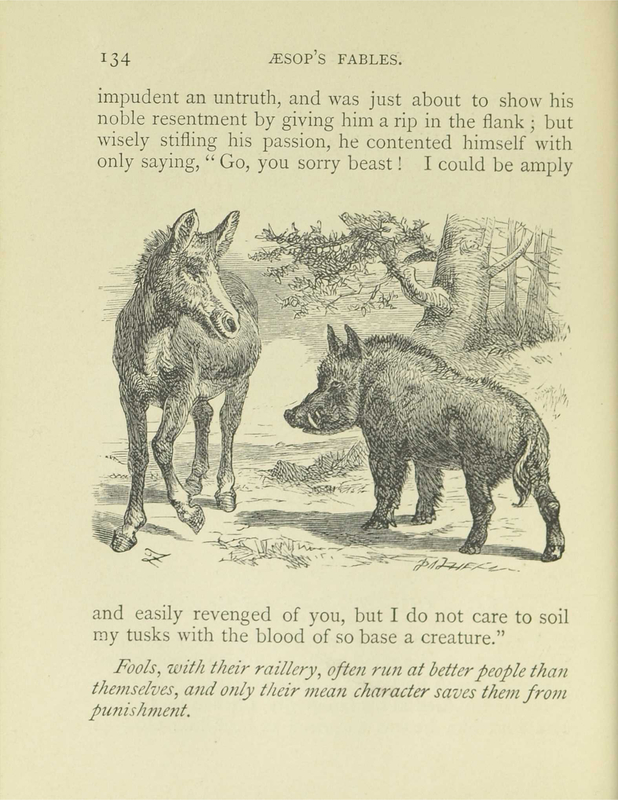
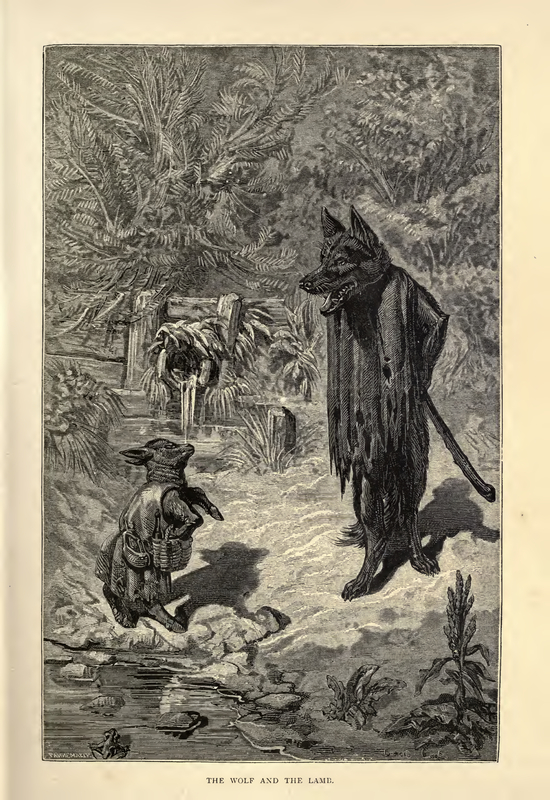
To the right of the image, a wolf stands tall like a human. It is wearing shaggy clothes and holding a stick behind its back. The wolf is looking down at a small lamb, its mouth is open as though it was talking. The lamb too is standing like a human. The lamb wears a long vest and has tools wrapped around its waist. The lamb is looking up at the wolf. Behind the lamb, there is small river. Further behind them, a wooden wall with a small water tunnel in the middle of it flows water into the river.
Two groups of Indigenous Brazilians engage in conflict. Members of both groups are armed with bows and arrows and clubs, and some carry shields. Several individuals blow into long instruments resembling a type of horn, and at least one person blows into a conch shell. There are two structures visible in the background, one of which is on fire. This illustration is a simplified and mirrored version of the one found on page 73 verso of Paris, 1557.
There is an illustration at the top of the page; below this illustration is a body of text. In the illustration, there are three men with two men towards the left of the illustration and one man towards the right. From the two men on the right, one is a well-dressed man holding a key and the other is a holy person who is talking to the third man. The third man is inside a structure of some type and his feet are sticking out of this structure from below whilst the rest of his body is inside.
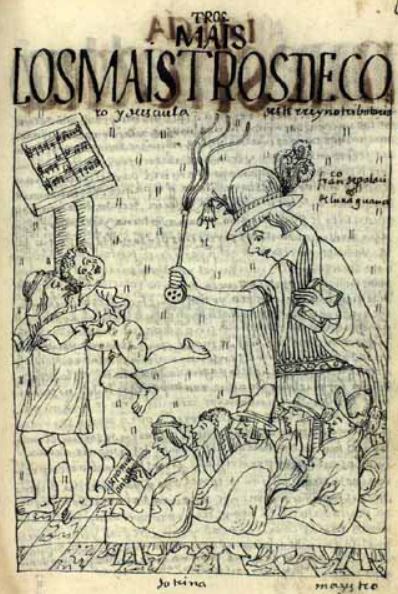
This image depicts a schoolmaster teaching a group of indigenous children. The schoolmaster is depicted holding a whip in his right hand and a book in his left. The name Francisco de Palacios de Luna, Guanca is written beside the schoolmaster. The children are seated on a small bench as they write down what their schoolmaster dictates. There is a music stand on the left side of the image that has sheet music resting on it. There is a servant on the left side of the image depicted carrying a child on his back. The child has the lower half of his body exposed for the schoolmaster to whip him. The child has tears running down his face. The author explains that the schoolmasters would teach children to read and write so that they can grow up to be good Christians.
In this image, Gulliver lies on the ground, reclining, speaking to the Lilliputian Emperor. The Emperor is identified by his cape, hat with three feathers, and sword. This image comes while Gulliver gives a detailed description of the Emperor. The same image appears in the 1839 Krabbe edition.
Here Jane sits in a straight back chair with her back to the viewer. Mr. Rochester requested Jane spent several evenings with him in the library. She obliged and is seen here in a discussion with Mr. Rochester. There is a similar image of Mr. Rochester on the opposite page to appear to the reader as though the two characters are having a conversation across the page.

![[Vanity Fair Chapter XXIX Historiated Initial]](https://collections.cemvc.ca/files/large/b109062fcbea334d0e2ee7ea8896e6d61e5ce99b.jpg)
![[Miss Flannigan and Amelia]](https://collections.cemvc.ca/files/large/b08abc0f637c333928b4111c339918170a2241c8.jpg)
![[European ships anchored along the coast near an abandoned Tupinambá village and the island Santa Catarina]](https://collections.cemvc.ca/files/large/c42045263042b1bb465b0be45bcfb5eea061c7c1.jpg)
![[Miss Horrocks at the Piano]](https://collections.cemvc.ca/files/large/9618c8d36c8b8ae1aae5a0e14e960fd674fd69eb.jpg)
![[Vanity Fair Volume I. Chapter XXV Historiated Initial, C]](https://collections.cemvc.ca/files/large/abd81aa551e98b8cdbb151d34f8861ff8e1c87ef.jpg)
![[Gulliver pulls Blefuscudian ships back to Blefuscu]](https://collections.cemvc.ca/files/large/9c53f2dc7d5c89012c45d234024b7ed19b2996c7.jpg)

![[Conflict between two groups of Indigenous Brazilian people]](https://collections.cemvc.ca/files/large/09fbf1b419e88e0b7c6d93cf65e477c72d17dd69.jpg)
![Vita et Fabulae [Two men converse with a person who is inside a small structure with only his feet sticking out]](https://collections.cemvc.ca/files/large/91b0031220f724b8be34424e06975879de071417.jpg)
![[Gulliver and the Emperor of Lilliput in conversation]](https://collections.cemvc.ca/files/large/9191e8e2f54ec331ce90a53eba94bd8907c7e7f1.jpg)
![[Jane Eyre sits in a chair looking at Mr. Rochester]](https://collections.cemvc.ca/files/large/f9cacbbb505b3a2ad0badbc1d9e7a20628a8ad75.jpg)