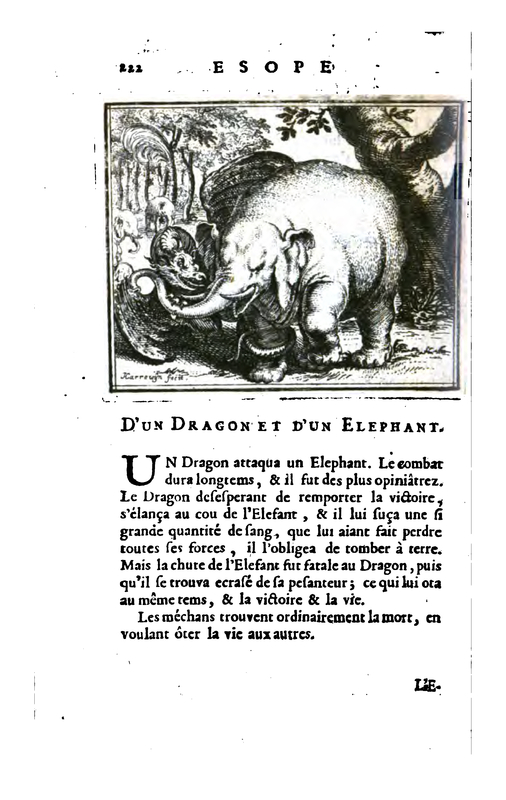
A dragon and an elephant appear to be angrily looking at each other. The dragon and elephant are close to each other, with the dragon's tail wrapped around the front right leg of the elephant. There are trees and other elephants in the background. The illustration has the signature of Harrewijn in the bottom left corner.
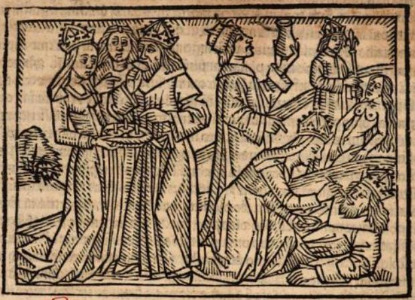
This engraving depicts multiple events. The left side of the engraving depicts Agrippina poisoning her husband Claudius with mushrooms. Agrippina is illustrated wearing a crown and holding a plate of mushrooms as she presents them to Claudius. Agrippina’s son, Nero, is depicted standing in between Agrippina and Claudius as he watches his stepfather being poisoned. Agrippina poisoned Claudius to obtain power for herself and make her son emperor. The right side of the engraving in the foreground depicts Agrippina kneeling as she gives Claudius more poison (the mushrooms did not kill him). The background of the engraving depicts Nero as emperor, looking at his mother’s dead, naked body. He began to resent her after becoming emperor, and after having her murdered, he observed her dead body and judged it before cremating it. Nero is depicted wearing a crown and holding a scepter, with a man beside him holding a cremation urn.
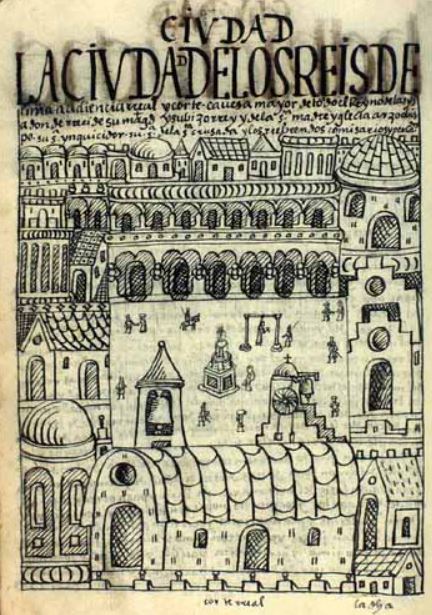
This image is depicted in the author’s chapter where he discusses cities, towns, villages, and provinces in colonial South America. This image depicts the large city of Lima in Peru. The city is arranged in a cluster of buildings which forms a square in the centre of the town. There is a fountain in the centre of the square as well as a gibbet used to hang people. There are soldiers holding spears walking in the square as well as a soldier riding a horse. There are also citizens walking around the square. The city of Lima was used as a centre for government and was changed to the capital of Peru after the Spanish conquered it. The caption at the bottom of the image reads, corte rreal [royal court].
On the left side of this illustration, we see a male figure and a female figure off by themselves, the latter of which is wearing a robe. These two figures could represent the scene in which Calisto talks with Melibea (although their conversation occurs through the door to Melibea’s house). To the right, we see a female figure wearing a robe and a veil. She is interacting with a group of four male figures. This could be viewed as denoting the scene in which Sempronio and Pármeno murder Celestina. However, in that scene there are two male figures and two female figures, so this representation is not closely related to the events of Act XII. [This illustration is identical to those found in Acts I (folio 9r), VII (folio 52v), IX (folio 67r), XI (folio 80r), XIV (folio 96v), XVI (folio 106v), and XIX (folio 115v).]
An Indigenous group from Newfoundland (as identified by the author) prepare to go to war. The group marches in a procession with large drums made from animal skins stretched over a wooden frame and bones as drumsticks. One man is carried on the shoulders of several others and holds a ceremonial weapon or other object. Most members of the group are barefoot and wear tunics, several have capes tied around their necks, and others wear headdresses of feathers or leaves. This illustration is a simplified and mirrored version of the one found on page 164 of Paris, 1557.
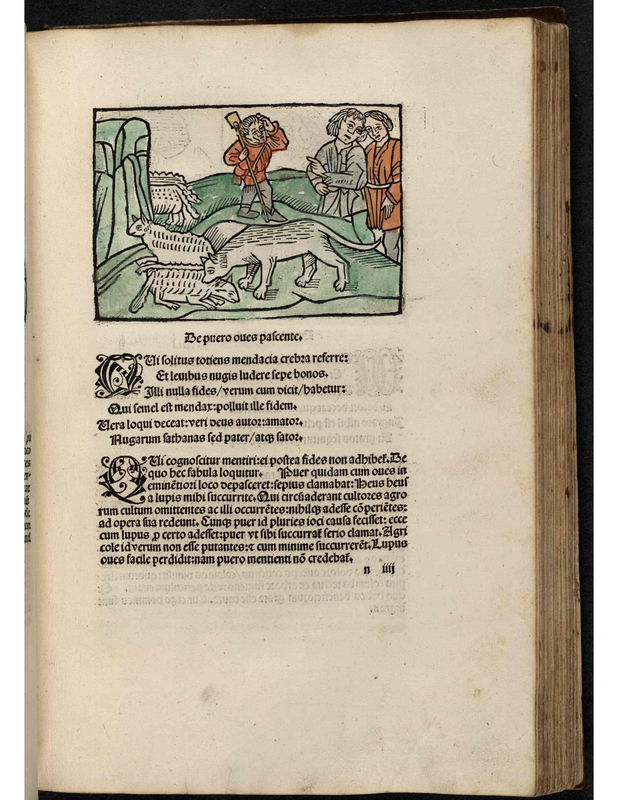
A cat bites a sheep of a throat, while two adults discuss near by, while pointing at a young shepherd. The young shepherd scratches his head while holding a staff in his other hand. Two other sheep peruse in the background.
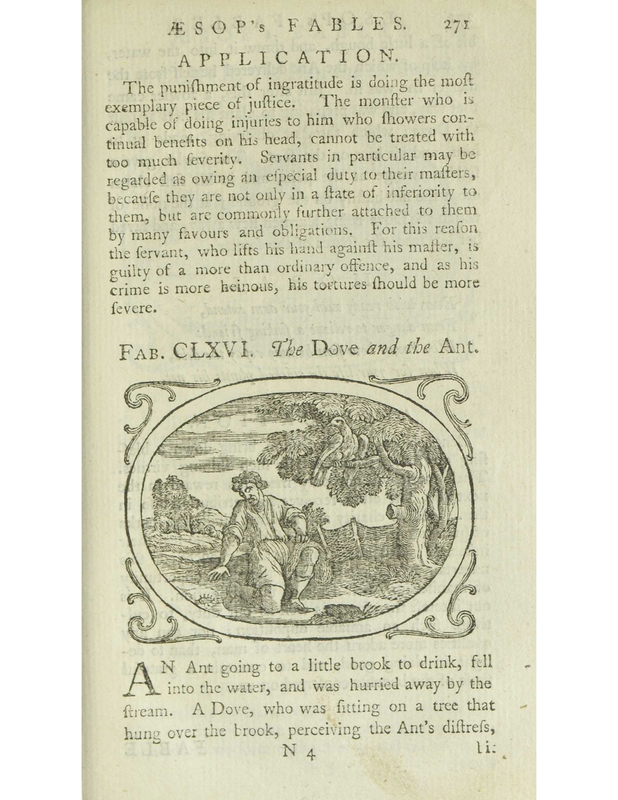
A man kneels on the ground, observing a small ant to his left. He is reaching towards them. In a tree to the right, a dove is sitting on a high branch. The dove is observing the man. In the background a there is a field with a couple of trees.
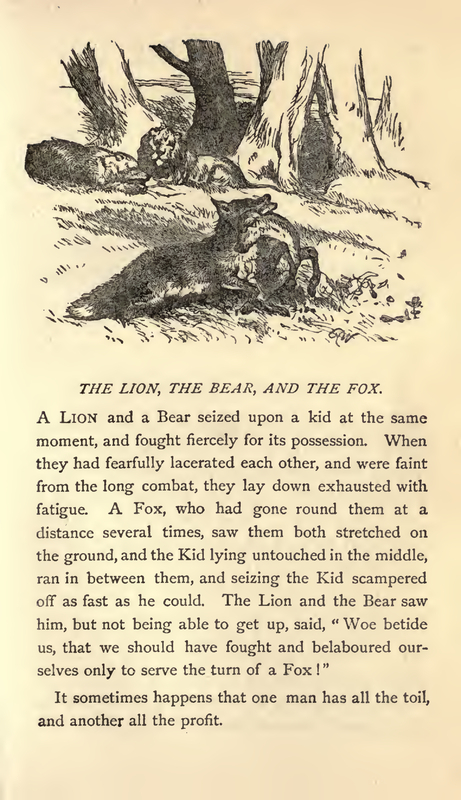
There are four animals in a forest: a bear, a lion, a fox and a kid. The bear and the lion are lying down in the distance looking at the fox. The fox is in front of them, carrying the kid, who seems to be dead, in its mouth. The fox seems unbothered by the bear and the lion while it walks away from them.
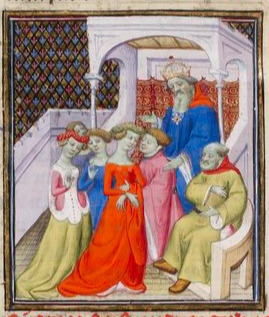
When the Emperor Otho laid eyes on Engeldruda, her beauty led him to choose her as the maiden that would be married off to a man named Illitio. She is represented standing with a group of women, with herself at the front wearing a bright red gown. The emperor is wearing a blue cloak with a crown, and Illitio is seated in the throne in a green cloak.
Here we see three Lilliputian seamstresses taking measurements for Gulliver’s clothes and bedsheets. Two women hold either end of a measuring tape, while the third stands in the middle taking measurements. The three women stand on top of Gulliver who is covered with a sheet. Gulliver has a bandana wrapped around his head which is resting on a basket. The same image appears in the 1843 Krabbe edition.
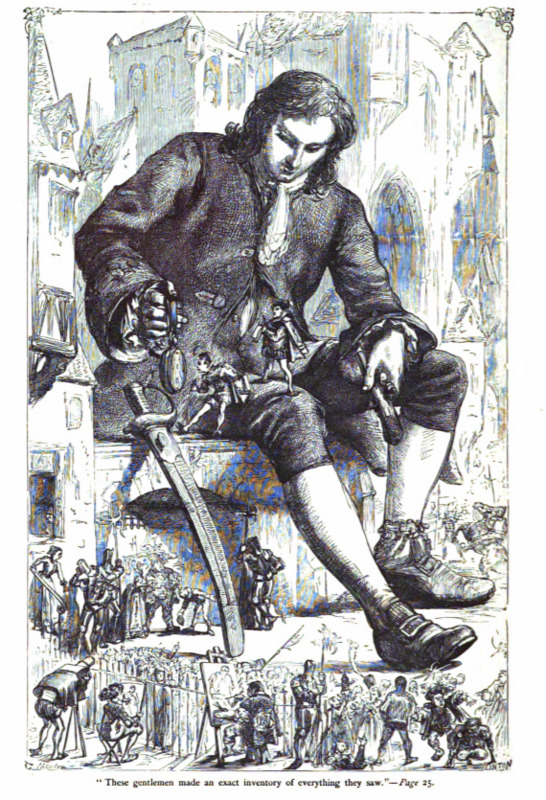
The Lilliputians took a detailed inventory of all of Gulliver’s belongings, shown here. Gulliver sits in the centre and shows the Lilliputians his things. He holds his pocket watch in his hand, and his sword is sheathed, leaning on the wall next to him. Two Lilliputians sit on Gulliver’s leg, while others are on the ground next to him.
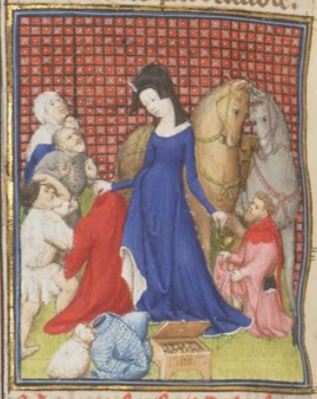
This illumination depicts a woman named Busa in the centre of the image looking at the group of people in front of her. Boccaccio explains that after a city called Cannae was attacked by Hannibal the Carthaginian, the people fled to Canusium. Busa opened her home graciously to the people who fled the danger of war and provided them with hospitality and food as illustrated in the image.
A canine on an ornate pedestal or trunk declaratively lectures two intent canine listeners. The two seem to howl in response to the lecturer. They are surrounded by forest and field.
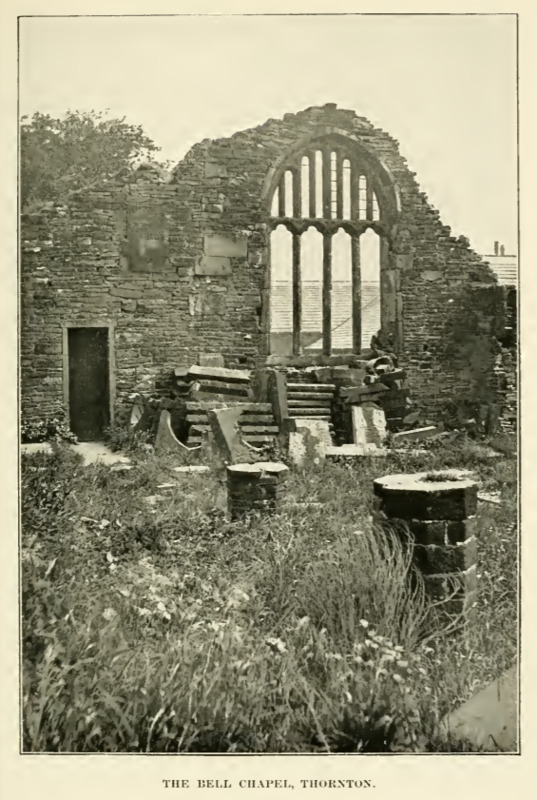
Here we see an image of the ruins of the Bell Chapel in Thornton, in Yorkshire. It is nicknamed the ‘Bronte Bell Chapel’, as it is where several members of the Bronte family were baptized, and Patrick Bronte, Charlotte, Emily, Branwell, and Anne’s father preached between 1815 and 1820. The image is a reproduction of a photograph using a technique called photogravure, where photographs are taken on plates which could then be etched on to create a plate for use in a printing press.
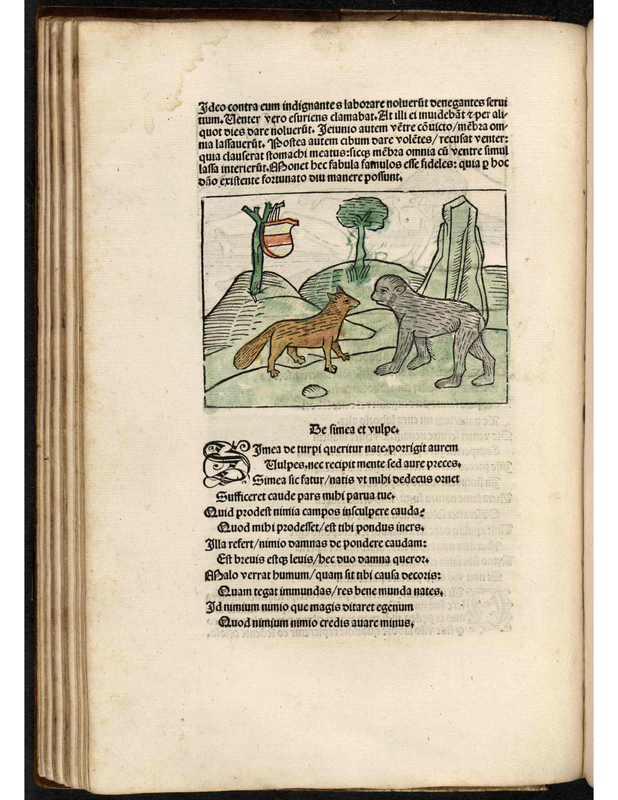
A fox and a monkey come face to face in an encounter, behind them there is a rocky structure as well as two trees, one has leaves and the other has no leaves but has a shield hanging off one of the branches.
Joseph Sedley sits on the roof of the cabin on the boat to Belgium. Beside him on the bench are a cup and bottle of beer. He looks very comfortable and relaxed.
A group of Tupinambá people participate in a celebration. Some members of the group smoke pipes while others drink out of bowls, all sitting on the ground in a large group. Many of the men wear feathered headdresses of various sizes. At the top of the image a group of people dance in a line holding objects that resemble rattles. At the bottom of the image there are four large pots on the ground, likely holding an alcoholic beverage that is shared amongst the group. To the right of the jars, a man crouches on the ground, appearing to vomit.
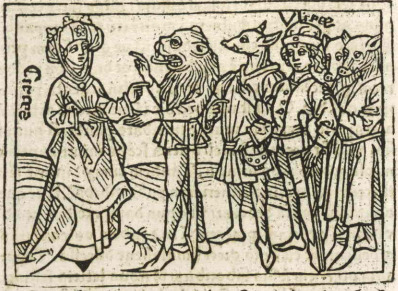
This engraving depicts Circe, the daughter of the Sun, on the left-hand side of the engraving. We know that this is Circe as her name is engraved horizontally adjacent to her body. Boccaccio explains that Circe was skilled in the art of magic and would often turn people who landed on her shores into animals. When Ulysses and his men happened upon Circe, she transformed Ulysses’ companions into beasts. They are depicted in the engraving with their bodies still in human form, while their heads are changed into animals such as lions and pigs. Ulysses is the one man among them that is still in human form (his name is engraved above his head). Ulysses threatens Circe with his sword, and she eventually changes his companions back into their original forms.
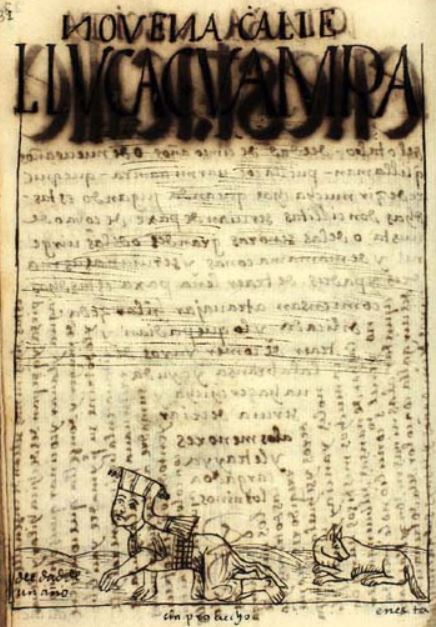
The author explains that there were ten paths for women to follow in the Inca Empire based on age division. This group was called llucac uamra [baby girls that crawl] and they were aged between one and two years old. The author explains these babies had no obligations and they were to be cared for by their mothers and the community. The image depicts a baby girl who is crawling on all fours. She is illustrated wearing a head garb with tassels on it. A dog is laying behind her. The caption on the image reads de edad de un añp, cin prouecho, which translates to one year old, does not work.
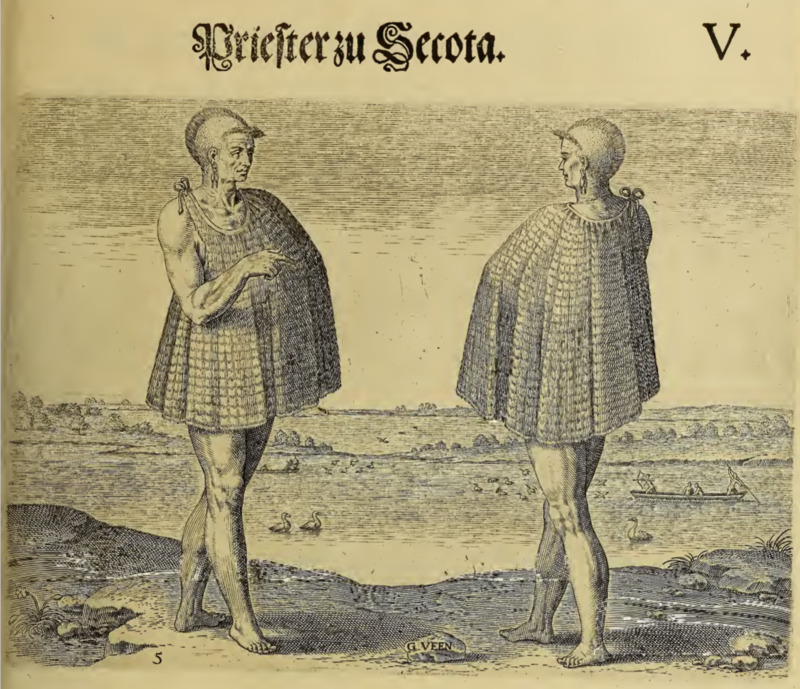
An Indigenous man (a shaman/priest/religious man) is shown standing on the bank of a river, from the front and from behind. He wears a cape-like garment, is barefoot, and wears no other adornment. In the river behind him, other Indigenous people are shown in canoes.

![[Act XII]](https://collections.cemvc.ca/files/large/e5e2e2049e5ee4cd8a6531d179d2501fe5d6d9be.jpg)
![[War procession of an Indigenous group from Newfoundland]](https://collections.cemvc.ca/files/large/0015f2c04bd3aa06528a65ebb19b354586763263.jpg)

![[Lilliputian seamstresses take measurements for Gulliver’s clothes and sheets]](https://collections.cemvc.ca/files/large/4ffb1eceb264c347dfc6f21587ed4b7675aeeb74.jpg)
![[Jos on the Boat]](https://collections.cemvc.ca/files/large/14e79326119e936eaf79123f910f6d53e6c9e6b9.jpg)
![[Tupinambá celebration with drinking and dancing]](https://collections.cemvc.ca/files/large/adc7b0989463627dc282bbde3cfc7a8c1bba6b47.jpg)