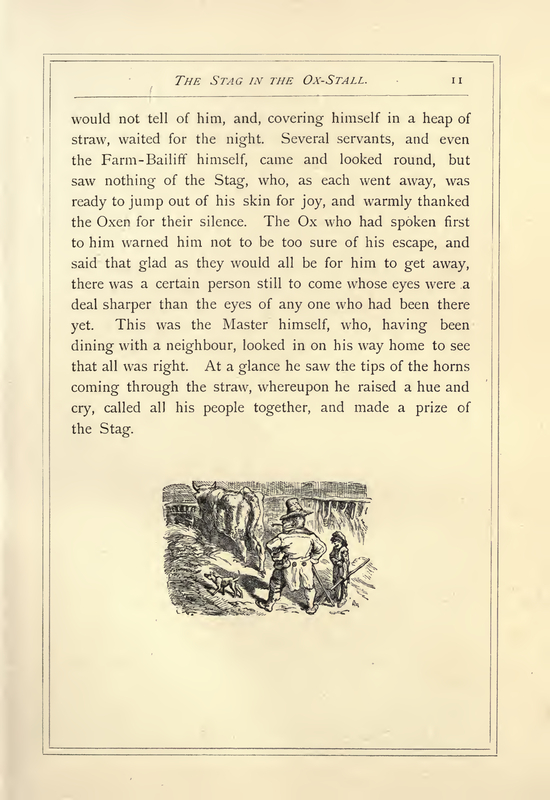
A large ox is facing towards a wall, while two people, a tall person wearing a hat, a long coat, boots, and a pipe in its mouth, and the other smaller, with a small hat and a rake, are behind it. Next to the tallest person, a small person stands wearing a hat and holding a rake. Next to the tallest person, a dog wanders around.
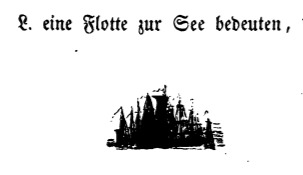
Here we see the letter L with a castle. The letter L using a method of coding developed by scholars at the Grand Academy on Balnibarbi signifies the phrase fleet at sea. This image comes in a description of a conspiracy found by a professor from the Grand Academy on Balnibarbi. This conspiracy is thought to be an allusion to the trial of Francis Atterbury, the bishop of Rochester for allegedly plotting with the Jacobites. Atterbury was charged with treason in 1722 and was exiled to France. The same image appears in the 1839 Krabbe edition.
Tom Stubble sits at one of the coffee-room tables at the Slaughter’s, writing a letter to his parents before his regiment leaves for Belgium. He is holding a pen against the piece of paper on which he has written only a couple of lines, and has his head drooped sadly into his other hand. On the table in front of him is an inkwell with another pen in it.
Two Spanish ships and one French (as determined by their flags) are shown, with the French firing cannons at the Spanish ship and vice versa. Several men are in the water, either deceased or having merely fallen, along with turtles and other sea creatures. There is a Tupinambá village on land near the shore, comprised of several long structures surrounded by two layers of tall fence. Several Tupinambá people rove along the shore carrying bows and arrows. In the background near the tree line of a forest, one individual hunts using a bow and arrows.
In this image, Gulliver speaks with Captain William Prichard, who convinced Gulliver to travel with him to the South Sea on the ship called the Antelope, visible in the background. The two men discuss their voyage on the land, with several barrels behind them. Other members of the crew can be seen walking and talking on the dock, behind Gulliver and Prichard, with two other men in a small boat, loading cargo from the dock to take to the ship. An anchor is in the water behind the men. A small sailing boat is next to the larger ship. The men can be identified by their clothing, with Prichard wearing a captain’s tricorne hat and fine coat, while Gulliver wears a flat brimmed top hat and carries a cane. The same image appears in the 1839 Krabbe edition.
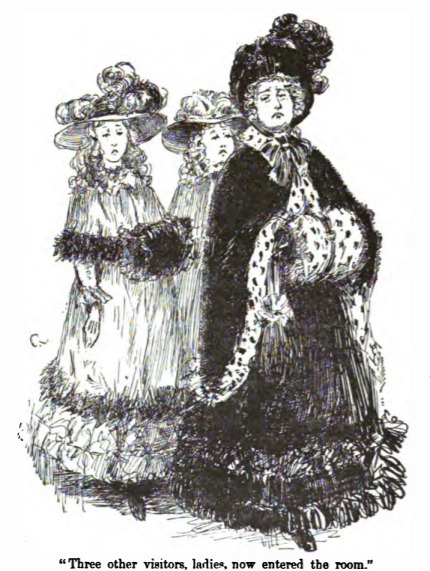
Shortly after arriving at Lowood School, Mr. Brocklehurst visited the school with his wife and daughters, seen here. Before arriving at Lowood, Mrs. Reed, Jane’s aunt, warned Mr. Brocklehurst that Jane was a troublemaker. While they visited the school, Jane dropped a slate, breaking it. Mr. Brocklehurst then noticed Jane, remembering what Mrs. Reed said and publicly humiliated Jane by forcing her to stand on a stool in front of the entire class for the remainder of the class.
This illustration depicts Ceres, goddess of the harvest, discovering agriculture as she sows seeds into the furrows of the ground. She is carrying the seeds in her apron and holding them up with her left hand as she spreads the seeds onto the ground with her right. The rest of her seeds are in a large white bag in the background. There are modern looking houses in the background as the illustration was made in the 15th century. Boccaccio explains that Ceres was a mortal woman before people began regarding her as the goddess of harvest and agriculture.
An Indigenous woman is shown from the front. She carries a spear with a ball on the end in her right hand. She wears a belted tunic that is open chested and laces under the breasts. A sword with a curved blade hangs from the belt around her waist. This woman is described as belonging to an Indigenous group that lived near the Picts. The Picts were an Indigenous group who lived in Britain long before the author’s time. Images of Picts were included in this book so that readers could compare their customs to those of the Indigenous people living in Virginia.
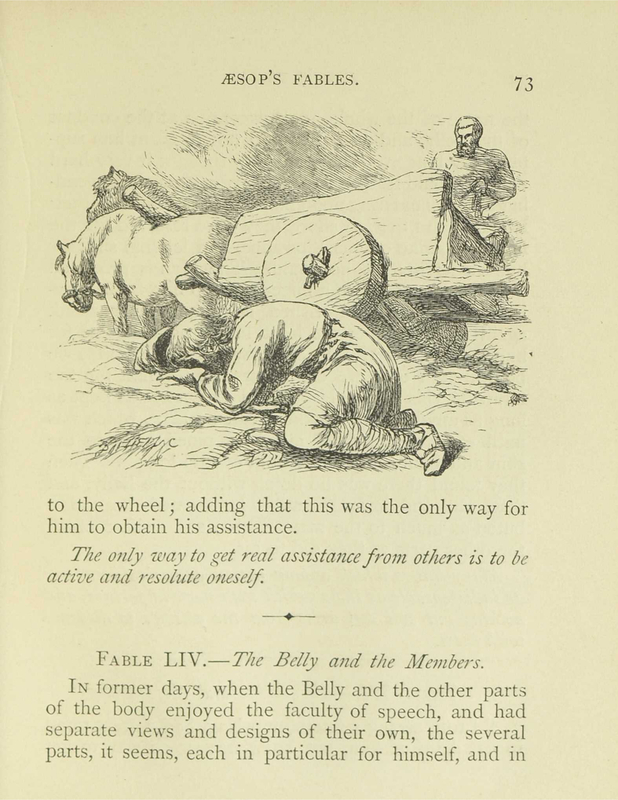
In the foreground a man lay crouched on the ground alongside a pathway seemingly in defeat. Behind him is a cart with two horses attached at the front of which appear not to be moving. In the background on the right is Hercules trying to pull the cart and help the man, holding rope in his hands and pulling with great force.
A large European ship sails near the coast of Brazil, close to an island labelled Insula S. Katrina. There are two Indigenous settlements along the coast, both comprised of several long structures. On the tip of a peninsula between the two settlements there is a large cross. Two small rowboats full of people are near the peninsula.
Rawdon Crawley stands in an opera box, looking up and to the right through his opera glasses. General Tufto and Rebecca Crawley are seated on either side of him, looking at each other, with the bouquet the general brought for her between them.
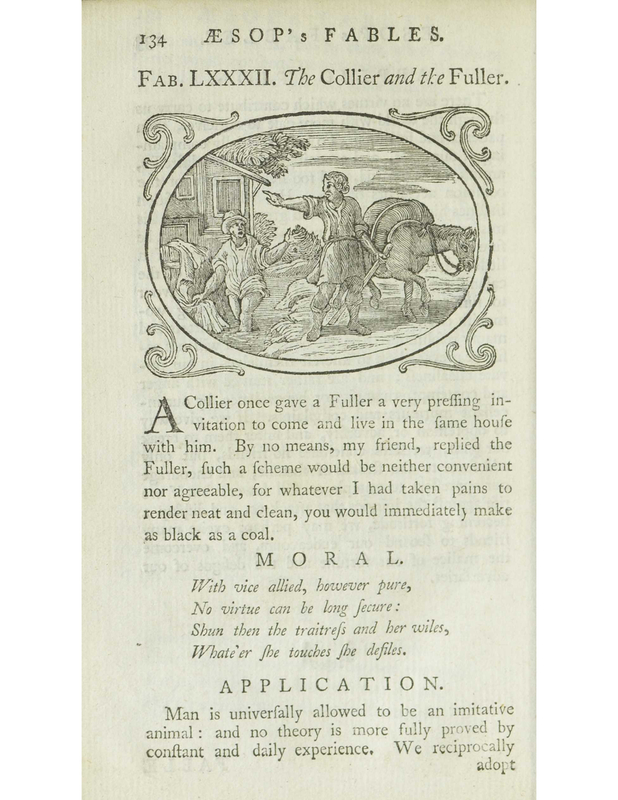
Two men talk to each other while one points off towards a house. Next to the man who is pointing, a horse or mule walks alongside him carrying a heavy load.
Joseph Sedley puts on his coat with help from Isidor, his valet. He is intending to go out to discover for himself whether the rumors of Napoleon’s victory are true.
There is an illustration at the center of the page, above and below this illustration are bodies of text. In the illustration, a short man is bringing a plate full of food towards a group of three men sitting at a table. The third man from the group of three sitting at the table is drinking from a glass. The table is full of utensils.
This illumination depicts a young servant girl, disguised as the noble Harmonia, lying on the ground after getting stabbed to death by the men who are standing above her. Boccaccio explains that there was a rebellion in Syracuse against nobility, and because Harmonia was the niece of the king, she was in danger. Harmonia’s nurse disguised a servant girl to look exactly like Harmonia so that when the rebels came, the real Harmonia would be safe. This illumination depicts the servant girl who died in Harmonia’s place. After seeing the bravery and selflessness of the servant girl, Harmonia willingly called out to the rebels and died in honour of the girl for dying in her place. Harmonia is depicted standing on the left side of the image getting stabbed in her chest by the same men who killed the servant.
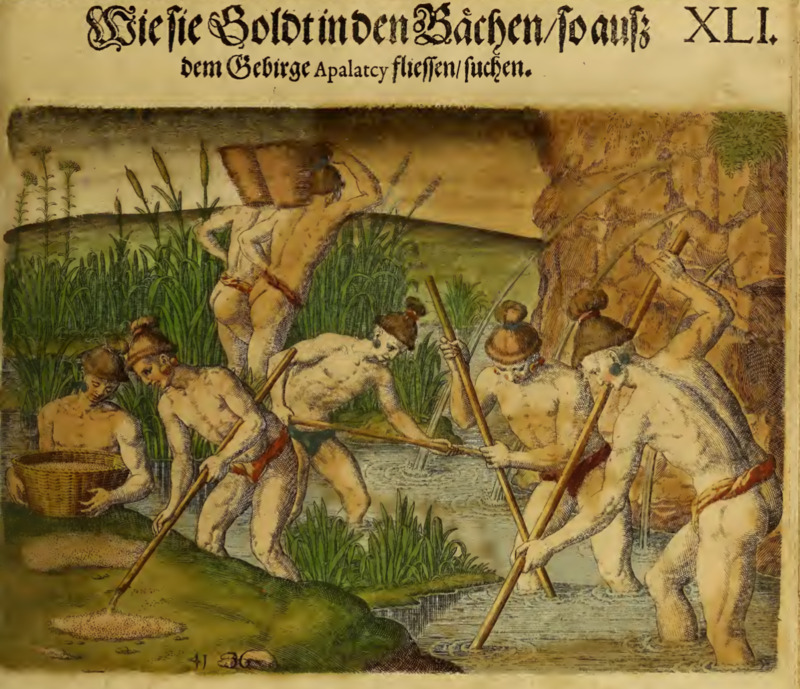
A group of Indigenous men is shown working in a river. They use long poles to stir up the mud at the bottom of the river and along the riverbanks. They put the collected gold into baskets. Two men are carrying baskets on their shoulders away from the river. This illustration is identical to the one found on page 131 of Frankfurt 1591, but colored.
In this image we see Gulliver’s arrival in Blefuscu. Gulliver waded across the water between Lilliput and Blefuscu and here we see him coming out of the water onto the land. He was met by a crowd of people, including members of the Royal Family of Blefuscu. In the image we see the crowd and several carriages. In the distance we also see a tower. Gulliver’s escape to Blefuscu is often linked to Henry Bolingbroke’s escape to France in 1715 after being charged during the Jacobite rebellion. The same image appears in the 1843 Krabbe edition.
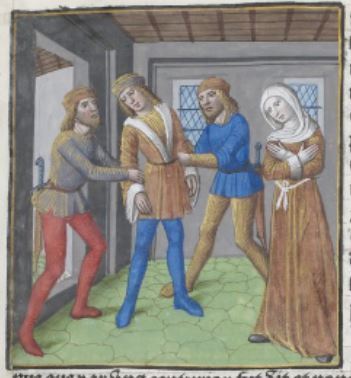
This image depicts Pompeia Paulina standing on the right side of the image and her husband Lucius Annaeus Seneca standing on the left side of the image being taken by centurion guards. When Emperor Nero ordered that Seneca was to be put to death, Pompeia Paulina wanted to die with him. Seneca was put into a tub and had his arms cut to bleed out, and Pompeia Paulina got into a tub with him and cut her arms as well. She survived the suicide attempt by slaves who intervened to save her. Boccaccio explains that he wrote on her to praise her devotion to her husband despite the failed suicide attempt.
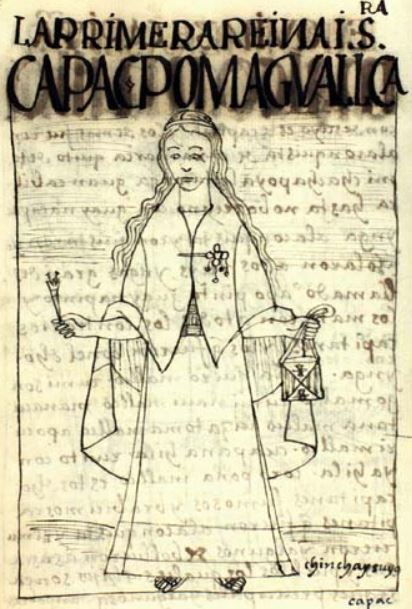
This illustration depicts the first lady of the region of Cinchaysuyu in the Inca Empire. Her name was Capac Huarmi Poma Hualca (also spelled Capac Warmi Poma Wallca). The author explains that this woman was beautiful and governed her region well. She was the wife of Apo Guaman Chaua, second in command of the Inca. She is depicted standing in the centre of the image with what appears to be a flower in her right hand and a small bag in her left.
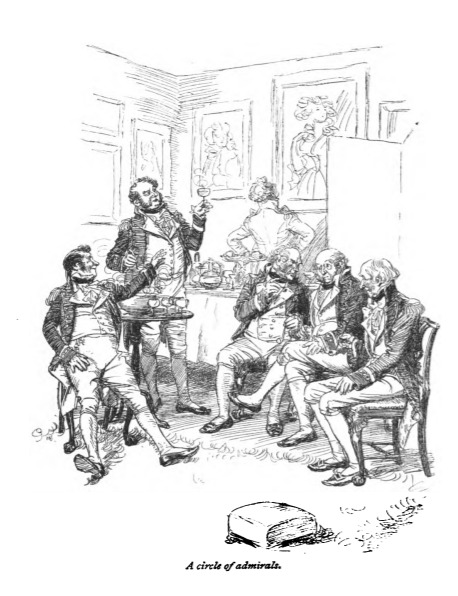
Here we see a group of naval admirals sitting in a circle. Edmund was speaking with Mr. Crawford about the navy. Mr. Crawford’s uncle was an admiral in the navy and Edmund was talking to Mr. Crawford about their mutual acquaintances in the navy. Sir Thomas Bertram had business in Antigua that caused him to meet several people in the navy. Mr. Crawford said that he knew very little of the inferior ranks. This scene occurs in chapter 6. The characters are shown in the traditional regency style. The Admirals wear waistcoats and tailcoats with breeches. The regency period dated to the early nineteenth century (1811-1820) when George, Prince of Wales, later George IV (r. 1820-1830), reigned as regent for his mentally ill father, King George III (r. 1760-1820). The regency period is associated with the rise of neoclassicism in art and fashion.
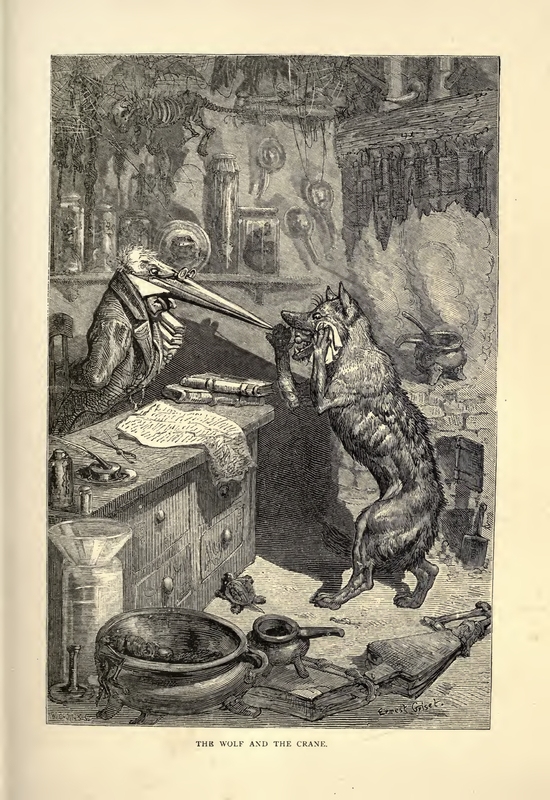
A wolf and a crane are inside of a laboratory. The crane, which is behind a large desk, wears circular glasses on the bridge of its long beak. It wears a blouse with a bowtie and a jacket. On the desk are papers, pen and ink, and books. On the other side of the desk, a skinny wolf is standing on its hind legs. It is holding onto the tip of the crane’s beak with its right paw while it holds onto the side of its face with a cloth with his left paw. The wolf’s mouth is open, and it is guiding the crane’s beak towards it. On the ground in the foreground of the image, laboratory supplies lie on the ground. In the background, there are other supplies such as a cauldron in the upper right corner, vases filled with strange creatures along the wall on the left-hand corner, and strange fossils hang on the walls.


![[Ensign Stubble Writing a Letter]](https://collections.cemvc.ca/files/large/89b6e899b4c96775b8ac7ac73d7f58d5b09d06b3.jpg)
![[Three European ships engage in a naval battle near the coast, where there is a Tupinambá village]](https://collections.cemvc.ca/files/large/099c54787f18a7dc441dd1bc67345c41a508a0bf.jpg)
![[Vanity Fair Chapter XXXIX Inhabited Initial]](https://collections.cemvc.ca/files/large/4f389d6f31901315eb3c267ebee2372d976e656a.jpg)
![[Gulliver in conversation with Captain William Prichard]](https://collections.cemvc.ca/files/large/793b8974a7eaed27b5b93e7606f6e948c339a3b1.jpg)
![[The Goddess Ceres Discovering Agriculture]](https://collections.cemvc.ca/files/large/cb7697c9e88e3c64793a04113508c7979a428e73.jpg)

![[A European ship sails near the coast, close to an Indigenous settlement with a large cross]](https://collections.cemvc.ca/files/large/b68f26c426b92a11eeff28e6badeb369a5d17c47.jpg)
![[General Tufto and the Crawleys at the Opera]](https://collections.cemvc.ca/files/large/c0f3bdeee7e65eeef9c29374f295a0506052cfe7.jpg)
![[Isidor Dressing Jos]](https://collections.cemvc.ca/files/large/fce9c18da61acc82bdb98107ac41273aff5950d6.jpg)
![Vita et. Fabulae [A man carries a plate as three men dine at a table]](https://collections.cemvc.ca/files/large/3e10d9dfaff8fa449112c09c65fc423785994edf.jpg)

![[Gulliver arrives on Blefuscu]](https://collections.cemvc.ca/files/large/a8a406bdf0afe5349e07b17e2da3731052e606cf.jpg)