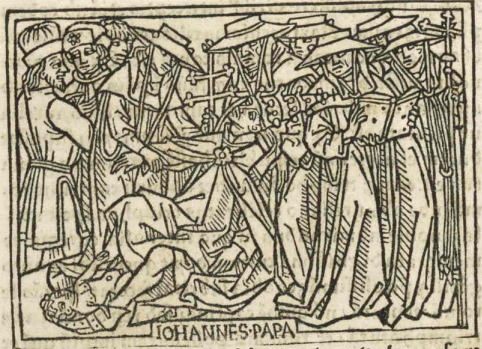
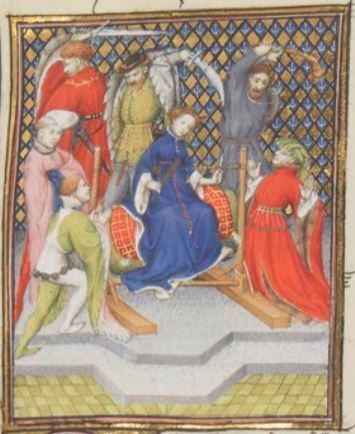
In order to follow her lover to England as he attended school, a maiden named Joan disguised herself as a man and went to school with her lover. Joan had excelled in academics and became incredibly knowledgeable. Continuing to dress as a man, Joan went to Rome and was elected to succeed as Pope, known as Pope John. No one had known she was a woman, however, she ended up having a love affair which resulted in pregnancy. This engraving depicts Joan, dressed as Pope John laying on the ground with her legs open as she gives birth to a child. There are other ecclesiastics surrounding her as they look disgusted that she is giving birth as a Pope. Pope John (Joan), was thrown into a dungeon where she would die.
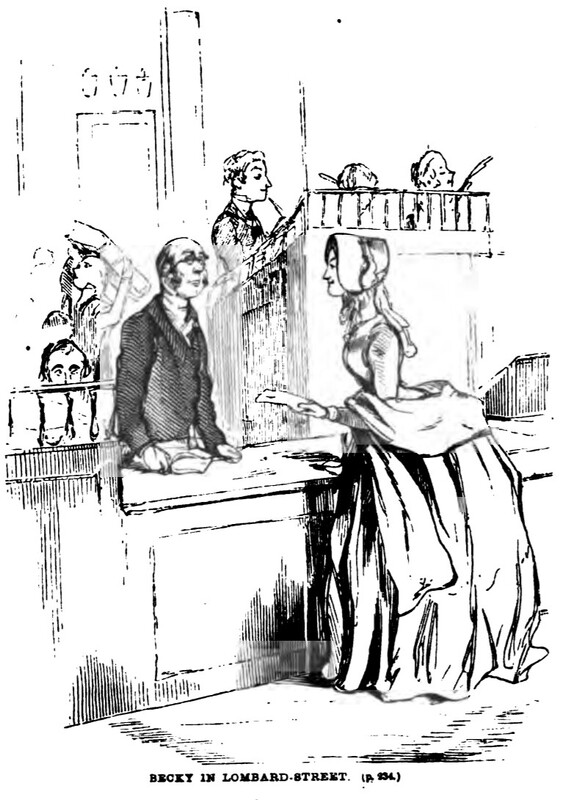
Rebecca Crawley stands at the desk of Messrs. Jones and Robinson’s bank. She is holding out a document which Lord Steyne sent to her, entitling her to a large sum of money. On the other side of the desk is a bank official, holding a coin shovel. In the background are other employees of the bank, seated and standing, carrying quills and books. Below the illustration is printed its title and location in the story, BECKY IN LOMBARD-STREET. (p. 234.).
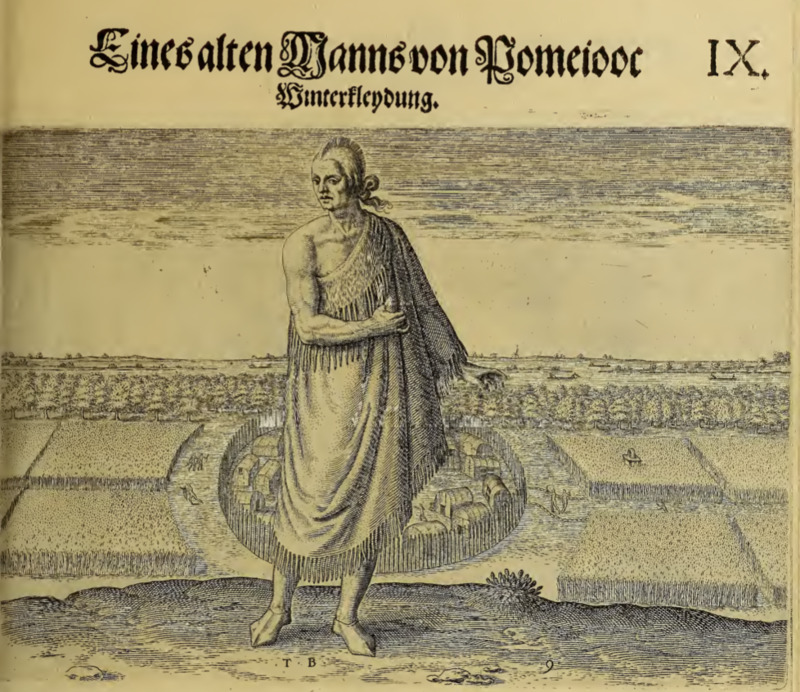
An old man stands on a hilltop. He wears a fringed garment draped around his body and over one shoulder. His hair is spiked down the middle of his head from forehead to nape of neck, where it is gathered into a knot. On his feet are slippers. Behind him on the ground below the hill, cultivated fields surround a village – a small group of dwellings with a fence around them.
This image depicts Penelope, the wife of Ulysses, weaving in the centre of the image as she waits for her husband to return from the Trojan War. Penelope had many suitors over the 20 years that she waited for Ulysses to return home; however, Boccaccio explains in his story that Penelope remained entirely faithful over the duration of his absence. Penelope told the suitors that she would continue to wait for her husband to return until she was done weaving a cloth, which is why she is depicted weaving in this image. Each night, she would undo all the weaving she had done that day so she could continue waiting for Ulysses. There are suitors in front of Penelope kneeling as they try to impress her. When Ulysses finally returned home, he had slain every suitor in his palace. Ulysses and two of his servants are depicted standing behind Penelope as they swing their swords to kill Penelope’s suitors.
In this image we see a group of giants crowding around to get a look at Gulliver. Most of the faces of the giants are obscured in some way to show that they are huddling close together. Gulliver stands in the centre of the ring of giants. Gulliver leans forward towards the giant on the far left as though he is speaking to one of the giants with his hat in his hand. This giant is likely the farmer who found him as he is not wearing a hat, just as he was shown in other images. All the other giants wear some form of cap. The same image appears in the 1843 Krabbe edition.
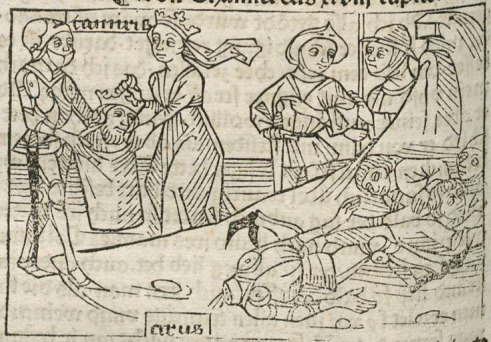
This engraving depicts Thamyris, queen of Scythia, placing the decapitated head of king Cyrus into a bag. Thamyris’ name is engraved beside her head, and Cyrus’ name is engraved beside his body at the bottom of the image. Boccaccio explains that Cyrus had invaded Scythia looking for glory, and when he had killed Thamyris’ son, she exacted her revenge by killing his entire army. When Thamyris found Cyrus’ dead body, she took his head. There are other dead bodies among Cyrus which are his men. There are Thamyris’ soldiers surrounding her, and one who is helping her put the head of Cyrus into the bag.
A European ship – broken in half – sinks near the coast of Brazil. Several men swim towards shore, with many clinging to debris, where several survivors already stand near the water helping others onto land. There are several settlements, both Indigenous and European, near the shipwreck site: on nearby island St. Maro there is a European settlement and a fortification wall, on a second island, St. Vincetii, there are two settlements and several single dwellings. To the left is a Tupinambá village labelled 'Brikioka' and on the right is another called 'Itenge Ehm'. There is an unlabeled village close to where the European men have come ashore.
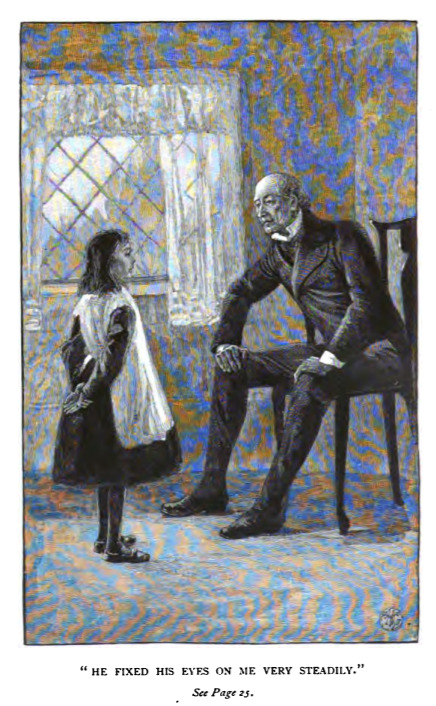
Here we see a scene where Jane Eyre meets Mr. Brocklehurst, the superintendent of Lowood School, and the pastor at the nearby town. After becoming ill, Jane confessed to the doctor that she wanted to go to school. Her aunt invited Mr. Brocklehurst to meet Jane in the hopes that he would admit her to the school, which he did. Jane stands in front of Mr. Brocklehurst in the front room at Gateshead hall.
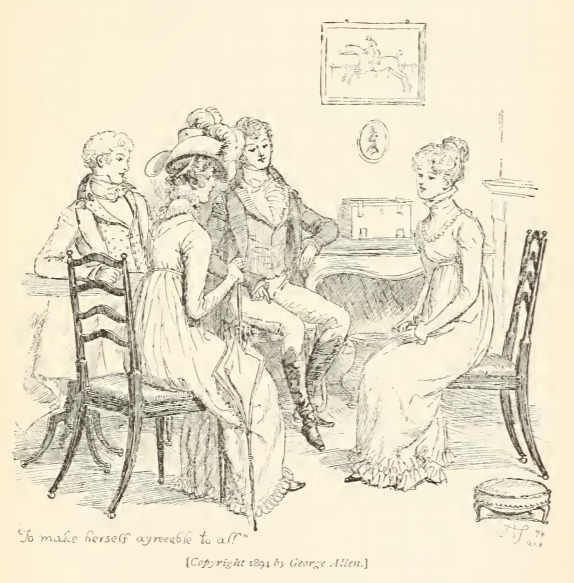
In this image Elizabeth entertains Mr. Darcy, Georgiana, and Mr. Bingley at Lambton. The three were staying at Pemberley while Elizabeth was visiting Derbyshire with her aunt and uncle. After visiting Pemberley, Mr. Gardiner invited Mr. Darcy to come pay a visit to Lambton, where they were staying in Derbyshire. Mr. Darcy happily accepted, and brought his sister, Georgiana, and Mr. Bingley. This scene occurs in chapter 44. The characters are shown in the traditional regency style. Georgiana and Elizabeth wear dresses with empire waistlines. Georgiana wears a bonnet and holds a parasol. Mr. Darcy and Mr. Bingley wear waistcoats and tailcoats with cravats. The regency period dated to the early nineteenth century (1811-1820) when George, Prince of Wales, later George IV (r. 1820-1830), reigned as regent for his mentally ill father, King George III (r. 1760-1820). The regency period is associated with the rise of neoclassicism in art and fashion.
This illustration depicts Libya, the daughter of King Epaphus of Egypt, holding and looking at her son, Busiris. She is illustrated wearing a brown/yellow dress which flows onto the ground. Boccaccio explains that he briefly wrote on Libya as her accomplishments must have been great due to the country of Libya being named after her.
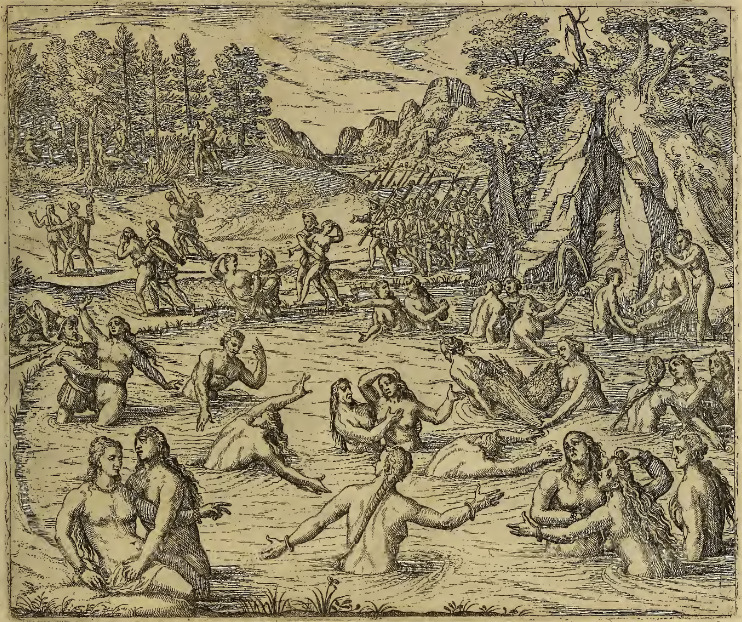
After the Inca Emperor Atahualpa (Atabalipa) was captured by Francisco Pizarro and his men, Spanish soldiers rampaged through the area around Cajamarca in Peru. Here, a group of soldiers have come across a pond where several Inca women bathe. Some of the Spaniards approach the pond from the far side, and others wade into the water and seize women. Several of the women have been pulled from the water and are dragged by the soldiers towards a stand of trees nearby. Women amongst the trees are pushed to the ground by soldiers, and sexually assaulted. This image is identical to one found on page 8 (125) of Frankfurt, 1597.
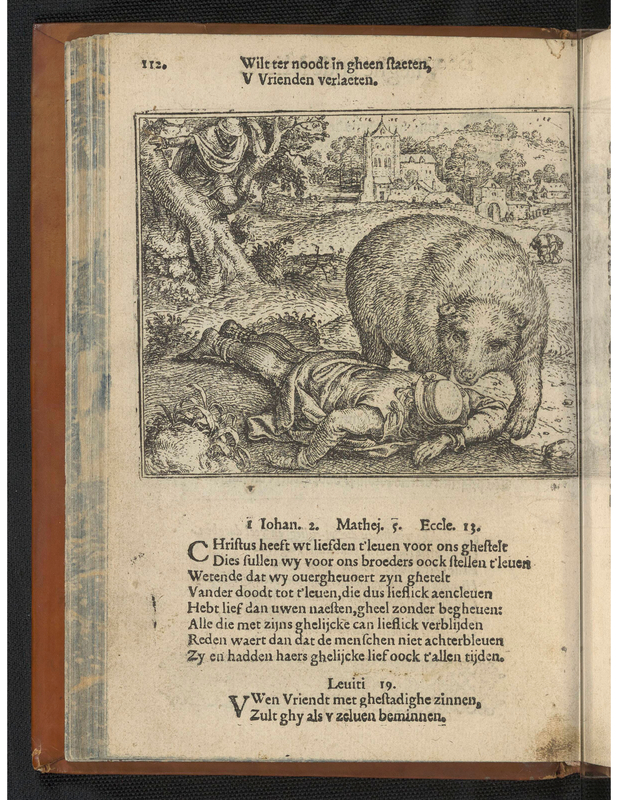
The bear and the two friends'; a bear at right stands next to a sleeping man; the bear is sniffing him; in the background a second man is hidden in a tree; Dutch letterpress on verso; illustration to Eduwaert de Dene's edition of Aesop's Fables, De Warachtighe Fabulen der Dieren (Pieter de Clerck, Bruges: 1567). c.1567Etching
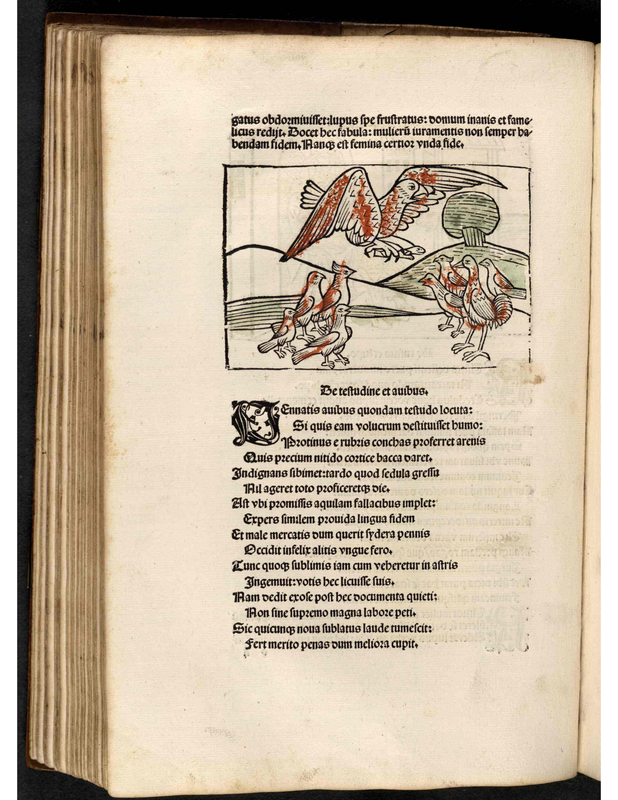
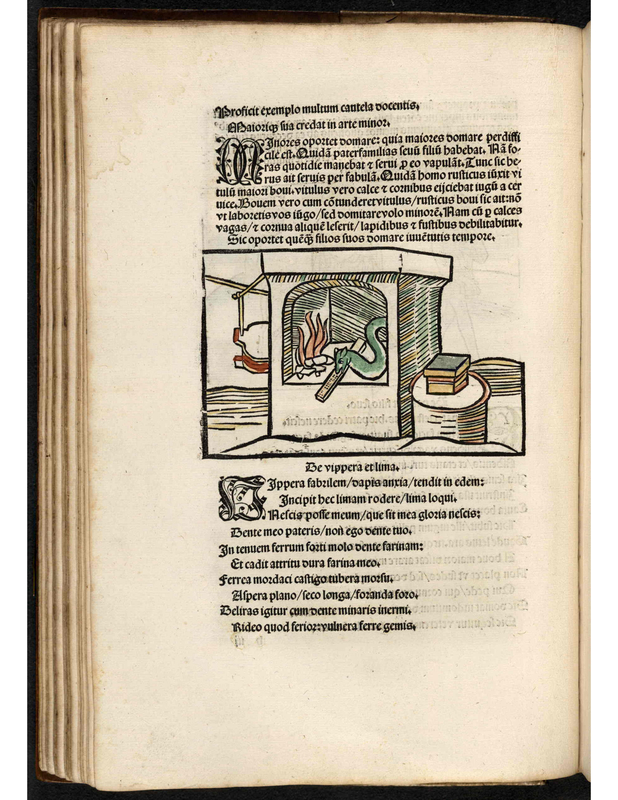
A viper holds a file inside of its mouth, it is inside an oven which has a fire inside of it. Next to the oven there is a pillar, on top of which there is a stack of books.
This engraving depicts Soaemias, a Greek woman, sitting in the middle of a meeting of the Roman senate with her son, Emperor Elagabalus. They are depicted sitting in a circle, with everyone looking at Elagabalus, who is illustrated wearing a crown and holding a scepter. The names Soaemias, written as Semiamira, and Elagabalus written as Eliogabolus, are engraved above their heads. Elagabalus would not have become emperor without his mother’s help, so he granted her the ability to have authority and did nothing without her consent. This image is highly significant as she was, as Boccaccio explains, the first woman to have a seat among the Roman senate and discuss her opinions and views on what must be done. The left side of the engraving depicts Soaemias kissing a man to represent her life as a prostitute before becoming mother to the emperor.
A group of Tupinambá women and children sit on the ground in a circle sharing food. In the middle of the circle there are two large dishes on the ground, one of which appears to hold human innards. The women and children fill individual bowls from the large dishes to eat from.
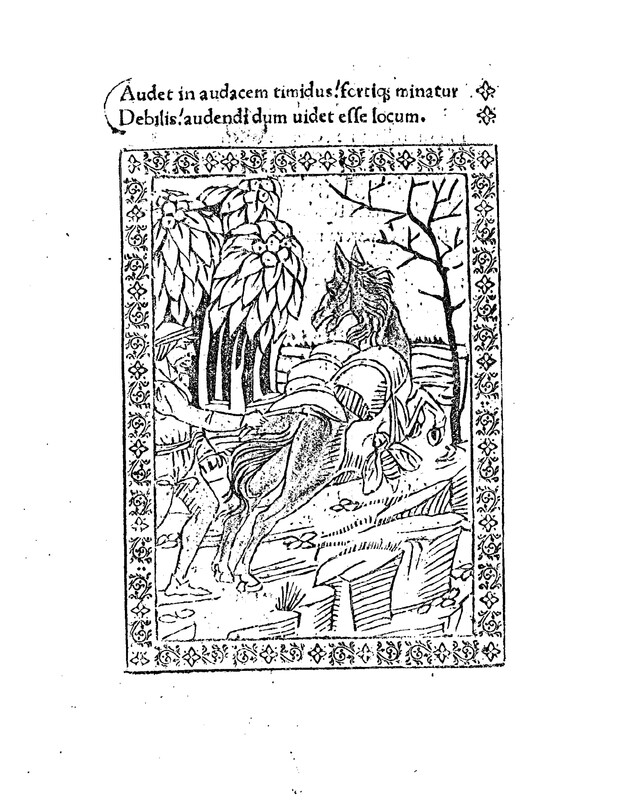
A Man with a hat is holding onto a strap on the back of a large Mule. The Mule has it's two front legs in the air and is looking back towards the man. There is a dead tree to the right and a forest of live trees to the left.The image is bordered by a vine design
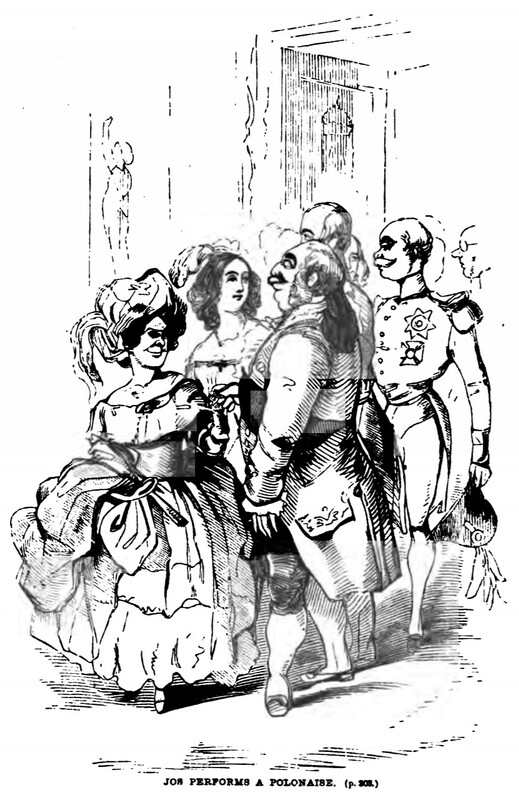
Joseph Sedley stands opposite the Countess of Schlüsselback, holding her hand as they walk a Polonaise at a Court-ball. Behind them in the row are Major Dobbin and Amelia Osborne, with another decorated officer in the pair after. Below the illustration is printed its title and location in the story, JOS PERFORMS A POLONAISE. (p. 303.).
A man and woman embrace each other forearms, the man is dishevelled and worn and she looks at him in shock. The woman stands just in front of a brick structure with bag of grain inside.
In this image we see a Lilliputian seated in a sedan chair – a covered chair used in the Georgian era as a form of transportation. The sedan chair was carried by either two or four men around town. In this image, only the woman, wearing a long gown, who owns it is seen; the men who carried the chair are not shown. It is richly decorated, and the letter A is along the top. This is because it is the first letter of the word auch, which is the first word of the chapter. The same image appears in the 1843 Krabbe edition.
When Sempronio arrives and chastises Celestina for her slackness, Celestina explains that delays will allow her to acquire greater rewards from Calisto. She asks Sempronio to join her in scamming Calisto, and offers him a share of her earnings, as well as her prostitute Elicia, in exchange for his loyalty. Sempronio readily accepts the proposal. Celestina departs for Melibea’s house, while Sempronio remains in Celestina’s house to spend intimate time with Elicia. Meanwhile, Pármeno continues with his attempts to dissuade Calisto from procuring the services of Celestina, but he finds no success. To the left of the image, Elicia can be seen hiding behind a large, indistinct object. She is depicted wearing a robe and a veil, as is Celestina (central figure). Sempronio is shown walking into Celestina’s house, his hat raised in his right hand and a sword mounted on his belt. The entire image is identical to the one found on page 237 of the text.
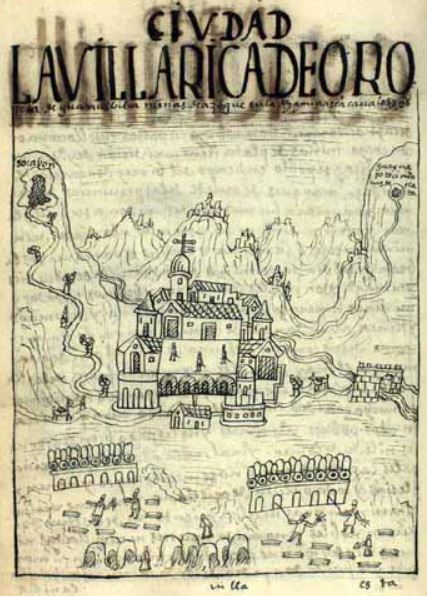
This image is depicted in the author’s chapter where he discusses cities, towns, villages, and provinces in colonial South America. This image depicts the town of Oropesa in Peru. The city is arranged in a cluster of buildings that forms a square in the centre where three people are depicted walking. There are many winding paths that lead into the city from the mercury mines that surround the area. There are people illustrated walking on these paths carrying supplies. The mine in the top left corner has a caption that reads, socabón [sinkhole]. The mine at the top right corner has a caption that reads, Guayna Potocí, minas de plata [Guayna Potoci, silver mines]. The foreground of the image depicts furnaces where the deposits from the mines are being smelted. The caption at the bottom of the image reads uilla [town].
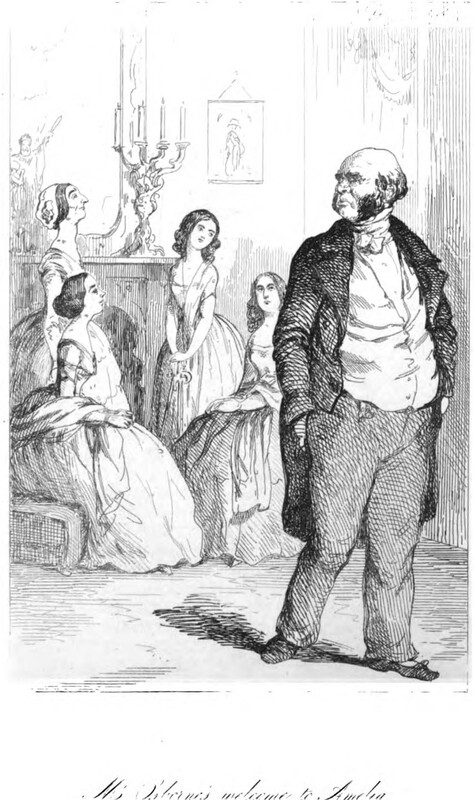
Jane and Maria Osborne are seated on two low chairs in front of the fireplace in their drawing-room. Upon it are a very large mirror, a statue of a warrior, and a candelabra; to the side of the mirror hangs a small portrait. Amelia Sedley is standing between the sisters, looking uncomfortable and holding her hands clasped together. Miss Wirt is standing opposite Amelia, looking haughty. In the foreground of the image is Mr. Osborne, mostly turned away from the others as he walks off with a scowl on his face. Below the illustration is printed in cursive its title, Mr. Osborne’s welcome to Amelia.



![[Giants on Brobdingnag crowd around to examine Gulliver]](https://collections.cemvc.ca/files/large/a3a60d8d7e2637537373adc6cd8c675164adb538.jpg)
![[Europeans are shipwrecked near the coast of Brazil, close to several European and Tupinambá settlements]](https://collections.cemvc.ca/files/large/53ea8402bc8101e290ab3e0834b937430f46ab86.jpg)
![[Queen Libya Holding her Son Busiris]](https://collections.cemvc.ca/files/large/1408229213c212d119a9dad90557fd8edecd2f5d.jpg)

![[Tupinambá women and children share a meal]](https://collections.cemvc.ca/files/large/73c7dd7ec263d6a4ad673162cddb32a126d97a35.jpg)
![[a Lilliputian woman seated in a sedan chair]](https://collections.cemvc.ca/files/large/ebc5aa9396db0d4c3a89fceeed94f56a05eed246.jpg)
![[Act III] Sempronio gaende na thuys van Celistina.](https://collections.cemvc.ca/files/large/9372df8edde63b78e35049dc56a964d514223a7e.jpg)