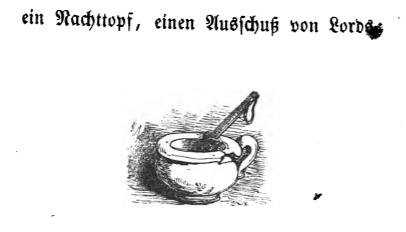
This image shows a chamber pot, which is the code word for a committee of Lords. This image comes in a description of a conspiracy found by a professor from the Grand Academy on Balnibarbi. This idea is representing code word for terms in the conspiracy that Swift is satirizing. The professor advises that those named in the conspiracy papers be closely monitored at all times, naming specifically while they were using the bathroom, as this is when men were most thoughtful. This conspiracy is thought to be an allusion to the trial of Francis Atterbury, the bishop of Rochester for allegedly plotting with the Jacobites. Atterbury was charged with treason in 1722 and was exiled to France. The same image appears in the 1839 Krabbe edition.
In this image we see Gulliver who has freed his left arm from the Lilliputian’s ties, attempting to stop the arrows of the Lilliputians. He is surrounded on all sides by the Lilliputians who are firing arrows at him. We see the shower of arrows in the air going towards Gulliver’s arm which is defending his face. Gulliver’s right hand and legs remain tied up. Gulliver’s hat lies behind his head, with a Lilliputian hiding behind it. The same image appears in the 1839 Krabbe edition.
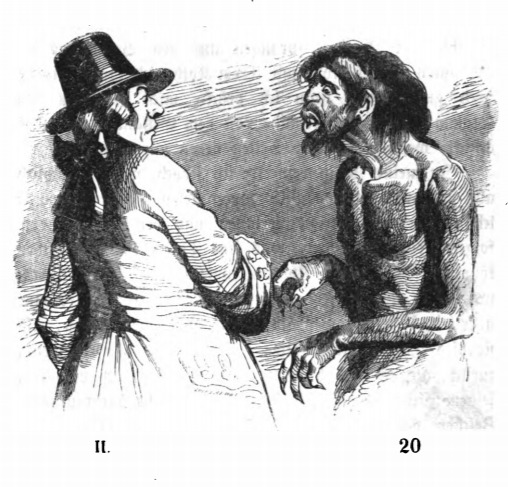
The yahoos are a form of human who live in the Country of the Houyhnhnms. Gulliver looks down on the yahoos, thinking of them as a form of inferior human, which is reflected in this image. The yahoo has long hair and a beard, has long fingernails, and does not wear clothes. The same image appears in the 1843 Krabbe edition.
Here we see the Lilliputian Emperor standing on a podium next to Gulliver’s ear. The Emperor is identified wearing a long cape and is surrounded by guards. The Emperor addresses Gulliver and the Lilliputian people as to what will happen to Gulliver.
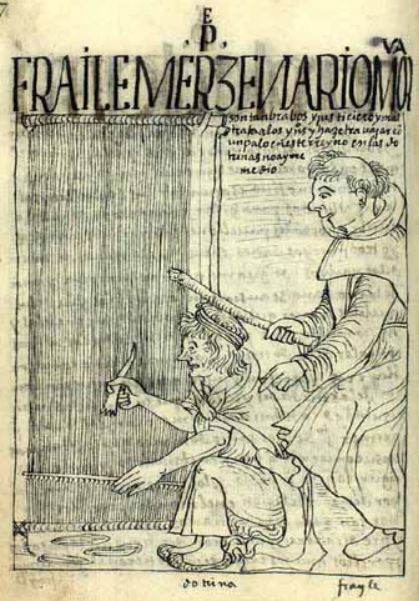
This image depicts a Mercedarian friar named Murúa abusing an indigenous woman. He is illustrated holding a stick in his right hand to beat the woman with. He is ordering her to weave. The woman is depicted squatting as she weaves at a loom. She has a frightened look on her face. The author heavily criticizes Mercedarian friars and Murúa specifically for abusing, robbing, forcing labour, and punishing the indigenous peoples of Peru. He was a prefect of the pueblo in Yanaca in the Aymaraes province and he heavily mistreated the indigenous peoples. This image reflects one of the many ways Murúa had treated the natives.
Three Indigenous Brazilians, a man, woman, and child, are shown under a tall tree with large fruit. The woman sits on a tree stump holding one of the fruits from the tree while the child stands nearby, also holding a large fruit. The man has placed one of the fruits on a nearby stump and stands bent over it. This illustration is a simplified and mirrored version of the one found on page 105 of Paris, 1557.
Here we see three Lilliputian seamstresses taking measurements for Gulliver’s clothes and bedsheets. Two women hold either end of a measuring tape, while the third stands in the middle taking measurements. The three women stand on top of Gulliver who is covered with a sheet. Gulliver has a bandana wrapped around his head which is resting on a basket. The same image appears in both the 1839 and 1843 Krabbe editions.
This image appears at the beginning of the story of the vestal virgin named Claudia. The story of Claudia, however, does not reflect the events in this image. This image depicts a woman and a man standing before two sitting elderly men as they appear to be discussing something of importance. Claudia’s story involves her saving her father from a group of plebeians who try to attack him during a tribune procession. The story and image do not seem to match.
The king Jupiter is holding a weapon is his right hand while flying on a creature in the sky. The camel looks scared on the ground. Other animals surround the scene, like a deer and a goat. There is a pyramid on the right side of the image.
Five figures, four men in tall hats and a woman a dark coat, sit upon a public carriage travelling from London to Queen’s Crawley. At the right of the picture, in the box, are the coachman and Sir Pitt, holding a crop. Behind them are a young man from Cambridge, who has lent one of his coats to Rebecca Sharp, who sits between him and the final man. On the left of the picture is the front of the pile of luggage stacked on the carriage roof.
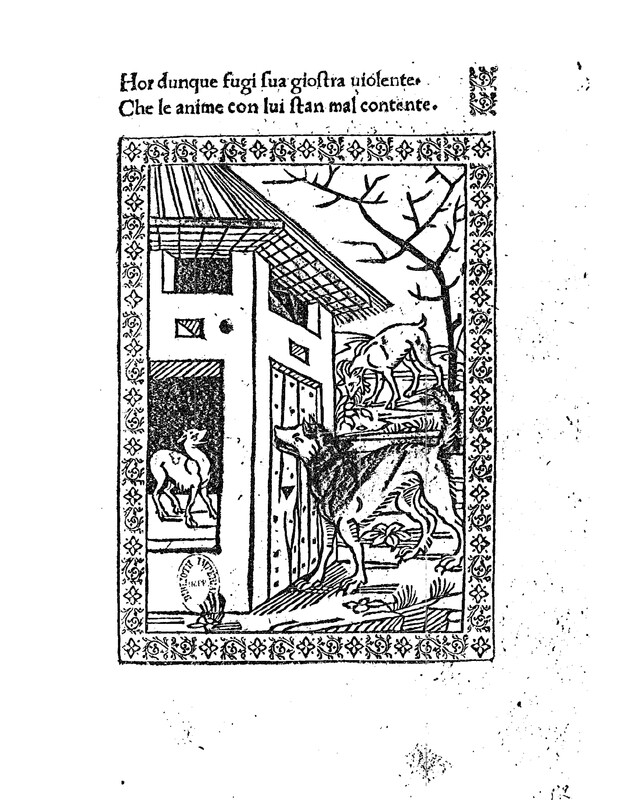
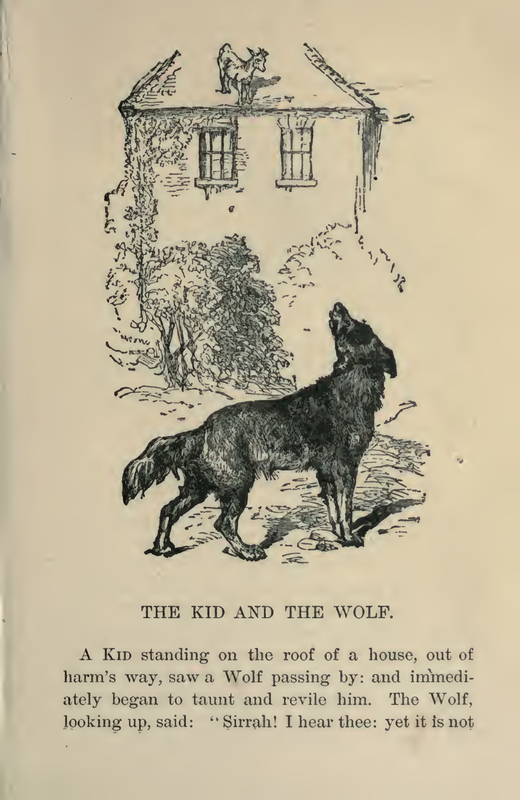
A wolf is in foreground, looking up at the roof of a tall house in background. The house lacks much detail, but there is much plants and vines growing around and on the house. Atop the house, a kid stands on the roof, looking down at the wolf.
Here we see Gulliver bringing the small boat he found overturned onto shore in Blefuscu. Gulliver saw the boat offshore and with the help of the Blefuscudians he brought it to shore where he intended to refurbish it so then he could use it to get home. In this image we see Gulliver pulling the boat up onto the dock. Gulliver stands in the water, with his pants rolled up to his knees and is barefoot. He is aided by the Blefuscudians who pull on several ropes tied to the boat. These ropes were used to drag the boat behind a warship while Gulliver pushed it from behind to get it to shore. There is a large crowd of Blefuscudians – some of whom help get the boat on shore, while other simply watch the scene. The city is visible in the background. The same image appears in both the 1839 and 1843 Krabbe editions.
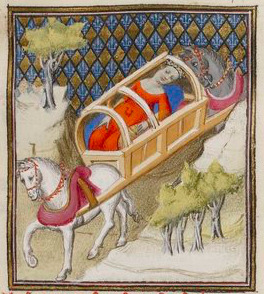
Poppaea died while pregnant when Nero kicked her. Refusing to have her cremated, he ordered that her funeral be very elaborate, like those of kings. She was embalmed and buried publicly. In the image, Poppaea’s body is seen being carted around by horses before she is buried. Her funeral was elaborate, and she is dressed in a nice gown and a crown.
This engraving depicts Manto, the daughter of the famous seer Tiresias. She is depicted with her body leaning over a burning fire. We know this figure is Manto as the creator engraved her name beside her head to identify her. Boccaccio explains that Manto became an incredible seer just like her father. She uses the movement and colour of the fire’s flames to tell the future, which is why there is a fire in the engraving. She also used the entrails of animals such as sheep and oxen for signs of the future. There is an ox and a sheep illustrated in the engraving with their organs protruding from their bodies. There are two distinct looking characters in the background of the engraving, which signifies Manto’s involvement in the dark arts in summoning spirits and gods from the underworld.
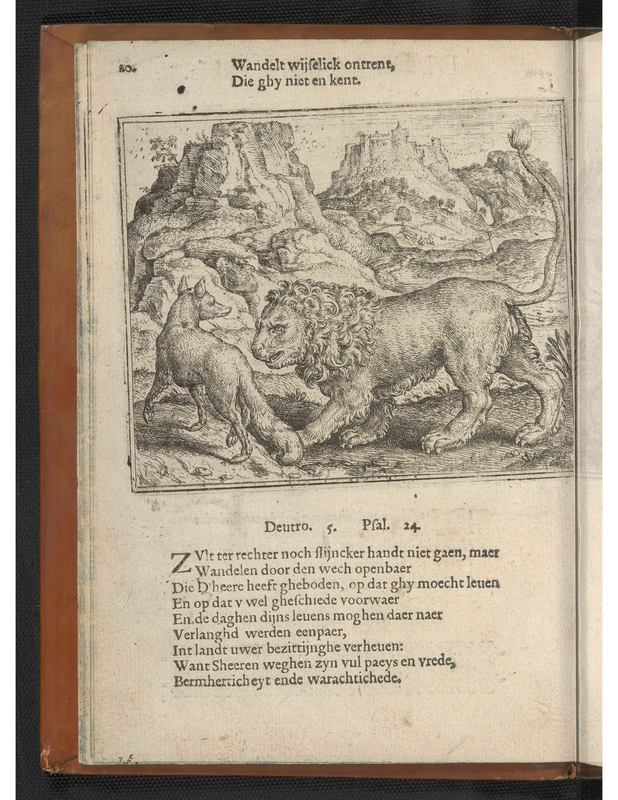
A fox walks carefully in front of a lion in a grassy plain. The lion walks towards the fox with its tail in the air. Rocky hills rise in the background. A castle sits on a hill in the back right of the image.
A wolf is standing at a closed door to a house, through the window you can see there is a small baby goat looking terrified. Another goat which may be the mother grazes in the backround underneath a dead tree. The image is bordered by a vine design and the signature of Liberale de Verona is stamped on the bottom left.
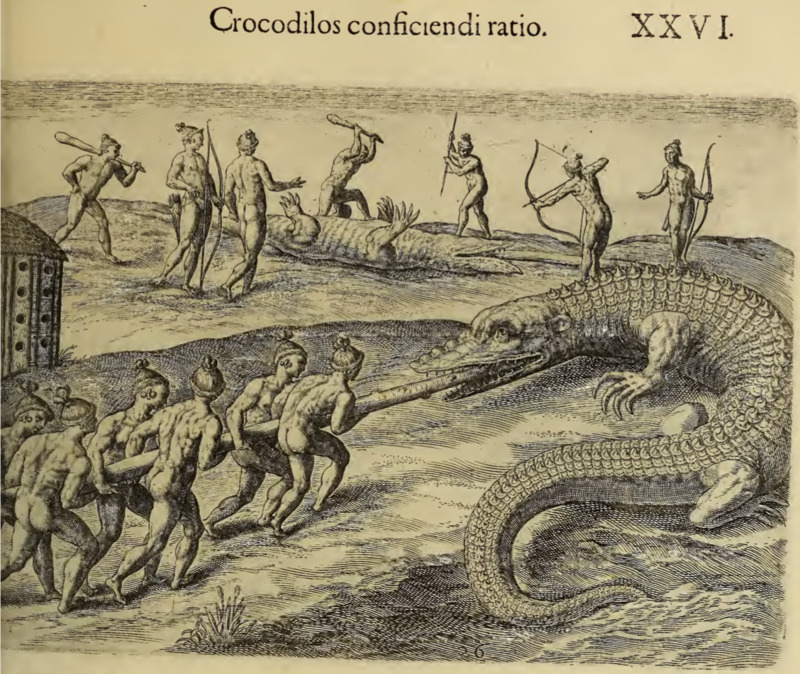
In the foreground, six Indigenous men ram a long log into the mouth of a large crocodile. Behind them, seven individuals surround a second crocodile, attacking it with clubs, spears, and bow and arrows.

![[Gulliver is attacked by the Lilliputians]](https://collections.cemvc.ca/files/large/cc1528891f58ee1e662cd0508d25a77b3d8f93a5.jpg)

![[The Lilliputian Emperor speaks in Gulliver’s ear]](https://collections.cemvc.ca/files/large/ae379fd60b6729507c9cd88f49f0c0b68d467136.jpg)



![[Indigenous Brazilian man, woman, and child under a tree]](https://collections.cemvc.ca/files/large/8af42ca232a5fd26b5518c55a30955f3d1c143e2.jpg)
![[Gulliver is measured by seamstresses for new clothes]](https://collections.cemvc.ca/files/large/bb72061c74bb79ebe4e0befdce1b81a007b17e61.jpg)
![[Claudia the Vestal Virgin]](https://collections.cemvc.ca/files/large/5b94a52df8a5dcda950426887526be7a5b562de4.jpg)
![[Jupiter and the Camel]](https://collections.cemvc.ca/files/large/d746f45f405be2ab681dead5ff79eae18edaa9eb.jpg)
![[Atop the Carriage]](https://collections.cemvc.ca/files/large/155c5ad44959eb90effdf9e9ae084e3e5211ed05.jpg)
![[Gulliver brings a boat onto Blefuscu]](https://collections.cemvc.ca/files/large/2ded6e3e76ce710a2b0c8f555405d0f113d69012.jpg)