In the middle of a field, a man is sitting on an decorated chair. He’s got his right hand in the air, with one finger sticking out. The man looks tired. The top of his head is bald, with curly hair flowing to his shoulders starting slightly at the top of his ears. Tree’s and bushes are in the background. Above the head of the man, to the left of the image, a bee flies in the sky.
Two assistants of Mr. Moses, the sheriff’s-officer, watching the Crawley’s residence on Chancery Lane. They are wearing black coats and tall hats, carrying thin sticks, and scowling.
This image shows the capture of a European man on the island of S. Maro. First, he is surrounded by the Tupinambá, who aim their bows towards him, in the group towards the far side of the island. Then he is shown having been captured and stripped of his clothes, with the Tupinambá holding him by both arms, in the group on the island nearer to the viewer. The canoes of the Tupinambá have been been pulled up to the shoreline of the island, with several people remaining in the canoes. Many of the Tupinamba wear feathered headdresses and adornments around their waists. Most carry a bow and arrow, although some have a spear or a club instead. There is a triangular fortification on the left side of the island with cannons at each point, and another walled fort with cannons on the mainland labelled ‘Brikioka’.
Here we see two horses pulling a carriage. The Houyhnhnms asks about the horses in Europe and how they live. Gulliver explains that humans or yahoos govern the country and care for the horses or Houyhnhnms. Gulliver tells his master that the horses in Europe were used for their strength and speed to pull carriages and chariots, racing, and travelling. The same image appears in the 1843 Krabbe edition.
Here we see a Lilliputian royal official reading Gulliver’s sentence of blinding via arrows publicly. This was common practice and was meant to show the leniency of the Emperor who spared Gulliver from death when he was faced with charges of treason. This can be read as an allusion to the Parliamentary Proclamation of 1715 praising George I of England’s mercy regarding the Jacobite's following a revolt – some of the rebels were executed despite this proclamation of mercy. In this image we see an official reading from a scroll with his mouth open. He is accompanied by another official and a woman who hands out copies of the proclamation to the crowd. This proclamation would have outlined the charges against Gulliver as well as his punishment. This scene takes place in the centre of the city and we can see a fountain behind the crowd and several other buildings. The same image appears in the 1843 Krabbe edition.
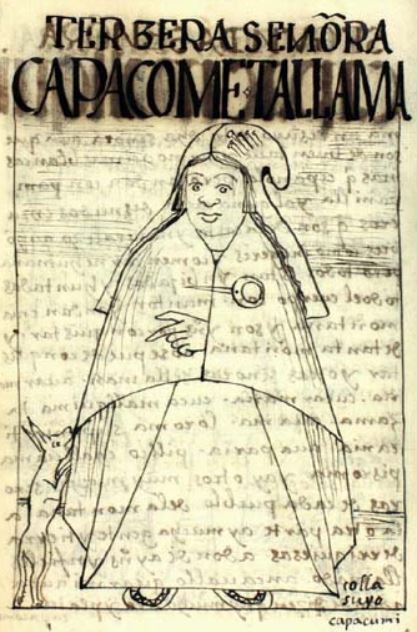
This image depicts the third lady of the region Collasuyu in the Inca Empire. Her name was Capacomi Tallama. The words colla suyo are written at the bottom of the image to identify Collasuyu as the region this image takes place in. The author explains that this woman was rich but very lazy. She is depicted standing in the centre of the image wearing a large cloak as a small dog jumps at her side.
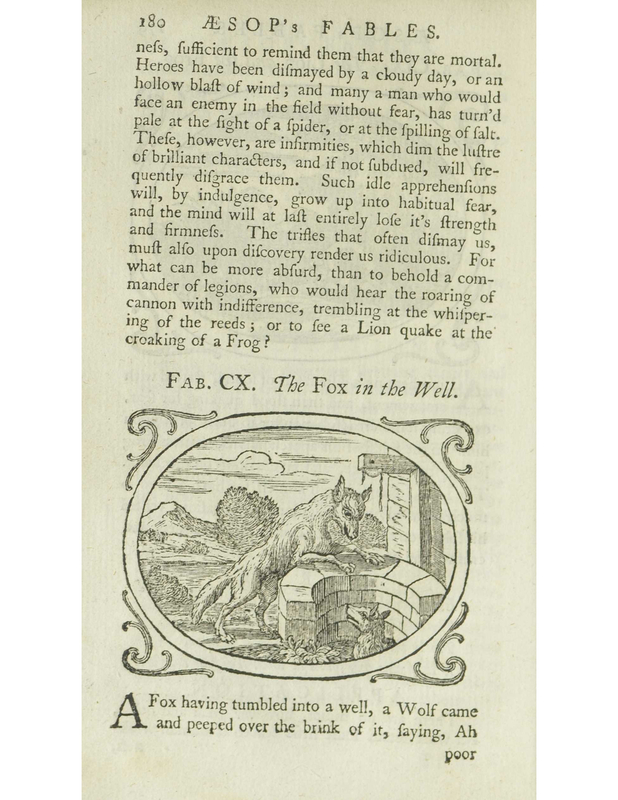
A wolf stands on its hind legs and looks into a shallow well. A fox is stuck inside the well, and looks up towards the wolf. In the background are shrubs, a mountain and clouds in the sky.
This illustration depicts the citizens of Rome worshipping a stone in the shape of the Mother Goddess, Opis (Ops). The stone is illustrated standing on top of a tall white/grey platform with one of her arms pointing outwards. The citizens are depicted with their hands in front of their chest, looking at the statue while praying. Boccaccio explains that this stone was sought out from Pergamum during the second Punic War as the Romans needed help and wished to offer sacrifices to this Mother Goddess and receive her aid in return. The stone was brought back to Rome and placed in the temple depicted in the illustration.
Two large European ships engage in a naval battle near the coast of Brazil. Smoke rises from both ships. There is an Indigenous settlement on land near the coast, comprised of three long buildings surrounded by a fence. The settlement is labelled Buttugaris. There are a few Indigenous people standing along the shore, two of which hold bows. There are two canoes near the shore.
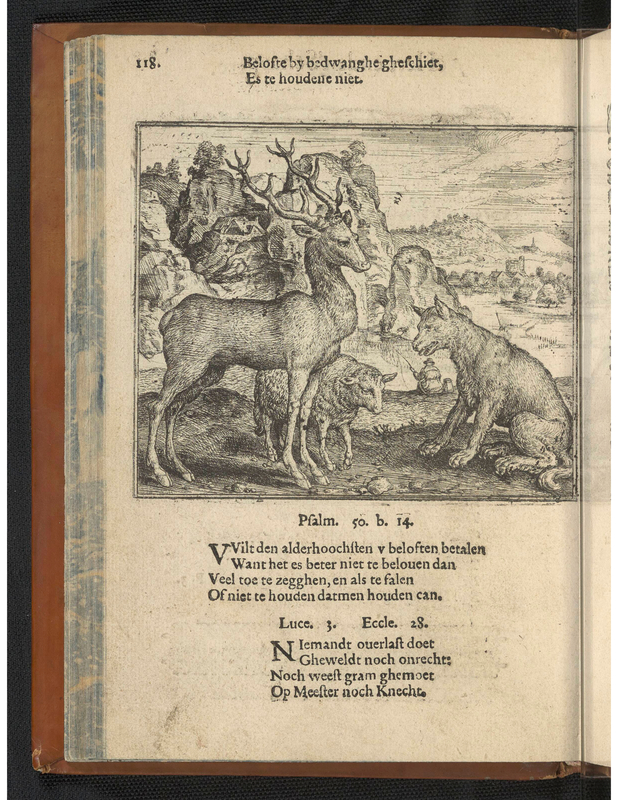
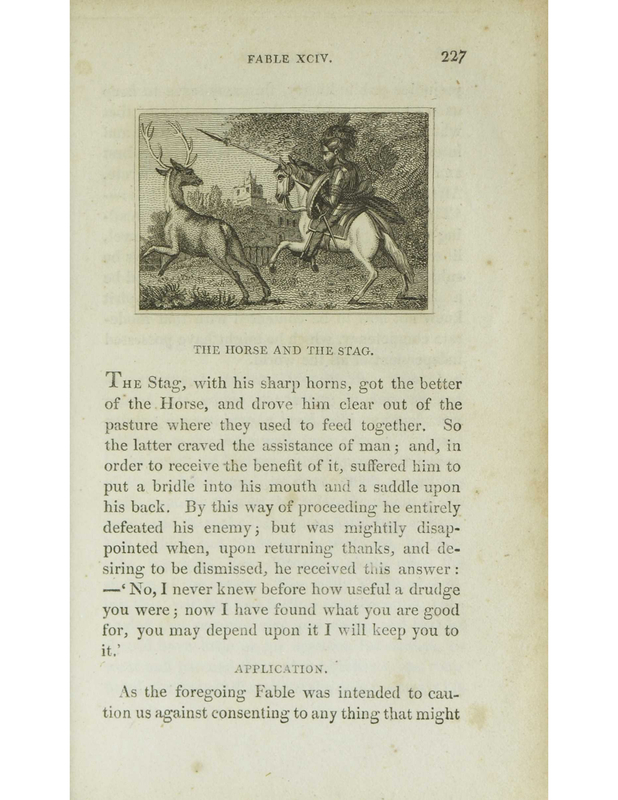
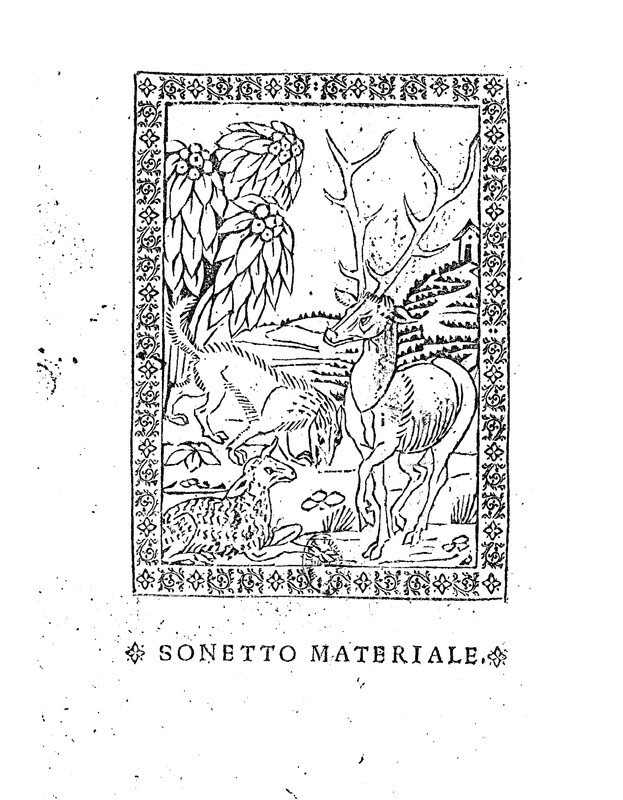
A Stag with large antlers is to the right of the image, a wolf is behind the Stag to the left. Infront of the Wolf and next to the Stag is a young Sheep. Trees in the backround to the left in the distance and a house in the distance to the right on the top of a hill with a path leading to it. The image is bordered by a vine design and the signature of Liberale de Verona is stamped on the bottom
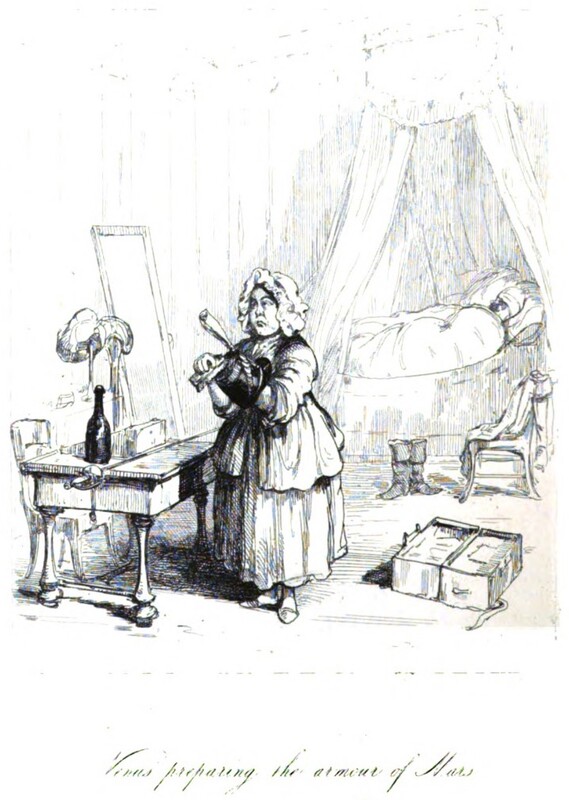
Peggy O’Dowd stands in her bedroom, brushing her husband’s cap. His sword lies on the table in front of her, along with a bottle and a large mirror. She has already packed his travelling-valise, which lies open on the ground next to her. Major O’Dowd himself is sleeping in the background, with his boots next to the bed and his coat thrown over a chair. Below the illustration is printed in cursive its title, Venus preparing the armour of Mars.
Pauline, the maid, stands in the kitchen looking at her lover, Regulus Van Cutsum. He is sitting on the table, drinking a flagon of beer, and still dressed in the military uniform from the battle which he was ordered by his colonel to flee.
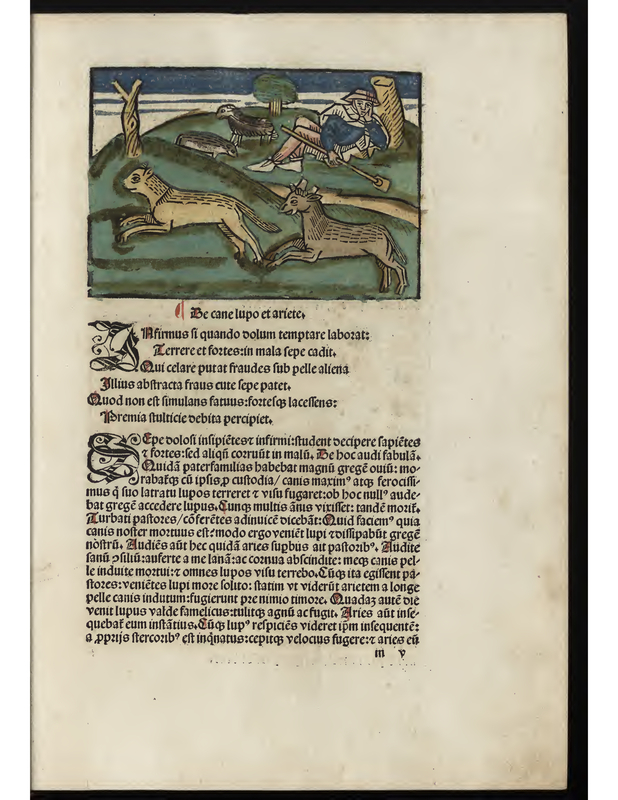
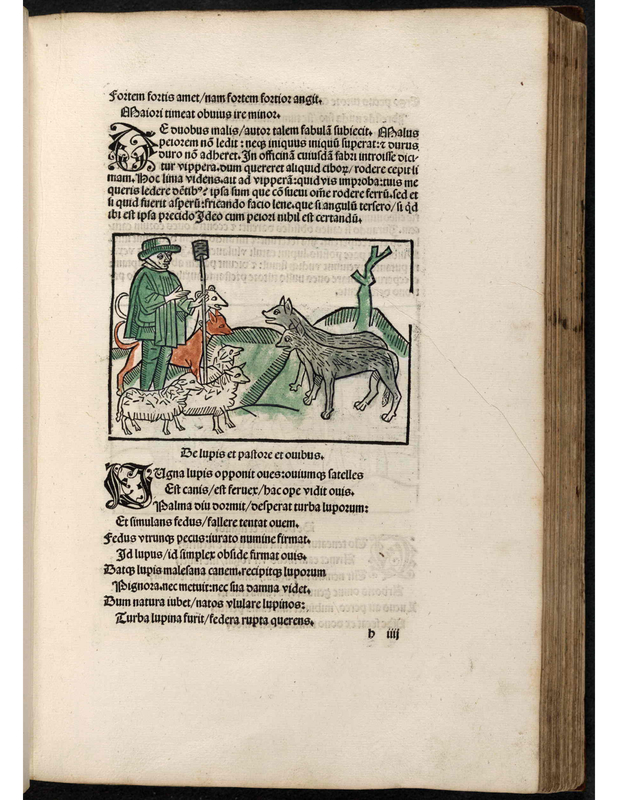
A man in a hat, holding a staff is leading a group of three sheep, accompanied by two dogs, they encounter 2 wolves, in the distance there is a tree with no leaves.
In this image Elizabeth relates the contents of Mr. Darcy’s letter to Jane. In this letter, Mr. Darcy wrote that Mr. Bingley loved Jane, but Mr. Darcy felt that Jane did not reciprocate his love. As a result, Mr. Darcy encouraged Mr. Bingley to leave Netherfield. This scene occurs in chapter 40. The characters are shown in the traditional regency style. Jane and Elizabeth wear the regency style with dresses with empire waistlines. The regency period dated to the early nineteenth century (1811-1820) when George, Prince of Wales, later George IV (r. 1820-1830), reigned as regent for his mentally ill father, King George III (r. 1760-1820). The regency period is associated with the rise of neoclassicism in art and fashion.
This illustration depicts a young woman named Europa being abducted by a group of panderers. Europa is depicted with a sad expression on her face as she is being lifted onto the ship that will take her to Crete. Boccaccio explains that Jupiter fell in love with Europa and ordered the panderers to abduct her from Phoenicia and take her to Crete so he can have her for himself.
Two Tupinambá men are shown in conversation. The man on the left is nude, barefoot and wears a necklace. He carries a traditional club in one hand. The man on the right is also nude and barefoot and wears a large feathered headdress that drapes down to the back to his knees. He carries a bow and arrows in one hand.
The Peruvian city of Cuzco, the capital of the Inca Empire, is shown from above. The city is laid out in an orderly fashion, with wide streets running in straight lines dividing city blocks. The city is surrounded on three sides by a square stone wall with towers built at each corner and in the middle of each wall. On the west side of the city there is a palace built atop several pyramidal layers and nestled into the hillside. There are guards armed with spears standing on each layer of ground leading up to the palace. A group of Inca people form a procession heading towards the palace. Four people carry a litter on their shoulders, upon which the Incan king Atahualpa sits. Atahualpa was the last Inca Emperor (or Sapa Inca) to officially rule before the Spanish conquistadors established their control. Along the bottom of the image, a group of Inca people on the left engage in acrobatic activities and a group on the right hold finely crafted statuettes, probably of gold. This image is identical to one found on page 6-7 of Frankfurt, 1596.
Elicia goes to Areusa’s house to inform her about the deaths of Celestina, Sempronio, and Pármeno. As she approaches the door, she overhears Areusa in a fit of rage. She realizes that Areusa is yelling at someone (Centurio), and waits for him to leave before entering. Areusa sees that Elicia is in mourning and asks her to explain why, and Elicia tells her about the deaths. With a desire to avenge the deaths that were caused as a result of Calisto's love for Melibea, they decide to ask Centurio to kill Calisto.In this image, we see Centurio reaching out toward Areusa, who appears to be pulling away from him. She is wearing a robe and a veil, while he is wearing a hat. In his left hand he is holding a sword, the tip of which is resting on the ground. To the right, we see Elicia awaiting the departure of Centurio (in the narrative she waits outside the house). She is wearing a robe and a veil, and her posture and expression convey an air of sadness.The entire image is identical to the one found on page 246 of the text
A stag and a sheep, both standing to right, looking at a fox which sits in the right foreground. A man with his back turned fishes in the centre background; Dutch letterpress on verso; illustration to Eduwaert de Dene's edition of Aesop's Fables, De Warachtighe Fabulen der Dieren (Pieter de Clerck, Bruges: 1567). c.1567
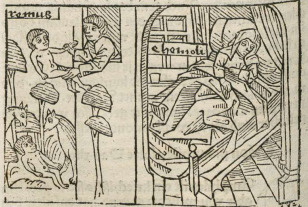
The vestal virgin Rhea Ilia is depicted on the right side of the engraving, lying in a bed with her eyes shut. We know that this is Rhea as her name is engraved beside her body. She has a saddened expression on her face as she had just given birth to twin boys named Remus and Romulus who were forced to be exposed. Boccaccio explains that as a vestal virgin, she was forbidden from becoming pregnant. Her son’s Remus and Romulus are depicted on the left side of the engraving being exposed through the window. Remus's name is engraved at the top left corner of the image. There are wolves surrounding Romulus as the mother wolf ends up raising the boys as her own. Rhea is buried alive for her punishment.
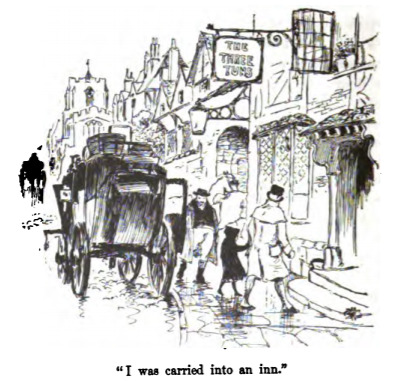
Here Jane Eyre is travelling to Lowood School from Gateshead Hall. Jane travelled for two days to reach Lowood. She stayed overnight in an inn, and in this image, she is being led into the inn by the carriage driver, who accompanied her on her journey.

![[The Old Man with the Bee]](https://collections.cemvc.ca/files/large/bf8f8be0ba13253f338d4f4ca3465eaa715542ae.jpg)
![[Mr. Moses’ Aides-de-Camp]](https://collections.cemvc.ca/files/large/a819500d8b979f56c79203372f2cc13c87d78fed.jpg)
![[A group of Tupinambá people take a European man captive]](https://collections.cemvc.ca/files/large/546a1beb8a5480369bcd0ec4b7ac5e6e2340dbe2.jpg)
![[horses pulling a carriage]](https://collections.cemvc.ca/files/large/ce18b2749062b10fa84b9eddf2819f55d9d070a0.jpg)
![[Lilliputian Royal Official reads Gulliver’s sentence publicly]](https://collections.cemvc.ca/files/large/fb769867b76b75a9366ce108de795d69b9682f89.jpg)
![[The Mother Goddess Opis Being Worshipped in a Temple]](https://collections.cemvc.ca/files/large/ec676e6ca0794809f872562ecd5f937991437774.jpg)
![[Conflict between two European ships near the coast of Brazil]](https://collections.cemvc.ca/files/large/d3673b75546e1e7edff5d50c489c1109145332a8.jpg)
![[Regulus and Pauline]](https://collections.cemvc.ca/files/large/fb7a1526ea23e27266a8bb7f73edb85f85a91704.jpg)
![[Elizabeth relates Mr. Darcy’s letter to Jane]](https://collections.cemvc.ca/files/large/8b17e0aded2f0acc7335b96dbd5447221d31e7b5.jpg)
![[Europa Being Abducted by Panderers]](https://collections.cemvc.ca/files/large/cfc0c07e6d107953726e011aace517ab194011d6.jpg)
![[Two Tupinambá men stand talking]](https://collections.cemvc.ca/files/large/2ddd6449d3fc9454b83a62956529eb441c28df40.jpg)
![Cvsco urbs nobilissima & opule[n]tissima Peruani regni in occide[n]tali parte sita, in qua habitabat magnus ille Rex Atabaliba quo tempore Hispani regnum illud armis sibi vindicarunt.](https://collections.cemvc.ca/files/large/1ea483ff9bb67362d4ff8ea88f30965890b8efb8.jpg)
![[Act XV – Areusa Recoils from Centurio While Elicia Waits for Centurio to Depart]](https://collections.cemvc.ca/files/large/51721a5df3d99e68f39796d4321c866e3e39ddcf.jpg)