In this image we see Gulliver swimming for his life after his shipwreck. We can see the ship faintly in the background as it sinks. Gulliver swims to the shores of Lilliput. His hand is reaching out of the rough waves. He still wears his hat which can be seen in the first image in the text of Gulliver and Prichard. The same image appears in the 1839 Krabbe edition.
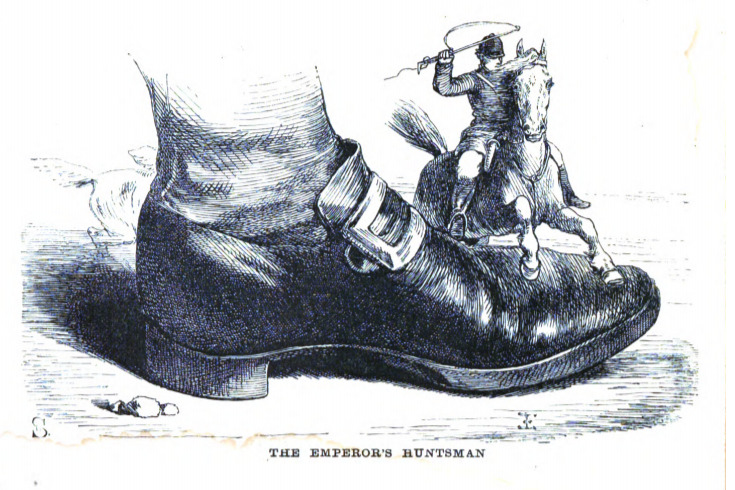
This image shows a cavalry huntsman jumping over Gulliver’s foot. The image appears when the Lilliputians become more comfortable with Gulliver. The Huntsmen begin to use Gulliver’s foot as jump training for their horses, seen here.
Here we see Gulliver’s crew fleeing Brobdingnag after seeing a giant, leaving Gulliver stranded. In the foreground we see Gulliver’s back as he watches the rest of the crew rowing away back to the ship. Gulliver runs along the coast, but the crew does not return to get him. Also in the foreground, we see waves crashing against a large rock, which is the same size as Gulliver. Six crew members are rowing a small rowboat and waving their arms fleeing. We see the silhouette of a giant in the distance. The giant also appears to be in the water while the crew tries to avoid him. The same image appears in the 1843 Krabbe edition.
Inside a structure, a group of Indigenous people tend to a sick man. The man stands in the middle of the group with his arms outstretched to either side. Two people each hold one of the sick man’s arms, with the person on the left touching his lips to the man’s arm. Another man stands behind the afflicted man and holds him by the shoulders. To the left, a man wearing a feathered headdress holds a rattle or other ornament over the group. There is a hammock slung between two beams of the structure behind the group, above them a monkey and a bird sit on another beam and a bow and bundles of arrows lie on the ground. This illustration is a simplified and mirrored version of the one found on page 88 verso of Paris, 1557.
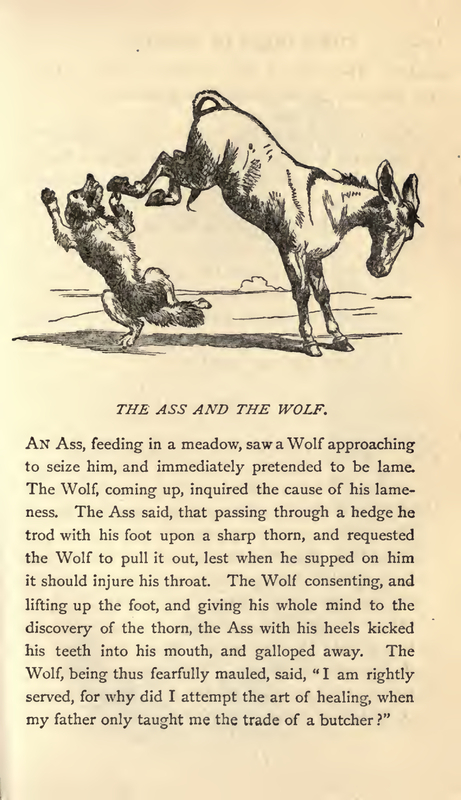
There are the ass and the Wolf. In this picture, the ass which look very angry, was kicking the wolf with his two left behind. The wolf was hit and fall back on the ground.
Amelia Osborne, wearing a bonnet, is shaking hands with Peggy O’Dowd, who has just entered the sitting room in a riding-habit. Through the doorway behind Mrs. O’Dowd are two officers of the regiment.
A mixed group of Indigenous people and Europeans stand on an island labelled ‘S. Maro’ and a group of Indigenous people in canoes are arranged along the shore facing the group on the island. The two groups are engaged in conflict, with the Europeans firing guns and the Indigenous people shooting arrows. At least two Indigenous people in one canoe (second from left) and one person in another (far right) have been killed or wounded. There appears to be a European captive in the prow of the canoe in the middle – the man is nude and has a rope tied around his neck, and he fires a gun at the group on the island. There are two fortifications on the island, as well as one on the mainland labelled ‘Brikioka’, from which several cannons are firing.
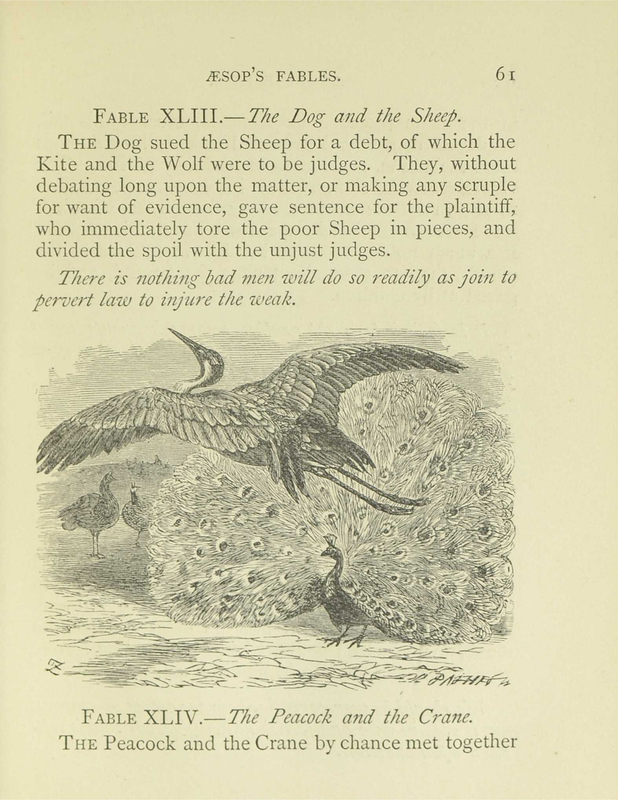
In the foreground we see a crane flying low to the ground with its wings outstretched in motion. Behind we see a peacock with its feathers open fully on the ground. In the far distance on the left there are two more birds looking the direction of the crane.
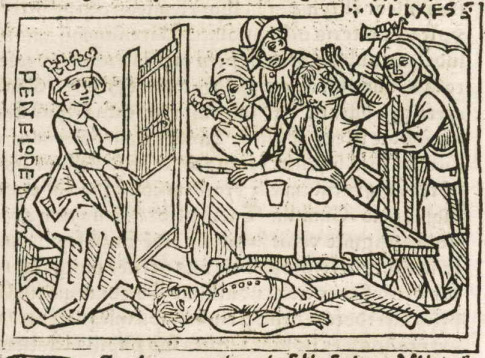
This image depicts Penelope, the wife of Ulysses, weaving on the left-hand side of the engraving as she waits for her husband’s return from the Trojan War. We know that this is Penelope as her name is engraved horizontally adjacent to her body. Penelope had many suitors over the twenty years that she waited for Ulysses to return home, however, Boccaccio explains in his story that Penelope remained entirely faithful over the duration of his absence. Penelope told the suitors that she will wait for her husband to return until she is done weaving a cloth, which is why she is depicted weaving in this engraving. Each night, she would undo all the weaving she had done that day so she could continue waiting for Ulysses. When Ulysses finally returns home, he slays every suitor in his palace. Ulysses is depicted on the right side of the engraving, disguised in peasant clothing with a sword in his hand as he kills the suitors. His name is engraved above his head in order to identify him.
Here we see Gulliver saying goodbye to his family as he leaves for another voyage only two months after returning from Lilliput and Blefuscu. Everyone here is crying. Gulliver’s wife is on his left while his daughter and son hug him. In the background we see the docks and the ship that Gulliver was leaving on. The same image appears in both the 1839 and 1843 Krabbe editions.
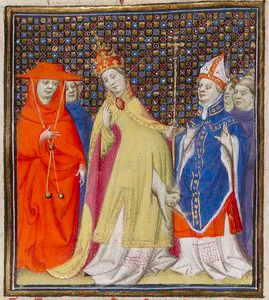
Pope Joan was known for her incredible birth story. She spent her adult life disguised as a man, Pope John. Her secret was exposed when she went into labor while she was in procession around the city. She is pictured in a yellow cloak in the center of the image. She is surrounded by men, all looking at her in awe. From the large stomach of her cloak, a baby is depicted as being born.
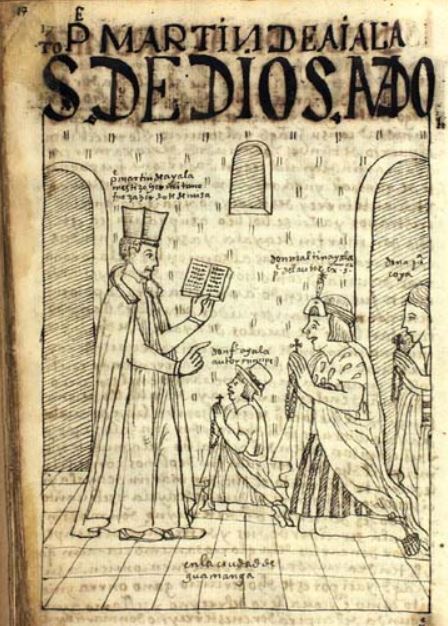
This illustration depicts a young Felipe Guaman Poma de Ayala in the centre of the image kneeling with a rosary in his hands. The words Don Felipe Ayala, Autor, Principe is written above his head to identify him. Behind the young author, his father is also kneeling with a rosary in hand. The words Don Martín Ayala, padre del autor, excelentísimo señor which translates to Don Martín Ayala, father of the author and most excellent lord, are written above his head. Don Martín’s wife is illustrated behind him with her name, Doña Juana Coya, also written above her head. The standing man on the left side of the image is Martín de Ayala, the step son of Don Martín. He is depicted preaching to his family from the book that he holds in his left hand. The words Padre Martín de Ayala Mestizo Hermitaño fue zazerdote de misa are written above his head, which translates to Father Martín de Ayala, mestizo hermit and priest who performed mass. The bottom of the image notes that this takes place in the city of Huamanga, as it reads en la ciudad Guamanga.
This image depicts a young Mariamne and Aristobulus sitting on the left side of the image having their portraits painted by the man sitting on the right side of the image. Mariamne and Aristobulus were the children of King Alexander and Queen Alexandra of Judaea. Mariamne and Aristobulus were renowned for their divine beauty, so their mother had an artist paint a portrait of them to send to the triumvir Mark Antony to win his favour. Mariamne would come to marry King Herod the Great.
In this image Gulliver is seated at a table looking at a Lilliputian carriage. There is a woman from the court inside the carriage that Gulliver speaks to. Two men are on the edge of the table talking to each other. These men are the driver and the finance minister. They had come to inform Gulliver that he would have to leave Lilliput as it was too expensive to keep him there and feed and clothe him. The same image appears in the 1843 Krabbe edition.
A satyr is sitting at a wooden table with a man. An older woman is holding the pot sitting in a fire. A dog is sniffing something on the ground next to the satyr. They are outside, next to a house.
A bull wades in a flowing stream that bends past land and trees, it is watching two frogs commune on the shore opposite to him, they are locked in eachothers gaze as the larger one sits atop a mound looking down at the smaller frog.
Queen Elizabeth I is depicted standing on a raised dais to the left of the image, drinking from a pitcher of beer she holds in both hands. In front of her is the ancestor of Pitt Crawley, a man with a pointed beard, kneeling and holding the platter from which the beer was taken. A slight figure of a guard can be seen behind the queen, and in the top right of the picture, the letter A from Among is seen through a window.
On the left side of this illustration, we see a male figure and a female figure off by themselves, the latter of which is wearing a robe. These two figures likely represent the scene in which Calisto meets with Melibea in her garden. To the right, we see a female figure wearing a robe and a veil. She is interacting with a group of four male figures. This scene has no apparent relation to the events portrayed in Act XIV.[This illustration is identical to those found in Acts I (folio 9r), VII (folio 52v), IX (folio 67r), XI (folio 80r), XII (folio 83v), XVI (folio 106v), and XIX (folio 115v).]
A group of Indigenous Canadians (identified as such by the author) hunt wild boar and deer with spears. They wear tunics, hats, leggings or tall socks with fur, and snowshoes on their feet. One individual in the background drags the body of an animal towards their village. This illustration is a simplified and mirrored version of the one found on page 151 of Paris, 1557.
In this image we are shown the scale of all the animals on Lilliput next to Gulliver’s ruler which measures twelve inches. The average Lilliputian man measures six inches tall. The scale includes a human, cow, horse, goat, ram, sheep, dog, monkey, cat, fox, rabbit, mouse, rooster, owl, parrot, parakeet, dove, swan, duck, toucan, turtle, lizard, frog, snake, fish, butterfly, moth, and several other types of insects. The purpose of the image is to demonstrate that the animals on Lilliput are roughly the same scale to the human as is true in the real world. Due to this scale we are also led to believe that the same animals exist on Lilliput as do in reality, simply on a smaller scale, and thus they likely have the same roles and utilities. This contrasts to some animals in the other lands visited by Gulliver later in the story where the animals are more highly fictionalized. The same image appears in both the 1839 and 1843 Krabbe editions.
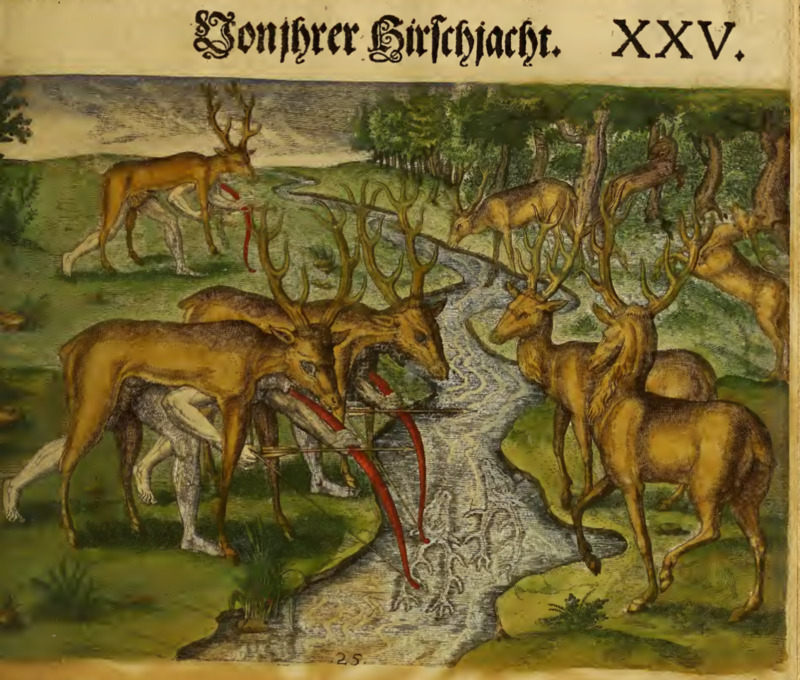
This image shows the Indigenous people’s method of hunting deer. Three individuals are hunting. They have taken the skin of deer previously killed and draped them over themselves as a disguise. They walk bent at the waist and hold bows and arrows in front of them. Across a small river, several deer stand watching the hunters. This illustration is identical to the one found on page 89 of Frankfurt 1591, but colored.

![[Gulliver swims for his life after the shipwreck]](https://collections.cemvc.ca/files/large/8af108912b1ce55cf76b49f89187e2f50957dd3f.jpg)

![[Gulliver’s crew flees after seeing a giant, leaving him stranded on Brobdingnag]](https://collections.cemvc.ca/files/large/0af96c370cc9a147b25698dd8461eed99df33a2b.jpg)
![[Practice of caring for the sick in an Indigenous Brazilian community]](https://collections.cemvc.ca/files/large/e7ac06c7245bf53c8a14b30381ec24d73797ddf5.jpg)
![[Amelia Meets Mrs. O’Dowd]](https://collections.cemvc.ca/files/large/c259a3ad9e3672206c92c3fb6dd3bd7e0aa8e3ed.jpg)
![[Combat between European and Indigenous men on an island and Indigenous people in canoes]](https://collections.cemvc.ca/files/large/79272481343b2786fef6c519736a7a136d466d59.jpg)
![[Gulliver leaves his family before his voyage to Brobdingnag]](https://collections.cemvc.ca/files/large/47974f4bd766855e11eca4f505c5b9a279f96b89.jpg)
![[Mariamne and her brother Aristobulus]](https://collections.cemvc.ca/files/large/cfe5f4a5f4a6e5cd1409507f5263c69996443c92.jpg)
![[Gulliver examines a Lilliputian carriage and converses with Lilliputians]](https://collections.cemvc.ca/files/large/7e60017589473bad12576e0a741ff956d1596f14.jpg)
![[The Satyr and the Traveller]](https://collections.cemvc.ca/files/large/10d46799543e24afee809a8f23e72ef0280b1076.jpg)
![[Vanity Fair Vol. I Chapter VII Historiated Initial]](https://collections.cemvc.ca/files/large/d557729ac571a64ba712840ce3573d3968ee05f4.jpg)
![[Act XIV]](https://collections.cemvc.ca/files/large/31db7436530a81a1f26584d57aaa1f0cb5ca192e.jpg)
![[Indigenous Canadians hunt in the winter]](https://collections.cemvc.ca/files/large/b1d48a2ef3f950b4092fd6feb679ce6e28125d27.jpg)
![[Diagram showing the scale of animals and insects on Lilliput]](https://collections.cemvc.ca/files/large/51c9e0b026982d01f0a048193229a0eaa967425f.jpg)