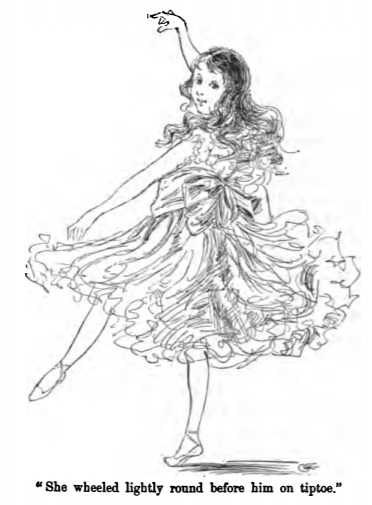
Here we see Adele dancing for Mr. Rochester and Jane. Her mother was a dancer and Adele emulated her. She always wanted to entertain Mr. Rochester and seized any opportunity to dance or recite for him and his guests.
In this image we see Gulliver sitting in his cell in Lilliput where he lived for a short time before gaining his freedom. We see Gulliver’s profile through the partially open wooden doors of the cell. The same image appears in the 1839 Krabbe edition.
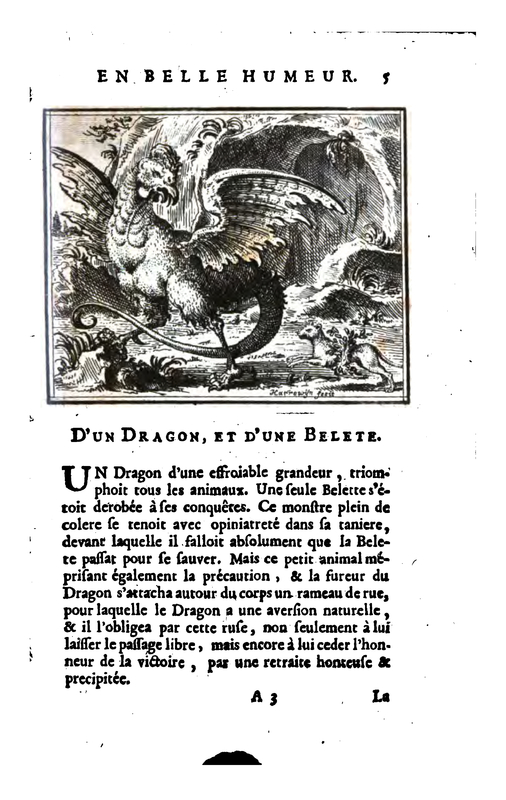
A creature that resembles a rooster/chicken and dragon is looking at a weasel. The weasel is running alongside the dragon. The dragon and the weasel appear angry with each other. The background looks like a rocky cliff. The illustration has the signature of Harrewijn in the bottom right corner.
Jane and Maria Osborne and their governess, all with displeased expressions on their faces. One sister is standing with her chin on one hand. She and the governess, Miss Wirt, are looking towards the right of the picture, staring in the direction in which Amelia Sedley just left. The other sister is seated on a cushioned chair, holding a piece of cloth or paper and looking back at the others. On the floor by her side there is a small dog.
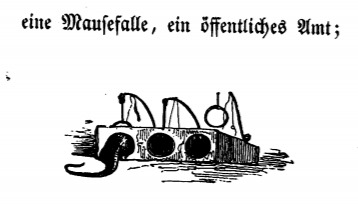
This image shows a mousetrap, which is the code word for an employment or public office. This image comes in a description of a conspiracy found by a professor from the Grand Academy on Balnibarbi. This idea is representing code word for terms in the conspiracy that Swift is satirizing. The professor advises that those named in the conspiracy papers be closely monitored at all times, naming specifically while they were using the bathroom, as this is when men were most thoughtful. This conspiracy is thought to be an allusion to the trial of Francis Atterbury, the bishop of Rochester for allegedly plotting with the Jacobites. Atterbury was charged with treason in 1722 and was exiled to France. The same image appears in the 1839 Krabbe edition.
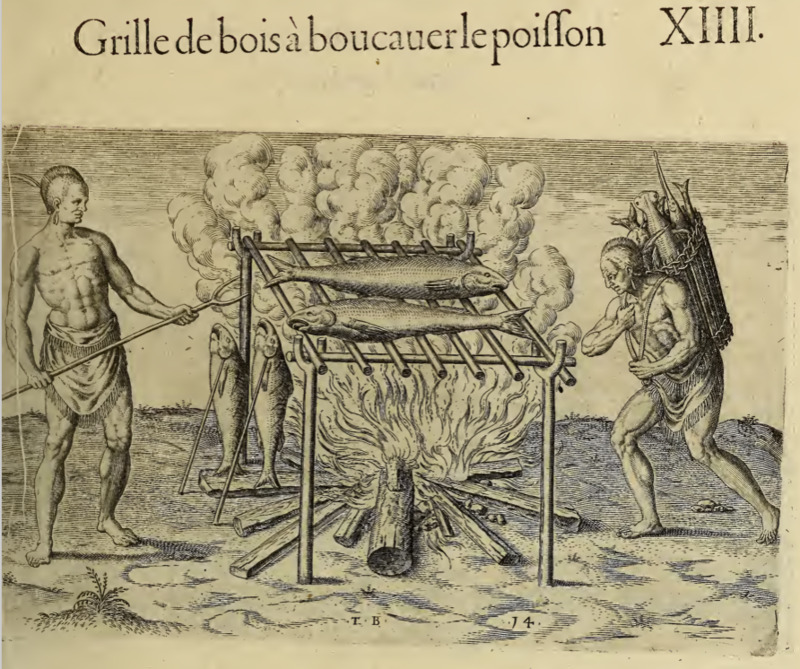
Two Indigenous men are shown cooking fish over a fire. Two fish are laid out on a rack over the flames, two others are propped up with sticks tail-down on the ground by the fire. The rack is composed of four forked sticks propped vertically on the ground, with four others forming a square horizontal to the ground, and five more laid across the square forming a rack. One of the men holds a forked stick, the other carries a basket of fish slung across his back. Both men wear fringed garments tied around their waists and have a single feather in their hair.
Here we see two lawyers in a debate in a court. Gulliver casts lawyers in a very negative light, saying their job was to convince people that white was black and black was white. This image appears when Gulliver explains various aspects of European life. The same image appears in both the 1839 and 1843 Krabbe editions.
Some time after telling Sosia that Areusa wanted to speak with him, Elicia visits Areusa to see if this has occurred. Shortly after she enters Areusa’s house and greets her, Sosia knocks at the door. Elicia conceals herself. Areusa manipulates Sosia into divulging where, when, and how Calisto enters Melibea’s garden. Sosia also tells her that Calisto is set to visit that same night at midnight. Upon acquiring this information, she tells Sosia that she has other matters to attend, and he departs.[The figures in this illustration are used in multiple other illustrations throughout this edition. Also, the choice to depict Sosia using a female figure is rather odd, seeing as there are multiple male figures used elsewhere in this edition.]
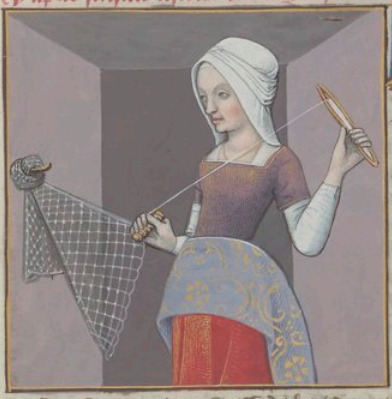
This illuminated image depicts a woman named Arachne spinning wool to make a net. Arachne is famous for having discovered the uses of woven cloth, and for being the first to think of making nets. Arachne is also known for having challenged Minerva to a weaving competition. When Arachne lost the competition, she killed herself as a result.
A human torso with both arms, head and one leg removed lies face down on the ground. One Tupinambá man removes the innards from an incision along the spine and sets them on a plate held by a woman while another man prepares to remove the final leg using a small axe or hatchet. Around the body three women hold the two arms and one leg, and a child holds the head. To the right there is a large pot set over a fire, and two women add innards and a head to the pot while another brings more firewood. A bearded European man stands behind the fire with his arms crossed over his chest, observing the group.
ALABAMA - GREAT SEAL MISSISIPI TENNESSEE GEORGIA FLORIDA GULF OF MEXICO TENNESSEE RIVER TOMBIGBEE RIVER BLACK WARRIOR RIVER ALABAMA CAHABA R. RIVER COOSA RIVER TALLAPOOSA R. CONECUH RIVER PEA R.
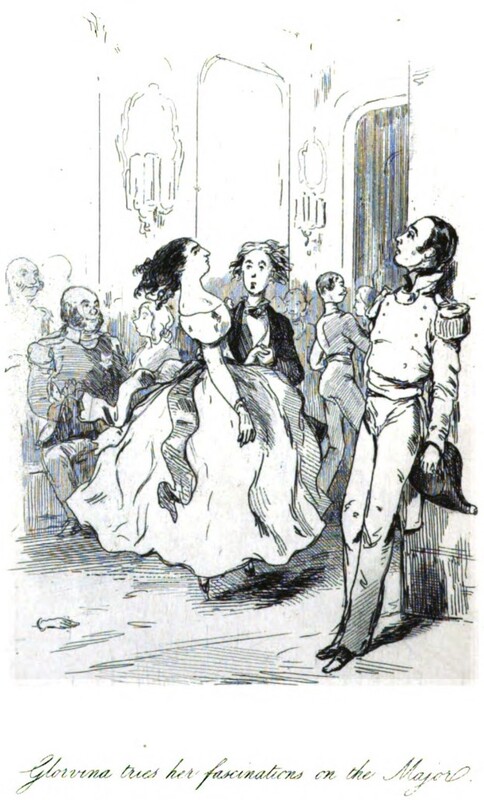
Miss Glorvina O’Dowd dances past Major William Dobbin, trying to get his attention. He is leaning against the wall, holding his hat in his hand, and paying no attention. In the background are assorted other officers and their ladies. Below the illustration is printed in cursive its title, Glorvina tries her fascinations on the Major.
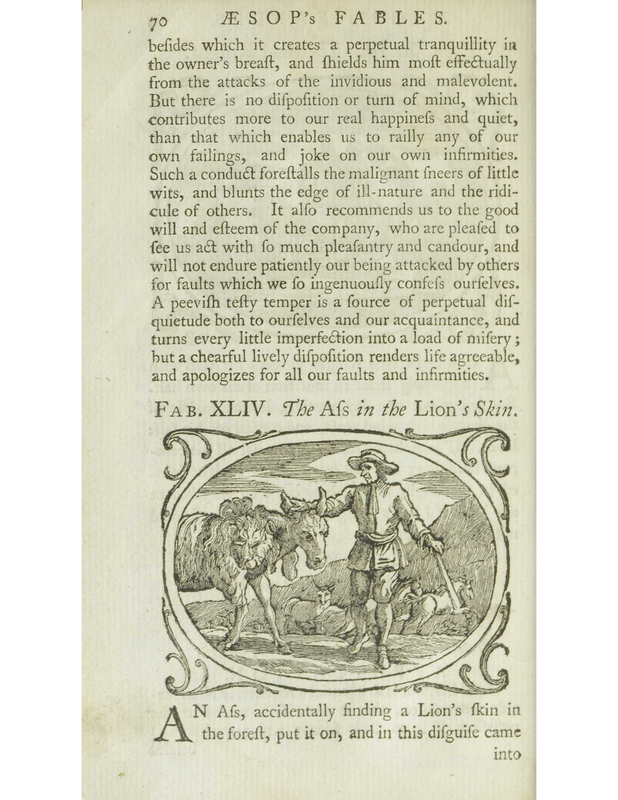
A donkey walks beside a farmer, with the faint image of a lion on its back. The farmer holds the donkey by its horn, pulling it alongside him. More animals are seen in the background by stables that appear to be made out of hay.
Here we see Gulliver sitting on a couch speaking with Captain William Robinson, who was the Commander of the Hope-well. Robinson asked Gulliver to join him on his trip to the Levant, working as a surgeon. Gulliver agreed and the set sail two months later. In this image we see the two men sitting on a couch together. In the background we see a telescope, Gulliver’s hat, and a map on the wall, and a pot of tea sitting on a table next to the couch. The same image appears in the 1839 Krabbe edition.
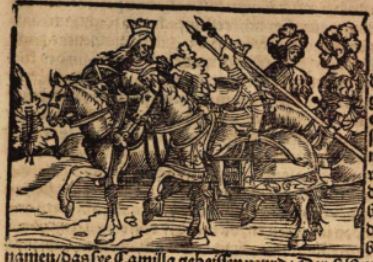
This image depicts the young Camilla, queen of the Volscians, leading an army into battle against the Trojans. She was raised in the wild by her father, King Metabus, as he was exiled from his own kingdom. Camilla grew up strong and became a great fighter and hunter as she was forced to hunt for her own food and fend for herself and her father. When old enough, she was called back to the kingdom of the Volscians to be their leader. She led her army in a war against the Trojans as allies to Turnus of the Rutuli people, where she met her final end. She is pictured riding a horse in the engraving and adorned in her armour as she is surrounded by other soldiers. She is wearing a crown to demonstrate her royal status.
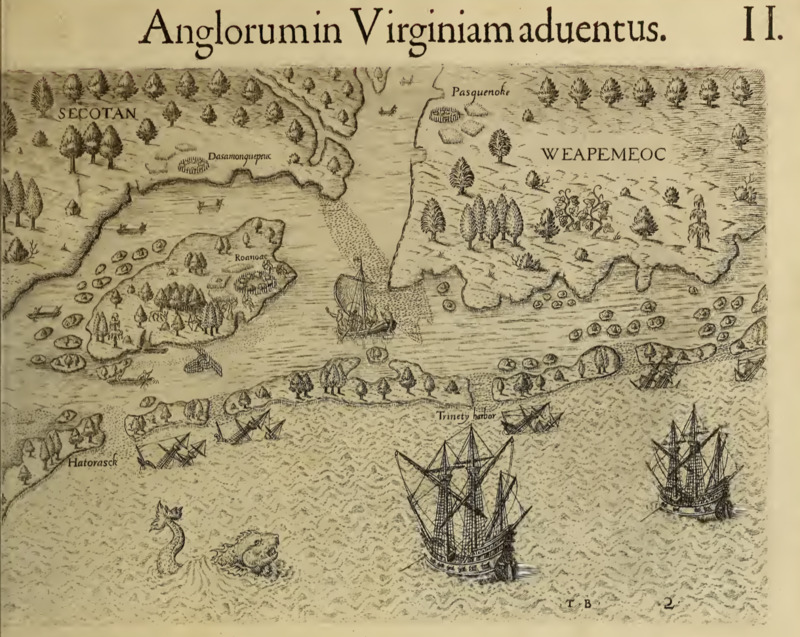
Two English ships are pictured sailing near the coast of Virginia (what is known today as the Outer Banks of North Carolina). One smaller ship is pictured within the outer islands, closer to the coast. Several Indigenous towns are labelled.
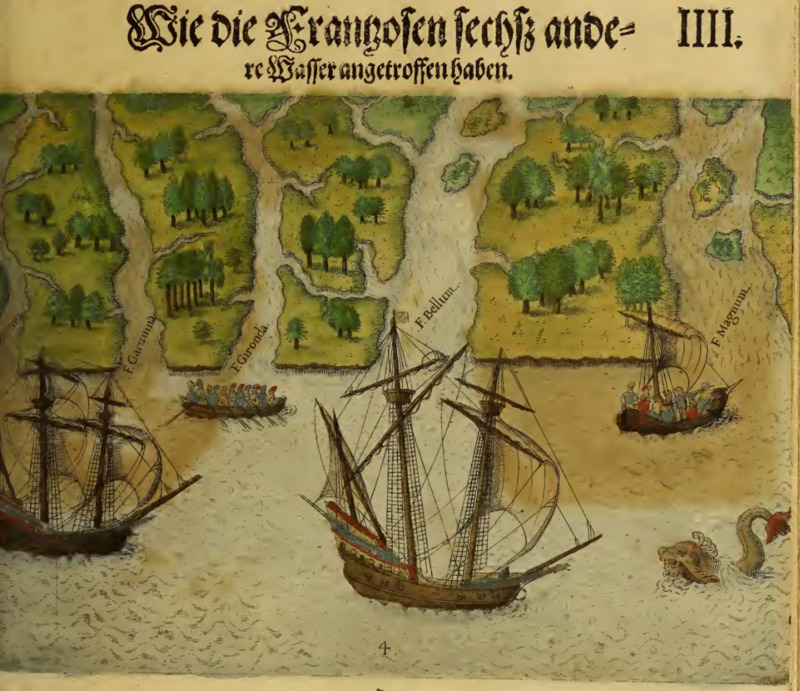
Two large ships are shown at the mouth of the river, while another smaller ship sails further up the river. Two Indigenous people on the bank of the river roast a small animal over the fire, while several others run with bows and arrows. On both sides of the river there are round structures. This illustration is identical to the one found on page 45 of Frankfurt 1591, but colored.
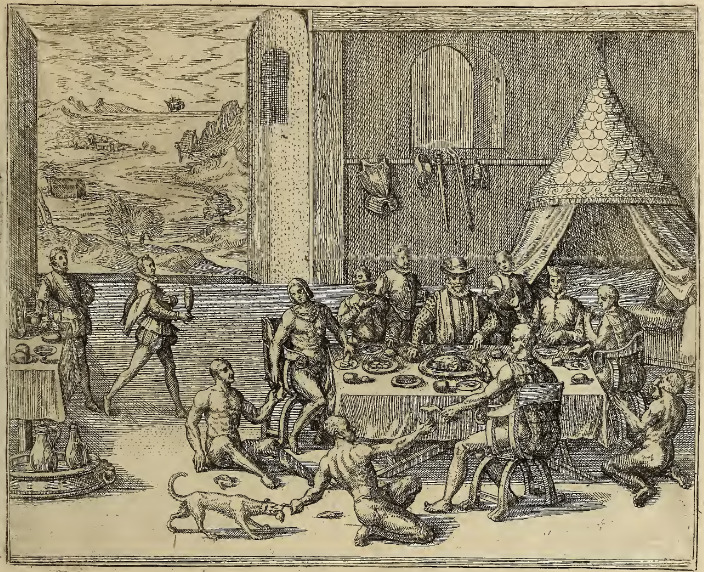
A group of Spaniards, one of whom is Diego Guttierez, governor of Costa Rica, share a meal with several Indigenous leaders, called Caciques. The group dines in a large structure with a canopy bed in one corner, two dining tables and wooden chairs. Several pieces of armor and weaponry have been hung on a rail near the bed. At the table, three Indigenous men wearing capes of feathers and necklaces (the Caciques) sit in chairs, while three more Indigenous men sit on the floor, one beside each leader. One of the Caciques passes meat to the man near him on the floor, who in turn feeds it to a dog.


![[Gulliver sitting in his cell on Lilliput]](https://collections.cemvc.ca/files/large/a21bf45ef280d76250b1fc93366dc55b895e6568.jpg)


![[The Osborne Sisters and Miss Wirt]](https://collections.cemvc.ca/files/large/d88107213d556a6b45d26e9da25847c39deb362f.jpg)
![[a court scene from England]](https://collections.cemvc.ca/files/large/02176eb834a98e486aa54ccdf073a95345c5ae94.jpg)
![[Act XVII – Elicia, Sosia, and Areusa]](https://collections.cemvc.ca/files/large/0915c687e88a753b52ed4cb43b878f59e2ab7b55.jpg)
![[The Tupinambá dismember a body for ceremonial cannibalism]](https://collections.cemvc.ca/files/large/aaf4d7b6bff2817285ce535ffa4130e25053ac94.jpg)


![[Gulliver speaks with Captain William Robinson before leaving for Laputa]](https://collections.cemvc.ca/files/large/3ee10f280f84b08ea52c06d72368e9bfb77380e1.jpg)