This illustration depicts Theoxena, a noblewoman from Thessaly, drinking a cup of poison while handing her child and her nephews arrows to kill themselves with. Boccaccio explains that Theoxena’s husband and brother in law had been killed by King Philip of Macedon, and when he decreed that all the sons of the men he has killed must be executed as well, she knew she had to protect her family. Rather than dying at the hands of a horrible king, she wanted her family to die at her hands instead. Theoxena gave her child and her sister’s children the option of either drinking poison or stabbing themselves. Theoxena is illustrated drinking the poison while handing the three boys arrows to pierce themselves with before the king can kill them all.
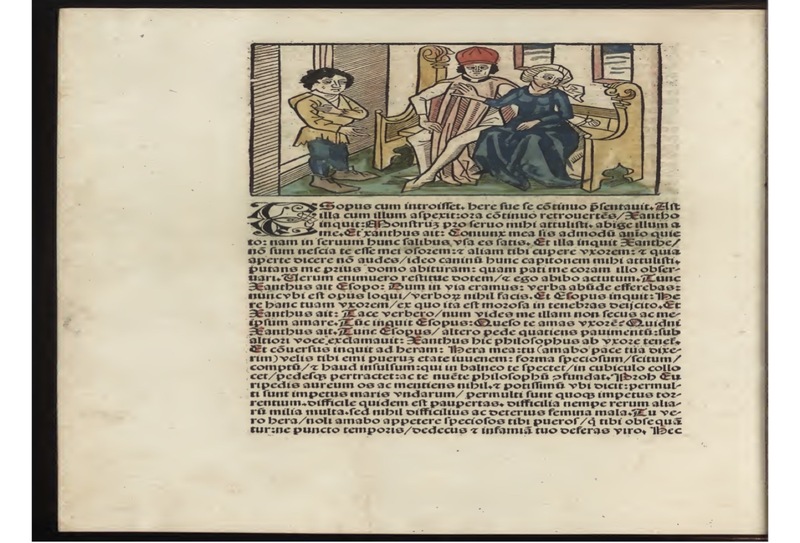
Three people are gathered in a building. One of the men and the woman, who both appear to be affiliated with the church or the crown, sit on a pew. Aesop stands to their right with his hand across his chest in a symbol of sincerity regarding what he is telling those sitting. The woman places her hand on the chest of the man sitting beside her and looks away in distraught.
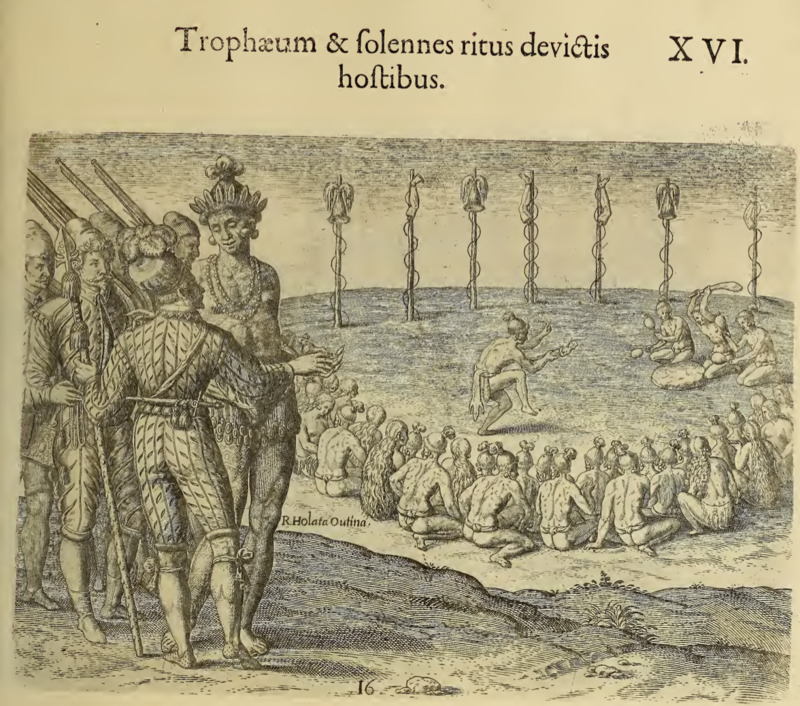
A group of Indigenous people sit on the ground in a semi-circle. A man dances in the middle of the group. In the background, the body parts of the defeated enemies have been mounted on poles that have been stuck into the ground as trophies. In the foreground an Indigenous man stands with a few colonists.
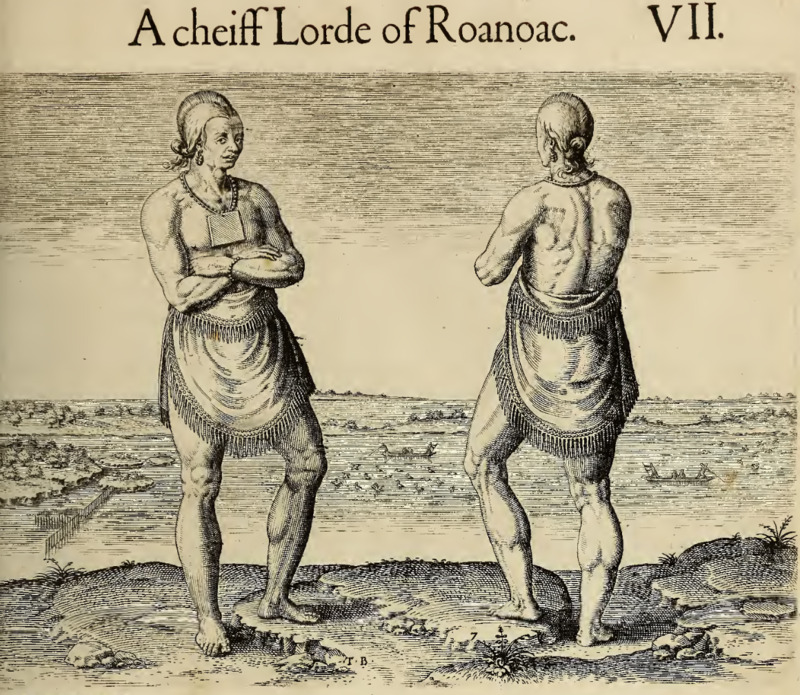
An Indigenous man, a chief, is pictured from the front and from behind standing on the bank of a river. A section of his hair is feathered in the middle of his head from his forehead to the nape of his neck, where the rest of his hair is gathered in a knot. He wears beaded earrings, a necklace with a large square pendant, and beaded bracelets around his wrists. He wears a fringed skirt draped around his waist and is barefoot and shirtless. In the background, other Indigenous people are seen in canoes, and there is a fishing apparatus in the water in the left part of the background.
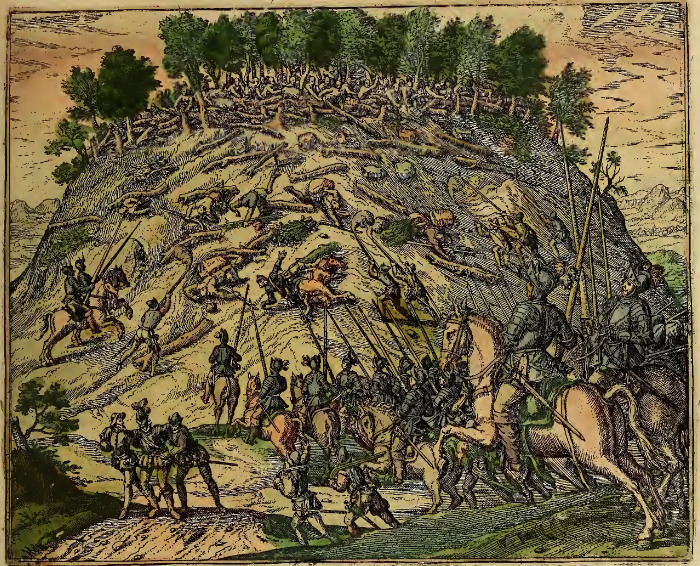
A conflict between Spanish soldiers and Indigenous people of Mexico takes place around a prominent hill. The Indigenous people are massed at the top of the hill and have fortified their position with a log fence. From there they roll rocks and logs down the hill to prevent the Spaniards from reaching them. Bodies of Spanish men and their horses litter the hillside. The Spanish soldiers gather at the base of the hill, some on foot and many on horseback armed with long spears. Some Spaniards attempt to climb the hill to reach the Indigenous defenders, firing muskets up towards them. This image is identical to one found on page 43 of Frankfurt, 1595, but colored.
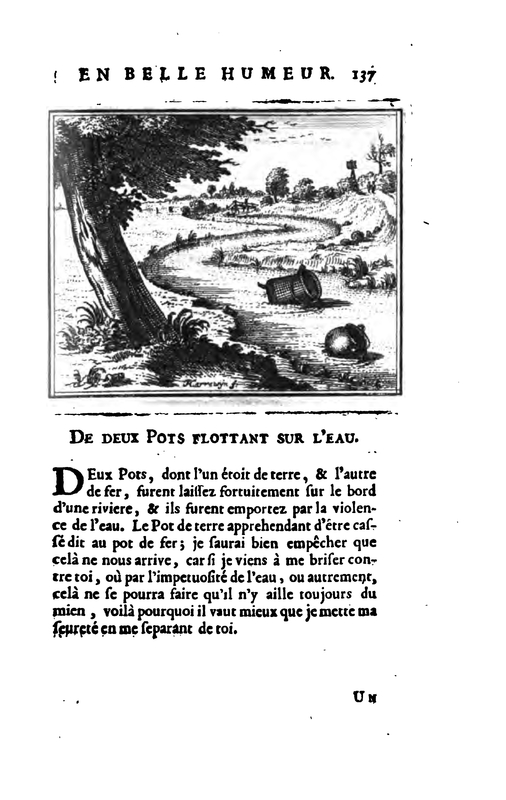
Two pots, one brass, and one clay, floated down a stream. The clay pot tried its best to keep apart from the brass one. whether the waves crash me into you or you into me, in either case I will be the one to break. Equals make the best parteners.
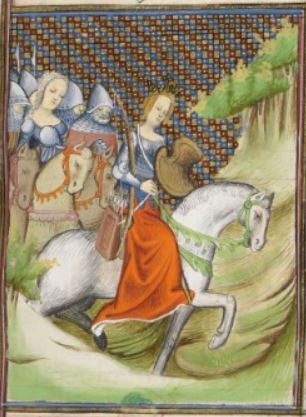
This illumination depicts Penthesilea, the queen of the Amazons, riding a horse while holding a bow and a shield. She has companions riding on horses behind her, which are other Amazon women. Penthesilea, as Boccaccio describes, was a great warrior. She wanted to secure a strong heir for the Amazons, so she sought out Hector of Troy to provide her with an heir. She fought in a battle against the Greeks to prove herself worthy of bearing Hectors child. She died in battle trying to impress Hector.
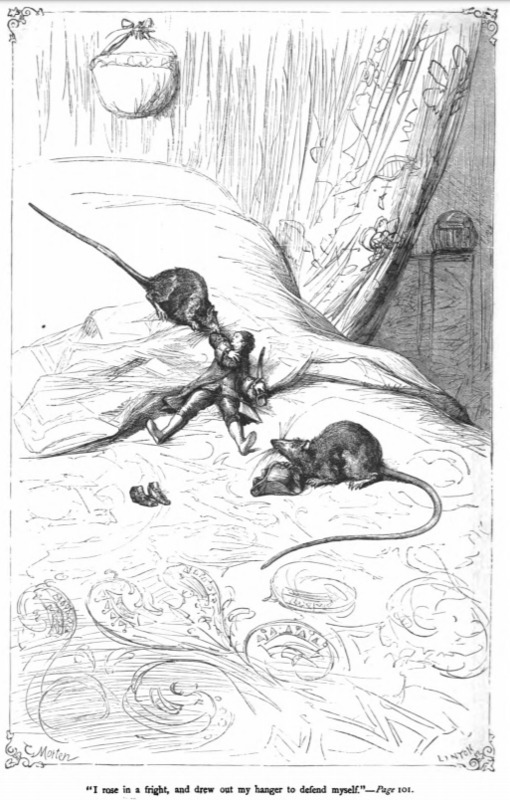
Here Gulliver defends himself from giant rats on Brobdingnag. While sleeping on the bed in Brobdingnag, two rats climbed up on the bed and began to attack Gulliver. These rats were almost the size of Gulliver. He drew his sword in self-defense and killed the rats.
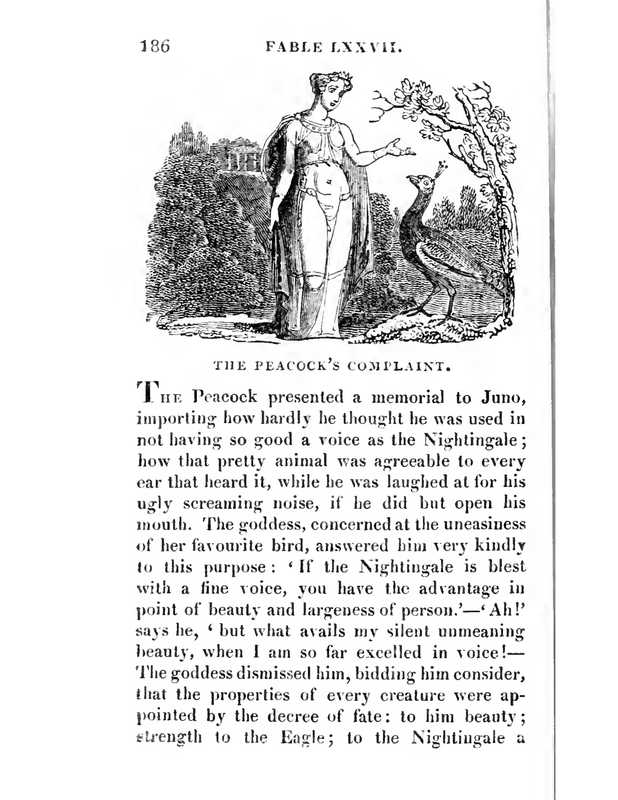
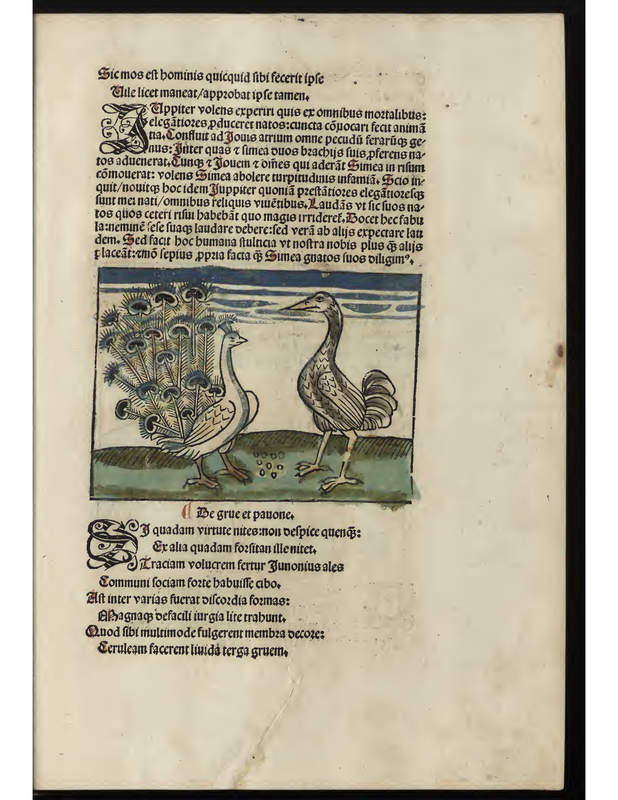
A women stands in the middle of the image with one hand at her side, and the other hand raised slightly. To her right there is a peacock standing and staring up at her. In the left side of the background there are many bushes, and on the right side a big tree that leans over the peacock.
Here we see a scientist from the Grand Academy of Lagado on Balnibarbi who greeted Gulliver by embracing him. Gulliver is now dressed in the style of the locals, wearing a jacket with a motif of astronomical and mathematical symbols on it. Gulliver was unhappy to be greeted in this manner as the room had a terrible stench. This smell was caused by the scientist’s experiments. He was attempting to restore excrement to the food that was consumed. The same image appears in the 1839 Krabbe edition.
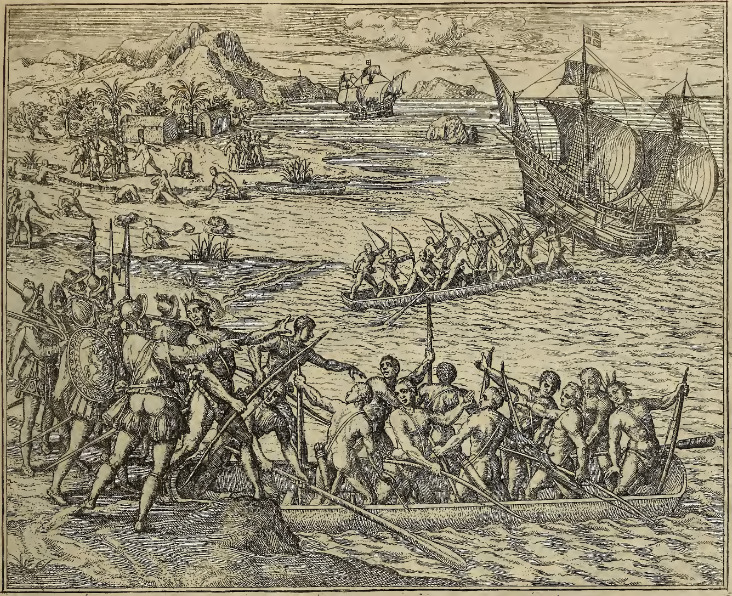
A group of Indigenous people are encouraged by Spanish colonists to attack and drive away a French ship near the island of Cubagua – the pearl island of Venezuela – in order to preserve the Spanish monopoly over the pearl trade. The Indigenous people launch their attack on the French ship from dugout canoes, using bows and arrows. In the background a group of Indigenous people harvest pearl oysters near the shore using long-handled nets, supervised by more Spaniards. There is also a village near the group. Another French ship sails further along the coast.
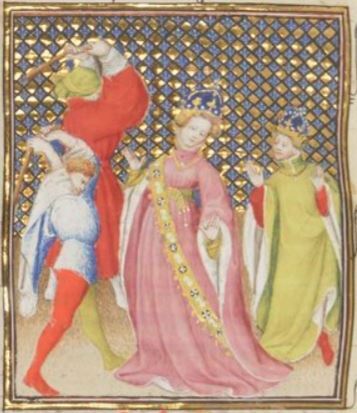
This illumination depicts Agrippina, the mother of Emperor Nero, standing in the centre of the image about to be beaten to death. There are two men on the left side of the image who are swinging clubs above their heads as they were instructed by Emperor Nero to kill his mother. Emperor Nero is illustrated on the right side of the image.
Here we see a man on crutches. This image appears when Gulliver explains European nobility and their conduct. Gulliver explains that many upper-class men hire prostitutes which causes them to contract various diseases, while they are engaged to women chosen by their family. The upper classes also tended to be incestuous, which caused children to be born with deformities and they were more likely to have weak constitutions and were frequently ill. Thus, wealthy children were often sick and weak. The same image appears in the 1839 Krabbe edition.
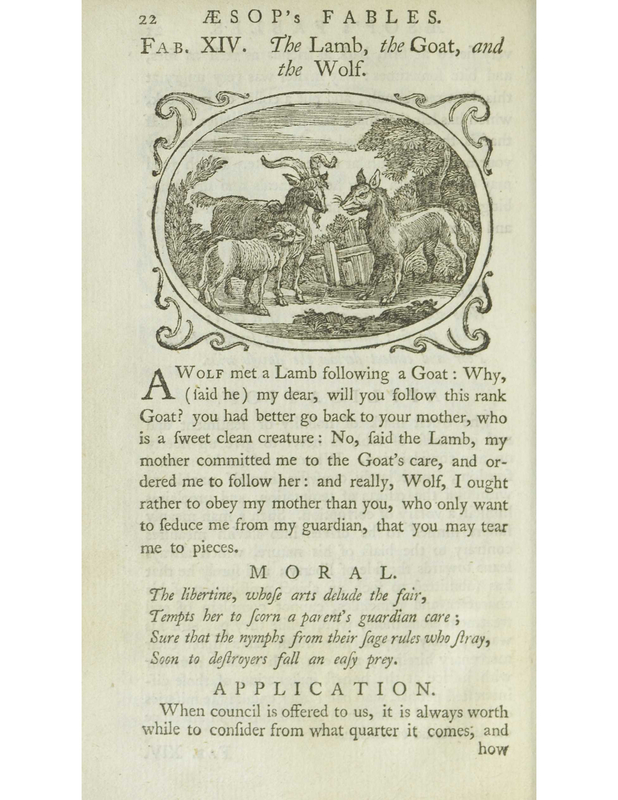
There is a small sheep, medium size goat with horns and a wolf standing in a mid circular form. The wolf looks angry or displeased. There are trees and a fence like structure in behind the animals. The sheep is less shaded than the other two animals. Some small tuffs of grass in between the animals, in the center of the image.
Here we see Gulliver talking to his family when he first sees them after returning to England from Brobdingnag. Gulliver tells us how he knelt down when his wife came to kiss him, because he felt like a giant. When his daughter came to speak with him, she knelt down but he could not see her until she stood up because he became so used to looking up to the giants. In the image, Gulliver’s family looks concerned as Gulliver tells them what he saw, thinking he had gone crazy. The same image appears in the 1839 Krabbe edition.
The left panel of this image depicts Areusa, one of Celestina’s prostitutes. She is wearing a veil, a robe, and a necklace of some sort. On the right we see Centurio (here misspelled ‘Centurion’), who is holding some sort of satchel and has a sword mounted on his belt.The entire image is nearly identical to the one found on page 125 (where the right panel is labeled ‘Pármeno’). The left panel is identical to the one found on page 208. The right panel is nearly identical to those found on pages 51 and 82 (where it has a decorative panel and is labeled ‘Sempronio’), and on page 235 (where it has a decorative panel and is labeled ‘Tristan’).
This engraving depicts the sibyl named Erythraea (also known as Eriphila) on the left side of the engraving with her fingers pointing to the man on the right side of the engraving. The man she is pointing to is Jesus Christ. Boccaccio explains that Erythraea was so intelligent that her prophecies were taken as Gospel rather than fortune-telling. She even prophesized the entire events from the life and death of Jesus, which is why he is depicted in this engraving. Boccaccio explains that Erythraea had also prophesized the fall of Troy, which is assumed to be the city in the background of the engraving.
Here we see the exterior of the royal palace of Brobdingnag. This image appears at the beginning of chapter four, in which Gulliver describes the country of Brobdingnag, as he travelled throughout the country both with the farmer and the King and Queen.
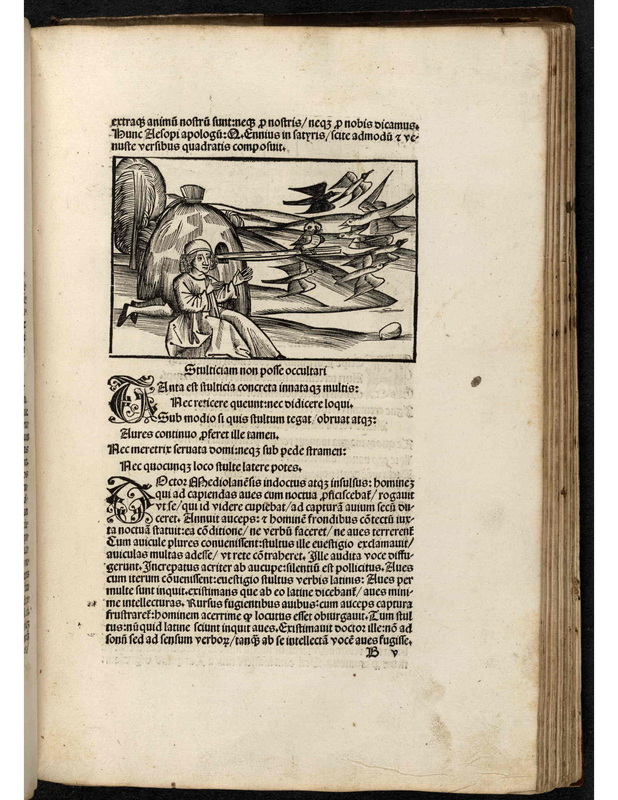
A man with his arms outstretched is seated in front of a straw hut that has legs sticking out from underneath it. The hut has a hole with a long stick protruding from it. There is a bird perched upon the end of said stick. There are different birds flying toward and away from the bird perched on the end of the stick.


![[Theoxena Killing Herself with Poison]](https://collections.cemvc.ca/files/large/6947d0e1501b6f6d783aec4b9700c84a34ded6b5.jpg)

![[Grave near a Forest]](https://collections.cemvc.ca/files/large/de9b61561b49d1fbc693487cc564853697561f61.jpg)
![[A scientist from the Grand Academy of Lagado embraces Gulliver]](https://collections.cemvc.ca/files/large/d83b0b43b4211db1d6df1ef3420a48edb28eb51e.jpg)
![[a man using crutches]](https://collections.cemvc.ca/files/large/1baaa4b2cd040e45f364c3009ec3945b3790550d.jpg)

![[Gulliver is reunited with his family after he returned from Brobdingnag]](https://collections.cemvc.ca/files/large/55de7df10b8bec5f27d36eb74ca8c3c686afbfa3.jpg)
![[Act XVIII – Areusa and Centurion]](https://collections.cemvc.ca/files/large/c530888f78600b5bb918c420fe3ef43e50a12627.jpg)
![[The Sibyl Erythraea Predicting the Fall of Troy and Life of Christ]](https://collections.cemvc.ca/files/large/8767ff6ff3fbebba99a29cd429fa76fe94798a6f.jpg)
![[The palace on Brobdingnag]](https://collections.cemvc.ca/files/large/58ce38cf0d902fa46b3cf6181d996cf40bf76f2b.jpg)