A casket is covered by black cloth adorned with a cross and on top of the cross there is a lone crown. In the foreground on the tiled floor sits a single goblet and in the background four lit candles upon tall candlesticks. The image is occasioned by Dolorida saying "In short, after many pros and cons, the Infanta standing stiffly to her engagement, without varying or departing from the declaration first made by her, the vicar pronounced sentence in favour of Don Clavijo, and gave her to him to wife; at which the queen, Donna Magoncia, mother to the Infanta Antonomasia, was so much disturbed, that we buried her in three days' time."
Having deceived all into thinking he has stabbed himself and subsequently asking for Quiteria's hand in marriage, Basilius (middle) lies on the ground and acts as if he is seized with a fainting fit. In the background all the by-standers act surprised, fearing that he is on the brink of death. Quiteria (right),dressed in her wedding attire, kneels next to Basilius and take his right hand in hers. A man with short hair holds Basilius' head upright, so that he might speak. A priest kneels over the priest with his right hand before his chest praying for Basilius' soul. On the right Don Quixote, clad in armor, kneels as well and looks off towards the left of the image.
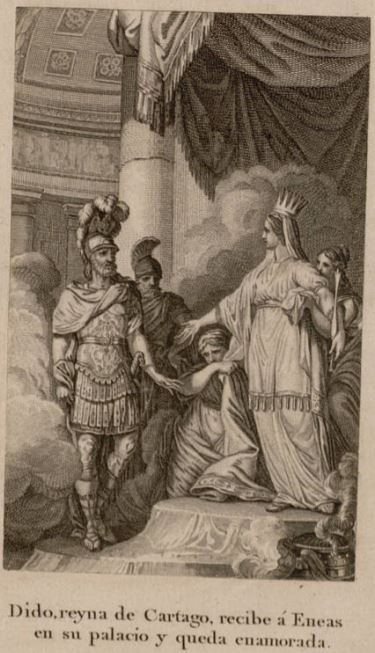
After Aeneas and his companions had been shipwrecked, Queen Dido of Carthage had welcomes Aeneas into her palace. This image depicts Dido on the right side of the image holding her arm out to welcome Aeneas and his companions. She is wearing a large crown to demonstrate her status as queen. Aeneas is depicted on the left side of the image wearing his armour. After Dido welcomes Aeneas into her home, she falls in love with him.
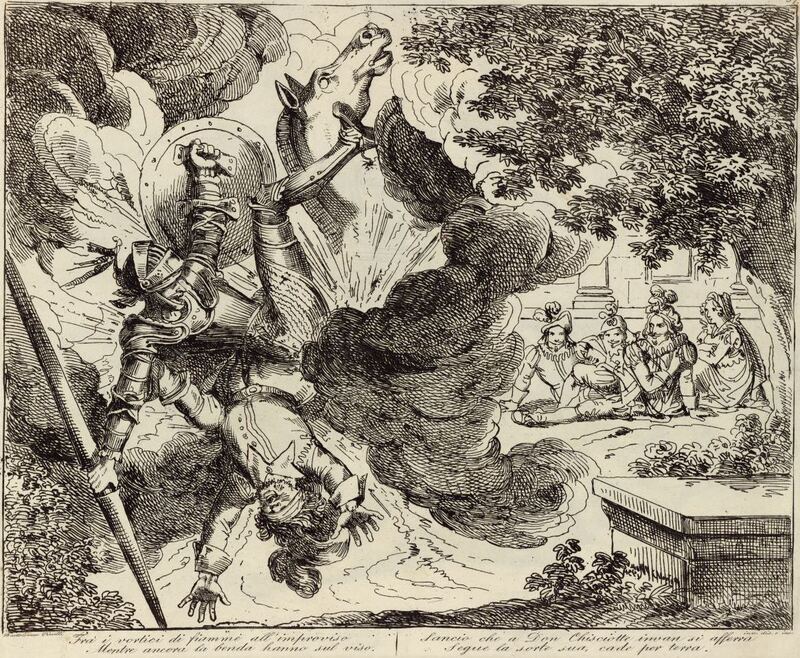
The firecrackers inside Clavileño explode, throwing Don Quixote and Sancho Panza in the air. The duke, the duchess, and their servants (background) observe the scene. Signed by Bartolomeo Pinelli (engraver and illustrator) and dated Rome, 1833. Plate 57. Part 2, ch. 41.
An envelope lies on the ground in the middle between an opened letter on the right upon which the name "Theresa Panza" is written, whereas on the left lies a large unclasped necklace of rich corals by way of a present from the duchess.
Sitting on a three layered pedastal are the busts of Don Quixote (right) and Sancho Panza (left). Strewn across the floor are various books, likely of chivalry and knight errantry, some opened others closed, all of them in poor shape. Resting on the first layer of the pedestal is the head of a lion from whom Quixote received the title "Knight of the Lions". On the second pedestal rests a pot of chicken (left) which Sancho had eaten from at Camacho's wedding. On the right of the second pedestal is a basin, the likes of which Don Quixote had mistaken for the helmet of the legendary knight Mambrino. Behind the pedestal, on the right, rests a sword and shield.
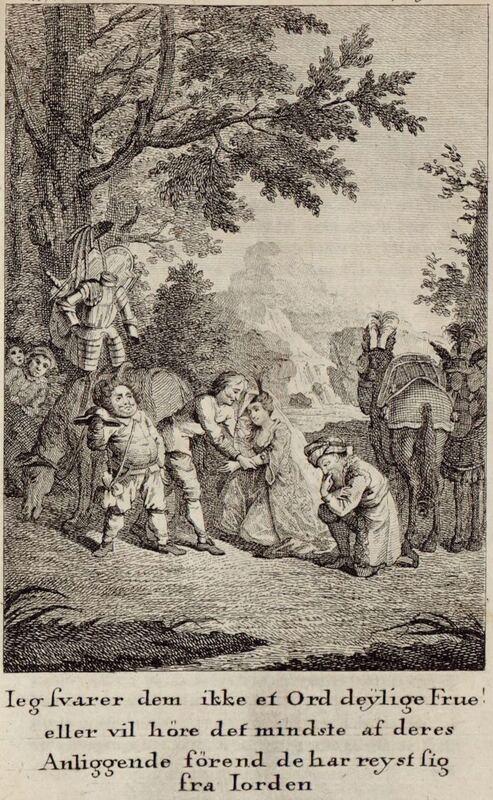
In Sierra Morena, princess Mimicona (Dorotea) kneels before Don Quixote and begs for his help. The barber is disguised as Dorotea’s page with a fake beard (an oxtail). Don Quixote’s armour hangs in a tree. In the background, the priest and Cardenio watch the scene, hidden behind some shrubs. Unsigned. Part 1, ch. 29.
Having travelled for a few days Quixote (not pictured) came to the cavern of Montesinos, the mouth, pictured in the middle of the image is wide and spacious, but overgrown with briars, wild fig-trees, and thorns, so thick and intricate that they conceal it. Of the trees the dead fig tree that hangs over the cave from the left is notable.
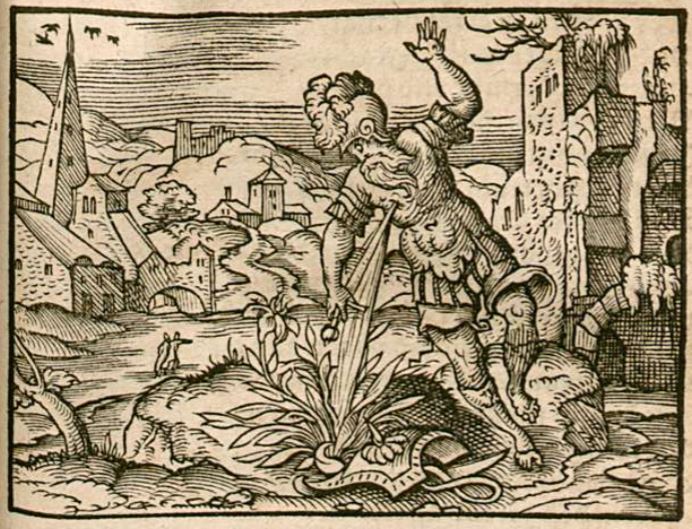
This engraving illustrates Ajax killing himself after finding out that he lost a debate to Ulysses. The prize of the debate was the armor and weapons of the great Achilles. Ajax, despite being Achilles cousin, lost the debate and therefore lost the right to take the armor. After hearing that Ulysses won, Ajax took his sword and stabbed himself with it. The blood that is illustrated pouring out of Ajax sprouts a flower as it hits the ground. The blood transforms into a hyacinth flower.
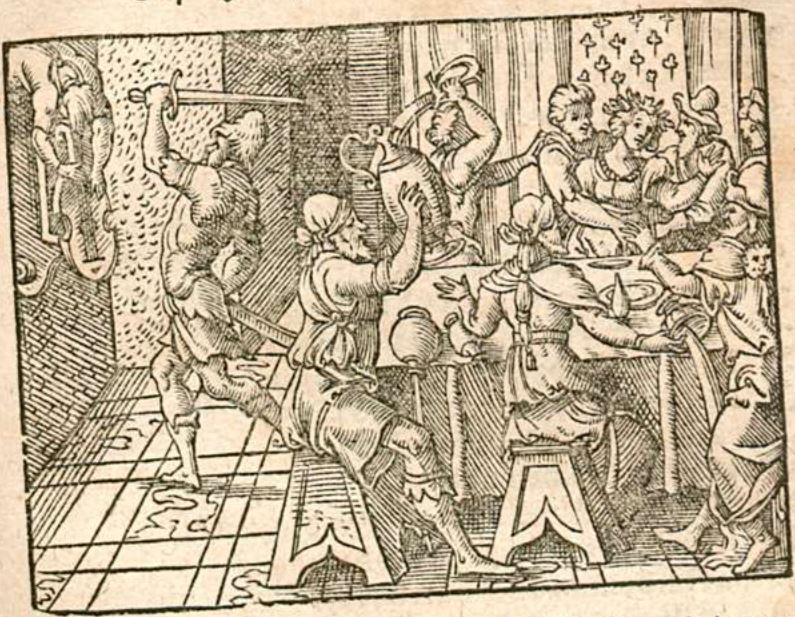
This image illustrates the chaotic wedding banquet of Andromeda and Perseus. Seated at the table are Andromeda, King Cephus and other companions who were in good spirits and telling stories to one another. Phineus, the brother of King Cephus had interrupted the banquet to announce that Perseus had stolen Andromeda from him. Phineus throws a spear at Perseus and misses. This causes an uproar, and a battle breaks out. Perseus ends up using the decapitated head of Medusa to turn Phineus and those who attacked into stone.
Don Quixote reads chivalric books in his library, resting his head upon his hand and dreaming of being a knight himself, slowly descending into madness in the process.
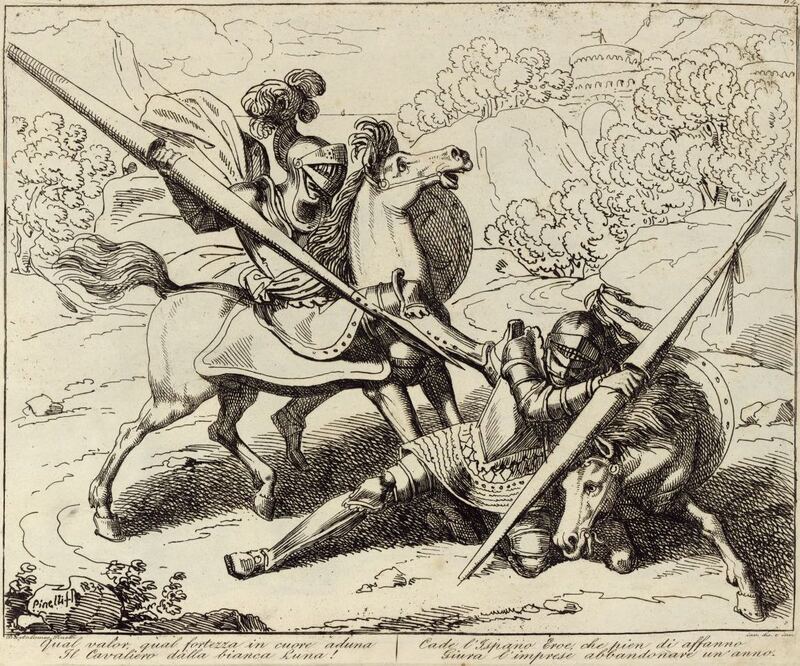
The Knight of the White Moon (Sansón Carrasco) defeats Don Quixote on the beach at Barcelona. Both wear bucklers and carry lances. Signed by Bartolomeo Pinelli (engraver and illustrator) and dated Rome, 1833. Plate 64. Part 2, ch. 64.
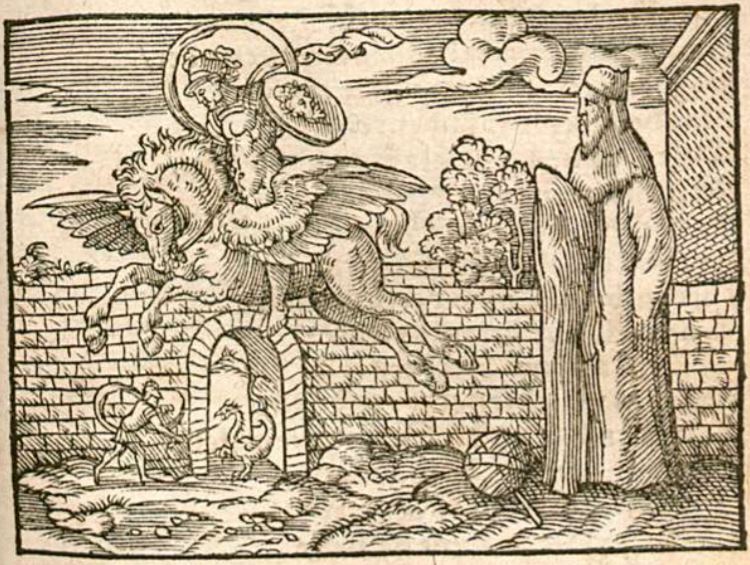
This image illustrates an encounter between Perseus, who is depicted flying in the sky on his winged horse, and Atlas, who is depicted on the right side of the engraving. Years ago, Atlas was given a prophecy that predicted a man born of Zeus would steal the apples off his trees. In order to protect the apples from Perseus, he erected a high wall made of stone and forced a dragon to guard the entrance to the orchard, all of which is depicted in the background of the illustration. Atlas commanded Perseus to leave his kingdom, and in retaliation, Perseus shows Atlas the head of Medusa. Instead of turning to stone, Atlas transforms into a mountain. The transformation is partially complete in the illustration as only Atlas’ beard and hair begin to turn into trees that will end up resting upon the mountain. Perseus flies away on his winged companion without stealing any of Atlas’ apples.
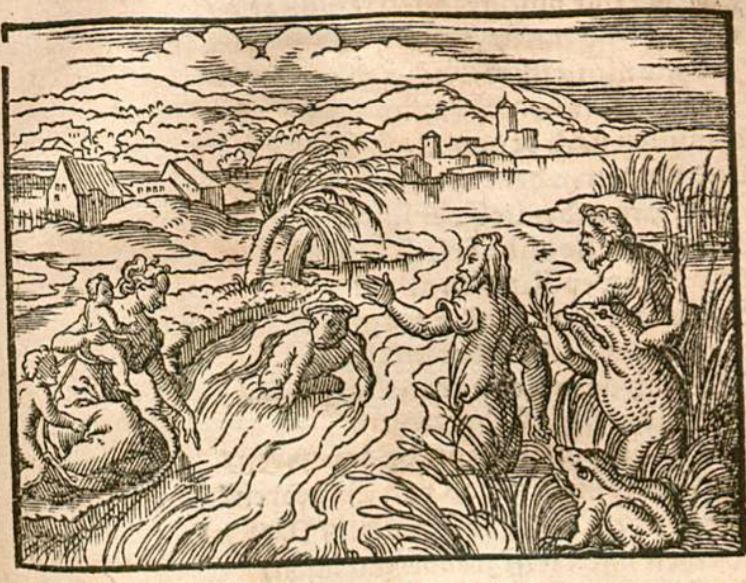
This engraving illustrates Latona, the daughter of Titans, kneeling by a lake with her hands reaching towards the water. Her children, Phoebus and Diana, are clutched to her side. Latona became fatigued from her journey and when she attempted to drink the water from the lake, local farmers denied her access. Offended by their behaviour, Latona punished the men by turning them into frogs. This is illustrated on the right-hand side of the engraving, where two of the men have undergone the transformation.
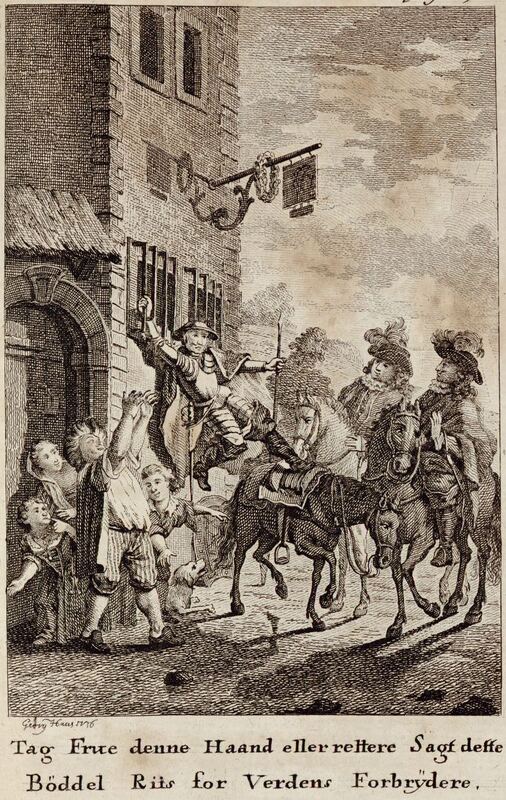
As four travellers (two in the illustration, but four in the text) arrive to the inn, Rocinante moves toward one of the mares, leaving Don Quixote hanging from the window by his hand. The innkeeper, his daughter, and Maritornes appear at the entrance of the inn. Signed by J.-J.-G. Haas (engraver). Part 1, ch. 43.
Two laurels cross to form a wreath around a single wheat straw that leans to the left. The image is occasioned by Quixote saying "The beautiful and honourable woman, whose husband is poor, deserves to be crowned with laurels and palms of victory and triumph."
During the invasion of Barataria Island, Sancho is armed by his attendants and tied between two bucklers. In his attempt to defend Barataria Sancho falls on the ground and remains unable to move. Sandwiched between his two shields, a soldiers tramples over the immobile and frightened Sancho triumphantly. Six figures of soldiers are remarkable: the one standing over Sancho with a sword in his right hand and a torch in his left. Behind him, two soldiers clad in armour march towards the city center. On the right, a robed bearded man directs two more warriors with a torch in his left hand.
Two women sit in a carriage dressed in courtly apparel, the young women in the foreground looks out of the carriage's window towards the sky, her arm leaning against the sill. In the background, an older woman clasps her hands over her stomach and stares ahead of her. The image is occasioned by Sanchica saying "Would to God it were to-day rather thanto-morrow, though folks that saw me seated in that coach with my lady mother should say: ' Do but see Sanchica the garlic-eater's daughter, how she sits in state, and lolls in her coach like a she-pope! But let them jeer ; let them trudge through the mud while I ride in my coach with my feet above the ground" (Page 537).
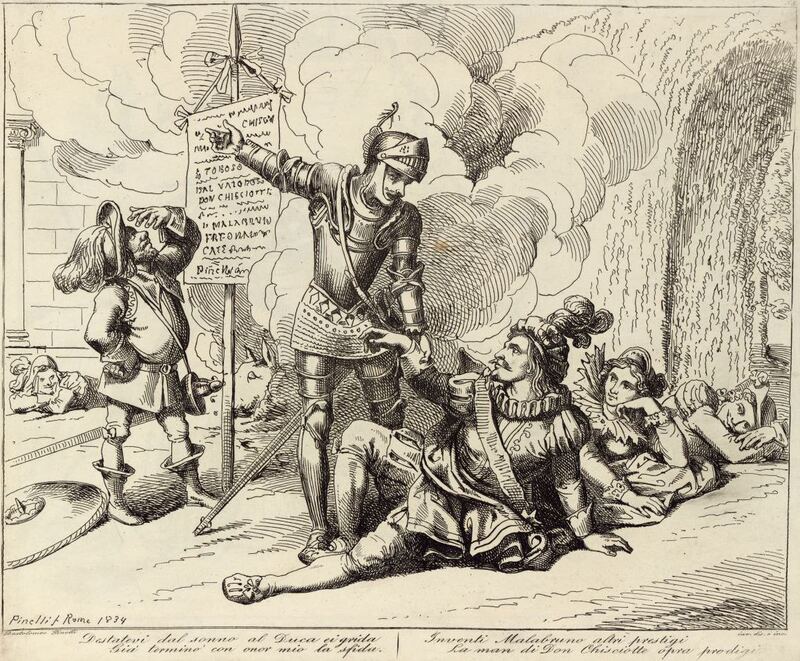
Don Quixote discovers a lance driven into the ground and hanging from it by two cords of green silk, a smooth white parchment on which, in large gold letters, the end of his adventure with Malambruno is announced. Also pictured are Sancho Panza, the duke, the duchess, and their servants. Signed by Bartolomeo Pinelli (engraver and illustrator) and dated Rome, 1833. Plate 58. Part 2, ch. 41.
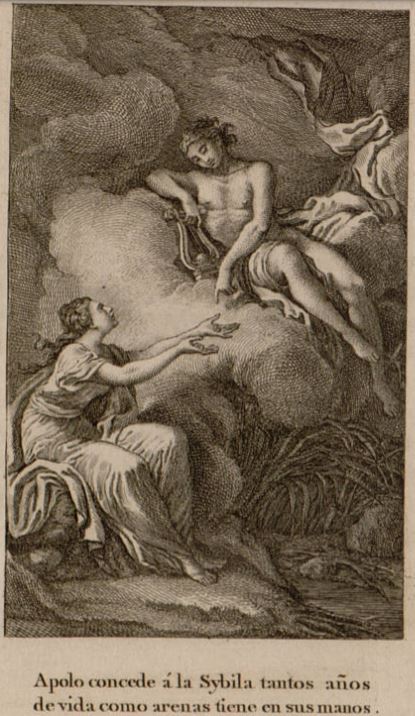
This image depicts the god Apollo offering the Sybil of Cumae eternal life in exchange for her virginity. The Sybil had picked up a pile of sand in her hand and wished for as many years of life as there were grains of sand in her hand. She forgot, however, to ask for the appearance of her youth to accompany the many years of life she was requesting. She is depicted holding her hand out to Apollo in this image. Apollo is depicted floating on a bed of clouds with his lyre.
As four travellers (two in the illustration, but four in the text) arrive to the inn, Rocinante moves toward one of the mares, leaving Don Quixote hanging from the window by his hand. The innkeeper, his daughter, and Maritornes appear at the entrance of the inn. Signed by Bonard (illustrator), no given name, and L. Cars (engraver). Part 1, ch. 43.
The priest reads aloud a manuscript found in the trunk of an inn. This manuscript relays the story of Anselmo and Lothario, two close friends, and how Lothario has an affair with Anselmo's wife Camilla. The illustration depicts the end of the manuscript wherein Camilla (left) forms a plan to trick Anselmo (foreground rushing towards her) by letting him know that her and Lothario will be meeting in a closet. Camilla meets Lothario (background emerging from closet) in the closet, and knowing that Anselmo is watching pretends to stab both herself and Lothario in order to fool Anselmo into thinking that she wishes to protect her chastity. This way Anselmo will not suspect that Camilla and Lothario will continue their affair.
Sancho Panza (middle) clasps his hands in prayer and ascends above the clouds into the heavens. He is carried by two angels with two large angelic wings.
Having been tied with rope over his doublet by Sancho Panza (right) and the Scholar (middle), Don Quixote (left), clad in armor, kneeled down clasped his hands together, closed his eyes, and prayed
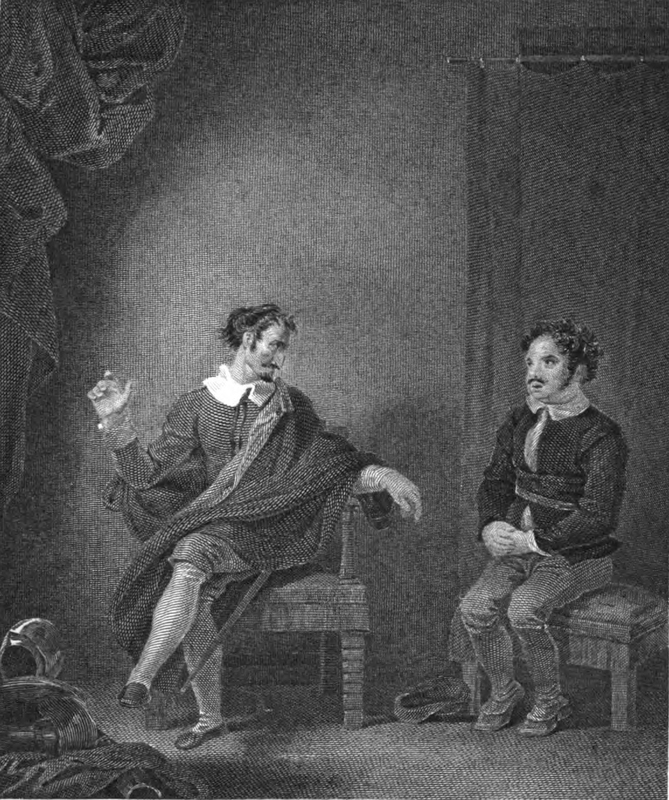
Don Quixote (left) brings Sancho to his chamber to give him advice before he departs to his government which Sancho has been tasked with governing. Sancho sit down by him with his hands grasped and placed daintily on his lap, having laid his hat on the floor to his right. Quixote addresses his squire with much solemnity, crossing his legs, raising his right hand to make a point and leaving his left hand rested on his chair. To the left of Quixote on the floor lies an iron helmet.

![[The Burial of Donna Magoncia]](https://collections.cemvc.ca/files/large/51c63bc6f92a438167263a76ae75a08b2697c1ed.jpg)
![[Quiteria Answers Basilius' Plea]](https://collections.cemvc.ca/files/large/50cd763ac578096c79d16881153c23b134ddfb9b.jpg)
![[An Opened Letter Adressed to Theresa Panza]](https://collections.cemvc.ca/files/large/4d61556271747735bb925590793cf12578bd9e38.jpg)
![[In Recognition of Don Quixote and Sancho Panza]](https://collections.cemvc.ca/files/large/97a4225337e77948f29bdf5be940d8eb18a5213c.jpg)
![[The Entrance to the Cave of Montesinos]](https://collections.cemvc.ca/files/large/25f8f35ae49da17f8e097d32439bfac6855672c2.jpg)
![[Don Quixote in His Study]](https://collections.cemvc.ca/files/large/b3b17bd0d0f05783bd3af5f040662661e5316df7.jpg)
![[Wheat and Laurel]](https://collections.cemvc.ca/files/large/59289bb003a0e51a83a19b6b406a356b9fcd55bc.jpg)
![[Of the Conclusion of Sancho Panza's Government]](https://collections.cemvc.ca/files/large/9176ffad95d4a7888f9157d84e3b0be8499b29e8.jpg)
![[Sanchica and Teresa Seated in a Coach]](https://collections.cemvc.ca/files/large/69bb3cf1d6ea35dbbd1aec01ff0036b776629bbb.jpg)
![[Don Quixote hangs from a window by his hand]](https://collections.cemvc.ca/files/large/fafd7b509315b50247bdf4b332ded2f9c65fc0ea.jpg)
![[Of How Camilla Fakes Her Death in the Chivalrous Manuscript]](https://collections.cemvc.ca/files/large/ff6e122c2fdb02e99f48e6520e9f72f94bdcccc1.jpg)
![[Sancho Panza Goes to Heaven]](https://collections.cemvc.ca/files/large/e70a7d4795e41d6d1fcb852f2cf7612a587d73c1.jpg)
![[Don Quixote Kneels Down and Prays in Front of the Cave of Montesinos]](https://collections.cemvc.ca/files/large/c4f7fe9567c39299076bb186b9af951054157792.jpg)