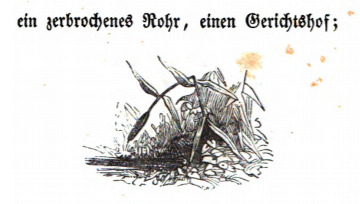
Here we see the broken stems of a reed plant. This is the code word for the Court of Justice. This image comes in a description of a conspiracy found by a professor from the Grand Academy on Balnibarbi. This idea is representing code word for terms in the conspiracy that Swift is satirizing. The professor advises that those named in the conspiracy papers be closely monitored at all times, naming specifically while they were using the bathroom, as this is when men were most thoughtful. This conspiracy is thought to be an allusion to the trial of Francis Atterbury, the bishop of Rochester for allegedly plotting with the Jacobites. Atterbury was charged with treason in 1722 and was exiled to France. The same image appears in the 1843 Krabbe edition.
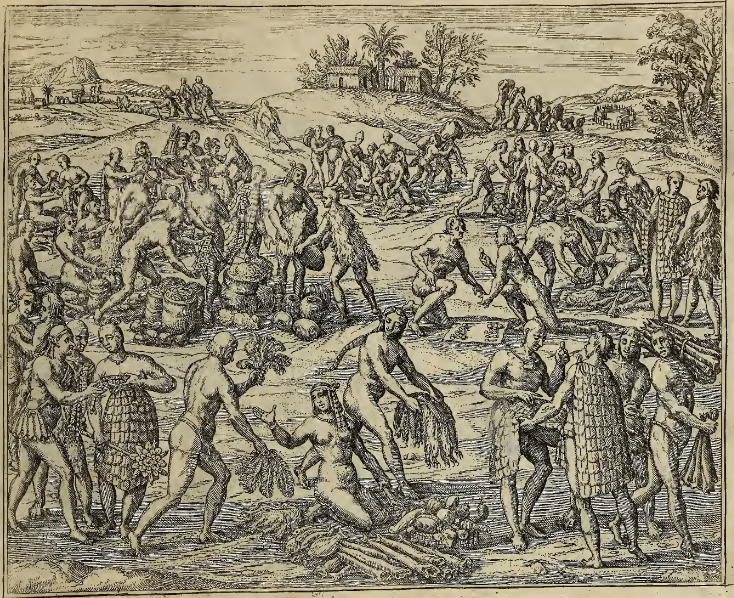
A large group of Indigenous people participate in an outdoor market in Cartagena, Colombia. Vendors have laid out their wares, which include belts, clusters of feathers, small handicrafts, and foodstuffs including fish and fruit. Some of the goods are laid out on pieces of fabric, and some are held in baskets or containers. Several individuals wear capes of feathers or fur. Three small villages can be seen in the background.
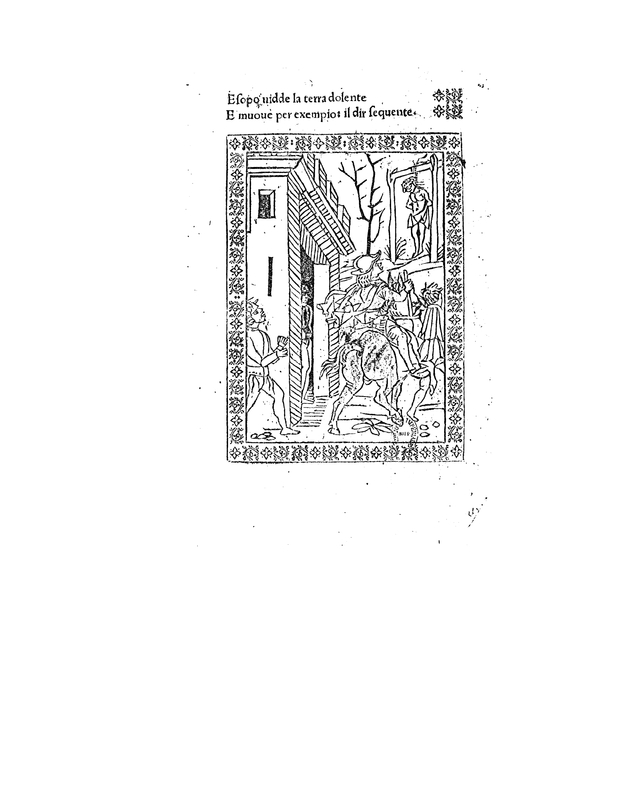
There is a person who has been hanged on top of a hill in the background. There is a man on a horse on the right in the forefront there is man on a horse at the bottom of the hill looking up at the person who has been hanged. There is a man infront of the building on the left also looking up at the hanged person. A fourth person can be seen in the shadow of the entrance to the building.
This illustration depicts Sempronia, daughter of Tiberius Gracchus, rejecting a kiss from a man named Equitius in front of a tribune of plebeians. Boccaccio explains that after her brothers were murdered, Sempronia was brought to trial by a tribune of plebeians. They told her to let herself be kissed by Equitius and accept him as a member of the Sempronian family, however, Sempronia rejects this to protect her family’s honour and nobility. Equitius is depicted with his arm around Sempronia as he attempts to kiss her. Sempronia has her face turned to the side to avoid his embrace. The other figures in the image are pointing at Sempronia with angered faces on their looks. Boccaccio explains that he wrote on Sempronia to highlight her courage and bravery in this situation.
A group of Indigenous Brazilians engage in cannibalism. A man on the right uses a hatchet to dismember a human body. Several limbs and torsos lie scattered on the ground around the group. A wooden frame has been erected over a fire, and an arm sits on the frame to roast over the fire. There is a structure on the right, and a dismembered head mounted on a long pole sticks out the window. This image is identical to one found on page 946 of Paris, 1575 (l’Huillier), and in Thevet’s Les Singularitez de la France Antarctique (page 77 of Paris, 1557 and page 77, a loose page tucked into the back cover of Paris, 1558).
A deer running across an open outdoor area with a man standing in the background with a horn in his mouth. Two baby deer are following the other deer as all three of them run off into the outdoors. There are trees, hills and a bunker in the hill of the image.
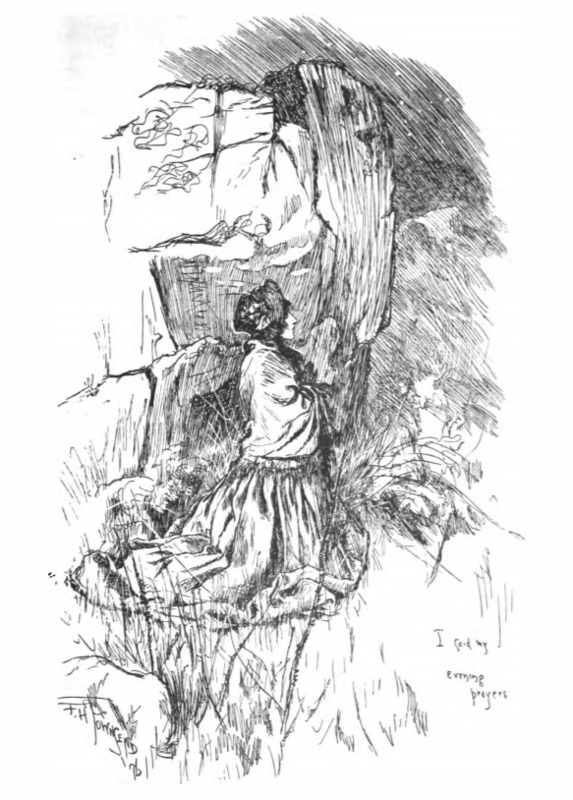
After breaking off her engagement to Mr. Rochester, Jane fled north as far as she could before she ran out of money. She arrived at the Moors of England when she could no longer afford a carriage. She slept outside for two days and two nights, before arriving at Moor House. In this image Jane says her prayers before sleeping outside.
Here we see a mercenary soldier on the battlefield, holding a musket with bayonet attachment. Gulliver explains that mercenary troops were available for hire for any nation, and thus did not necessitate a patriotic army. When Swift wrote Gulliver’s Travels in 1727, mercenary troops were common, and we are just beginning to see national armies. The same image appears in the 1843 Krabbe edition.
A figure in a winged cap sits with his elbows on his knees and his face in his hands. A sword with a thick, rounded handle leans against the wall, point up. Above his head is the moon, which forms the letter O from Our.
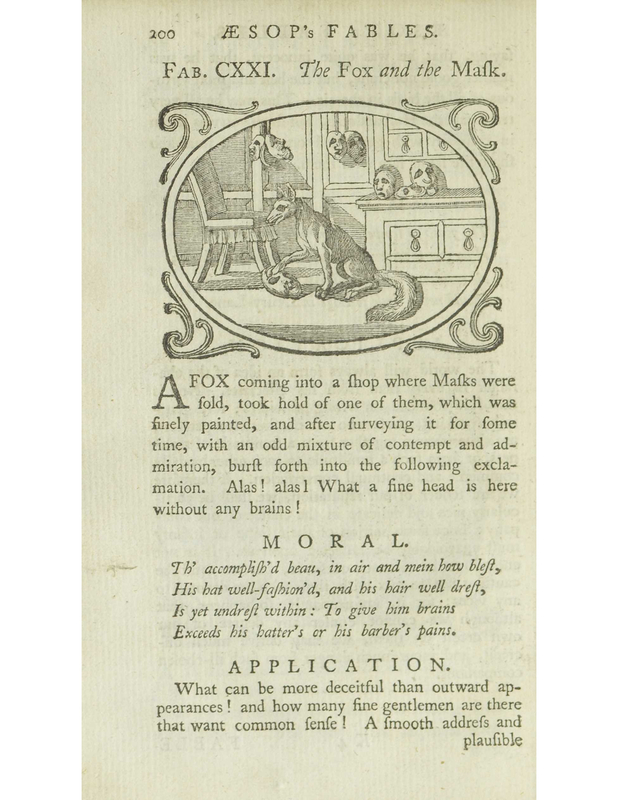
A fox is sitting on the ground inside of a mask shop. Underneath its right paw is a finely painted mask. Behind the fox is a chair, a shelf with three mask on top of it and five masks hanging from the wall.
Here we see a Lilliputian teacher holding a book, giving a lecture. The image appears in an appendix to Gulliver’s travels to Lilliput, which follows the conclusion of Gulliver’s trip to Brobdingnag. Gulliver’s description of the Lilliputian education is very negative, saying that what is taught is simply superfluous, and not anything of substance, as his bias makes him think that the European model for education is the correct model. The same image appears in the 1839 Krabbe edition.
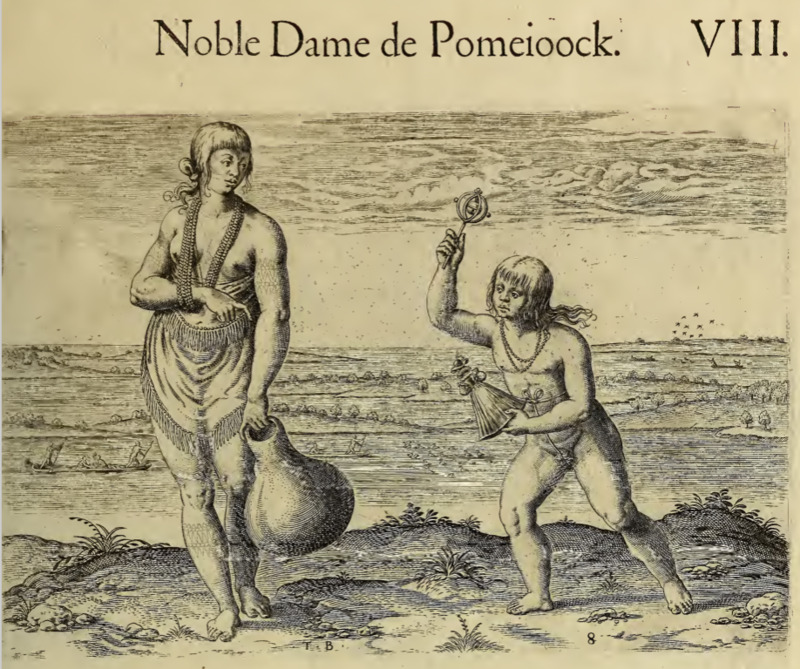
An Indigenous woman, a chief, is pictured standing on the bank of a river. Her hair is knotted at the nape of her neck, she wears several strands of beads around her neck, and her right wrist is cradled in the beads. She wears a fringed skirt around her waist and is topless and shoeless. She holds a large pot/container in her left hand. Beside her is a child, nude except for two strands of beads around their neck. The child holds a doll dressed like an English lady in one hand, and an object similar to a rattle in the other. Behind the pair, other Indigenous people are seen in canoes.
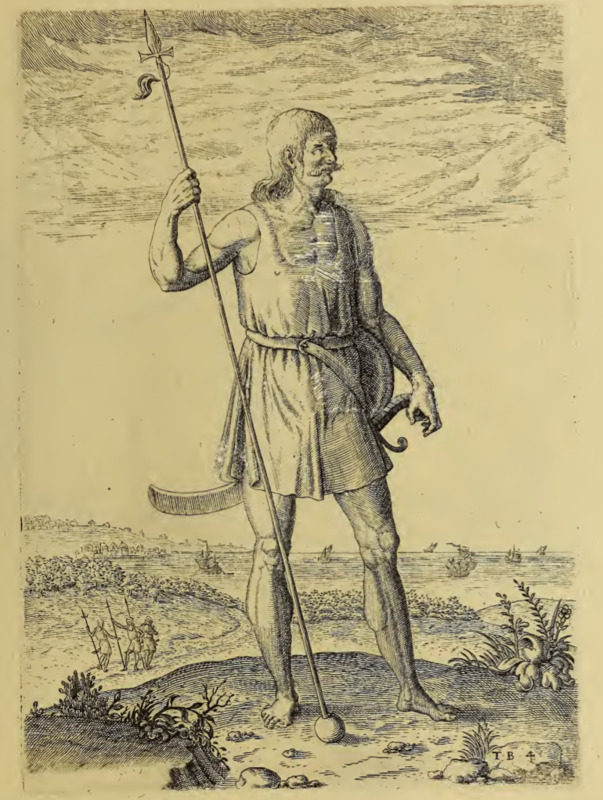
An Indigenous man is shown from the front. He carries a spear with a ball on the end in his right hand. He wears a belted tunic, and both a round shield and a sword with a curved blade hangs from the belt around his waist. This man is described as belonging to an Indigenous group that lived near the Picts. The Picts were an Indigenous group who lived in Britain long before the author’s time. Images of Picts were included in this book so that readers could compare their customs to those of the Indigenous people living in Virginia.
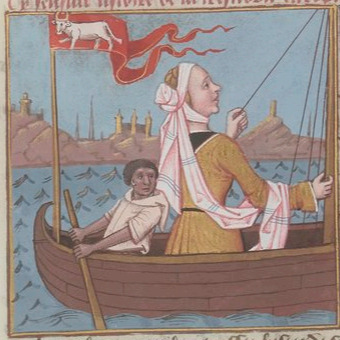
This illuminated image depicts Europa, the daughter of king Agenor of Phoenicia, on a ship that is sailing towards Crete. The ship has red flag with an emblem of a white cow on the left side which symbolizes the god Jupiter. Jupiter had fallen in love with Europa and abducted her and put her on the ship illustrated in the image. They then sailed to Crete together, where she became the queen. There is what appears to be a slave on the ship as well who is holding an oar as he rows the boat.
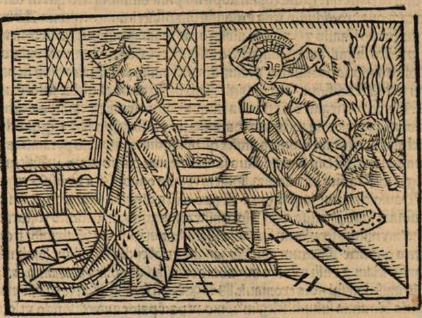
Artemisia was married to Mausolus, the king of Caria. Boccaccio explains that when he died, Artemisia was so grieved by his death that instead of putting his ashes in an urn after his cremation, she drank the ashes in order to be closer to him. The right side of the engraving depicts Artemisia cremating her husband’s body in a fire. Mausolus' head is visible in the fire. Artemisia is illustrated scooping her husband’s ashes and putting them into a bag. The left side of the engraving depicts Artemisia drinking her husband’s ashes.
This image is illustrated in a chapter that discusses the Christian priests in the colonial government in Peru. The image depicts a Jesuit priest who the author praises for keeping true to his religious duties and being charitable and loving. The author previously criticized many priests for having abused their powers against the indigenous peoples of Peru. The priest is illustrated standing in front of a kneeling indigenous man whose hands are together in prayer as he makes a confession. The priest is handing a rosary to the man. There are words of dialogue written above the indigenous man which reads, Confiesame, padre, de todos mis pecados. No me preguntes de las uacas, ydolos, y por amor de Jesucristo y de s[u] madre Santa María, me apsolueme y no me eches por la puerta. Ten misericordia de mi ánima [I confess father, of all my sins, Do not ask me about the idol huaca, and for the love of Jesus Christ and your mother Saint Mary, support me and do not throw me out the door, have mercy on my soul]. The large caption at the bottom of the image reads, ci los dichos rrebrendos padres fuesen dotrinando euangelios y predicase paciones de jesucristo y de la uirgen maría y de todos los santos y día del Jjycio y de la sagrada sscritura, no se huyrían los yndios [if the said revered fathers were endowing gospels and preaching patrons of Jesus Christ and the Virgin Mary and all the saints and judgement day and sacred scriptrure, the indians would not flee].
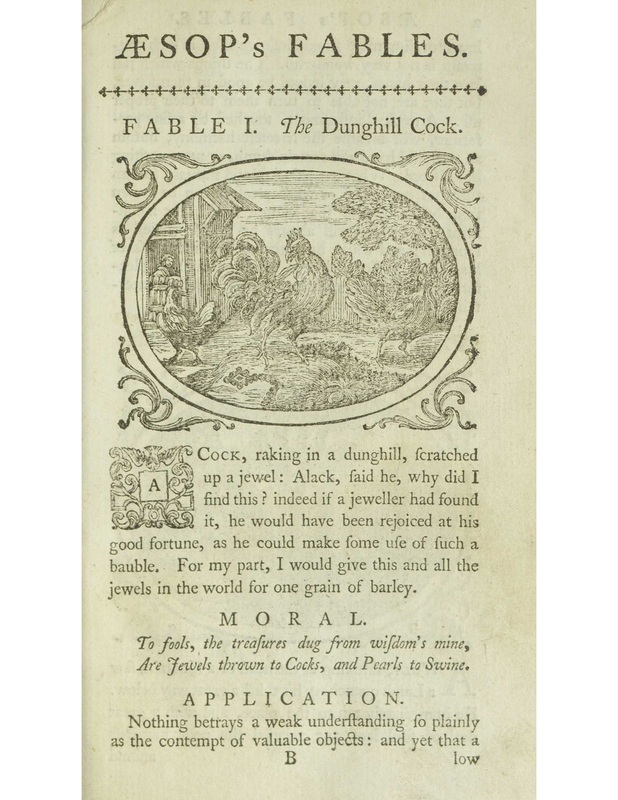
A cock and several chickens are in a yard. The cock is looking at a jewel. There is a stable person or farm hand in the background. The cock is standing on a dunghill. Some trees and a farm type building can also be seen behind the cock and chickens.
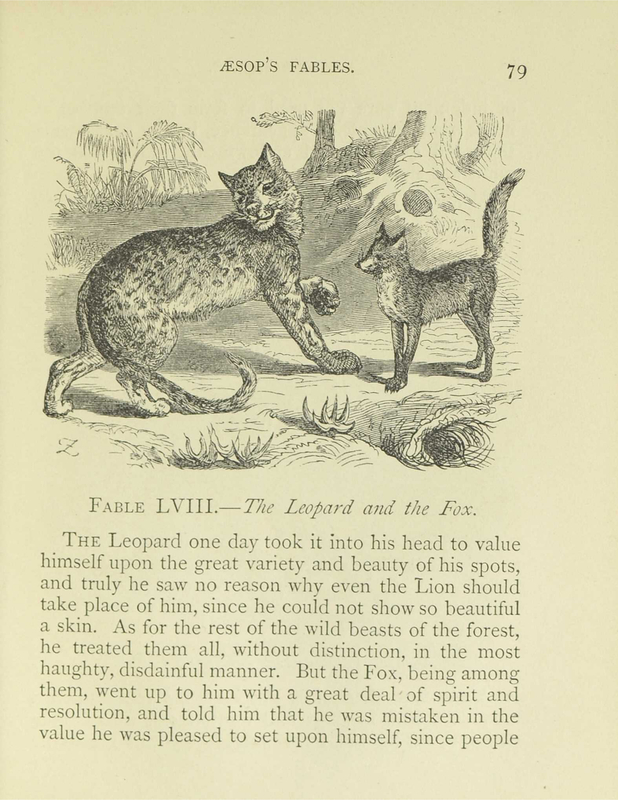
To the left, a leopard stands tall in front of a fox, dismissive of the fox’s presence. The fox, to the right, stands firm amongst the leopard’s disdain.
Rebecca Sharp, wearing a bonnet, holds onto the arm of Joseph Sedley, who is wearing a top hat and carrying a cane. The two figures are standing beneath a crescent moon. In the background is another couple, possibly George Osborne and Amelia Sedley, possibly a pair of strangers.
Celestina is very pleased with her success, considering so many others had failed to do what she did (that is, use witchcraft and manipulation to make a woman fall in love). Sempronio is excited to know what happened, but Celestina waits until Calisto is present to recount the preceding series of events. In this scene, we see Celestina holding the girdle that belongs to Melibea. She and Sempronio are coming toward Pármeno and Calisto. Pármeno notifies his master of their approach, and Calisto is eager to know what transpired.This entire illustration is identical to the one found on page 2 of the text [Servants Introducing Calisto to Celestina].
Here we see the exterior of Gulliver’s house in Brobdingnag. The house is a box that is sixteen square feet and twelve feet high. It was built to resemble the style of the houses in London in the early eighteenth century. There is a large front door, with two arched windows on the front and a square window on the side. The roof comes off so the giants could see Gulliver more easily. The house is still under construction in this image, as the front door is not attached, and Gulliver’s furniture is outside. Gulliver’s sleigh bed, writing desk, and chairs are on the table, outside his house. Gulliver sits on a bench outside his house. His house sits on a table with a drawer and a chair. The same image appears in the 1843 Krabbe edition.

![[Sempronia Rejecting a Kiss from Equitius]](https://collections.cemvc.ca/files/large/928803c8fa40c0a21afda5f2fb0c6988dd6b2ccd.jpg)

![Comme les Sauuages rotisse[n]t leurs ennemis.](https://collections.cemvc.ca/files/large/119bbcc5a36ad9433fdb412e61dc3372c69cbc92.jpg)
![[A man and the deer]](https://collections.cemvc.ca/files/large/4569f0d6a40318006796f3544065b3b62302a8ca.jpg)

![[A mercenary soldier]](https://collections.cemvc.ca/files/large/bea5fc1d8f5173d434c24ad418ce2c59bf79b3f0.jpg)
![[Vanity Fair Volume II. Chapter XI Inhabited Initial, O]](https://collections.cemvc.ca/files/large/316aadf8296ec7865911ac0f4a2af0b5a22dee18.jpg)

![[A Lilliputian teacher gives a lecture]](https://collections.cemvc.ca/files/large/3fed0731a14a247410522347775353d12559c426.jpg)

![Los P[adr]es de la Conpania de Jesus, Santos Hombres en Todo el Mundo que Cre[e], Ama y Haze Caridad y da lo que Tiene a los Pobres mas en Este](https://collections.cemvc.ca/files/large/627df0988d2fe898577eac7042ea2deb15159e97.jpg)
![[Rebecca and Joseph]](https://collections.cemvc.ca/files/large/6c42228b76502ac7fce03ffa69f75bc273ca078c.jpg)
![[Act V - The Eagerness of Calisto]](https://collections.cemvc.ca/files/large/4bb7c2c752406fb6b93c1b22b6410ebed9582703.jpg)
![[Gulliver's house in Brobdingnag]](https://collections.cemvc.ca/files/large/f8b565dbc298ff5790a223481e6d182fc958b6b0.jpg)