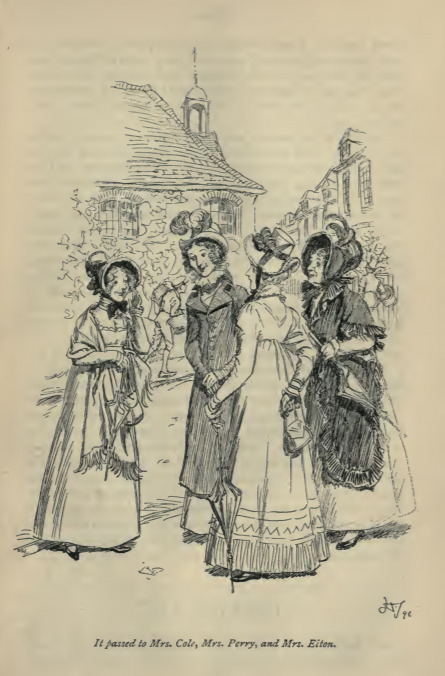
In this image Miss Bates tells Mrs. Cole, Mrs. Perry, and Mrs. Elton about Emma’s engagement to Mr. Knightley. Emma told Mrs. Weston and Miss Bates about her engagement. Miss Bates was the town gossip and word of the engagement spread quickly throughout the town. This scene occurs in chapter 53. The characters are shown in the traditional regency style. The women wear regency style dresses with empire waistlines. They wear bonnets and carry parasols, both used to protect their faces from the sun. The regency period dated to the early nineteenth century (1811-1820) when George, Prince of Wales, later George IV (r. 1820-1830), reigned as regent for his mentally ill father, King George III (r. 1760-1820). The regency period is associated with the rise of neoclassicism in art and fashion.
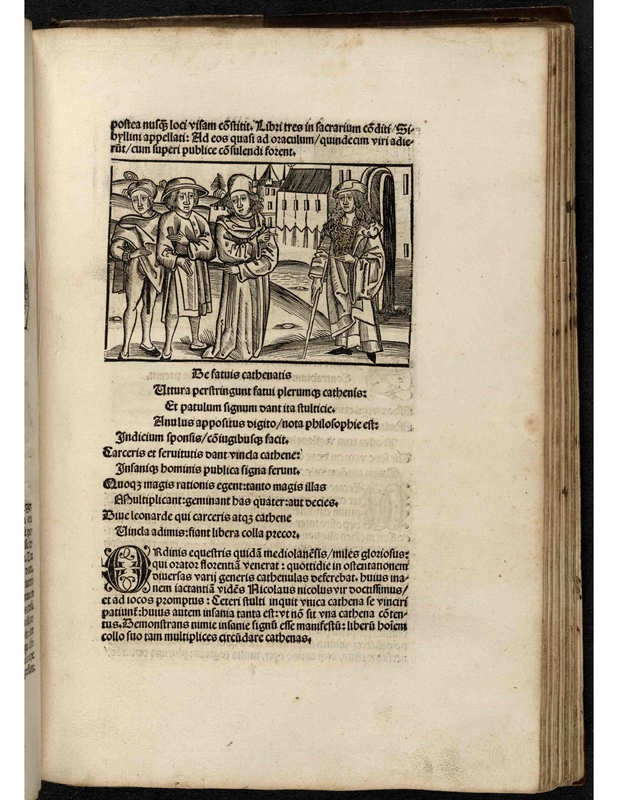
Three men stand to the left and one man stands to the right in front of a large building, resembling a castle. The man on the right wears a chain necklace and holds a stick. The man in the center points to the man on the right.
Joseph Sedley, seated in a chair in his bed-chamber, gestures at his face to tell Isidor to shave off his moustaches. Jos is afraid of being mistaken for a military man and killed by the victorious French army. He has tried ordering a shave, but his French is not good enough to be understood.
This image depicts Celestina in conversation with Lucrecia. Although Melibea is included in this act, we know that the figure to the left is likely Lucrecia, since Melibea was previously depicted in regal attire. Melibea’s mother Alisa, another older woman, is included in this act as well, but because she only talks with Melibea, we can infer that the figure to the right is Celestina. Celestina is shown holding a jug of some sort. Based on her character in the book, we are likely meant to interpret this vessel as containing wine. Both figures are shown wearing a robe and a veil.The right side of the illustration, including the figure and the vegetation at the bottom, is a reproduction of the right side of the illustration found on page 155 of the text. The left side, including the figure and the vegetation at the bottom, is a reproduction of the right side of the illustration found on page 69 of the text (although the figure is used to depict Elicia in that instance).
BELFORD - CHAPEL HILL - FAIRVIEW - HARMONY - LEONARDO - LINCROFT - LOCUST - MIDDLETOWN VILLAGE - ONMOUTH HILLS - NAVESINK - NEW MONMOUTH - NORTH MIDDLETOWN - NUT SWAMP - OAK HILL - PORT MONMOUTH - RIVER PLAZA MIDDLETOWN TOWNSHIP 1664 NEW JERSEY
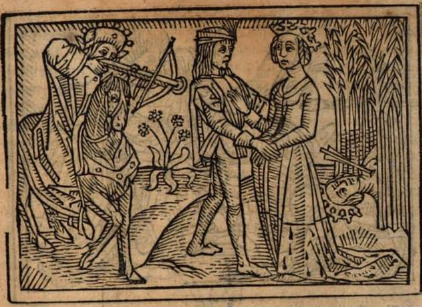
When Cephalus was told that his wife (Procris) would abandon him in exchange for money and treasures, Cephalus began testing his wife. Cephalus would disguise himself and offer her gold and treasures in exchange for her love. This scene is depicted on the right side of the engraving. Procris rejected the disguised Cephalus multiple times, however, she eventually accepted his treasures. In this scene she is holding his hand and looking at him lovingly. Procris ended up regretting what she had done to her husband. To punish herself, Procris went to live in the woods. Cephalus had been hunting one day and had mistaken his wife for an animal and shot her. Procris is visible behind the grass in the background of the engraving while Cephalus is depicted with a cross bow in his hands after shooting her.
Because this illustration is printed in the 21st act, where only Pleberio and Alisa have dialogue, we can assume that they are the figures represented on the right. The identity of the third figure on the left is uncertain, but it may be one of their servants. Pleberio is holding an indistinct stick-like object in his right hand (perhaps a cane or walking stick), and his left hand is raised. Alisa is wearing a veil and a robe, and her right hand is held out to Pleberio. The third figure seems to be walking away from them, with a look of stupor on his face (although this facial appearance may be a result of the quality of the print/engraving). This image is not reproduced anywhere else in the text.
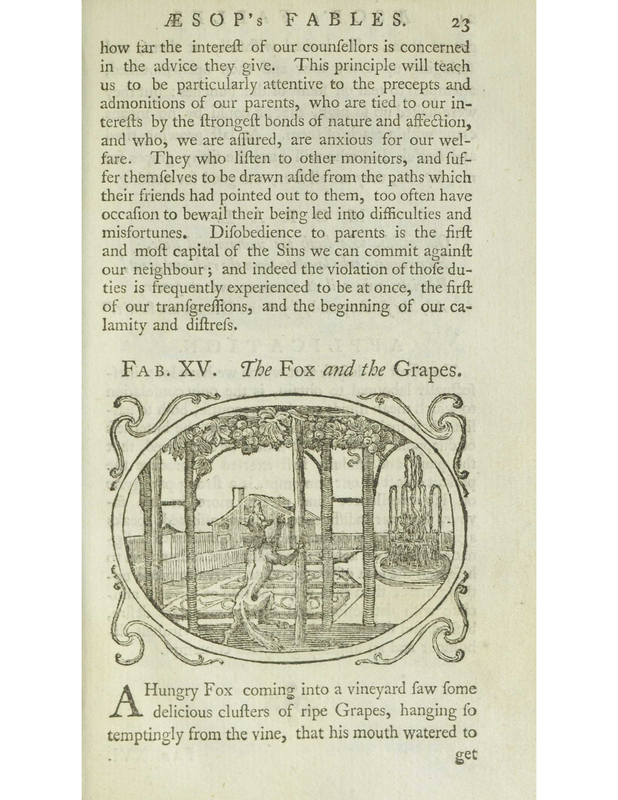
There is a fox standing on his hind legs against a tree of grapes. The tops of the trees are very full of grapes and some vines can be seen near the tops of the trees. The fox’s mouth is open while it stands under the tree. There are three rectangular forms on the ground, in the background of the image, on the left-hand side. On the right side, there is a functioning water fountain. The trees have a different surface under them than the fountain area, beyond the trees do. A house can be seen in the distance of the left side of the picture. The house has a chimney and is in an fenced in area. The fountain and rectangular objects are in the fenced in area as well.
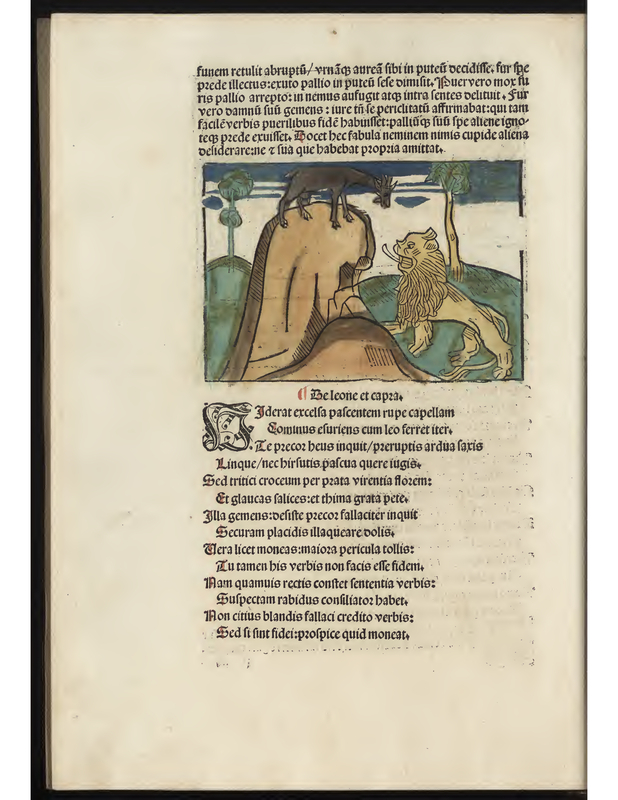
A lion and a goat are outside in surrounding hills and trees. The goat stands on a tall hill looking down at the lion standing on the ground. The lion is roaring.
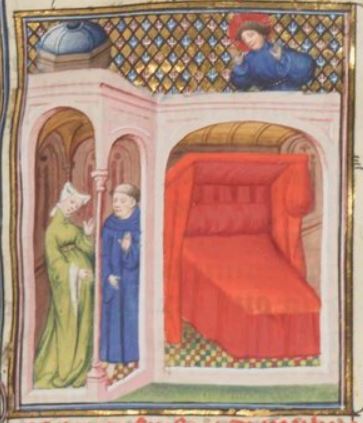
This illumination depicts a Roman woman named Paulina speaking with a priest on the left side of the image. Paulina was a chaste and devout woman and is renowned for her naivety by being tricked into losing her virtue. A man named Mundus (who is depicted hiding above the bed on the right side of the image) had fallen in love with Paulina and devised a plan to trick her into having relations with him. He bribed a priest to tell Paulina that if she stayed the night at the temple, the Egyptian God Anubis would come to her in her sleep. She believed this deception, and when she slept at the temple, Mundus disguised himself as Anubis and tricked Paulina into having intercourse with him. When Paulina realized she was deceived, her husband went to the emperor and had Mundus exiled. The priest of the temple was tortured as his punishment.
This illustration depicts two men of the Roman Senate sitting on the left side of the image. One man is illustrated pointing at the women in front of him, and the other man is depicted holding hands with one of the women. The women illustrated in the image are some of the most chaste women in all of Rome. After a statue to Venus Verticordia was erected, the Senate oversaw choosing one out of several women to consecrate the statue. The woman that they chose was Sulpicia, wife of Fulvius Flaccus and the most chaste woman in Rome. Sulpicia is most likely the woman who is holding hands with one of the Senate as she was the one chosen to consecrate the statue.
Here we see yahoos digging for gemstones. Gulliver’s master explains the relationships among the yahoos in the Country of the Houyhnhnms. Gulliver’s master says that the yahoos enjoy digging for various stones, which they would then fight over. The same image appears in the 1839 Krabbe edition.
A professor from the mathematical school at the Grand Academy of Balnibarbi conducted experiments in teaching and learning. His idea was to write concepts on a thin wafer in a cephalic tincture then have the students consume the wafers and eat nothing else except bread and water for the subsequent three days. The idea was that the tincture would travel to the student’s head and bring the concept with it. This idea is playing off of the Catholic communion wafers, and as Swift is writing from an Anglican perspective, a swipe at the Catholic doctrine of transubstantiation. In this image we see a tray with the wafers with concepts written on them. There is also a quill and a bottle of liquid that is the cephalic tincture. A young student holds the wafer in his hand, while the professor looks on. The same image appears in the 1843 Krabbe edition.
The footman Sambo, Mrs. Blenkinsop the housekeeper, and the cook stand at the landing-place outside the drawing room to listen to Rebecca Sharp sing. In the background is another figure in uniform, possibly a page boy.
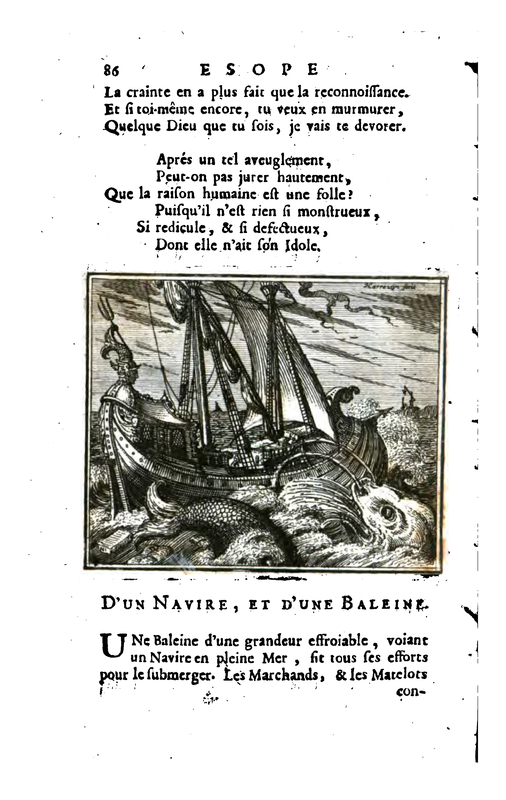
The image depicts a ship at sea under attack by a large whale. The sailors and merchants on the ship throw some of their merchandise overboard to escape.
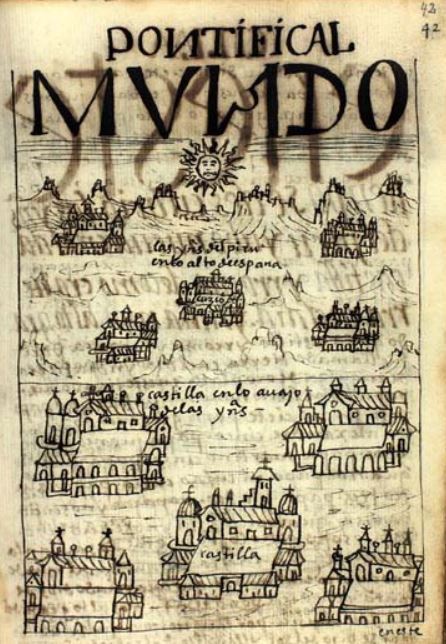
This illustration depicts the colonization of the West Indies from the perspective of the author. There are settlements depicted all over the image, and there is writing below the sun which reads, las yndias del piru en lo alto de espana, which translates to the Indies of Peru, above Spain. In the centre of the building that is depicted below that inscription is the word Cuzco. The bottom half of the illustration is identified as castilla en lo auajo de las indias, which means Castille, below the Indies. The building at the bottom of the image has the word Castille written on it.
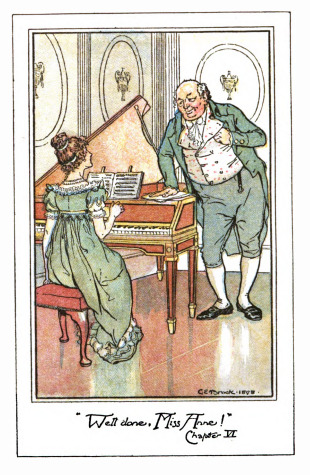
Here we see Mr. Musgrove complimenting Anne as she played the piano. After Sir Walter let Kellynch, Anne went to visit her sister Mary at Uppercross Cottage. Mary married Charles Musgrove, whose parents lived in the Great House at Uppercross. Mr. And Mrs. Musgrove frequently had parties with dancing during Anne’s visit. Anne, not liking to dance herself, provided the music for these events, playing English country dances, a style influenced by the quadrille and the waltz, on the piano. Young upper-class women of this era were encouraged to be successful in at least one art form, often music or drawing. This scene occurs in chapter 6 as noted underneath the title of this image. The characters are shown in the traditional regency style, with Anne wearing the regency style dress with an empire waist. Her hair is worn tied up, as was tradition for women after their coming out before the queen, signaling her entrance into society. Mr. Musgrove wears a waistcoat and tailcoat, and breeches that stopped at the knee. The regency period dated to the early nineteenth century (1811-1820) when George, Prince of Wales, later George IV (r. 1820-1830), reigned as regent for his mentally ill father, King George III (r. 1760-1820). The regency period is associated with the rise of neoclassicism in art and fashion.
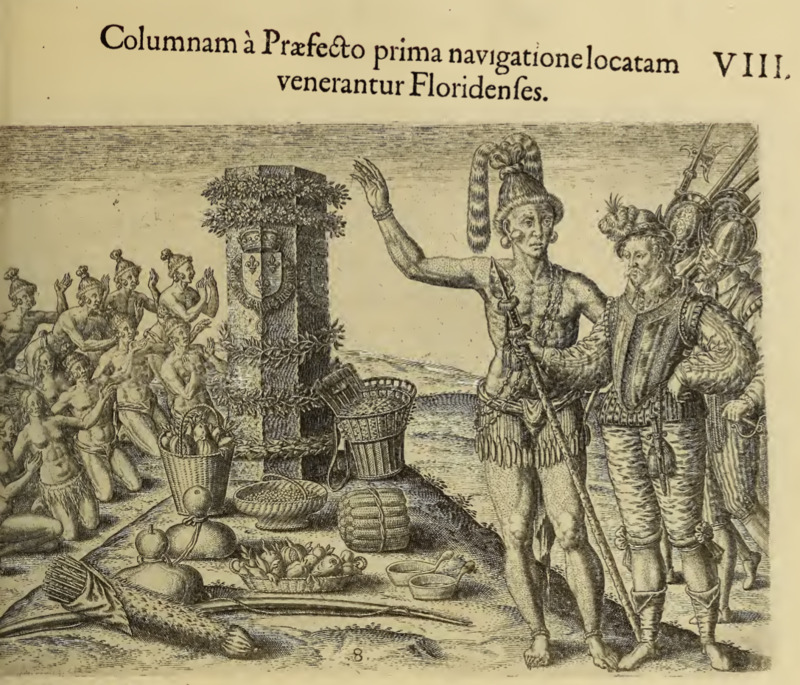
The monument erected by Jean Ribault during the voyage of 1562 is shown. There are various items on the ground around the monument, including a bow and quiver of arrows, baskets of foodstuffs, and other containers. In the foreground, an Indigenous man stands beside a colonist and gestures to the monument. The Indigenous man wears a headdress with racoon tails, a garment around his waist, a decorative chain of beads across his body, and large earrings. René de Laudonnière stands beside him. Behind the two men are several other colonists. On the left of the monument a group of Indigenous people are shown kneeling, appearing to worship the monument.
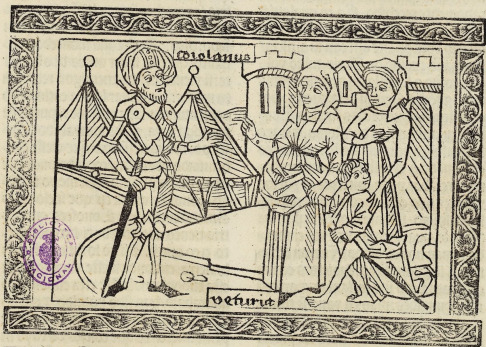
An old noble Roman woman named Veturia is depicted on the right side of the engraving with her daughter-in law and grandchild beside her. We know this figure is Veturia as her name is engraved below her feet. She is illustrated pointing at the man on the left side of the engraving. This man is her son, Coriolanus (his name is engraved above his head). Boccaccio explains that after Coriolanus had been exiled from Rome for neglecting the plebian class, he planned an attack on Rome. Veturia, with the help of her daughter-in-law (Volumnia) and grandchild, went to speak with Coriolanus at his camp and convinced him to not go through with the attack. Boccaccio explains that he decided to write on Veturia for her honour as a mother and a woman.
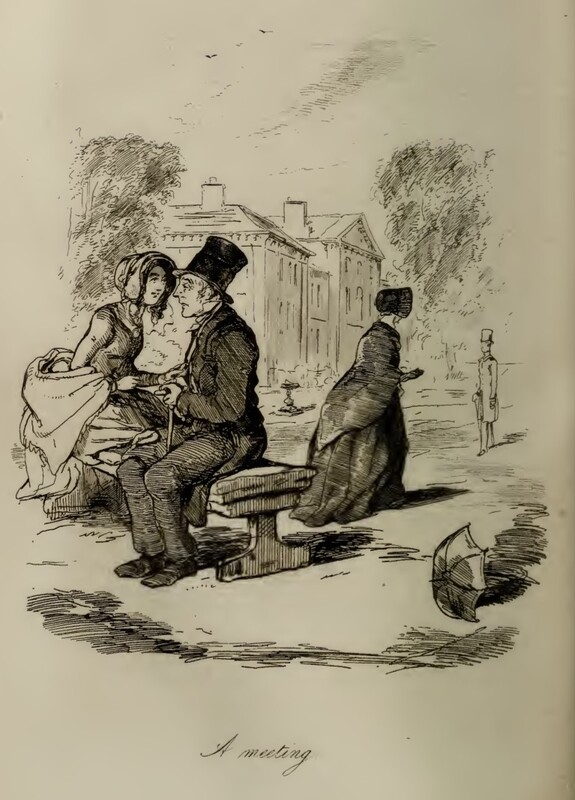
John Sedley sits on a bench in the park, holding onto his cane. Next to him is his daughter, Amelia Osborne, holding onto his arm. Mary Clapp, also in a shawl and bonnet, is standing facing away from them. In front of her is William Dobbin, who she has brought to meet the pair. On the ground near the bench is a small parasol or umbrella. Below the illustration is printed in cursive its title, A meeting.
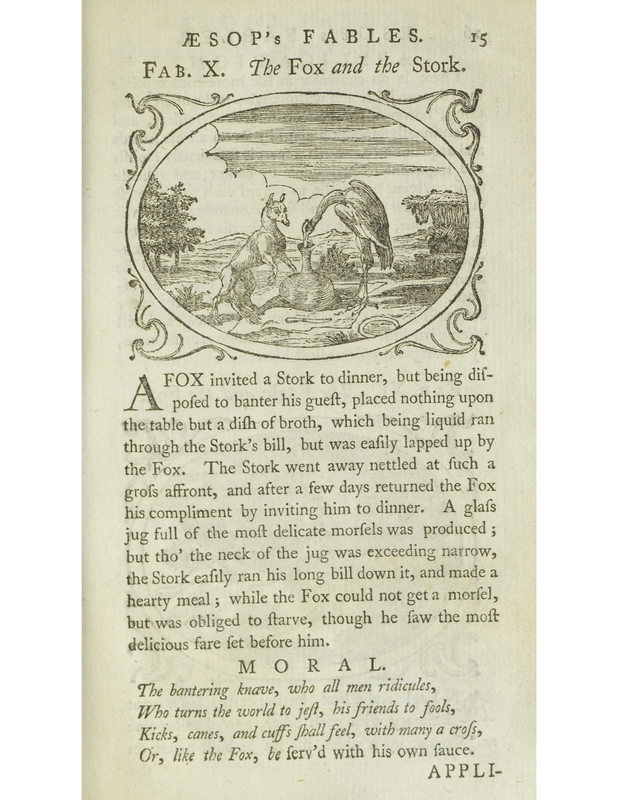
There is a fox on their hind legs, looking at a stork, who has their beak in a vase. A tablecloth is set out under the animals, along with a knife and plate. The fox appears to be hovering around the vase, waiting their turn at the vase. The background has a few trees to the left of the image and a few shrubs to the right of the image.

![[scrolls from Swift’s biography]](https://collections.cemvc.ca/files/large/1e46445c8fec36187a63a7505b52f077b70809e3.jpg)
![[Jos Tries to get a Shave]](https://collections.cemvc.ca/files/large/a5c6c59a3b7823001db8b12b70f27efbab2c17c3.jpg)
![[Act X - Lucrecia and Celestina]](https://collections.cemvc.ca/files/large/de224ef0cb120fb03df6da3763feeca02d084b01.jpg)

![[Act XXI – Pleberio, Alisa, and an Unknown Third Figure]](https://collections.cemvc.ca/files/large/d2b0b9b138cbd07fdeff3e0fbcaf3d3bcb1048e2.jpg)

![[Sulpicia Being Chosen as the Most Chaste Woman of Rome]](https://collections.cemvc.ca/files/large/bb74732125a2d68ecd05c9d240037a94f71e47ee.jpg)
![[Yahoos digging for gemstones]](https://collections.cemvc.ca/files/large/99a8c888779fac996c7bc204498ab4d58f7c82e9.jpg)
![[an experiment from The Grand Academy on Balnibarbi on a new method of learning]](https://collections.cemvc.ca/files/large/04389a64b8aebfb3ea9af8a29cc73f0b0322605d.jpg)
![[Listening to Becky Sing]](https://collections.cemvc.ca/files/large/583d53131be54db990f39fe1a104a0277019a973.jpg)