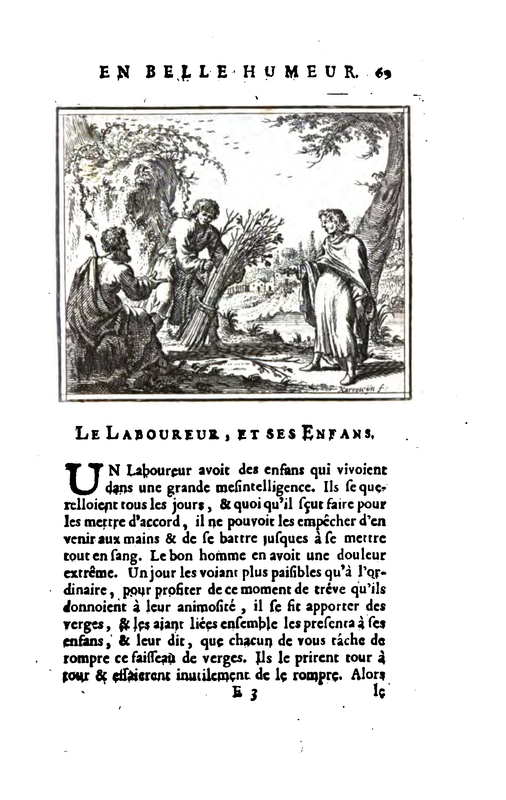
A farmer had children who lived in great harmony. They quarreled every day, and whatever he could do to bring them to an agreement, he could not prevent them from coming to blows and fighting until they were all in a rage. The good man was in extreme pain. One day seeing them more peaceful than usual, to take advantage of this moment of trepidation that they gave to their animosity, he brought some rods, and having tied them together presented them to his children, and said to them, that each of you try to break this bundle of rods. they took it in turn and tried intuitively to break it.
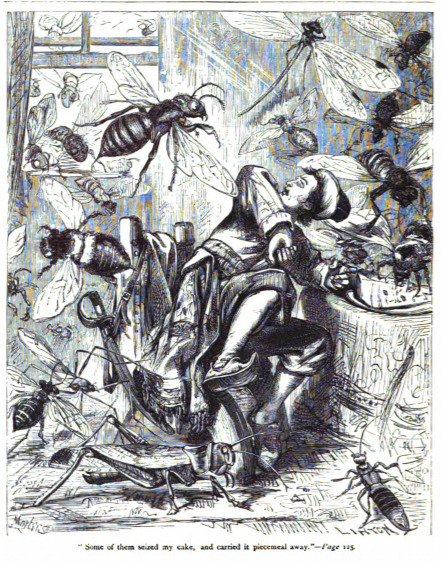
Here giant wasps from Brobdingnag attacked Gulliver. Glumdalclitch gave Gulliver a piece of cake, however the wasps saw it and attacked Gulliver, trying to get the cake. Gulliver fought them off using his sword and brought some of the stingers home to England with him.
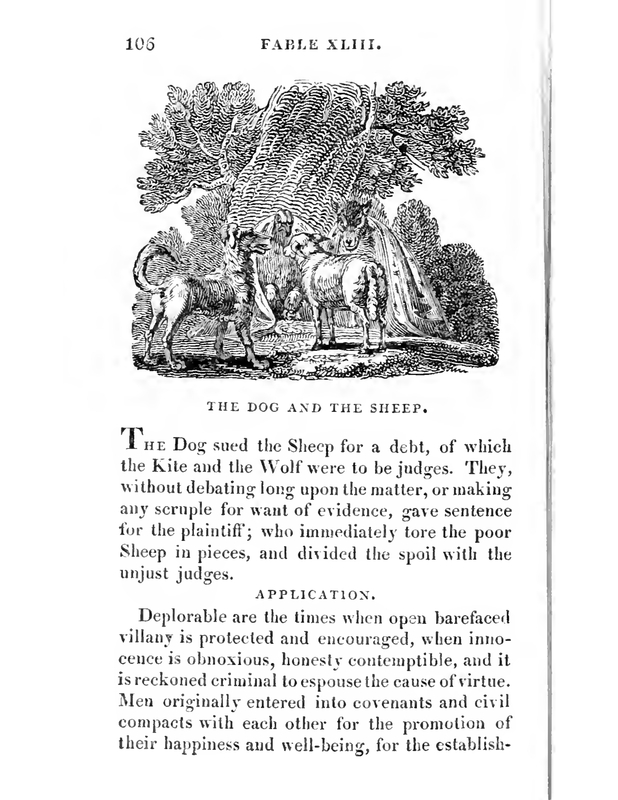
A dog stands to the left of a sheep. Both of them are facing away from the viewer and are looking at a wolf and a vulture (kite) who are wearing robes and sitting on the ground. They sit in front of a large tree. The dog stands straight and upright and has a tail curled to the right.
We cannot be certain of which character the left panel depicts, since Calisto, Sempronio, and Pármeno are all included in the fifth act. The figure, dressed in regal attire, is also wearing a hat and has a sword mounted on his belt. To the right we see a female figure. This must be Celestina, since she is the only female character in this act. She is wearing a robe and a veil. In her right hand she is holding a flower, while in her left she is holding the girdle cord hanging from her waist. At her feet, a dog is standing on its hind legs with its front paws extended toward her. Both figures are placed outside.This entire illustration is identical to those found on pages 120 and 171 of the text.Both panels are near carbon-copies of panels found multiple times throughout the earlier 1529 Lyon edition. However, the lower attention to detail in these panels makes it clear that they are reproductions and not duplicates. The artist likely referred to a copy of the 1529 edition when creating these panels.
This is a portrait of Jonathan Swift. The image is a part of Swift’s biography which precedes Part One of Gulliver’s Travels. The purpose of this illustration in the biography is to provide context for the political atmosphere and insight into Swift’s satirical writings. The same image appears in the 1839 Krabbe edition.
Here we see a tooth that was pulled from one of Glumdalclitch’s servants. Gulliver gave the tooth to the captain of the ship that rescued him. Gulliver’s hat and a plate are on the table next to the tooth to show the size. Gulliver stands in the background, with his back to the viewer. The same image appears in the 1839 Krabbe edition.
This is a bust of Robert Walpole, who served as the first de facto Prime Minister of England between 1721 and 1742. The image is a part of Swift’s Biography which precedes Part One of Gulliver’s Travels, in which the biographer is describing the political climate of the early eighteenth century to provide readers with context for the story.
Mr. James Crawley, while visiting his aunt Miss Matilda Crawley, leans out the bedroom window while smoking his pipe. He is in his coat and breeches, with his pants and shoes in a pile on the floor next to the chair on which he is leaning. Behind him, Mr. Bowls and Mrs. Firkin have rushed into the room to stop the smoke, which is bothering Miss Crawley downstairs. Below the illustration is printed in cursive its title, Mr. James’s pipe put out.
Here we see Gulliver and the Sorrel Nag building a boat that Gulliver would use to leave the Country of the Houyhnhnms. The Council of the Houyhnhnms told his master that Gulliver either had to live with the yahoos or return to Europe but could not live with the Houyhnhnms any longer. Gulliver was shocked by this, and decided he had to leave rather than live with the yahoos. Gulliver was given two months to build a boat to leave the country. The same image appears in both the 1839 and 1843 Krabbe editions.
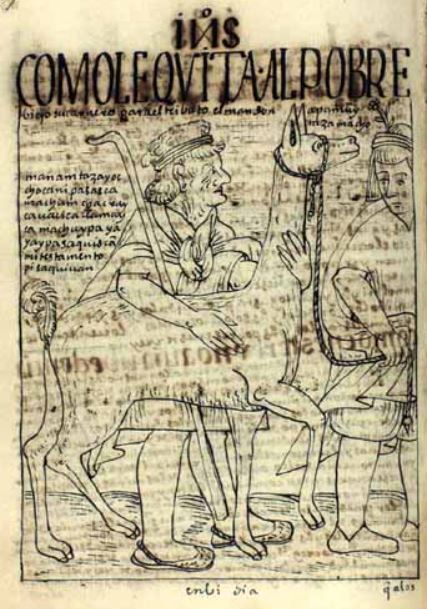
This image depicts a native official trying to confiscate an old native man’s llama for tribute. The old man is depicted holding on to his llama’s back with his right hand and the llama’s neck with his left hand as he tries to prevent the official from taking it. He has tears running down his face. The official is standing on the right side of the image holding the rope tied to the llama as he tries to take it away. The old man’s dialogue written on the left side of the image reads, Manam tazayoccho cani. Pasasca machum. Chacrayca, uacica, llamayca machuypa yayaypa saquiscanmi. Testamentopi saquiuan [I am not taxable. I am already old. The fields, my house and my llama are what my father left me, he left me these things in his will].
This illustration depicts Irene, a Greek woman, sitting on a bench looking focused as she paints a portrait of a girl. There is a girl sitting in front of the easel as her model. Irene is holding a brush in her right hand and a painting pallet in her left. Boccaccio explains that there is not much known on Irene except that she was an exceptional painter, and worthy of remembrance for her skills.
Four people in the foreground look on at Ximena, who is pleading King Ferdinand for vengeance against Rodrigo, as he has just killed her father the Count of Gormaz. She wears black robes and a veil, due to her mourning. Rodrigo is in attendance, and may be the person in the centre of the foreground, but he does not interfere with the scene; he silently leaves upon being addressed by Ximena. The scene takes place in front of a massive and highly-decorated arch, presumably a part of the castle of Burgos.
Here we see the Gulliver and his guide walking through the halls of the Grand Academy of Lagado in Balnibarbi. Here scholars gather to work on problems and innovate. Gulliver visits the Academy and sees first-hand the experiment that the scholars are working on. The Academy is made up of several buildings and Swift likely took his inspiration from Gresham College in the City of London which housed the Royal Society. In this image there is the letter C on a light fixture because it is the first letter of the chapter. The same image appears in the 1843 Krabbe edition.
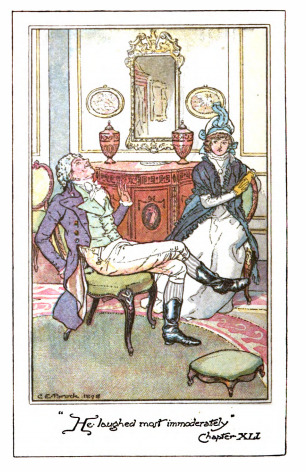
Here we see Elinor and Robert Ferrars, the younger brother of Edward Ferrars. After the news of Edward and Lucy Steele’s engagement, Elinor felt she ought to pay a visit to her half-brother, John Dashwood, and his wife Fanny, who became hysterical after hearing the news. While visiting, Robert Ferrars arrived. He berated his brother for his decisions. Edward Ferrars was planning to enter into the clergy because his mother but him off from his inheritance. Robert laughed at the notion, finding it unbelievable that his brother would work for the clergy, seeing it as a lowly career. This scene appears in chapter 41 as indicated underneath the image. The characters are shown in the traditional regency style, as Elinor wears the regency style dress with an empire waist. Her hair is worn tied up, as was tradition for women after their coming out before the queen, signaling her entrance into society. She wears a bonnet to protect their faces from the sun. Going for walks was a popular pastime among young upper-class women at this time, and bonnets were worn to protect the face from getting tanned, because having light skin was more fashionable. Robert wears a waistcoat and tailcoat, with knickers that stop at the knee. The regency period dated to the early nineteenth century (1811-1820) when George, Prince of Wales, later George IV (r. 1820-1830), reigned as regent for his mentally ill father, King George III (r. 1760-1820). The regency period is associated with the rise of neoclassicism in art and fashion.
Gulliver’s master explained various aspects of the Yahoos that lived in the Country of the Houyhnhnms. He told Gulliver that the yahoos lived in filth, which Gulliver related to living like swine in Europe, shown here. The same image appears in the 1843 Krabbe edition.
Marcia, a Roman woman who remained a virgin her entire life, is depicted on the right side of the engraving painting a portrait. Boccaccio explains that Marcia is worthy of renown for her chastity and for her painting and sculpting abilities. She is known to have mostly painted and sculpted figures of women, which is why there is a portrait of a woman wearing a crown in her painting. The left side of the engraving depicts Marcia sculpting a figure of a woman. Her sculpting tools are illustrated on the table in front of her. Marcia’s name is engraved at the top of the engraving on the right side to identify her. The name Varronis is engraved at the top on the leftt side of the engraving, which refers to her father, Varro.
Two Indigenous people hunt large animals in Florida. The animals, which are likely bison, have long shaggy fur and curved horns. The two men wear garments made from the animals’ pelts, which protect them from cold (according to the text), and use a spear and a bow and arrow to hunt the animals. Thevet mentions in the text that ‘Buttol’ is the Indigenous peoples’ name for the animals. This image is identical to one found on page 1007 verso of Paris, 1575 (l’Huillier).

![[Act V – (?) and Celestina]](https://collections.cemvc.ca/files/large/3bdd43173e2bee12a58458ca9fde051377260b72.jpg)

![[Bust of Jonathan Swift]](https://collections.cemvc.ca/files/large/eccb4da0525f71bce2078cab9aa6d0a6fc322be5.jpg)
![[A tooth from a giant from Brobdingnag]](https://collections.cemvc.ca/files/large/fd6e9626931211945d2e9e05d57c3ce8f9f4aa9e.jpg)
![[Bust of Robert Walpole]](https://collections.cemvc.ca/files/large/77913e3d30087537f04b8d255cc09ca248bab08c.jpg)


![[Animals Chasing Monkeys]](https://collections.cemvc.ca/files/large/483563a9403b98f5036e67a40faaff17758c4219.jpg)

![[Gulliver and the Sorrel Nag build a boat]](https://collections.cemvc.ca/files/large/f69c47539f352574658955e3fad2659f1f5404f7.jpg)
![[Irene Painting a Portrait of a Girl]](https://collections.cemvc.ca/files/large/e7f5e96c5878e534ee5f191c9daea8e4f7e4e553.jpg)


![[Ximena demands vengeance for her father]](https://collections.cemvc.ca/files/large/9eb8182f52986fc75183db4d04da6ca332f4f5c6.jpg)
![[Gulliver and his guide walk through the halls of the Grand Academy of Lagado]](https://collections.cemvc.ca/files/large/db493e0eaf16b2073fe33fb51b6afb65db1d3153.jpg)
![[swine]](https://collections.cemvc.ca/files/large/f3f08bd8fcc1080ef8c33cf44ca1dc810db63f21.jpg)

![Buttol, beste cornue & mo[n]struese.](https://collections.cemvc.ca/files/large/e64267b5bba4ec8ce9818ff1b18098bc385ff76f.jpg)