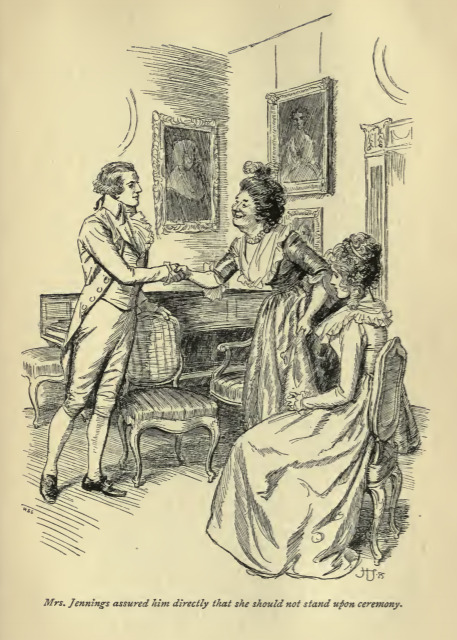
In this image John Dashwood visits Mrs. Jennings, Elinor, and Marianne at Mrs. Jennings home in London. After running into them in town Mrs. Jennings invited John Dashwood to visit them the next day. He obliged but his wife Fanny could not join him. In this image Mrs. Dashwood shakes his hand, as Elinor sits down after being assured by Mrs. Jennings that she need not stand simply for ceremony. This scene occurs in chapter 33. The characters are shown in the traditional regency style, as Elinor and Mrs. Jennings wear regency style dresses with empire waistlines and wear bonnets. John Dashwood wears a waistcoat and tailcoat with breeches, and a cravat. The regency period dated to the early nineteenth century (1811-1820) when George, Prince of Wales, later George IV (r. 1820-1830), reigned as regent for his mentally ill father, King George III (r. 1760-1820). The regency period is associated with the rise of neoclassicism in art and fashion.
Sempronio goes to Celestina’s house on behalf of Calisto and chastises her for not working quickly enough. She explains that the delays will increase her profit, since they will allow her to ask Calisto for more rewards whenever she makes a bit of progress. She asks Sempronio to join her in scamming Calisto, and she offers him her prostitute Elicia (to the left of the image), whom he loves, as a reward for his loyalty. He agrees and joins her.To the right of the image, Sempronio is depicted wearing a hat, and he has a sword mounted on his belt. His body language conveys an air of anger or frustration toward Celestina. Celestina is depicted in a robe and a veil. Her face hints at her displeasure with Sempronio’s reprobative discourse, while the index finger on her right hand is held up, indicating that she is asking for a moment to explain herself. To the left of the image, we see Elicia wearing a robe and a veil. With a distraught look on her face, she appears to have overheard the conversation between Celestina and Sempronio. The exact nature what of she is doing is vague; based on the basket in the lower left corner, she may be weaving or doing laundry.Also of note: Celestina’s left hand appears to be pointing toward something on the ground between Sempronio’s feet. This may be mere coincidence, but the nature of the rounded lines, quite distinct when compared to the other environmental linework, leads me to believe that this could possibly be an artist's signature of some sort.
Here we see a teacher standing at a blackboard, with two students sitting in front of them. The image represents Gulliver’s nurse Glumdalclitch, teaching Gulliver the language of the giants of Brobdingnag. This image appears at the beginning of the second chapter, and the letter M is in the top right corner because the first word of the chapter is My.
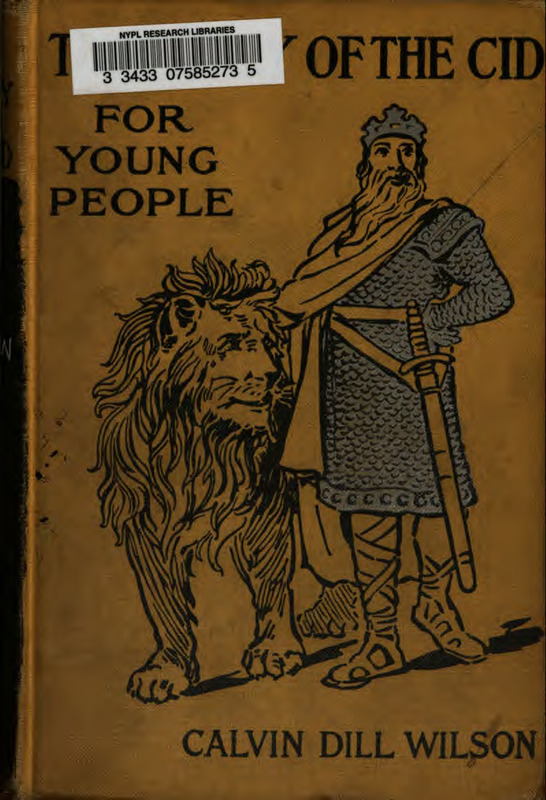
The Cid takes control of a lion which escaped from its keepers. It broke into the palace and came into the room where he was sleeping, and upon waking up the lion instantly and miraculously obeyed him. This incident led to strife with his sons-in-law the Infantes, as they fled out of fear when the lion came in while others did not. The Cid did not fault them for this, but their shame cause them to resent him. This image is used again at page 222, with somewhat more detail but without the colour of the Cid's armour and crown.
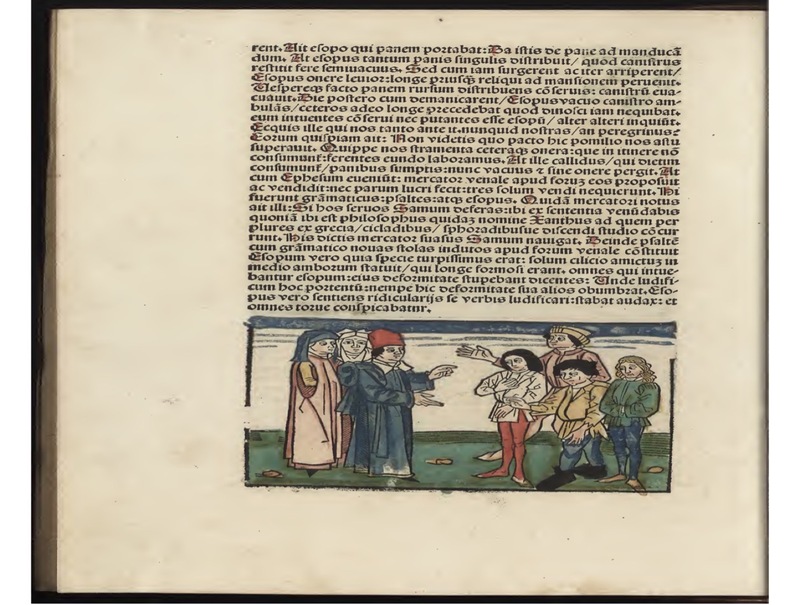
Three religious officials stand to the left of the engraving, two women standing behind the man. To their right stands a group of four men who appear to need help. The male religious official has his hands raised in the direction of the group of four.
The maids of honour of the Queen of Brobdingnag entertain themselves looking at Gulliver. In the image we see two women with their shoulders exposed, partially undressed. Their hair is loose and the woman on the right has her corset unlaced. They wear earrings and necklaces. Gulliver sits in the centre looking up at the women. The scene appears when Gulliver describes the women on Brobdingnag, talking about their dress, appearances, and scent. The same image appears in the 1843 Krabbe edition.
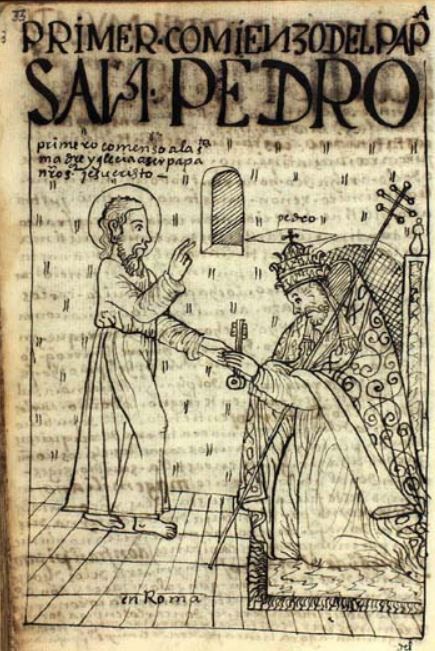
This illustration depicts Jesus Christ on the right side of the image as he hands the keys to the kingdom of Heaven to Peter, traditionally known to be the first Pope of Rome. Peter’s name, written in Spanish as. Pedro, is written above his head in order to identify him. He is wearing pontifical attire and holding a staff with three horizontal bars, which symbolizes the Pontiff. The words en Roma, are written at the bottom of the image to indicate that this is taking place in Rome.
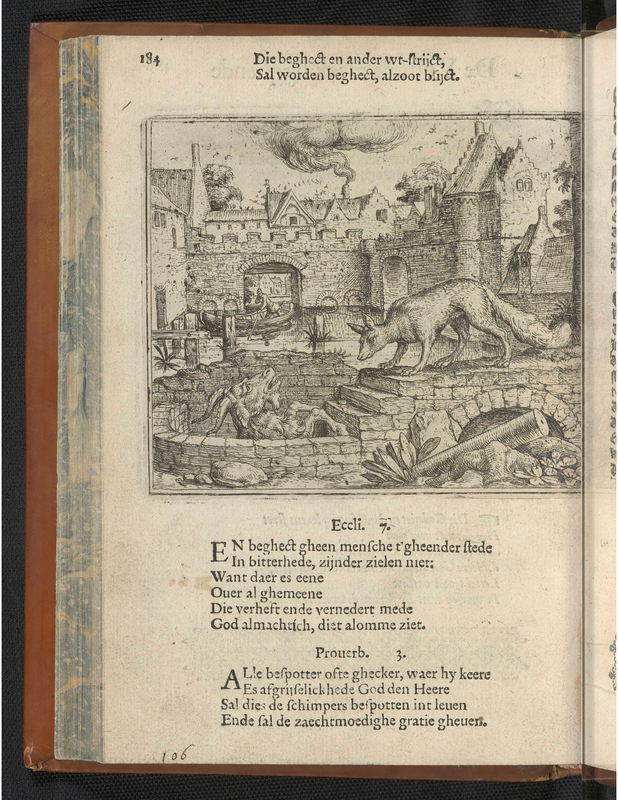
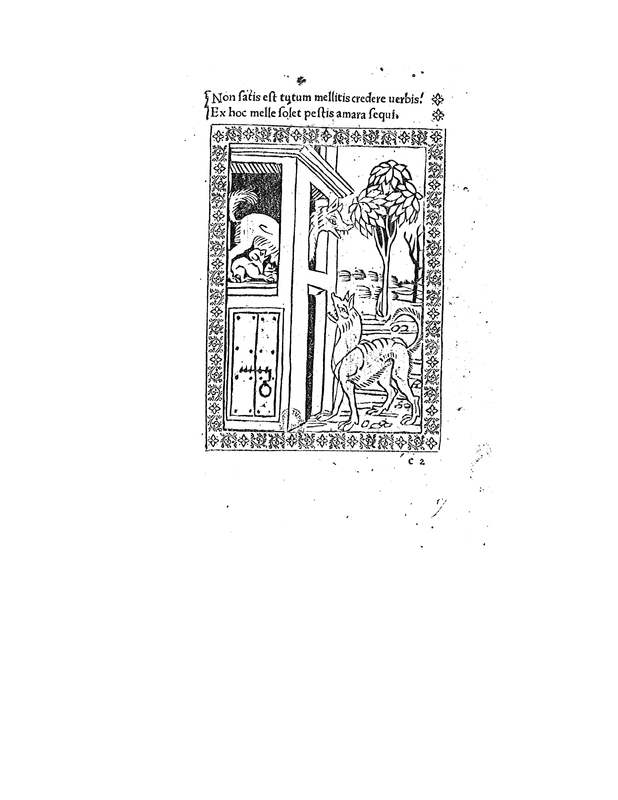
There are two large dogs, one is outside of the house, the other is on the second floor looking out the opening with a taunting demeanor. The dog that is outside looks irritated. The dog on the second floor is a female dog and there is a pup suckling from it.
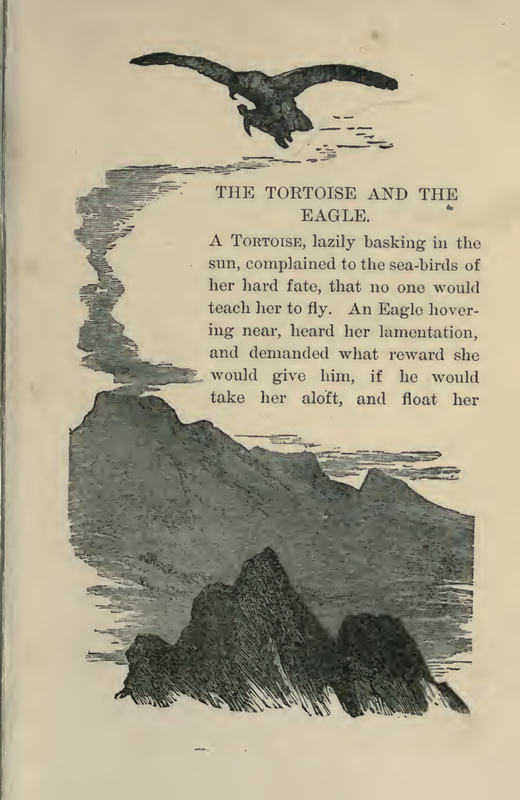
The lower half of the page is covered in mountains and hills. Up in the very top of the page, an eagle is flying in the sky, holding a tortoise in its claws.
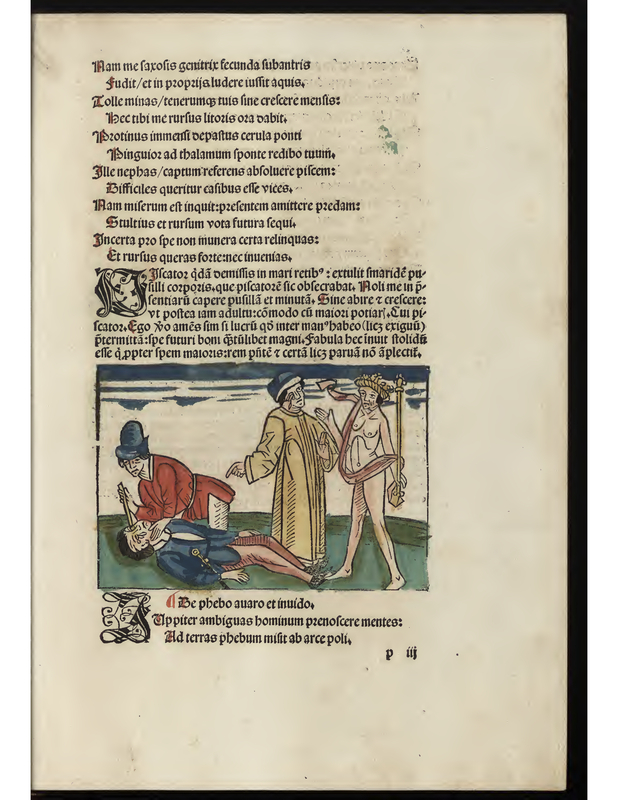
Four men are outside in a field. One man is naked, wearing a crown and holding a scepter, another man is dressed in a cloak and two others are in civilians’ clothes. One of the men is kneeling to remove another man’s eyes, while the cloaked man points and speaks to the naked man. The cloaked man appears to be blind in one eye.
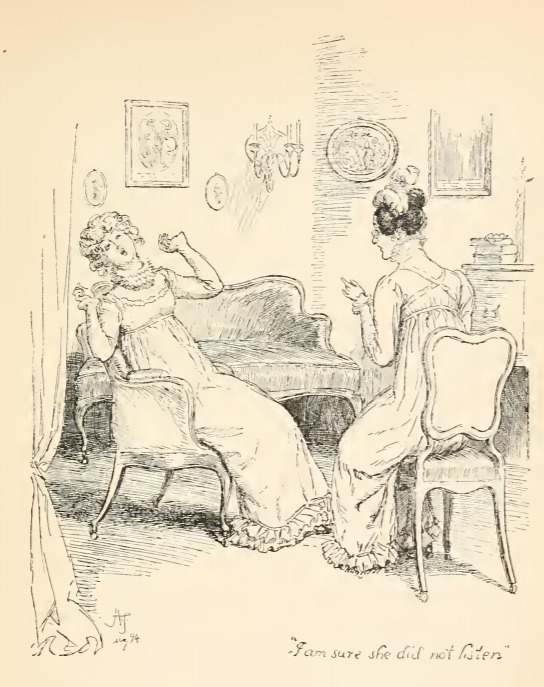
In this image Mrs. Gardiner reprimands Lydia. After Lydia and Wickham had been found she went to live with Mr. and Mrs. Gardiner at their home in London before returning to Longbourn. During this time Mrs. Gardiner repeatedly reprimanded Lydia for her wickedness but she was sure Lydia was not listening. This scene occurs in chapter 52. The characters are shown in the traditional regency style. Mrs. Gardiner and Lydia wear regency dresses with empire waistlines. The regency period dated to the early nineteenth century (1811-1820) when George, Prince of Wales, later George IV (r. 1820-1830), reigned as regent for his mentally ill father, King George III (r. 1760-1820). The regency period is associated with the rise of neoclassicism in art and fashion.
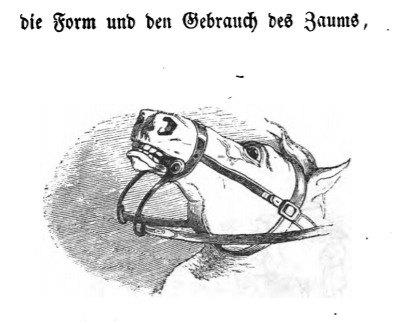
Here we see a horse with its bridle. The Houyhnhnms asks about the horses in Europe and how they live. Gulliver explains that humans or yahoos govern the country and care for the horses or Houyhnhnms, and how humans use their horses, including how humans use bridles on horses. The same image appears in the 1839 Krabbe edition.
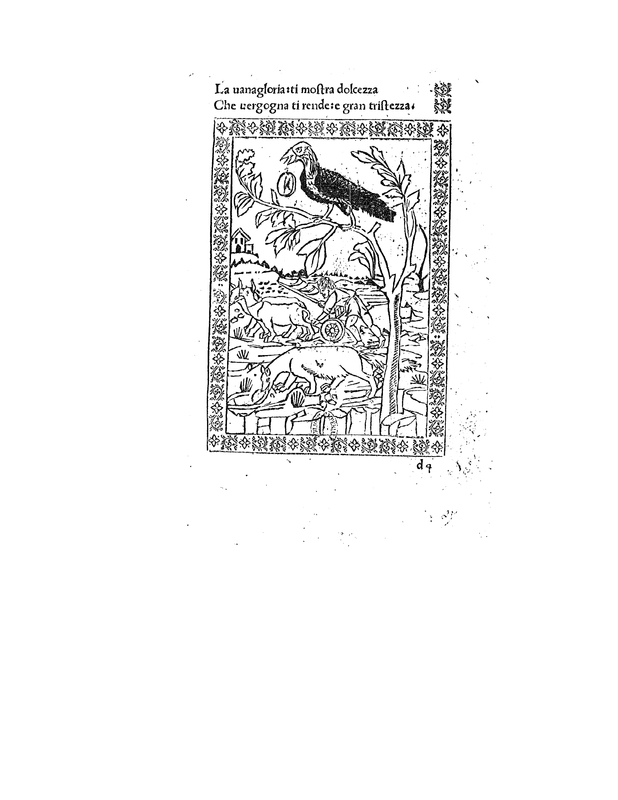
In the centre of the image there is a raven who is sitting on top of a branch of a tree. It has just dropped what seems to a piece of food (cheese). Below the raven on the ground there is a fox with the piece of food (cheese). The fox has a devious demeanor. In the background of the image there is a person working the field with what seems to be a plough and two animals pulling.
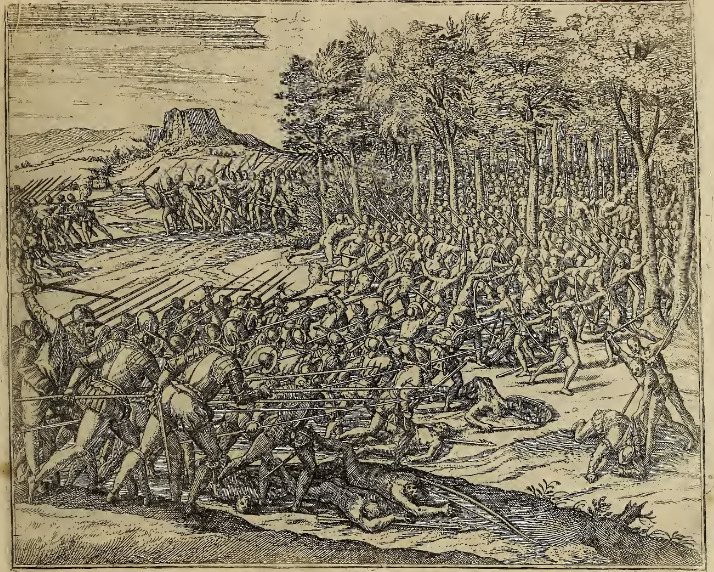
A large battle takes place between the Indigenous peoples of Costa Rica and the Spanish occupiers. Diego Guttierez, the Spanish governor of Costa Rica, is killed in the battle. Spaniards, mostly armed with spears but with some swords and muskets, chase Indigenous people away from the battle into a nearby forest, stepping over the bodies of fallen Indigenous people as they go. The Indigenous people, mostly armed with bows and arrows but with some spears, clubs, and shields, flee the Spanish. Some turn to fire arrows at the oncoming Spaniards. In the right corner, two Indigenous people kill a Spanish man with a spear and a club. In the background, a second group of Indigenous warriors engage the Spanish, appearing to drive them back.
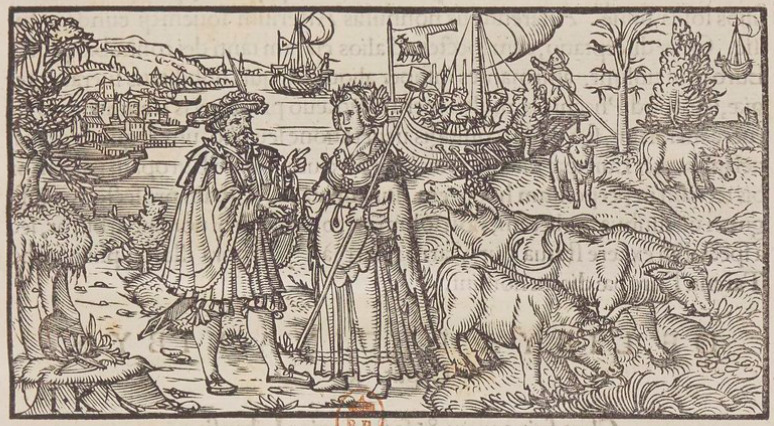
Europa was seized and taken to Crete in the ship shown in the background of the image. The emblem on the ships’ sail is a bull. Jupiter, a Cretan that was in love with Europa, decided to kidnap her and turn himself into a bull so he could swim to Crete with Europa. This is where she was raped by Jupiter. In the photo she can be seen pregnant, shaking hands with the Lord of Crete. Five bulls are seen beside Europa, representative of the animal that is associated with her.
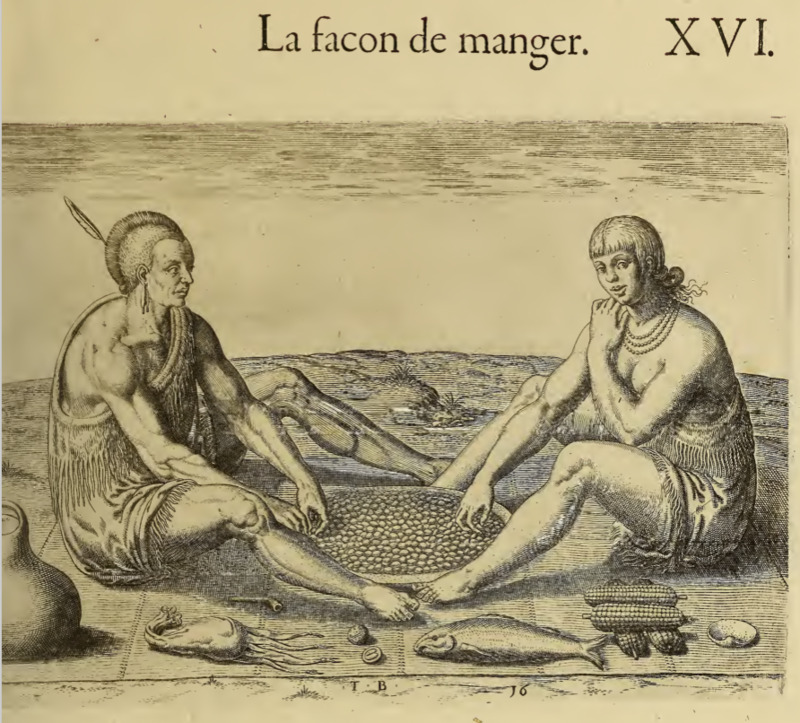
Two Indigenous people are shown sharing a meal. A man sits on the left, and a woman on the right. They sit on a mat on the ground. A large dish with food is between them, and around them are a jug, a pipe, some nuts, a fish, some cobs of corn, and other objects. The man wears a fringed garment draped around his body and over one shoulder and a single feather in his hair. The woman wears a similar fringed garment draped over one shoulder and two strands of beads around her neck.
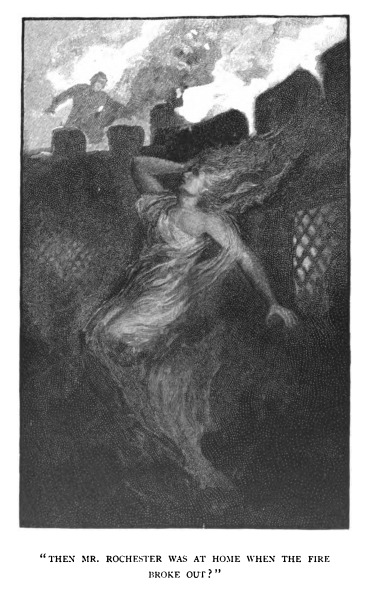
Here we see Mr. Rochester standing on the roof of Thornfield as his mentally ill wife committed suicide by jumping off the building. Mr. Rochester’s wife set fire to the building before running up onto the roof. Mr. Rochester followed her, but she jumped off the roof just as he got there. A neighbour of Thornfield told Jane this story when she returned to Thornfield from Moor House and arrived finding it in ruins, destroyed by fire.
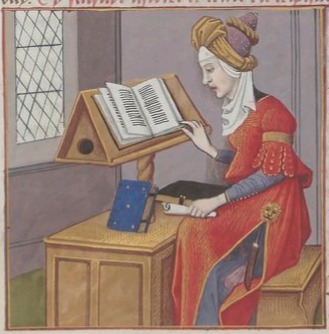
This illuminated image depicts a woman named Erythraea (also known as Eriphila) sitting down while reading a book. Erythraea was a famous sibyl and was known for predicting many major events in history. Boccaccio explains in his story of Erythraea that she predicted the fall of Troy, as well as the life and death of the Son of God.
In the foreground and to the left, we see a female figure knocking on the door to a house. Her long veil and slightly more aged appearance indicate that this is meant to represent Celestina. In her left hand she is holding either a lantern or a bag. In the foreground and to the right, we see a male figure (perhaps Calisto) walking toward the house with a horse. A figure (perhaps Melibea) watches from a window above (top left corner), and two other figures (perhaps Melibea’s parents Alisa and Pleberio) watch from a balcony.The entire image is identical to the one found on the title page.
The illustration is divided into two panels. It is associated with the scene in which Calisto, while practicing falconry, encounters Melibea in her garden. On the left, we see Calisto dressed in noble attire, with a sword mounted on his belt. On the right, we see Melibea dressed in a robe and a veil. In her left hand, she is holding the girdle cord that will become important later in the narrative, while in her right hand she has a flower. She appears to be holding it in front of her face, perhaps an expression of her modesty. A small dog stands at her feet, perched on its two hind legs while extending its front paws toward her. The entire image is identical to the one on page 196 of the text. The left panel is identical to those on pages 43, 162, and 190. The right panel is identical to those on pages 150 and 244.
Here we see Gulliver’s arrival on Balnibarbi, the continent underneath the flying island of Laputa. After sailing for several days, he sees land. He sailed around for several hours to find the best place to come inland, and after finding a creek, he arrives on shore. He then prepared his food by making a fire, seen in this image. His small boat is visible behind the cliff. After eating, he found a small cave where he slept and stored the rest of his provisions. The same image appears in the 1839 Krabbe edition.
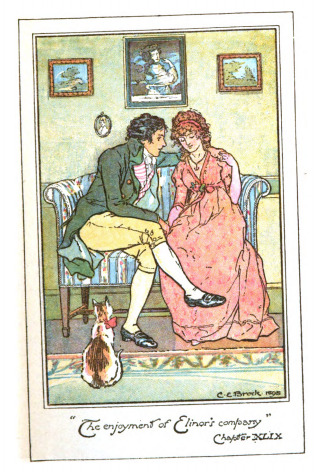
Here we see Edward Ferrars with his arm around Elinor’s shoulder. After leaving Cleveland Elinor and Marianne returned home to Barton Cottage. No one had heard anything from Edward Ferrars after he left London to go to Oxford. One of the Dashwood’s servants had been in Oxford and saw Lucy Steele and she said that she was married, but he did not speak with Edward. When he came home with this information, Elinor was upset because she would not accept his marriage, believing that he might still come back to her. Soon after this, Edward arrived at Barton Cottage. He told Elinor that Lucy ran away with his brother Robert and they got married. Edward then came to propose to Elinor, and their marriage was planned within hours of his arrival. This scene appears in chapter 49 as indicated underneath the image. The characters are shown in the traditional regency style. Elinor wears the regency style dress with an empire waist. Her hair is worn tied up, as was tradition for women after their coming out before the queen, signaling her entrance into society. Edward wears a waistcoat and tailcoat with knickers that stopped at the knee. The regency period dated to the early nineteenth century (1811-1820) when George, Prince of Wales, later George IV (r. 1820-1830), reigned as regent for his mentally ill father, King George III (r. 1760-1820). The regency period is associated with the rise of neoclassicism in art and fashion.
Gulliver’s master explained various aspects of the Yahoos that lived in the Country of the Houyhnhnms. This image is a bust of an important yahoo teacher. The same image appears in the 1843 Krabbe edition.

![[Act III] Sempronio gaende na thuys van Celistina.](https://collections.cemvc.ca/files/large/e4fbf8ef287ee709137bdfe68ef58f16eacbf90f.jpg)
![[Bird Drinking from Water Well]](https://collections.cemvc.ca/files/large/3fa1f4ea2aec38336b0a30a4850d38221cdfe48e.jpg)
![[A teacher at a blackboard]](https://collections.cemvc.ca/files/large/8f8f09f66551da91ff9e8a51c018b670f0bd9eb4.jpg)
![[Gulliver with the maids of honour on Brobdingnag]](https://collections.cemvc.ca/files/large/9e67ee60f0ff67a0984d7e3ecf68011c72f3ac1a.jpg)
![[Act I – As Celestina Knocks on a Door, a Horseman Approaches and Three Figures Observe (Repeated)]](https://collections.cemvc.ca/files/large/fec70b271584c66d46fe7f85e636842696eee66b.jpg)
![[Act I – Calisto and Melibea]](https://collections.cemvc.ca/files/large/6e75ce7c5759e82205d858a06deb68268bc24b21.jpg)
![[Gulliver lands on Balnibarbi]](https://collections.cemvc.ca/files/large/5ea53d9128bb932ad13a6397ea7b574cee226a53.jpg)
![[carved bust of a yahoo]](https://collections.cemvc.ca/files/large/32b938c59edd0994e2bf39394ac2cfce28f6b624.jpg)