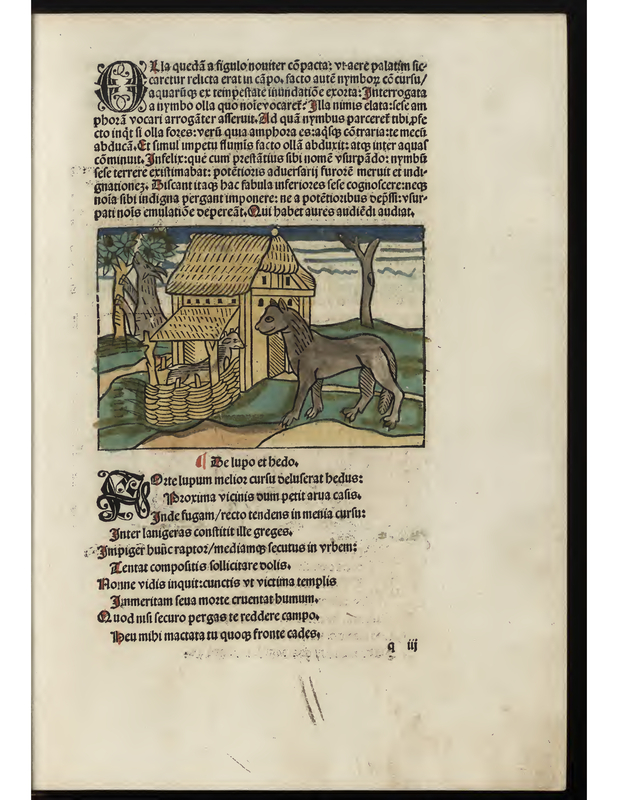
A young buck is inside the stable of a house speaking to a large older wolf. The wolf looks inviting and pleased. Behind the house is an older buck who seems to be distracted while grazing on a tree.
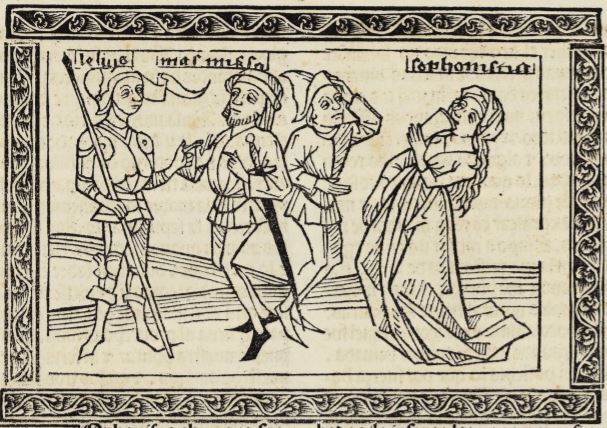
Masinissa, the King of Numidia is depicted on the left side of the engraving speaking with a man named Laelius. Laelius is depicted pointing at Masinissa as he reproaches him for marrying a captive of the Romans. We know that these figures are Masinissa and Laelius as the creator engraved their names written as Masmissa and Lelius above their heads. Not able to disobey Laelius, Masinissa ordered a servant to give Sophonisba, his wife, a cup of diluted poison. Sophonisba is depicted on the right side of the engraving willingly drinking the poison. The servant in front of Sophonisba looks astonished at how willfully she drank the poison. We know that the woman depicted in the engraving is Sophonisba as her name is engraved above her head.
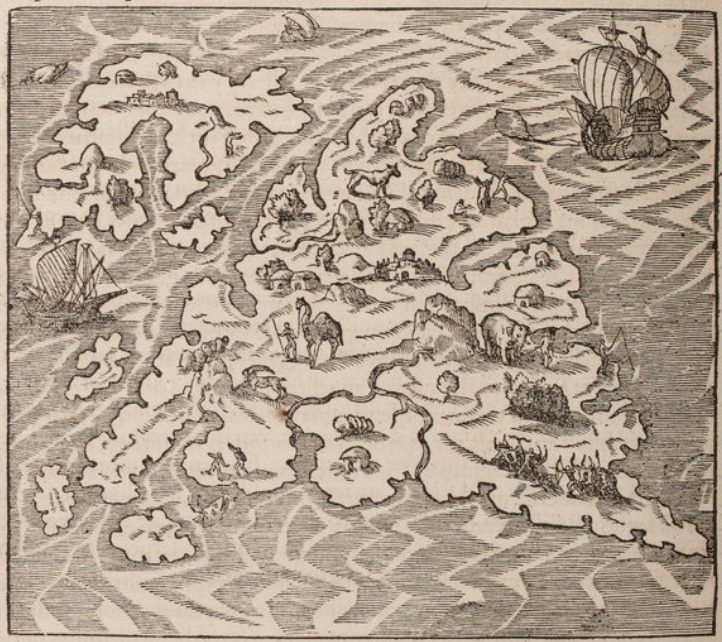
An aerial view of an island is shown, identified as Isle Espaignolle (Spanish Island – possibly Hispaniola, today Haiti and the Dominican Republic) by the author. Two groups of Indigenous people are engaged in combat with bows and arrows in the bottom right corner of the island. Elsewhere on the island, other Indigenous people fish and walk leading animals that resemble camels and elephants. There are several settlements on the island, as well as on a smaller island nearby. A large European ship sails in the top right corner. This image is identical to one found on page 911 verso of Paris, 1575 (l’Huillier).
Sambo, standing on the right, presents a platter on which rests a letter for Miss Amelia Sedley from her brother. Amelia, who is reaching for the letter, sits on the sofa next to Rebecca Sharp. Amelia looks concerned, while Becky looks irritated. On the wall behind them is a portrait of the man in question atop an elephant, and on the table to the left of the illustration lies an open book and inkwell with a pen and quill.
This image depicts two creole servants of the Spaniards in Spanish colonial Peru. The man standing on the left side of the image is playing a mandolin and the woman on the right has her hands in the air as she dances to the music. The author criticizes creoles and believes that they become lazy gamblers and thieves who do nothing but get drunk and play music and sing. There are song lyrics written on the page which reads, chipchi llanto, chipchi llanto, pacay llanto, maypin caypi rrosas tica, maypim caypi chiccan uaylla, maypim, caypi hamancaylla [Light and shadows, light and shadows, hiding shadows, Where? Here, the roses. Where? Here, the wide pastures. Where? Here, the calla lilies]. The word fiesta [party] is written at the bottom of the image.
This image depicts the story of a young Roman woman who saved her mother from starving to death. Boccaccio explains that this young woman’s mother had been sentenced to death, and when she was locked away to die of starvation, her daughter saved her with her own breast milk. The young woman is depicted sitting down with her breasts exposed as she provides milk to her mother. The young woman’s belly is large as she had just given birth, which is why she is able to produce the milk. Boccaccio explains that he wrote on this unknown young woman due to her filial devotion.
Diego Lainez grants his sword to his son Rodrigo, surrounded by his other sons. Diego had been grievously insulted by Don Lozano Gomez, and Rodrigo, though still very young, was eager to avenge him while his other sons were not. He uses his father’s sword to duel and kill Lozano over the offence.
Here we see a professor from the Grand Academy on Balnibarbi holding a book which is filled with parts of sentences created by his machine. This machine had all the words in the language of Balnibarbi in different moods, tenses, and declensions written on blocks. These blocks were held together by wires on a frame, and students of the professor would rotate the handles, forming different arrangements of the words. They would then find sentence fragments and record them in this book. The goal of this experiment was to create a complete body of work that comprised all of the arts and sciences. The same image appears in the 1843 Krabbe edition.
This image is illustrated in a chapter that discusses and criticizes the government and society in Spanish conquered Peru. This image depicts a Spanish Corregidor [Magistrate] on the right side of the engraving dressed in traditional European clothing. He is illustrated looking over to the man on the left side of the image who has his hands and feet shackles and his legs through stocks. This man’s name is Don Cristobal de Leon, and the author explains that he was imprisoned and tortured by the Corregidor for refusing to give him indigenous peoples for laborious work such as, transporting goods, weaving, and spinning yarn. There is script written in the centre of the image which is the dialogue of the Correigedor. It reads, warcuscayqui galera-man carcoscayqui [I’ll send you to the galleys]. The writing on the stocks is Don Cristobal’s dialogue which reads, runarayco cay sepo-pi nacarisac [for my people I shall suffer in these stocks].
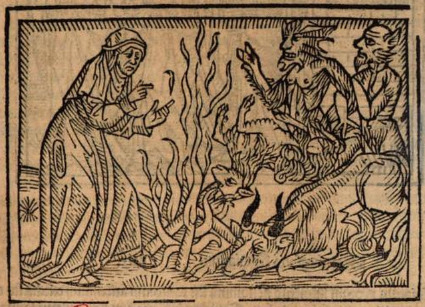
This engraving depicts Manto, the daughter of the famous seer Tiresias. She is depicted with her body leaning over a burning fire. Boccaccio explains that Manto became an incredible seer just like her father. She used the movement and colour of the fire’s flames to tell the future, which is why there is a fire in the engraving. She also used the entrails of animals such as sheep and oxen for signs of the future. There is an ox and a sheep illustrated in the engraving with their organs sticking out from their bodies. There are two distinct looking characters on the right side of the engraving, which signifies Manto’s involvement in the dark arts and summoning spirits and gods from the underworld.
During his time on the Country of the Houyhnhnms, Gulliver began to hate all humans, because he viewed the Houyhnhnms to be superior beings, while the yahoos were inferior. It got to the point where Gulliver began to hate his own reflection because he looked like the yahoos. This sentiment stuck with Gulliver even after he returned home to England, and he could never look at a human the same way. The same image appears in both the 1839 and 1843 Krabbe editions.
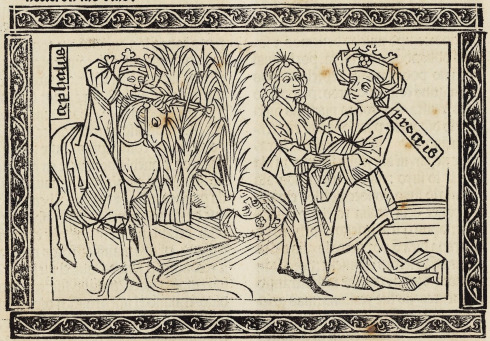
Boccaccio explains that when Cephalus was told that his wife (Procris) would abandon him in exchange for money and treasures, Cephalus began testing his wife. Cephalus would disguise himself and offer her gold and treasures in exchange for her love. This scene is depicted on the right side of the engraving. Procris rejected the disguised Cephalus multiple times, however, she eventually accepted his treasures. In this scene she is holding his hand and looking at him lovingly. Procris ended up regretting what she had done to her husband. To punish herself, Procris went to live in the woods. Cephalus had been hunting one day and had mistaken his wife for an animal and shot her. Procris is visible behind the grass in the background of the engraving while Cephalus is depicted with a cross bow in his hands after shooting her. Cephalus’ name is engraved beside his arm to identify him.
Here we see the eagle carrying away Gulliver’s house from Brobdingnag. In the image we see the eagle’s head with a rope attached to Gulliver’s head in his beak. Gulliver leans out the window, looking up at the eagle. We see the straps attached to Gulliver’s house which were worn like a backpack when he was travelling. This is the smaller of his two houses, as this was designed for travel. The same image appears in the 1839 Krabbe edition.
This is a bust of William III of England - also known as William of Orange. The image is a part of Swift’s Biography which precedes Part One of Gulliver’s Travels, in which the biographer is describing the political climate of the early eighteenth century to provide readers with context for the story.
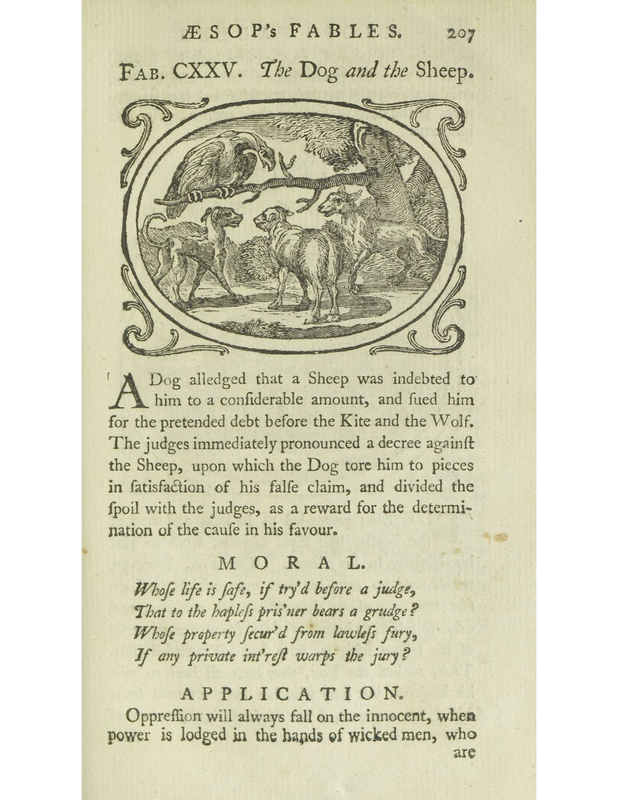
The scene is taken place outside, there is a Kite that is perched up on a large branch of a tree looking down at a Dog, Sheep and Wolf standing in a circle facing eachother, surrounded by plenty grass and plants in the area. The Dog had sued the Sheep, and the Wolf and Kite are the judges in their court session.
This illumination depicts the story of Jocasta and Oedipus. Jocasta is depicted on the right side of the image stabbing herself in the abdomen, while her husband Oedipus is on the left side of the image looking horrified. Jocasta is stabbing herself because she found out that her husband, Oedipus, is her son. The two smaller figures in the centre of the image are Eteocles and Polynices, the sons of Jocasta and Oedipus. They kill each other in war, which is why they are depicted stabbing one another in this illustration.
Three men are walking together through a field. Two of the men are armed with swords and seem to be supporting the man in the middle. One of the two men is holding up a large gold goblet. The man in the middle is wearing a red robe and looks weak. Behind them seems to be a pile of luggage.
In this image, Swift is the central figure, with his teachers looking over his shoulder. The image appears in Swift’s biography, during the discussion of Swift’s university years at the Trinity College in Dublin. A shadowy figure behind Swift’s shoulder on the left of the image reads a book. This image also appears in the 1843 Krabbe edition.
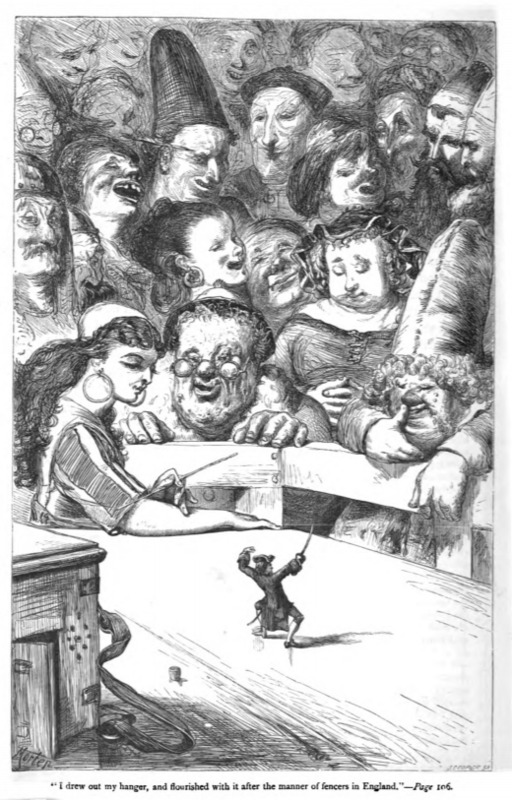
Here Gulliver performs for a crowd of giants. The farmer who found Gulliver created a show as a way of making money. Gulliver entertained the crowd by using his sword to mimic fencers. A barrier separates the crowd from the stage, and Glumdalclitch sits inside the barrier.

![[Sambo Brings a Letter]](https://collections.cemvc.ca/files/large/d9cd5fe7f8d0f5525d43512e2412db623f44717e.jpg)
![Criollos I Criollas In[di]os](https://collections.cemvc.ca/files/large/8d879bc8bb1897780f6722bdf8fbf041007cbca8.jpg)
![[A Roman Woman Saves Her Mother with her own Breast Milk]](https://collections.cemvc.ca/files/large/666c914c49a2be2e17516bd0ea7dc3e297c69404.jpg)
![[a professor from The Grand Academy on Balnibarbi shows Gulliver his book of research on language]](https://collections.cemvc.ca/files/large/536722273fc2b0ff503f8a7f2aaa01a7471f0d7b.jpg)
![Coreg[id]or Tiene Preso y Amolestado a Don Cristobal de Leon, Segunda Persona, Porque Defendio a los Yndios de la Prouincia](https://collections.cemvc.ca/files/large/04b37df899d33004a51c3af6f8bd00c689671892.jpg)
![[Pot Collecting Water]](https://collections.cemvc.ca/files/large/26d8c9237b2f08255dc87ee11ec210fea61d1057.jpg)
![[Gulliver recoils at his reflection]](https://collections.cemvc.ca/files/large/18bfde9608bcd883bd8283ffee09166f7a6111a7.jpg)
![[Gulliver's house is carried away from Brobdingnag by an eagle]](https://collections.cemvc.ca/files/large/aadacd9a9b75de386c13e05b94170a2aa94d736e.jpg)
![[Bust of William III of England]](https://collections.cemvc.ca/files/large/83faba329d0102378ab4bc6c06474bbc3d0ed9e0.jpg)

![Esopi Appologi siue Mythologi cum quibusdam carminum et fabularum additionibus Sebastiani Brant. [Three men walking through a field]](https://collections.cemvc.ca/files/large/af697451aa33f3ee16e1cea2575138a8dc095fdc.jpg)
![[Swift with his teachers behind him]](https://collections.cemvc.ca/files/large/92adf647120e4091e76ee1bdcc581dbf5f819859.jpg)