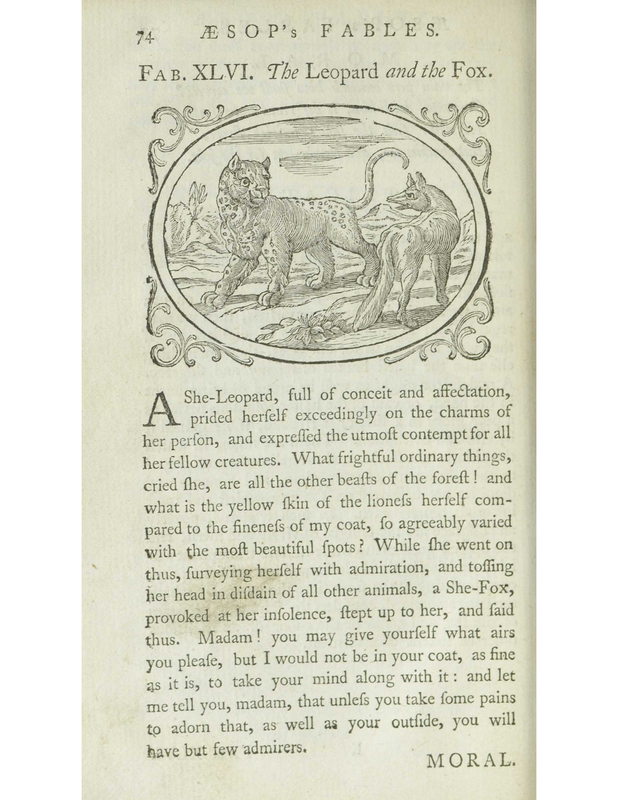
A leopard stands on the left side of the image, staring at a fox who appears to be making some sort of noise at the leopard. The fox appears angry, while the leopard appears startled and alert.
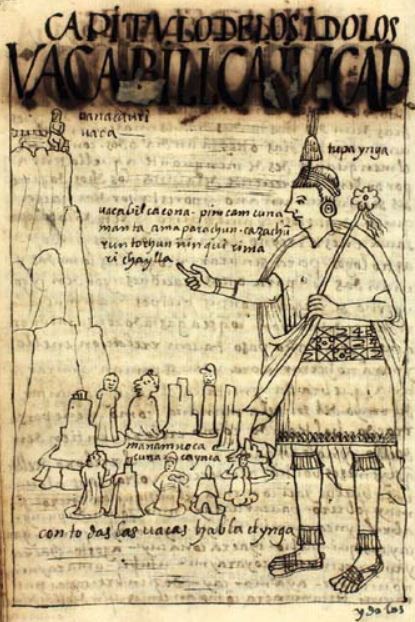
This chapter is dedicated to describing the idols and gods of the Incas. This image depicts the Inca Emperor, Topa Inca, speaking to local huacas [deities] on the uana cauri [Huanacauri] mountain. Topa Inca is depicted on the right side of the image wearing his royal garb and his name is written by his head to identify him. The idols are arranged in a circle at the base of the mountain. There are words on the image which is the dialogue spoken between the Inca and the idols. The dialogue written in front of the Inca reads uaca bilcacona - pim camcunamanta ama parachun cazachun runtochun ninqui rimari chaylla, which translates to deities, who among you has said for it not to rain, not to freeze, not to hail? Speak, that is all. The dialogue written in the circle of the idols reads manam nocacunaca ynca, which translates to it was not us, Inca. The writing below the circle of the idols is a caption for the image which reads contodas las uacas habla el ynga. This translates to the Inca speaks to all the idols.
A boy in a tall hat, carrying a stack of books, is looking yearningly upon the items at a street-side vendor. In the background is a coach labelled with the number six, a man standing next to all tall signpost, and, in the top right corner of the image, the letter T from The.
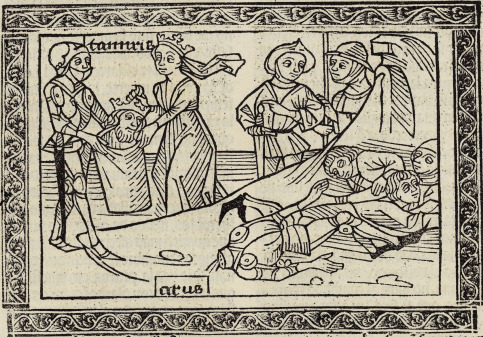
This engraving depicts Thamyris, queen of Scythia, placing the decapitated head of king Cyrus into a bag. Thamyris’ name is engraved beside her head, and Cyrus’ name is engraved beside his body at the bottom of the image. Boccaccio explains that Cyrus had invaded Scythia looking for glory, and when he had killed Thamyris’ son, she exacted her revenge by killing his entire army. When Thamyris found Cyrus’ dead body, she took his head. There are other dead bodies among Cyrus which are his men. There are Thamyris’ soldiers surrounding her, and one who is helping her put the head of Cyrus into the bag.
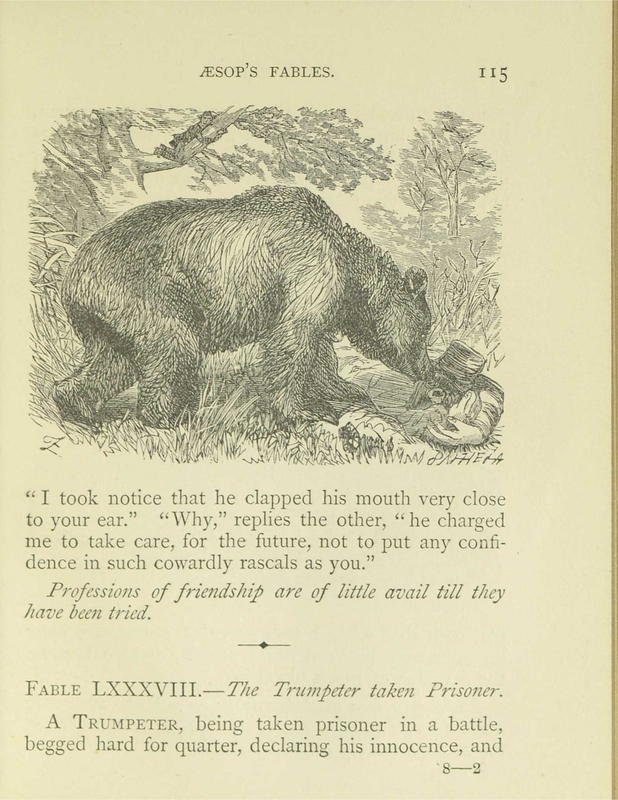
A bear noses at a man lying on the ground. The man is on the right side of the page with his arms crossed over the crown of his head and his face to the ground. Another man up in the boughs of a tree in the background looks on at the scene.
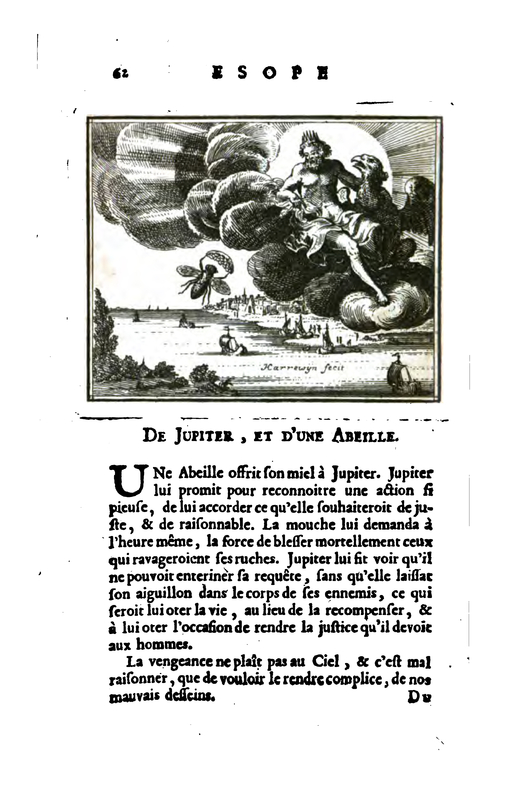
A Bee offered its honey to Jupiter. Jupiter promised her to acknowledge such a pious action, to grant her what she wished to be just and reasonable. The Bee asked him at that very moment, for the strength to mortally wound those who would ravage her hives. Jupiter saw that he could not bury her request without her leaving her sting within the body of her enemies, which would deprive her of her life, instead of rewarding her, and to deprive her of the opportunity to render the justice which he owes to men.
To the right side of the image, Amelia Sedley, wearing a white dress, has come through the door to the drawing-room singing. On the left side of the image is William Dobbin in his black military uniform, bowing his head to her.
Sempronio goes to Celestina’s house to negotiate Calisto’s wishes. She tells him that Calisto only paid her a small sum, and that she is trying to scam him out of more money. Sempronio reminds her that Calisto is willing to increase payment if he gets what he wants. The mutual interest of scamming Calisto unites them, and Celestina awards Sempronio one of her prostitutes, Elicia, in exchange for his loyalty (he is seen standing with her to the left). However, they doubt that Pármeno will join them in their cause, seeing as he was an assistant to Celestina when he was young and thus knows her treacherous ways. Sempronio and Elicia leave Celestina alone, and she casts a love spell (or curse) on Melibea. Now certain that she will succeed, she leaves her house to visit Melibea.
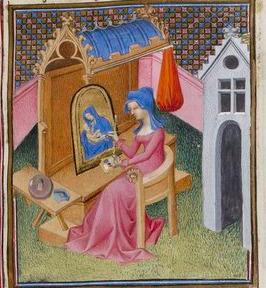
Thamyris, daughter of Micon, painted a portrait of Diana that the Ephesians treasured deeply. The image depicts her painting the famous portrait. In the portrait, Diana is represented as Mary and Jesus.
Lord Steyne leans back in his chair, looking pleased. On the other end of the table are the Reverend Mr. Trail and Father Mole, in the midst of a debate which Lord Steyne started. The table between them is set with several plates and many cups and pitchers.
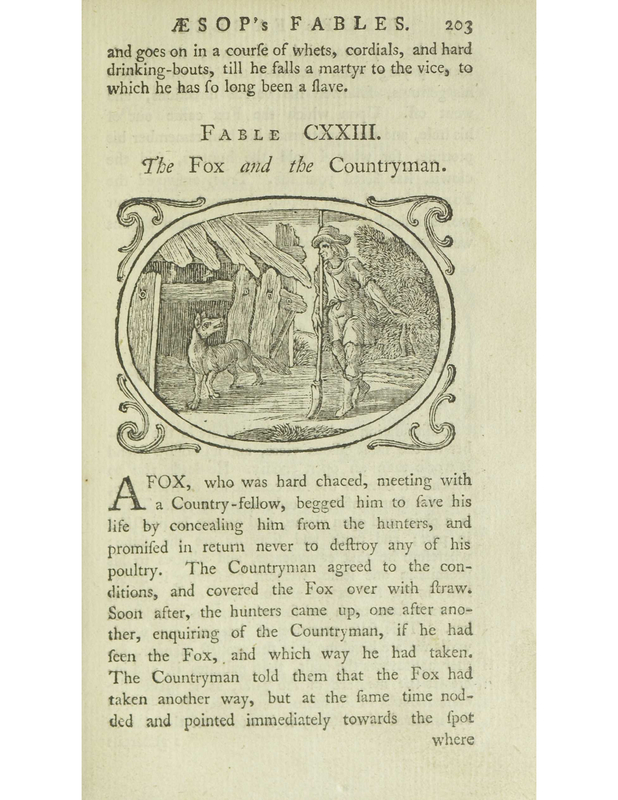
A fox is walking past a poorly constructed wooden barn and looking up at the peasant beside him. The peasant is standing next to the fox with a long gardening tool in his hand. There are trees behind the man.
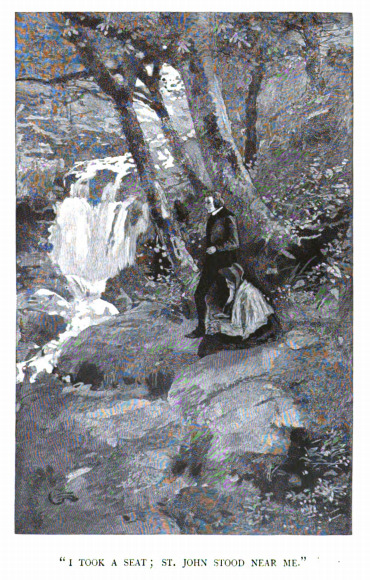
Here we see Mr. Rivers and Jane Eyre standing outside in the moors of England. Mr. Rivers tried to convince Jane to join him on a mission with the church to India, but she refused. He asked her to marry him before he left to go to India, but Jane refused, saying that she would never get married. He argued that missionary work was much more effective when a married couple went together, but Jane was uninterested. He told Jane to take some time to consider his offer. She went for a walk in the moors and sat down near a waterfall. Mr. Rivers found her, and she ultimately declined his offer.
Areusa (leftmost figure) and Elicia (rightmost figure) go to Centurio’s house. When they enter, Centurio (central figure) acts with arrogance toward Areusa. Offended, she prepares to leave without asking for his help. With cunning words, she manages to make Centurio submissive to her desires. She then tells him that, to gain her favour once again, he will have to kill Calisto. He agrees, but he immediately starts considering ways in which he could avoid fulfilling this duty himself. He decides to send some of his companions, among them Thraso, to enact the deed in his place. [The figures in this illustration are used in multiple other illustrations throughout this edition.]
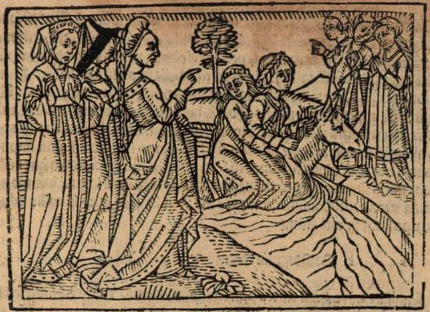
This engraving depicts Cloelia, a young Roman woman, riding a horse through a deep river with many women looking at her. Boccaccio explains that Cloelia was given to a foreign king as a hostage, and when she escaped, she took many other hostages with her to get back to Rome. While escaping, she came across a river that was too treacherous to pass. She found a horse, and despite never having ridden one, she got herself and the other women across safely by means of this horse. This image depicts her taking the other women across the river one by one as there is only one other female on the horse with Cloelia.
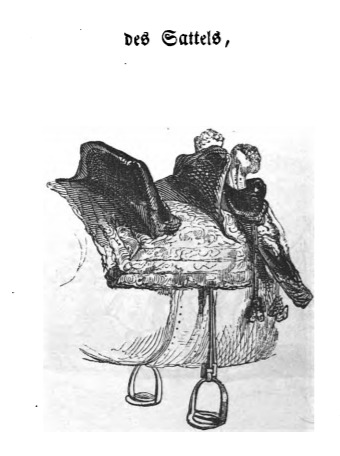
Here we see a saddle on a horse’s back. The Houyhnhnms asks about the horses in Europe and how they live. Gulliver explains that humans or yahoos govern the country and care for the horses or Houyhnhnms, and how humans use their horses, including how humans use saddles on horses. The same image appears in the 1839 Krabbe edition.
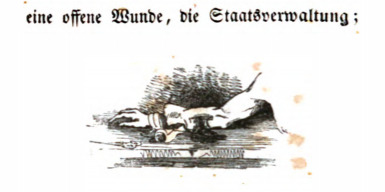
Here we see a wound that it is seeping. This is the code word for the state administration. This image comes in a description of a conspiracy found by a professor from the Grand Academy on Balnibarbi. This idea is representing code word for terms in the conspiracy that Swift is satirizing. The professor advises that those named in the conspiracy papers be closely monitored at all times, naming specifically while they were using the bathroom, as this is when men were most thoughtful. This conspiracy is thought to be an allusion to the trial of Francis Atterbury, the bishop of Rochester for allegedly plotting with the Jacobites. Atterbury was charged with treason in 1722 and was exiled to France. The same image appears in the 1843 Krabbe edition.
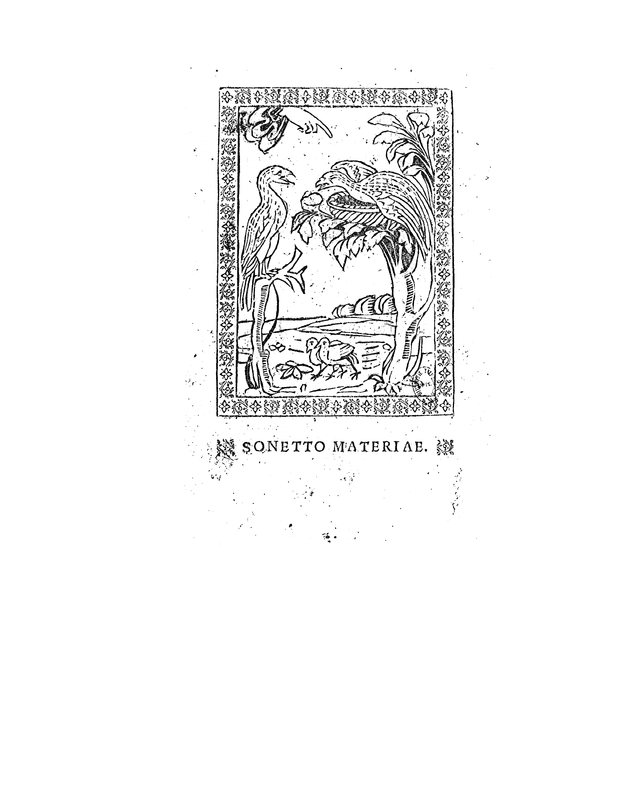
A mother bird has assumed an defensive posture in her nest which is sat atop of a tree on the right side of the image. The mother bird has an aggressive look, opposite the mother bird is another bird (kite) sat on a tree trunk they appear to be in dialogue. On the ground in the centre of the image there are two juvenile birds walking together. There is what appears to be a divine hand pointing at the mother bird from the sky, top left of the image.
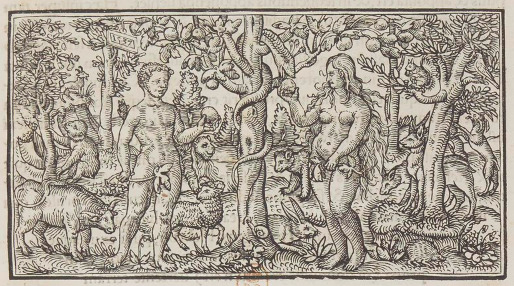
This engraving depicts Adam and Eve in the forest. Eve is being offered a forbidden apple by the viper, which is illustrated as being coiled around the tree in the centre of the image. They are naked but have their genitals covered by leaves. Animals surround them. The date of the engraving is known because of the date stamp in one of the trees in the background on the left-hand side. Eve was the most ancient mother, according to Christian tradition, and mother of us all, which is why she is the first in the text.
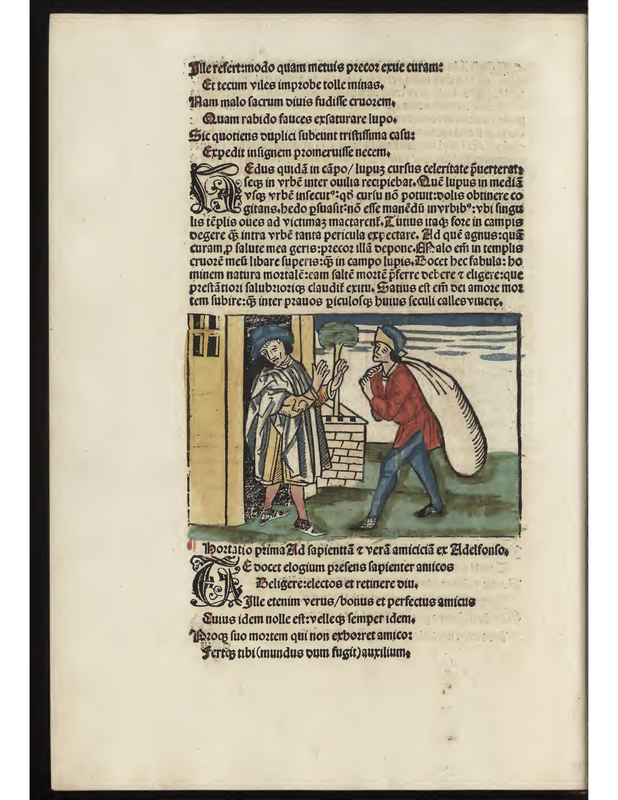
Two mean are standing in a doorway. A young man carrying a sack over his shoulder is complimenting the second man, as the second man gracefully refuses by putting both his hands out in humility.
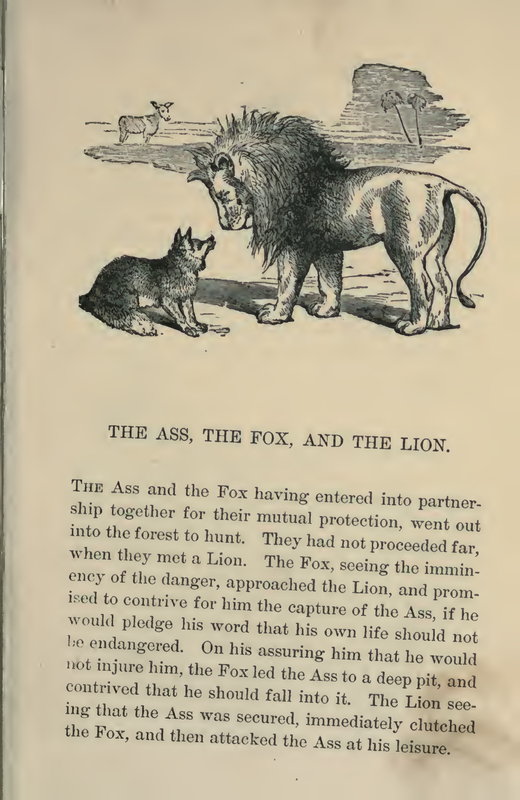
To the right, there is a lion looking to the left on the ground. Where a small fox is looking back at it. The fox is slightly bending away from the lion, as though intimidated by him. In the distance, near tall palm trees and possibly a shore, an ass stands on the far-left side of the image, looking at the fox and lion exchanging words.
Two women, a man, and a single bird in the outdoors stnding around in a deserted looking area with much land and not many buildings. The two women are talking on the side while the man is stading there with his arms crossed together.
![[Vanity Fair Chapter LIX Inhabited Initial]](https://collections.cemvc.ca/files/large/f5d391db8974702c035a02bd202cb6d7cdfeeb60.jpg)
![[Dobbin Meets Amelia]](https://collections.cemvc.ca/files/large/ee013dfccb527d7e419f17308c6dd8c7eea9fb58.jpg)
![[Act III - Sempronio with His Lover Elicia at Celestina's House]](https://collections.cemvc.ca/files/large/457cd18b85972029c18430b26f22742ec85e8430.jpg)
![[Lord Steyne, Mr. Trail, and Father Mole]](https://collections.cemvc.ca/files/large/d27480aae411d39be805940bb0495b33d3128643.jpg)
![[Act XVIII – Areusa, Centurio, and Elicia]](https://collections.cemvc.ca/files/large/652cbfffeca4966b8c18ddd6a2b5a525829835f2.jpg)

![[Conversations of a Man and Two Women]](https://collections.cemvc.ca/files/large/66a6721215fdbab496d688d52835551e27014212.jpg)