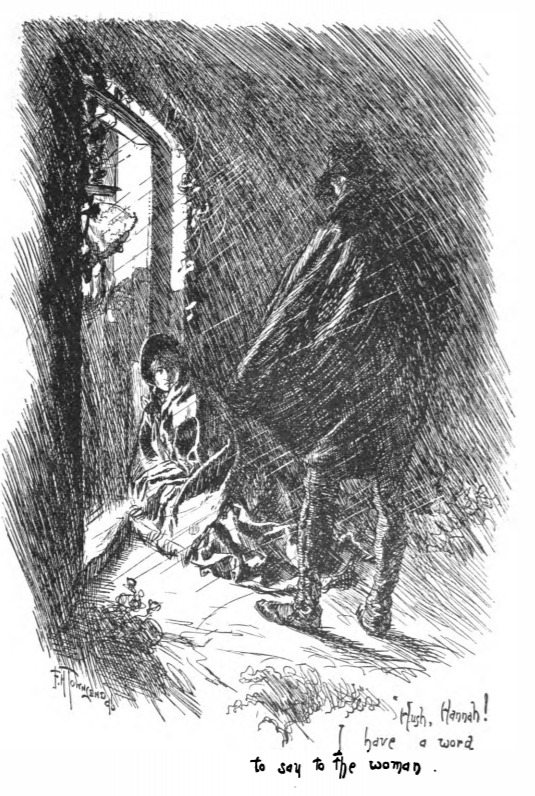
After breaking off her engagement to Mr. Rochester, Jane fled north as far as she could before she ran out of money. She arrived at the Moors of England when she could no longer afford a carriage. She slept outside for two days and two nights, before arriving at Moor House. Here we see Jane’s arrival at Moor House. She knocked on the door asking for shelter but was first turned away by the housekeeper, Hannah. A few minutes later Mr. Rivers, the owner of the house, arrives home and agrees to give Jane shelter and allow her to recover there.
Here we see the Queen of Brobdingnag’s dwarf tormenting Gulliver. The dwarf holds Gulliver between his fingers as Gulliver leans away from him. The dwarf wears a pointed cap with bells. The letter J is on his cap, as it is the first letter of the chapter. The same image appears in the 1843 Krabbe edition.
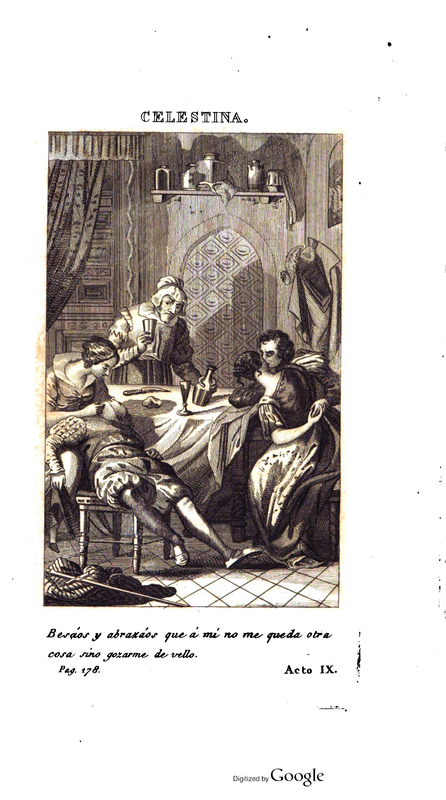
Sempronio and Pármeno go to Celestina's house to enjoy a meal with their lovers Elicia and Areusa, two of Celestina's prostitutes. They arrive late, which has caused their lovers some frustration. When Sempronio praises Melibea's beauty and virtue, Elicia is thrown into a fit of anger. Celestina manages to calm her down, and she encourages the lovers to embrace one another (as seen in this illustration). Meanwhile, Celestina indulges herself with plentiful wine.
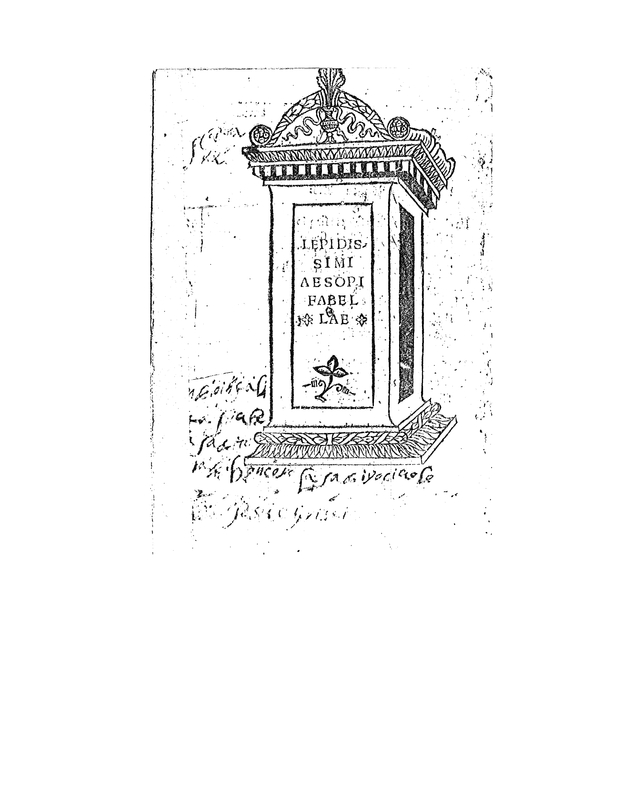
A monument with decorative encravings at the top and the bottom. There is also an engraving in the middle of the momument that reads Lepidis-simi Aesopi Fabel Lae. There is illegible writing in the bottom left of the image.
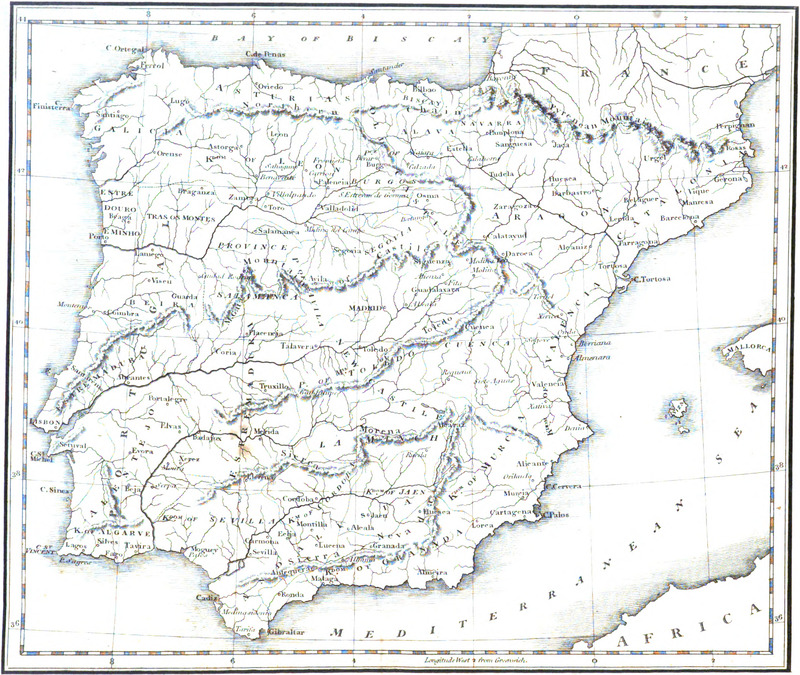
A physical map of the Iberian Peninsula, showing mountain ranges, rivers, and cities, and naming the kingdoms as they would have existed at the time of the Cid.
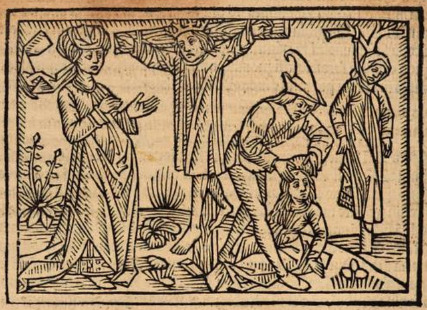
This engraving depicts Olympias of Macedonia on the left side of the engraving approaching a man hanging on a cross. The man being crucified is Pausanias, a man who helped Olympias with the murder of King Philip of Macedon (husband to Olympias). Boccaccio explains that Olympias placed the golden crown that Pausanias is wearing on his head to honour him and reward him for the assassination. Along with getting her husband murdered, she also had her husband’s new wife and child murdered out of anger. Cleopatra, King Philips other wife, is pictured on the right side of the engraving hanging by her neck on a tree. Cleopatra’s child is depicted sitting on the ground as one of Olympias’ servants is bashing her head with a rock.
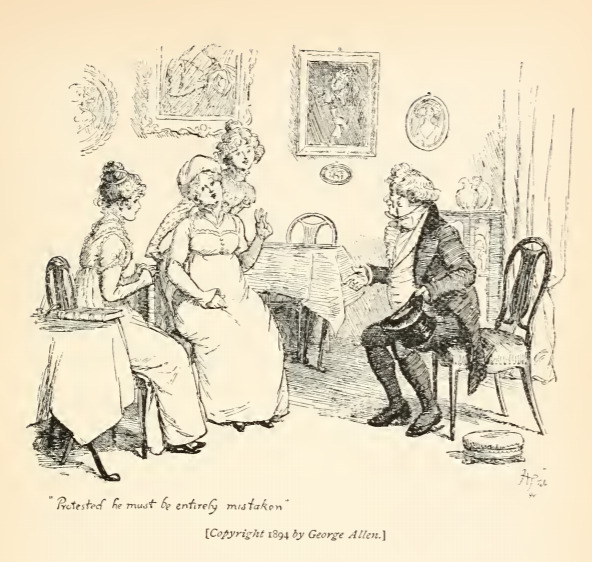
In this image Sir William Lucas sits at Longbourn, announcing the engagement between his daughter, Charlotte, and Mr. Collins. Mrs. Bennet and Lydia both rudely exclaim that they cannot believe it and that he must be mistaken. By Charlotte’s marrying Mr. Collins it meant that she would become the mistress of Longbourn after Mr. Bennet’s death, because at this time inheritance passed from one man to his closest male relative, who was Mr. Collins. This scene occurs in chapter 23. The characters are shown in the traditional regency style. Mrs. Bennet and her daughters wear regency style dresses with empire waistlines. Sir William Lucas wears a waistcoat and tailcoat. The regency period dated to the early nineteenth century (1811-1820) when George, Prince of Wales, later George IV (r. 1820-1830), reigned as regent for his mentally ill father, King George III (r. 1760-1820). The regency period is associated with the rise of neoclassicism in art and fashion.
Here we see Gulliver stuck in the hollowed-out marrow of a bone. The Queen of Brobdingnag’s dwarf stuck Gulliver into the bone because he was jealous that Gulliver replaced him as the Queen’s favourite. In the image we see Gulliver stuck in the bone with only his head sticking out of the bone. The bone sits on a platter with other leaves and food. The dwarf’s face is visible in the background. The same image appears in both the 1839 and 1843 Krabbe editions.
A group of Indigenous Tupinambá people is shown preparing to execute a captive man. The captive man is restrained by a rope tied around his waist, with two men holding either end of the rope, and his hand is raised in a gesture of protest against his impending death. Another man swings a club above the head of the captive. To the left a man lays on the ground with a woman kneeling next to him. To the right, a man stands holding a bow with one hand and gesturing with the other. A crowd of Indigenous people holding bows stands in the background.
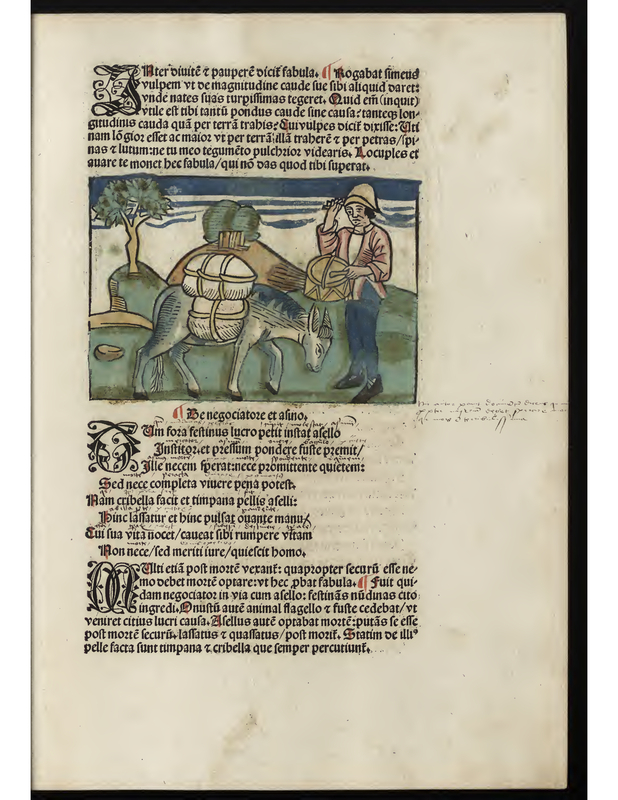
On the left stands the donkey with their head down, strapped to them are a few bundles tied with rope. To the right of the donkey stands the merchant holding a basket and looking down at the donkey. In the background there is a few trees, and a cliff.
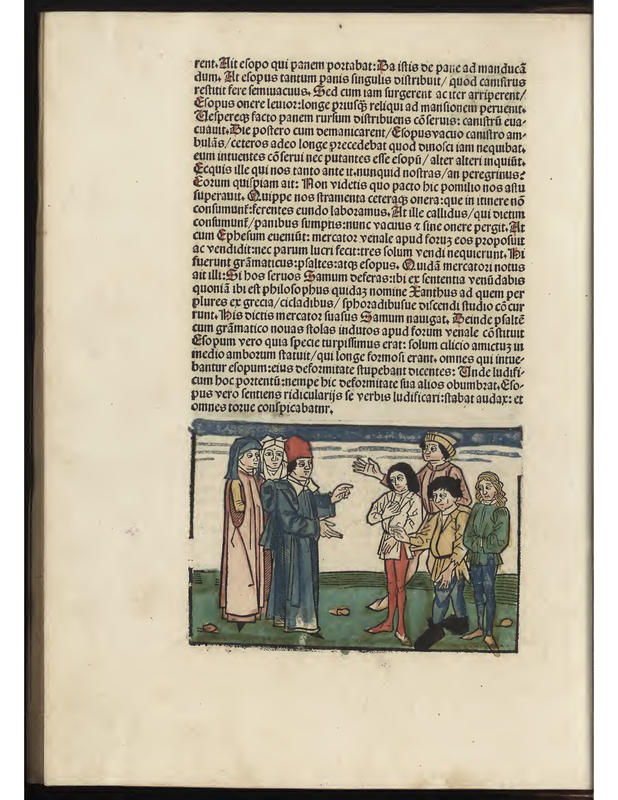
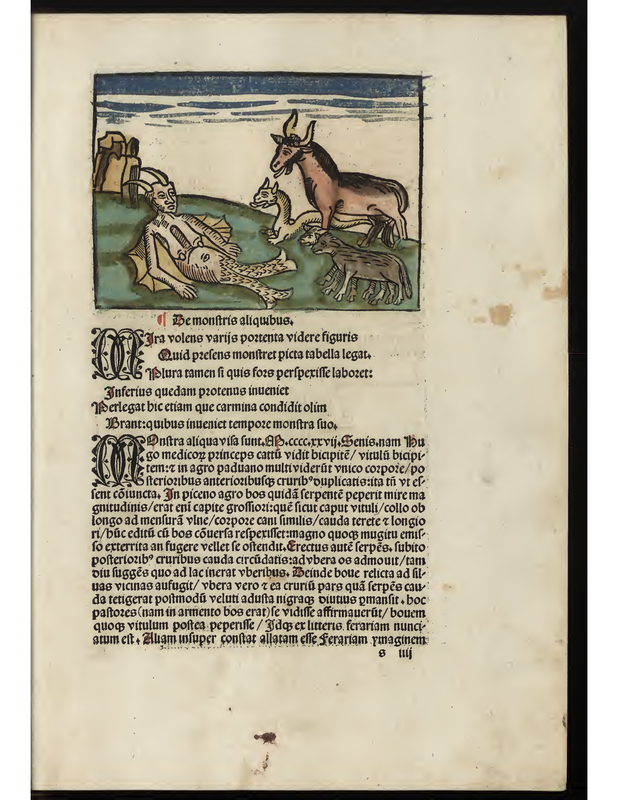
A man who was born extremely deformed talks to other deformed animals. The man has horns on his head, webbed arms that resemble wings and his legs look like fish tails. The creatures he talks to is a goat with one eye, a sheep the has a conjoined twin and what appears to be a snake with two legs and horns that resembles a dragon.
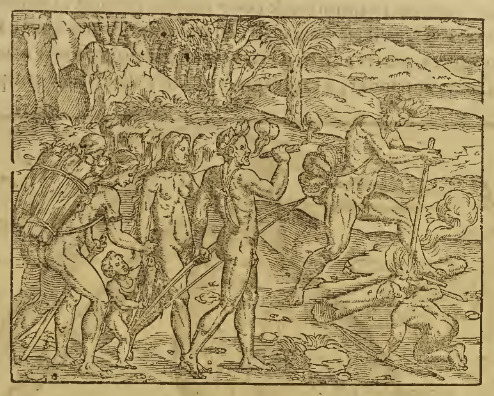
An Indigenous man wearing a feathered headdress and ornament at his back starts a fire by twirling a long stick against a log on the ground. Another man, also wearing a feathered headdress and carrying a bow, watches and smokes a cigar (or similar item). Several women and children are also amongst the group, including a small child carried in a basket on a woman’s back and another child who carries a miniature bow and kneels on the ground to watch the fire starting. This image is identical to one found on page 938 of Paris, 1575 (Chaudière), and in Thevet’s Les Singularitez de la France Antarctique (Paris 1557, Paris 1558).
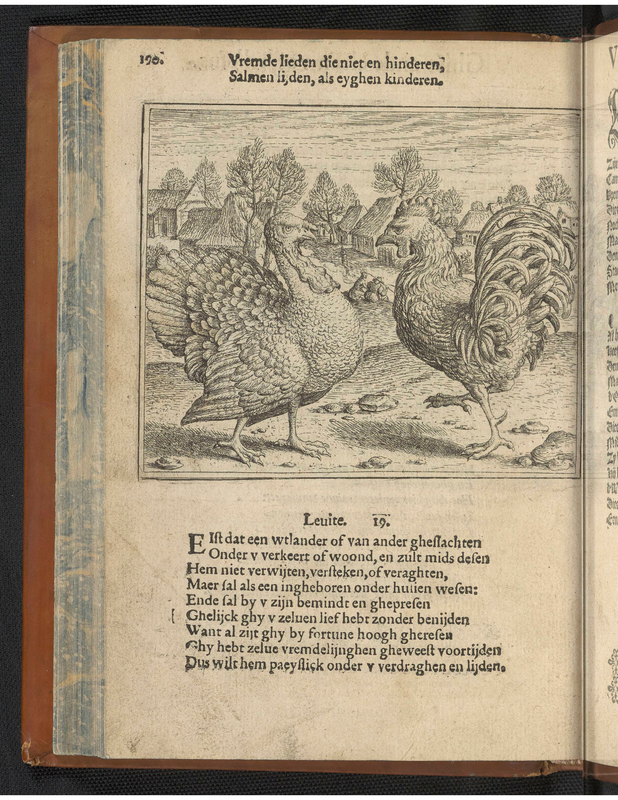
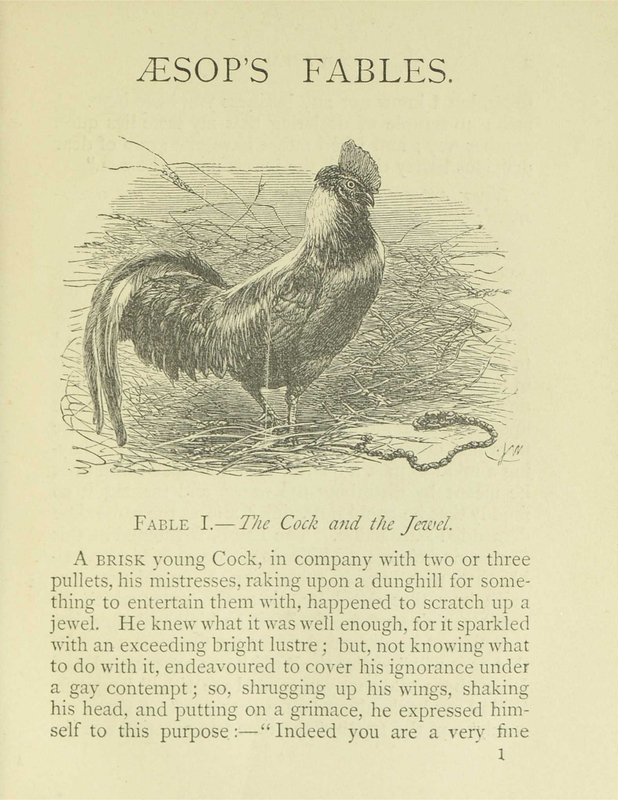
A brisk young Cock, in company with two or three pullets, his mistress. raking upon a dunghill for something to entertain them with happened to scratch up a jewel.
As midnight approaches, Calisto (central figure), Sempronio (leftmost figure), and Pármeno (left-central figure) leave for Melibea’s house. Calisto asks Pármeno to knock on her door, but Pármeno replies that it would be best if his was the first voice she heard. When Calisto knocks, he is first greeted by Lucrecia (rightmost figure?), who confirms his identity. Calisto and Melibea (right-central figure; only her shoulder and headpiece are showing) talk for some time through the door, but soon Pármeno and Sempronio hear a commotion in the distance and flee. They realize the noise is coming from the alguacil’s (justice’s) men patrolling another street, and they head back toward Melibea’s house. However, the alguacil’s men soon enter upon the street where Melibea’s house lies, causing Calisto and his servants to flee to Calisto’s house. While Calisto takes his rest, Sempronio and Pármeno decide to pay Celestina a visit.
Gulliver waved his arms at the floating island of Laputa and got the attention of a few Laputans and soon a crowd assembled to see Gulliver. They lowered a chair down then raised Gulliver up to the island on the chair using a pulley system, as is seen here. Gulliver is raised up over the rocks and arrives on Laputa. The same image appears in the 1843 Krabbe edition.
Every four years a representative council of the Houyhnhnms meets in a large plain about twenty miles from the house where Gulliver was staying. They discuss the conditions of the different districts of the country. This includes anything that a district is lacking, including hay or oats, as well as the regulation of children. The same image appears in the 1839 Krabbe edition.
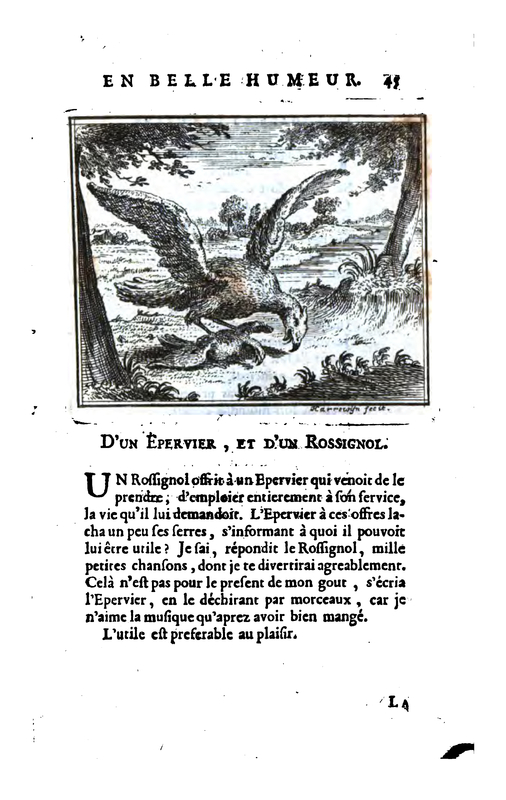
A Nightingale offered to a Sparrow hawk, who had just taken him, to employ him entirely at his service, the life which he asked of him. The Sparrow hawk at these offers let go a little of his talons, inquiring how he could be useful to him? I am making, replied the Nightingale, a thousand little songs, which I will entertain you with. This is not for the present to my taste, cried the Sparrow hawk, tearing him to pieces, for I love music only after I have eaten well.
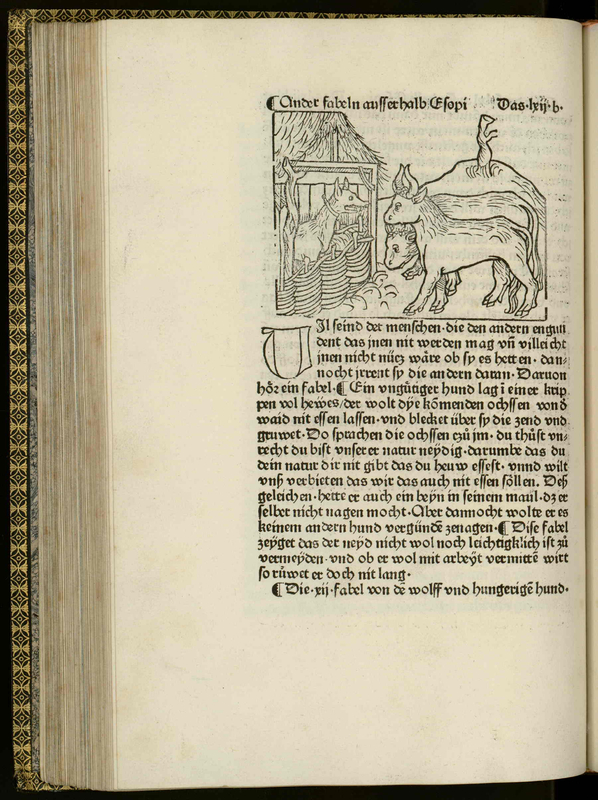
On the left side of the image there is a wolf tied up in a small barn. On the right side, two bulls are facing the wolf. Behind them there is a hill with a tree trunk on top.
In this image we see a crowd of Lilliputian. This image appears in the appendix to Gulliver’s travels in Lilliput. In the appendix, Gulliver discusses various aspects of life on Lilliput, including education, employment, approaches to science and philosophy, language, and interactions between people in the community. The same image appears in the 1843 Krabbe edition.
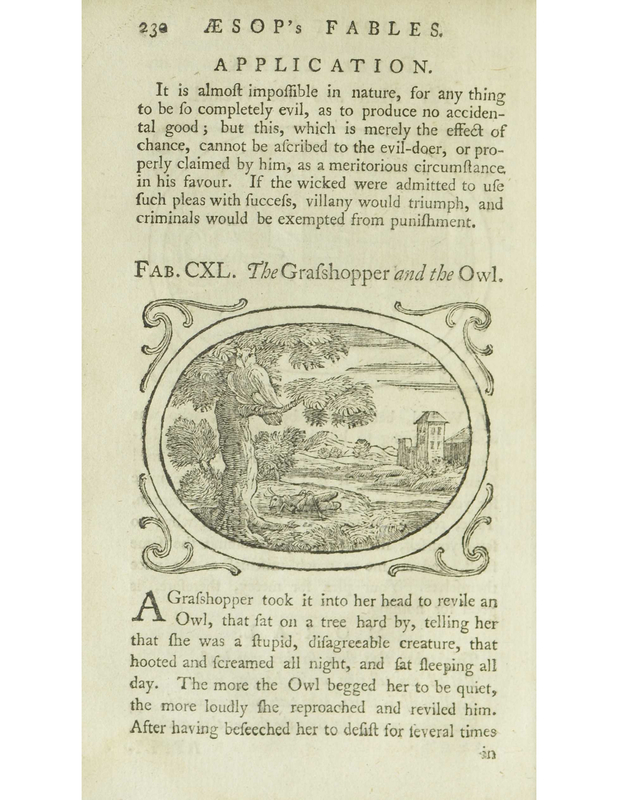
The scene is taken place outside, there are mountains in the distance with trees along with a building. There also seems to be some sort of river or stream. There is a large tree up close which the Owl is sitting on one of the branches, and the Grasshopper is sitting below on the ground with other plants around. The Grasshopper is reviling the Owland the Owl is begging her to be quiet.

![[the Queen of Brobdingnag’s dwarf torments Gulliver]](https://collections.cemvc.ca/files/large/845620364fe107433ecb5d5cf0db7d134911aab0.jpg)

![[The Queen’s dwarf teases Gulliver by sticking him in a bone]](https://collections.cemvc.ca/files/large/5c960dc425cfa3fa540c247bd027464f80e20d5b.jpg)
![[A group of Tupinambá people take a man captive]](https://collections.cemvc.ca/files/large/e6c0bac8bdeb9fb32bbcd833e6e86c9d5b07de14.jpg)
![[Act XII (First Illustration) – Calisto Talking to Melibea and Lucrecia Through Melibea’s Door While Sempronio and Pármeno Stand Guard]](https://collections.cemvc.ca/files/large/d4582bd1b65c97980c0726f8d473ffba5041f865.jpg)
![[Gulliver is raised up to the floating island of Laputa on a chair]](https://collections.cemvc.ca/files/large/7724701e00deb7a566542b3f50c043c22c9ef9a6.jpg)
![[general meeting of the Houyhnhnms]](https://collections.cemvc.ca/files/large/ea108c12023809c67a7111c747db8d2020762d52.jpg)
![[a crowd of Lilliputians]](https://collections.cemvc.ca/files/large/51cdfb8b5066cf17c123d4839cb2e778182b27e3.jpg)
![[Becky and Amelia on the Stairs]](https://collections.cemvc.ca/files/large/6fdbdd953daaf5404e556d95042f049b8535a207.jpg)