Two Tupinambá people – a man and a woman – and a European man are shown. The woman has long hair twisted into two braids and is nude. She crouches on the ground with her hands over her face, seemingly in emotional distress. The European man sits in a hammock, also holding a hand over his face in a display of emotion. There is a bucket on the ground under the hammock. Behind the two, the Tupinambá man balances a bow and arrow in one hand and holds a knife against the end of the arrow in his other hand.
During his time on Balnibarbi Gulliver visited the Grand Academy of Lagado and the scholars who worked there. Here we see some of the chemicals and other materials used by scientists at the Academy. There is the letter I in the top corner as this image appears at the beginning of chapter six, and the first word of the chapter is In.
This scene shows a celebratory procession. Gulliver stands in the centre surrounded by several of the Lilliputians, who are one-twelfth of his size. In the bottom left corner there is a carriage, presumably that of the Lilliputian king, surrounded by several others. In the bottom right corner is a tent, again with Lilliputians surrounding it. On the left side in the middle is a raised, covered stage, with Lilliputians both on the stage and underneath it. Behind Gulliver is a royal building. A cavalier army rides on horseback under Gulliver’s legs, as a military procession. The same image appears in the 1761 German edition, however the 1761 German edition is coloured.
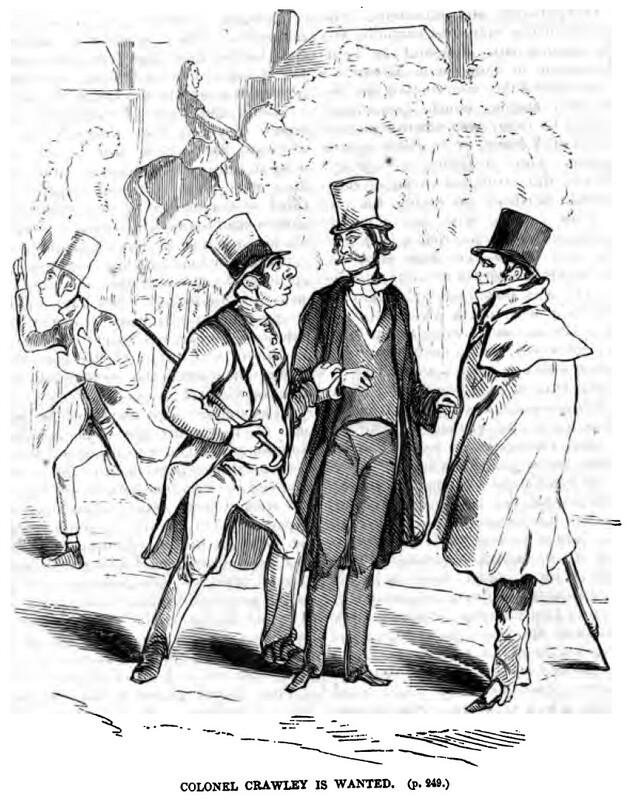
Rawdon Crawley stands with Mr. Moss and his assistant each holding one of his arms. They have come to collect his debt to Mr. Nathan. Behind them, Mr. Wenham, who has no money to lend him, is leaving with his hand raised and his cane tucked under his arm. In the background, amongst the trees is a statue of a horse and rider. Below the illustration is printed its title and location in the story, COLONEL CRAWLEY IS WANTED. (p. 249.).
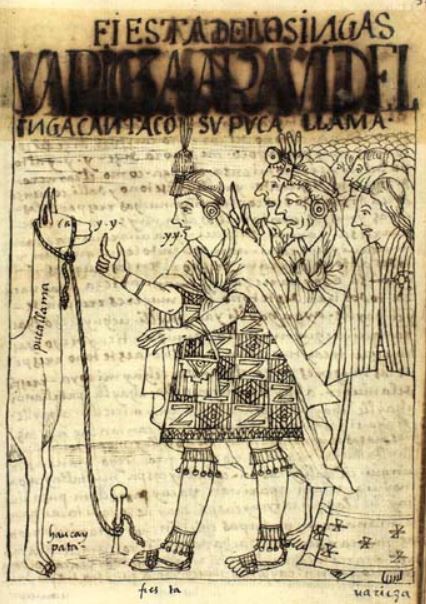
This chapter is dedicated to discussing the various celebrations and festivals that would be held in the Inca Empire. This image depicts a festival in which the Inca king would dance and sing for a reddish-brown llama. The llama is depicted on the left side of the image with a rope that’s wrapped around its head tied to a peg in the ground. The words puca llama [reddish-brown llama] are written on the neck of the llama. The letters y-y are written in front of the Inca’s mouth, which are the sounds he would sing to the llama. There is a crowd of people standing behind the Inca who are also participating in the festivities. The caption haucay pata [main square, Cusco] is written at the bottom of the image to identify the location.
Four birds, possibly roosters, are on top of a tree between its leaves. Three dogs watch them from the ground. The smallest of the dogs looks up at the tree with anger.
The left side of the image depicts a crucifix, and the right side of the image depicts the Castilian coat of arms. The letters INRI are written above the crucifix which stands for Iesus Nazarenus, Rex Iudaeorum which in English translates to Jesus the Nazarene, King of the Jews. The author included this image to represent the influence Christianity had in Peru and how he wanted Peru to be considered as an equal partner with Spain. The caption at the bottom of the image reads, en el mundo [in the world].
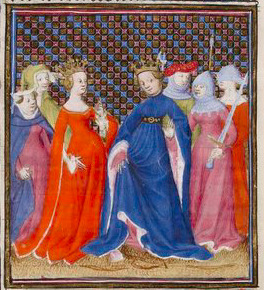
Queens Maresia and Lampedo are in the center of the image wearing a red gown and blue gown, and crowns. They were the elected queens that ruled the Amazons together, after the men were killed, with great success. Other Amazon women stand around the two queens, admiring them.
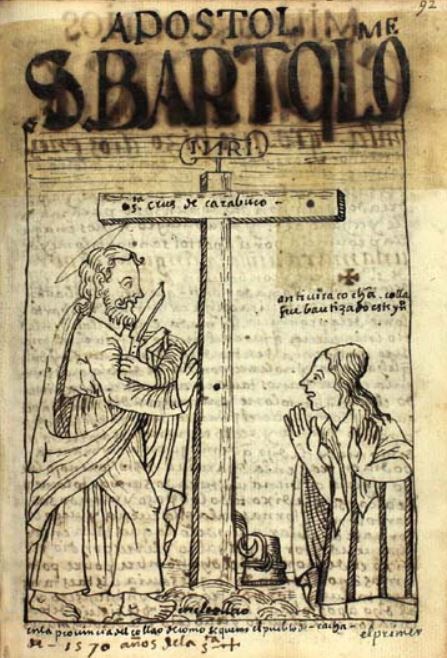
This illustration depicts the apostle Saint Bartholomew performing a conversion and baptism to an indigenous Peruvian named Anti, whose baptismal name became Anti Waricocha. Saint Bartholomew also places the holy cross of Carabuco in the province of Callao. The words santa crus de carabuco are written at the top of the cross to identify it. Anti Waricocha is depicted kneeling on the right side of the engraving looking up to Saint Bartholomew. The words anti uira cocha colla fue bautizado este yndio are written above Anti’s head, which translates to Anti Waricocha from Callo, this Indian was baptized. A note at the very bottom of the image reads de 1570 años de la santa cruz which tells us that this event happened 1,570 years ago at the time of publication.
Here we see the eagle carrying away Gulliver’s house from Brobdingnag. In the image we see the eagle’s head with a rope attached to Gulliver’s head in his beak. Gulliver leans out the window, looking up at the eagle. We see the straps attached to Gulliver’s house which were worn like a backpack when he was travelling. This is the smaller of his two houses, as this was designed for travel. The same image appears in the 1843 Krabbe edition.
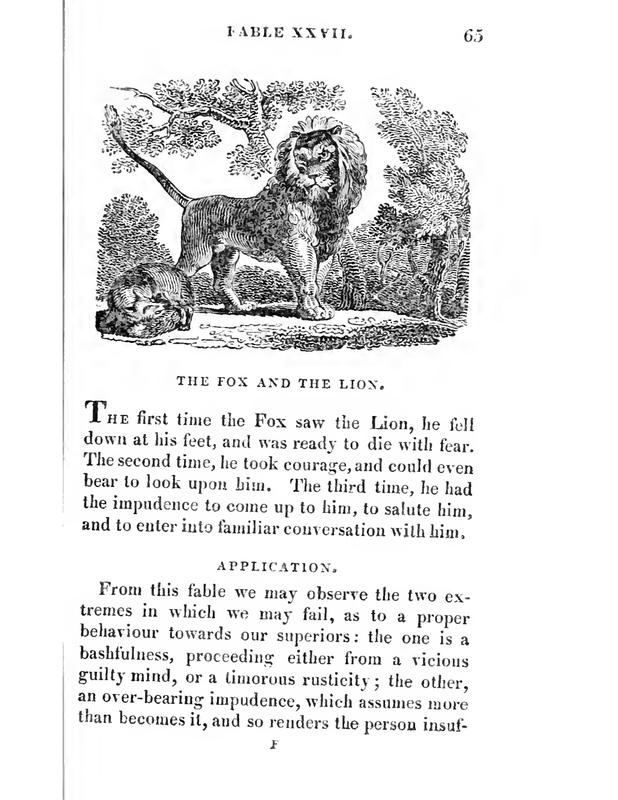
A fox is curled up in the bottom left corner. Behind it in the centre is a male lion looking out to the viewer with a straightened tail sticking up. There are multiple trees in the background.
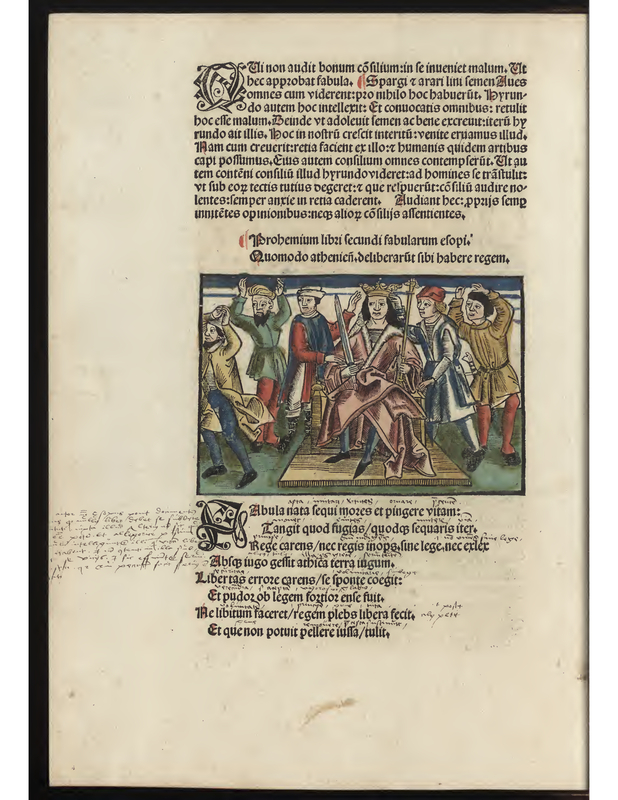
A king sits on a throne surrounded by five of his subjects, all of whom are staring into the distance to the left. The king is holding a sword in his right hand and a staff in his left. two of the subjects are reaching for the king's crown, while the other three have their hands in the air.
Sir Pitt Crawley leans against a fireplace at his brother Rawdon Crawley’s house. He is dressed in his Court suit and has a thin sword at his side. Mrs. Rebecca Crawley is seated on a chair next to him, and is turned in his direction to admire his uniform.
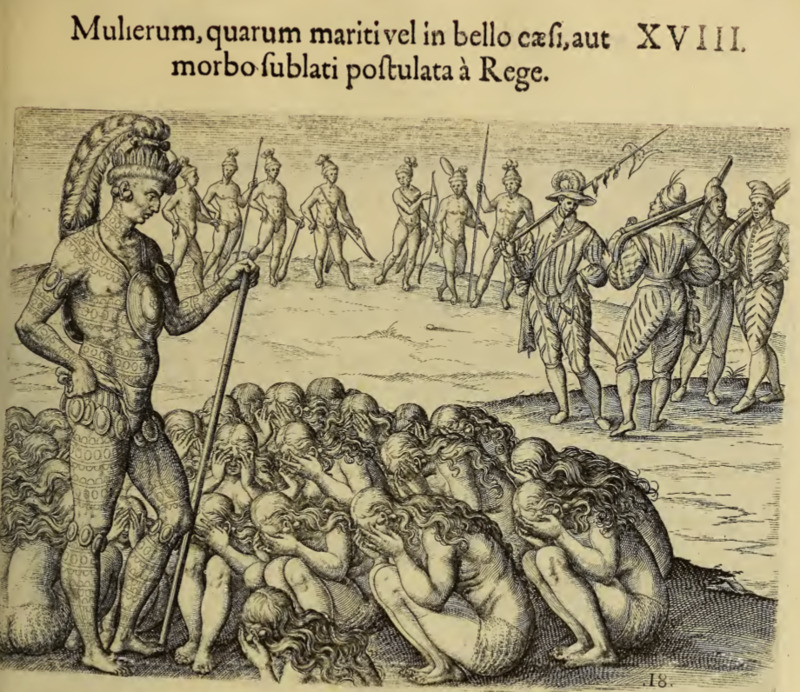
A group of Indigenous women crouch close to the ground with their hands covering their faces, in front of the chief. The chief wears a headdress with a large feather and animal tail hanging from the back, a round plate against his chest, a loincloth with small ovals hanging from it, and jewelry featuring the same small ovals around his upper arms and below his knees. His body is covered in designs, and he gazes down at the woman. In the background, a group of settlers stand together holding rifles. To the left of the group, a group of Indigenous men stand holding bows and arrows and clubs.
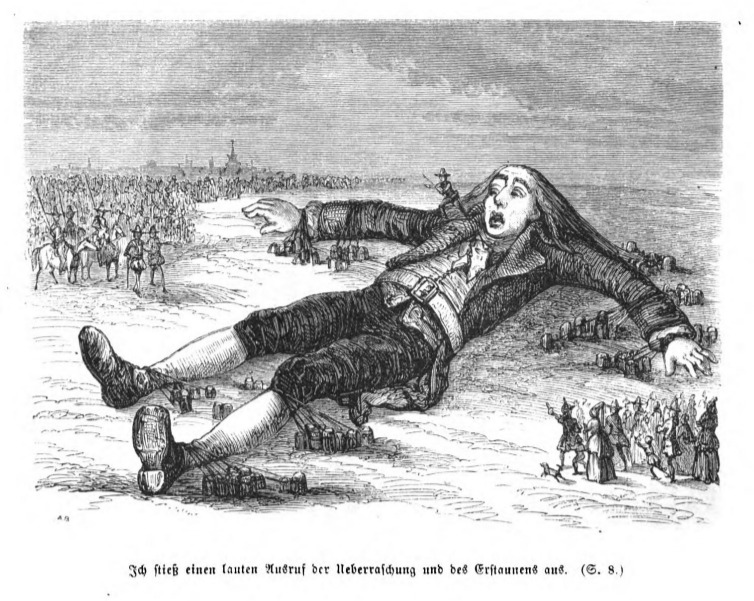
After his arrival on Lilliput, Gulliver was unconscious. The Lilliputians discovered him and tied him up. In this image Gulliver had just woken up, and is startled, as the Lilliputians who were one twelfth of Gulliver’s size surround him. Some Lilliputians walk on top of Gulliver while others look on. The same image appears in both the 1839 and 1843 Krabbe editions.
Three people belonging to the Tupinambá Indigenous group are shown; a man, woman and child (possibly a family unit). The man stands in front holding a bow in his right hand and arrows in his left. He wears a necklace and an adornment on his chin and is otherwise nude. The woman stands behind him with one hand on his shoulder and a baby in her other arm. Her hair is long, and she is nude. There is a hammock behind the group.
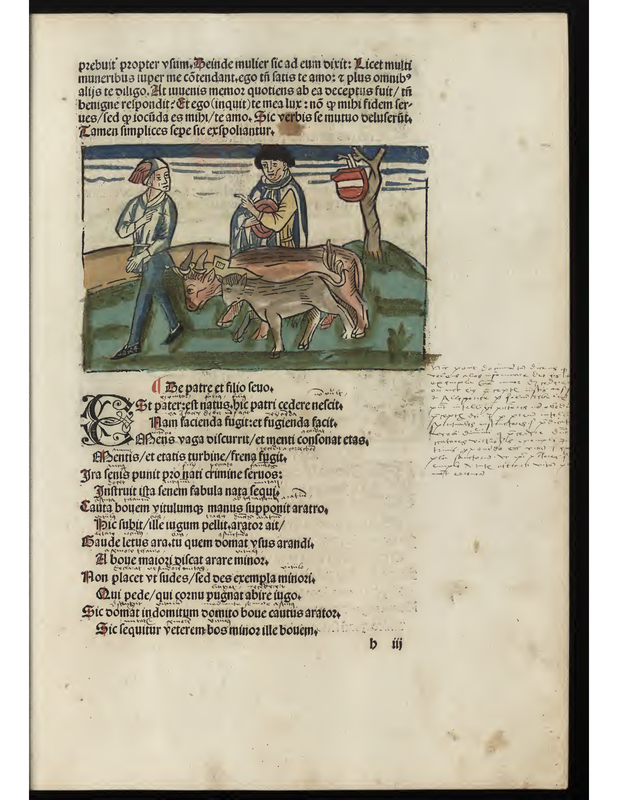
A father walking behind his son. The son is on the left of the image, looking back at his father. The father is pointing his finger at the son. There are two animals walking beside them carting a heavy object. There is a tree in the background with a red and white bag on one of the branches.
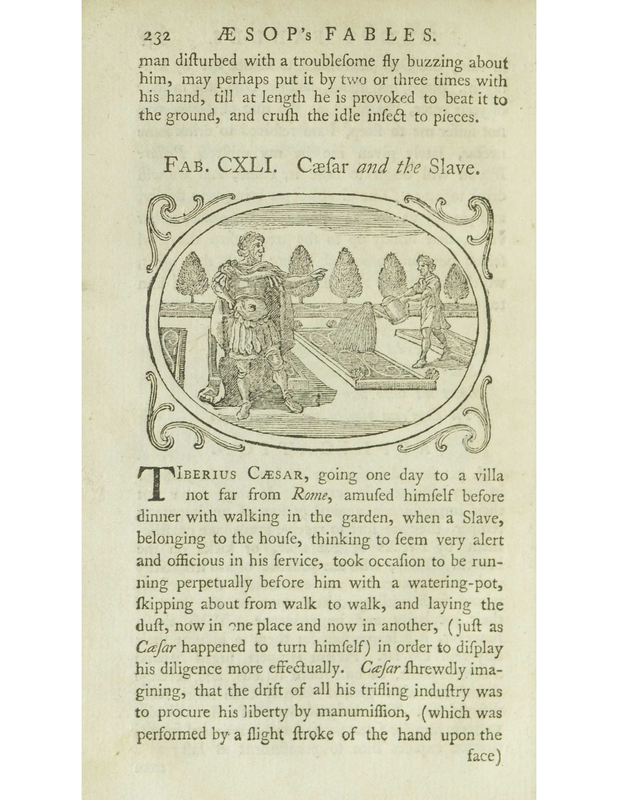
The scene is taken place outside in garden, there are five tall trees behind a fence. There are four different squares of the garden with resources in them seen in the engraving. Tribius Caesar is seen amusing him by taking a walk through the the garden talking to the slave pointing towards him as he pours water from his water-pot into the garden.
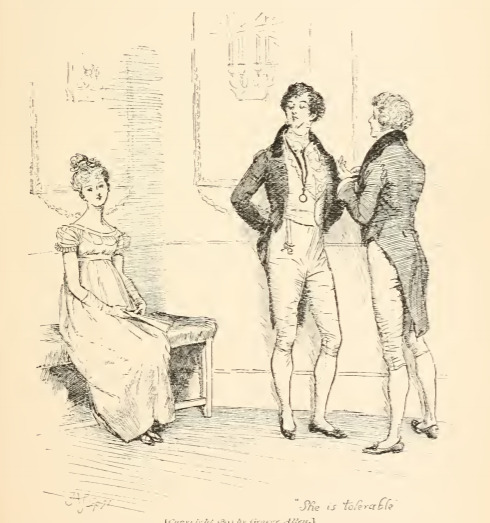
In this image Mr. Darcy looks at Lizzy. Mr. Bingley was dancing with Jane, and asked if Mr. Darcy wanted Jane to introduce him to Lizzy. Mr. Darcy replied that she was tolerable but not handsome enough to tempt him to ask her to dance. This scene occurs in chapter 3. The characters are shown in the traditional regency style. Mr. Bingley and Mr. Darcy wear waistcoats and tailcoats with cravats. Lizzy wears a regency style dress with an empire waistline. She has gloves that reach her elbows and carries a fan. Fans were used at this time to communicate to others across the room at balls. The regency period dated to the early nineteenth century (1811-1820) when George, Prince of Wales, later George IV (r. 1820-1830), reigned as regent for his mentally ill father, King George III (r. 1760-1820). The regency period is associated with the rise of neoclassicism in art and fashion.
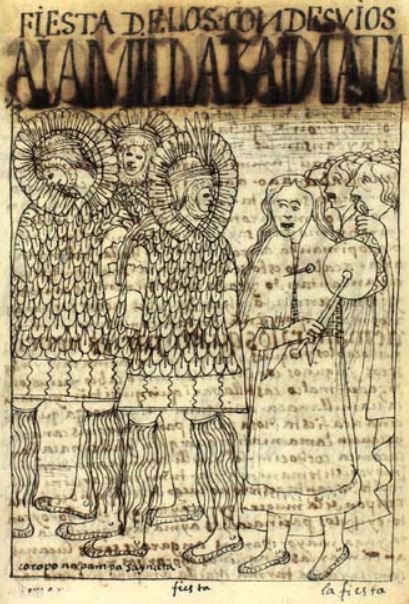
This chapter is dedicated to discussing the various celebrations and festivals that would be held in the Inca Empire. This image depicts the celebrations held in the Condesuyo region in the Inca Empire. There is a crowd of people on the right side of the image singing a song with the woman at the forefront holding and playing a drum. The three figures on the left side of the image are depicted wearing feathered clothing and a feathered head piece for the celebrations. They are also depicted wearing aya milla saynata [masks that resemble the dead]. There is a caption at the bottom of the image which identifies the location. Coropona was a peak between Arequipa and Ayacucho, which are both now modern cities in Peru.
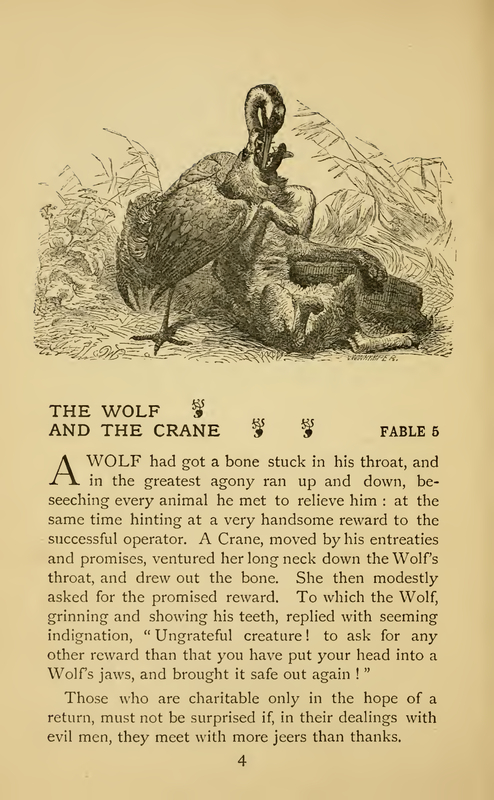
A crane is sticking her beak down the throat of a wolf. They are in the grass surrounded by high weeds. The crane seems to be helping the wolf, as the wolf is not attacking nor is the crane struggling.
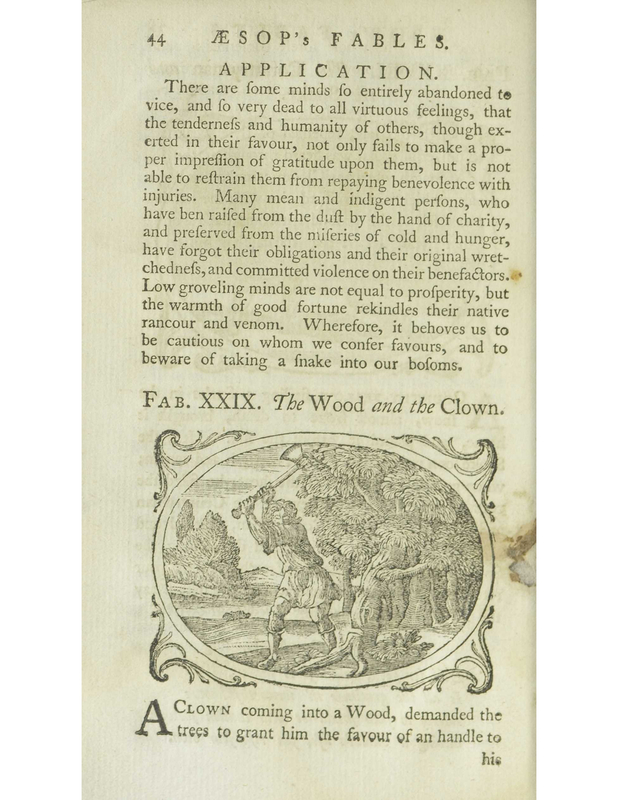
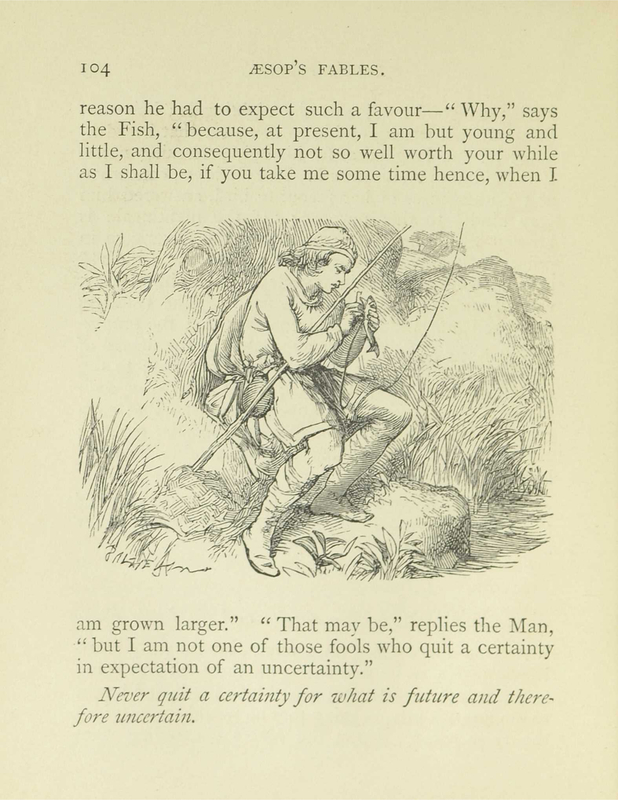
A man stands in the centre of the page with an axe in hand, ready to swing. There is a large tree with a significant amount of its trunk cut out by the axe. There is a wooded area on the right side of the image. In the background, there are more trees and rolling hills.

![[A European man and a Tupinambá woman weep into their hands while a Tupinambá man stands behind them]](https://collections.cemvc.ca/files/large/48599182e855e308870b0e82ada7d7ca797f2b06.jpg)
![[Various potions used in the Grand Academy of Lagado]](https://collections.cemvc.ca/files/large/2892c47618f00569f0551b15f889e741f57ddfb9.jpg)
![[Gulliver and the Lilliputians]](https://collections.cemvc.ca/files/large/ac2a658db1c235ba11d34e217741e322942cb357.jpg)
![[Birds on tree]](https://collections.cemvc.ca/files/large/cf14297551c9e7b47232906e9eb721506bdb685a.jpg)
![La S[an]ta Fe Catolica y las Armas Rreales y su Corona Rreal Hinchi Todo el Mundo y Este Rreyno Sobre Todo lo Sea](https://collections.cemvc.ca/files/large/c73109492559c0ee65ca57bdfa5271e05f2963f1.jpg)
![[Eagle carries Gulliver’s house away from Brobdingnag]](https://collections.cemvc.ca/files/large/27a8112176da3090f24016812e297ad18b34d6f5.jpg)
![[Sir Pitt’s Diplomatic Suit]](https://collections.cemvc.ca/files/large/c3af6542a5cd7ba747cd10484f59f8bdbb8492a6.jpg)
![[A Tupinambá man, woman and child]](https://collections.cemvc.ca/files/large/1608aef6d72789ed717cdefb7a845a70eee858d9.jpg)