Here we see a Lilliputian teacher holding a book, giving a lecture. The image appears in an appendix to Gulliver’s travels to Lilliput, which follows the conclusion of Gulliver’s trip to Brobdingnag. Gulliver’s description of the Lilliputian education is very negative, saying that what is taught is simply superfluous, and not anything of substance, as his bias makes him think that the European model for education is the correct model. The same image appears in the 1843 Krabbe edition.
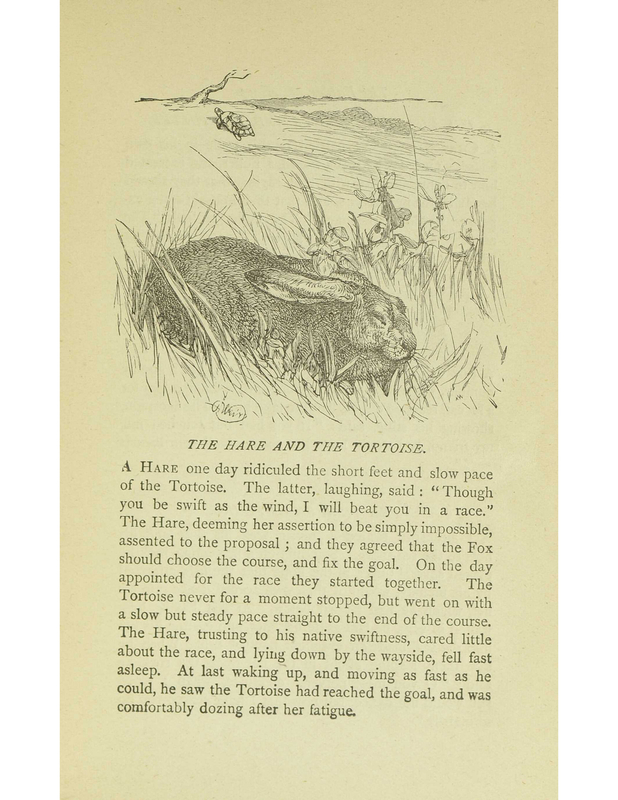
A large hare is hiding in tall grass. Its long ears are bent backwards, and its eyes are closed as though it is sleeping. Small flowers grow tall on the right hand-side of the image next to the hare. In the background, a shore is seen on the right side. To the left, a tortoise is walking away from the hare, towards a tree.
Colonel Rawdon Crawley visits his son, the younger Rawdon Crawley at the Whitefriars, where he is attending school. Rawdy is standing tall and proud in his black gown and breeches. In the background are assorted other boys, talking and playing games.
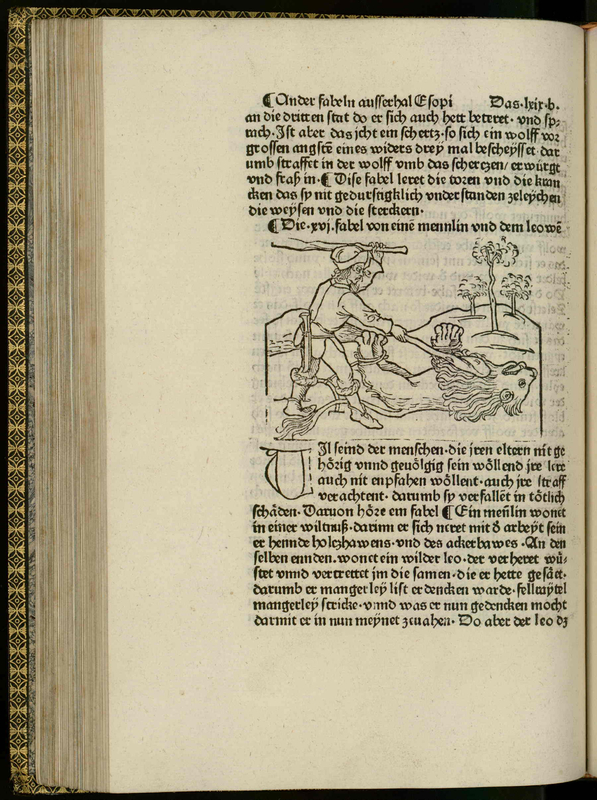
A human is beating a lion. The lion is laying upside down and it’s paws are tied. The human is beating him with sticks of woods. Behind them there are hills with trees.
After spending the night with Areusa, Pármeno (rightmost figure) wakes to find that it is already noon. Areusa asks him to stay and talk, but he explains that his master Calisto will already be upset with his lateness. He proposes that they have dinner with Celestina, Elicia, and Sempronio that night, and she happily agrees. When he returns to Calisto’s house, he is met by Sempronio (leftmost figure), who chides him for his lateness. Pármeno explains his new love for Areusa, and Sempronio immediately infers that Pármeno is now working to scam Calisto with him and Celestina. They decide to check on Calisto (central figure) in his bedroom, and they find him in a state of despondency, talking to himself in verse. When he regains a semblance of sanity, he tells them that he is going to Saint Mary Magdalene’s Church to pray for a remedy to his situation.
Here we see a Laputan scholar about to run into a post because he is so deep in thought he becomes unaware of his surroundings. His Flapper gently taps his eyes with a blown bladder filled with peas or pebbles to warn him that he will hit the post. The Laputans wear clothes with astronomical and musical motifs. On the post there are mathematical and geometric motifs. The Flapper walks behind the scholar and holds the bladder over one shoulder. In the background of this image we see another scholar with his Flapper. The Laputans’ faces were not symmetrical, with their heads tilting to one side, and one eye turning inwards and the other looking straight up. The same image appears in the 1843 Krabbe edition.
Here we see a set of cups used by the Houyhnhnms. This image appears when Gulliver explains how the Houyhnhnms use the hollow part of their pastern and hoof on their forefeet similarly to hands. Gulliver says they use this part of their bodies to do things like thread needles, milk cows, reap oats, and operate tools, including cups. These cups are made of wood and clay and are baked in the sun. The same image appears in the 1839 Krabbe edition.
Here we see the busts of the types of men that Gulliver thought to ruin his life in Europe, and whom he was glad to be free of in the Country of the Houyhnhnms. These men include: physicians, lawyers, informants, censurers, backbiters, pick-pockets, highwaymen, housebreakers, attorneys, bawds, buffoons, gamesters, politicians, tedious talkers, controverters, ravishers, murderers, virtuosos, and robbers. The same image appears in the 1843 Krabbe edition.
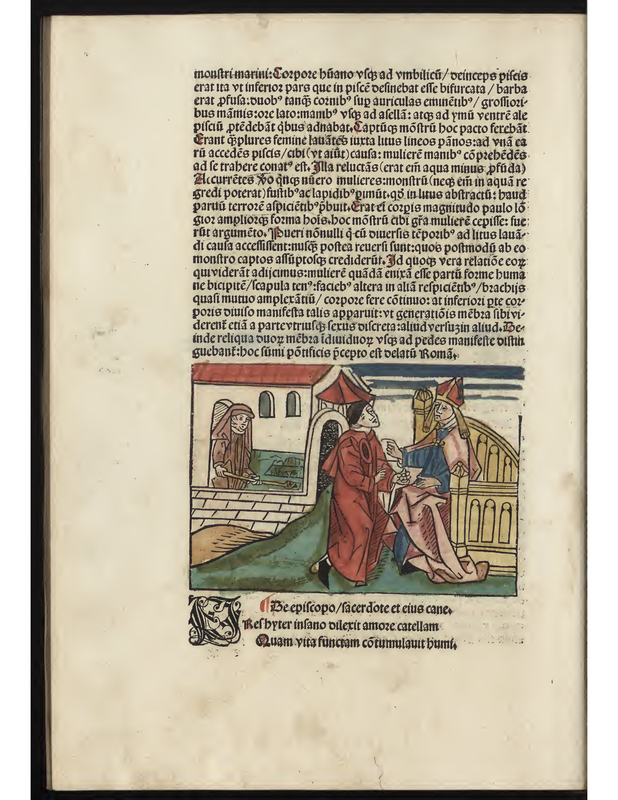
A man in robes talks to a priest who sits on an intricate chair. Behind them, a woman is shoveling in her garden behind a stone wall in front of her house.
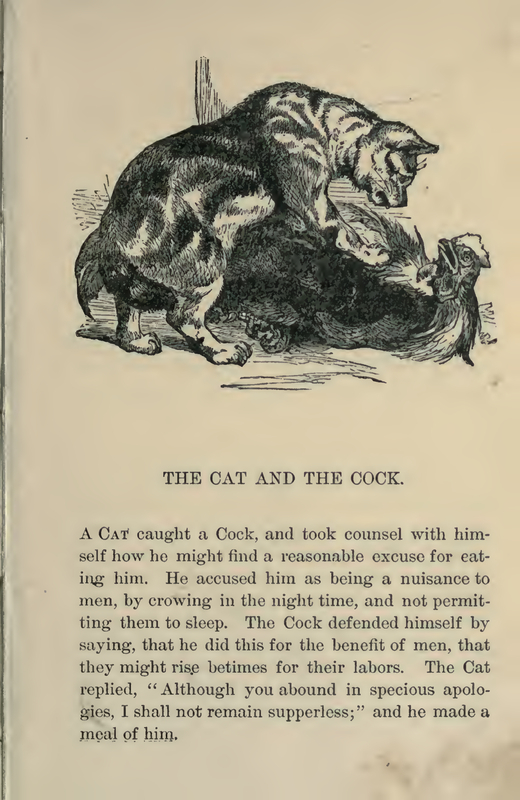
A large tabby cat with stripes in its fur is standing on top of a cock. Its two front paws holding the cock down. The cock is looking up at the cat, frightened. The cat seems to be slightly drooling, so he probably intends to eat the cock.
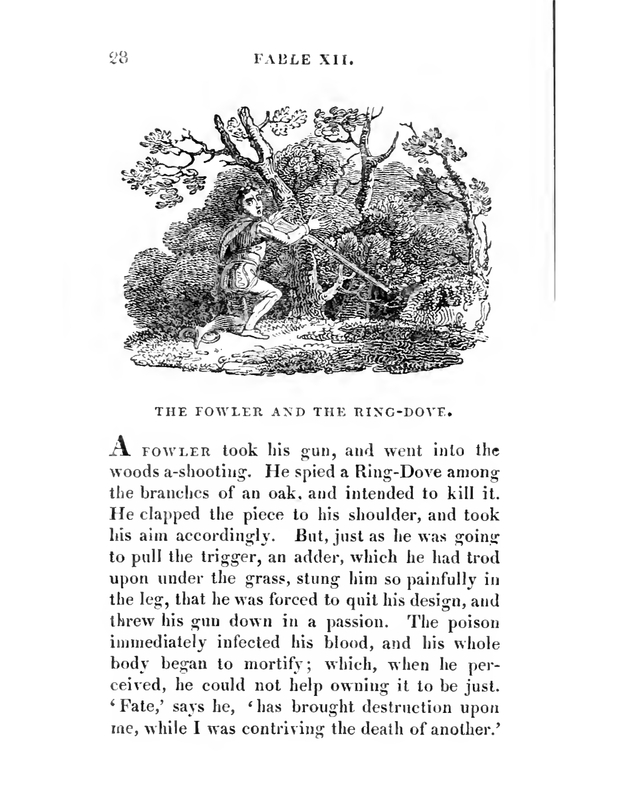
On the middle of the illustration, a fowler lunged down amongst the woods. He dropped his gun which was aimmed towards the Ring-Dove among the branches of an oak. His face was in shock by the painfully sensation on his leg which was strung by a adder.
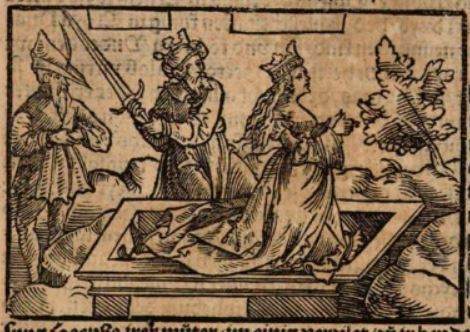
This engraving depicts Polyxena, the daughter of king Priam of Troy, getting executed on top of Achilles’ tomb. Polyxena is illustrated kneeling on the tomb of Achilles with her hands crossed while looking up to the sky as she accepts her fate. The man about to execute Polyxena is Neoptolemus, the son of Achilles. He is executing her because she had lured Achilles into the temple of Apollo, where Paris shot and killed Achilles with his arrow. Neoptolemus is the one to execute her as she is the one who is partly responsible for killing his father. There is a man on the left side of the engraving who is crossing his hands, as he and many others were moved by Polyxena’s willingness to accept her fate. Boccaccio explains that he wrote on Polyxena due to her fearlessness before her execution.
An Indigenous village is shown, full of fantastical creatures. In the center of the scene an Indigenous person speaks with two European men. A large hairy creature stands to the left of the three. In the foreground on the left an individual holding a bow emerges from a building. In the center another person lays on the ground with a horned, humanoid creature leaning over them. To the right two more individuals run from another of the horned creatures. There is a ship and a large creature in the water near the coast on the right, and further up the coast a person chases after a large winged creature. There are several structures in the background.
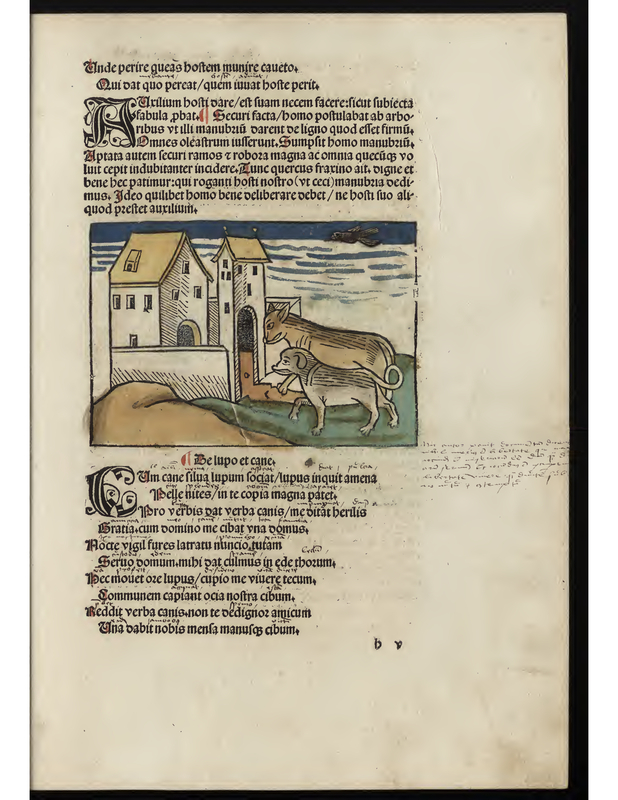
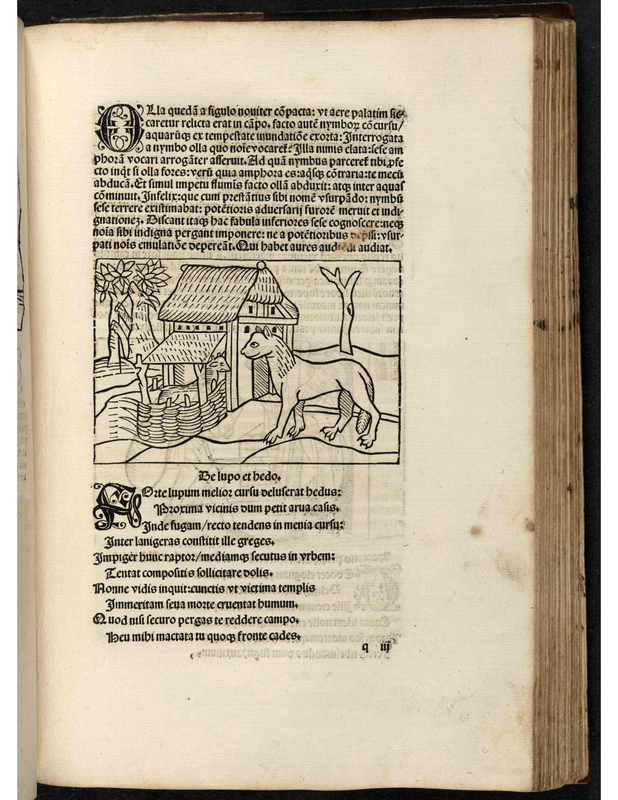
On the right of the image a wolf and a doge are walking side by side into a building. The building has many windows and large doors and a skylight. Above, a bird is flying in the sky.
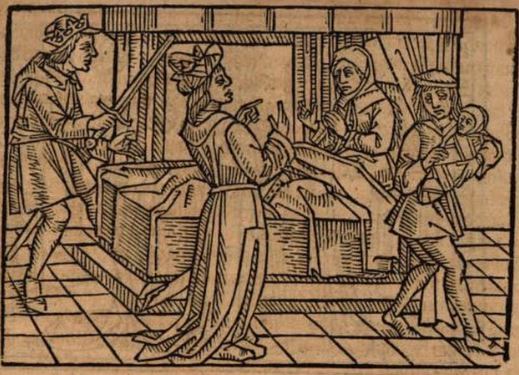
Ops, the wife of Saturn, is depicted in this image laying in a bed after just having given birth to her children, Jupiter, Neptune and Pluto. Jupiter is illustrated being carried away to safety by a servant on the right side of the engraving. Boccaccio explains that Saturn and Ops’ brother, Titan, planned to kill the new born babies to avoid them growing up and defeating them. Saturn is illustrated with his hands outstretched towards baby Jupiter. Titan is at the foot of Ops’ bed with a sword in his hand.
In this image Mr. Collins proposes to Charlotte Lucas. After Lizzy rejected his proposal, her close friend, Charlotte, became very attentive to him. The two grew closer and Mr. Collins proposed to her, and she happily accepted. This scene occurs in chapter 22. The characters are shown in the traditional regency style. Charlotte Lucas wears a regency style dress with an empire waistline and a bonnet to protect her face from the sun. Mr. Collins wears a waistcoat and tailcoat. The regency period dated to the early nineteenth century (1811-1820) when George, Prince of Wales, later George IV (r. 1820-1830), reigned as regent for his mentally ill father, King George III (r. 1760-1820). The regency period is associated with the rise of neoclassicism in art and fashion.
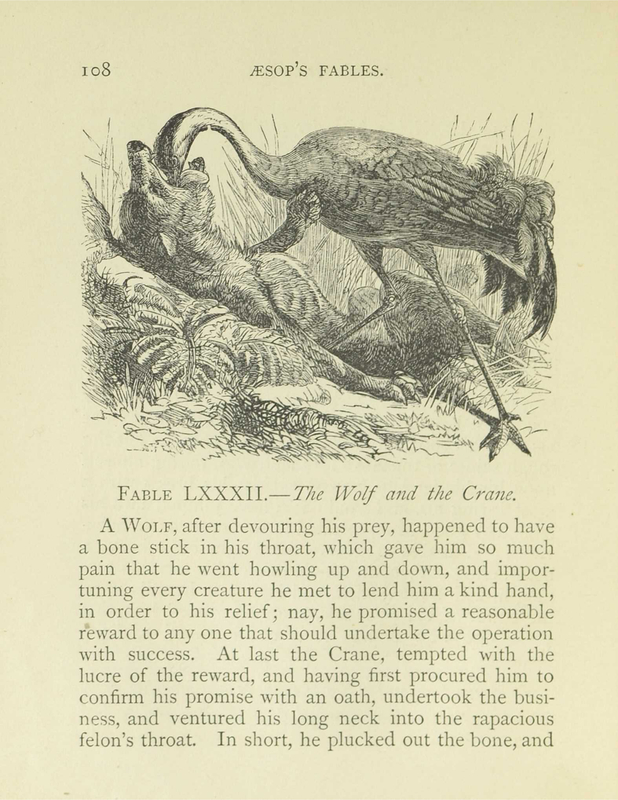
A wolf leans back against the trunk of a tree, his mouth open and tongue falling out to the side. A crane with ornate feathers sticks its head into the wolf’s mouth to retrieve a foreign object.
Two small figures appear to be performing in the middle of a street. One, in a triangular hat, is standing on stilts, to which the other, in a hat with two tails and a sword at his hip, clings. In the background are the shapes of buildings and people in the crowd. The top right of the image contains the letter W from When.
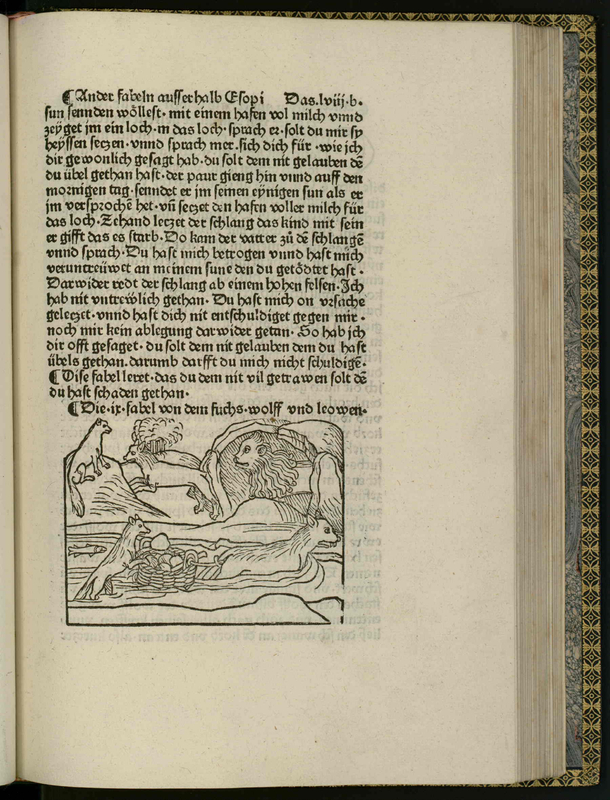
In the top half of the image, there are two wolfs between mountains and a lion at the entrance of a cave facing the wolfs. In the bottom half of the image, there is a wolf in the water pulling a basket of rocks. There is a fox behind the basket and helping the wolf by pushing it.
Gulliver was trained in medicine through an apprenticeship in London, which was the typical mode of becoming a surgeon in the eighteenth century. Gulliver used this training to become a surgeon on a ship. Here we see Gulliver studying, surrounded by various vials, skeletons, and books. The same image appears in both the 1839 and 1843 Krabbe editions.
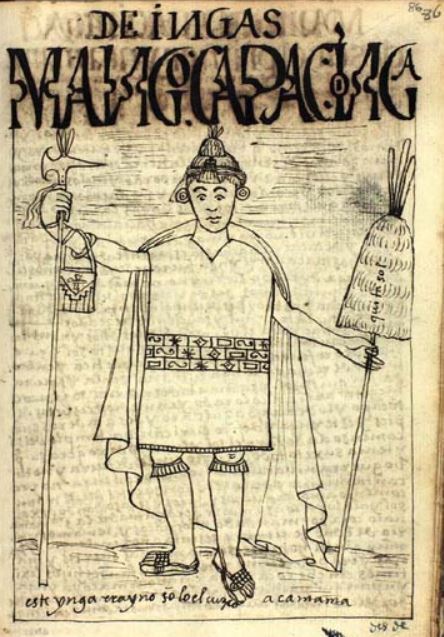
This image depicts the first father of the Incas, Manco Capac Inca. He is pictured wearing a feathered head garb and large ear plugs. He is holding a ceremonial ax in his right hand and a parasol in his left. His shirt has three stripes in the middle with distinct shapes on them. The author explains that Manco Capac Inca brought all of Cusco under his control and rule. It is believed that he lived to be 160 years old. The bottom of the image reads este ynga rayno solo el cuzco aca mama which translates to this Inca ruled over only Cusco (Acamama).
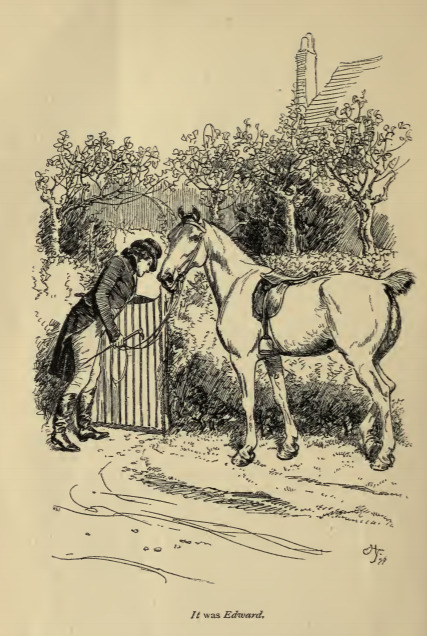
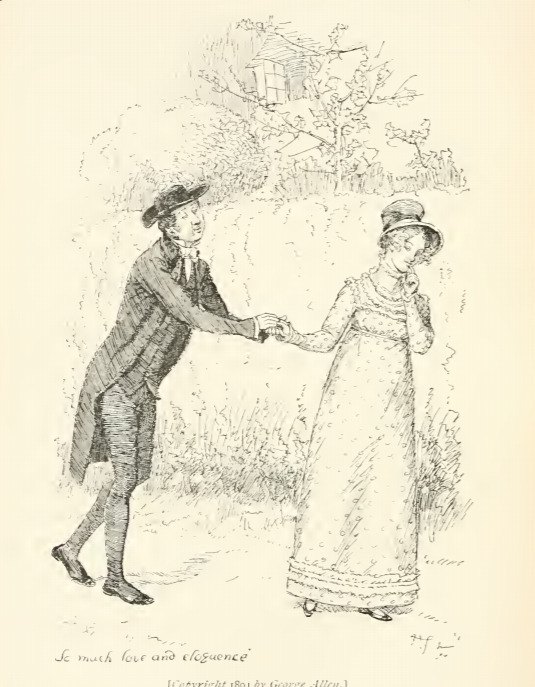
In this image Edward Ferrars arrives outside of Barton Cottage. He told Elinor that he had not married Lucy Steele and she had run away with his brother Robert. Edward came on this trip to propose to Elinor and she happily accepted. This scene occurs in chapter 48. The characters are shown in the traditional regency style. Edward Ferrars wears a waistcoat and tailcoat, with a top hat. The regency period dated to the early nineteenth century (1811-1820) when George, Prince of Wales, later George IV (r. 1820-1830), reigned as regent for his mentally ill father, King George III (r. 1760-1820). The regency period is associated with the rise of neoclassicism in art and fashion.

![[Lilliputian teacher gives a lecture]](https://collections.cemvc.ca/files/large/4032ded77755e2c43cb97ef8734792ac8e8e21da.jpg)
![[Colonel Crawley Visits his Son at School]](https://collections.cemvc.ca/files/large/7b4d2e129b10a8593ea67a811145be6a8219d41a.jpg)
![[Act VIII – Sempronio, Calisto, and Pármeno Talking Amongst Themselves]](https://collections.cemvc.ca/files/large/818fc70e5afcecc6c3011a15ccd9f531f1e1b185.jpg)
![[A Laputan scholar and his Flapper]](https://collections.cemvc.ca/files/large/603eaf5b762b948ac3361c3c3ee2083545e60fd4.jpg)
![[cups used by Houyhnhnms]](https://collections.cemvc.ca/files/large/598b4939e988fe44817edbf0c3f6d6e59322be89.jpg)
![[Men that Gulliver thought to destroy life in Europe]](https://collections.cemvc.ca/files/large/292c7a5578257fa8ebddc267d108e9fa6351f87a.jpg)
![[Fantastical scene of an Indigenous village]](https://collections.cemvc.ca/files/large/a4df722f1a75380d323180ac8a250e8c0b18ec70.jpg)
![[Vanity Fair Chapter XLIX Inhabited Initial]](https://collections.cemvc.ca/files/large/c95b7d8a5034be38d14d8db03c5849903329b8d7.jpg)
![[Gulliver studying medicine]](https://collections.cemvc.ca/files/large/2780f07b2891a1f05d99e7d6db581f65f6ad9ada.jpg)