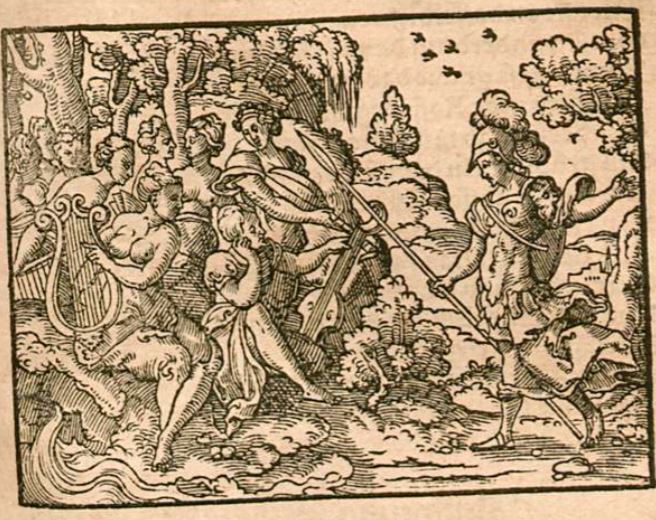
This image illustrates the virgin goddess Minerva (also known as Pallas) on the right side of the engraving with a spear in her hand and fully equipped in her armour. She stands in front of a group of virgin muses on Mount Helicon who welcome Minerva graciously as they play their instruments. The Muses recount different stories to Minerva who listens intently. One story that The Muses speak of involves nine sisters who were transformed into magpies, which are illustrated at the top of the engraving in the sky.
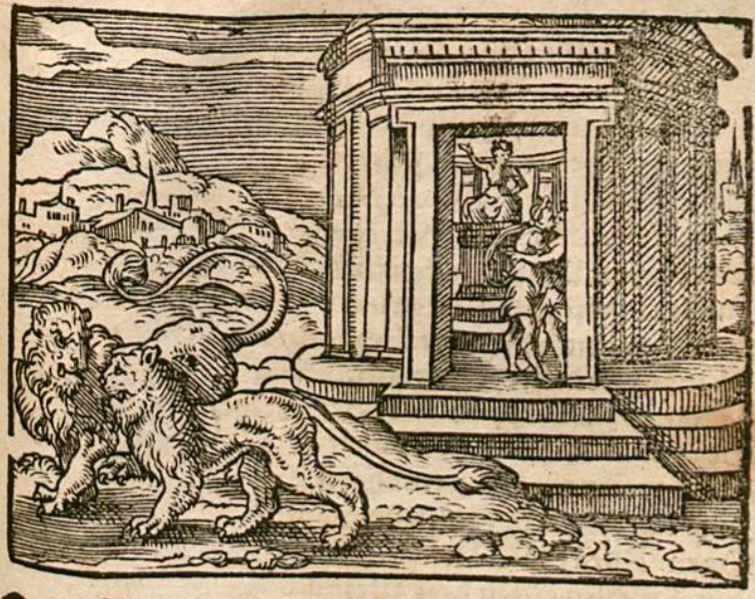
A man named Hippomenes sought the help of Venus so he could win a race against a woman named Atalanta and claim her as his prize. Venus helped Hippomenes win the race and she became angered with him when he did not thank her for her help. After Hippomenes won Atalanta as his prize, they found themselves at a temple of Cybele and had sexual intercourse inside the temple. Venus thought this to be an opportune moment to exact her revenge on the mortals for not appreciating her help. The couple are depicted on the inside of the temple embracing in front of the statue of Cybele. Venus transformed them into lions as punishment for their actions, and they walk out of the temple in their newly transformed state, as depicted on the left side of the engraving.
Don Quixote, clad in armor, steps forward to receive the countess Trifaldi, clad in a black robe, she kneels and gives him her right hand while in her left hand she clutches a white cloth. On the left, the duchess and the duke sit and watch this meeting while dressed in courtly attire. Behind Quixote, Sancho Panza holds his hands respectfully and looks towards the ground, while on the right the squire of Trifaldi stands in black robes with a great long white beard and a tall sword grasped in both hands next to two pages dressed in white vests.
Don Quixote contemplates the barber’s basin (which he to be Mambrino’s enchanted helmet), mounted on Rocinante. He is wearing his armour and carrying his shield and lance. Sancho Panza, leading his mule, laughs at him. In the background, the barber flees the scene. Signed by F. Hayman (illustrator) and S. F. Ravenet (engraver). Part 1, ch. 21.
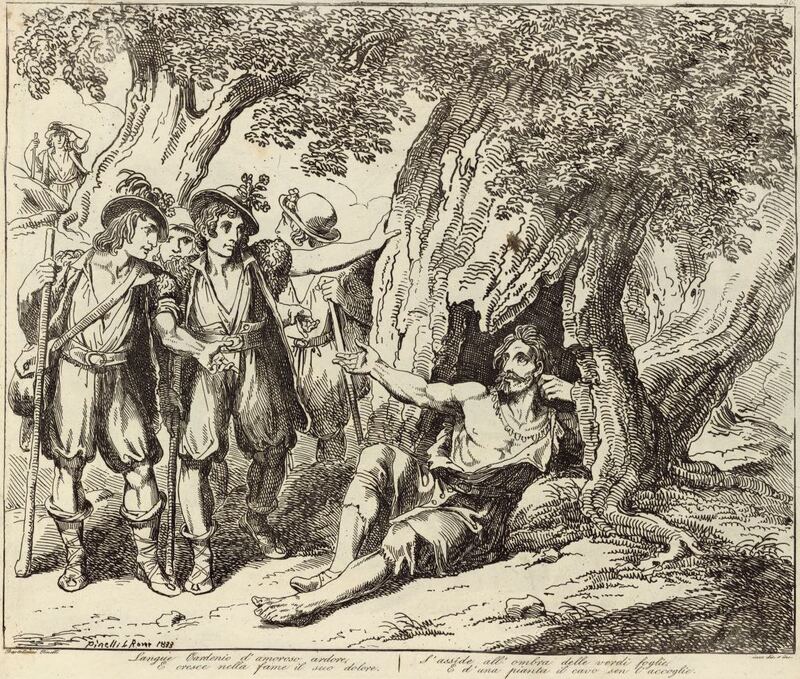
The goatherds find Cardenio in the hollow of an old cork tree. His clothes are torn and he claims to be performing a penance that was imposed on him because of his many sins. In Cervantes’ text, a goatherd gives an account of this scene to Don Quixote and Sancho Panza. Signed by Bartolomeo Pinelli (engraver and illustrator) and dated Rome, 1833. Plate 26. Part 1, ch. 23.
A young moustached man enters dressed in the clothing of a cavalier and a cap with a tall feather with a dagger by his waist. He is followed closely behind by another woman who tries to intervene and keep him from entering the chamber. On the left, a young woman, dressed in a nightgown rises from laying faced down on her bedding to look upon the intruding character. The image is occasioned by the countess Trifaldi saying "My imprudence, my great ignorance, and my little caution, melted me down, opened the way and smoothed the passage for Don Clavijo, for that is the name of the aforesaid cavalier. Through my intervention, he entered, not once, but often, in the chamber of the (not by him but by me) betrayed Antonomasia, under the title of her lawful husband ; for, though a sinner, I would never have consented, without his being her husband, that he should have come within the shadow of her shoe-string."
This image appears at the beginning of the eleventh book and contains many elements that appear throughout the book. There is a lyre on the left side of the image which represents Orpheus and his story. There is a reed at the bottom left corner of the image to represents Pan and his musical abilities. The centre of the image depicts Orpheus being attacked by the Maenads. There is a snake in the bottom right corner which is representative of many elements in the book where snakes appear.
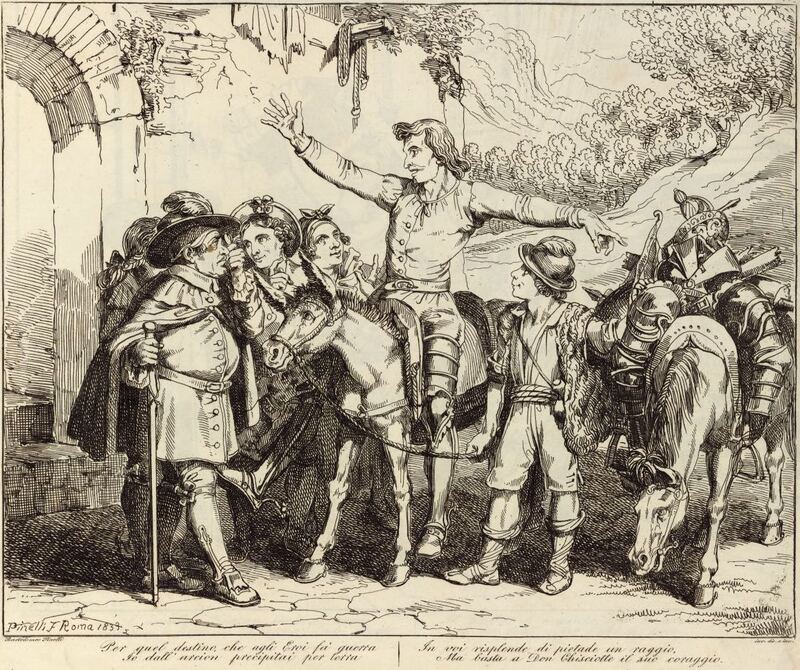
Don Quixote and Sancho Panza return to their village, and are welcomed by the priest, the barber, the housekeeper, Don Quixote’s niece, and Sancho’s family. Sancho leads his donkey (left). Signed by Bonard (illustrator), no given name, and L. Cars (engraver). Part 2, ch. 73.
The top right corner of the engraving illustrates many gods sitting on a cloud looking at Jupiter who is wearing a crown and holding thunder bolts. Venus begs Jupiter to stop the assassination of Julius Caesar before it happens. Jupiter, however, explains that there is nothing Venus can do to stop the fates from ending Caesar’s life. The left side of the engraving depicts the assassination of Julius Caesar. Venus is illustrated in a cloud above Caesar with her hands reaching towards him as she transforms him into a star and deifies him once he is dead. Cupid, Venus’ winged son, is depicted directly behind her on the cloud.
The vignette is a portrait of Sancho Panza as governor of Barataria Island. He wears a cloak and a cap, and holds a staff. Signed by A J.-J.-M. Devéria (illustrator) and E. J. Ruhierre (engraver). Part 2, ch. 45.
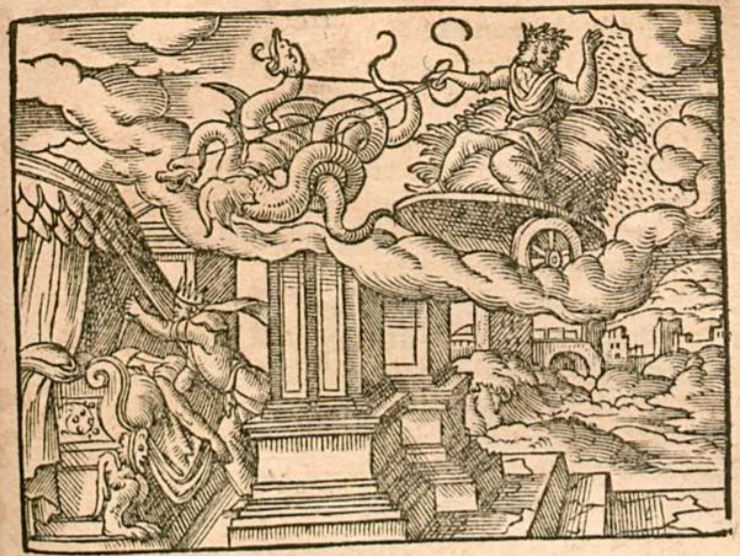
This image illustrates Triptolemus riding Ceres’ chariot drawn by two dragons. Ceres commanded Triptolemus to take her chariot and scatter seeds across different regions. This brought him to the kingdom of Scythia, where Lyncus was king. King Lyncus received Triptolemus into his home but betrayed him and attempted to murder him. Ceres interfered and saved Triptolemus and proceeded to turn king Lyncus into a lynx for his crime of attempted murder. The bottom left corner of the image depicts King Lyncus holding a knife above Triptolemus’ head attempting to murder him.
In the backyard of an Inn which Don Quixote has mistaken for a castle, Quixote asks to be knighted by the innkeeper who has has mistaken for a king. The innkeeper agrees to assuage Quixote's madness and also because the other guests of the inn found the whole affair humorous. Before the ceremony he bid one of the ladies to prepare his equipment, and upon her return swore to dignify her name of Tobosa. In a great feathered hat, the innkeeper knighted Quixote with a sword in his right hand and the inn's ledger which he pretended was a holy scripture in his left. Beside the innkeeper, a young boy held aloft a single candle in his right hand. For the entire ceremony Don Quixote recites the knightly prayers he has memorized from reading books of chivalry.
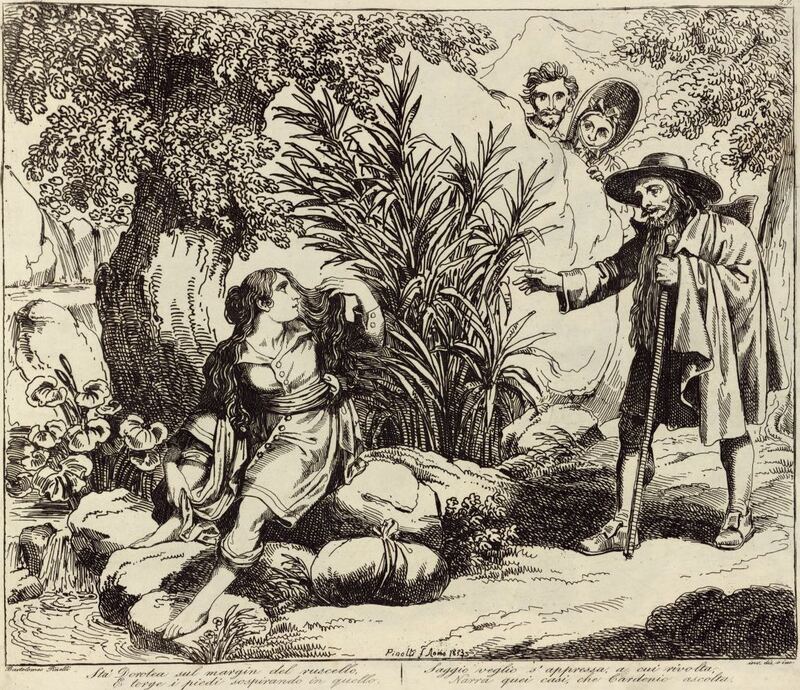
The priest, the barber, and Cardenio encounter Dorotea, washing her feet in a stream and combing her hair. The priest is disguised with a fake beard and the barber with women’s clothes. Signed by Bartolomeo Pinelli (engraver and illustrator) and dated Rome, 1833. Plate 29. Part 1, ch. 28.
Don Quixote attacks a procession of priests. They are bound for Segovia and are carrying the bones of a gentleman who died and was originally interred in Baeza. After knocking Alonso López and his mule to the ground, Don Quixote holds his lance to his throat and interrogates him. Sancho Panza observes him, holding a chicken he found on a pack mule. The scene is lit by a fallen torch. In the background, the other priests flee into the fields. Signed by F. Hayman (illustrator) and S. F. Ravenet (engraver). Part 1, ch. 19.
At the inn, Sancho Panza gives Maese Pedro two reales and asks the monkey to tell him what his wife Teresa is doing and how she is spending her time. The monkey leaps on the puppet master’s shoulder and clicks his teeth together, making as if he were whispering the answer to the question in his ear. Maese’s left eye is covered with a patch of green taffeta. Signed by J. Rivelles (illustrator) and A. Blanco y Asensio (engraver). Part 2, ch. 25.
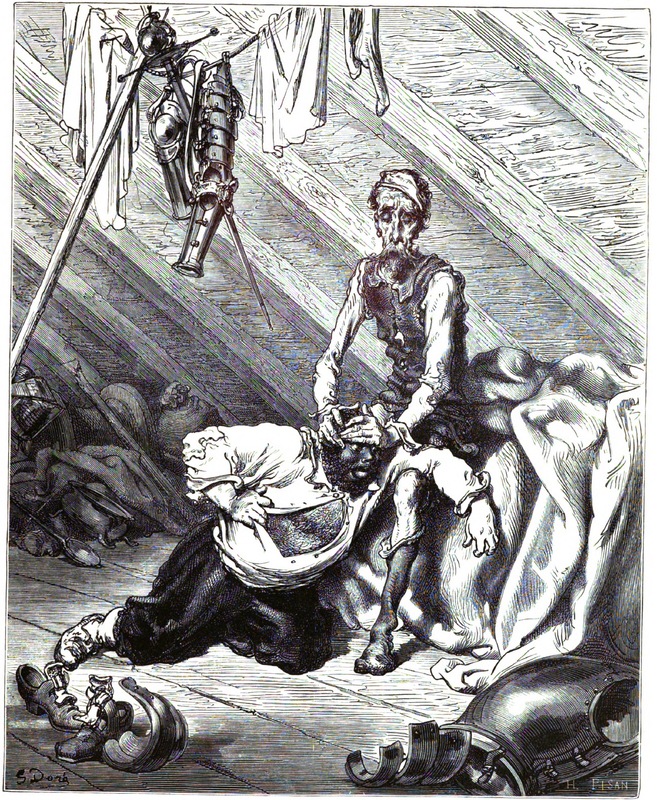
In order to recover from the injuries Don Quixote and Sancho Panza sustained during the brawl in the the inn, Don Quixote creates a balsam that he believes to be the balsam of Fierabras. Upon tasting it, Sancho Panza has a terrible reaction, believing that he may be dying from the illness caused by the potion. This scene is found in Part 1, Book 3, Chapter 3.
After assuming the form of a bull in order to approach Europa, Jupiter gains her trust through this disguise. She is soon convinced that the bull means no harm, and she sits on his back. Jupiter gradually moves closer to the shoreline, eventually entering the water. He then swims to Crete with her on his back (as seen in this illustration).
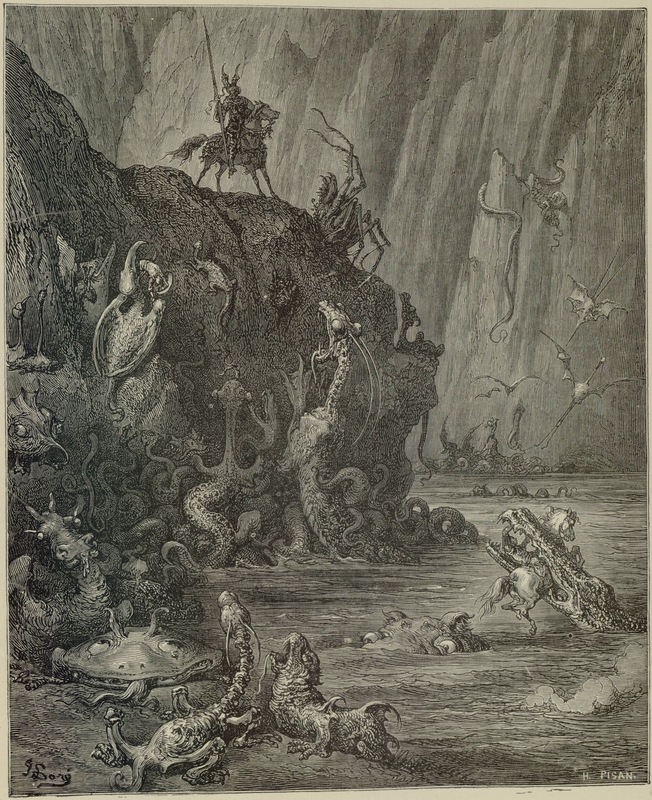
The illustration represents part of the tale of the Knight of the Lake, as told by Don Quixote to the canon of Toledo in defense of chivalric novels: the Knight arrives at a great lake of boiling pitch in which swim snakes, serpents, lizards, and all manner of other fierce and fearsome creatures. Signed by G. Doré (illustrator) and H.-J. Pisan (engraver). Part 1, ch. 50.
The manuscript that the priest reads from tells the story of Lothario, Camilla, and Anselmo, a tale of adultery between Lothario and Camilla. Learning of his wife's infedility with his closest friend, Lothario, Anselmo mounts his horse and sets out, oppressed with sorrow, to find Lothario, but before he had reached halfway, overwhelmed with the thoughts of his misfortune, he was unable to proceed and tied his horse to a dead tree, at the foot of which, he sunk down upon a rock, and gave vent to the most bitter and mournful lamentations. A cupid flies overhead, symbolic of Anselmo's lovelorn plight. His cap he has tossed to the foreground.
In the foreground, Don Quixote lies dazed on the broken bed. In the background, the innkeeper, holding a candle, discovers the fight between Sancho, Maritornes, and the muleteer. The light of the moon, depicted in the upper right corner of the plate, partly illuminates the scene. Unsigned. Part 1, ch. 16.
Don Quixote returns home from his first sally, mounted on Pedro Alonso’s mule. Rocinante carries Don Quixote’s shield, lance, and armour. The housekeeper, the niece, the priest, and the barber welcome the travellers. Signed by Bartolomeo Pinelli (engraver and illustrator) and dated Rome, 1833. Plate 10. Part 1, ch. 5.
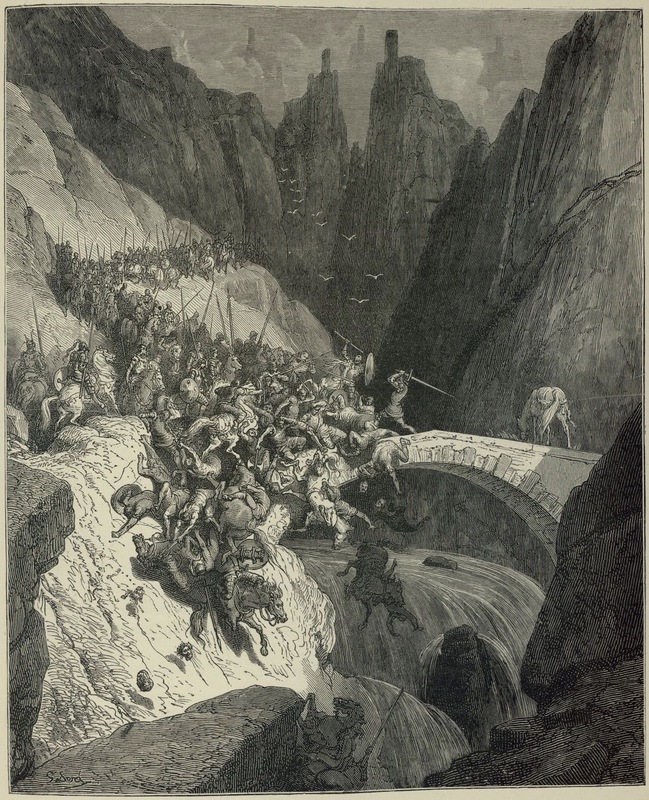
The illustration represents the story of Diego García de Paredes as told by the priest to the innkeeper while discussing chivalric novels. Diego was a native of the city of Trujillo and a courageous soldier. So strong that with one finger he could stop a millwheel as it turned, he once brought an immense army to a halt with a broadsword at the entrance to a bridge. Signed by G. Doré (illustrator) and H.-J. Pisan (engraver). Part 1, ch. 32.
A young woman dressed in a white gown sits with her legs to the right, her long black hair tied up in a braid and hung over her left shoulder. She rests her hands on her lap and looks straight ahead, a white veil parted and pulled back. The image is occasioned by Sancho Panza saying "and I can tell you that your daughter went away so beautiful that all the town went out to see her, and ever}' body said she was the finest creature in the world" (Page 577).
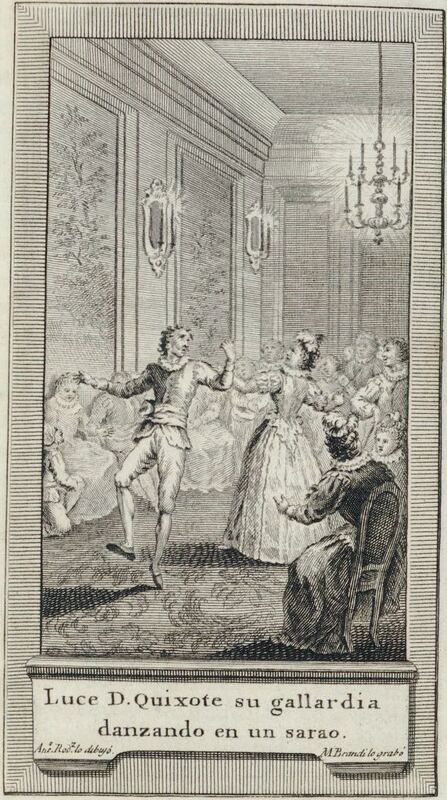
Don Quixote dances with a lady during the soirée at Don Antonio Moreno’s house. Signed by A. Rodríguez (illustrator) and M. Brandi (engraver). Part 2, ch. 62.
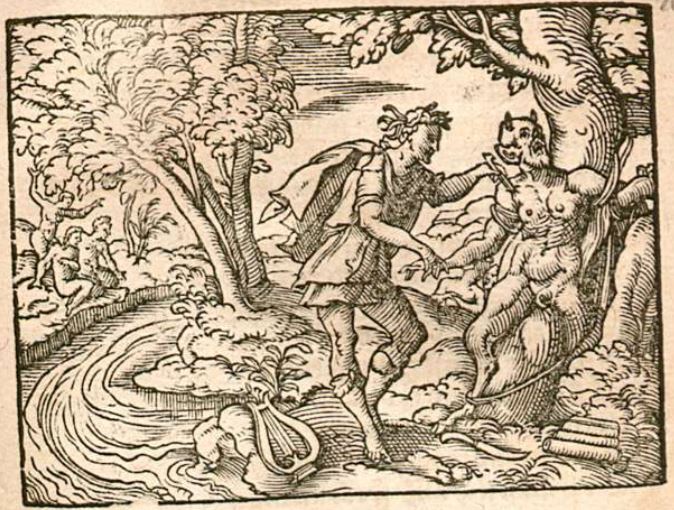
This engraving illustrates the god Apollo (also known as Phoebus) skinning the satyr Marsyas alive. Apollo, being the god of music, was angered that Marsyas had challenged him to a flute playing contest. There is a reed flute on the ground beside Marsyas’ feet. After defeating Marsyas in the challenge, Apollo skinned him alive. Apollo is depicted cutting Marsyas on the shoulder. The river that flows beside the two figures is being formed by the tears of Marsyas.

![[Don Quixote Recieves the Countess Trifaldi By Her Hand]](https://collections.cemvc.ca/files/large/4fceca6e040aedd1a9e95d1cd020ff5c419f6c2b.jpg)
![[Mambrino's helmet]](https://collections.cemvc.ca/files/large/e34eec5d385fc2060c8b9c5ef9b15f45d43e210d.jpg)
![[Don Clavijo Enters the Chamber of Antonomasia]](https://collections.cemvc.ca/files/large/db7b966a5961bf4c9d59d7b671254efa306ae901.jpg)
![[Fables from the Eleventh Book]](https://collections.cemvc.ca/files/large/b3651313e5ebc1d13425082d7bb621e75ffdc44c.jpg)
![[Don Quixote and Sancho Panza return to their village]](https://collections.cemvc.ca/files/large/469eb425e6bf39cd6ad9361af2f245f54cab1b9c.jpg)
![[The Assassination of Julius Caesar]](https://collections.cemvc.ca/files/large/c7cf2de503a5b08686a55deacb57c30a031d48f5.jpg)
![[Sancho Panza as governor]](https://collections.cemvc.ca/files/large/2f87b99391c3aa9934d503296302e93b27e60030.jpg)
![[Of How Don Quixote Came to be Knighted at an Inn which he Mistook for a Castle]](https://collections.cemvc.ca/files/large/feecc6ae6f77225f47eb1d842c30a917a0af5250.jpg)
![[Adventure of the dead body]](https://collections.cemvc.ca/files/large/2e08a49d99a5aa2358efb6139db2b2b0f6b0f895.jpg)
![[Don Quixote meets Maese Pedro and his monkey]](https://collections.cemvc.ca/files/large/e1eb4ab02589b95946b08b6e1dd596a6ca6fadc4.jpg)
![[After Assuming the Form of a Bull, Jupiter Swims to Crete with Europa on His Back]](https://collections.cemvc.ca/files/large/bc6d102b4a487b92750133c5770e2eb7a1f04693.jpg)
![[Anselmo's Lamentation]](https://collections.cemvc.ca/files/large/6cd6748af6d35649adb894f37957b075c3991672.jpg)
![[Fight between Don Quixote, Maritornes, and the muleteer]](https://collections.cemvc.ca/files/large/a81290ba258cf49866ae3a4e5138091b8087b659.jpg)
![[Ricote's Daughter]](https://collections.cemvc.ca/files/large/4428dd0f439a98f931623d75d8a2395e30355b9c.jpg)