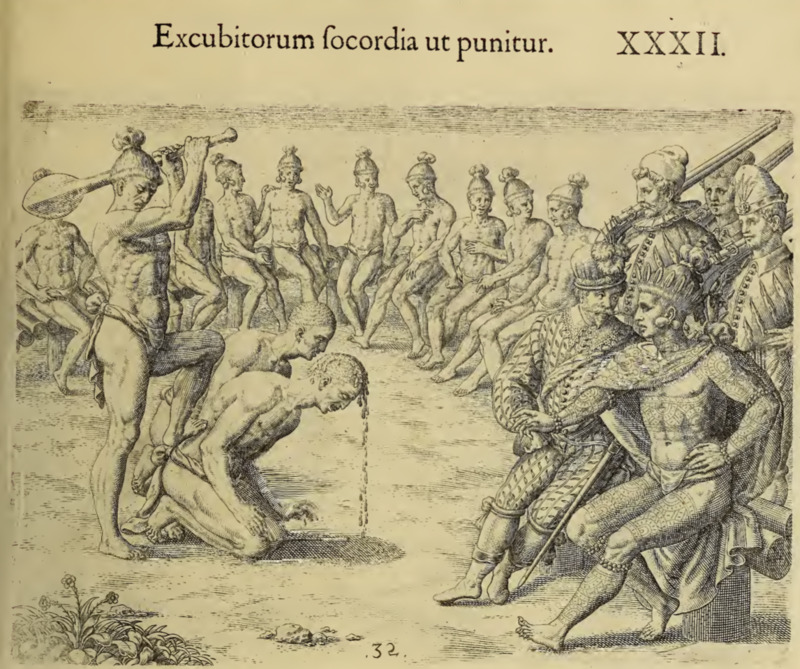
A group of Indigenous and colonist men sit on wooden benches in a semi-circle. In front of the group, two Indigenous men kneel on the ground. Another man stands behind them holding a club in the air above the head of one of the men. The man kneeling is bleeding from the head from a previous blow.
A man is sitting on a throne having a conversation with a woman. The man has a sort of crown, and they are both wearing long robes. They appear to be in a palace-like building. Behind them across a fence there is a man who appears to be working. He is lifting objects with a shovel.
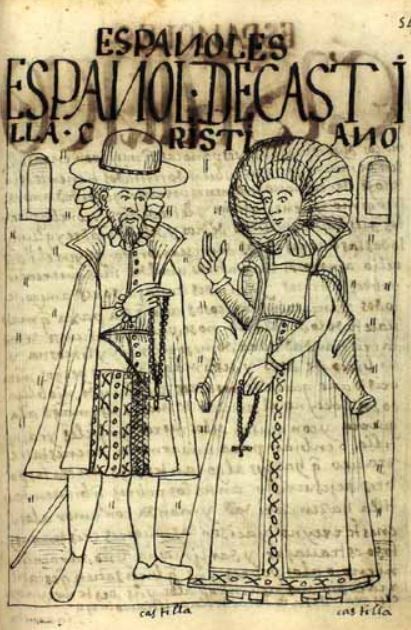
This image is illustrated in a chapter that discusses and criticizes the government and society in Spanish conquered Peru. This image depicts two Christian Spanish nobles from Castile. They are wearing old-fashioned European clothing and holding rosaries. The author commends Castilian men and women for having honour and being devout Christians. The caption at the bottom of the image reads, castilla [Castile].
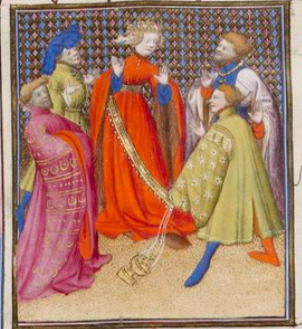
Venus is pictured in a red gown and crown. Venus was known for her physical beauty, sexuality, and supposed promiscuity – therefore, men are seen approaching and surrounding her to admire her beauty.
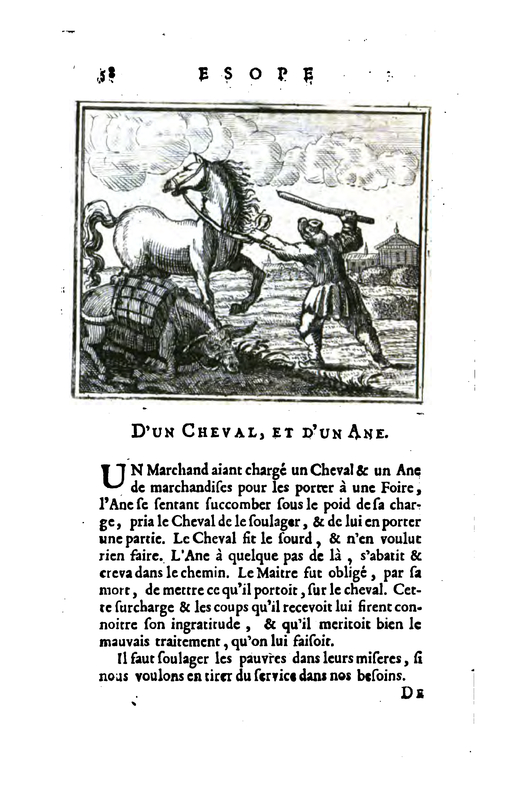
There is a man holding a horse by its tie with a sharp object on the other hand threatening the horse. Under the horse there is a donkey laying on the floor carrying heavy goods. In the vast distance there is a house and the sky is very clear with some clouds. There is nothing between the man and the house expect a field of grass.
During his time on Balnibarbi, Gulliver visited the Grand Academy of Lagado and the scholars who worked there. One scholar was testing a theory that by writing mathematical concepts on a wafer and having the student eat the wafer that the student would then learn the concept by a form of osmosis. The problem, however, was that the ink used caused nausea, and the student would often run-away and vomit.
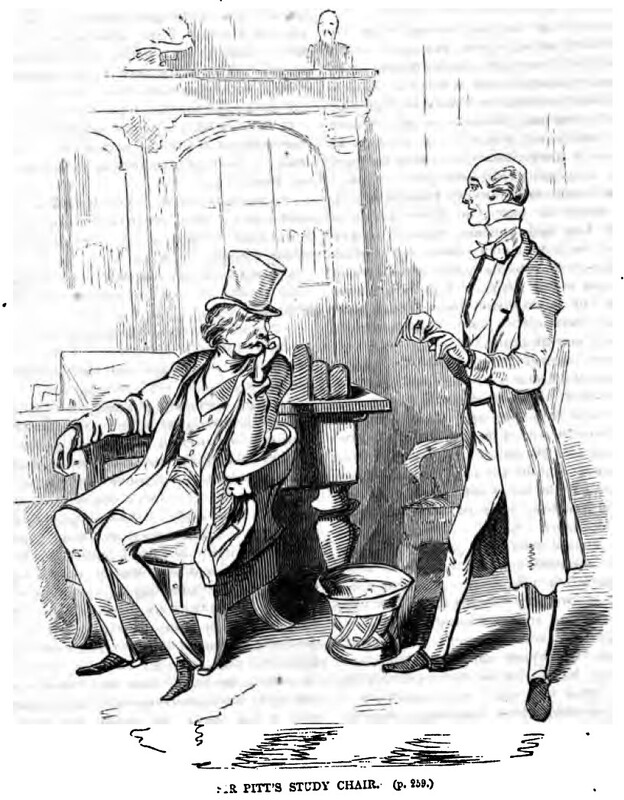
Rawdon Crawley sits in the chair at his brother’s desk with his chin on his hand, looking gloomy. His brother, Sir Pitt Crawley, stands next to him, trimming his nails as they talk. Rawdon wishes for Pitt and Jane to take care of his son once he leaves. Behind the desk is a cabinet with glass doors, and between the two men in the trash bin. Below the illustration is printed in cursive its title, SIR PITT’S STUDY CHAIR. (p. 259.).
Here we see Gulliver talking to his family when he first sees them after returning to England from Brobdingnag. Gulliver tells us how he knelt down when his wife came to kiss him, because he felt like a giant. When his daughter came to speak with him, she knelt down but he could not see her until she stood up because he became so used to looking up to the giants. In the image, Gulliver’s family looks concerned as Gulliver tells them what he saw, thinking he had gone crazy. The same image appears in both the 1839 and 1843 Krabbe editions.
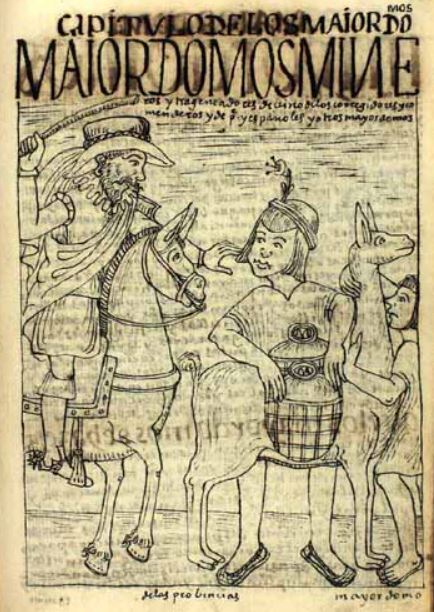
This image is illustrated in a chapter that discusses and criticizes the government and society in Spanish conquered Peru. This image depicts a steward riding a horse on the left side of the image. The stewards were administrators who were usually Spanish and were hired by Spanish business owners to handle day-to-day operations. The author criticizes these officials as they would take advantage and disrespect local indigenous peoples. This image depicts the steward abusing an indigenous labourer. He is holding his hand out to grab him and his other arm is swinging his sword. The indigenous man is loading his llama up with supplies. There is a second indigenous person in front of the llama holding on to it. The caption at the bottom of the image reads, de las probincias [from the provinces].
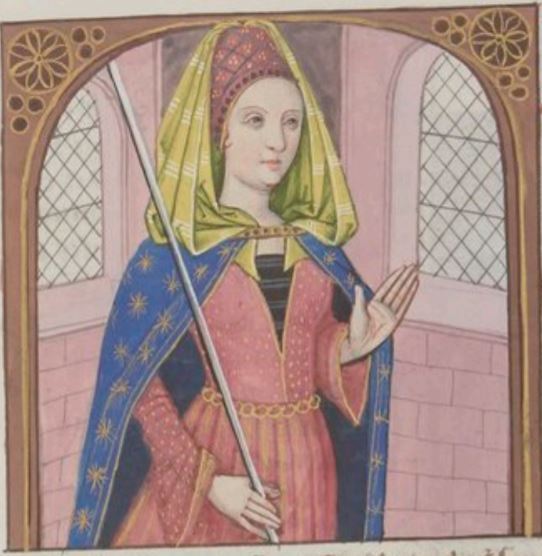
This illumination depicts a portrait of a woman named Hecuba, the queen of Troy and wife of king Priam of Troy. Boccaccio explains that he wrote on Hecuba to highlight her terrible misfortunes. She had watched many of her children die, including the hero Hector, and watched her husband be disemboweled. Along with watching her loved ones violently die, she watched her entire city fall to the ground. Many believe she had become a slave to the Greeks once the city was taken.
Circe, the daughter of the Sun, is depicted on the right side of this engraving. Boccaccio explains that Circe was skilled in the art of magic and would often turn people who landed on her shores into animals. When Ulysses and his men happened upon Circe, she transformed Ulysses’ companions into beasts. They are depicted in the engraving with their bodies still in human form, while their heads are changed into animals. The men, in order from left to right, are depicted with the heads of a stag, a rabbit, a pig and a lion. Ulysses is the one man among them that is still completely in his human form. Ulysses threatens Circe with his sword, and she eventually changes his companions back into their original forms.
A family walks down a path next to a stone marked with an X. The man is holding the boy’s hand and carrying a basket on a stick over his shoulder. The woman is covered in a shawl, carrying a basket on one arm, and holding a walking stick in the other. She is turned to face away from the stone marker. In the background are a hill or bridge and the letter F, from Friend.
It was a custom in Luggnagg to lick the floor in front of the throne before addressing the king. If the king wanted someone to be executed, the floor would be sprinkled with poison before the person lick it. In this image we see a person lying dead on the floor after this ceremony, as the king looks on.
Here we see Gulliver performing for a crowd of giants. The farmer sold tickets to other giants to see Gulliver. On the front right, we see Glumdalclitch speaking to Gulliver and giving him instructions, while an older woman leans over her shoulder. Two other children stand in front of the table watching Gulliver. Behind the children are their parents. There are two more rows of giants in shadow. Gulliver stands on a table holding a piece of straw as though it was a fencing sword. The same image appears in the 1839 Krabbe edition.
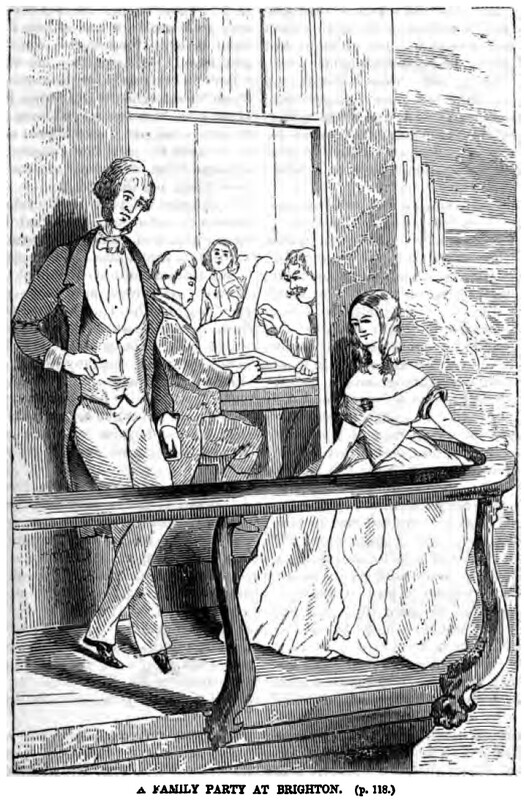
George Osborne and Rebecca Crawley are on the balcony of the inn at Brighton, looking at the ocean. He is leaning against the building, facing out, while she is seated by the railing, facing him. Through the doorway, Joseph Sedley and Rawdon Crawley can be seen inside at the table, playing backgammon. In the far background, Amelia Osborne is sitting alone in an armchair, looking forlornly at the others. Below the illustration is printed its title and location in the story, A FAMILY PARTY AT BRIGHTON. (p. 118.).
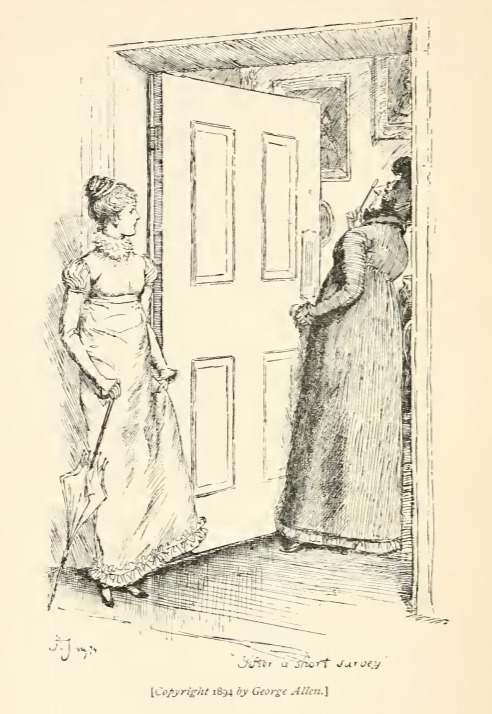
In this image Lady Catherine de Bourgh looks into various rooms in Longbourn. As Elizabeth led Lady Catherine through Longbourn, she stopped at every door to look into the dining parlour and drawing room. Lady Catherine said that they were decent rooms and then continued on, eventually going out into the gardens. Lady Catherine came to Longbourn to discuss the rumours that Mr. Darcy was going to propose to Elizabeth. Lady Catherine wanted Elizabeth to deny the rumours and promise not to accept his proposal should he offer one. This is because Lady Catherine wanted Mr. Darcy to marry her daughter instead. Elizabeth refused Lady Catherine’s request, saying that if Mr. Darcy proposed she would happily accept. This infuriated Lady Catherine and she left in anger. This scene occurs in chapter 56. The characters are shown in the traditional regency style. Lady Catherine and Elizabeth wear regency dresses with empire waistlines. Lady Catherine wears an overcoat and a bonnet and carries a purse and walking stick. Elizabeth carries a parasol, used to protect her face from the sun when they went outside into the garden. The regency period dated to the early nineteenth century (1811-1820) when George, Prince of Wales, later George IV (r. 1820-1830), reigned as regent for his mentally ill father, King George III (r. 1760-1820). The regency period is associated with the rise of neoclassicism in art and fashion.
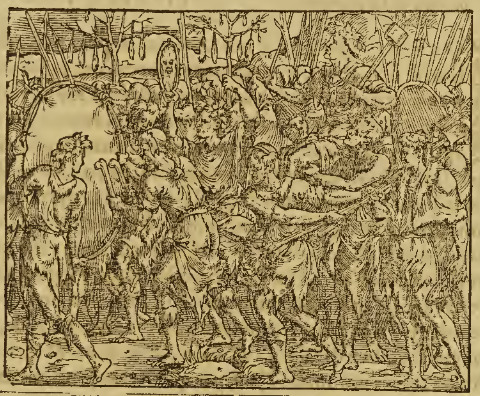
An Indigenous group from Newfoundland (as identified by the author) prepare to go to war. The group marches in a procession with large drums made from animal skins stretched over a wooden frame and bones as drumsticks. One man is carried on the shoulders of several others and holds a ceremonial weapon or other object. Most members of the group are barefoot and wear tunics, several have capes tied around their necks, and others wear headdresses of feathers or leaves. This image is identical to one found on page 1013 of Paris, 1575 (Chaudière), and in Thevet’s Les Singularitez de la France Antarctique (page 164 of Paris, 1557 and page 164 of Paris, 1558).
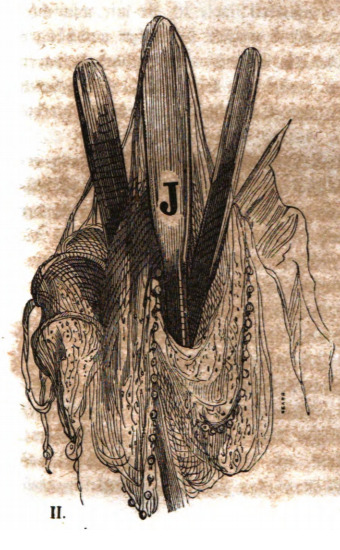
Here we see Gulliver’s paddles and fishing nets. This image appears at the beginning of the eleventh chapter in which Gulliver sails away from the Country of the Houyhnhnms and arrives on New Holland. The same image appears in the 1843 Krabbe edition.
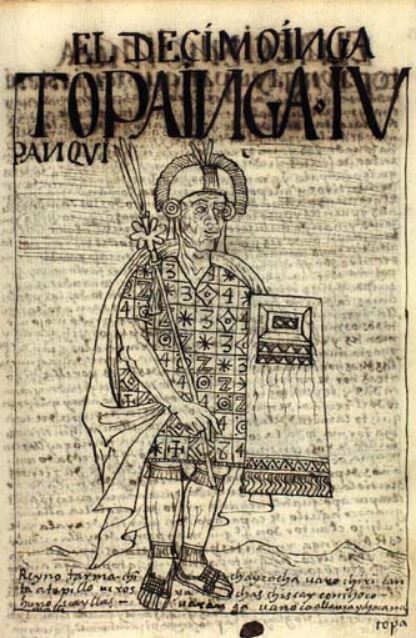
This illustration depicts the tenth king of the Inca Empire, Topa Inca Yupanqui. He is the successor of his father Pachacuti. He is depicted wearing an embroidered shirt while holding a shield in his left hand and an ax in his right. There are words written at the bottom of the image which reads, Reynó Tarma, Chinchay Cocha, Uarochiri, Canta, Atapillo, Ucros, Yachas, Chiscay, Conchoco, Huno Uayllas, Uaranga Uanoco Allauca e Ychoca, Uamalli. These are all the regions that this king had conquered during his reign. The author explains that this king named all the monuments and landmarks in his kingdom.
Here we see Gulliver waving to the Houyhnhnms he lived with during his time on the Country of the Houyhnhnms as he sails away. The Council of the Houyhnhnms told his master that Gulliver either had to live with the yahoos or return to Europe but could not live with the Houyhnhnms any longer. Gulliver was shocked by this, and decided he had to leave rather than live with the yahoos. On the shore behind the Houyhnhnms we see the special trees that grow in the Country of the Houyhnhnms, seen in an earlier image. Gulliver sails away in a small sailboat that he built with the help of the Sorrel Nag during his last two months in the Country of the Houyhnhnms. The same image appears in the 1839 Krabbe edition.
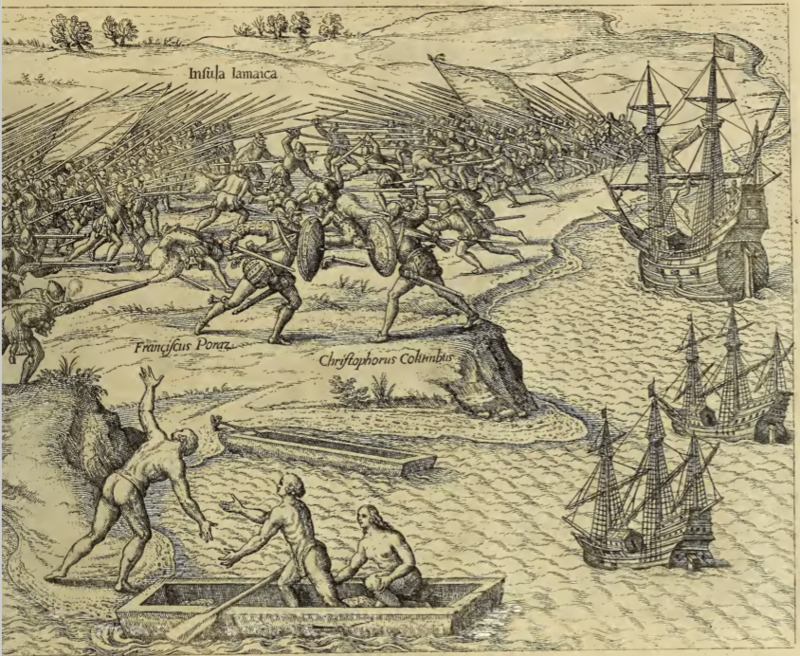
On the island of Jamaica, Christopher Columbus and Francisco de Porras (both labelled in the image) engage in battle. The two men face off against each other, each armed with a sword and shield. To one side of the two men and stretching along the shore, their two armies engage in combat with muskets, swords, and spears. Three European ships are anchored along the shore. In the foreground, three Indigenous people either arrive or depart the area by canoe. One of the men, standing on the shore, gestures widely in the direction of the battle.

![[Man on throne]](https://collections.cemvc.ca/files/large/9ca95fb126d211531a619aea29b943a1f7d6a783.jpg)
![[A student runs away from his teacher]](https://collections.cemvc.ca/files/large/a0cf0fd188dc40061858c96ec2871df2f8f8bf63.jpg)
![[Gulliver sits with his family after arriving home from Brobdingnag]](https://collections.cemvc.ca/files/large/40a46f9f686f684a013bb76708a4b1df2b33b2e0.jpg)


![[Vanity Fair Volume II. Chapter XVIII Inhabited Initial, F]](https://collections.cemvc.ca/files/large/fab1801a1472bdfaff3b974e51eab1720bd4b288.jpg)
![[A man is killed after licking the floor in Luggnagg]](https://collections.cemvc.ca/files/large/c4c895bb5beeaddc4cd777064ab94bd631f25dff.jpg)
![[Gulliver performs for a crowd on Brobdingnag]](https://collections.cemvc.ca/files/large/ed76a6ff2ff511ad9ec56c09d9a9a6d1ef165ce0.jpg)

![[Gulliver waves as he leaves the Country of the Houyhnhnms]](https://collections.cemvc.ca/files/large/c377b57b45ac5cc180b6ec6e396261331d783594.jpg)