Here we see two canaries in a cage. The image comes after the King of Brobdingnag said he wanted to find another woman who was the same size as Gulliver so they could reproduce, then keep his children as pets for other families on Brobdingnag. Gulliver’s response was that he would rather die than be kept in a cage like a canary. The same image appears in the 1843 Krabbe edition.
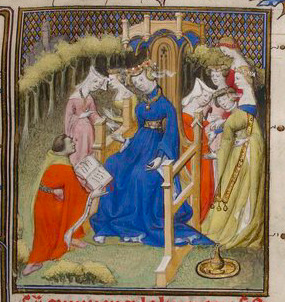
Boccaccio, the left-most figure wearing the red cloak, crouches on a knee to offer his book to the Countess of Hauteville, who is seated in a throne wearing the blue cloak. The figures that surround them are the Countess’ followers. Boccaccio is the original author of the book.
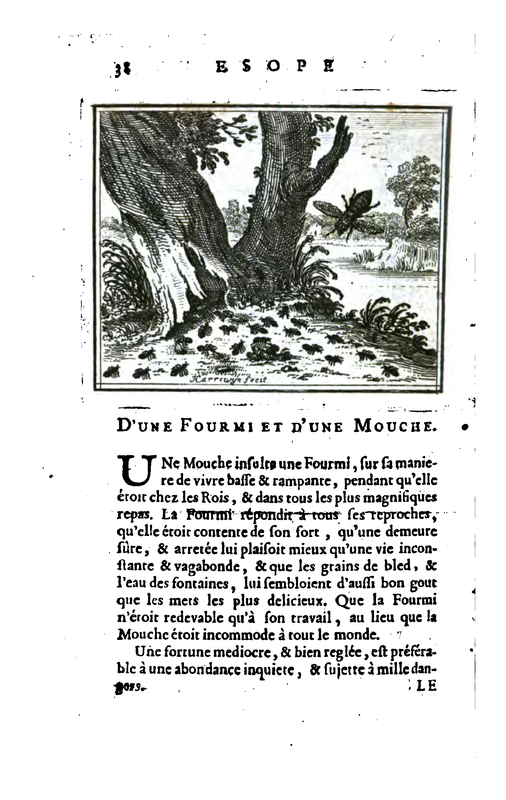
At the base of two tree trunks, a group of ants swarms on a hill. Lush grass grows from the ground around the two trees. A Large fly is above, flying down in the direction of the ants.
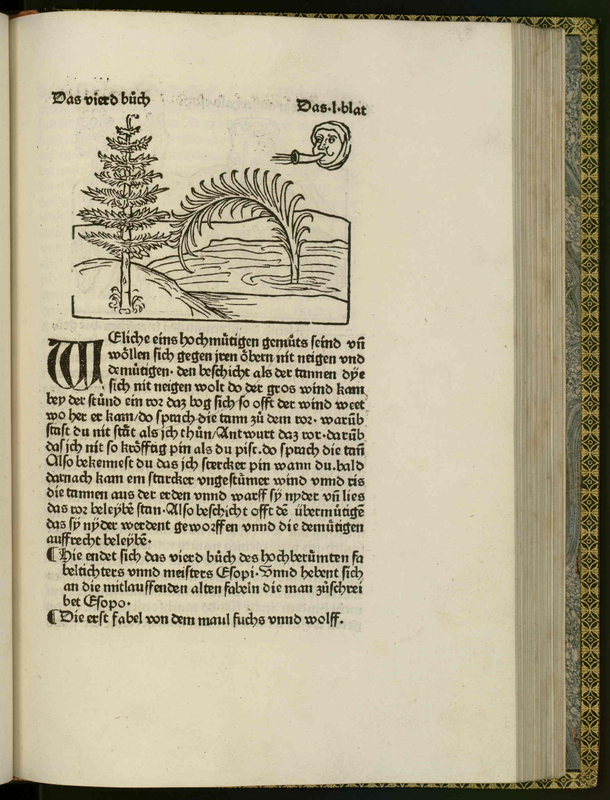
On the left side of the image, there is a tree on a hill. On the right side of the image, there is a human face blowing in a horn. The wind makes the tree that is in the water bend towards the left.
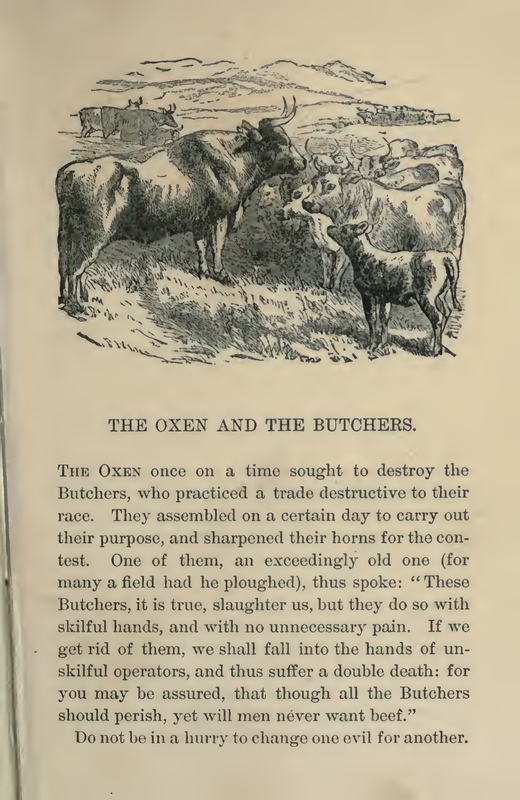
A large group of oxen are gathered together in a field. The biggest ox stands to the left side of the image, while smaller oxen gather to the right of the image, all looking at the bigger ox as though it were their leader. More oxen are seen in the far back. Hills stretch even further in the background.
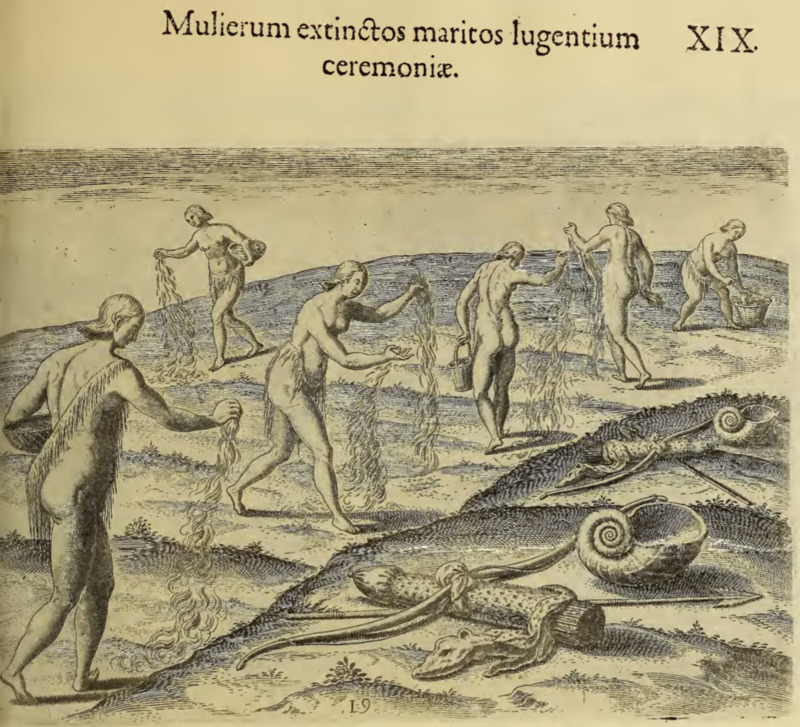
Several Indigenous women are shown scattering a substance, possibly leaves or a grass, onto the ground. The women are mostly nude, although some wear a light skirt of grass tied around their waist or draped from their shoulder to their waist.
Two Tupinambá men are shown, each holding a different weapon. One man stands in front of the other, holding a club with feathers on the end in one hand. The man standing behind him points a bow and arrow at something beyond the right edge of the image. Both men are nude and have an adornment on their chin. The man in front has marks (tattoos or paint) on his chest, biceps and thighs. The head of another man from an enemy group lays on the ground behind the men.
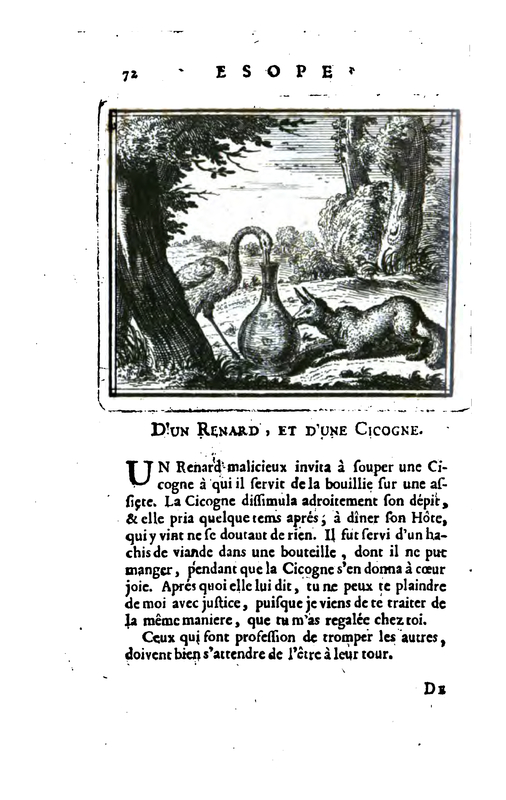
There is a strock eating fishes from a large tall vase, while a fox is licking the vase. The fox is hungry and upset about the decision the food is being served while the strock is having the time of its life. There are trees on the backgound and a clear sky.
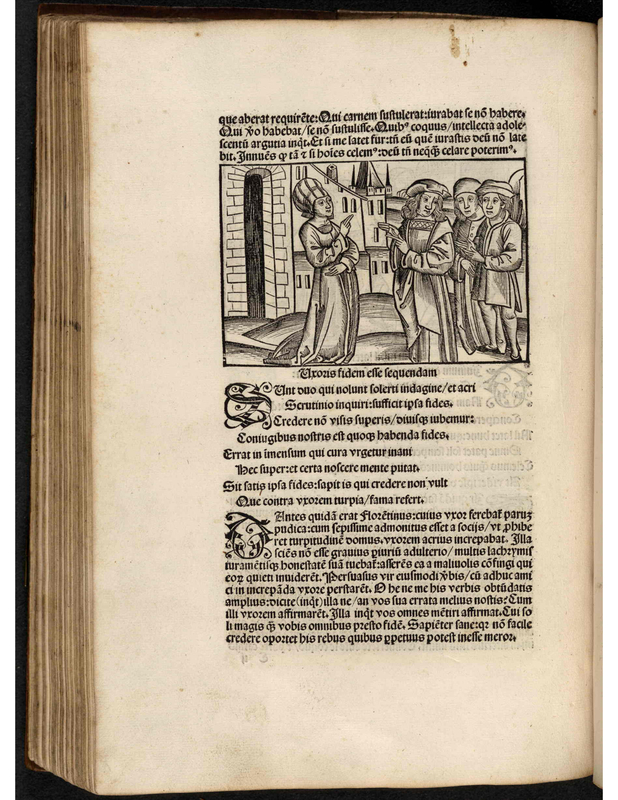
Four people stand outside the castle. Two are speaking in the centre, and two are off to the right side. The centre person rightmost is facing the people off to the side.
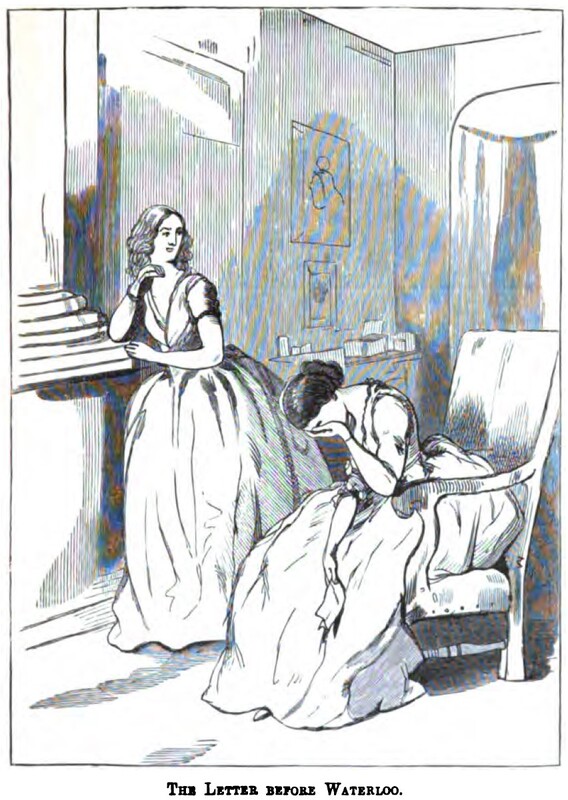
On the left, Rebecca Sharp is standing against a column and looking to the right towards Amelia Sedley, who sits crying in a chair with one hand over her face. In her other hand she holds the letter which her husband gave to Becky in an earlier chapter, asking her to run away with him. In the background can be seen two pictures on the wall, a dresser with various objects placed upon it, and part of the canopy of a bed. Below the illustration is printed its title, The Letter before Waterloo..
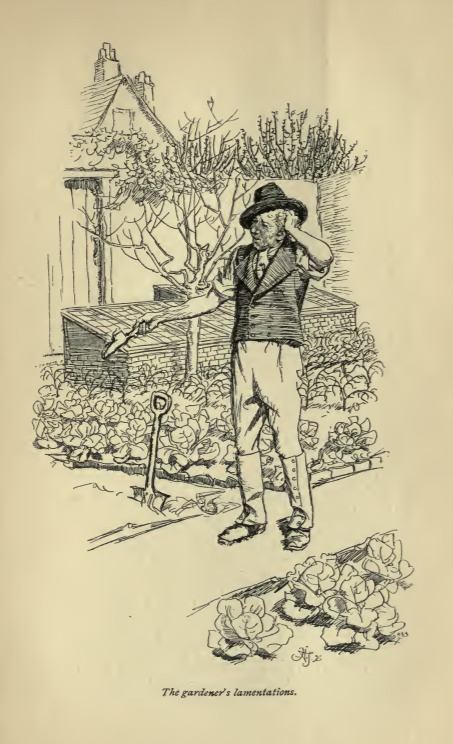
In this image Mrs. Palmer’s gardener speaks to Marianne. Marianne and Elinor travelled to the Palmer’s estate after leaving London and before returning to Barton Park. Marianne spent most of her time walking through the gardens. She spoke often to the gardener on her walks. This scene occurs in chapter 42. The characters are shown in the traditional regency style. The gardener wears a waistcoat and long pants and a sleeve around his ankles to protect the bottoms of his pants from the dirt. The regency period dated to the early nineteenth century (1811-1820) when George, Prince of Wales, later George IV (r. 1820-1830), reigned as regent for his mentally ill father, King George III (r. 1760-1820). The regency period is associated with the rise of neoclassicism in art and fashion.
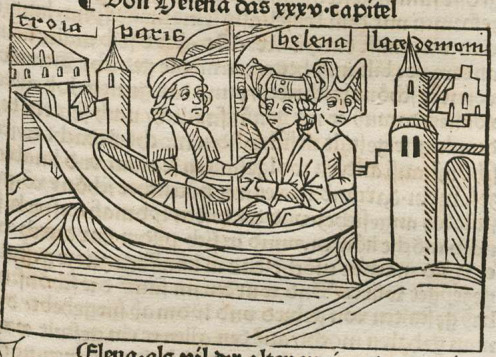
This engraving depicts prince Paris of Troy leaving the shores of Lacedaemon on a ship that carries queen Helen, wife of king Menelaus. Boccaccio explains that Paris had fallen in love with Helen while he was a guest in king Menelaus’ home. It is debated whether Helen’s feelings towards Paris were mutual and she willingly went with him, or if he had taken her by force. This image depicts Paris sitting on the left side of the ship (his name is engraved above his head), and Helen sitting on the right side (her name is also engraved above her head). Lacedaemon is illustrated on the right side of the engraving, while the city of Troy is on the left side. The ship is pointing towards Troy as that is their destination. Paris and Helen going to Troy is the cause of one of the greatest wars of all time: The Trojan War.
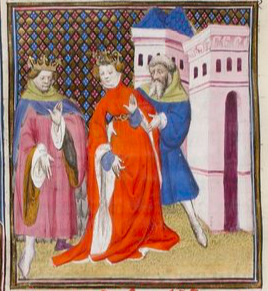
Hypermnestra, in the red gown, is being put in prison by her father Danaus, in the pink robe and crown. She is being imprisoned for being the only daughter not to murder her husband while he slept, a command made by Danaus.
The left panel depicts Melibea wearing a veil and a robe. To the right, Calisto is wearing a hat and has a sword mounted on his belt, the latter of which is partially concealed by his coat. Both figures are placed outside. The left panel is identical to those found on pages 12 and 208, and is nearly identical to those found on page 84 (where it is labeled ‘Lucrecia’), pages 173, 287, 306, and 317 (labeled ‘Areusa’), and page 350 (labeled ‘Alisa’). The right panel identical to the one found on page 263, and nearly identical to those found on pages 70 and 114 (where it is labeled 'Sempronio'), page 187 (labeled ‘Sepronio’ [likely a printing error]), page 326 (labeled ‘Tristan’), and page 350 (labeled ‘Pleberio’).
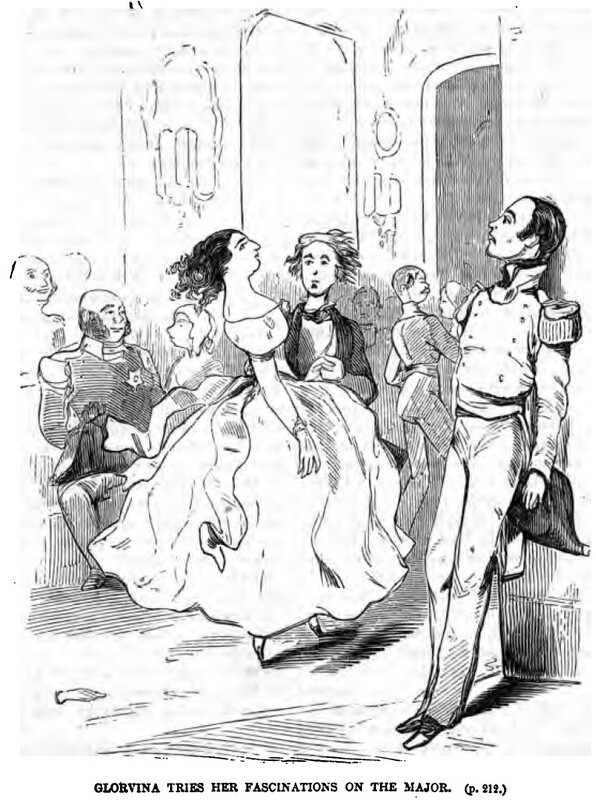
Miss Glorvina O’Dowd dances past Major William Dobbin, trying to get his attention. He is leaning against the wall, holding his hat in his hand, and paying no attention. In the background are assorted other officers and their ladies. Below the illustration is printed its title and location in the story, GLORVINA TRIES HER FASCINATIONS ON THE MAJOR. (p. 212.).
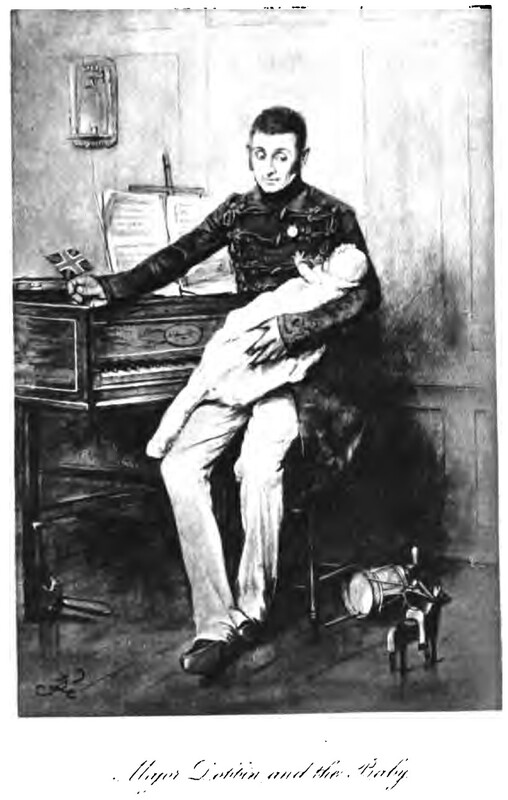
A photo-etching done by Frederick Barnard from the original character sketch. It pictures Major Dobbin seated at a piano, holding baby Georgy Osborne in one arm. His other hand, holding a British flag, rests on the top of the piano next to an open book of sheet music. A toy drum and horse are on the floor next to his feet.
Here Gulliver tries to explain his situation to two Houyhnhnms. He asks them for shelter, and in return he says he will make them a present in return for the favour using his knife. The Houyhnhnms spoke between themselves and agreed to help Gulliver. During their conversation Gulliver heard the two saying the word yahoo, so Gulliver repeated the word back to them. The Houyhnhnms looked surprised, then proceeded to teach Gulliver the correct pronunciation of the word. The Houyhnhnms then took in Gulliver and taught him the language. The same image appears in both the 1839 and 1843 Krabbe editions.
This engraving depicts Thisbe, a young virgin from Babylon killing herself after finding her lover, Pyramus, already dead. Boccaccio explains that the two lovers were forbidden from being together, so they devised a plan to run away. Thisbe waited for Pyramus by the fountain depicted on the left-hand side of the engraving, when a lioness appeared. Thisbe ran into the woods, as depicted in the background on the right side of the image. The lioness, with a blood stained mouth, chewed on the cloak that Thisbe left behind after running. This is illustrated in the foreground of the engraving. Pyramus had then arrived at the meeting point, only to find the bloody cloak of Thisbe. Believing her to be dead, Pyramus killed himself with his sword. Pyramus is depicted in the foreground of the engraving, lying on the ground with his sword impaled through his chest. The creator engraved his name beside his leg to identify him. Thisbe found Pyramus as he was dying and impaled herself with the same sword in order to be with her lover. Her name is engraved above her left arm.
Here we see Gulliver in his room on the Country of the Houyhnhnms. His room was built about six yards from the main house and made of clay. Gulliver had mats made of rush plants, and a mattress made with hemp and filled with feathers. In this image we see Gulliver cleaning his house. He wears clothes of leather made from the dried skins of yahoos. The same image appears in the 1839 Krabbe edition.
After his brief encounter with Melibea in her garden, Calisto (figure to the right) laments the absence of his love. Calisto’s servant Sempronio (on the left) proposes that he employ the help of Celestina, an old procuress and brothel owner. Calisto agrees, and he tells Sempronio to visit Celestina and request her aid. When Sempronio departs, Calisto’s other servant Pármeno warns Calisto against the old woman’s deceptive and treacherous ways.
Three Indigenous men stand in the foreground beside a tall leafy tobacco plant. Two of the men hold tobacco leaves rolled up, one is lighting the end of the roll of leaves and the other has already lit his and is smoking. The third man reaches for a leaf from the plant. Two of the men carry bows, and the one on the left wears a necklace, in the middle a cape, and to the right a round feathered adornment. In the background closer to the village, several structures of which can be seen, another man carrying a bow smokes from a rolled leaf. This image is identical to one on page 927 of Paris, 1575 (l’Huillier).

![[Canaries on Brobdingnag]](https://collections.cemvc.ca/files/large/d3d73e3753aff4eb32e1da071271ae40f708df0d.jpg)
![[Two Tupinambá men with weapons]](https://collections.cemvc.ca/files/large/7669ce8bf19d0ca57a01ce042c3a25384d89cbb7.jpg)
![[Act XIV – Melibea and Calisto (Alternate)]](https://collections.cemvc.ca/files/large/f47f71122763b189016dd3b0c3e6c6b7c51b9d17.jpg)
![[Gulliver speaks with the Houyhnhnms and shows them his knife]](https://collections.cemvc.ca/files/large/c82b13beb8936f5b555e517aad4033f95eef971a.jpg)

![[Gulliver in his room on the Country of the Houyhnhnms]](https://collections.cemvc.ca/files/large/5d11cbc8a24c5696cfb1fe248a6d24a980564f75.jpg)
![[Act I (Second Illustration) – Calisto Laments the Absence of Melibea to Sempronio]](https://collections.cemvc.ca/files/large/14f32da2edc9310956a850eb75179e004d5244dd.jpg)
![Portrait de l’herbe Petu[n] ou Angoulmoisine.](https://collections.cemvc.ca/files/large/908c48a51f856c53b7371332712bbee33a49b0e7.jpg)