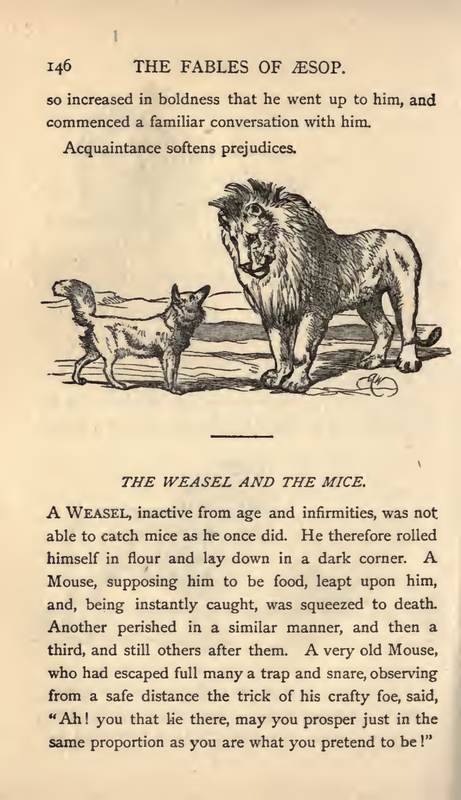
A wolf and dog are walking in the outdoors towards a building surrounded by a fence. Above them in the sky there’s a bird flying towards the building. The building is tall with 8 visible windows, and the fence has a large entrance with 7 windows on it near the top.
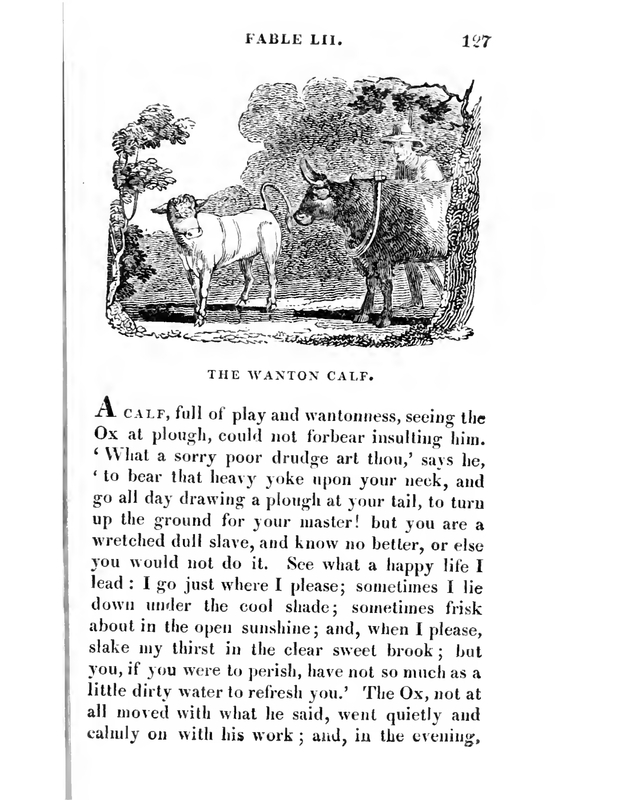
A calf, an ox, and a man stand in what appears to be a clearing surrounded by trees. The two animals look at each other while the man looks at the ox. The white calf stands on the left-hand side. The ox stands in front of the man on the right-hand side with a yoke on its neck. The man stands behind the ox, he wears a brimed hat.
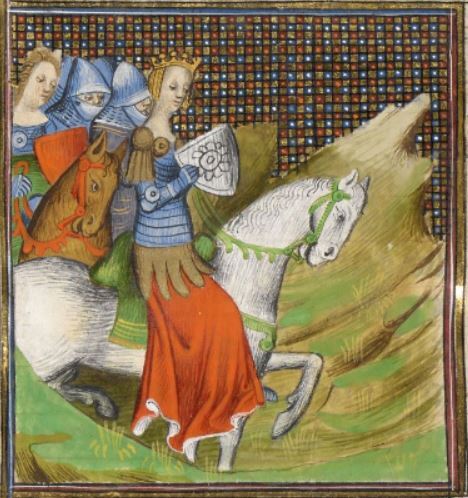
This image depicts Orithya and Antiope, the queens of the Amazons, riding on their horses while suited in armor. They are depicted not wearing helmets in order to differentiate them from the other Amazon women behind them. The queen in the front is also depicted wearing a crown to symbolize her royal status.
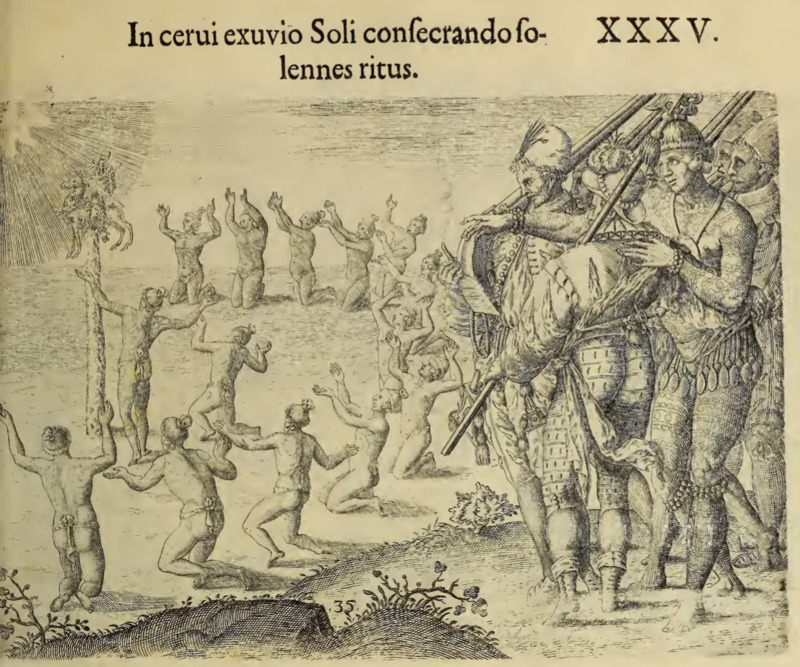
In the foreground, several colonists stand with an Indigenous man. The Indigenous man wears an adorned loincloth and bracelets around his wrists and knees. His skin is covered in tattooed or painted designs. To the left of the men, a group of Indigenous people kneel on the ground in a semi-circle with their arms outstretched or raised above their heads. At the center of the circle there is a log standing on end. Two Indigenous people are beside it, one standing and one kneeling, both with their arms raised. In the upper left corner, the sun is shown, with the remains of a deer in the sun beams.
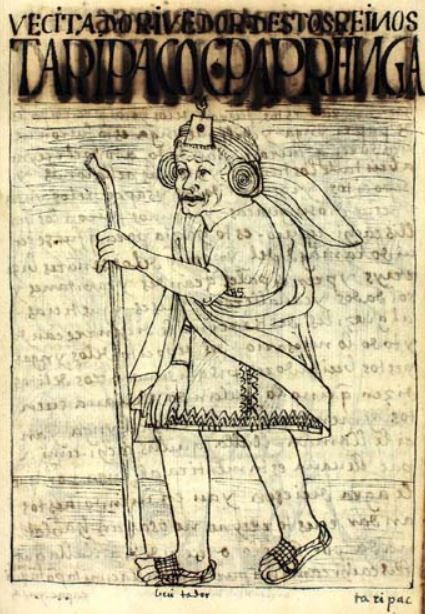
This chapter discusses the system of administrative officials in the Inca Empire. This image depicts the taripacoc [inspector] standing in the centre of the image wearing ear ornaments and holding a walking stick in his left hand. The inspectors were responsible for checking in on communities, storehouses, tambos [housing for royal officials], and nuns in the empire. The author explains that these officials would make up false stories and lie to the Inca about what they would find on their inspections in order to gain the Inca’s favour.
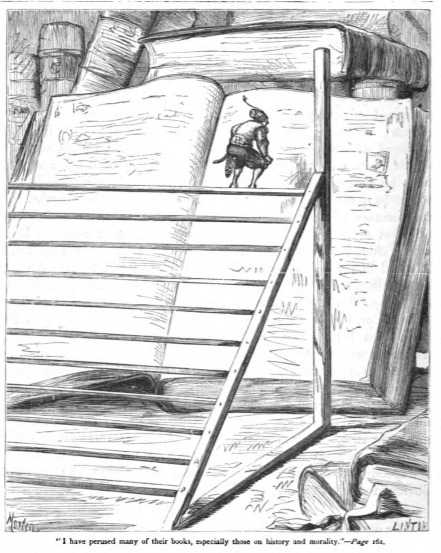
Here Gulliver reads books on Brobdingnag. Gulliver climbs a ladder to be closer to the text. He read widely in the royal library but was particularly interested in books on the history of the giants of Brobdingnag, and philosophical texts on morality. He did this to better understand how the giants of Brobdingnag differed from Europeans.
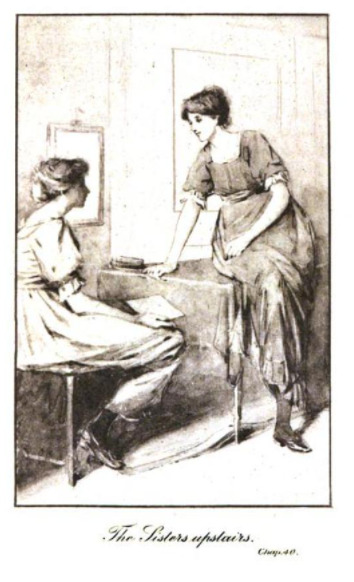
Here we see Fanny with her younger sister, Susan. When her brother William was on leave from the navy after being promoted to lieutenant, Fanny went home to Portsmouth to see him. She then stayed in Portsmouth for almost three months, visiting her parents and younger siblings. She learned quickly that she much preferred the quiet of Mansfield to the loud bustling of her small family home in Portsmouth. While she was there, she became close friends with her sister Susan, who was four years younger than herself. They shared a room, and Fanny taught Susan manners and read with her. When Fanny returned to Mansfield, Susan went with her, and after Fanny’s marriage to Edmund, Susan took her place as her Aunt Bertram’s companion. This scene occurs in chapter 40 as noted underneath the title of this image. The characters are shown in the traditional regency style, with Fanny and Susan wearing the regency style dress with an empire waist, and their hair is worn tied up. The regency period dated to the early nineteenth century (1811-1820) when George, Prince of Wales, later George IV (r. 1820-1830), reigned as regent for his mentally ill father, King George III (r. 1760-1820). The regency period is associated with the rise of neoclassicism in art and fashion. The same image appears as an insert between pages 170 and 171 for the Dent 1893, 1894, 1895, 1896, and 1897 editions of Mansfield Park.
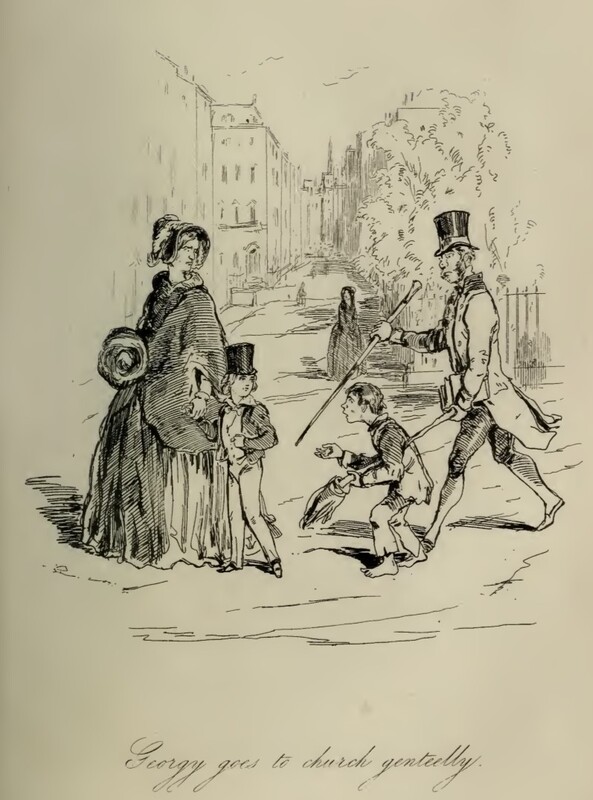
Georgy Osborne in a top hat and suit, holds onto his aunt Jane Osborne’s hand, turned to face the boy who has come up behind him. He is a young sweep, barefoot and with ragged clothes, begging for money. The footman, carrying the church books, is behind the sweep, trying to drive him away with a cane. In the background is Amelia Osborne, who was going for a walk on the cross-street to the one the others are taking to church, watching proudly as her son gives money to the sweep. Below the illustration is printed in cursive its title, Georgy goes to church genteelly.
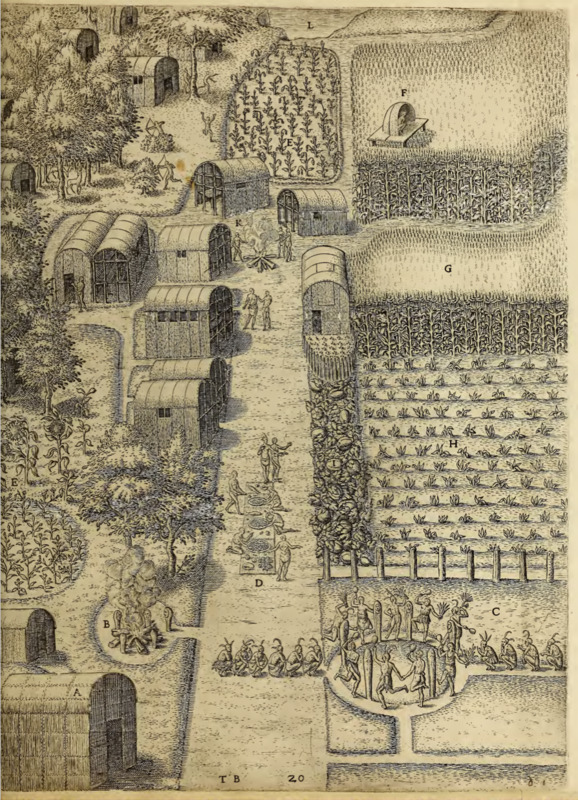
The Indigenous town of Secota is pictured. Multiple structures are grouped along a flattened path. There are cultivated fields all around the structures where corn and other crops are seen in varying stages of growth. There are several bonfires, and in the centre of the village several individuals are grouped around a meal. There is a dance circle where a ceremony is taking place, several people sit and others dance. Elsewhere a few individuals hunt or practice with bows and arrows.
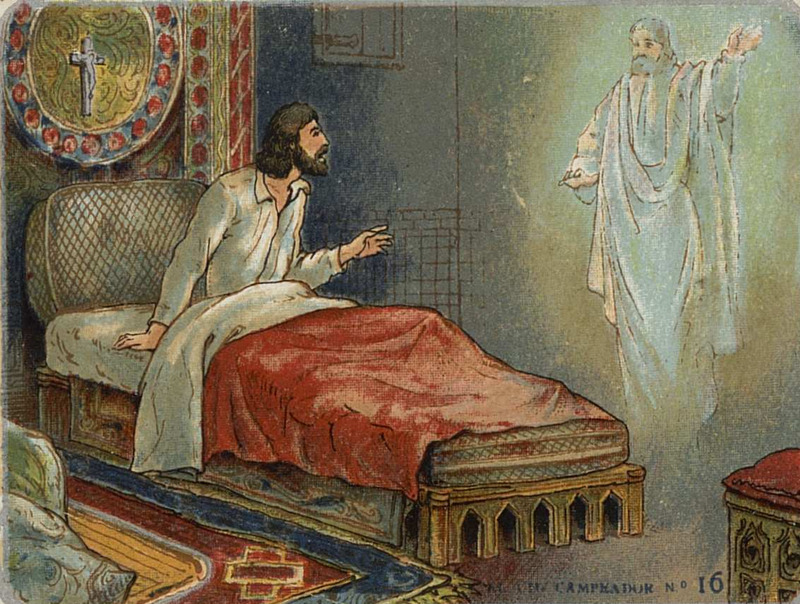
In this image El Cid is in bed and visited by the celestial apparition of S. Lazarus. El Cid is wearing a white nightshirt and he has a brown beard and hair. He is lying in his bed. His bed has red sheets and has a pillow. On top of his pillow is a plate with a cross at the middle. It is golden in the middle of the plate and red with silver around the plate. The ghost is transparent and wearing a long cloak. He has a beard. On the floor there is a red, blue and yellow carpet. On the far right of the image there is a wooden box with a red cushion on it.
Here we see Gulliver sitting on a couch speaking with Captain William Robinson, who was the Commander of the Hope-well. Robinson asked Gulliver to join him on his trip to the Levant, working as a surgeon. Gulliver agreed and the set sail two months later. In this image we see the two men sitting on a couch together. In the background we see a telescope, Gulliver’s hat, and a map on the wall, and a pot of tea sitting on a table next to the couch. The same image appears in the 1843 Krabbe edition.
A group of Indigenous men, women, and children gather around two large pots, one sitting on the ground and one resting on a fire. The group cooks and eats meat and fish. Two individuals sit in a large hammock while the rest sit and stand on the ground around the pots. One structure is visible in the background. This image is identical to one found on page 930 verso of Paris, 1575 (Chaudière), and in Thevet’s Les Singularitez de la France Antarctique (page 57 of Paris, 1557 and page 57 of Paris, 1558).
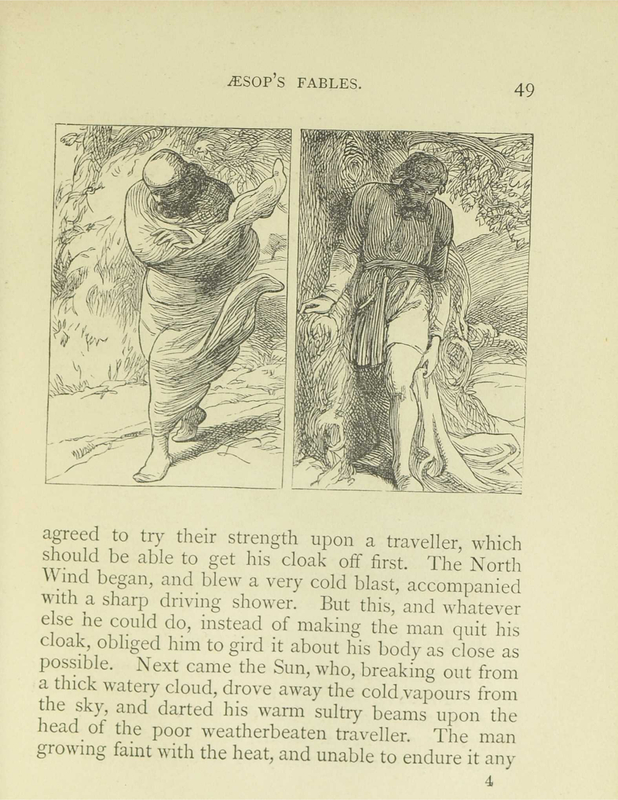
On the left we see a visual representation of the wind by the figure with loose clothing draped across and appears to be blown back as they try to walk forward. There is lots of foliage in the background as well to suggest a forest scene. On the right we can see the visual representation of the sun shown by the figure leaning up under a tree with the shadow cascading along their body with the left leg stuck out into the sun, which is shown with a brighter value, no hash marks. Besides the tree on the left there is also some foliage in the background of this image as well.
After murdering Celestina, Pármeno (lying dead on the stretcher) and Sempronio (on his knees in the foreground) jump from a third storey window in her house and are captured by the alguacil’s (justice’s) men. The justice then sentences them to execution by public decapitation. Crowds gather to witness the proceedings (as seen in this illustration). Sosia, one of Calisto’s servants, witnesses the event and rushes to inform his master. Tristan, another of Calisto’s servants, sees Sosia walking toward the house in tears and asks him the nature of his sorrow. Sosia explains the events that had unfolded. They ascend to Calisto’s bedroom and inform him of the tragic news, and he becomes melancholic. When he asks the cause of their execution, Sosia explains that they murdered Celestina because she would not give them their share of Calisto’s gold chain. Calisto blames the unfortunate circumstances on Celestina’s treacherous and deceptive ways.
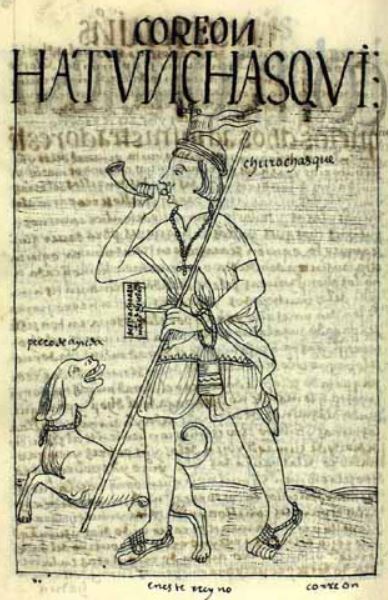
This image depicts an indigenous messenger boy in Spanish colonial Peru. The messengers were responsible for being royal couriers and delivering mail to the king’s offices around the kingdom. He is illustrated standing in the centre of the image blowing through a horn as he holds a letter in his left hand. There is a bag strapped to his wrist and he is also holding a ceremonial staff in his hand. There is a rosary around his neck, and he is wearing a headpiece that has a cross and a flag on it. There is a dog running alongside the messenger who is labelled as, perro de ayuda [help dog]. The letter that the messenger is holding reads, despacho a su magestad deste rreyno [dispatch to his majesty of this kingdom].
When Gulliver arrived on Luggnagg he was informed that the ship to Japan would not be ready to depart for another month, and so he should take a trip to the nearby island of Glubbdubdrib, which was the island of sorcerers. Gulliver agreed and was greeted by the Governor of Glubbdubdrib, who was a necromancer. The Governor could resurrect anyone he wanted for twenty-four hours and have them in his service. In this image we see Gulliver’s arrival at the palace, which was surrounded by guards whom Gulliver describes as strange or grotesque. Gulliver is seen here on the left, walking between rows of guards all of whom were much taller than he was, and wearing several types of uniform. One reason for these variations in uniform might be that the guards were people from different eras or locations who were resurrected by the Governor and were therefore wearing the uniform that suited the era in which they lived. The same image appears in the 1843 Krabbe edition.
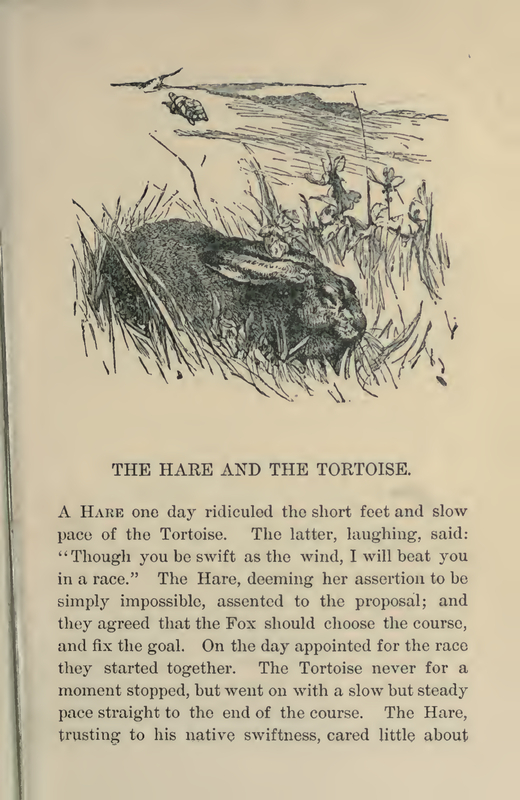
A large hare is lying in the grass in the fore ground. Its long ears are bent backwards, and its eyes are slightly closed, it looks as though the hare is sleeping. In the background, a tortoise is lounging on the sand near the shore, its little head looking in the direction of the sleeping hare.
Sambo, Mrs. Blenkinsop, and the cook stand at the landing-place outside the drawing room to listen to Amelia Sedley and Rebecca Sharp sing. In the background is another figure in uniform, possibly a page boy.

![[The Wolf and the Dog]](https://collections.cemvc.ca/files/large/6d904d6d9789ebe8f5c8f56ba32196253b3d9004.jpg)
![[Vanity Fair Chapter II Inhabited Initial]](https://collections.cemvc.ca/files/large/1be270c2490bb96cd16c4486c21c9203ed0ab4e2.jpg)
![[Gulliver speaks with Captain William Robinson]](https://collections.cemvc.ca/files/large/7a08dfcdb6dccbd33b6dbbeb3b80b3c42ed62b1c.jpg)
![Comme[n]t les Sauuages boivent & mangent.](https://collections.cemvc.ca/files/large/8148d251a8cff6b5f6855513a6a4dae1ba92c07e.jpg)

![[Act XIII – Many Bystanders Observe as Sempronio Is Executed in Front of Pármeno, Who Lies Dead Behind Him]](https://collections.cemvc.ca/files/large/dc99b00563ba3df9a9f184d6ffe4d0e9b9b7e170.jpg)
![[Gulliver arrives at the Palace at Glubbdubdrib]](https://collections.cemvc.ca/files/large/2597f6133b46630749e2f7f8eb0b312629fa19ed.jpg)

![[Listening at the Drawing-Room Door]](https://collections.cemvc.ca/files/large/e68f4b90b11ef5af36b0791d8633372485c1755b.jpg)