This image is illustrated in a chapter that discusses and criticizes the government and society in Spanish conquered Peru. This image depicts a Spanish Corregidor [Magistrate] hosting a dinner with lower-class people. The Corregidor is illustrated on the far left of the image drinking out of his cup. The word corregidor is written on his armchair. There is writing on the Corregidor’s arm which reads, brindes [...] senor curaca [toast to you, senor curaca]. A curaca was an official in the Inca nobility. The two men sitting on the left side of the Corregidor are identified by having mestizo and mulato written on their hats. The indigenous man on the far right of the image is identified as yndio tributario [tributary Indian]. There is writing on his arm that reads, apo, muy sino, noca ciruiscayqui [Lord, I am here to serve you]. There is also a child depicted in front of the table who appears to be serving the table. The author criticizes the Corregidor for dining with lower-class people as he believed people should dine with those of their own status.
In this image Gulliver floats in a bowl of milk. Glumdalclitch is seen behind the bowl as is the Queen’s dwarf, who threw Gulliver into the milk out of jealousy. A piece of bread and a spoon sit next to the bowl. The same image appears in both the 1839 and 1843 Krabbe editions.
Here we see Gulliver playing the piano in Brobdingnag. The piano is over sixty feet long, so Gulliver devised a new way of playing using two round bars. Gulliver used this method to play traditional English songs for the court of Brobdingnag. Gulliver stands on a raised bench. The king and queen look over the edge of the piano, watching Gulliver perform. The same image appears in the 1839 Krabbe edition.
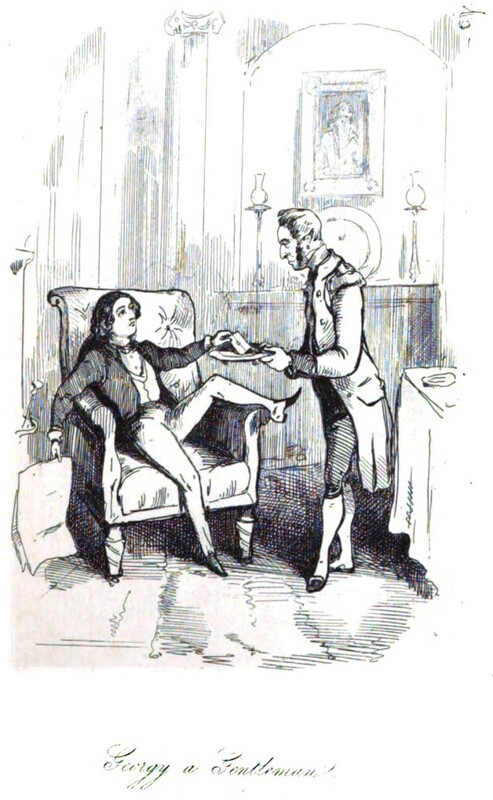
Georgy Osborne lounges in an armchair, with one arm dangling a sheet of paper over the side and the opposite leg up over the arm of the chair. He is taking with his other hand a letter which a serving man has presented to him on a platter. Behind the serving man is a table, and on the wall is a portrait between two lanterns. Below the illustration is printed in cursive its title, Georgy a Gentleman.
A man stands holding a drum in his hands with a horse carrying luggage on its back while walking outdoors. In the background there is a tree and a bush on the hills. The man is hitting his drum and the horse is looking down at the ground while walking.
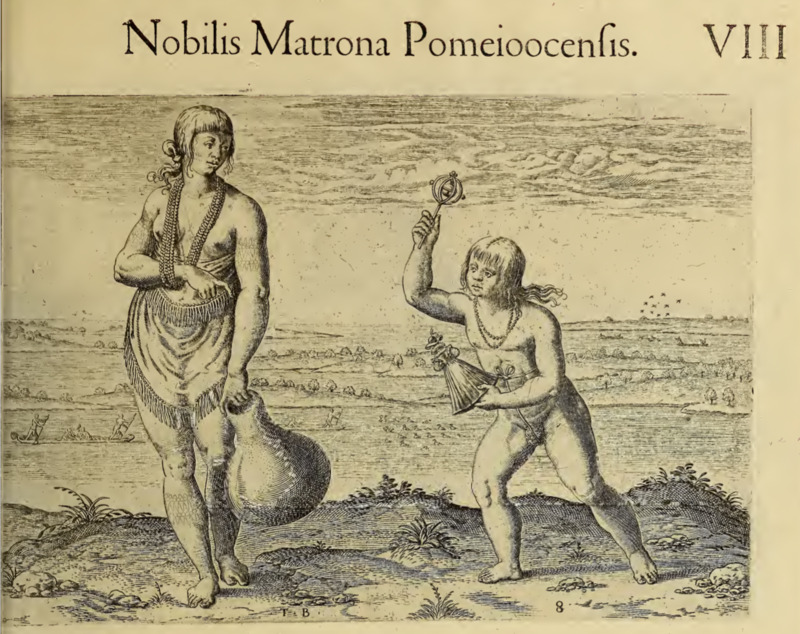
An Indigenous woman, a chief, is pictured standing on the bank of a river. Her hair is knotted at the nape of her neck, she wears several strands of beads around her neck, and her right wrist is cradled in the beads. She wears a fringed skirt around her waist and is topless and shoeless. She holds a large pot/container in her left hand. Beside her is a child, nude except for two strands of beads around their neck. The child holds a doll dressed like an English lady in one hand, and an object similar to a rattle in the other. Behind the pair, other Indigenous people are seen in canoes.
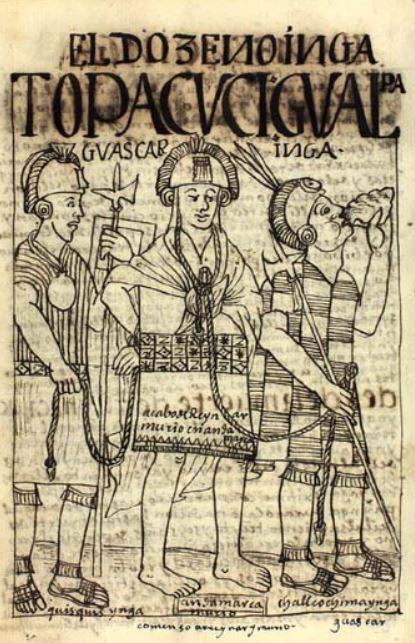
This illustration depicts the twelfth and final king of the Inca Empire, Topa Cusiwualpa Wascar, standing in the centre of the image. In this image, he is depicted being taken as a prisoner by his enemies. His hands are bound behind him and the two men on either side of him are holding the ropes attached to him. There are words written on his tunic which reads, Acabó de rreynar, murió en Andamarca which translates to His rule ended, he died in Andamarca. There are words written at the bottom of the image under the feet of both of his captors. These are the names of his captors, with the far-left figure being identified as Quisquis Inca and the figure on the right is identified as Challcochima Inca. The words written at the bottom which are outside the image border reads Comensó a rreynar y murió which translates to He began to rule and he died.
Here we see Gulliver and the Sorrel Nag building a boat that Gulliver would use to leave the Country of the Houyhnhnms. The Council of the Houyhnhnms told his master that Gulliver either had to live with the yahoos or return to Europe but could not live with the Houyhnhnms any longer. Gulliver was shocked by this, and decided he had to leave rather than live with the yahoos. Gulliver was given two months to build a boat to leave the country. The same image appears in the 1839 Krabbe edition.
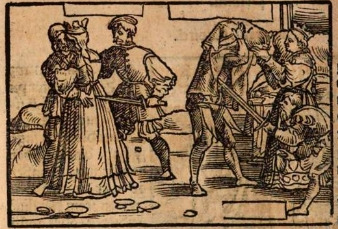
Queen Clytemnestra of Mycenae is depicted on the right side of the engraving putting a sweater on her husband, Agamemnon. The person sneaking up beside Clytemnestra is the person she has been having an affair with: Aegisthus. Aegisthus and Clytemnestra conjured a plan to kill Clytemnestra’s husband, King Agamemnon, in order to gain control of Mycenae. Clytemnestra gave Agamemnon a piece of clothing that had no neck hole. As he struggled with the garment, the adulterer Aegisthus pierced Agamemnon with a sword, as depicted in the image. Orestes, the son of Agamemnon and Clytemnestra, sought to avenge his father’s death. He is depicted on the left side of the engraving killing both his mother and Aegisthus while they share an embrace.
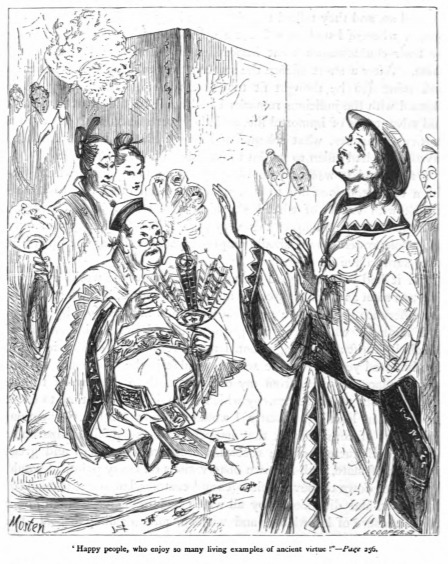
Here we see Gulliver’s initial excitement at the prospect of being born as an immortal on Luggnagg. He rejoiced at the idea that people could carry ideas of virtue from the past to the modern times. He soon learned, however, that the quality of life of these immortals declined steadily as they aged.
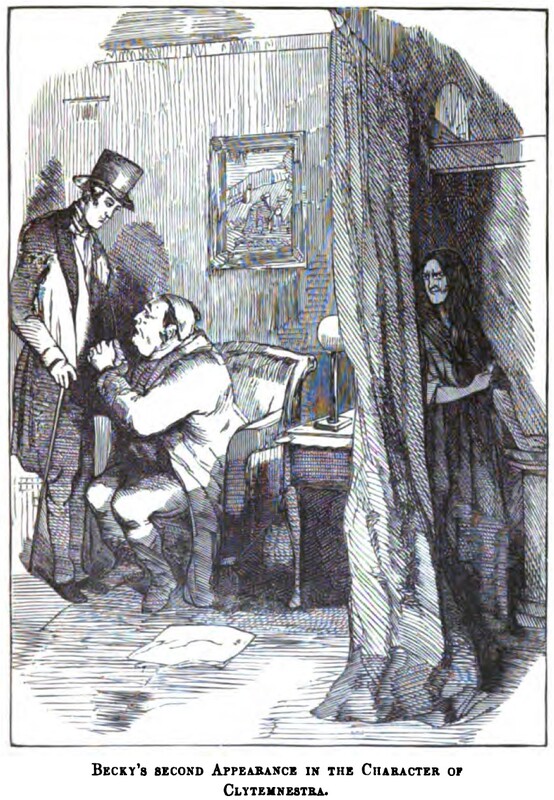
Joseph Sedley sits in a chair, begging William Dobbin, now his brother-in-law, to come and live near him, or else help him escape to India without Becky finding out. Dobbin was sent there by Amelia, who is worried about her brother after finding out that he has purchased a large life insurance policy. Behind a curtain on the far side of the room is Rebecca Crawley, listening in and holding a dagger in one hand. Below the illustration is printed in cursive its title, Becky’s second Appearance in the Character of Clytemnestra..
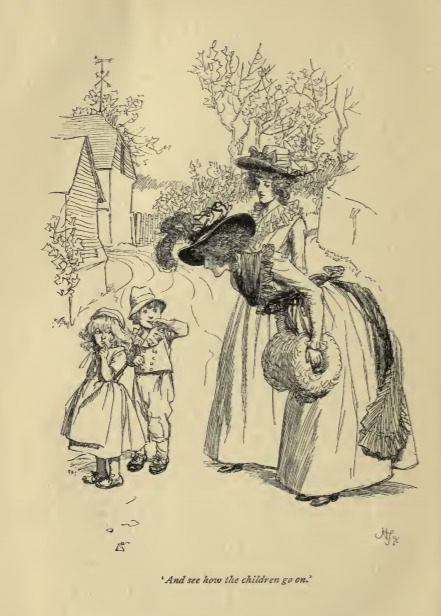
In this image Elinor and Marianne walk through the streets of Barton and speak with the children there. This scene occurs while Marianne and Elinor talk about what they will do once Marianne has fully recovered from her illness. This scene occurs in chapter 46. The characters are shown in the traditional regency style. Marianne and Elinor wear regency style dresses with empire waists. They wear bonnets and carry muffs. The regency period dated to the early nineteenth century (1811-1820) when George, Prince of Wales, later George IV (r. 1820-1830), reigned as regent for his mentally ill father, King George III (r. 1760-1820). The regency period is associated with the rise of neoclassicism in art and fashion.
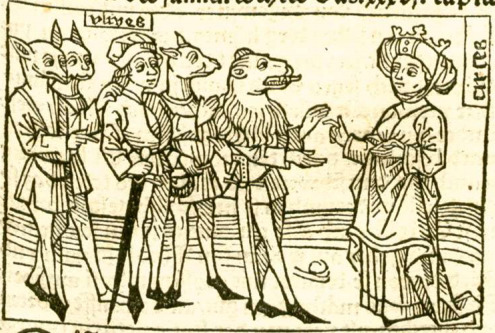
This engraving depicts Circe, the daughter of the Sun, on the right side of the engraving. We know that this is Circe as her name is engraved beside her body. Boccaccio explains that Circe was skilled in the art of magic and would often turn people who landed on her shores into animals. When Ulysses and his men happened upon Circe, she transformed Ulysses’ companions into beasts. They are depicted in the engraving with their bodies still in human form, while their heads are changed into animals such as lions and pigs. Ulysses is the one man among them that is still in human form (his name is engraved above his head). Ulysses threatens Circe with his sword, and she eventually changes his companions back into their original forms.
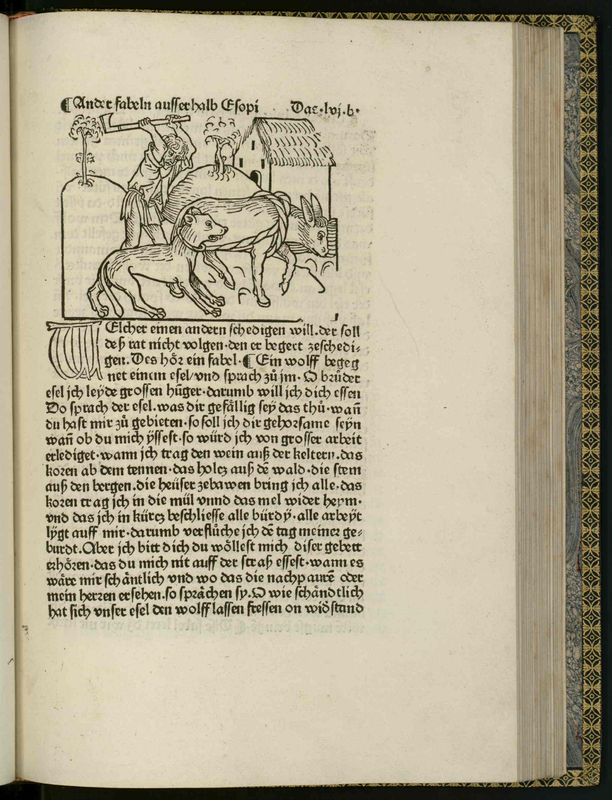
In the middle of the image, there is a donkey with ropes around his body connected like a leash to a wolf. The donkey is dragging the wolf forward. Behind them there is a man with an ax about to hit one of the animals. On the upper left side of the image there is a house.
Here we see Gulliver in his boat, preparing to leave Blefuscu and return to England. Gulliver found an abandoned boat off the shore of Blefuscu and he refurbished it and sailed away and was eventually picked up by a larger ship. Five hundred workers were tasked with making sails, and between ten and thirty cables were twisted together to make rope for the boat. Gulliver made masts, rudders, and oars out of trees, and water-sealed the boat with fat from three hundred oxen. Gulliver was given provisions by the Emperor and he set sail.
Here we see several types of reptiles and insects, including a snake, a spider, a slug, a worm, a caterpillar, and two lizards. They are shown because following Gulliver’s explanation of the various political and legal traditions in England, many of which were very corrupt, the King of Brobdingnag compared the English and their nobility, politicians, lawyers, among others to vermin. The same image appears in the 1843 Krabbe edition.
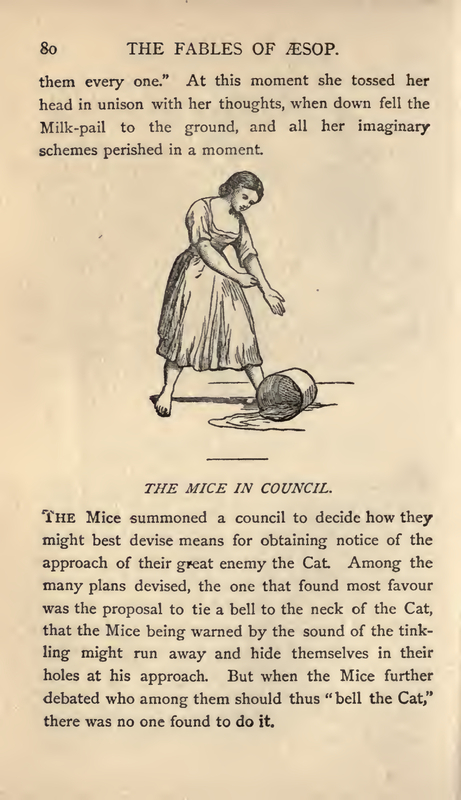
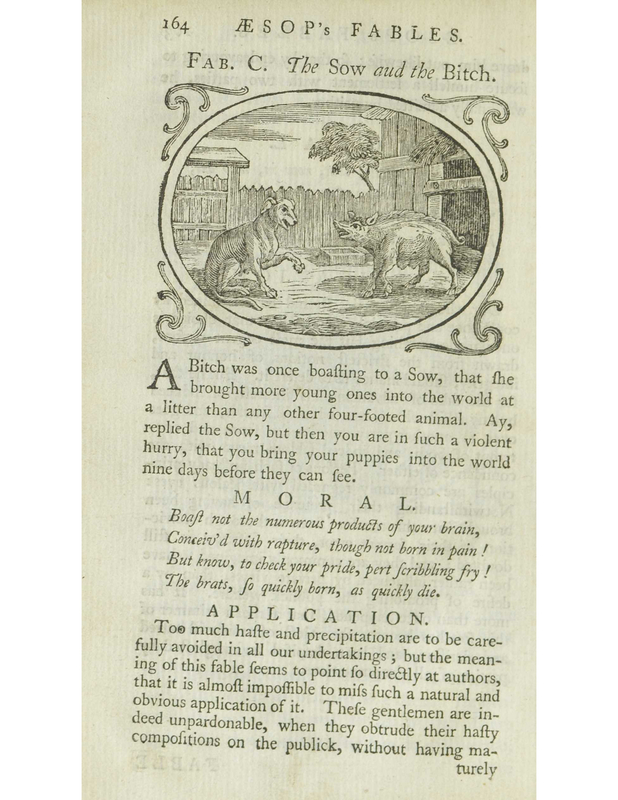
On the left side of the image, a female dog is sitting down with one front paw raised, facing the right. On the right side of the image is a mother pig looking in the direction of the dog. In the background there is a barn with a connected fence, with a tree looming in the distance.
Here we see Gulliver attending to a concert given by the king of Brobdingnag. Gulliver stands at the window and holds his fingers in his ears because he found the music too loud. In the background we see a musician playing an oboe, with a trombone slide, a bass drum, and the bell of a trumpet visible behind him. The same image appears in the 1839 Krabbe edition.

![Q[ve] el Coreg[id]or Conbida en su Mesa a Comer a Gente Vaja, Yndio mitayo, a Mestizo, Mulato y le Honrra](https://collections.cemvc.ca/files/large/e8da2f6a6df508a572eb2d2bb6398c1446f94218.jpg)
![[Gulliver floating in a bowl of milk]](https://collections.cemvc.ca/files/large/f34da661c8265d79349e320c633e4f58ce12f7e9.jpg)
![[Gulliver plays piano using sticks on Brobdingnag]](https://collections.cemvc.ca/files/large/dc737699213ad5713be10f9179b37c7a798e2bb1.jpg)
![[The Luggage Horse and Man]](https://collections.cemvc.ca/files/large/ea54c830e1c9cd4bf2c23f52b69427829036905e.jpg)
![[Gulliver builds a boat to leave the Country of the Houyhnhnms with the help of the Sorrel Nag]](https://collections.cemvc.ca/files/large/2dcc54df9ba90041a673ddc02d47f15400ae9fb9.jpg)

![[Vanity Fair Chapter L Inhabited Initial]](https://collections.cemvc.ca/files/large/e95113a154554127950aa6f71f61877d57f405bc.jpg)
![[Gulliver in his boat, ready to sail home to England]](https://collections.cemvc.ca/files/large/4ef752526d5d697a44a2b451e8275ff67cdd12e7.jpg)
![[Several types of reptiles]](https://collections.cemvc.ca/files/large/9559d7f92e932a1f11216a1230b7a8f522c6da25.jpg)
![[Gulliver attends a concert Brobdingnag]](https://collections.cemvc.ca/files/large/56c3091e0fde870ecfd4e618b551dcd7a28784c3.jpg)