Mrs. Maria Bullock sits in her chariot, looking haughtily away from her nephew Georgy Osborne as he rides by. With her are her husband and their three children, who are looking out the window at their cousin. The carriage has a fancy lantern attached to the window and is decorated on the side with the image of a bull.
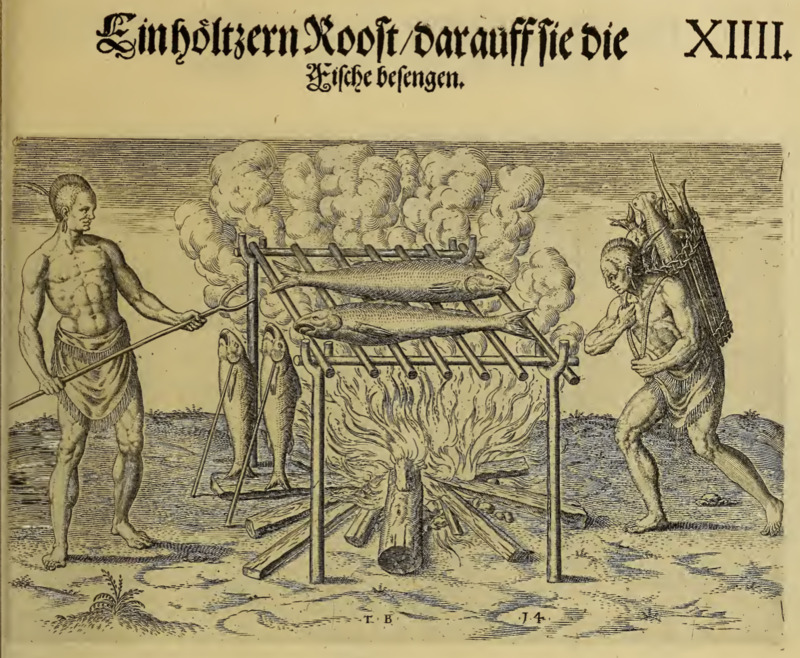
Two Indigenous men are shown cooking fish over a fire. Two fish are laid out on a rack over the flames, two others are propped up with sticks tail-down on the ground by the fire. The rack is composed of four forked sticks propped vertically on the ground, with four others forming a square horizontal to the ground, and five more laid across the square forming a rack. One of the men holds a forked stick, the other carries a basket of fish slung across his back. Both men wear fringed garments tied around their waists and have a single feather in their hair.
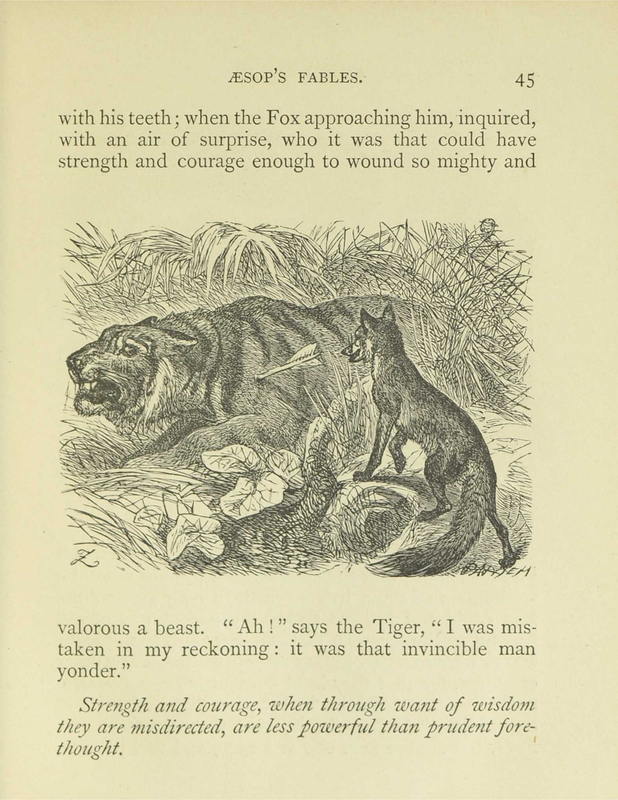
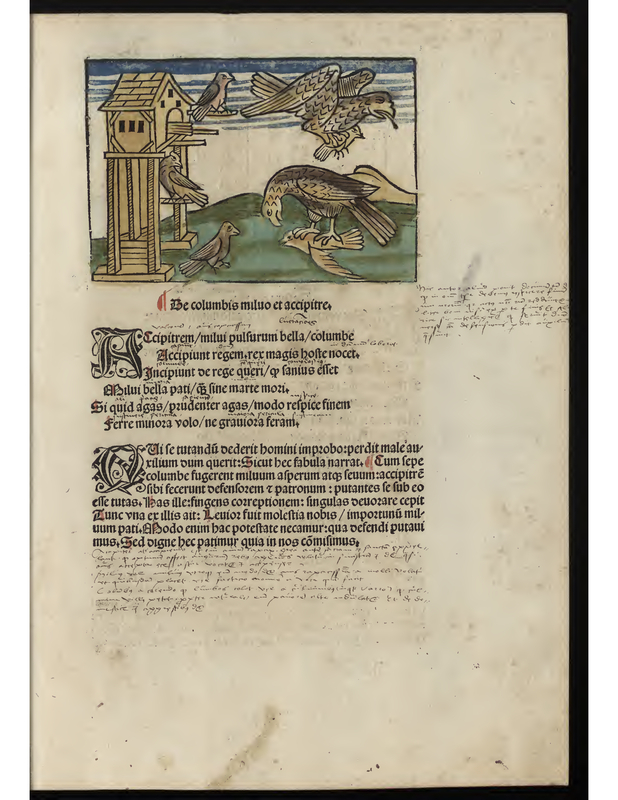
A tiger lays down in an overgrown field, looking in distress, with an arrow sticking out of its left shoulder. In the foreground a small fox perches atop a higher point and looks out curious at the tiger in need, lots of tall foliage stands around them.
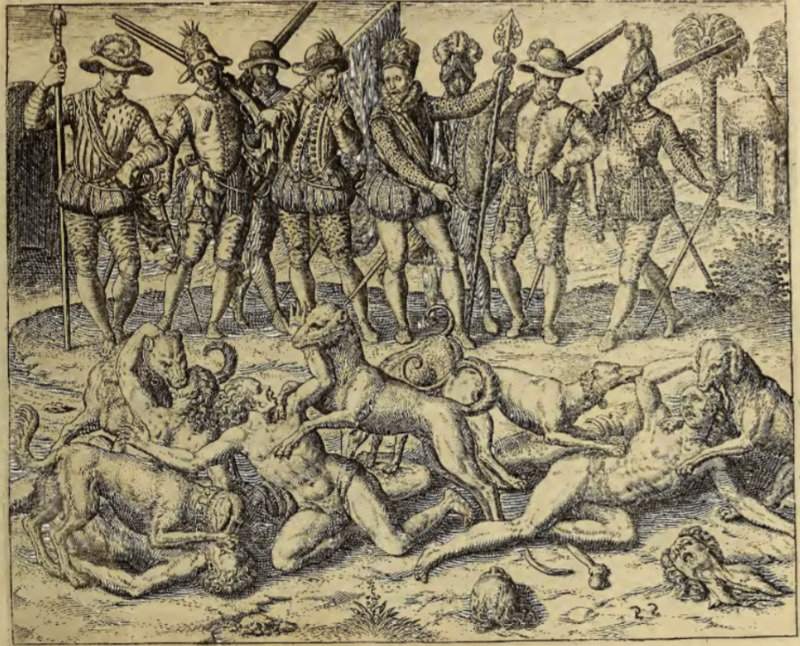
Spanish colonists punish Indigenous men for engaging in sex with other men. Several Indigenous men on the ground try to fend off hunting dogs which have been unleashed on them. The dogs bite at the surviving men; several men have already been dismembered and killed by the dogs. A group of Spaniards stand nearby, watching the vicious attack. The men are finely dressed, and carry muskets, swords, spears, and a flag or banner. In the background, at least two dwellings are visible. This image is identical to one found on page 191 of Frankfurt, 1594.
Here we see Gulliver and the Governor of Glubbbdubdrub, who was a necromancer. The two men stand on a balcony and the Governer asked Gulliver what he wanted to see. Gulliver responded that he wished to see Alexander the Great after the battle of Arbela. Alexander appeared in the field under the balcony and called up to Gulliver, speaking Greek. Alexander said that he died of fever from excessive drinking, not by poisoning. Alexander the Great was a Macedonian King from 336-323 BCE. Alexander conquered Greece and Egypt and at the battle of Arbela he defeated Darius III, the King of Persia, in 331 BCE. Rumors at the time of his death said that he had been poisoned, however, Plutartch’s Lives, said that he died of fever, which Alexander corroborates, as this is a more honourable death than dying by poison. The same image appears in the 1843 Krabbe edition.
Here we see a dying Houyhnhnm travelling around visiting its friends before it dies. It travels in a sedan chair carried by yahoos. These chairs were also used when a Houyhnhnm was aging, ill or injured. The same image appears in the 1839 Krabbe edition.
Here we see Gulliver in his room on the Country of the Houyhnhnms. His room was built about six yards from the main house and made of clay. Gulliver had mats made of rush plants, and a mattress made with hemp and filled with feathers. In this image we see Gulliver cleaning his house. He wears clothes of leather made from the dried skins of yahoos. The same image appears in the 1843 Krabbe edition.
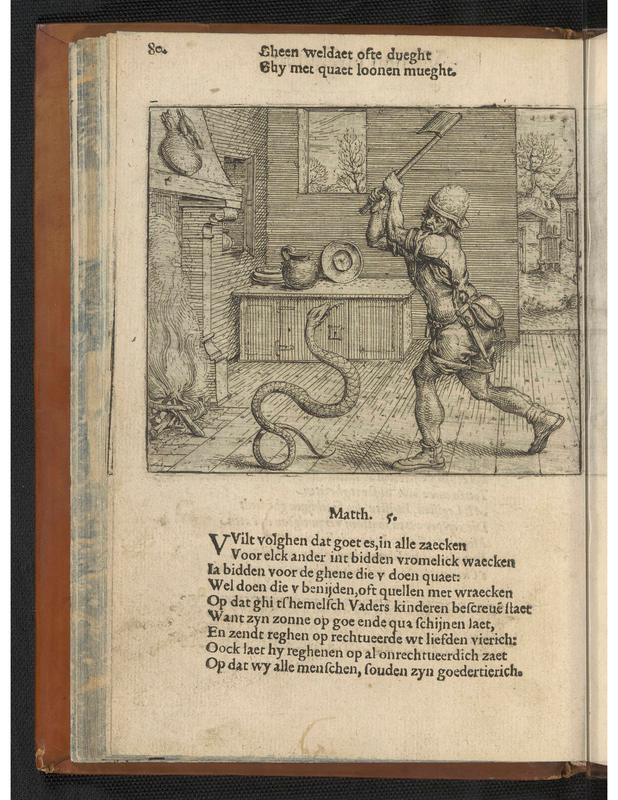
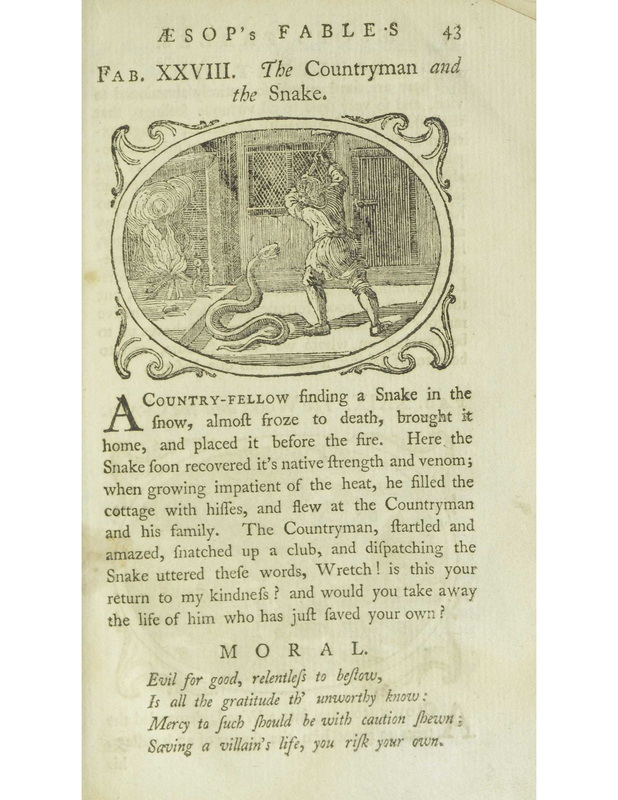
A man stands before a large, hissing snake with an axe in hand, preparing to strike. A fire is ablaze in the background underneath a wooden structure, next to a house with gates in the window.
A group of Indigenous people sit on the ground in a semi-circle. A man dances in the middle of the group. In the background, the body parts of the defeated enemies have been mounted on poles that have been stuck into the ground as trophies. In the foreground an Indigenous man stands with a few colonists. This illustration is identical to the one found on page 67 of Frankfurt 1591, but colored.
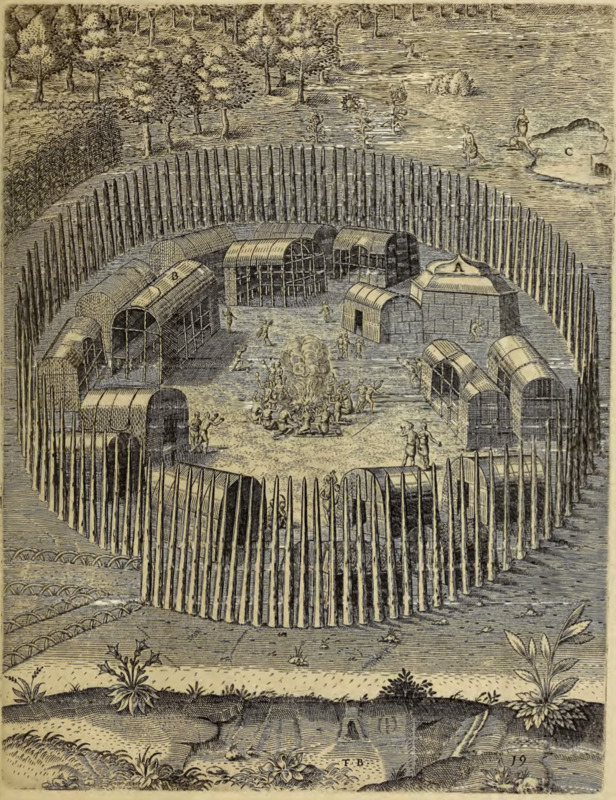
The Indigenous town of Pomeiooc is shown. Multiple structures are arranged in a circle. At the centre of the circle is a large bonfire, and surrounding the structures is a fence of tall poles stuck into the ground. There is one gap in the poles that serves as an entrance. There is a cornfield to the left of the village.
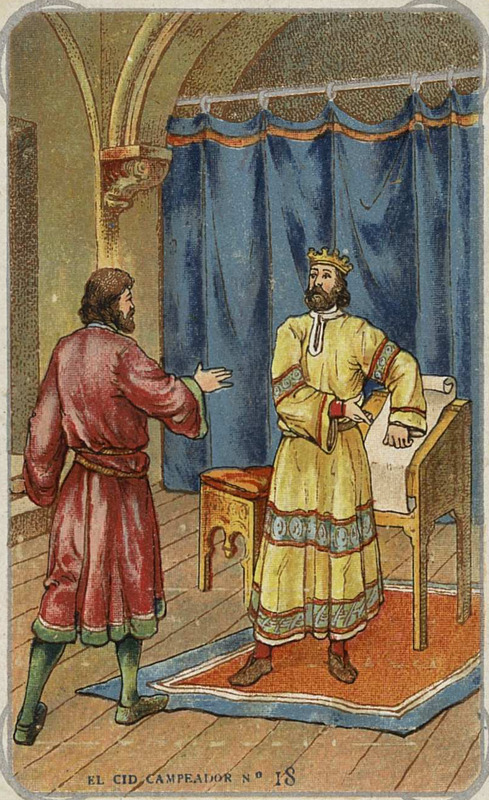
In this image there are two men, El Cid and the king Sancho. EL Cid is wearing red robes. He has a brown beard and hair. The man in front of him is Don Sancho and he is wearing yellow robes with blue and red patterns on it. He has a brown beard and hair. On his head stands his golden crown. He has his arm on a desk behind him. On this desk there is a white parchment. Next to the desk there is a stool with a red cushion on it. Behind the king in the background there is a blue curtain. At the foot of the king there is a red blue and white carpet.
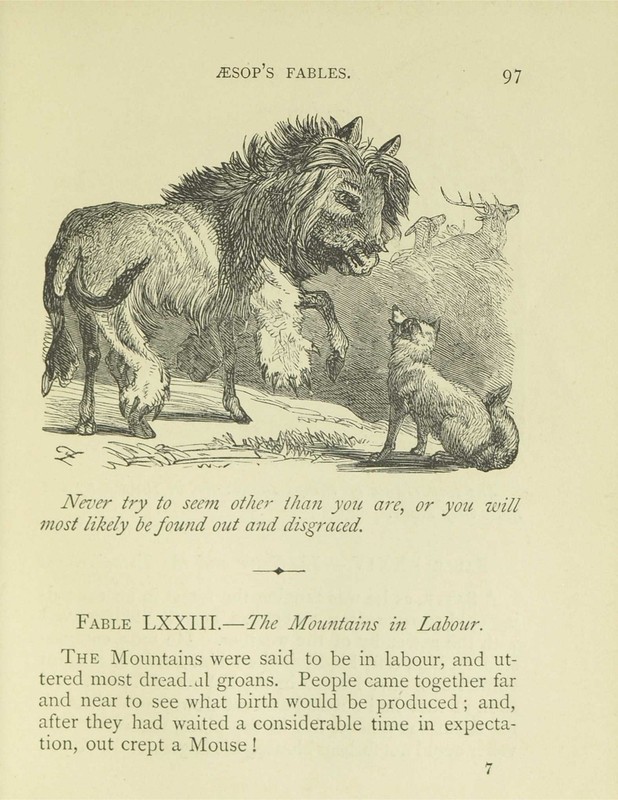
A large donkey stands in the left part of the image. It wears a lion costume, the limbs of the costume hanging awkwardly, the tail hanging still. The tail, limbs and face of the donkey are obviously visible. The donkey looks at a fox sitting to its right. The fox looks up at the costumed donkey. Behind them a cluster of deer run away.
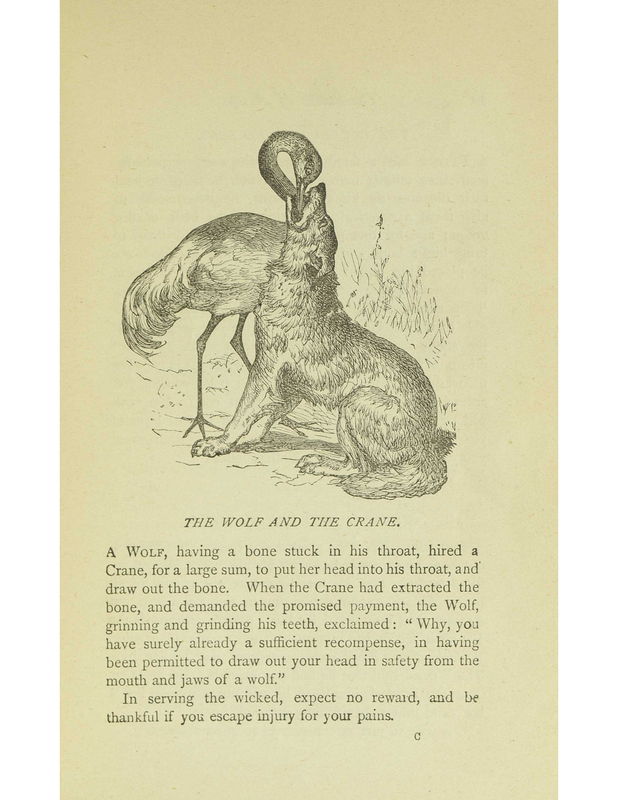
A wolf is sitting down, front legs stretched out slightly, its head bent backwards as a crane is sticking its long beak inside of the wolf’s mouth. The wolf is not trying to attack the crane, thus insinuating that the crane is helping the wolf.
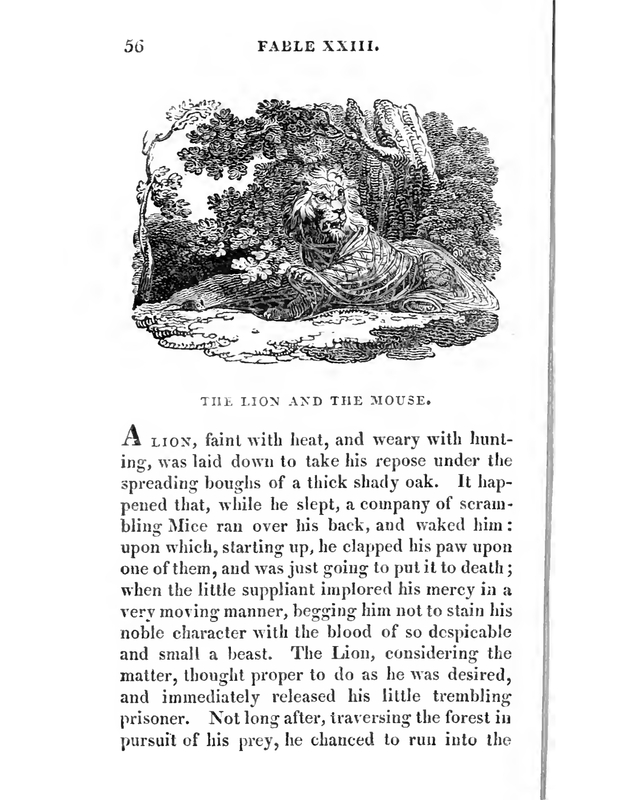
A Lion laid down under the spreading boughs of a thick oak. His face was in high altered when woken up. His eyes were filled with fierceness and his mouth opened with two visble canines. His left paw was above the ground. On his left was a Mouse. He was frozen and faced towards the lion, yet remained unharmed.
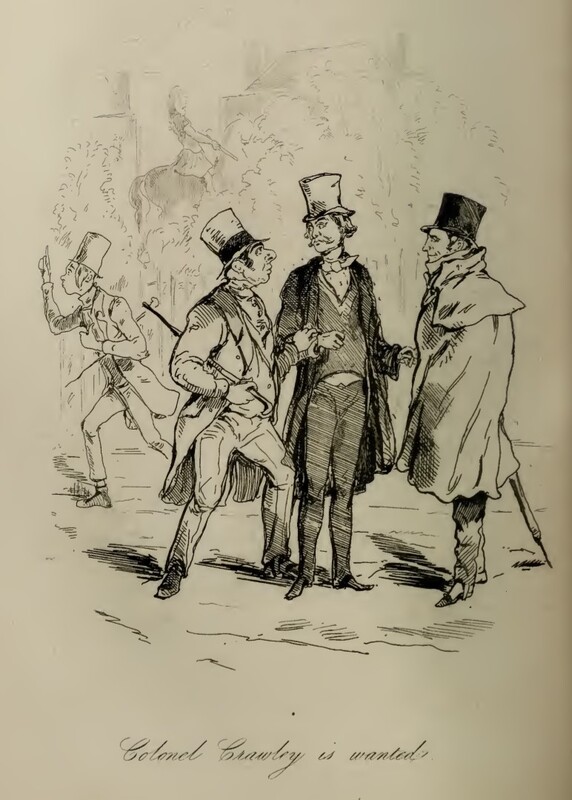
Rawdon Crawley stands with Mr. Moss and his assistant each holding one of his hands. They have come to collect his debt to Mr. Nathan. In the background Mr. Wenham, who has no money to lend him, is leaving with his hand raised and his cane tucked under his arm. Below the illustration is printed in cursive its title, Colonel Crawley is wanted.
This image is a depiction of a court scene from Gulliver’s Travels, likely to the land of Glubbdubdrib. The image appears to depict a stage, as there are curtains along the top of the image, with lights lining the bottom of the stage, denoting the difference from the stage and the man, likely Gulliver, who observes the king and a courtier on the stage. A wall separates Gulliver from the other characters. Statues in the Classical or Neoclassical style line the walls of the hall, with stairs at the back leading to a throne. This image also appears in the 1746 von Wiering German edition of Gulliver's Travels.
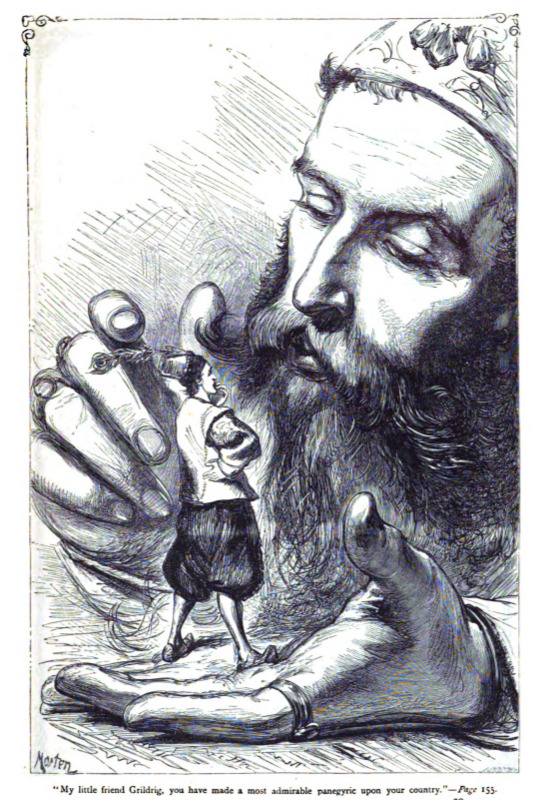
Here the King of Brobdingnag holds Gulliver in his hand as Gulliver tells him about the customs and traditions of England and elsewhere in Europe. Gulliver’s name in Brobdingnag was ‘Grildig’. The King found several English customs to be very bizarre and laughs as Gulliver explains them. The two often debated the correct manners for policies and running a country.
A boy kneels before a black man, likely either a teacher or judge, with his hands together in entreaty. The man is dressed in a black robe and tasseled cap, holding a short-handled broom. In the background are many other boys, some smiling, some with expressions of shock. In the top right corner of the image is the letter W from Whatever.
In the middle of a room, a man raises an axe toward a snake that prepares to lunge. A fire is roaring in the fireplace, and the door to the house sits open.

![[The Bullocks in Their Carriage]](https://collections.cemvc.ca/files/large/2379c8967e01c4b7f097e38f772f8d89f64ef9f1.jpg)
![[Osborne and Amelia at the Piano]](https://collections.cemvc.ca/files/large/1ef0ca5f34cad25a9baf454515a5af59487f67b5.jpg)

![[Gulliver and the Governor of Glubbdubdrib look over a scene of the victory of Alexander the Great]](https://collections.cemvc.ca/files/large/a200ce5e6c49c78558071c871ef503e5793332d0.jpg)
![[a dying Houyhnhnm travels in a sedan chair]](https://collections.cemvc.ca/files/large/1f87cd1de15ee2e0cb5410a33e176d3c32d30f43.jpg)


![[Depiction of the court at Glubbdubdrib]](https://collections.cemvc.ca/files/large/5c939f498fbb2a502c1fe74f55bcd6e122c0c95b.jpg)
![[Vanity Fair Volume II. Chapter XXXII Inhabited Initial, W]](https://collections.cemvc.ca/files/large/e303ea427913f08cceec5716177bc9d43dae87be.jpg)