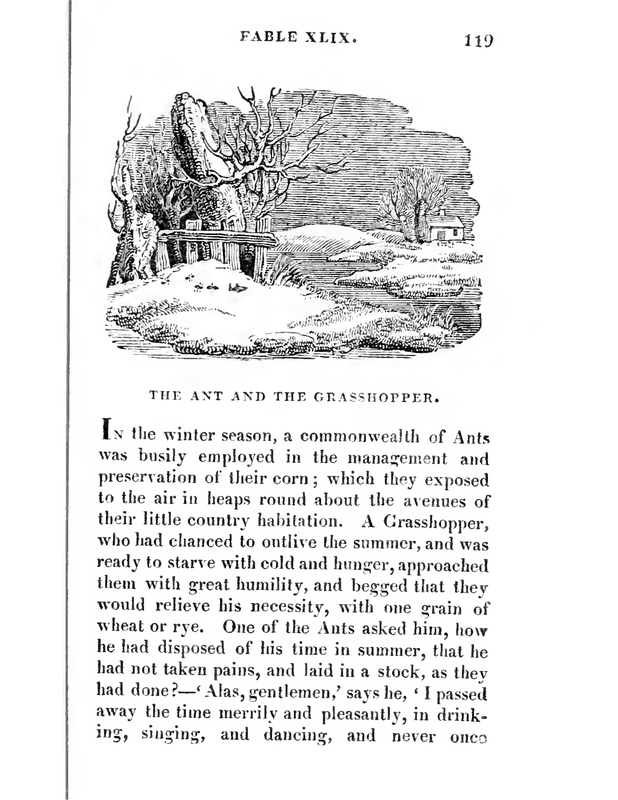
A group of four ants (on the left) and a grasshopper (on the right) gather on the banks of a river during the winter. On the right-hand side of the image, there is a small house in the background. On the left-hand side, behind the bugs, there is what apprears to be a wooden fence in front of a bunch of deciduous trees.
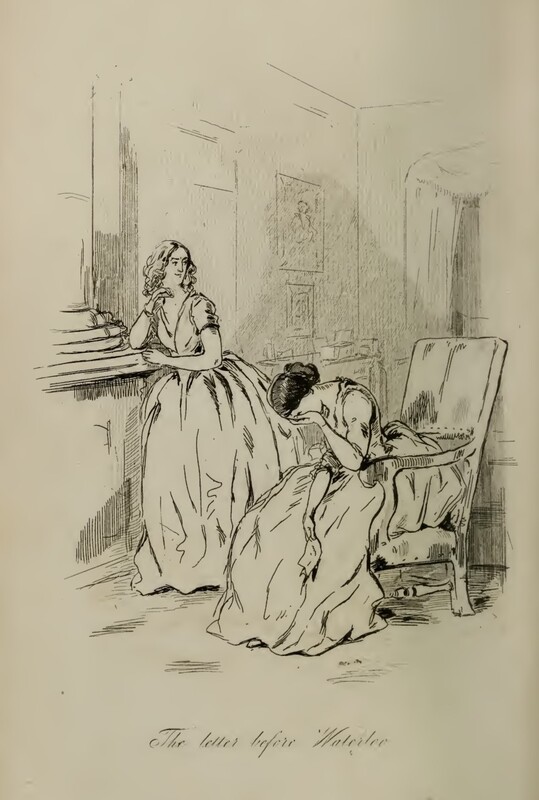
The image depicts a scene from Chapter LXVII. On the left, Rebecca Sharp is standing against a column and looking to the right towards Amelia Sedley, who sits crying in a chair with one hand over her face. In her other hand she holds the letter which her husband gave to Becky in Chapter XXIX, asking her to run away with him. In the background can be seen two pictures on the wall, a dresser with various objects placed upon it, and part of the canopy of a bed. Below the illustration is printed in cursive its title, The letter before Waterloo.
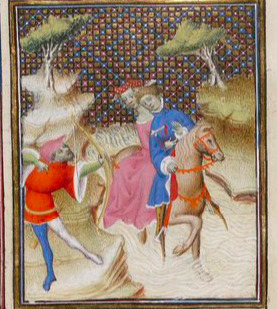
Deianira, on the back of the horse wearing a pink gown, was won for marriage by Hercules. When Hercules tried to take her home to his country, they met a flooded river. Nessus, a centaur who was in love with Deianira and is seated on the horse in a blue cloak, showed up and offered to help Hercules by taking Deianira across the river. Hercules agreed, but then Nessus ran away with Deianira. Hercules could not keep up with them on foot but was able to shoot Nessus with an arrow poisoned with venom from the Hydra. Hercules is on the left of the image holding a bow and arrow.
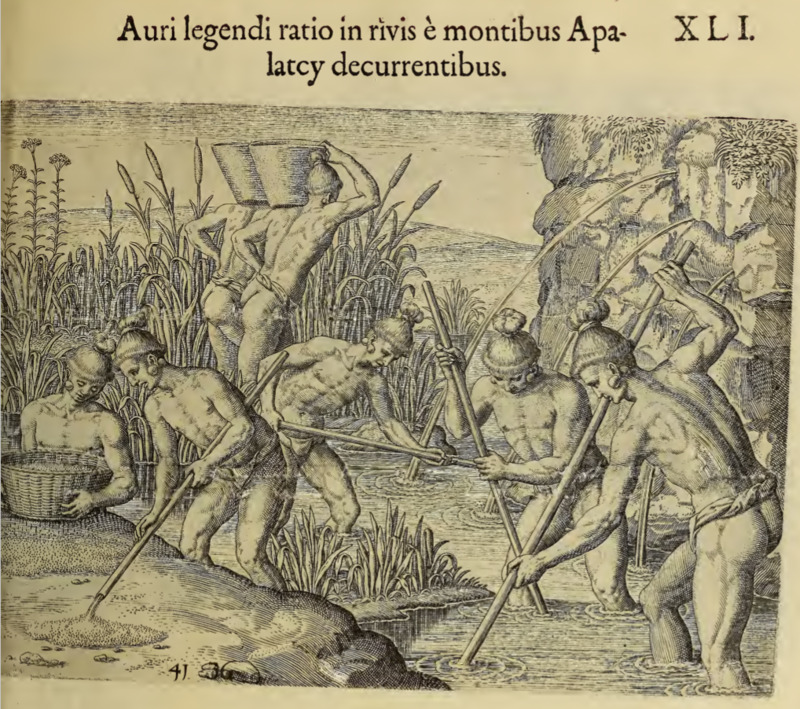
A group of Indigenous men is shown working in a river. They use long poles to stir up the mud at the bottom of the river and along the riverbanks. They put the collected gold into baskets. Two men are carrying baskets on their shoulders away from the river.
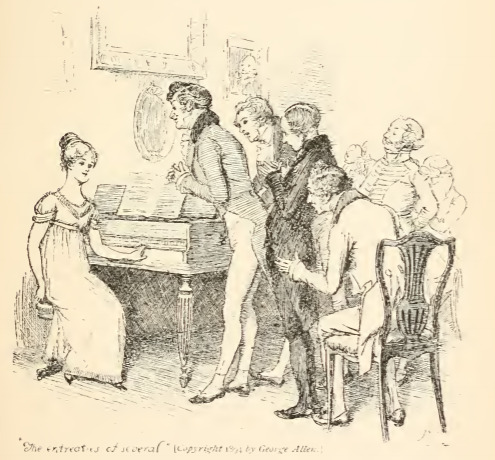
In this image Lizzy sits at a piano at a party hosted by Colonel William Lucas. Mr. Darcy became interested in Lizzy, wanting to spend more time with her, despite his initial rejection of her. Upper class women of this era were encouraged to practice some art form, often drawing or playing piano. Lizzy played piano and several people at this party entreated her to play for them. This scene occurs in chapter 6. The characters are shown in the traditional regency style. The men wear waistcoats and tailcoats with cravats. Lizzy wears a regency style dress with an empire waistline. The regency period dated to the early nineteenth century (1811-1820) when George, Prince of Wales, later George IV (r. 1820-1830), reigned as regent for his mentally ill father, King George III (r. 1760-1820). The regency period is associated with the rise of neoclassicism in art and fashion.
This image is a landscape overlooking a river in Dublin. The image is in a preface to the story, which provides a bibliography of the author, Jonathan Swift. A mouse is in the foreground, with a dog farther back. The scene is painted from the top of a hill, looking down towards several houses leading into a town, and a bridge crossing a river. This image also appears in the 1839 Krabbe edition.
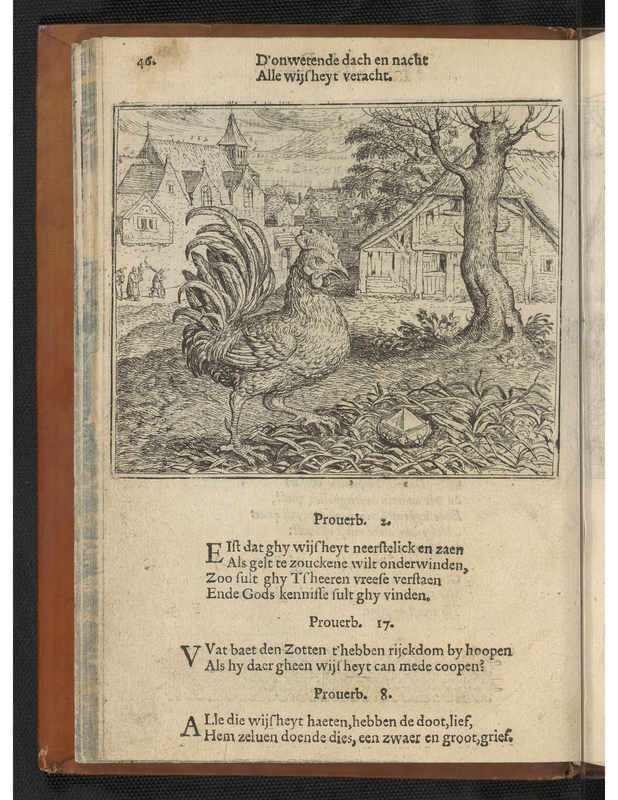
A rooster walking in a barnyard comes across a shiny object in the hay. A decorated box with a prism on top sits on the ground in front of the rooster. A barn is in the back right hand side of the image. A single tree on the right side of the image stands in front of the barn. Other buildings can be seen in the back left hand side of the image.
The farmer who found Gulliver created a show as a way of making money. Gulliver entertained the crowd by using his sword to mimic fencers. The farmer then began to travel with the show. In this image we see the giants travelling between shows. The farmer rides the first horse, and his daughter Glumdalclitch rides on the back of the horse, carrying Gulliver’s box.
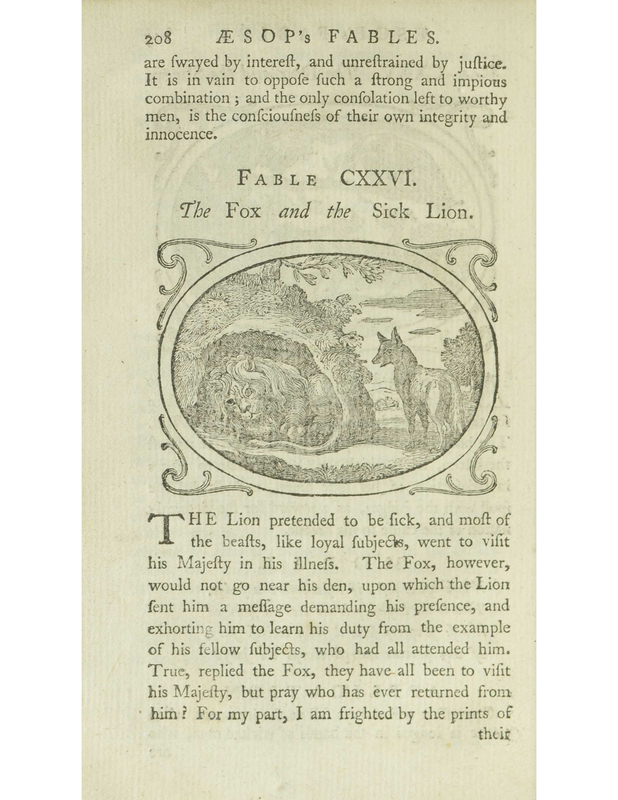
The scene is taken place outside, there is Lion laying in his den who is pretending to be sick. A Fox is standing nearby facing the Lion, because the Lion sent him a message demanding his presence because he was the only animal that did not come and visit him. There are also plenty of different plants and grass covering the Lions den and the surrounding area, and trees in the background.
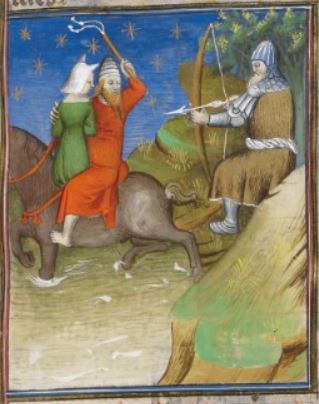
Hercules is illustrated on the right side of the image with a bow and arrow in his hand. He is pointing his arrow at Nessus, who is riding a horse through a river on the left side of the image. Hercules was with his wife Deianira when they came across the flooded river depicted in the image. Nessus came along and offered to take Deianira safely across the river on his horse. Nessus is illustrated looking at Hercules while holding a riding crop in his left hand. Nessus betrayed Hercules’ trust and began to run away with Deianira after crossing the river. Hercules uses a poison infused arrow to shoot Nessus and rescue his wife.
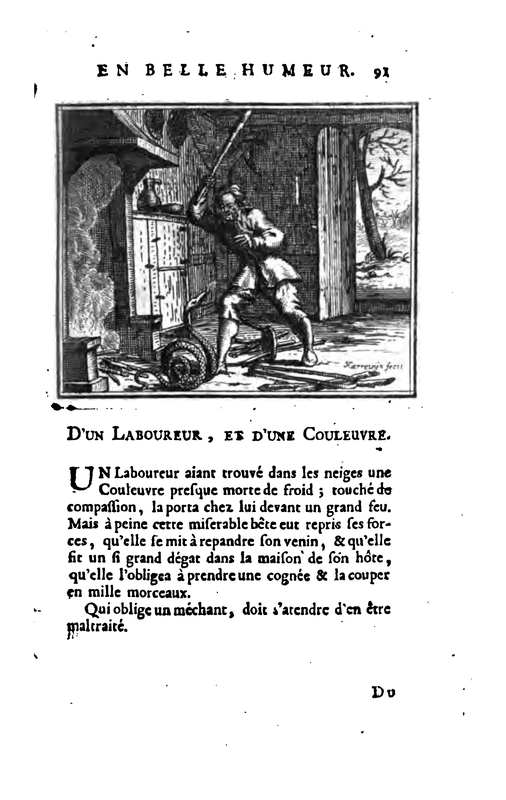
The image depicts a farmer and a snake inside the farmer’s house in combat. The farmer found the snake cold and close to death outside and upon bringing it indoors to warm up near the fire the snake regained its strength and attempted to bite the farmer.
The narrator is depicted as a piper, standing beneath a tree on a hill and playing his pipe for the small dog that sits in front of him, looking up. In the distance are the silhouettes of the buildings of a town. In the top right of the image is the letter I.
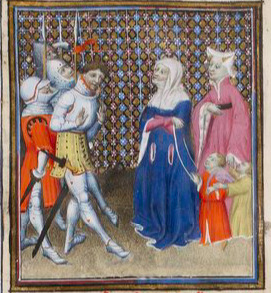
Veturia, in the blue gown, speaks to her son. She is accompanied by her daughter-in-law and two children. Her son betrayed Rome and her. She blames him for being a bad person, but blames herself for giving birth to him. She believes she should have never given birth to him, to spare Rome of his decisions.
As Celestina makes her way to Melibea’s house to follow through on Calisto’s request, she now fears that she might be rejected. Melibea’s servant Lucrecia opens the door. Aware that Celestina only does things which are to her benefit, she knows that Celestina’s visit is not random. Upon entering the house, Celestina talks for a while with Alisa (Melibea’s mother) on the pretense of trying to sell her yarn. Alisa is soon called away by the page/servant of her sick sister (seen to the left of the image), leaving Celestina alone with Melibea (seen to the right, with Lucrecia listening from a distance). Celestina circles around the true purpose of her visit, until she finally reveals that she is there on behalf of Calisto. Melibea becomes furious and refuses to discuss him whatsoever, in order to preserve her sense of honour. Celestina manages to talk her down from her rage, and manipulates her into giving up her girdle. Celestina also requests a charm or spell to cure Calisto, and Melibea asks her to return the following day so that she may have the night to write out the charm. Lucrecia realizes that Celestina is trying to manipulate Melibea, but Celestina secretly offers to make her more attractive in exchange for her loyalty.
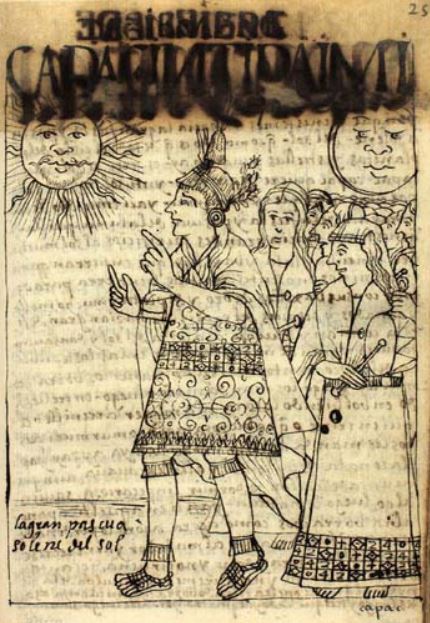
This chapter is dedicated to discussing the traditions and rituals of each month during the Inca Empire. The Incas tracked the months and years through the stars and their months consisted of thirty days. This image depicts the month of December, which was dedicated to celebrating the Sun, the king of all things. Many sacrifices of gold, silver and children, all dedicated to the sun were performed throughout this month. After the sacrifices they would have a large festival. This image depicts the celebrations as a crowd gathers underneath the sun. The Inca Emperor is illustrated standing in front of the crowd looking at the sun. The people behind him are playing musical instruments. The caption at the bottom of the image reads la gran pascua solene del sol, which translates to the great Easter-like festival of the Sun.
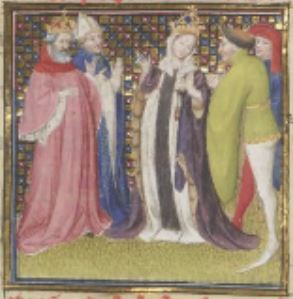
This image depicts Constance, the daughter of King William of Sicily, about to marry Henry, the emperor of Rome. Constance was forced to be a nun at a young age due to a prophecy which foretold Constance would somehow cause the destruction of Sicily. Her father, William, put her in a convent to prevent the prophecy from happening. At an older age, Constance was forced to marry Emperor Henry as her father had died and the throne was to be kept within the family. Constance then gave birth to a son at the age of fifty-five (despite being fifty-five, Constance is depicted young in this image). Constance is depicted in a black cloak and a crown on her head. Henry is depicted wearing a crown and a red robe on the left side of the image. A bishop is illustrated beside Henry as he officiates the marriage. There are two additional figures on the right side of the image.
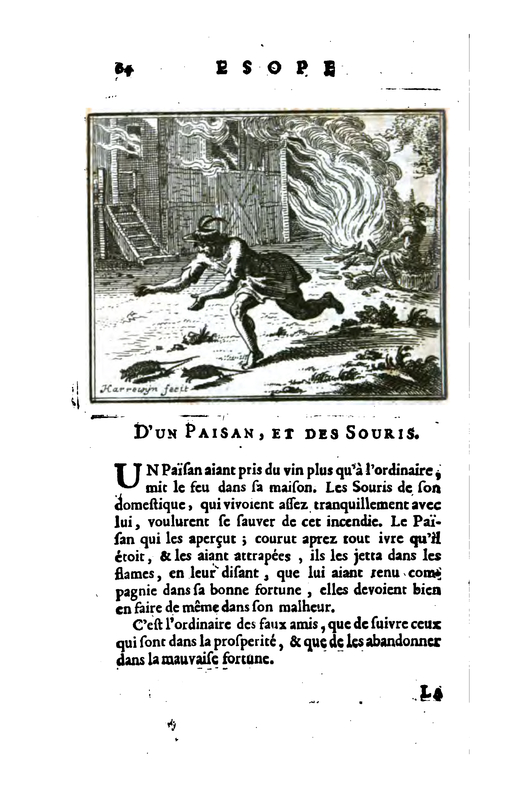
A peasant having taken more wine than usual, set fire to his house. The mice of his servant, who lived quietly with him, wanted to save themselves from this fire. The peasant who saw them, ran after them as drunk as he was, and having caught them, he threw them into the flames, telling them that, having kept him company in his good fortune, they should do the same in his misfortune.
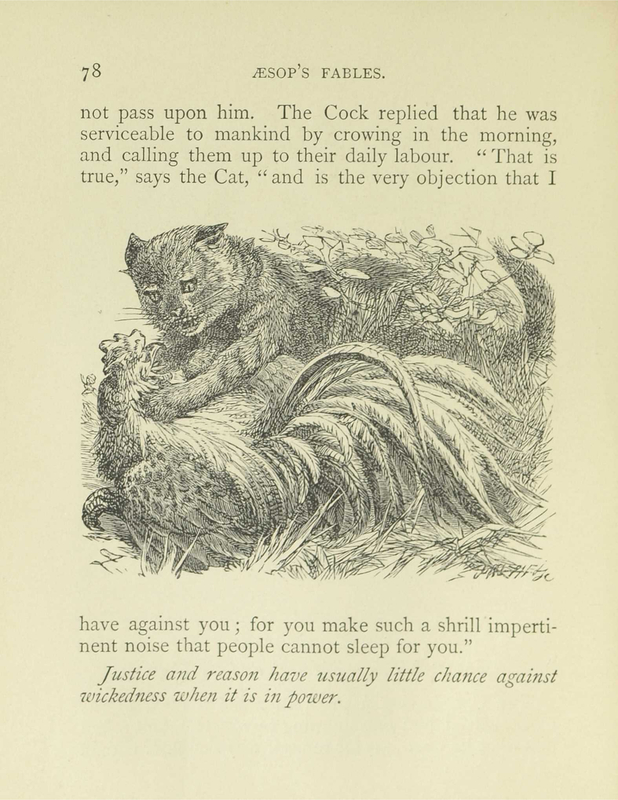
In the top portion of the image, a house cat emerges hastily from some bushes, surprising a rooster in the foreground. The cat’s claws pin the rooster to the ground by its neck.
Amelia Osborne kneels on a chair, tying her father’s neckcloth for him. He is shaky and crying, glad to be going to see his son again but missing his wife.
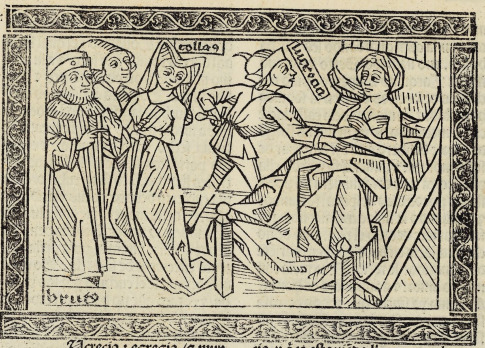
Lucretia is depicted on the right side of the engraving, lying in bed as she is approached by Sextus, her husband’s relative. The creator engraved Lucretia’s name beside the bed to identify her. Lucretia is depicted with her hands crossing her chest as Sextus is forcing himself upon her. He is illustrated with a sword in his hands while he threatens to kill her if she screams for help. The left-hand side of the engraving illustrates Lucretia with her husband, Collantinus, and her husband’s relative, Brutus (Brutus’ name is engraved below his feet). Lucretia told the men what Sextus had done to her in the night, and then plunged a knife into her own chest in shame.
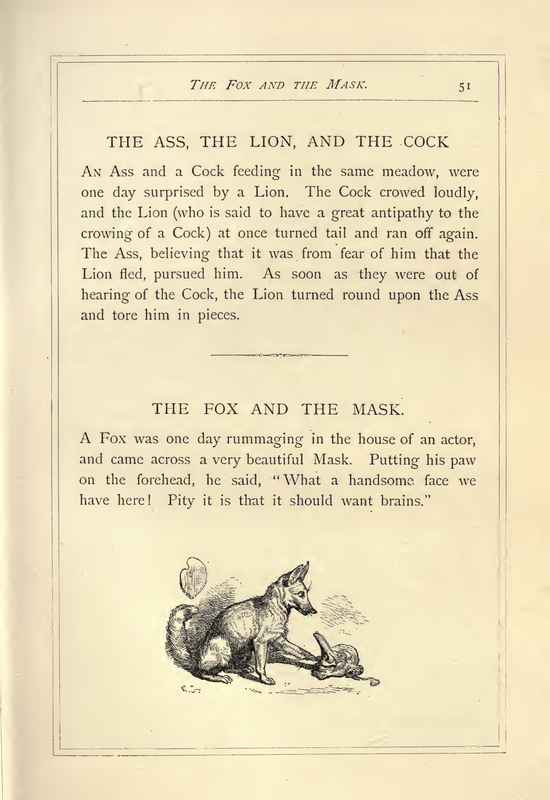
A fox is sitting down on the left side of the image. On the ground next to it, there is a mask. The mask has a very long nose, ears, wrinkled sin, and wide-open eyes. The fox is tossing it with its left paw.


![[Landscape overlooking river in Dublin]](https://collections.cemvc.ca/files/large/6259dbaa525a1ea1a5985899ba45e320abdcc633.jpg)
![[Gulliver’s master travels for performances]](https://collections.cemvc.ca/files/large/6c7fdc6d78f216602799a72825a8d1481c868b9a.jpg)
![Esopi Appologi siue Mythologi cum quibusdam carminum et fabularum additionibus Sebastiani Brant. [Two men assisting a man sitting down]](https://collections.cemvc.ca/files/large/f8538ead845a5eb3c22c24fa10b8aaec939f7bef.jpg)
![[Vanity Fair Vol. I Chapter VI Historiated Initial]](https://collections.cemvc.ca/files/large/ff641ac5a599188c49fb389530f20e6eb1288294.jpg)

![[Act IV - Celestina Visits Melibea]](https://collections.cemvc.ca/files/large/6b79838e0677db0fe3414a16c274ccc5900cc4bc.jpg)
![[Amelia and her Father]](https://collections.cemvc.ca/files/large/3d19722e2f98553031e4dff8d6264c083f68c12f.jpg)