This illustration depicts a woman named Flora surrounded by men who are touching various parts of her body. There is a man on the right side of the image touching her shoulder, as well as a man behind her touching just below her breast, and another man touching her right arm. Flora herself is pulling her dress up to reveal her leg. Flora was a famous prostitute and gained wealth through this profession.
An illustration of a lady and officer, attired as they would accurately be at the time of the story. The lady wears a long, thin dress and elongated bonnet, while the officer wears a coat with tails and oversized, pointed hat, and carries a very thin cane. In the background are many small figures and what appears to be an elaborate bridge or terrace pagoda.
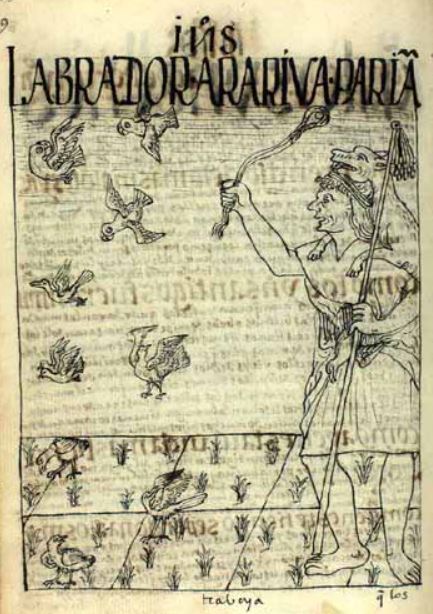
This image depicts a native man standing in a field protecting a field of crops from the swarm of sparrows. The man is holding a whip in his right hand as he swings it towards the birds and he is holding a walking stick in his left hand. His guard dog is depicted helping him scare away the birds as he rests on his back and rests on his head. Some birds are flying in the air while three are on the ground eating the sprouts coming out from the ground. The caption at the bottom of the image reads, trabajo [labour].
Here we see the scientist nicknamed the ‘universal artist’ from the Grand Academy on Balnibarbi. This man oversaw fifty other scientists all working on several different hypotheses, including condensing air into a tangible substance, softening marble to use it as pillows, petrifying hooves of living horses, and sowing the land with chaff to make it more virtuous. Gulliver encountered him in the wing of speculative learning. This man is likely an allusion to Sir Robert Boyle, a scientist who conducted experiments in several aspects of the natural world and was also a theologian. In this image, the scientist is depicted with a particularly large head, likely to indicate his intelligence. The same image appears in the 1843 Krabbe edition.
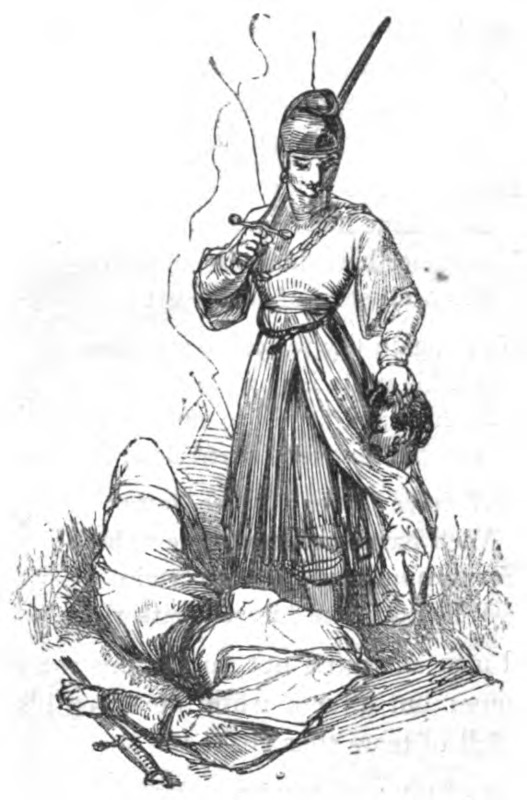
A young Rodrigo stands over the body of Count Lozano, holding his decapitated head in his left hand. Rodrigo has killed the Count due to his offence against Rodrigo’s father, which caused the family great shame.
Gulliver’s master explained various aspects of the Yahoos that lived in the Country of the Houyhnhnms. He told Gulliver that when a foreign female yahoo approached, she would be surrounded by other female yahoos who would examine her and speak with her, often expressing their contempt or disdain. The same image appears in the 1843 Krabbe edition.
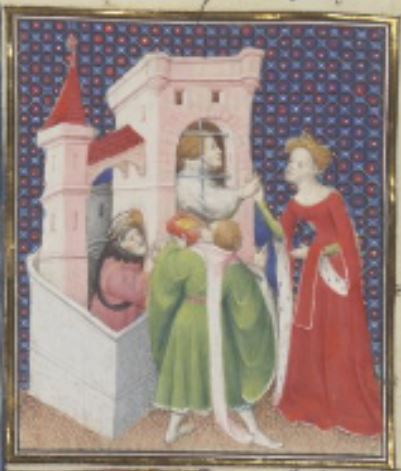
This image depicts Camiola, the daughter of Lawrence of Torringo, paying a ransom to release Roland of Sicily from prison. She felt sympathy for Roland of Sicily who was left to rot in a jail after a battle, so she paid for his ransom in exchange for his hand in marriage. Camiola is depicted wearing a red dress standing in front of Roland who is chained in a prison cell. There are two figures beside Camiola delivering the ransom money on behalf of her to the man dressed in red and black behind the city wall. Roland had agreed to marry Camiola, but when he was freed, he pretended as though he did not agree to marry her. She is famous for having proved herself in front of a judge and spoke out against her husband’s vile behaviour in rejecting her and his promise to her.
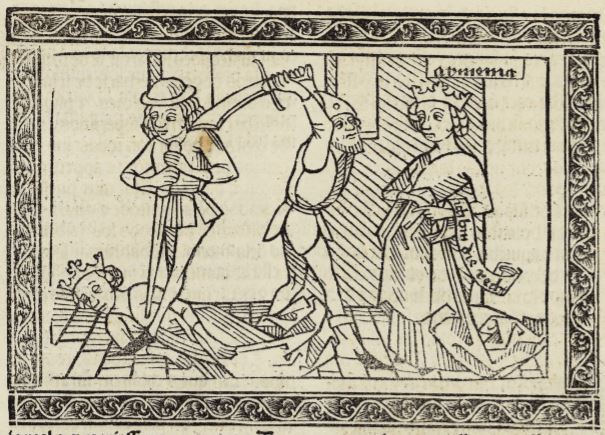
This engraving depicts a young servant girl getting stabbed in the chest with a sword by a man standing above her. This young servant girl is disguised to look exactly like Harmonia, the daughter of Gelon (brother to the king of Syracuse). Boccaccio explains that there was a rebellion in Syracuse against nobility, and before the murderers could get to Harmonia, her nurse disguised this young woman to look like Harmonia. The real Harmonia is depicted on the right side of the engraving. The creator engraved her name, written as Armonia, above her head to identify her. There is a man swinging a sword above his head which appears to be heading in Harmonia’s direction, however, Boccaccio explains that Harmonia hid from the murderers until they killed the look-alike servant.
Gulliver and Glumdalclitch travel with the king and queen of Brobdingnag, during which time both Gulliver and Glumdalclitch became ill. Gulliver had a cold, however Glumdalclitch was so sick she could not leave her chambers. They stopped close to the water, and Gulliver asked to be taken to the ocean. Glumdalclitch reluctantly agrees, but cries when Gulliver prepares to leave, seen here. Gulliver is standing on the table, outside his travelling house, which had two straps on the back, seen in the image. The page who took Gulliver to the water stands behind Glumdalclitch. The same image appears in the 1839 Krabbe edition.
This is a bust of Stella Johnson, with whom Swift was romantically involved. The image is a part of Swift’s Biography which precedes Part One of Gulliver’s Travels.
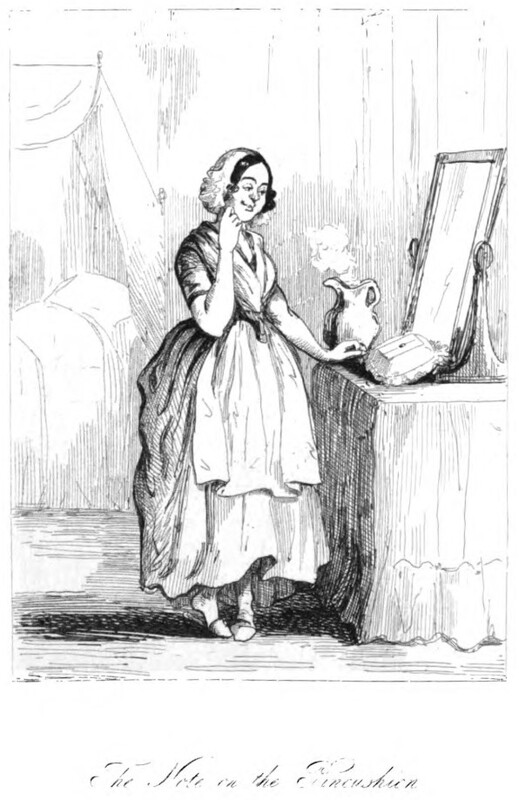
The image depicts a scene from Chapter XXXII. On the left, Rebecca Sharp is standing against a column and looking to the right towards Amelia Sedley, who sits crying in a chair with one hand over her face. In her other hand she holds the letter which her husband gave to Becky in Chapter XXIX of Volume I, asking her to run away with him. In the background can be seen two pictures on the wall, a dresser with various objects placed upon it, and part of the canopy of a bed. Below the illustration is printed in cursive its title, The letter before Waterloo.
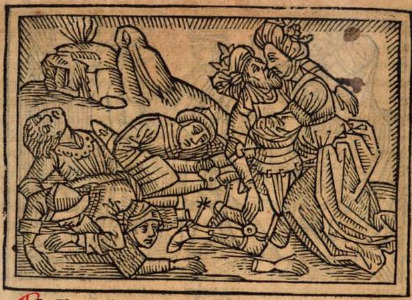
Argia, the daughter of King Adrastus of Argos is depicted on the right side of the engraving holding the body of her husband, King Polynices of Thebes. Boccaccio explains that Polynices had fought in a war against his brother Eteocles and died on the battlefield. Argia snuck herself onto the battlefield after the war to see her husband’s body. She is depicted holding his lifeless body and kissing him on the lips. Behind Polynices are the other men who had fought and died in this war. Boccaccio believes her to be praiseworthy as it took courage to risk her life in order to find her husband on the battlefield.
This image is illustrated in a chapter that discusses and criticizes the government and society in Spanish conquered Peru. This image depicts a Corregidor [Magistrate] sleeping comfortably in his bed with a female companion on the right side of the image. There is a man named Don Cristobal de Leon on the left side of the image with his hands and feet shackled and legs in a stock. The author explains that the Corregidor in this image and the previous Corregidor both imprisoned and abused Don Cristobal for speaking in favour for the indigenous peoples of Peru. There is writing on the curtains of the Corregidor’s bed which represent his dialogue. It reads, hina wanuy pleytista [die where you are, troublemaker]. There is also writing on the stock that Don Cristobal’s legs are in. It reads, por dios pasare este trauajo [For God I will suffer these troubles].
Here we see Gulliver making himself new shoes after his worn out during his time on the Country of the Houyhnhnms. Gulliver made his shoes out of wood and leather. The leather was made of the skins of yahoos and dried in the sun, seen behind Gulliver. The same image appears in both the 1839 and 1843 Krabbe editions.
Here we see the Queen of Brobdingnag’s dwarf shaking an apple tree to drop apples on Gulliver. Gulliver was walking through the garden when the dwarf saw him and began to shake the tree, dropping apples on Gulliver to torment him. In the image, Gulliver is lying underneath four apples with only his head and arms sticking out. The dwarf shakes the tree. The same image appears in the 1843 Krabbe edition.
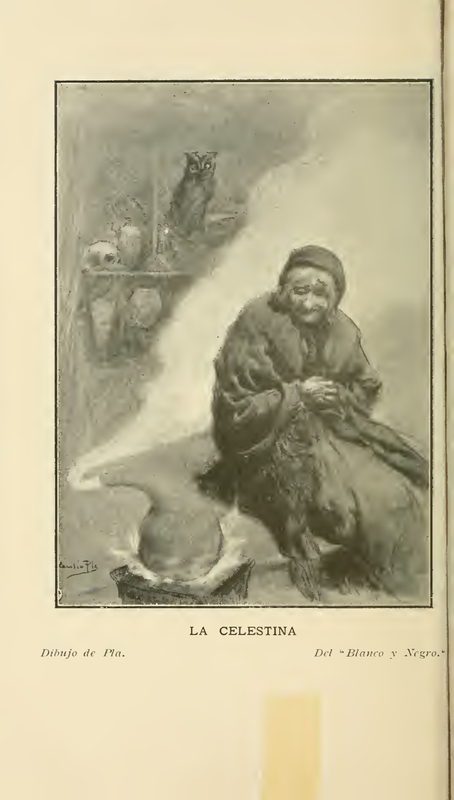
This image depicts Celestina as an old lady, seated on what appears to be some sort of bench. She is known to use people's greed, love, and sexual appetites to manipulate them. A skull is placed on the shelf behind her, and beside it an owl is perched.

![[Flora the Prostitute]](https://collections.cemvc.ca/files/large/caca2d310b239c2ef38bd6fdbb1785f9852ce2b3.jpg)
![[Historical Dress]](https://collections.cemvc.ca/files/large/03527d41f59d20f8298eb6f227dcc74d116be00b.jpg)
![[The universal artist from The Grand Academy on Balnibarbi]](https://collections.cemvc.ca/files/large/6d35a101c6f1345e0a34900fd65d0d4cf79a6434.jpg)

![[a group of female yahoos]](https://collections.cemvc.ca/files/large/3ae3f405c559a24b87fa38a518ab2c1fc603dc89.jpg)

![[Glumdalclitch cried because Gulliver was leaving Brobdingnag]](https://collections.cemvc.ca/files/large/48a2b948d7a1c4436d9dc8d8f02699f8c4272c51.jpg)
![[Bust of Stella Johnson]](https://collections.cemvc.ca/files/large/30a3fa7b009c5a2ed54ea91b9c38de6f21325e47.jpg)
![[Two Animals Meet]](https://collections.cemvc.ca/files/large/689724c8d2fbeb4f1ce5ade76e5bf4cfb31105dc.jpg)

![Otro Coreg[id]or le Amolesta a Don Cristobal de Leon Otra Ues Porque le Rrespondio en Fabor de los Yndios](https://collections.cemvc.ca/files/large/7cfcb33a89adf03b2ed03191cb97f050cc01720a.jpg)
![[Gulliver makes himself shoes]](https://collections.cemvc.ca/files/large/696dc4dc84531061a6ee6a04d45d5c9aa86aa093.jpg)
![[the Queen of Brobdingnag’s dwarf shakes apples on Gulliver]](https://collections.cemvc.ca/files/large/5d5f65aa152fc983fe9b8781121d46f4e5d9a96b.jpg)