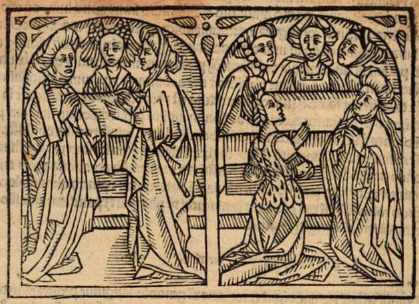
Verginia, a noble Roman woman is depicted in this engraving in both the right and left scenes. Boccaccio explains that Verginia, despite being a noble woman, was cast out of a temple in Rome by the other noble patrician women due to her being married to a plebeian man. The right side of the engraving depicts Verginia at the altar with noble women surrounding her as they cast her out of the temple. The left side of the engraving looks similar to the right side; however, the left side depicts Verginia with plebeian women. After being cast out of the Patricia Pudicitia temple, Verginia created her own temple and altar named the Plebeia Pudicitia, and opened it up to the plebeian class.
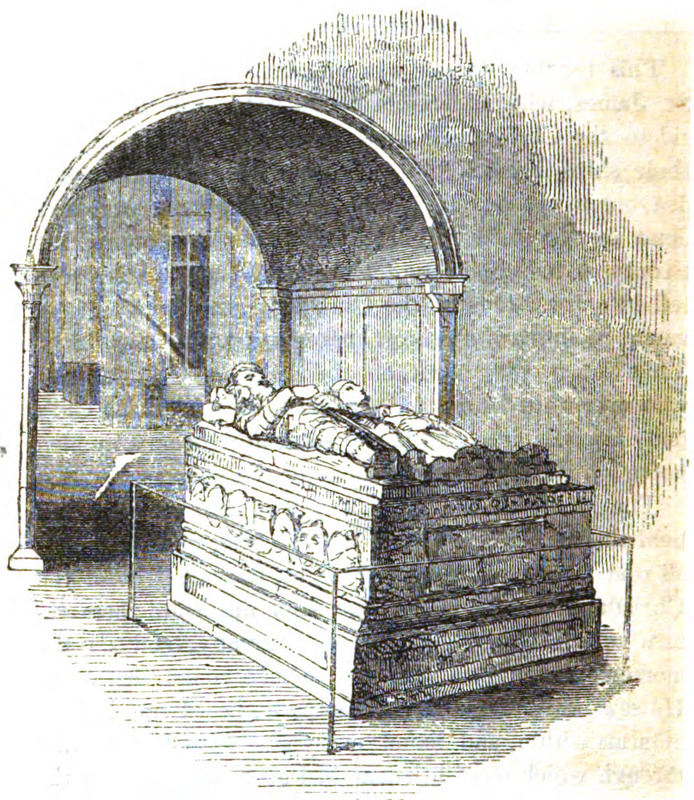
This image shows the tomb of the Cid. The figures on top are presumably statues of the Cid and Ximena. The Cid was not initially entombed, with his body instead being left on display for a number of years, but he was eventually moved.
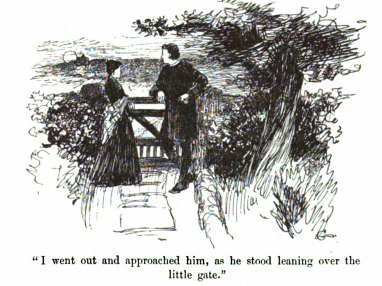
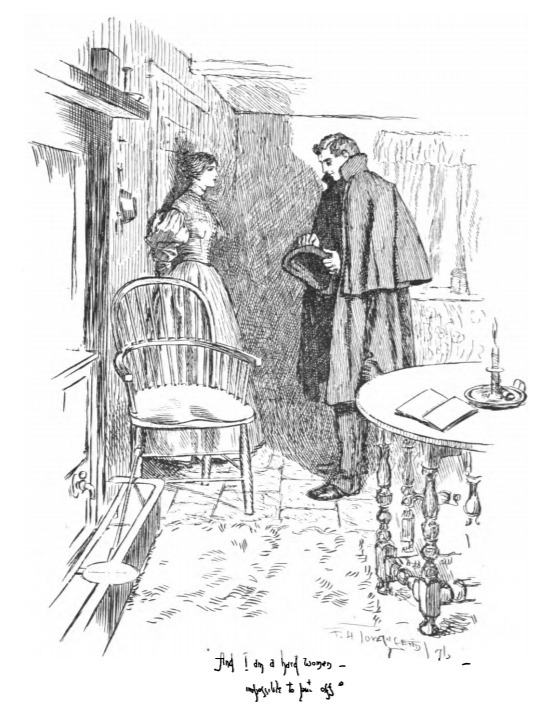
Here we see Mr. Rivers and Jane Eyre standing near the gate of Moor House. Mr. Rivers tried to convince Jane to join him on a mission with the church to India, but she refused. He asked her to marry him before he left to go to India, but Jane refused, saying that she would never get married. He argued that missionary work was much more effective when a married couple went together, but Jane was uninterested. In this image, Jane says goodbye to Mr. Rivers before he left to go to India alone.
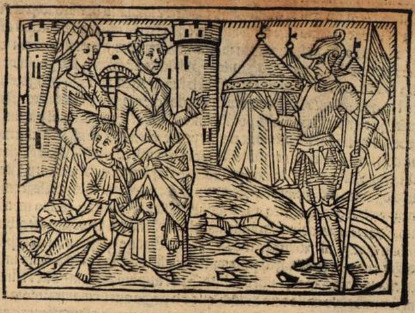
An old noble Roman woman named Veturia is depicted on the left side of the engraving with her daughter-in law and grandchild beside her. She is illustrated pointing at the man on the right side of the engraving. This man is her son, Coriolanus. Boccaccio explains that after Coriolanus had been exiled from Rome for neglecting the plebian class, he planned an attack on Rome. Veturia, with the help of her daughter-in-law (Volumnia) and grandchild, went to speak with Coriolanus at his camp and convinced him to not go through with the attack. Boccaccio explains that he decided to write on Veturia for her honour as a mother and a woman.
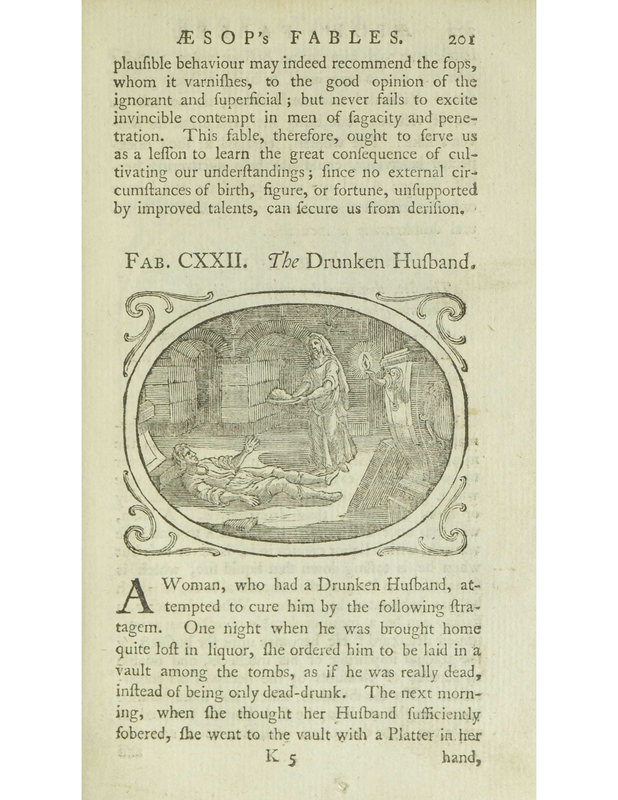
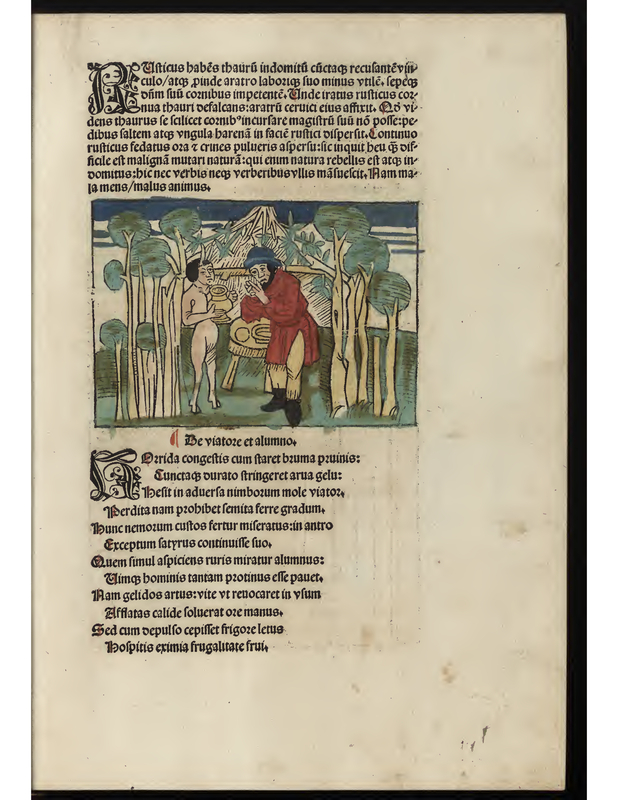
A drunk man lays on the ground while reaching out with his left hand towards a woman who approaches him with a platter of food. They are inside of a tomb, an underground cemetery, which is lit up by a single flame coming from a candle on the wall. The man and woman are husband and wife.
This image depicts Calisto and Pármeno. On the left we see Calisto, who is dressed in noble attire and has a sword mounted on his belt. On the right we see Pármeno pointing upward. His clothing is far less ornate than that of Calisto, which is is illustrative of his status as one of Calisto’s servants. Like Calisto, he also has a sword mounted on his belt. They are both wearing hats and standing outside.The entire image is nearly identical to the one found on page 190 of the text (where the right panel is labeled ‘Sosia’). The left panel is identical to those found on pages 8, 162, and 196. The right panel is identical to those found on pages 105 and 135, and nearly identical to the one found on page 221 (where it is labeled ‘Sosia’).
After fleeing Thornfield, Jane arrived in the Moors of England. She then became the schoolmistress of the Morton school, a position to which she was appointed by Mr. Rivers. He then informed her that Mr. Briggs, a lawyer from London was looking for her, because she inherited twenty-thousand pounds from her uncle in Madeira. She then found out that Mr. Rivers and his sisters Diana and Mary were really her cousins. Jane decided in that instant that she wanted to share the money with her cousins. Mr. Rivers tried to convince her to wait a few days to make that decision, however, she said that she would not change her mind and that her decision was final.
Here we see the letter N with people surrounding it. The letter N using a method of coding developed by scholars at the Grand Academy on Balnibarbi signifies the word plot. This image comes in a description of a conspiracy found by a professor from the Grand Academy on Balnibarbi. This conspiracy is thought to be an allusion to the trial of Francis Atterbury, the bishop of Rochester for allegedly plotting with the Jacobites. Atterbury was charged with treason in 1722 and was exiled to France. The same image appears in the 1843 Krabbe edition.
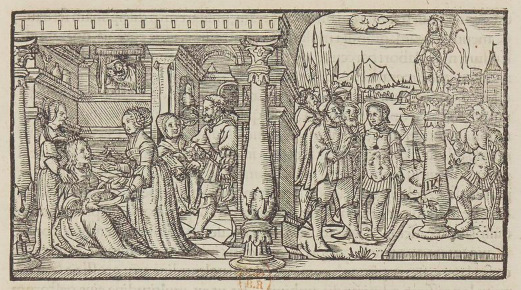
Queen Semiramis of Assyria, perhaps the original inventor of chastity belts, sits with two women on the left of the scene. She often successfully dressed as her son, as they shared many similarities both in appearance and voice, to be able to participate in battle. Her son, which was her in disguise, was celebrated for this, as seen in the statue that depicts her dressed as her son, but she was chastised for being promiscuous in her female identity.
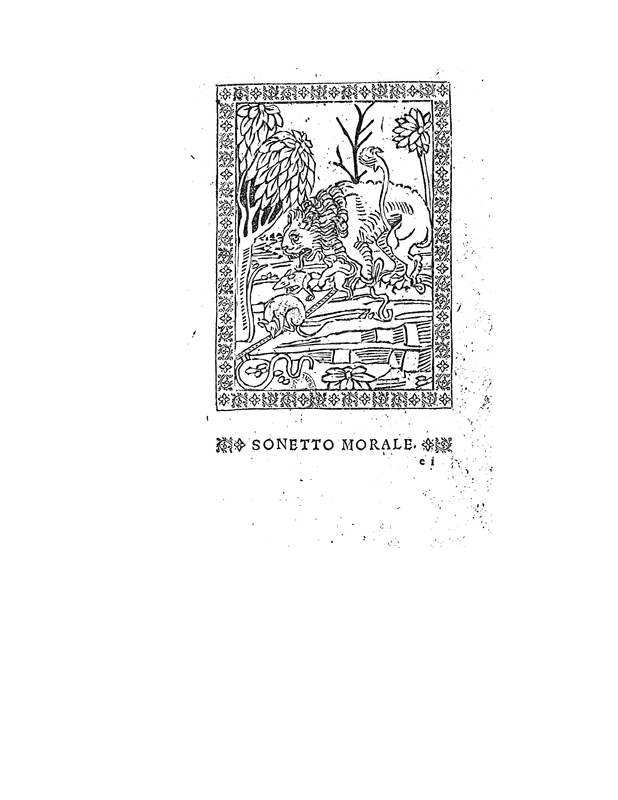
There is a lion with its tail between its legs and seems to have a rope tied to it. The left front paw of the lion is pinning down a mouse. In the forefront of the image there is mouse chewing on the rope that is trapping the lion.
Here we see Gulliver waving to the Houyhnhnms he lived with during his time on the Country of the Houyhnhnms as he sails away. The Council of the Houyhnhnms told his master that Gulliver either had to live with the yahoos or return to Europe but could not live with the Houyhnhnms any longer. Gulliver was shocked by this, and decided he had to leave rather than live with the yahoos. Gulliver sails away in a small sailboat that he built with the help of the Sorrel Nag during his last two months in the Country of the Houyhnhnms. The same image appears in both the 1839 and 1843 Krabbe editions.
Here we see Gulliver riding on a horse after arriving in England. He waves people out of the way as he rides home. He writes that he felt as though he were on Lilliput because everything felt so small. Thus, he waves people out of the way, fearing he might trample people. Naturally, he received several strange looks from people walking along the road, which can be seen in the image. The same image appears in the 1839 Krabbe edition.
This image is a depiction of Gulliver and the giant farmer who shelters Gulliver in Brobdingnag. The farmer carries a scythe to indicate his position. The image is a part of Swift’s biography which precedes Part One of Gulliver’s Travels.
A boy with short curls and a girl with long ringlets and oversized ribbons walk towards each other on tiptoes, both smiling. Between and above them is a large letter T, from The.
Gulliver’s master explained various aspects of the Yahoos that lived in the Country of the Houyhnhnms. He told Gulliver that female yahoos would sometimes stand behind a bush to watch the males, who would later approach her. The same image appears in the 1843 Krabbe edition.
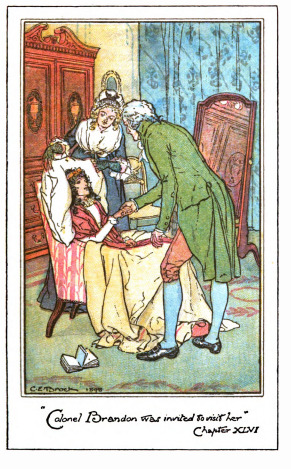
Here we see Marianne sitting in a chair with Elinor standing behind her and Colonel Brandon holding her hand. Elinor and Marianne left London with Mrs. Jennings to go to Cleveland, the estate belonging to Mrs. Jennings' daughter and son-in-law, the Palmers. Marianne spent most of her time going for walks, and one day she was caught in a storm and got her feet wet. This resulted in her becoming quite ill, developing an infection. She spent several days sick in bed, culminating in a night where she was overcome with a terrible fever. Elinor was very concerned and sent Colonel Brandon to fetch her mother from the cottage near Barton Park. Marianne was given medicine by the apothecary in town and her fever broke and she recovered quickly. Once she had begun to feel better, Marianne asked to see Colonel Brandon to thank him for going to Barton Cottage to fetch her mother. This scene appears in chapter 46 as indicated underneath the image. The characters are shown in the traditional regency style, as Elinor wears the regency style dress with an empire waist. Her hair is worn tied up, as was tradition for women after their coming out before the queen, signaling her entrance into society. Marianne sits in a chair with a shawl wrapped around her shoulders. Colonel Brandon wears a tailcoat and knickers that stop at the knee. The regency period dated to the early nineteenth century (1811-1820) when George, Prince of Wales, later George IV (r. 1820-1830), reigned as regent for his mentally ill father, King George III (r. 1760-1820). The regency period is associated with the rise of neoclassicism in art and fashion.


![[Act II – Calisto and Pármeno]](https://collections.cemvc.ca/files/large/a6da8bbf173f502140d3ec028dbd958f3d4c544a.jpg)
![[Vanity Fair Volume II. Chapter XII Inhabited Initial, A]](https://collections.cemvc.ca/files/large/98af533f9d861941af52a46adc8e6a734120d857.jpg)

![[a method of coding using acrostics by scholars at the Grand Academy on Balnibarbi]](https://collections.cemvc.ca/files/large/750bfae3a23ae7c438c2bc497ad24bafba03994d.jpg)
![[Person Gutting Bird]](https://collections.cemvc.ca/files/large/7f45a97427ea77a235ba22f8172cb2afcdb94ac9.jpg)

![[Gulliver leaves the Country of the Houyhnhnms]](https://collections.cemvc.ca/files/large/534e6c23c2b855c9a143e7364d20a8a0c576ec0c.jpg)
![[Gulliver rides home after returning to England from Brobdingnag]](https://collections.cemvc.ca/files/large/72582a68202487f6885bee71e65005b649ecb184.jpg)
![[Gulliver and the giant farmer from Brobdingnag]](https://collections.cemvc.ca/files/large/f059719ddad42b007376931c0e08c629f0c3e38c.jpg)

![[Vanity Fair Volume I. Chapter XXXIV Inhabited Initial, T]](https://collections.cemvc.ca/files/large/6965541f8e64791be29b4eabafb053e4f5f53758.jpg)
![[a female yahoo flirts with the males]](https://collections.cemvc.ca/files/large/ad80984694d9c3e2538646f460c914f775305326.jpg)