This engraving depicts Sulpicia, a woman renown for her chastity, consecrating a statue of Venus. Sulpicia is depicted on the left side of the engraving with her hands reaching out towards the nude statue of Venus. We know that these figures are Sulpicia and Venus as their names are engraved above their heads. There are doves flying above the statue of Venus as dove’s are known to be one of many symbols of the goddess. There is a group of women depicted behind Sulpicia as they were all chosen as some of the most chaste women of their time, and they all voted for Sulpicia to be the one to consecrate the statue.
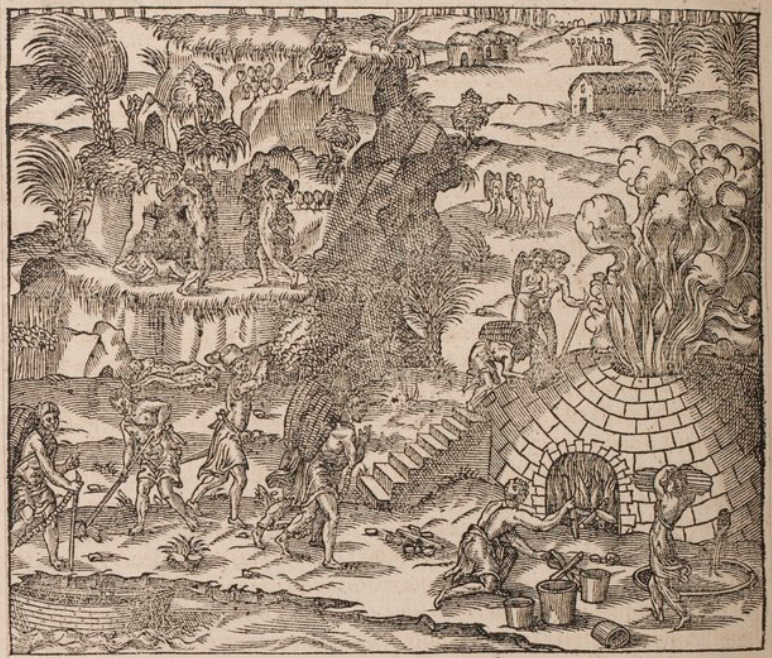
Enslaved Indigenous people work at a mine near the mountain Potosí (Thevet described the mountain as being on an island near Cuba, but it was really a mining town in Upper Peru founded in 1545). Some of the Indigenous people mine the ore using hoes, then others carry it in baskets on their backs to a large kiln-like structure where the ore is smelted. A European man wielding a club supervises them and stands poised to swing the club. Large numbers of enslaved and indentured Africans and Indigenous South Americans died working in the silver mines of Potosí. Potosí is found in present-day Bolivia, where silver is still mined. This image is identical to one found on page 984 verso of Paris, 1575 (l’Huillier).
This illustration depicts Leontium in an embrace with a man in her brothel chamber. Boccaccio explains that Leontium was an intellectual and scholar and became renowned for criticizing and speaking against certain philosophers of her time and was a philosopher herself. There are books in the background of the illustration to symbolize her intellectual life. Boccaccio believes her fame was hindered by becoming a prostitute.
This image depicts a young indigenous man physically abusing his father with a stick. He is standing on the right side of the image as he puts his right foot on his father’s stomach and beats him with the stick in his hands. The father is holding up his left hand to try and stop his son from hitting him. There is a house in the background of the image. There is a caption written on the house that reads, uanoy, macho [Die old man!], and diosrayco, ama macho yayayquita macauaycho justiciaman uillasac diosta manchay [For God’s sake, do not hit me, your old father, I will accuse you for justice, fear God]. The author criticizes young indigenous people who would abandon God and not follow the commandments of the Lord.
Here we see a scientist at the Grand Academy of Lagado on Balnibarbi. This is the first scientist Gulliver encountered. This scientist was attempting to extract sunbeams out of cucumbers, a project he had been working on for eight years. His goal was to be able to supply the Governor’s garden with sunlight. The scientist has a long beard that is singed in several places and soot on his hands and face. He wears clothes with astronomical and scientific imagery, similar to what was worn on Laputa. He holds a beaker with a curved funnel. The same image appears in the 1843 Krabbe edition.
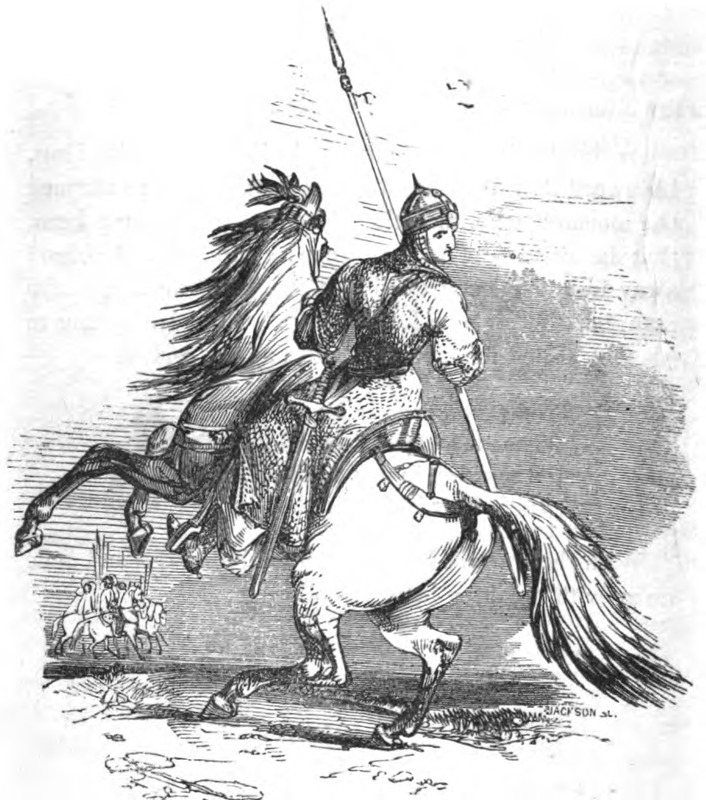
Rodrigo angrily rides away from King Ferdinand, followed by his 300 followers. Rodrigo and his father Lainez had just encountered the king while riding to Burgos, and though everyone else dismounted to swear homage to him Rodrigo initially refused due to his pride. When his father eventually convinced him, his sword slipped out of his scabbard while he knelt, frightening the king. The king shouted at him in surprise and fear, and Rodrigo, taking this as an insult, rode away.
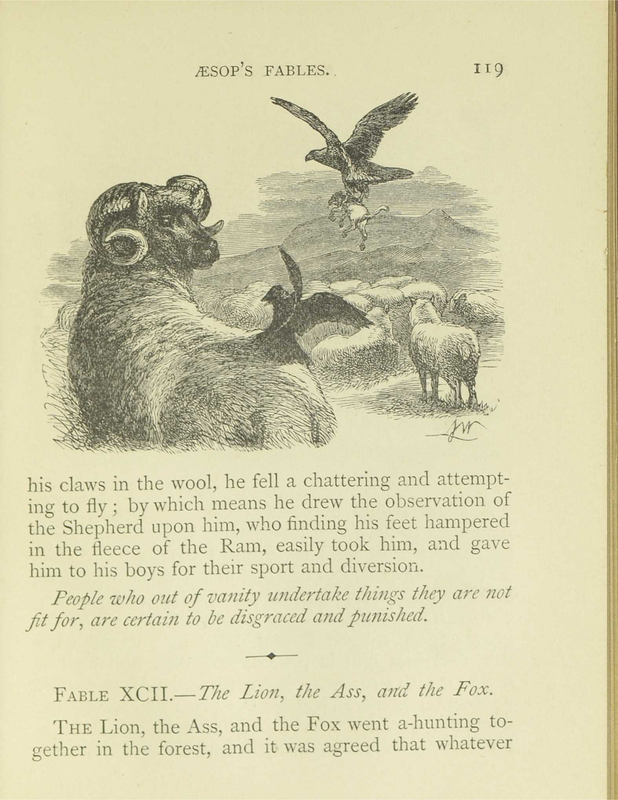
A ram looks over its shoulder at a crow with its talons caught in the ram's fleece on the left-hand side of the image. In the background, there is a flock of sheep in front of a mountain range. In the upper right hand corner of the image, an eagle lifts a lamb into the air.
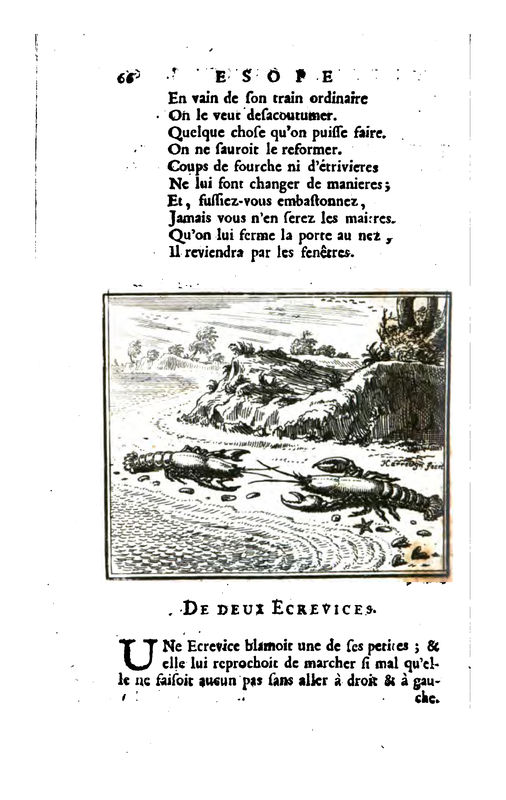
A crayfish blamed one of her little ones; and she reproached her for walking so badly that she could not take any step without going straight and to the left. Two crayfish on the beach facing each other.
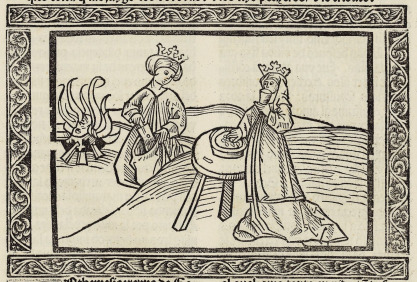
Artemisia was married to Mausolus, the king of Caria. Boccaccio explains that when he died, Artemisia was so grieved by his death that, instead of putting his ashes in an urn after his cremation, she drank the ashes in order to be closer to him. The left side of the engraving depicts Artemisia cremating her husband’s body in a fire. Mausolus head is visible in the fire. Artemisia is illustrated scooping her husband’s ashes and putting them into a bag. The right side of the engraving depicts Artemisia drinking her husband’s ashes.
William Dobbin walks along a path next to a high, thick wall, looking shy with his hands clasped in front of him. He is led by a child in the appearance of a cupid, with small wings and a bow. A window high up in the wall forms the letter O from Our.
This image depicts an indigenous woman approaching a convent. The indigenous woman is illustrated wearing a long dress that has an embroidered waist. She also has a wrap over her head that appears to be carrying items. The indigenous woman is holding a plate of food and offering to the woman in the window. The woman behind the barred window is a nun and she is depicted with her hands together in prayer. There is dialogue written above the indigenous woman’s head which reads, cay limosnallayta diosrayco chasquiuay, senora santa monja [For God, holy nun, receive my alms]. The nun replies, sea por amor de dios, madre [Be it for God’s sake, mother].
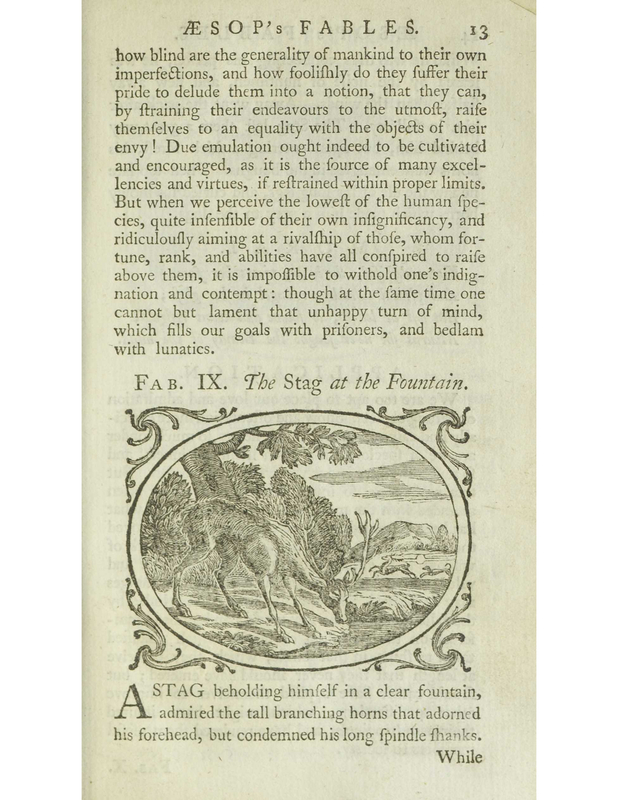
There is a stag dinking at a stream of water. There is one stag running in the opposite direction the main stag in the image is facing. This stag appears to be being chased by a wild cat of sorts. The stag drinking from the water has two horns. There are trees on the left side of the image in the background and there are mountains on the right side of the image.
A female figure, representing Becky Sharp, is seated in a wooden letter P of Poor on the banks of a stream or river. She holds in her left hand a fishing rod, which has attracted the attention of a single large fish, representing Joseph Sedley. In the background are several trees and the shapes of buildings in a city or town in the distance.
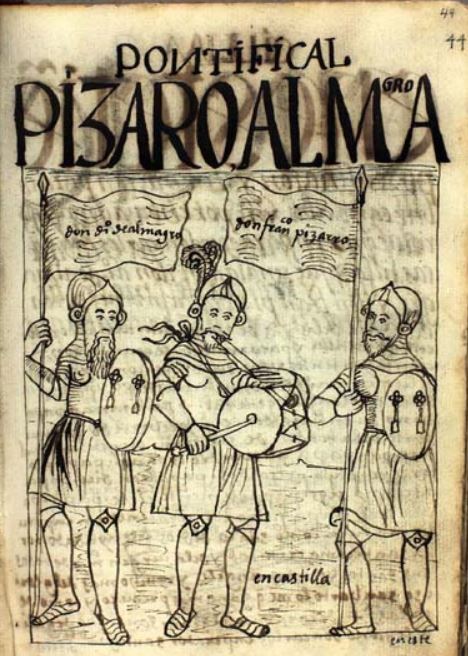
This illustration depicts Don Diego de Almagro on the left side of the image and Don Francisco Pizarro on the right side. These two men were chosen as captains for King Don Carlos of Castille to embark to the West Indies. Their names are written on the flags that they are holding. There is an unidentified man in the centre of the image playing a drum. The words en castilla are written in between the drummer and Pizarro, which identifies that they are in Castille.
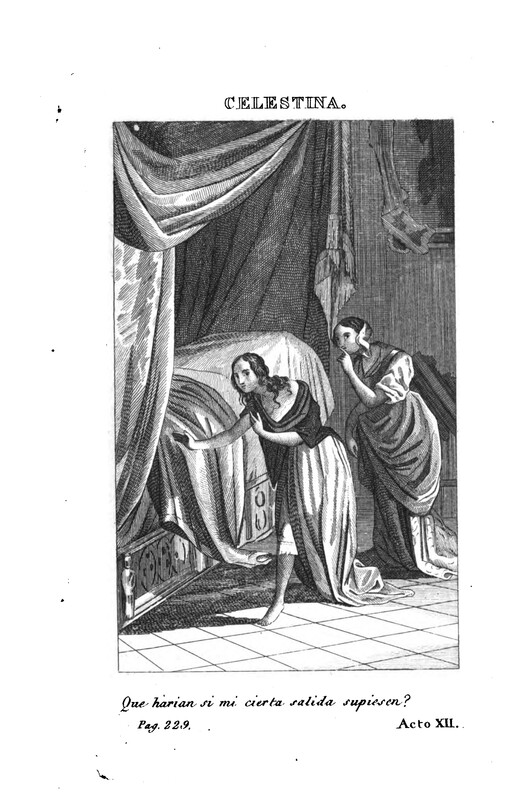
In this image we see Melibea and her servant Lucrecia sneaking out of her bedroom at night, so that Melibea can meet with Calisto. Lucrecia holds a finger to her mouth to signal that they need to be quiet.The same illustration is also found on the cover page of this edition.
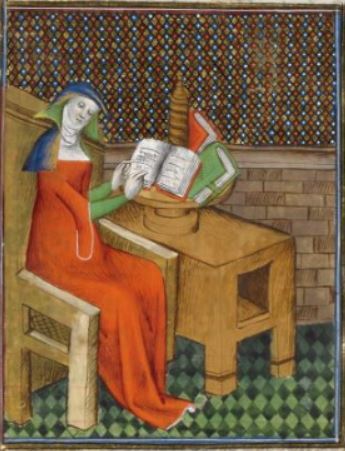
This illuminated image depicts the sibyl, Amalthea (also called Deiphobe), sitting down while looking at a book which is resting on a lectern. There are two other books behind her open book. Amalthea is famous for having had nine books to give to the Tarquinius Priscus, however, when he denied her payment, she began burning three books at a time until he gave her the money. There were three books left when he paid her. These three books contained all the future events that would happen to the Romans.
This image depicts a relief with the profiles of Voltaire, Rabelais, and Swift. Voltaire is on the left side, facing Rabelais and Swift. Rabelais and Swift are both on the right hand side, with Rabelais behind Swift. The names of the writers are written above their heads. The image is a part of Swift’s biography which precedes Part One of Gulliver’s Travels. The purpose of this illustration in the biography is to provide context for the political atmosphere and insight into Swift’s satirical writings. Through the image, Swift is compared to other notable writers of the same era, securing his importance in the writing stage. This edition was published over a century after Swift’s initial publication, thus Swift’s importance had already been secured. The same image appears in the 1839 Krabbe edition.
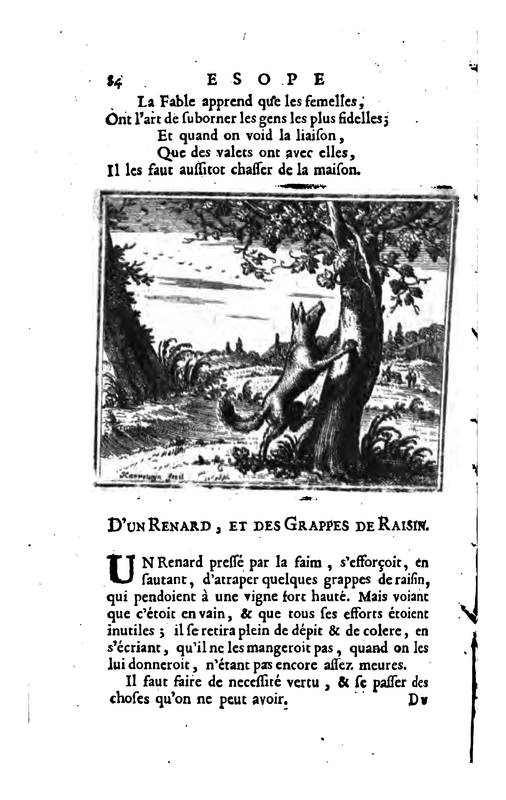
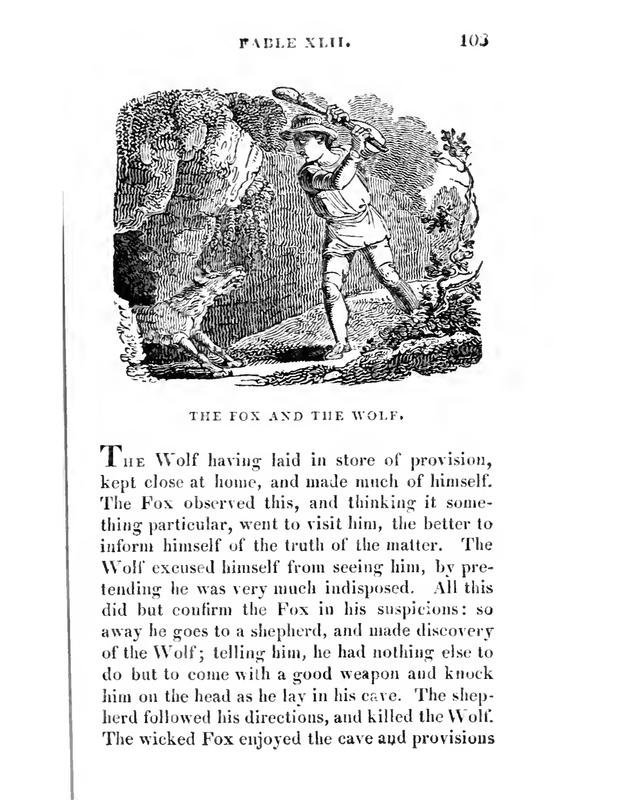
A man is in the centre of the page facing left and looking down at a wolf. The man is holding a club above his head in both hands on his right side. He is wearing a hat and a short tunic. The wolf is baring its teeth, looking up at the man, and is half emerged from a cave in the bottom left corner. Most of the background is filled with rocks and there is a tree on the right side.
We cannot be certain of which character the left panel depicts, since Calisto, Sempronio, and Pármeno are all included in the sixth act. The figure, dressed in regal attire, is also wearing a hat and has a sword mounted on his belt. To the right we see a female figure. This must be Celestina, since she is the only female character in this act. She is wearing a robe and a veil. In her right hand she is holding a flower, while in her left she is holding the girdle cord hanging from her waist. At her feet, a dog is standing on its hind legs with its front paws extended toward her. Both figures are placed outside.This entire illustration is identical to those found on pages 112 and 171 of the text.Both panels are near carbon-copies of panels found multiple times throughout the earlier 1529 Lyon edition. However, the lower attention to detail in these panels makes it clear that they are reproductions and not duplicates. The artist likely referred to a copy of the 1529 edition when creating these panels.


![[Leontium Standing with a Man in a Brothel]](https://collections.cemvc.ca/files/large/6337f22cf617523ee50c3e8afa2f54d3d8497dc7.jpg)

![Q[v]e No Obedeze a sv P[adr]e: Mana Yayayquita, Mamayquita Yupaychacoc, Yallinrac Collocouan Macanqui](https://collections.cemvc.ca/files/large/9466144fbccd3d196d18ecd8f7e7fa8c3a928188.jpg)
![[A scientist at the Grand Academy of Lagado]](https://collections.cemvc.ca/files/large/063db32efc32a104f5b529390a904690069e6178.jpg)
![[Vanity Fair Chapter LVIII Historiated Initial]](https://collections.cemvc.ca/files/large/d7d0508d4ac6d67cf3dd3f77950a5faff513365e.jpg)
![Monjas S[eno]ras S[an]tas de Conventos](https://collections.cemvc.ca/files/large/57ec76ea43aacd172b5af3552ae799566619d68b.jpg)
![[Vanity Fair Vol. I Chapter IV Historiated Initial]](https://collections.cemvc.ca/files/large/ea8c1906cae848772a58d31f4f035670a6f6f603.jpg)
![[Relief with Voltaire, Rabelais, and Swift]](https://collections.cemvc.ca/files/large/e63c844bf8a23b907754137fb5fd7ba57a9c6aef.jpg)
![[Act VI – (?) and Celestina]](https://collections.cemvc.ca/files/large/d79d93153e7b50568a3924566c902615b4869a76.jpg)