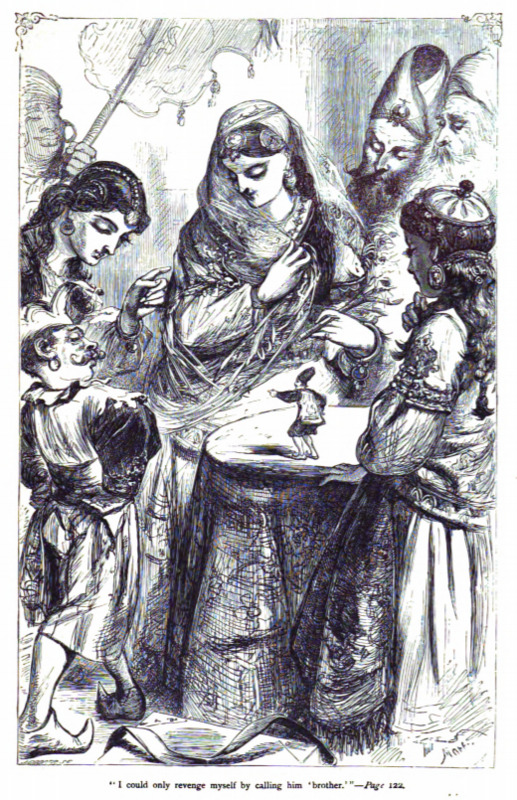
Before finding Gulliver, the Queen of Brobdingnag had a dwarf in her court. After Gulliver arrived, the dwarf became jealous and began tormenting Gulliver. Because of his size, Gulliver could not fight back, so he called him ‘brother’ as a way of irritating him. In this image the dwarf looks disapprovingly on Gulliver, who stands on a table entertaining the court.
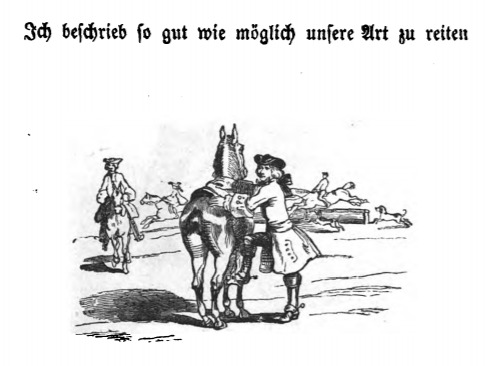
Here we see a horse wearing a saddle and its rider. The Houyhnhnms asks about the horses in Europe and how they live. Gulliver explains that humans or yahoos govern the country and care for the horses or Houyhnhnms, and how humans use their horses. The same image appears in the 1839 Krabbe edition.
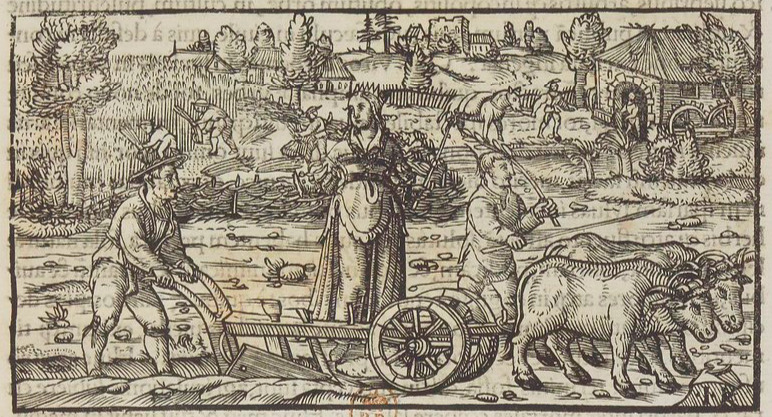
Ceres, the goddess of the harvest, stands in the middle of the photo. Ceres was the queen of Sicily, and was the first of the Sicilians to tame and train oxen to pull plows and plowshares, which she invented. The plows were used to prepare the ground for agriculture, as well as plant seeds. Her inventions are represented in the photo as she stands between two men, instructing them on how to use the oxen for plowing. In the field behind her, others are cutting down crops and leading livestock around.
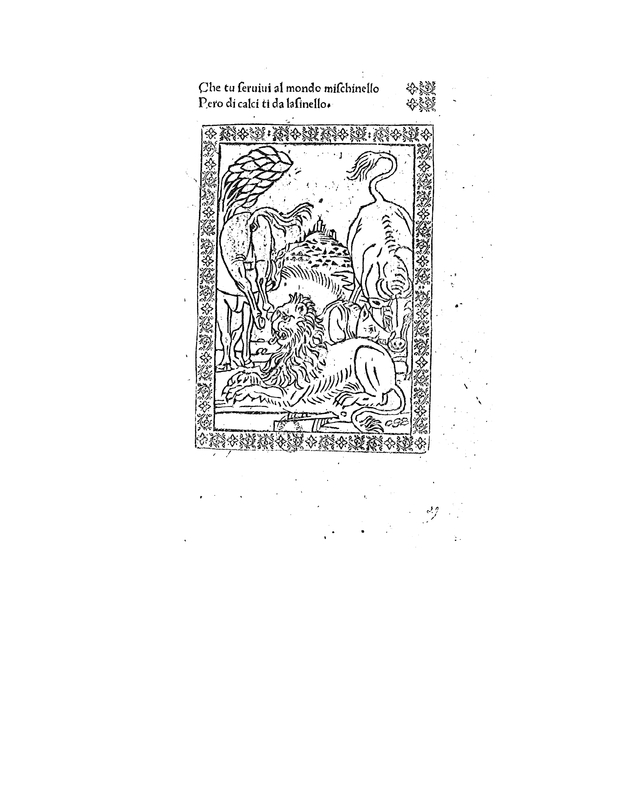
A lion who looks in pain and distressed is lying in the middle. On the left there is a donkey about to kick the lion. On the right there is a bull lowering itself seemingly also getting ready to ram the lion. Just behind the lion a boar can be seen.
In a forest, a pack of wolves are sniffing the ground and looking for food. In foreground, there is one wolf on the left lower corner sniffing the ground in front of a small tree. In the background, on a piece of higher ground, a wolf sniffs from the hand of a man. Next to that man are two more animals sniffing the ground. Trees are behind them, giving way to an open sky.
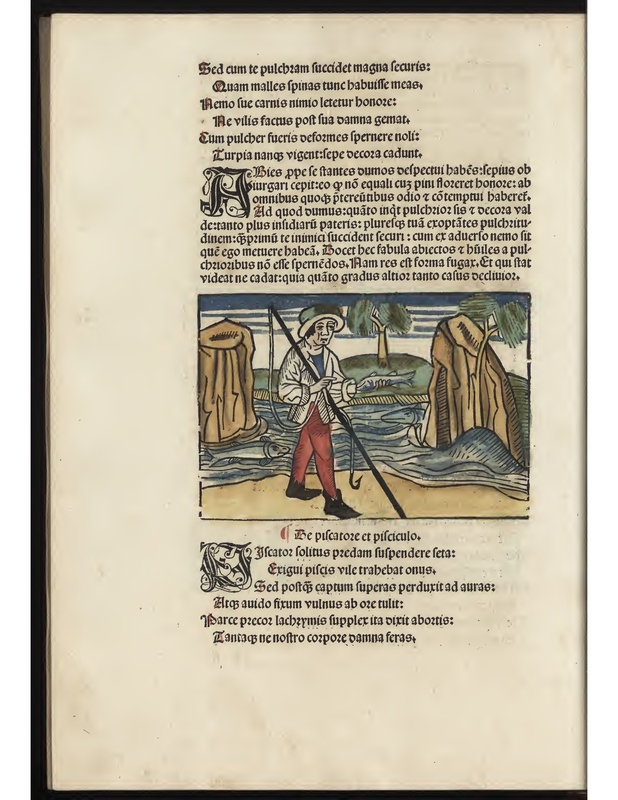
A fisherman holding a fishing rod is standing outside next to a river. The man is holding a fish in his left hand. Two more fish are swimming in the river.
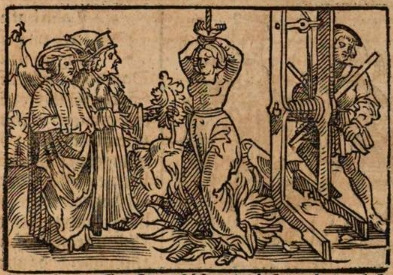
This engraving depicts the prostitute Leaena being tortured for information regarding a conspiracy. She is depicted with her hands bound by rope, which is attached to some form of torturing device that a man is controlling on the right side of the engraving. She is also depicted standing in a burning fire as another torturing method. Boccaccio explains that she is being tortured for being involved in a conspiracy to overthrow a tyrant. In order to avoid revealing information to those torturing her, she bites off her own tongue. The two figures on the left side are the ones attempting to get information regarding the conspiracy from Leaena.
Shortly after Gulliver set sail again, his ship was overtaken by two Dutch pirate ships. The Dutch and the English were rivals, despite both being members of the Grand Alliance against the French. Gulliver first begs the Dutch captain for mercy, saying that since they were both Christians he and the crew should be spared, playing off of Dutch religious toleration. The Dutchman rejected this, however the Captain of the second ship intervened. The second captain was Japanese and spared Gulliver and his crew. Gulliver chided the Dutchman for having less mercy for a fellow Christian than did a Japanese man. The Dutchman then argued to the Japanese that Gulliver should be killed, but the Japanese captain refused to go back on his word. However, for Gulliver’s insolence, he was set adrift alone with only enough provisions for four days. In this image we see Gulliver pleading with the Japanese captain to spare him, while the rest of the crew bows on their knees, asking to be spared. The same image appears in the 1839 Krabbe edition.
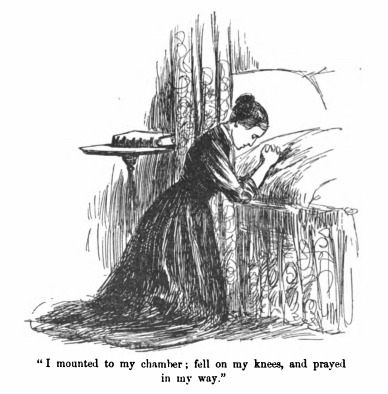
Here Jane kneels in front of her bed, praying. This scene occurs while at Moor House. She had visions of Mr. Rochester, that ultimately convinced her to return to Thornfield. She prayed for an answer about what to do about these visions where she would hear Mr. Rochester calling her name.
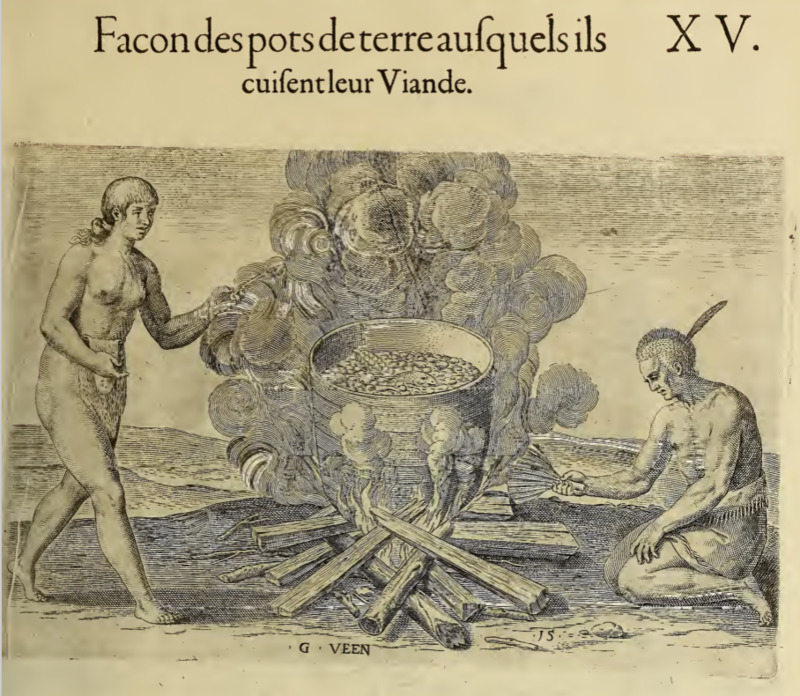
An Indigenous man and woman cook food in a large earthen pot over a fire. The woman holds a ladle, and the man kneels on the ground and fans the flames under the pot. Inside the pot a fish is identifiable, amongst other foods. Both individuals wear a fringed garment tied around their waist, and the man has a single feather in his hair.
In the foreground and to the left, we see a female figure knocking on the door to a house. Her long veil and slightly more aged appearance indicate that this is meant to represent Celestina. In her left hand she is holding either a lantern or a bag. In the foreground and to the right, we see a male figure (perhaps Calisto) walking toward the house with a horse. A figure (perhaps Melibea) watches from a window above (top left corner), and two other figures (perhaps Melibea’s parents Alisa and Pleberio) watch from a balcony.The entire image is identical to the one found on page 13 of the text.
This illuminated image depicts the Orithya and Antiope, sister queens of the Amazons. They are illustrated wearing chest plates for armour and holding what appears to be either scepters or spears in their hands. The queen on the right side of the image is holding a girdle in her right hand. This girdle ends up being one of Hercules’ twelve labours.
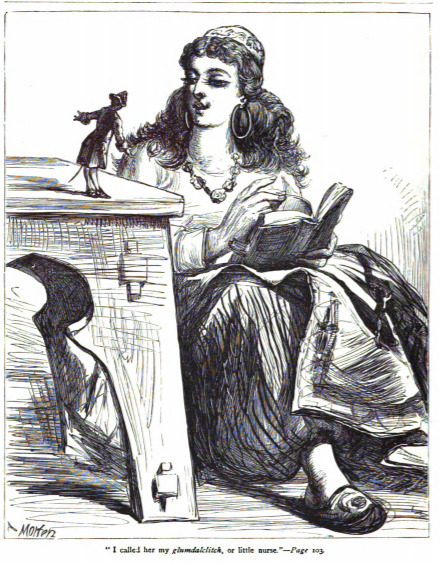
Here Gulliver stands on a table, speaking to Glumdalclitch, who became Gulliver’s nurse. Glumdalclitch sits on the floor reading to Gulliver. Glumdalclitch was the daughter of the farmer who found Gulliver, and she accompanied him when Gulliver went to live with the King and Queen of Brobdingnag.
In this image John Dashwood is introduced to Mrs. Jennings. Elinor and Marianne went to the shops to sell some of their mother’s old jewels. Mrs. Jenning had to run another errand across the street and told them she would meet them back at the carriage. Elinor and Marianne met their half-brother John Dashwood and he walked them back to the carriage where he was introduced to Mrs. Jennings. This scene occurs in chapter 33. The characters are shown in the traditional regency style, as Marianne, Elinor, and Mrs. Jennings wear regency style dresses with empire waistlines and wear bonnets. John Dashwood wears a waistcoat and tailcoat with breeches, a cravat and raises his top hat. The regency period dated to the early nineteenth century (1811-1820) when George, Prince of Wales, later George IV (r. 1820-1830), reigned as regent for his mentally ill father, King George III (r. 1760-1820). The regency period is associated with the rise of neoclassicism in art and fashion.
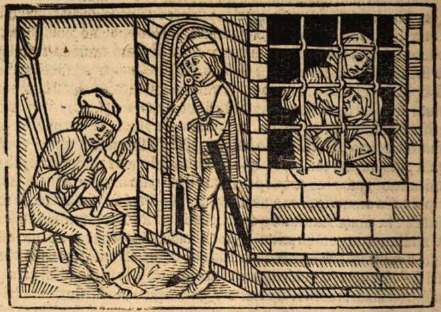
This engraving depicts a story of a young Roman woman who saved her mother from starving to death. Boccaccio explains that this unknown woman’s mother had been sentenced to death, and when she was locked away to die of starvation, her daughter saved her with her own breast milk. The girl and her mother are depicted behind the window of the jail cell as the mother drinks the milk of her daughter’s breast. The men that are standing guard outside the prison cell seem unconcerned and relaxed. They are unsuspecting of the young woman because they searched her every time that she visited her mother and she never seemed to carried food with her. The young woman saved her mother’s life through her breast milk, and Boccaccio explains that he wrote on this unknown young woman due to her filial devotion.
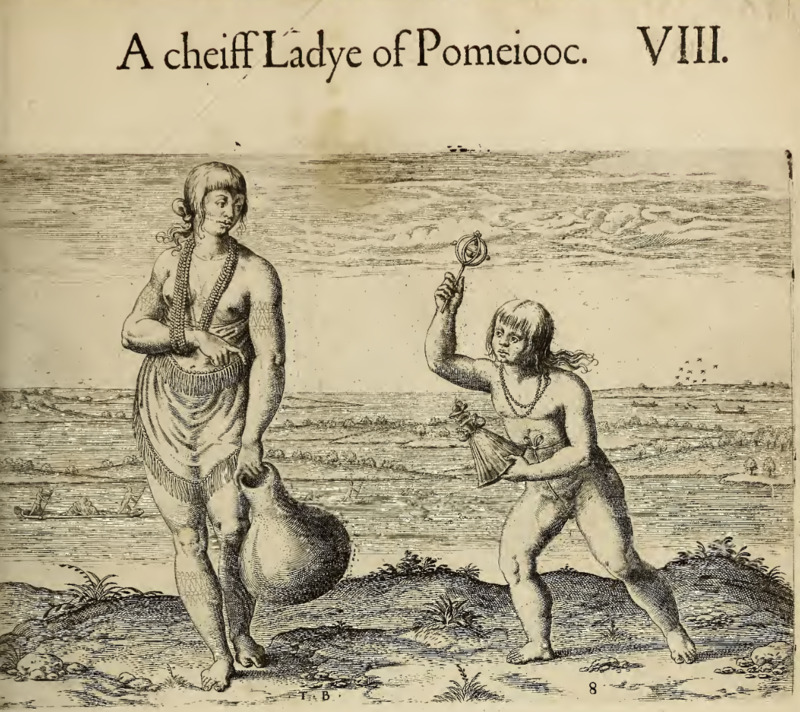
An Indigenous woman, a chief, is pictured standing on the bank of a river. Her hair is knotted at the nape of her neck, she wears several strands of beads around her neck, and her right wrist is cradled in the beads. She wears a fringed skirt around her waist and is topless and shoeless. She holds a large pot/container in her left hand. Beside her is a child, nude except for two strands of beads around their neck. The child holds a doll dressed like an English lady in one hand, and an object similar to a rattle in the other. Behind the pair, other Indigenous people are seen in canoes.
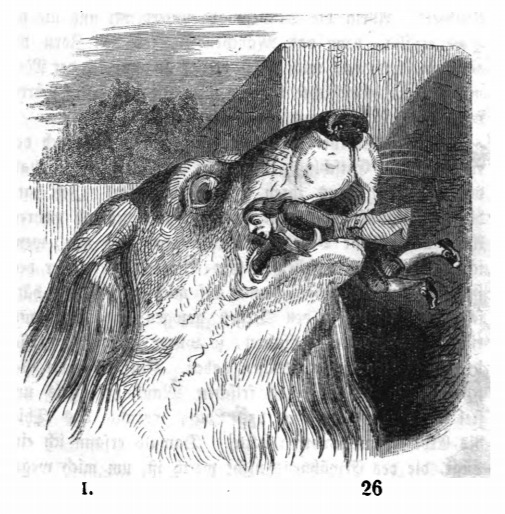
While Gulliver was walking through the garden the gardener's dog picked up Gulliver in his mouth, before the gardener returned and rescued Gulliver. In the image we see Gulliver lying between the dog’s teeth. The same image appears in the 1843 Krabbe edition.
On the right side of the image there is a person who is being bitten by a snake and is in distress. On the left side of the image there is a man who appears dazed, hunched over and grabbing the bottom of his robe.
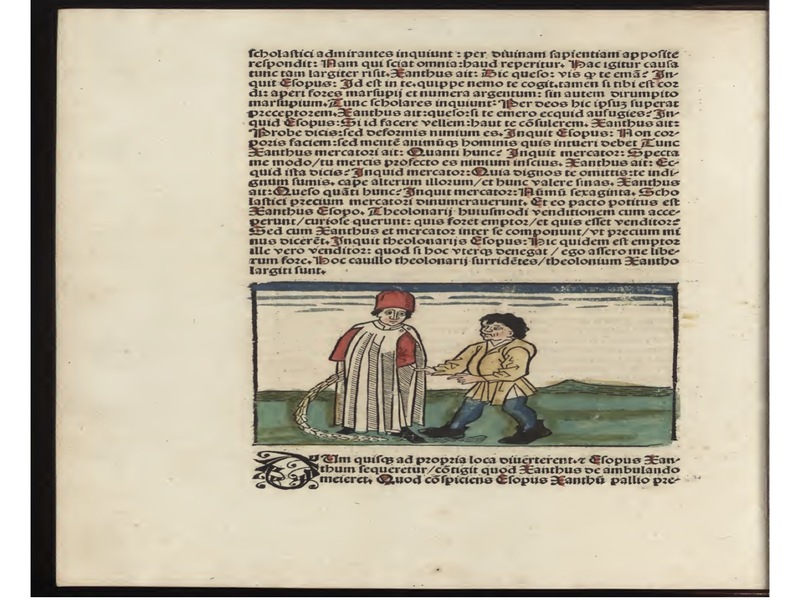
Two men stand in the middle of the engraving. The man on the left appears to be a religious official and carries a long, weaved rope in his right hand. The man to his left, Aesop, gestures with his hands while talking.
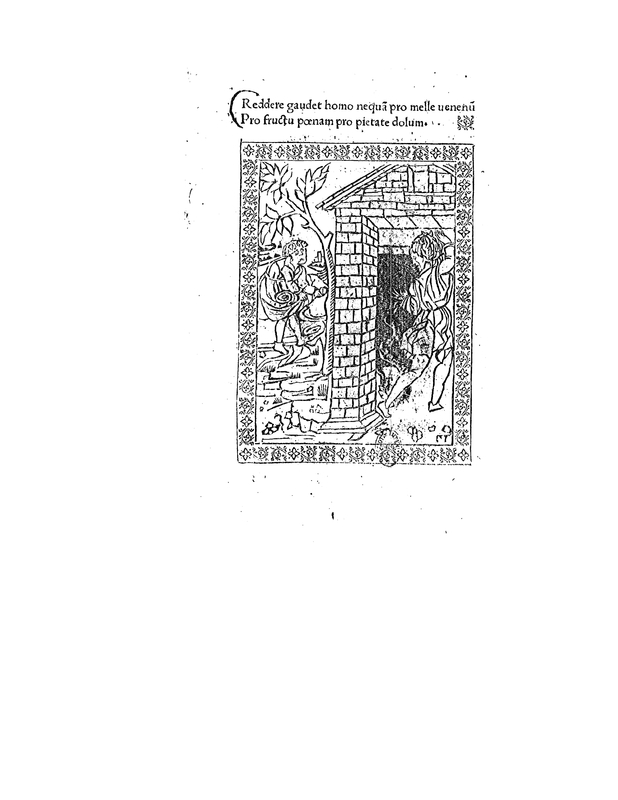
The image shows a couple wolves taking over a foxes den with a dead fox laying upside down in the back of the den. There’s a couple of trees and small hills in the background of the image.

![[The Hunting Wolves]](https://collections.cemvc.ca/files/large/5186bf6c2bf6f83cacf6bbaaff77e4239dff9235.jpg)

![[Gulliver begs for mercy from the captain of a pirate ship]](https://collections.cemvc.ca/files/large/ccf17435d051f55f23a667d9d66484d02b526a5f.jpg)
![[Title Page – As Celestina Knocks on a Door, a Horseman Approaches and Three Figures Observe]](https://collections.cemvc.ca/files/large/17c67088c530ea6ed64d0485f62850bdf16548c5.jpg)


![[Person Sharpening Animals Horns]](https://collections.cemvc.ca/files/large/bf1086914bff6d8ac5cc8d86abbb8651041b0f7e.jpg)
![[The Fox and the Wolf]](https://collections.cemvc.ca/files/large/364b44aec975e170500f949ce7511046bacba589.jpg)