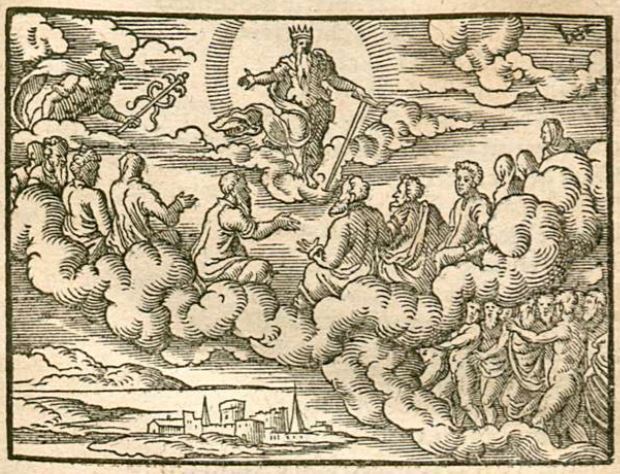
This image illustrates the twelve gods of Olympus seated on clouds with Jupiter at the center, leaning on his ivory scepter. There is a city depicted beneath the gods. The gods are holding a council at the request of Jupiter to discuss his intentions on destroying mankind. Jupiter had been angry with the violent ways of the humans. Jupiter mentions to the other gods that the only beings he wants to save are the demi-gods, nymphs, and satyrs as they all live on earth.
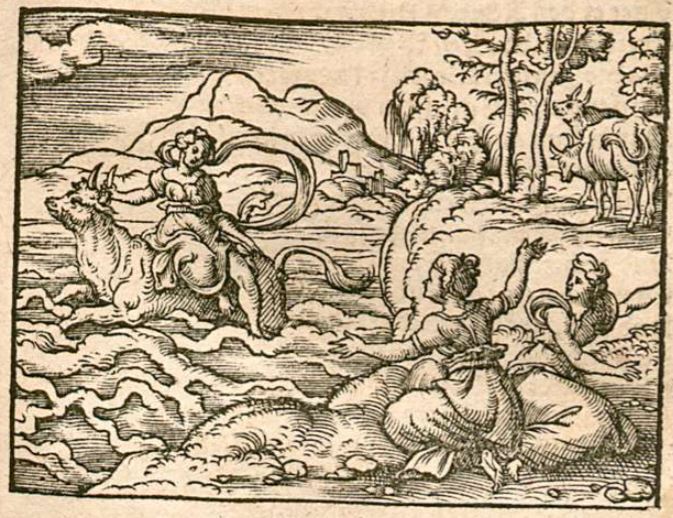
This image illustrates Jupiter in the form of a bull with Europa on his back holding onto one of his horns for safety. Jupiter had acted gentle and kind in the form of the bull in order to gain Europa’s trust. Once Europa had trusted the bull and admired his beauty, she got on the bulls back, unknowing that it is in fact a god. Jupiter, still in the form of the bull, ran off into the sea with Europa, and carried her far away. There are two women depicted on the beach watching Jupiter carry Europa away to sea.
Sancho Panza (right) sits comfortably in high throne above the crowd dressed in courtly apparel. He is surrounded from below by his citizens who look at him to see how he governs, some of whom carry tall halberds. His attendant stands with his arms crossed in the foreground on the right with a sword by his hip. On the left, a young woman with black curly hair grabs the shoulder of the man behind her in an accusatory manner as she speaks to Sancho. The man is dressed in the manner of a rich herdsman and holds up his hands to try and prove his innocence.
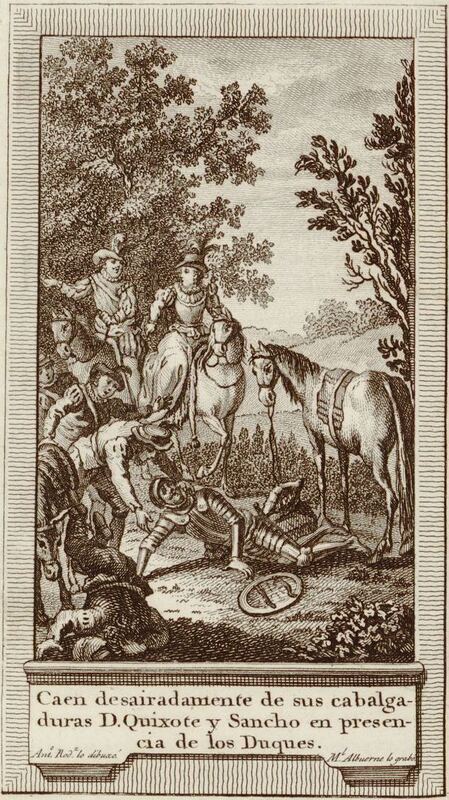
The duke and duchess’ servants help Don Quixote and Sancho Panza after falling to the ground from their mounts. Accurate to Cervantes’ text, the duchess is pictured on horseback, holding a goshawk. Signed by A. Rodríguez (illustrator) and M. Albuerne (engraver). Part 2, ch. 30.
Having been warned of an invading army against the city of Barataria, the servants of governor Sancho bring him two huge shields and tie them over his shirt with rope, insomuch that he remained walled and boarded up straight like a spindle without being able to bend his knees or walk one single step. They also put a halberd into his hand to lean upon to keep himself on his feet. The servants carry torches and look at Sancho with bemusement while Sancho's face is plastered with a look of absolute terror.
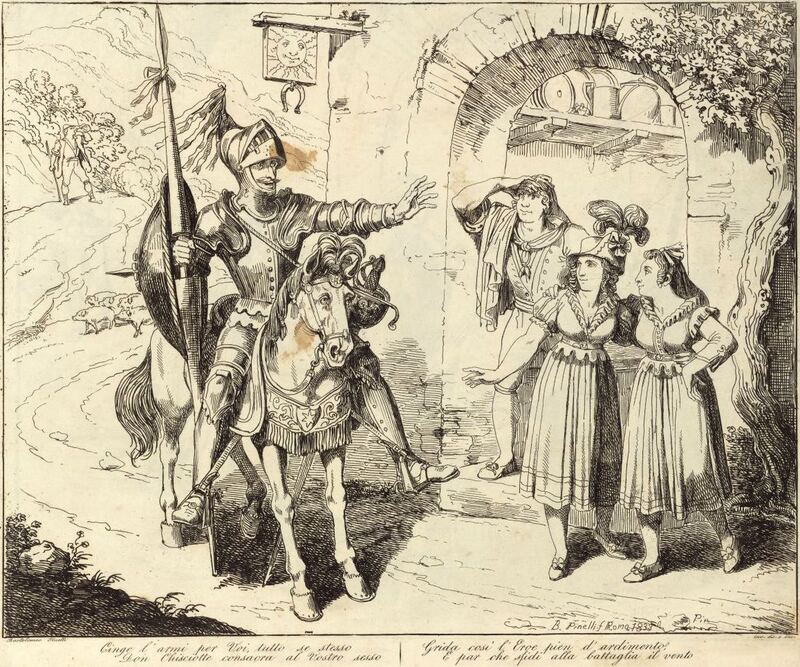
Don Quixote arrives at the inn, which he perceives to be a castle, mounted on Rocinante. He carries a lance and a sword, and attempts to calm two ladies frightened by the sight of him. In the background, a swineherd blows a horn. Don Quixote confuses the latter with a dwarf welcoming the knight to the castle. Signed by Bartolomeo Pinelli (engraver and illustrator) and dated Rome, 1833. Plate 2. Part 1, ch. 2.
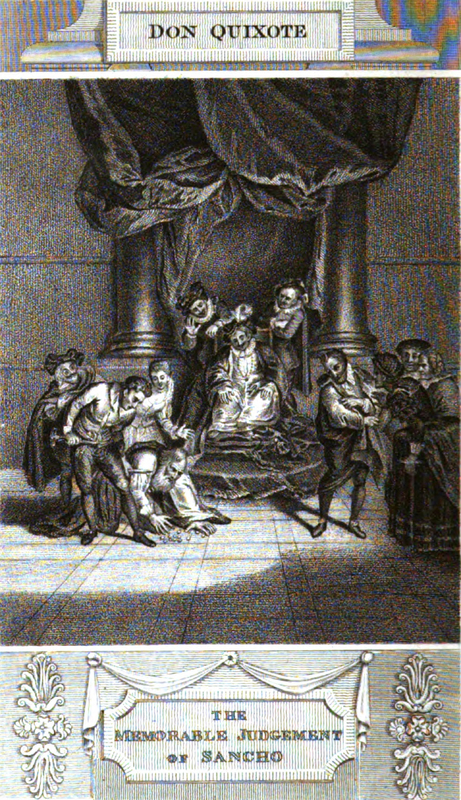
Being carried to the tribunal of justice Sancho is placed in the chair at the head of the hall with an attendant by either shoulder and told to answer the questions presented to him by the city's inhabitants. The second dilemma presented before Sancho, were two ancient men, one with a cane in his hand for a staff (pictured on the right, arms crossed) and the other without any staff (pictured on the right picking up coins from the ground). Having sworn to have never been loaned ten gold, Sancho commanded the cane to be broken before them all, which is done by a young attendant of Sancho pictured on the left with the head of the cane in his right hand . Which being done, there were found in the hollow of the cane ten crowns of gold. The old man who lent the money dropped to his knees and picked up the ten crowns of gold. The onlookers are surprised to find the gold hidden within the hollowed out cane and amazed by Sancho Panza's wisdom.
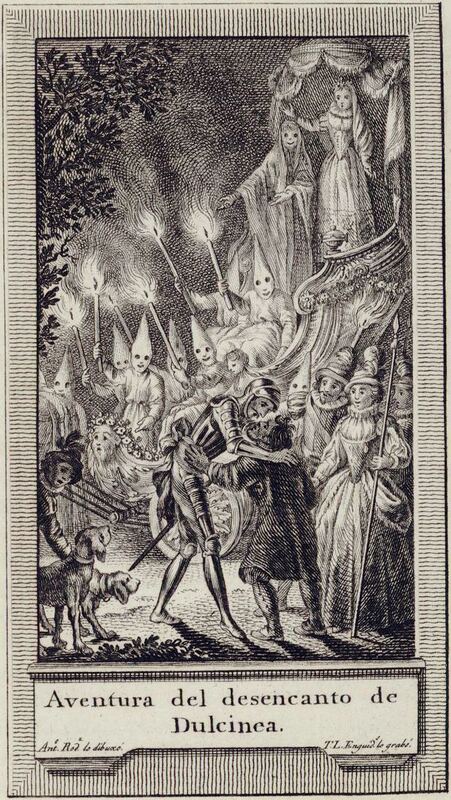
To the rhythm of music, a triumphal cart approaches Don Quixote, Sancho Panza, the duke, and the duchess, pulled by six gray mules caparisoned in white linen. The triumphal is surrounded on all sides by penitents dressed in white and holding large, burning wax torches. On a raised throne sits a nymph draped in a thousand veils of silver cloth with gold sequins. Her face is covered by a transparent and delicate sendal. Next to her is Merlin, dressed as the figure of Death. Don Quixote embraces Sancho Panza after his squire accepts to give himself lashes to disenchant Dulcinea. Signed by A. Rodríguez (illustrator) and T. Enguídanos (engraver). Part 2, ch. 35.
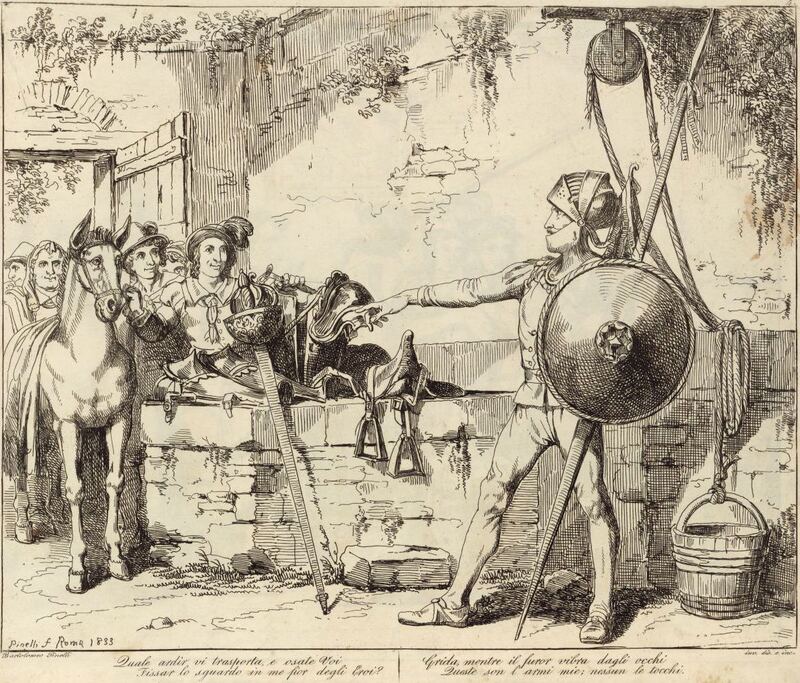
During his night vigil, Don Quixote orders the muleteers not to touch his arms, placed on a water trough next to a well. The scene is not accurate to Cervantes’ text: the first muleteer arrives alone in the text, while in the illustration they appear all at once. Signed by Bartolomeo Pinelli (engraver and illustrator) and dated Rome, 1833. Plate 4. Part 1, ch. 3.
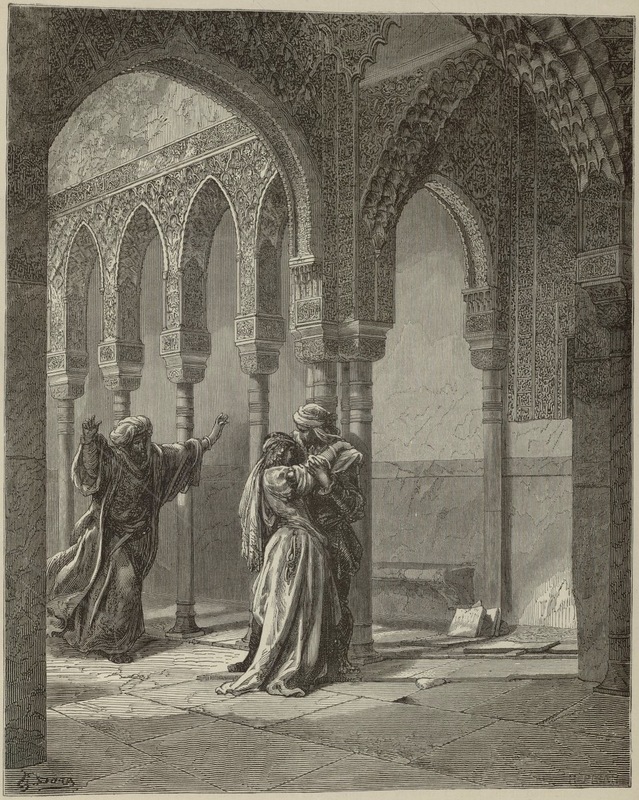
The illustration represents part of the captive’s tale: Zoraida pretends to faint when her father, Agi Morato, discovers her with the captive. Signed by G. Doré (illustrator) and H.-J. Pisan (engraver). Part 1, ch. 41.
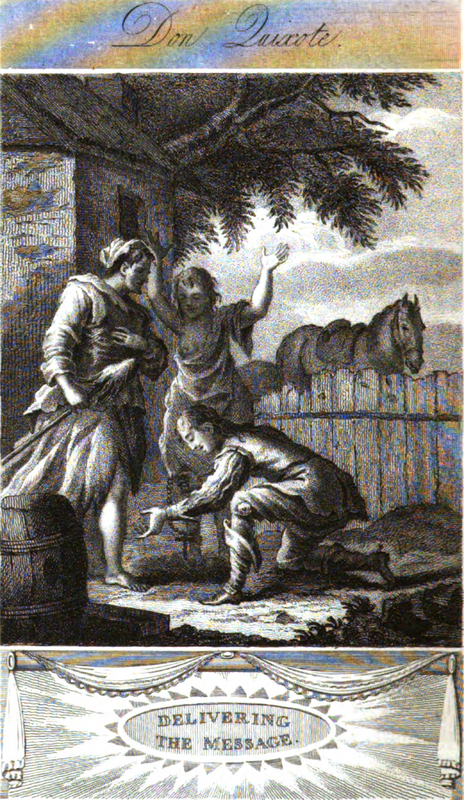
Sancho Panza's daughter meets the page sent by the Duke and the Duchess on behalf of Sancho Panza. Running to their house, Sancho's daughter (pictured in the middle with her hands raised in celebration) called for her mother. Her her mother, Teresa Panza (pictured on the left), came out, wearing a gray petticoat, a gray bodice also and loose smock sleeves. Upon meeting Teresa, the page went and kneeled before the lady Teresa with great respect. Then he pulled out of his pocket a string of corals, each bead set in gold and presented it to Teresa. In the background, the page's horse looks over the farm's fence at the ensuing events.
In the foreground, three shepherds dig Grisóstomo’s grave. In the background, Marcela makes her appearance and speech, while Vivaldo reads Grisóstomo’s song. Don Quixote, Ambrosio, and Grisóstomo’s body are also pictured. Unsigned. Part 1, ch. 14.
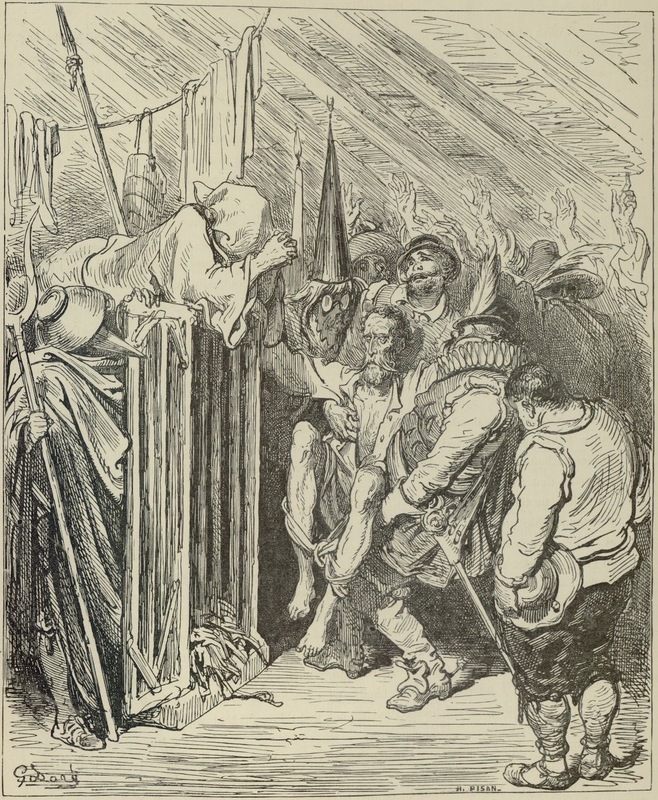
Don Fernando, his companions, Don Luis’ servants, the officers of the Brotherhood, and the innkeeper, all of them under the direction and guidance of the priest, cover their faces and disguise themselves before seizing Don Quixote from his room as he sleeps. He believes that they are phantoms from the enchanted castle and that he, himself, has been enchanted. They lock him in a cage, nailing the bars so firmly that they cannot be quickly broken. Signed by G. Doré (illustrator) and H.-J. Pisan (engraver). Part 1, ch. 46.
On the road, Don Quixote and Sancho Panza are overtaken by Don Diego de Miranda mounted on a beautiful dapple mare. He wears a coat of fine green cloth trimmed with tawny velvet and a cap of the same material. A Moorish scimitar hangs from a wide green and gold swordbelt. Sancho Panza, after having heard the gentleman recount his life, dismounts his donkey to kiss the saintly Don Diego’s feet. Don Diego de Miranda insists that he is not a saint but rather a great sinner, and that Sancho must be a good man. Signed by J. Rivelles (illustrator) and A. Blanco y Asensio (engraver). Part 2, ch. 16.
Sancho Panza (right), scared of the Squire of the Woods' nose (left) climbs atop a cork tree to get as far away from its horrible size. Don Quixote (foreground), clad in full armor is mounted upon Rocinante with a lance in his left hand. In the background, among the trees, the Knight of the Mirrors is mounted upon his a horse, equipped with his own lance, prepares to duel Quixote. A hat and a wineskin lie on the ground near Rocinante's feet.
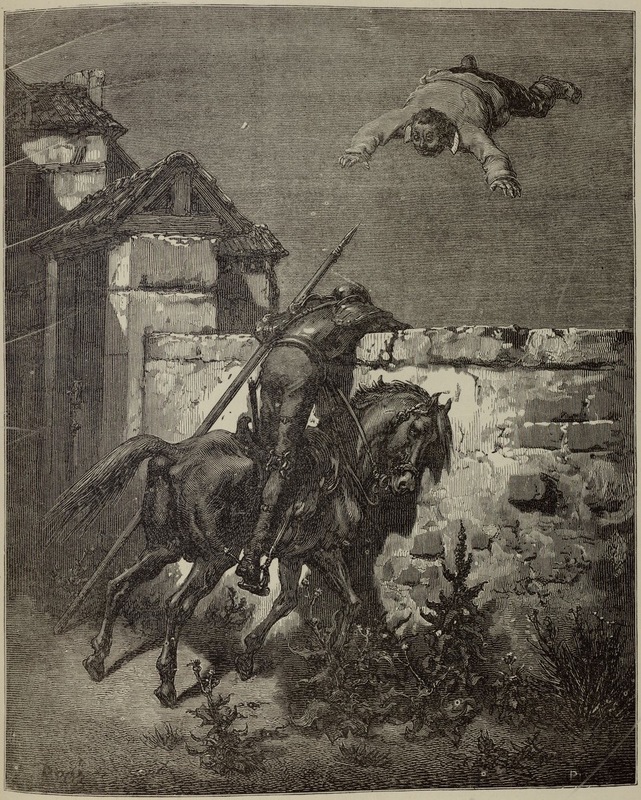
When Sancho Panza refuses to pay the innkeeper, guests at the inn toss him in a blanket in the courtyard and make merry with him. In the foreground, Don Quixote hears Sancho’s cries and watches from outside the walls of the corral. Signed by G. Doré (illustrator) and H.-J. Pisan (engraver). Part 1, ch. 17.
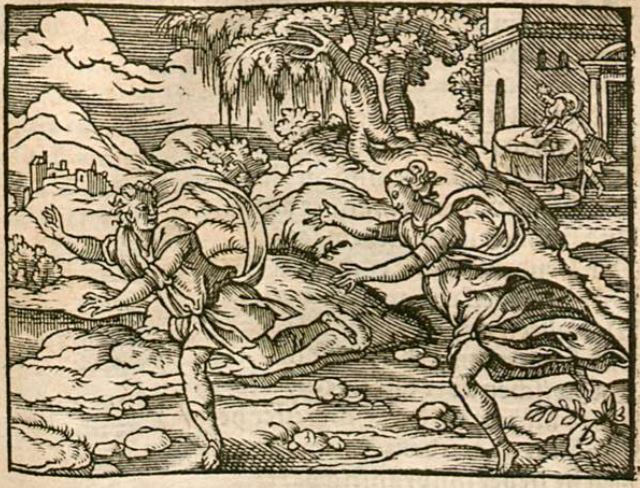
This engraving illustrates the story of the twins named Byblis and Caunus. In the background of the engraving, Byblis is illustrated writing on a wax tablet declaring her incestuous love for her twin brother. When her brother receives the letter, he is absolutely repulsed that his sister is in love with him and does not reciprocate the feelings. The forefront of the engraving illustrates Byblis chasing after Caunus as he runs away from her advances.
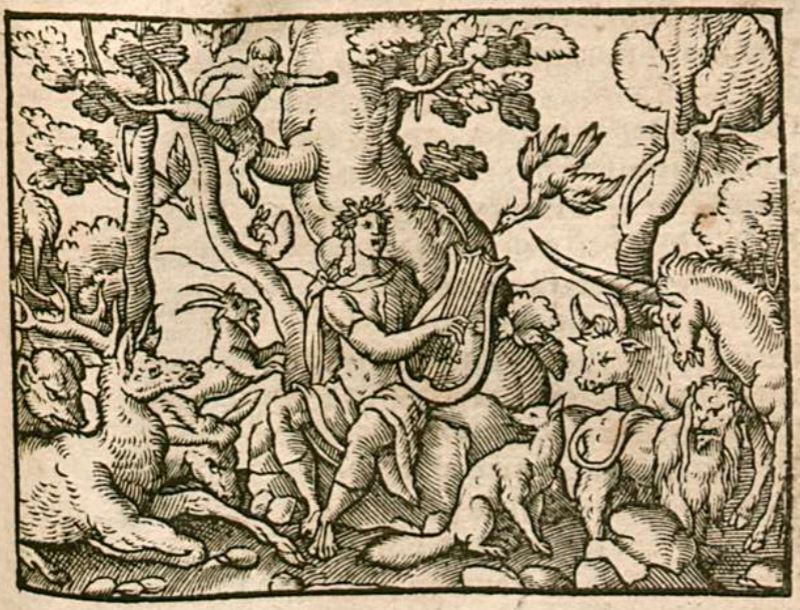
The scene that this engraving depicts takes place just after Orpheus had tried rescuing his wife, Eurydice, from the Underworld. Orpheus was meant to travel out of the Underworld without looking back to check that Eurydice was following him. He did, however, look back at Eurydice and she vanished, never to return from death. Grieved by his mistake, and angered with the Gods, Orpheus finds himself on the side of Mount Rhodope where he spent three years singing and playing his lyre for the animals and trees to enjoy. The engraving illustrates the many types of animals and trees flocking to hear the sound of Orpheus’ soulful music.
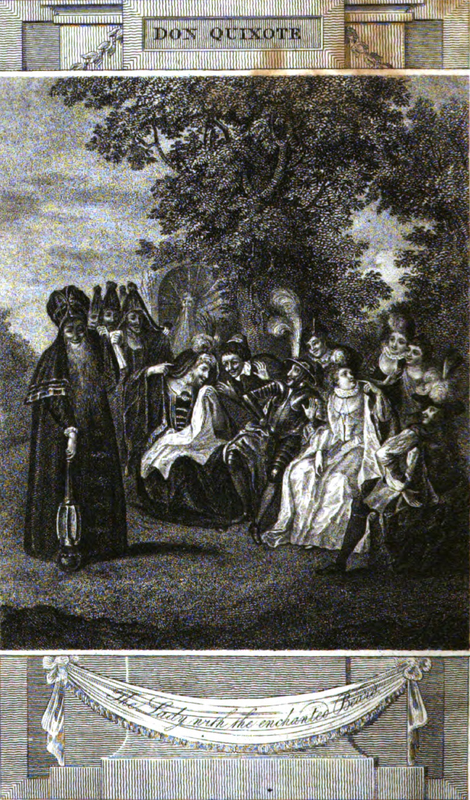
After the Duchess has told Don Quixote and Sancho Panza of the tragic enchantment placed on the Countess Trifaldi, doleful music enters the garden and twelve duennas, divided into two files, all clad in black mourning habits, with white veils of thin muslin, so long appeared. Behind them came the Countess Trifaldi, whom squire Trifaldi of the White Beard led by the hand. Upon the appearance of this squadron of duennas, the duke (pictured on the far right), duchess (pictured next to Quixote in a white dress pointing towards the procession), and Don Quixote (pictured in armor with a great feather flying from his helm),looked on from their seats, as did all the rest (notably Sancho Panza who stands behind Quixote) who also beheld this grand procession. The twelve duennas halted and made a lane through which squire Trifaldi was received by the Duchess' company.
In the background, Sancho Panza and Don Diego de Miranda run away, while in the foreground, Don Quixote prepares to fight the lion as the the lion keeper opens the gate of its cage. Don Quixote holds his lance in one hand and his sword in the other. Unsigned. Part 2, ch. 17.
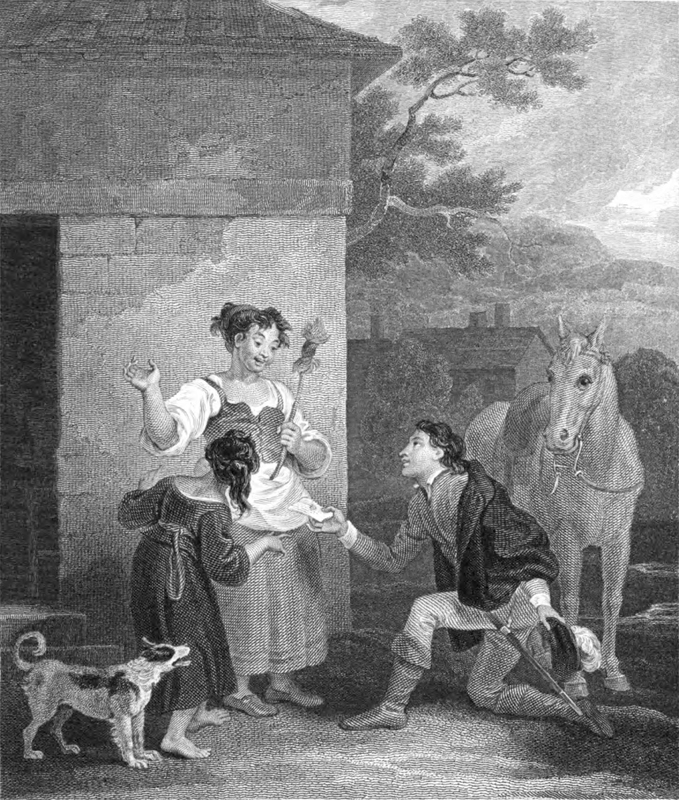
The page of the duchess kneels before Teresa Panza who holds a tow ball that she had been spinning, and hands Sancho's letter to her. Sanchica, Sancho's daughter, stands barefoot next to her mother, looking at the letter in surprise. A dog stands by Sanchica's feet and a horse behind the Page.
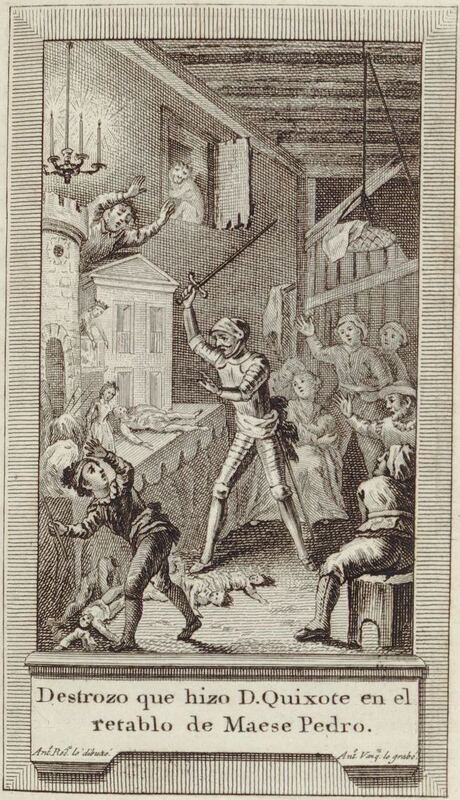
Don Quixote attacks Maese Pedro’s theatre and puppets, while the innkeeper and other astonished theatregoers watch. Accurate details: Maese’s monkey flees through the open window and his assistant holds a rod with which he pointed to the figures as they came out. Signed by A. Rodríguez (illustrator) and B. Vázquez (engraver). Part 2, ch. 26.
A turtle wades up upon a beach, its limbs, head, and neck protruding from the shell. In the background, five birds fly off into the horizon. The image is occasioned because Sancho will attach a shield to either side of his person in Barataria and be likened to a turtle.

![[A Young Woman Testifies Before the Governor Sancho Panza that she Has Been Raped]](https://collections.cemvc.ca/files/large/c83f4cac7564abf241ed3b27700d0b1477769a6f.jpg)
![[Sancho Panza Armed For Battle in Barataria]](https://collections.cemvc.ca/files/large/1d7186d0a50a41cc8a559c9db850bbd6aa6bd6ca.jpg)
![[Grisóstomo's burial and Marcela's appearance]](https://collections.cemvc.ca/files/large/4e6ca8e0ae3e4d44f80d28d2cc1e25bef280acae.jpg)
![[Sancho Panza kisses Don Diego de Miranda's feet]](https://collections.cemvc.ca/files/large/9a3cb33ab3f80619df23c8772ab1a760a9d23d14.jpg)
![[Of How Sancho Panza Was Frightened by the Squire of the Woods' Nose]](https://collections.cemvc.ca/files/large/ed316fdfabe3c864042e9c31916ad165097d5398.jpg)
![[The Violent But Not Violated Woman of Barataria]](https://collections.cemvc.ca/files/large/a8aa6131f6d7b884ce9aa4b51e341a3057a5078b.jpg)
![[Don Quixote and the lion]](https://collections.cemvc.ca/files/large/61dcf6c597dd7d523f1740f9c1ab9e6e6de7c185.jpg)
![[A Turtle On a Beach]](https://collections.cemvc.ca/files/large/18d63bfc42085d226b01ed55121b3e3e1bc87663.jpg)