Here we see a scientist from the Grand Academy on Balnibarbi who was working to use spider’s webs to make clothing. Gulliver walks into his studio that is covered in cobwebs, and the scientist tells Gulliver not to disturb them. The scientist was attempting to domesticate spiders and use their webs in a similar manner to silkworms. He even went as far as to attempt to alter the spider’s webs through feeding them certain foods so that the webs they spun were colourful. In this image we see the scientist’s laboratory, whose walls are covered in cobwebs. On the table we see an apparatus used to wrap the webs into thread. The scientist wears a robe with images of insects on it. The same image appears in the 1839 Krabbe edition.
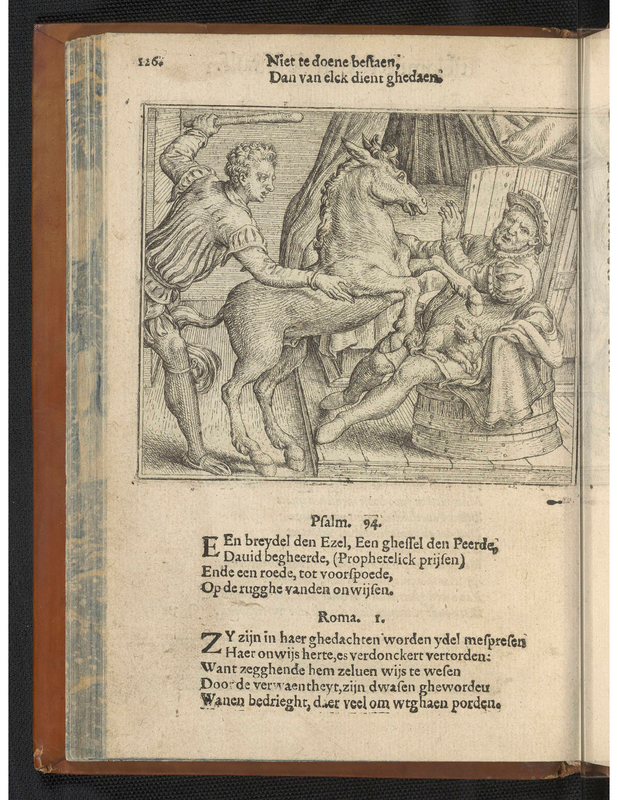
A man is sitting in a chair with a dog on his lap, while a donkey its front feet on the mans lap as well. The donkey is about to be punished for this act, as a man on the right side of the image has a stick raised above his head in motion to hit the donkey. The chair design is lavash and both men are wearing unique hats.
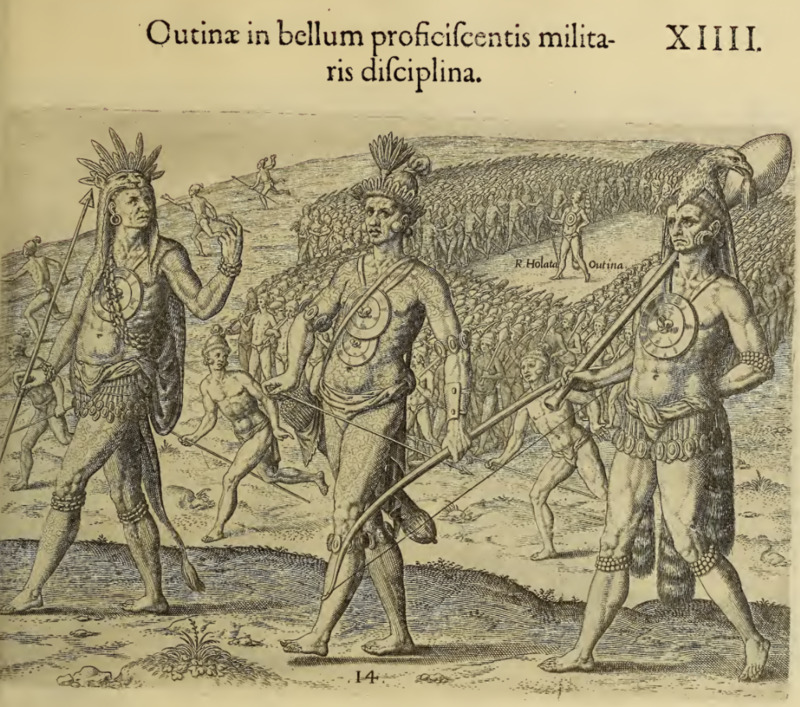
Three Indigenous men stand in the foreground. All three carry a different weapon: the one on the left a spear, on the right a club, and in the middle a bow and arrow. They each wear a different headdress as well, the one on the left a small mammal and feathers, on the right a bird, and in the middle feathers. All three men wear round plates hanging from their necks, loincloths with tails hanging from the rear, and various adornments including earrings, bracelets above their elbows, around their wrists and below their knees, and the two men on the left are painted or tattooed. In the background a large group of Indigenous people stand in a battle formation, al holding spears. In the center of the formation there is a square of empty space, where another man stands.
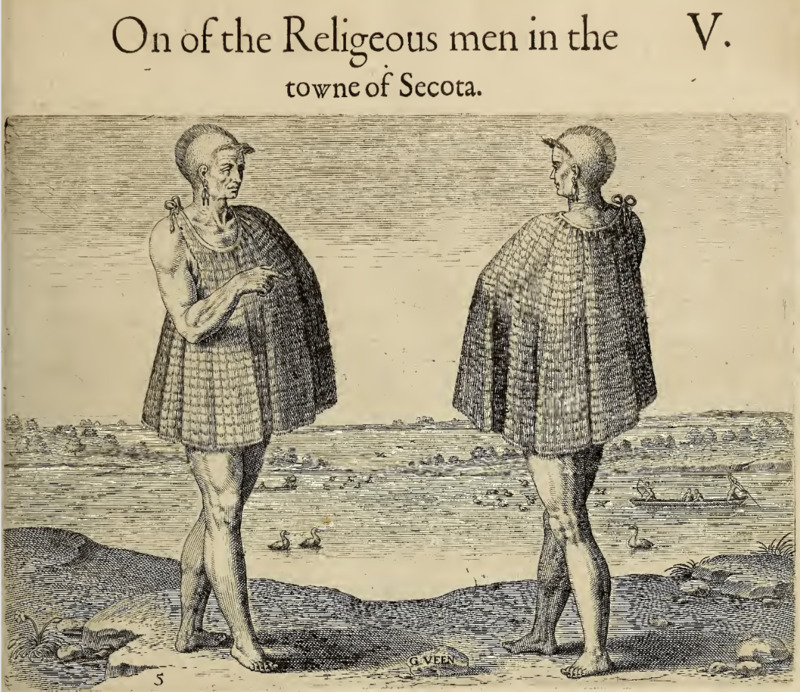
An Indigenous man (a shaman/priest/religious man) is shown standing on the bank of a river, from the front and from behind. He wears a cape-like garment, is barefoot, and wears no other adornment. In the river behind him, other Indigenous people are shown in canoes.
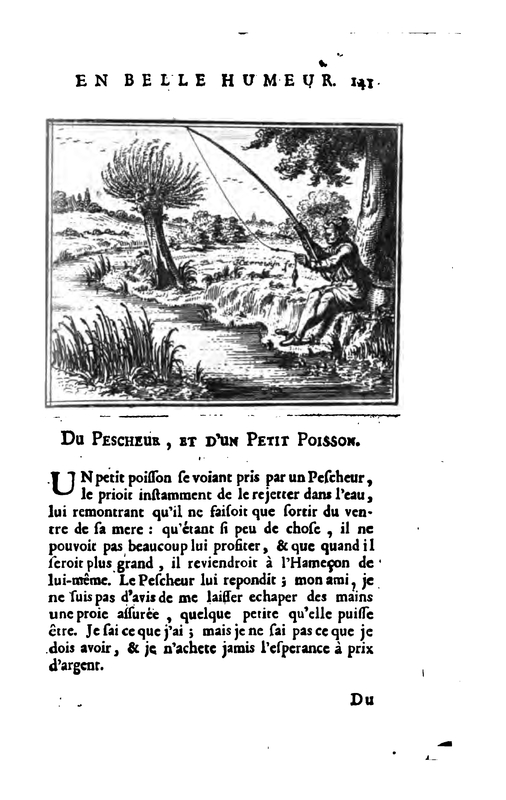
A fisherman had bad luck one day and caught nothing but a small fry. The fisherman was about to put it in his basket when the little fish said: Please spare me. I am so small it is not worth it to carry me home. I will make a much better meal when I am bigger. The fisherman quickly put the fish into his basket. I would be foolish to throw you back. However small you may be, you are better than nothing at all.
The left panel depicts Melibea’s father Pleberio, who is wearing regal attire and a large chain. This panel was first used to represent Calisto, which explains the falcon perched on his left arm. (It is odd that the printer would use this panel to represent someone other than Calisto.) On the right we see Melibea, who is wearing a robe and a veil. In her left hand she is holding the girdle cord that she gave to Celestina earlier in the story. In her right hand she has a flower, which she appears to be holding in front of her face (perhaps intended to express her modesty). A small dog stands at her feet, perched on its two hind legs while extending its front paws toward her. The left panel is nearly identical to those found on pages 88 (where there is no decorative panel and it is labeled ‘Calisto’), 135 (where the label is changed to ‘Sepronio’ [likely a printing/engraving error]), 170 (where there is no decorative panel and it is labeled ‘Calisto’), and 216 (where there is no decorative panel). The right panel is identical to those found on pages 8, 150, and 196.
Two sticks-the left one forked, the right one pointed-hold up a banner with the title Vanity Fair. Each letter is on a separate piece of paper, connected by a string tied to the sticks. Beneath the banner is printed the subtitle and author, A Novel without a Hero. By William Makepeace Thackeray.. At the base of the banner, a haggard man with a plumed helmet is lounging against an open chest, holding up a mirror from which he peruses his reflection. By his side are a doll and what appears to be a handmade axe or hammer, with a flat rectangular stone or piece of wood tied to a longer, thinner stick. In the background can be seen trees, a fence, and several buildings.
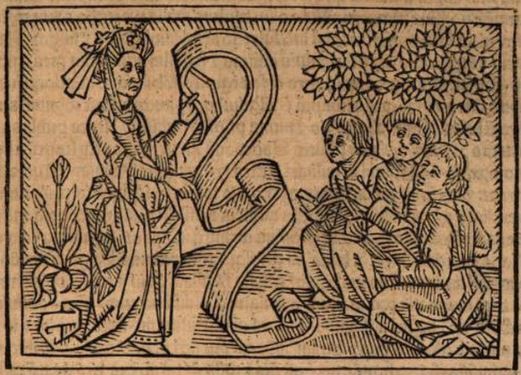
This engraving depicts Nicostrata, a woman who was a famous prophetess during her time, holding a scroll of parchment. Nicostrata had gone with her son, Evander, to Italy and he founded the city of Pallantium. Boccaccio explains that once Nicostrata realized that the inhabitants of this city were not well educated or literate, she decided to give them their own language with their own letters and symbols. This was the Latin language. Nicostrata taught the new letters and language to the people of Pallantium, which is what the engraving depicts. There are people sitting on the ground who are listening intently to the prophetess, as she is holding the parchment and teaching them the language. The citizens are also holding books as they listen to Nicostrata.
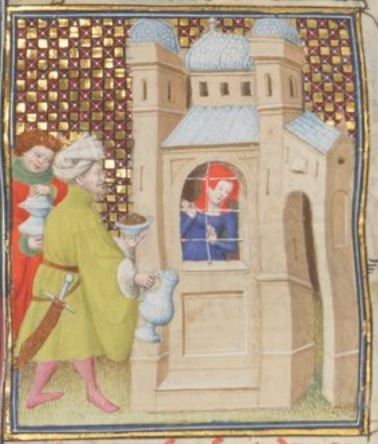
This illumination depicts Agrippina, the wife of Germanicus, being forced to eat food while in prison. Agrippina is in the centre of the image as she looks out of the window of her prison cell. Her father-in-law, Tiberius, put her in prison after killing his son (her husband, Germanicus). Agrippina decided to starve herself to death to avoid dying at Tiberius’ hands, however, Tiberius force fed her so that she would not die on her own accord. The men on the left side of the image are carrying food and water to force Agrippina to eat so that she does not starve herself to death.
Marcia, a Roman woman who remained a virgin her entire life, is depicted on the right side of the illustration bent over as she chisels into a sculpture that she is working on. Boccaccio explains that Marcia is worthy of renown for her chastity and for her sculpting and artistic abilities. She is known to have mostly painted and sculpted figures of women, which is why she is sculpting a statue of a woman in the image. Her sculpting tools are illustrated on the table in front of her.
Here we see an image of a machine created by one of the professors from the Grand Academy on Balnibarbi. This machine had all the words in the language of Balnibarbi in different moods, tenses, and declensions written on blocks. These blocks were held together by wires on a frame, and students of the professor would rotate the handles, forming different arrangements of the words. They would then find sentence fragments and record them in this book. The goal of this experiment was to create a complete body of work that comprised all of the arts and sciences. The same image appears in the 1843 Krabbe edition.
Here we see a group of Yahoos fighting each other. Gulliver’s master explains the relationships among the yahoos in the Country of the Houyhnhnms. Gulliver’s master says that the yahoos fight more than any other species, seen here. The same image appears in the 1839 Krabbe edition.
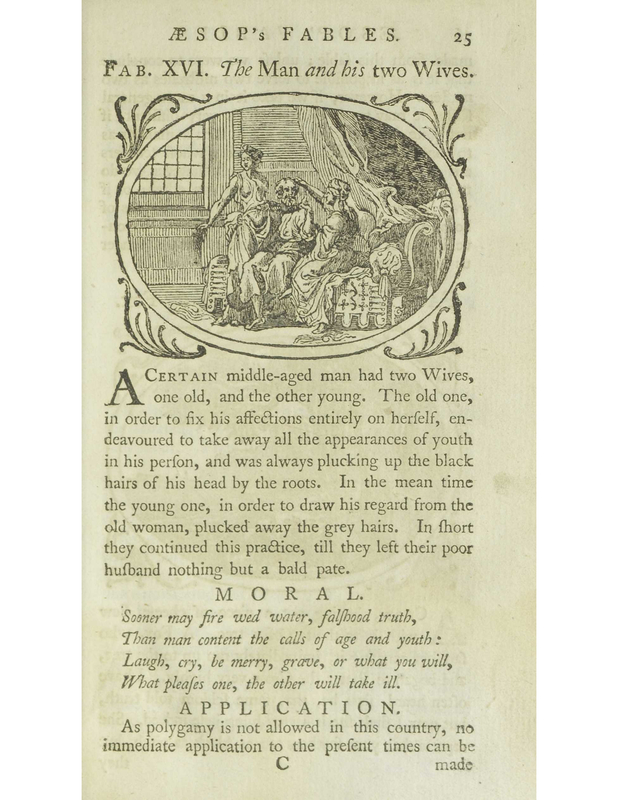
There is a man in the center of two females. One female appears to be younger and one female appears to be older. Each of the female characters clothing is different from each other. Their body image/posture is much different than each other. The female on the right is the one who appears to be older. She is seated on a couch. The man is to her left, also seated on a couch, wearing a robe. The other female is to the left of the man and is standing near his side. Both females are wearing long dresses, covering each different areas of the body. There is a curtain of sorts to the right of the image in the background and a large window to the left of the image background. Some type of decoration on the front side of the couch.
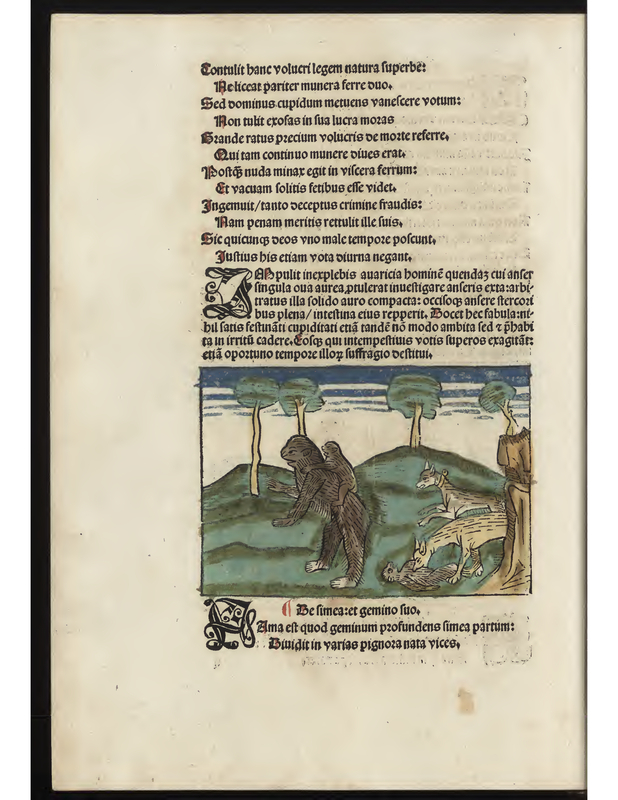
A monkey with a cub on its back is preyed on by two wolves as it tries to escape. One of the wolves has caught one cub and eats it while the other wolf continues to hunt.
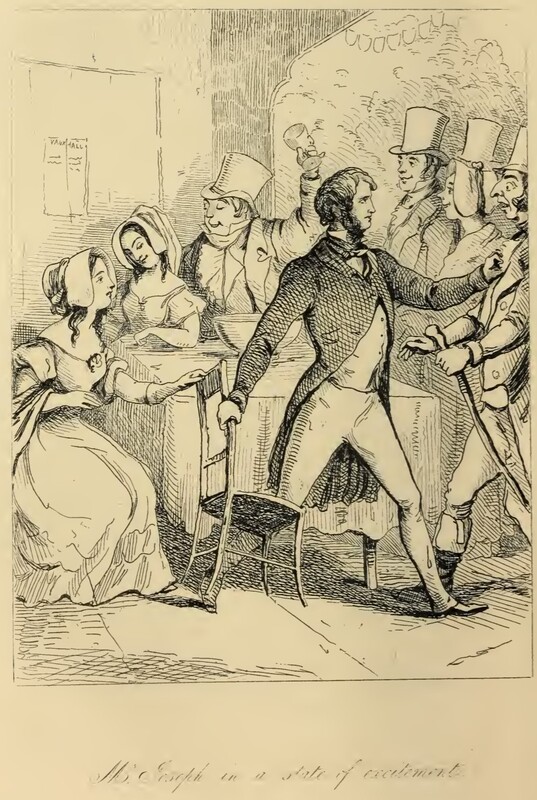
In the center of the image is Joseph Sedley, waving around his cup and singing. On the table before him is the bowl of alcohol of which he has drunk all by himself. Amelia Sedley and Rebecca Sharp are seated at the table to the left of the image, with Rebecca gazing down at Amelia, who looks concerned. To the right is George Osborne, holding onto his chair and facing a crowd of onlookers, the nearest of which he is blocking from coming closer. Below the illustration is printed in cursive its title, Mr. Joseph in a state of excitement.
Calisto is eager to know what happened when Celestina visited Melibea, and how she was able to convince Melibea to give up her girdle (to the right of the image, Celestina is seen presenting Calisto with Melibea's girdle). Celestina lies, and explains to him that Melibea was brave. Celestina promises Calisto that if she does not die, she will win him his mistress. In return for this promise, she requests a reward, and Calisto is willing to offer anything to be united with his love. Throughout this, Pármeno is unable to restrain his negative comments about Celestina and Calisto, thus putting at risk the deal between Celestina and Calisto (and, consequently, the secret deal between Celestina and Sempronio). To the left of the image, Sempronio can be seen chastising Pármeno for his aforementioned negative comments.
In this image we see Gulliver being examined by three scholars from Brobdingnag. The scholars were invited by the King to examine Gulliver’s ‘physical form’. They came to the conclusion that he did not conform to the ‘usual course of nature’, as he was significantly smaller than any other creature on Brobdingnag. They also questioned him regarding his diet and his education. There are three giants crowded around Gulliver who is standing on a table. They each wear elaborate hats and have beards. The giant on the left holds a magnifying glass to his left eye. His hat has what looks like a tree and an insect on top. The centre giant’s face is somewhat in shadow, and his hat has an image of a compass and a globe. The man on the right has depictions of scientific instruments on his hat. Gulliver is seated on a table that is elaborately carved and looks up at the giants. The same image appears in the 1843 Krabbe edition.
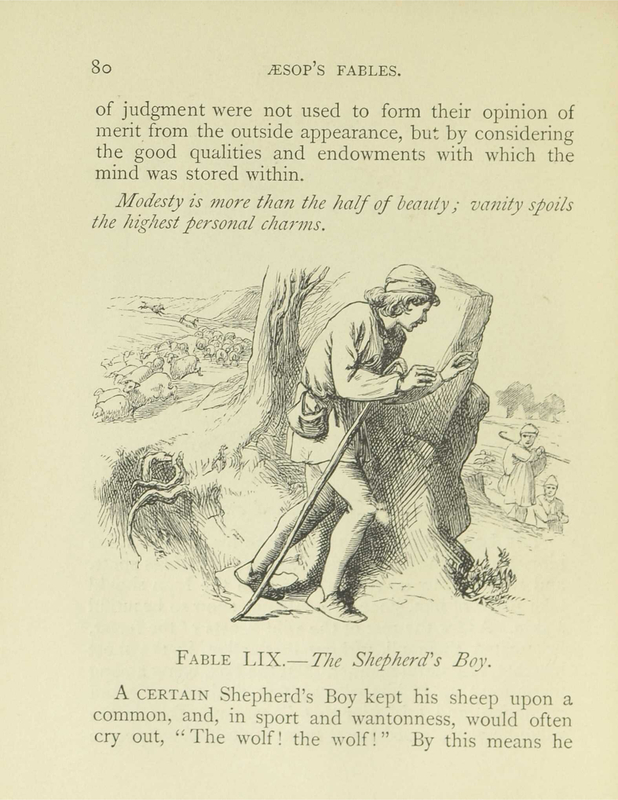
In the centre, a young boy stands hunched behind a large boulder, peering over to look at other men in the distance. Behind him to his left, a flock of sheep are hunted by a wolf.
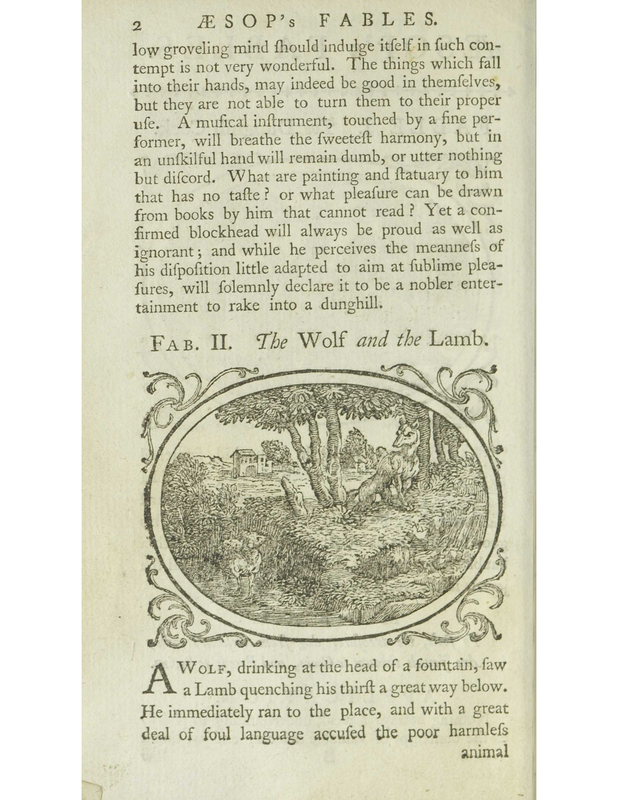
A wolf is looking at a sheep on the lower portion of the ground. The sheep looking at the wolf. Both animals are near the water and amongst the forest. There are a few homes in the background. Lots of tall trees and grasses enclose a small body of water.
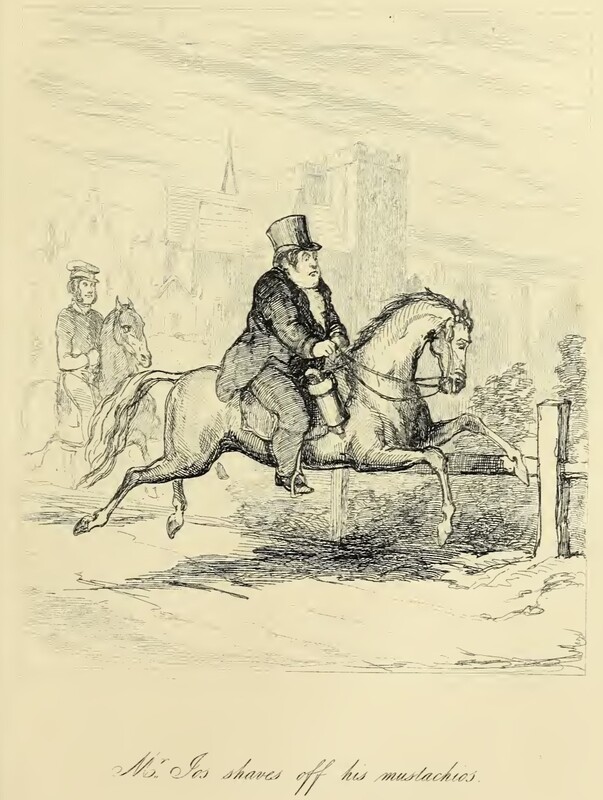
Joseph Sedley, freshly shaven, upon one of a pair of horses he has just purchased from Rebecca Crawley for an unreasonably large sum in order to flee from Brussels. Behind him is Isidor, his valet, on the other horse from the pair. Amelia has refused to go with the two, as her husband is still on the battlefield. Below the illustration is printed in cursive its title, Mr. Jos shaves off his mustachios.
Because Pármeno is the only male character included in the seventh act, and because of the wrinkled appearance of the female figure, we can infer that this image depicts Pármeno and Celestina in conversation. Pármeno is depicted as quite small in stature, likely implying his younger age. This could also be intended to represent his lower social standing as a servant to Calisto. Celestina is holding a jug of some sort. From her depiction in the story, we are likely meant to interpret this vessel as containing wine. She is wearing a veil and a robe, while Pármeno is wearing a hat and a cloak of some sort.The right side of the image, including the figure and the vegetation behind her, is reproduced on the right side of the image found on page 221 of the text. The left side, including the figure and the hatched surface behind him, is a reproduction of the left side of the image found on page 69 of the text (although the figure is used to depict Sempronio in that instance).
a man and a staggering donkey at left moving towards a seated man with a little dog on his lap at right; the seated man is scared of the donkey; the dog barks at the donkey; Dutch letterpress on verso; illustration to Eduwaert de Dene's edition of Aesop's Fables
![[A scientist from the Grand Academy of Lagado experiments with spider webs]](https://collections.cemvc.ca/files/large/44078ade63bc2725be7aafc267a4f9758f32c409.jpg)
![[The Lapdog and the Donkey]](https://collections.cemvc.ca/files/large/5b63772acd7ed6ac5364d86f1bea15b1b3b75a86.jpg)
![[Act XX – Pleberio and Melibea]](https://collections.cemvc.ca/files/large/47640fdba9de6ca32ff60370740c03b9743212d9.jpg)


![[Marcia Chisels a Statue of a Woman]](https://collections.cemvc.ca/files/large/bbd450fb0dd33a51ff45083326e676ec777a43a8.jpg)
![[invention from The Grand Academy on Balnibarbi to create a complete body of language]](https://collections.cemvc.ca/files/large/46d35eeddddedc3744001ccc3c243ca180723019.jpg)
![[a group of Yahoos fighting]](https://collections.cemvc.ca/files/large/92c076d67375eb0245c86ab68cfc199440ec7269.jpg)
![[Act VI - Celestina Delivers the News and Girdle to Calisto, While Sempronio Chastises Pármeno for Chiding Them]](https://collections.cemvc.ca/files/large/cfee471a476375095a28a5f3c81b653b0fe39e34.jpg)
![[Gulliver is examined by three scholars from Brobdingnag]](https://collections.cemvc.ca/files/large/bad1fdc6d6201c813be4b89e22790b84acb44541.jpg)
![[Portrait of Swift]](https://collections.cemvc.ca/files/large/587a09c6f0a5561fbdc307ac8b05a12492dc29b1.jpg)
![[Act VII - Pármeno and Celestina]](https://collections.cemvc.ca/files/large/a9a73667aa69c2c607e532e493895839a64c4db5.jpg)