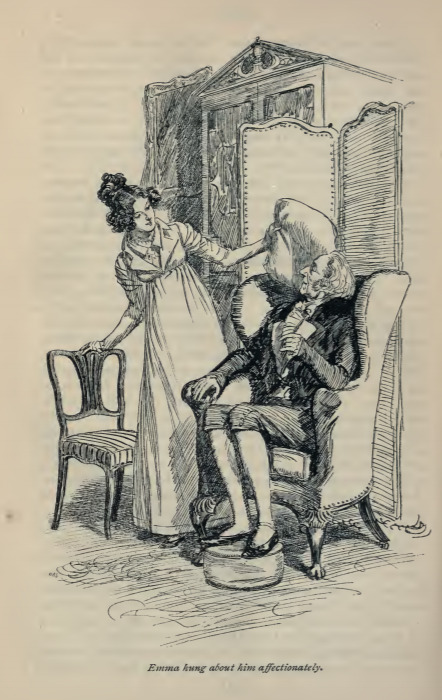
In this image Emma hands her father a pillow. After announcing her engagement to Mr. Knightley, Mr. Woodhouse was very upset. Emma spent most of her time with him, caring for him and assuring him that she would not be leaving him. Mr. Woodhouse eventually came around to her marriage. This scene occurs in chapter 53. The characters are shown in the traditional regency style. Emma wears the regency style dress with an empire waistline. Mr. Woodhouse wears a waistcoat and tailcoat with a cravat. The regency period dated to the early nineteenth century (1811-1820) when George, Prince of Wales, later George IV (r. 1820-1830), reigned as regent for his mentally ill father, King George III (r. 1760-1820). The regency period is associated with the rise of neoclassicism in art and fashion.
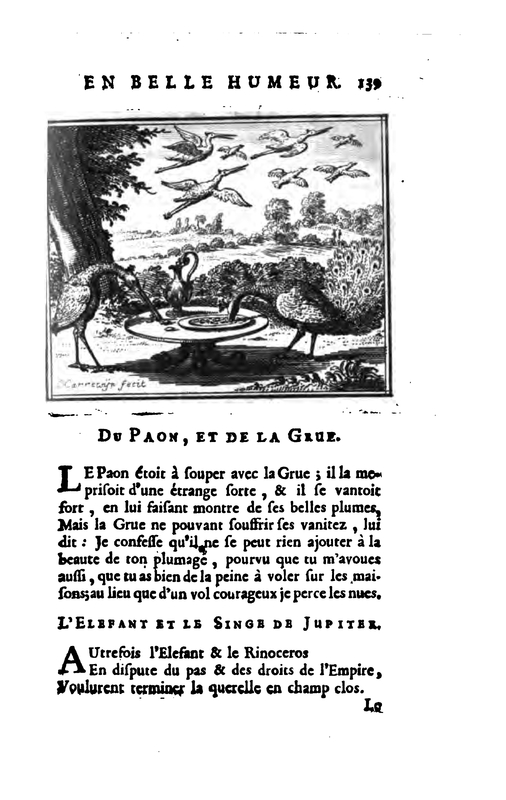
A peacock met a crane, and to impress him spread his gorgeous tail. The peacock says: What have you to compare with this? I am beautiful, while you are grey as dust. The crane spread his broad wings and flew up into the sky, Follow me if you can, he said. The peacock stayed among the birds of the barnyard, while the crane soared in freedom.
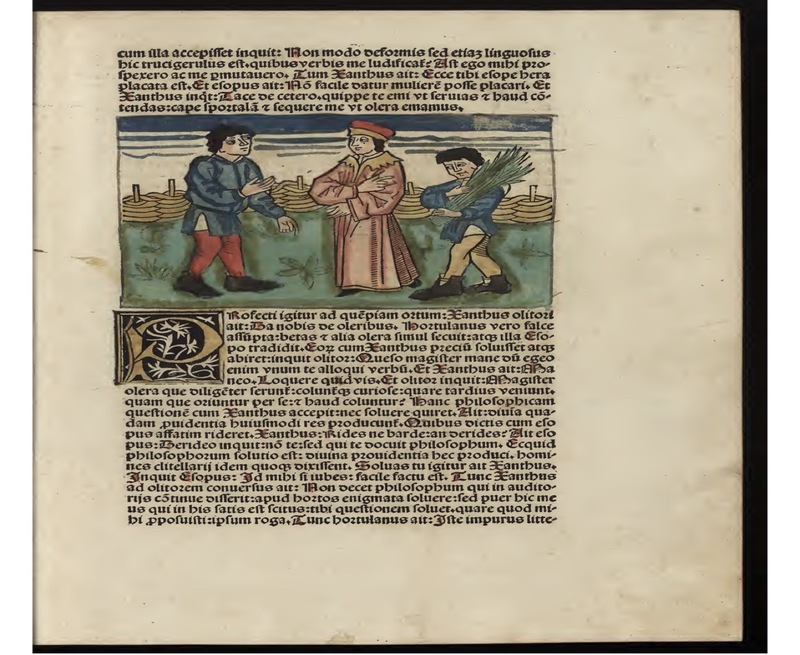
Three men stand in a working field. Aesop, a slave, carries an armful of agriculture and stands behind his employer. The employer listens to the other man speaking.
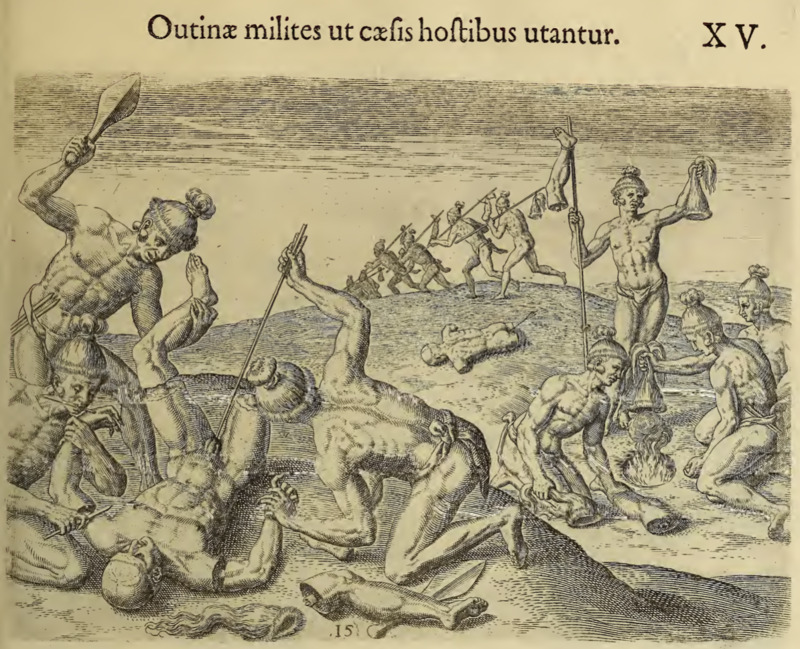
This image shows members of the Indigenous group led by Outina dismembering and scalping the deceased bodies of other Indigenous people from an enemy group.
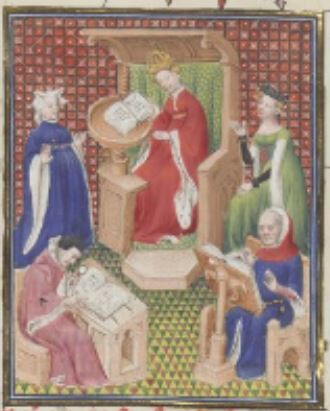
Despite having been a prostitute, Soaemias of Emesa rose to high status as she was the mother of Emperor Elagabalus. Her significance amongst the Roman people were high as she was given the title of Augusta and she was invited by her son to join meetings of the Senate, which had previously never had a woman in attendance. This image depicts Soaemias wearing a red dress and sitting in a large chair with a book in front of her. She is surrounded by Roman matrons who are either reading books or standing by Soaemias’s side.
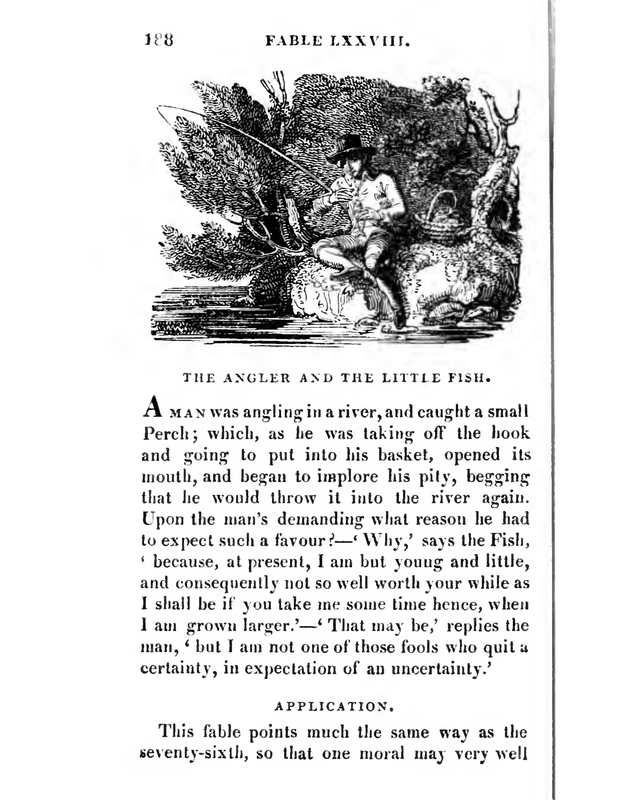
In the middle of the image a man is seen sitting on a rock, and his feet are dangling over body of water. To the left of him there are many trees and branches sticking out. To his right there is a basket sitting on the same rock. In the background are many trees and bushes.
While sleeping on the bed in Brobdingnag, two rats climbed up on the bed and began to attack Gulliver. He then drew his sword and killed the rats. In this image we see Gulliver standing over the corpse of the rat.
Here we see a scientist at the Grand Academy of Lagado on Balnibarbi. This is the first scientist Gulliver encountered. This scientist was attempting to extract sunbeams out of cucumbers, a project he had been working on for eight years. His goal was to be able to supply the governor’s garden with sunlight. The scientist has a long beard that is singed in several places and soot on his hands and face. He wears clothes with astronomical and scientific imagery, similar to what was worn on Laputa. He holds a beaker with a curved funnel. The same image appears in the 1839 Krabbe edition.
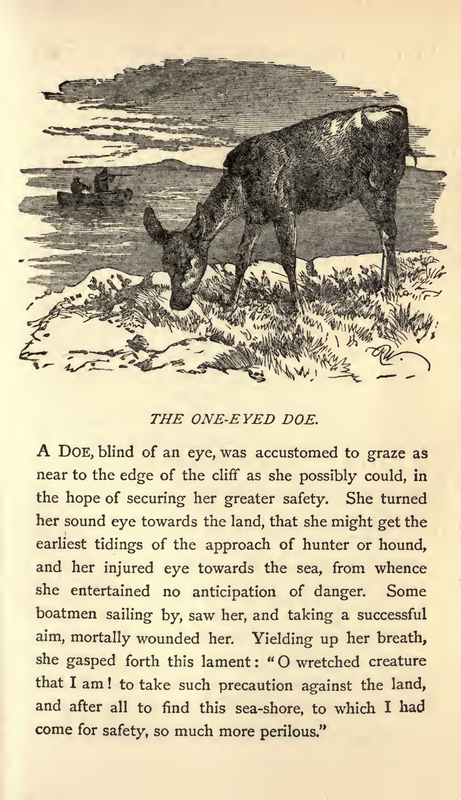
A lion is trying to kill a goat but is having some trouble due to the goat having the high ground. The lion cannot reach the goat therefore the goat is safe for the time being.
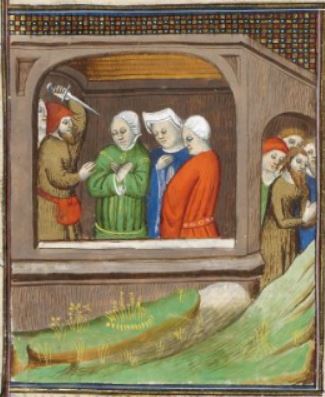
There are men depicted on the right side of the illustration wearing women’s clothing as they leave a jail. They are Minyan men who had been sentenced to death for their crimes against their city. They are wearing women’s clothing so they could escape the jail unnoticed. Boccaccio explains that the Minyan’s wives had gone into the jail and swapped clothing with their husbands and switched places with them. The men in disguises slipped past the guards unnoticed and into freedom, while their wives were executed in their place. The women, disguised as their husbands, are illustrated on the left side of the image with an executioner about to stab them. Boccaccio explains that he chose to write on these women to demonstrate that there is no greater love than a wife’s love for her husband.
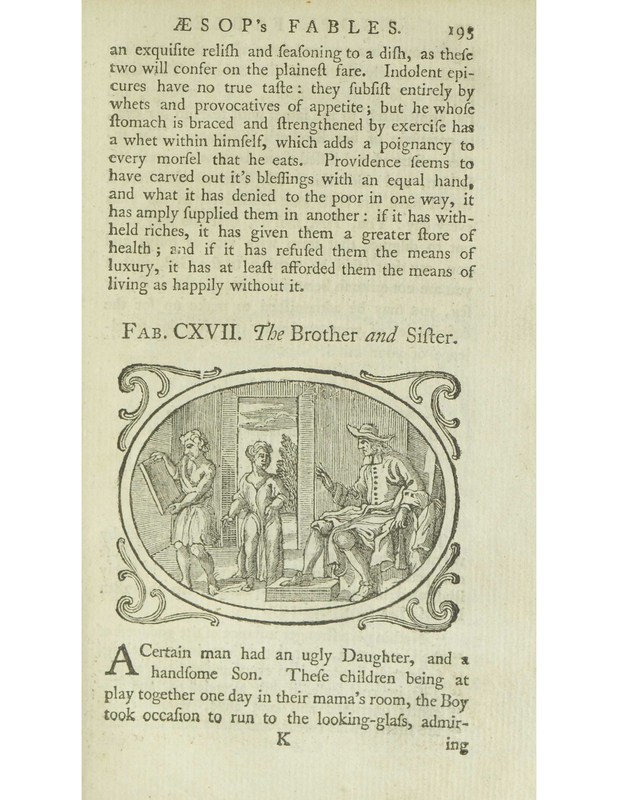
A boy dressed in a toga holds a rectangular mirror and looks at himself. A girl in a dress walks into the room through the door behind the boy, and looks to her right at a man who is her father. The man is sitting in a chair facing the left, raising his right hand to address his daughter.
William Dobbin sits in a wooden chair at his desk, reading the first of his letters, with the others left bundled on his desk. The letter he holds is from Amelia Osborne, congratulating him on his engagement - though she was told about it by his sister, no such engagement exists.
In this image we see a group of rabbits running. The image represents children who have been reprimanded, who then become too shy to answer again for fear of being incorrect. This serves as a detriment to children’s learning and is thus forbidden in Lilliput. The rabbits represent children who have been punished and then run away for fear of being punished again. This image appears in the appendix to Gulliver’s travels in Lilliput. In the appendix, Gulliver discusses various aspects of life on Lilliput, including education, employment, approaches to science and philosophy, language, and interactions between people in the community. The same image appears in the 1839 Krabbe edition.
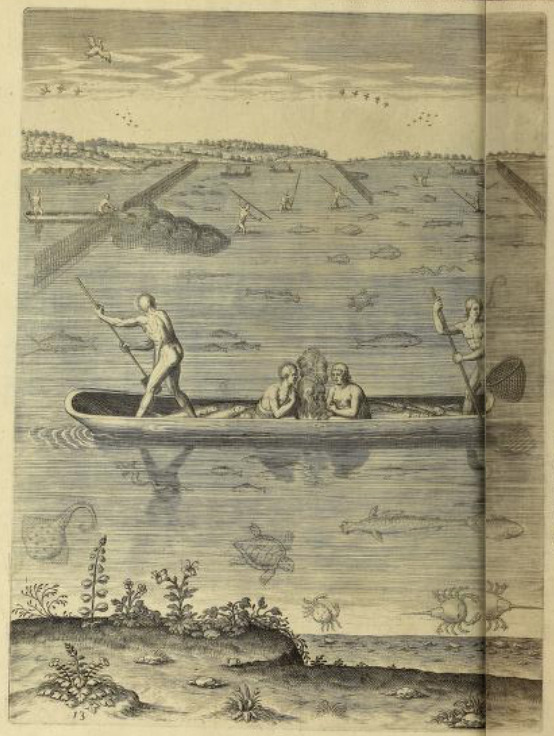
Four Indigenous people are shown in a canoe on the river. The person in the right end of the canoe fishes with a net on the end of a long stick, while the person in the left of the canoe appears to paddle. There are two individuals in the middle of the canoe sitting on either side of a fire. In the background several other Indigenous people fish in the shallows of the river on foot and in canoes using spears.
Here we see a mercenary soldier on the battlefield, holding a musket with bayonet attachment. Gulliver explains that mercenary troops were available for hire for any nation, and thus did not necessitate a patriotic army. When Swift wrote Gulliver’s Travels in 1727, mercenary troops were common, and we are just beginning to see national armies. The same image appears in both the 1839 and 1843 Krabbe editions.
Melibea overhears her parents Pleberio and Alisa (the two rightmost figures) talking about finding her a husband. They discuss her innocence, highlighting that she is still a virgin and has probably never considered having a male companion. Melibea grows frustrated with their assumption that she is naïve and ignorant and asks Lucrecia (as depicted by the two leftmost figures) to disrupt their conversation.[The figures in this illustration are used in multiple other illustrations throughout this edition.]
This illuminated image depicts a portrait of Medea, the daughter of king Aeetes of Colchis. Medea is pictured holding a scepter in her left hand and pointing with her right. Medea is well known for her involvement in magic and dealing with herbs. Boccaccio explains that Medea knew incantations to make winds gust, which is why there are depictions of a wind storm in the background of the image. There is a flower in the foreground beside Medea which symbolizes her skills in dealing with herbs for her magic.
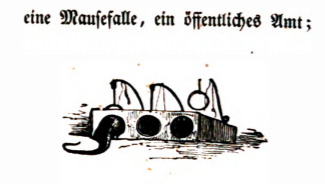
This image shows a mousetrap, which is the code word for an employment or public office. This image comes in a description of a conspiracy found by a professor from the Grand Academy on Balnibarbi. This idea is representing code word for terms in the conspiracy that Swift is satirizing. The professor advises that those named in the conspiracy papers be closely monitored at all times, naming specifically while they were using the bathroom, as this is when men were most thoughtful. This conspiracy is thought to be an allusion to the trial of Francis Atterbury, the bishop of Rochester for allegedly plotting with the Jacobites. Atterbury was charged with treason in 1722 and was exiled to France. The same image appears in the 1843 Krabbe edition.
This illustration depicts Sophonisba, a young noble woman who was previously married to king Syphax of Numidia, on her knees with her hands together in prayer as she pleads to the man standing in front of her. Sophonisba is wearing a crown and royal garb to signify her royal status. Boccaccio explains that Sophonisba was swayed by her father to convince her husband to abandon friendship with Rome and attack them. When this went wrong and Rome attacked in response to their betrayal, Sophonisba was left to defend herself. When a Roman general named Masanissa took over Numidia, Sophonisba pleaded to him for her life. This is the man Sophonisba is kneeling in front of in the image. He is depicted with his army standing behind him in the tent. Masinissa spares her life and marries her as he was taken away with her beauty.

![[Gulliver stood over the corpse of the rat]](https://collections.cemvc.ca/files/large/66fe2292cdc224d46c8a3eb7d31781203a7efa47.jpg)
![[A scientist from the Grand Academy of Lagado]](https://collections.cemvc.ca/files/large/776871b3e35a41f7918488463c581aa81b0ce65a.jpg)

![[Lion Preying on a Goat]](https://collections.cemvc.ca/files/large/c844b4d23dfab834ad4ad970de125f1ef699eea0.jpg)

![[Dobbin Reading his Letters]](https://collections.cemvc.ca/files/large/b1b1a74f4fa8f41dde04322d49a74a91126700fe.jpg)
![[Rabbits running]](https://collections.cemvc.ca/files/large/d047889d392de15fa6c14887ffe92e9fada6485e.jpg)
![[a European mercenary]](https://collections.cemvc.ca/files/large/170f27ce42536308960bd2ba071234bd4068aa27.jpg)
![[Act XVI – Melibea, Lucrecia, Alisa, and Pleberio]](https://collections.cemvc.ca/files/large/4310f8f643091daf0015ba36b4dff6d1c999d8be.jpg)




![[Sophonisba Pleading to King Masinissa for her Life]](https://collections.cemvc.ca/files/large/160f1afd27d2e8afd01377086a78e134c2aa8fdc.jpg)