A group of Spaniards, one of whom is Diego Guttierez, governor of Costa Rica, takes at least four Indigenous leaders (Caciques) hostage and binds them in chains. Two of the Indigenous men have been bound by chains attached to the post of a large canopy bed inside the structure. Two others have been bound with chains around their necks, the ends of which are held by two Spanish men. On the left, two Indigenous men offer a basket full of exotic animals and vessels made of gold to the Spaniards. A large bonfire has been set on the left, and in the background two more Indigenous people walk towards the structure, escorted by two Spanish men.
There are various animals that are shown in this image, including a bat, two deer, two horses, three birds, a fox, and a bunny. Some of the animals are attacking one another, as an example one of the birds looks like its trying to eat the bunny near the bottom right corner of the image.
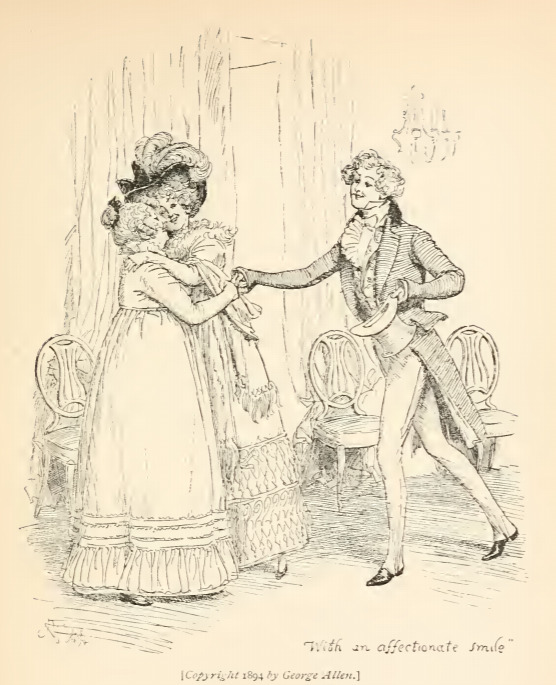
In this image Lydia and Mr. Wickham arrive at Longbourn. Mrs. Bennet embraces Lydia upon her arrival, thankful for her safety. During their visit Mr. Wickham acted as if they had done nothing wrong, infuriating Elizabeth. On Lydia’s wedding day that came shortly after their arrival. On the wedding day, Jane and Elizabeth felt more pity for themselves than joy for their sister. This is because it was customary for sisters to wed in order of eldest to youngest, meaning according to tradition Jane should have been married first, followed by Elizabeth, and Lydia would have been last. This scene occurs in chapter 51. The characters are shown in the traditional regency style. Mrs. Bennet and Lydia wear regency dresses with empire waistlines. Mrs. Bennet wears a bonnet and a shawl around her shoulders. Mr. Wickham wears a waistcoat and tailcoat with a cravat. In his hand he holds his top hat. The regency period dated to the early nineteenth century (1811-1820) when George, Prince of Wales, later George IV (r. 1820-1830), reigned as regent for his mentally ill father, King George III (r. 1760-1820). The regency period is associated with the rise of neoclassicism in art and fashion.
Several Indigenous men and women cut down brazilwood trees along the coast. They use axes to fell the trees, stack the logs into piles, then load the logs into rowboats to ferry them out to the larger European ships. Brazilwood was very popular in Europe in the 16th century and was mainly exported by the Portuguese with the help (and later, enslavement) of the Tupi people, although pirates and other European merchants also harvested and traded the wood. This image is identical to one found one page 950 verso of Paris, 1575 (l’Huillier).
Here we see a bust of Queen Anne. This image appears when Gulliver explains England’s political system. Gulliver begins with the Glorious Revolution of 1688 which removed the Catholic James II, replacing him with Protestant William III. He continues on to explain to the war of Spanish Succession. He ends with the current system, with the accession of Queen Anne. The same image appears in the 1843 Krabbe edition.
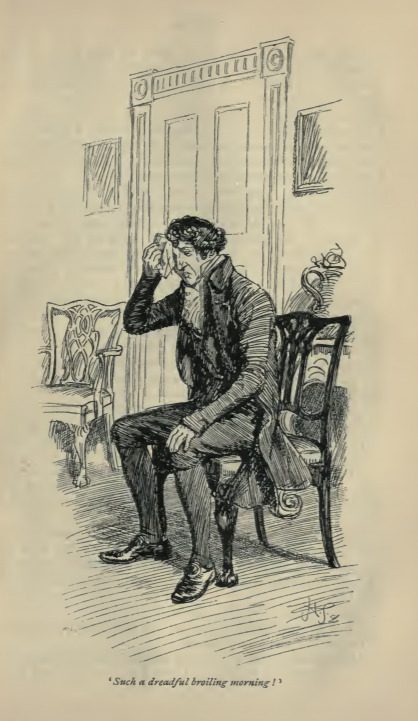
In this image Mr. Elton dries his brow with his handkerchief. He had gone over to Donwell Abbey but could not find him there. He was quite perturbed that he had walked all the way to Donwell only to find it empty. He met William Larkins, but he only said that he did not know where Mr. Elton could find Mr. Knightley. This scene occurs in chapter 52. The characters are shown in the traditional regency style. Mr. Elton wears a waistcoat and tailcoat with a cravat. The regency period dated to the early nineteenth century (1811-1820) when George, Prince of Wales, later George IV (r. 1820-1830), reigned as regent for his mentally ill father, King George III (r. 1760-1820). The regency period is associated with the rise of neoclassicism in art and fashion.
Miss Matilda Crawley sits in her wheelchair, bundled up in a bonnet and muff. The chair is being pushed by a thin man in a coat and tall hat. In the top right of the image is the letter T from The.
In the left panel we see Celestina wearing a long robe and a veil. She is holding some sort of book between her body and her right arm. To the right, Lucrecia is shown in similar (although fancier) attire. In her right hand she is holding a flower, while in her left she is holding the girdle cord hanging from her waist. At her feet, a dog is standing on its hind legs with its front paws extended toward her. Both figures are placed outside. The decision to use this figure to depict Lucrecia is somewhat odd, seeing as the girdle is closely tied to Melibea’s storyline. The entire image is nearly identical to the one found on page 208 (where the name labels are absent). This is the only illustration in the edition to feature name labels. The panel to the right is a near carbon-copy of a panel found multiple times throughout the earlier 1529 Lyon edition. However, the lower attention to detail in this panel makes it clear that it is a reproduction and not a duplicate. The artist likely referred to a copy of the 1529 edition when creating this panel.
Gulliver entertained both the Queen of Brobdingnag and her ladies in waiting. Here Gulliver looks in the mirror with a lady, keeping her company. Gulliver's duties at the court in Brobdingnag included entertaining the Queen's ladies.
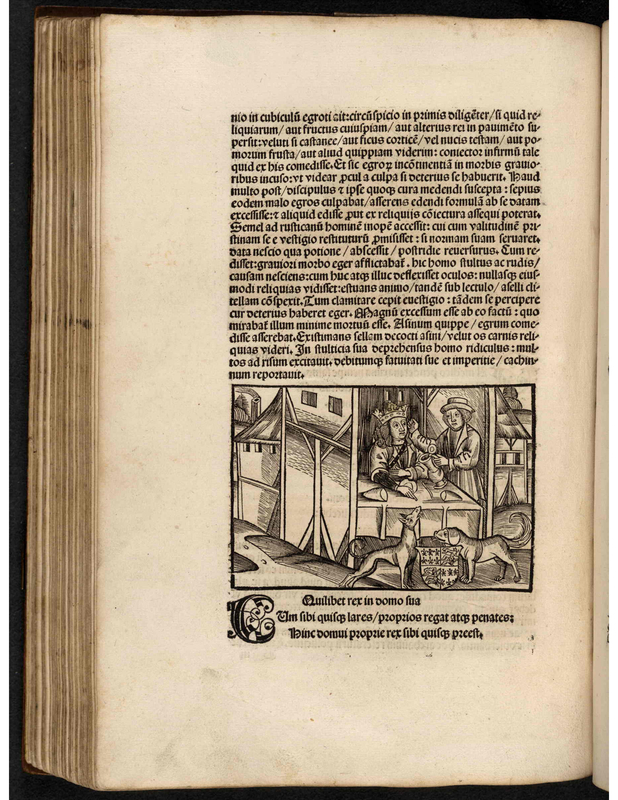
A woman is serving a seated man, presumably a king, who is wearing a crown. Two dogs stand below them, one looking up at them. There is a shield between the two dogs, with a checkered design on it.
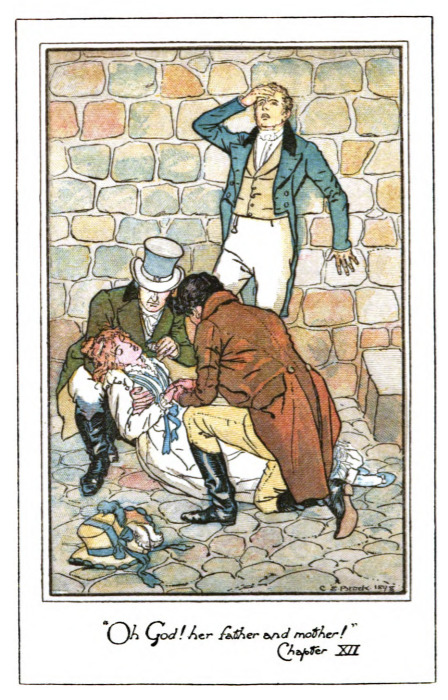
Here we see Captain Wentworth, Captain Benwick, and Charles Musgrove gathered around Louisa Musgrove after she hit her head after jumping down some stairs while on a walk at Lyme. Louisa jumped once and landed successfully and enjoyed the experience so much that she wanted to do it again. The second time she jumped she slipped and hit her head on the stone wall. Captains Benwick and Wentworth cradle Louisa as her brother Charles leans against the wall in horror. Anne takes control of the situation, instructing Captain Benwick to go fetch a surgeon and Captain Wentworth to carry her back to the Inn. This scene occurs in chapter 12 as noted underneath the title of this image. The characters are shown in the traditional regency style, with Louisa wearing the regency style dress with an empire waist. Her hair is worn tied up, as was tradition for women after their coming out before the queen, signaling her entrance into society. Her bonnet is on the ground next to her. The men wear waistcoats and tailcoats with breeches. Captain Wentworth wears a top hat. The regency period dated to the early nineteenth century (1811-1820) when George, Prince of Wales, later George IV (r. 1820-1830), reigned as regent for his mentally ill father, King George III (r. 1760-1820). The regency period is associated with the rise of neoclassicism in art and fashion.
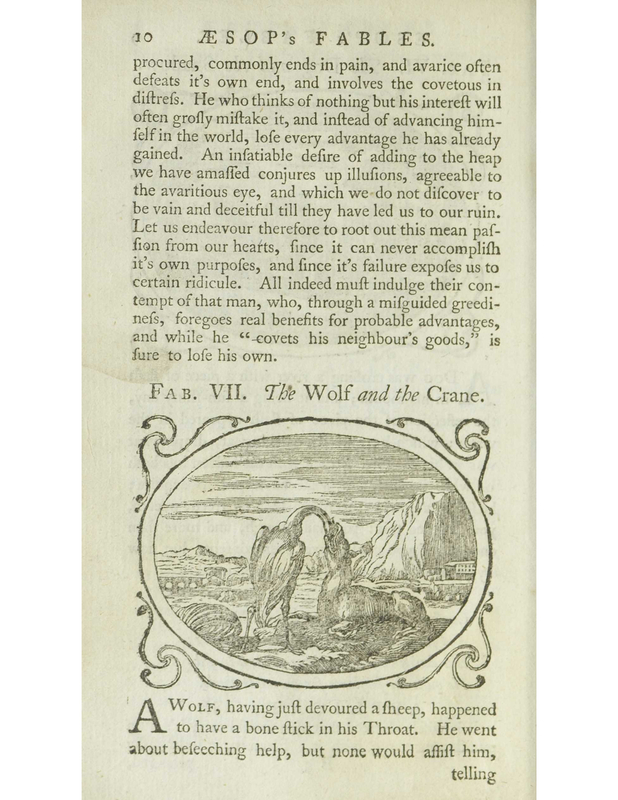
There is a crane who has their beak in the mouth of a wolf. The wolf is laying down and the crane is in an upright position. There are mountains and a building in the background. There is a bone carcass to the left of the image, almost behind the crane.
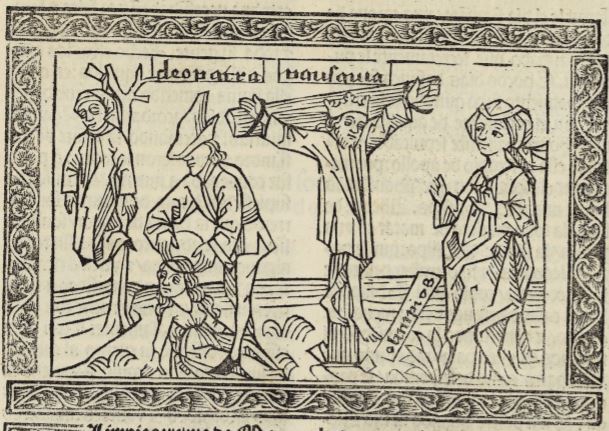
This engraving depicts Olympias of Macedon on the right side of the engraving approaching a man hanging on a cross. We know that this figure is Olympias as her name is engraved beside her body. The man being crucified is Pausanias, a man who helped Olympias with the murder of King Philip of Macedon (husband to Olympias). Boccaccio explains that Olympias placed the golden crown that Pausanias is wearing on his head to honour him and reward him for the assassination. Along with getting her husband murdered, she also had her husband’s new wife and child murdered out of anger. Cleopatra, King Philips other wife, is pictured on the left side of the engraving hanging by her neck on a tree. Her name is engraved above her head. Cleopatra’s child is depicted sitting on the ground as one of Olympias’ servants is bashing her head with a rock.
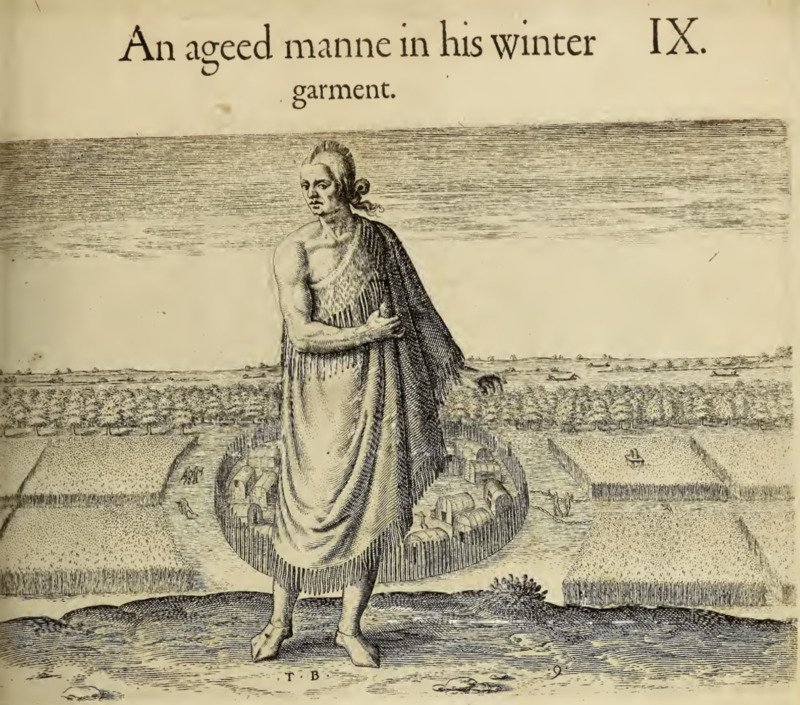
An old man stands on a hilltop. He wears a fringed garment draped around his body and over one shoulder. His hair is spiked down the middle of his head from forehead to nape of neck, where it is gathered into a knot. On his feet are slippers. Behind him on the ground below the hill, cultivated fields surround a village – a small group of dwellings with a fence around them.
In this image Gulliver floats in a bowl of milk. Glumdalclitch is seen behind the bowl as is the Queen’s dwarf, who threw Gulliver into the milk out of jealousy. A piece of bread and a spoon sit next to the bowl. The same image appears in the 1843 Krabbe edition.
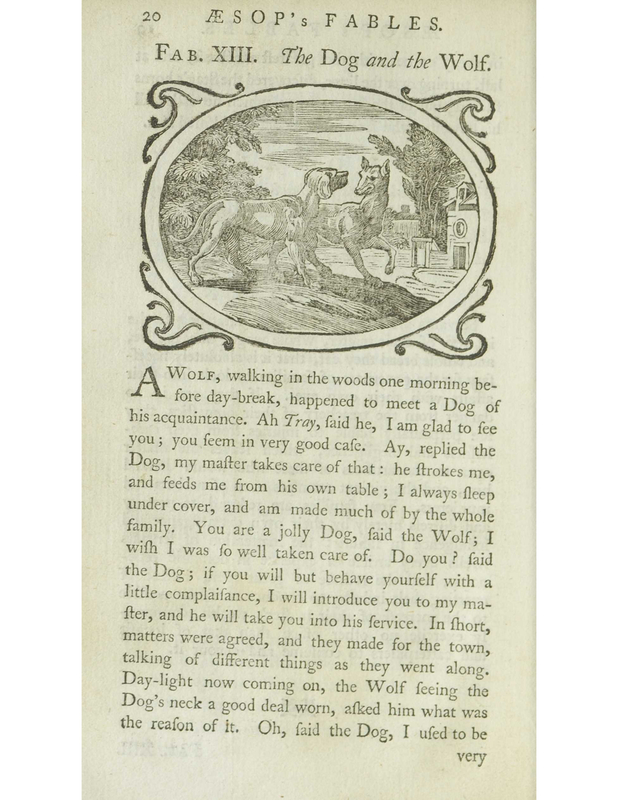
There is a dog and wolf side by side on the image. The animals are facing each other. In the background of the image there are some trees, a house and a smaller building. There is a spot that is more distinguished on the dog’s upper body, near the neck. Seems to be ruffled/worn more than the rest of the fur on the dog. The wolf looks muscular.
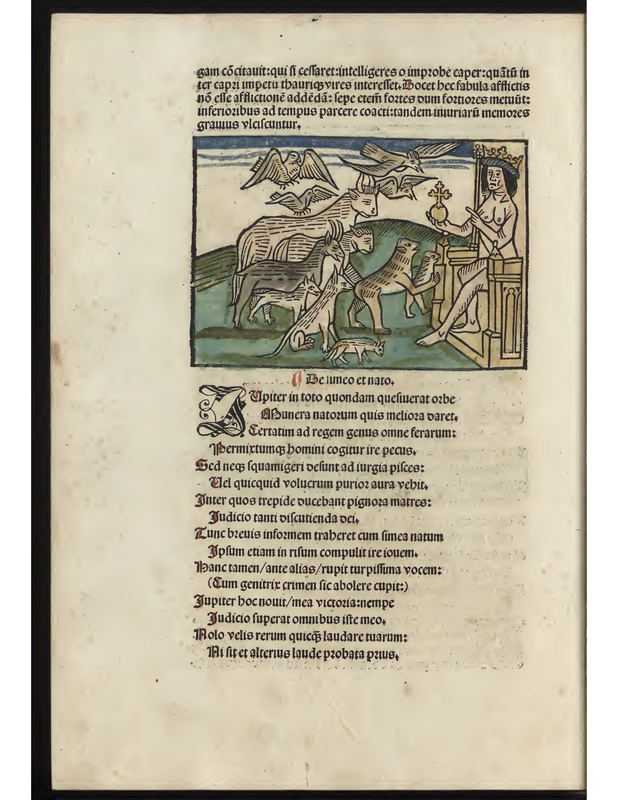
A naked man who appears to be a king sits on a throne wearing a crown and holding a scepter. The whole animal kingdom appears before the man, who is instructing the animals.
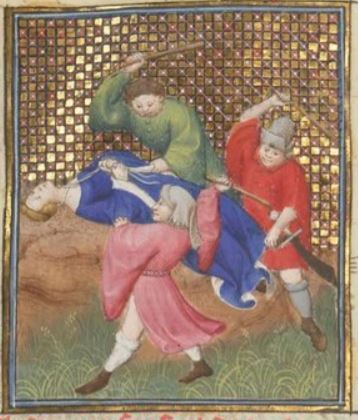
This illumination depicts the freedwoman, Epicharis, being tortured for information regarding a conspiracy to kill Emperor Nero. Epicharis is depicted lying on a large rock while three men attack her with clubs. Epicharis heard the details of the conspiracy to assassinate Emperor Nero, and when she put her faith in the wrong person, they told Emperor Nero that she was involved in the plan. They tortured her many times; however, she did not reveal the names of anyone involved in the conspiracy. She ended up killing herself to avoid revealing the details to the emperor.
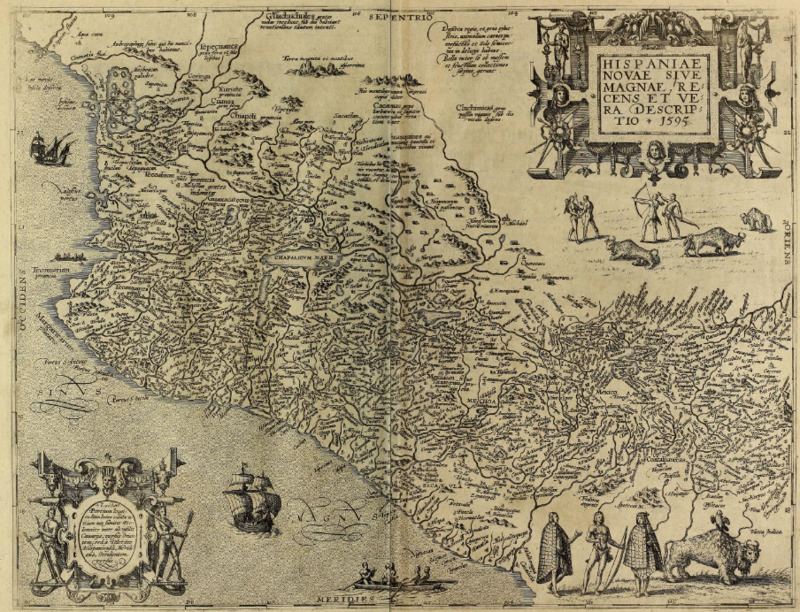
This map of the west coast of Mexico (also called New Spain at the time) was originally published by Abraham Ortelius in his work Theatrum Orbis Terrarum, first published in 1570 and considered to have been the first modern atlas. The decorative depictions of Indigenous peoples are unique to de Bry’s rendition of the map, which also includes more place names than Ortelius’ original copy. On the right below the map title, two Indigenous men stand together, both carrying bows and arrows. A man and woman stand together nearby. The man holds a spear, and the woman carries an infant on her back. On the bottom right side of the map, three Indigenous people stand together. Two of them wear feathered capes, and the person in the middle holds a bow. To the left of the trio, a group of five Indigenous people row a canoe near the shore.
Here we see a coat of arms of the family with whom he is staying in the Country of the Houyhnhnms. There are images of horses and other animals on the coat of arms. The image appears at the end of chapter six, when Gulliver explains various aspects of English society, including medicine, the Prime Minister, and the nobility. The same image appears in the 1839 Krabbe edition.

![[The Attack of the Animals]](https://collections.cemvc.ca/files/large/3050366b1f401bd6aef67d158c1c98eae07b108e.jpg)
![Co[m]me ce peuple couppe et porte le Bresil és nauires.](https://collections.cemvc.ca/files/large/d124088126c71b50002e2021b0ac60367fb2430b.jpg)
![[a bust of Queen Anne]](https://collections.cemvc.ca/files/large/6d7bf817821df96e335d5382e98263fff74dd25d.jpg)
![[Vanity Fair Vol. I Chapter XXXIII Historiated Initial]](https://collections.cemvc.ca/files/large/d4a9bd81573dbfc0f5c398021109c977456e11b6.jpg)
![[Act IV – Celestina and Lucrecia]](https://collections.cemvc.ca/files/large/419fc86b64e6c31ce95fe66c444592230617cec8.jpg)
![[Gulliver looks in the mirror with a lady in waiting]](https://collections.cemvc.ca/files/large/b199fed644cf9052868a0805667b76be11c163ad.jpg)
![[Gulliver in a bowl of milk on Brobdingnag]](https://collections.cemvc.ca/files/large/6249579fad5bd08f2a07dfa831a4631be58309e9.jpg)
![[A coat of arms of the Houyhnhnms]](https://collections.cemvc.ca/files/large/a11539f3c876192ee9e6f89dd90f25107338c1cf.jpg)